Electromagnetic Theory · Ampère's Circuit Law
#19 Integral and differential forms of Ampère's circuit law, selecting an Amperian loop, and the infinite straight-wire application
Choose a symmetry-matched loop, obtain the infinite-wire field in a few lines, and convert Ampère's law to point form.
Question

Explain Ampère's circuit law; give the steps for choosing an effective loop, derive the infinite straight-wire field, and use Stokes' theorem to obtain the differential form.
Written solution and narration transcript(shows the full solution)
Below are all the lines written in the notebook together with the full narration transcript.
1. Move from Biot-Savart to the Ampère shortcut
A symmetry-matched closed loop relates the field integral to enclosed current and shortens the calculation. In the last video we derived the Biot-Savart law.It works for any current distribution, but it requires integrating the contribution of every single current element.That can get painful.Today we'll see a much easier tool: Ampere's circuit law.It plays the same role for magnetostatics that Gauss's law played for electrostatics.When the geometry is symmetric, it hands you the magnetic field in just a few lines.Narration transcript
In the last video we derived the Biot-Savart law. It works for any current distribution, but it requires integrating the contribution of every single current element. That can get painful. Today we'll see a much easier tool: Ampere's circuit law. It plays the same role for magnetostatics that Gauss's law played for electrostatics. When the geometry is symmetric, it hands you the magnetic field in just a few lines.
2. Visualize an Amperian loop

A symmetry-matched closed loop relates the field integral to enclosed current and shortens the calculation. Picture a long straight wire carrying a steady current I.The magnetic field lines form perfect concentric circles around the wire.Now imagine walking around the wire along one of those circles.The path we take is called an Amperian loop.Ampere's law connects the field along this closed loop to the current passing through it.Narration transcript
Picture a long straight wire carrying a steady current I. The magnetic field lines form perfect concentric circles around the wire. Now imagine walking around the wire along one of those circles. The path we take is called an Amperian loop. Ampere's law connects the field along this closed loop to the current passing through it.
3. Build the integral law
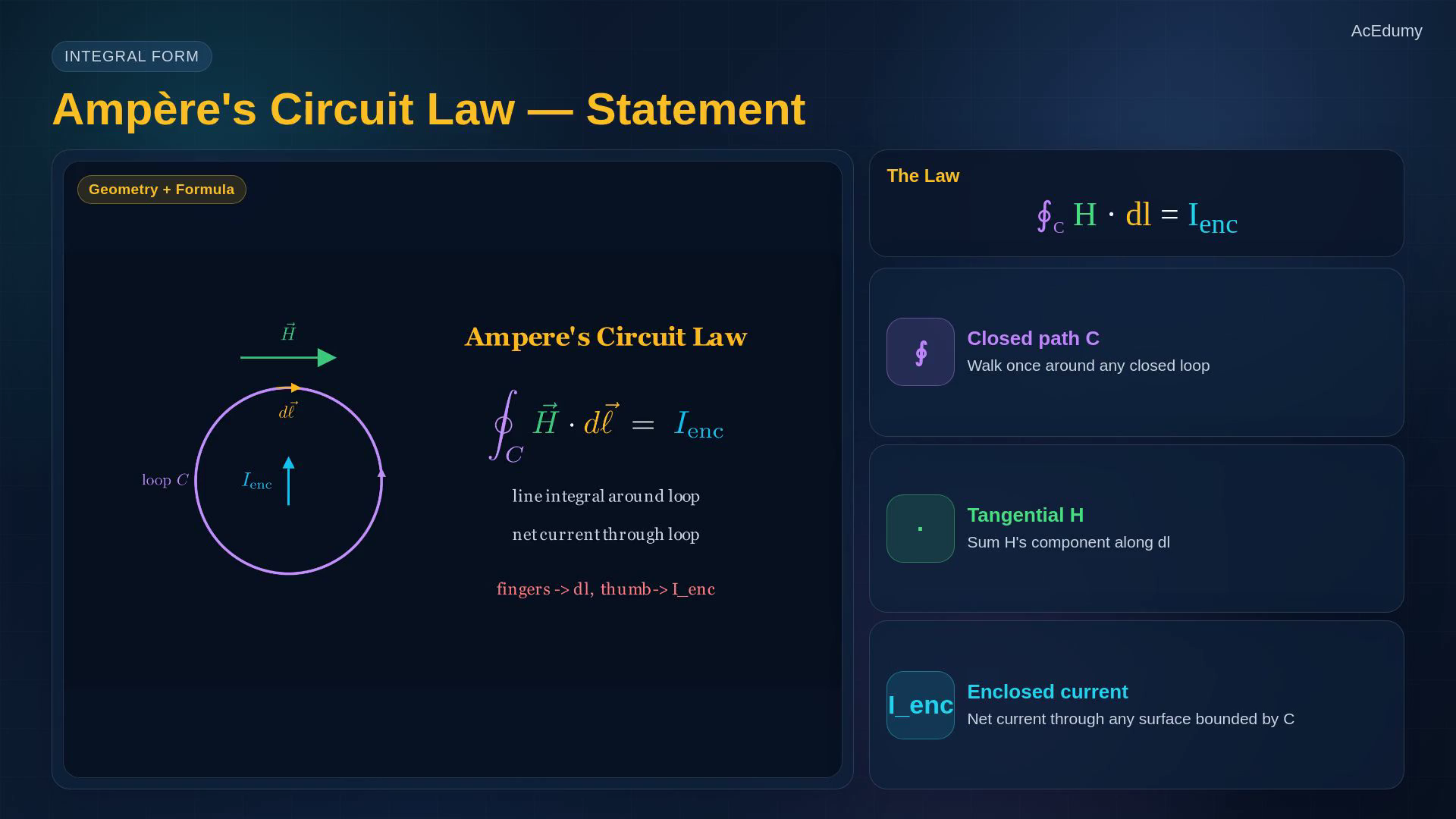
A symmetry-matched closed loop relates the field integral to enclosed current and shortens the calculation. Here is the statement.The closed line integral of H dotted with dl around any closed path equals the total current enclosed by that path.∮C H·dl = Ienc.On the left side, we walk once around the loop and sum up the component of H along our direction of travel.On the right side, we count how much net current pokes through the surface bounded by that loop.The direction convention follows the right-hand rule: curl your fingers along the path, and your thumb points in the positive direction for enclosed current.Narration transcript
Here is the statement. The closed line integral of H dotted with d l around any closed path equals the total current enclosed by that path. Written as an equation: the loop integral of H dot d l equals I enclosed. On the left side, we walk once around the loop and sum up the component of H along our direction of travel. On the right side, we count how much net current pokes through the surface bounded by that loop. The direction convention follows the right-hand rule: curl your fingers along the path, and your thumb points in the positive direction for enclosed current.
4. Apply the four-step recipe

A symmetry-matched closed loop relates the field integral to enclosed current and shortens the calculation. So how do we actually use this?Four steps.First, identify the symmetry of the problem.Ampere's law is only easy when you can argue, by symmetry, that H has constant magnitude along some simple path.Second, choose an Amperian loop that matches that symmetry.For an infinite wire, a circle around the wire is perfect.For an infinite sheet or solenoid, a rectangle usually works.Third, evaluate the line integral.If H is constant along the path, the integral becomes H times the path length.Fourth, count the enclosed current and solve for H.That's it.Narration transcript
So how do we actually use this? Four steps. First, identify the symmetry of the problem. Ampere's law is only easy when you can argue, by symmetry, that H has constant magnitude along some simple path. Second, choose an Amperian loop that matches that symmetry. For an infinite wire, a circle around the wire is perfect. For an infinite sheet or solenoid, a rectangle usually works. Third, evaluate the line integral. If H is constant along the path, the integral becomes H times the path length. Fourth, count the enclosed current and solve for H. That's it.
5. Derive the infinite-wire field
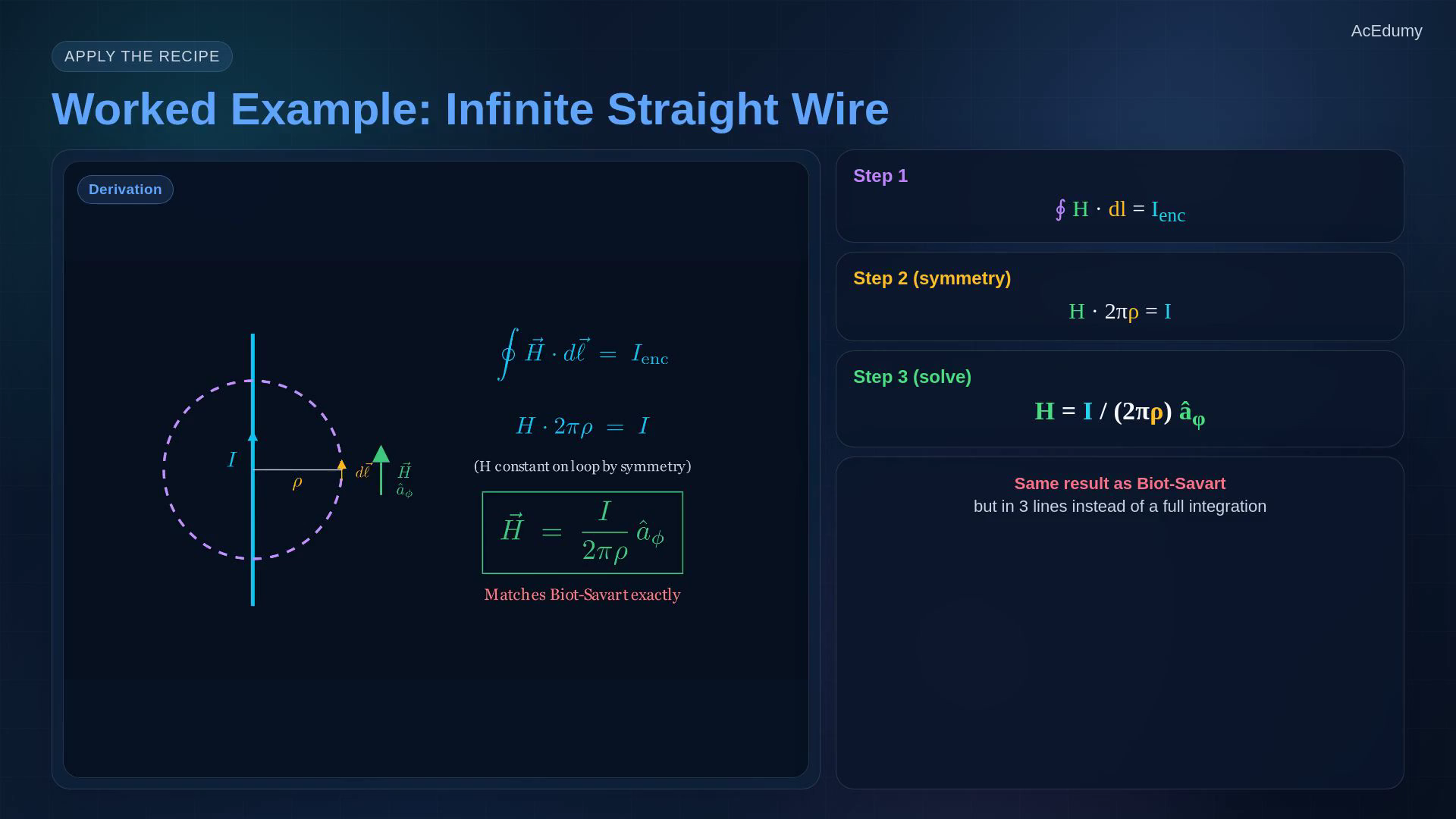
A symmetry-matched closed loop relates the field integral to enclosed current and shortens the calculation. Let's apply this to an infinite straight wire.By symmetry, H can only depend on the distance ρ from the wire, and it must point along âφ, circling the wire.Choose an Amperian loop: a circle of radius ρ, centered on the wire.On this loop H is constant in magnitude and always parallel to dl.∮H·dl = H(2πρ).The current enclosed is simply I, the current in the wire.Compare this with what we got from Biot-Savart last time: exactly the same answer, but now in three lines instead of a full integration.Narration transcript
Let's apply this to an infinite straight wire. By symmetry, H can only depend on the distance rho from the wire, and it must point along a-hat-phi, circling the wire. Choose an Amperian loop: a circle of radius rho, centered on the wire. On this loop H is constant in magnitude and always parallel to d l. So the line integral of H dot d l is just H times the circumference, which is H times 2 pi rho. The current enclosed is simply I, the current in the wire. Setting the two sides equal: H times 2 pi rho equals I. Solving for H: H equals I divided by 2 pi rho, in the a-hat-phi direction. Compare this with what we got from Biot-Savart last time: exactly the same answer, but now in three lines instead of a full integration.
6. Use Stokes' theorem to obtain point form
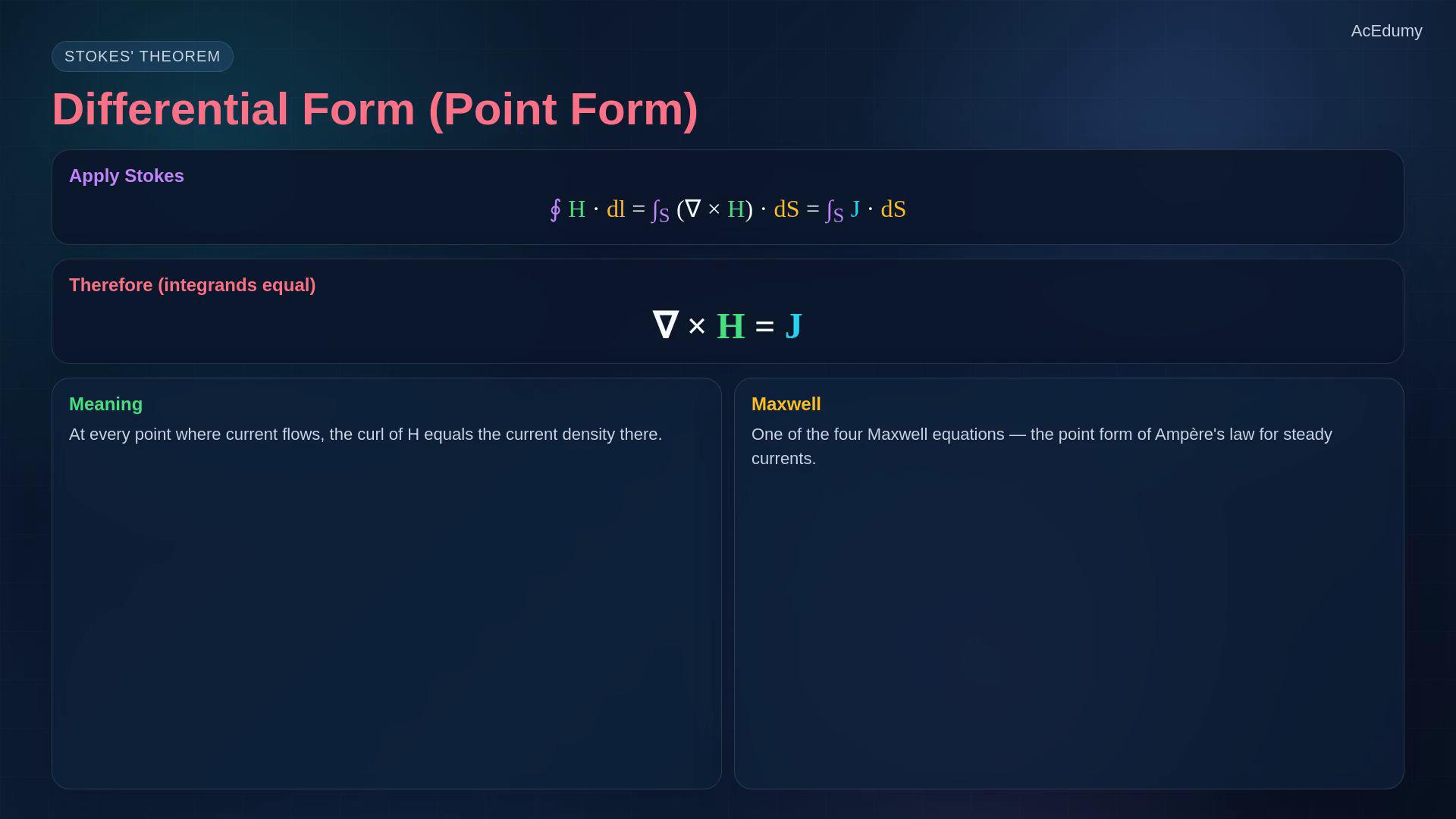
A symmetry-matched closed loop relates the field integral to enclosed current and shortens the calculation. Ampere's law also has a differential form.Stokes' theorem: ∮C H·dl = ∫S(∇×H)·dS.The enclosed current is Ienc = ∫S J·dS.Since this holds for every surface, the integrands must match.Magnetostatic point form:This is one of the four Maxwell equations — the point-form of Ampere's law for steady currents.It tells us that wherever current flows, the magnetic field has a curl.Narration transcript
Ampere's law also has a differential form. Apply Stokes' theorem to the left side: the loop integral of H dot d l becomes the surface integral of curl H dotted with d S. On the right side, the enclosed current is the surface integral of the current density J dotted with d S. Since this holds for every surface, the integrands must match. That gives us: curl H equals J. This is one of the four Maxwell equations — the point-form of Ampere's law for steady currents. It tells us that wherever current flows, the magnetic field has a curl.
7. Review Ampère's law

A symmetry-matched closed loop relates the field integral to enclosed current and shortens the calculation. To wrap up: Ampere's circuit law says the closed line integral of H around any loop equals the enclosed current.Magnetostatic differential form:When your problem has symmetry — cylindrical, planar, or solenoidal — Ampere's law is the fastest route to the magnetic field.In the next video we'll apply it to four classic geometries: infinite wire, coaxial cable, infinite sheet of current, and the solenoid.Narration transcript
To wrap up: Ampere's circuit law says the closed line integral of H around any loop equals the enclosed current. In differential form, curl H equals J. When your problem has symmetry — cylindrical, planar, or solenoidal — Ampere's law is the fastest route to the magnetic field. In the next video we'll apply it to four classic geometries: infinite wire, coaxial cable, infinite sheet of current, and the solenoid.
Source video: Electromagnetic Theory (v2) #19 | Ampère's Circuit Law (4:37)