Communication Basics · Analog vs Digital Transmission
#05 Analog/digital representation, AM-FM-PM, ASK-FSK-PSK, modem versus codec, and simplex/half/full duplex
Treat representation, modulation, media coding, and communication direction as separate design axes; scope BER and efficiency claims to channel assumptions.
Question
Separate analog and digital representation from channel performance. Compare AM, FM, and PM with ASK, FSK, and PSK by their mathematical properties, then define modem, codec, ADC/DAC, and duplex functions within scope.
Written solution and narration transcript(shows the full solution)
Below are all the lines written in the notebook together with the full narration transcript.
1. Separate analog/digital representation from performance
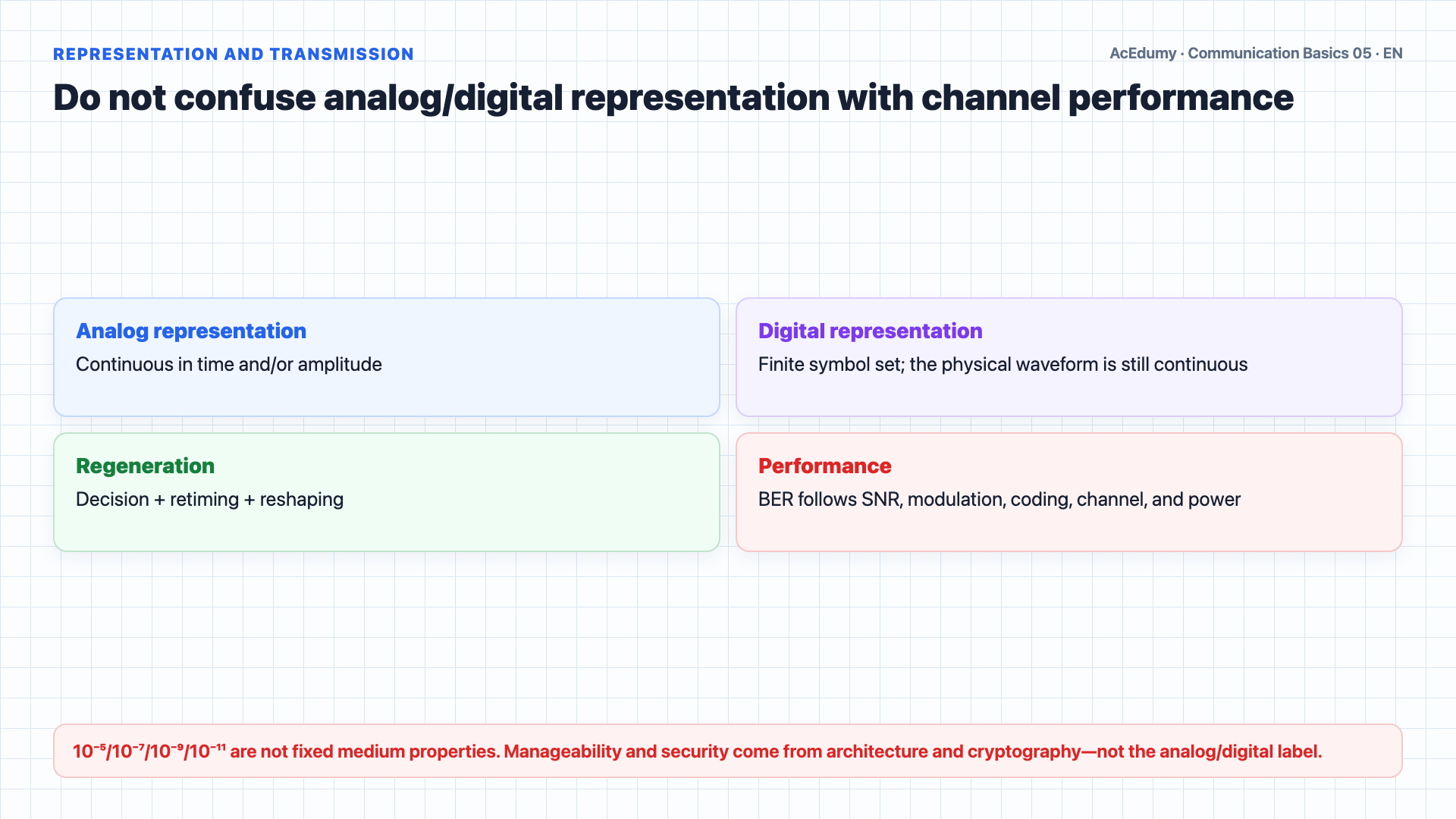
Analog/digital representation, modulation family, media coding, and communication direction are separate engineering choices. In this lesson, we compare the two fundamental approaches to transmission: analog and digital.An analog signal takes continuous values in time and/or amplitude; ‘continuous frequency’ is not required as a universal definition.Acoustic sound and optical scenes are physically continuous, while video can be represented analog or digitally. Human-voice spectrum depends on speaker and measurement criterion.However, analog transmission has significant drawbacks.Noise accumulates as the signal propagates.Repeaters can amplify the signal, but they also amplify the noise.This leads to signal degradation that is very difficult to repair, requiring shorter repeater distances.Manageability and security depend more on architecture and cryptography than the analog/digital label; analog transmission has no universal BER value.Digital signals, on the other hand, are represented by discrete pulses — zeros and ones.The key advantage is regenerative repeaters.A digital regenerator decides, retimes, and reshapes estimated symbols; an incorrect decision cannot perfectly recover the original.Regeneration can limit accumulated noise, but repeater spacing depends on medium, loss, SNR, rate, coding, and hardware.Digital networks can facilitate monitoring and cryptography; BER is not a fixed medium property and depends on SNR, modulation, coding, power, distance, and receiver.Narration transcript
In this lesson, we compare the two fundamental approaches to transmission: analog and digital. Analog signals are continuous in both amplitude and frequency. Natural voice and video are analog — human voice spans 100 hertz to 10 kilohertz. However, analog transmission has significant drawbacks. Noise accumulates as the signal propagates. Repeaters can amplify the signal, but they also amplify the noise. This leads to signal degradation that is very difficult to repair, requiring shorter repeater distances. Analog networks have poor management capabilities, low security since tapping is easy, and high bit error rates of around 10 to the minus 5. Digital signals, on the other hand, are represented by discrete pulses — zeros and ones. The key advantage is regenerative repeaters. Unlike analog amplifiers, digital repeaters don't just amplify — they completely regenerate the original signal. This allows much longer repeater distances. Digital networks offer better management through remote monitoring, high security through encryption, and much lower bit error rates: 10 to the minus 7 over twisted pair, 10 to the minus 9 over satellite, and 10 to the minus 11 over fiber optic.
2. Build the AM, FM, and PM families
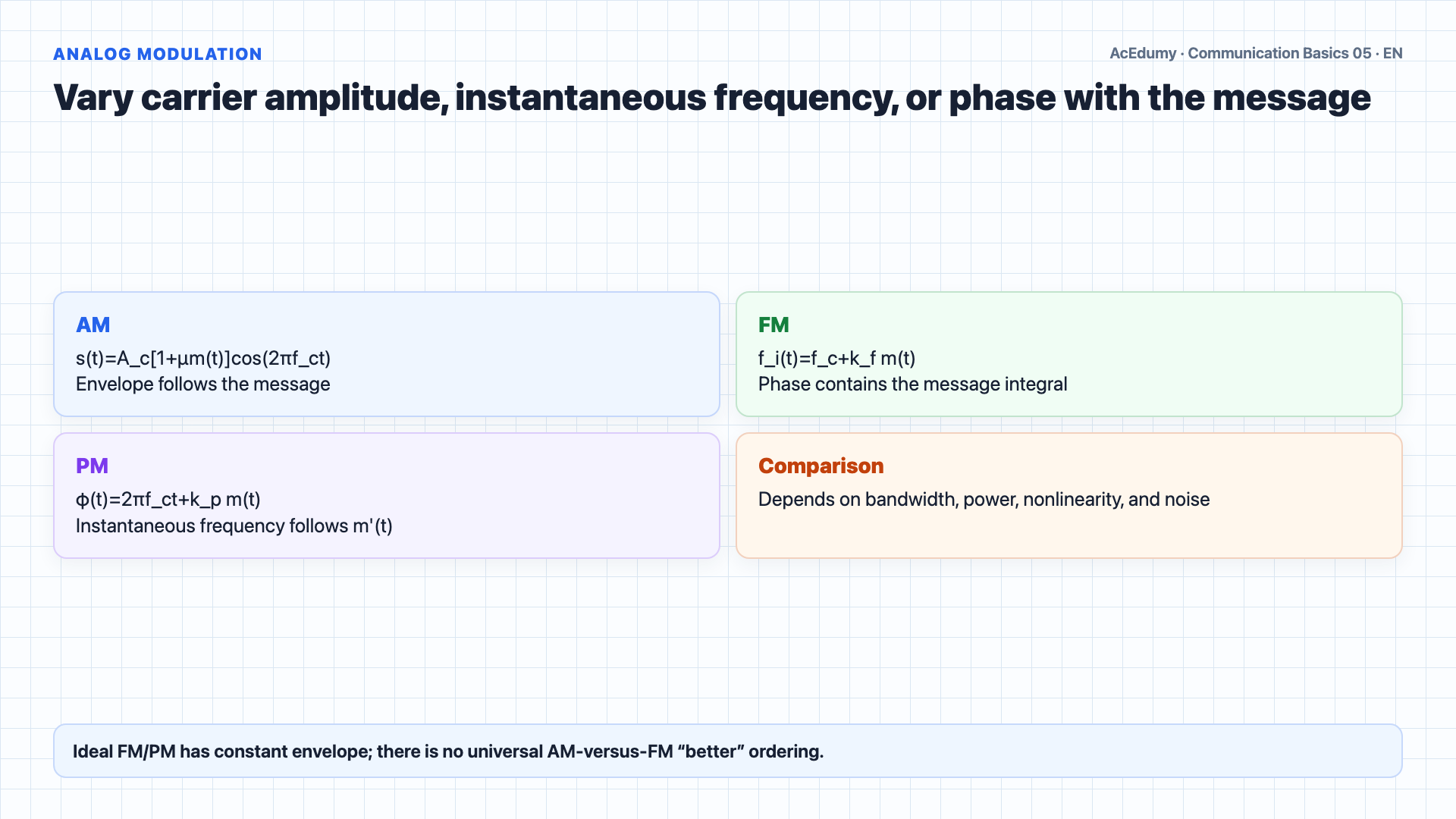
Analog/digital representation, modulation family, media coding, and communication direction are separate engineering choices. To transmit information over a carrier wave, we modify, or modulate, one of the carrier's properties.In conventional AM the carrier envelope follows the message: s(t)=Ac[1+μm(t)]cos(2πfct), with ideal carrier frequency fc.When the message signal is high, the carrier amplitude is large; when the message is low, the carrier amplitude is small.AM is simple and used in AM radio broadcasting.In ideal FM, instantaneous frequency is fi(t)=fc+kfm(t), phase contains the message integral, and envelope is constant.When the message signal is high, the carrier frequency increases; when the message is low, the frequency decreases.FM can reject amplitude noise better than AM under stated conditions; bandwidth, threshold effect, power, and receiver design must also be compared.In ideal PM, φ(t)=2πfct+kpm(t), so instantaneous-frequency deviation depends on the derivative of the message.PM is closely related to FM and forms the basis for many digital modulation techniques.Narration transcript
To transmit information over a carrier wave, we modify, or modulate, one of the carrier's properties. In Amplitude Modulation, or AM, the carrier's amplitude changes according to the message signal while its frequency stays constant. When the message signal is high, the carrier amplitude is large; when the message is low, the carrier amplitude is small. AM is simple and used in AM radio broadcasting. In Frequency Modulation, or FM, the carrier's frequency changes according to the message signal while its amplitude stays constant. When the message signal is high, the carrier frequency increases; when the message is low, the frequency decreases. FM offers better noise immunity than AM and is used in FM radio. In Phase Modulation, or PM, the carrier's phase shifts according to the message signal. PM is closely related to FM and forms the basis for many digital modulation techniques.
3. Build the ASK, FSK, and PSK families
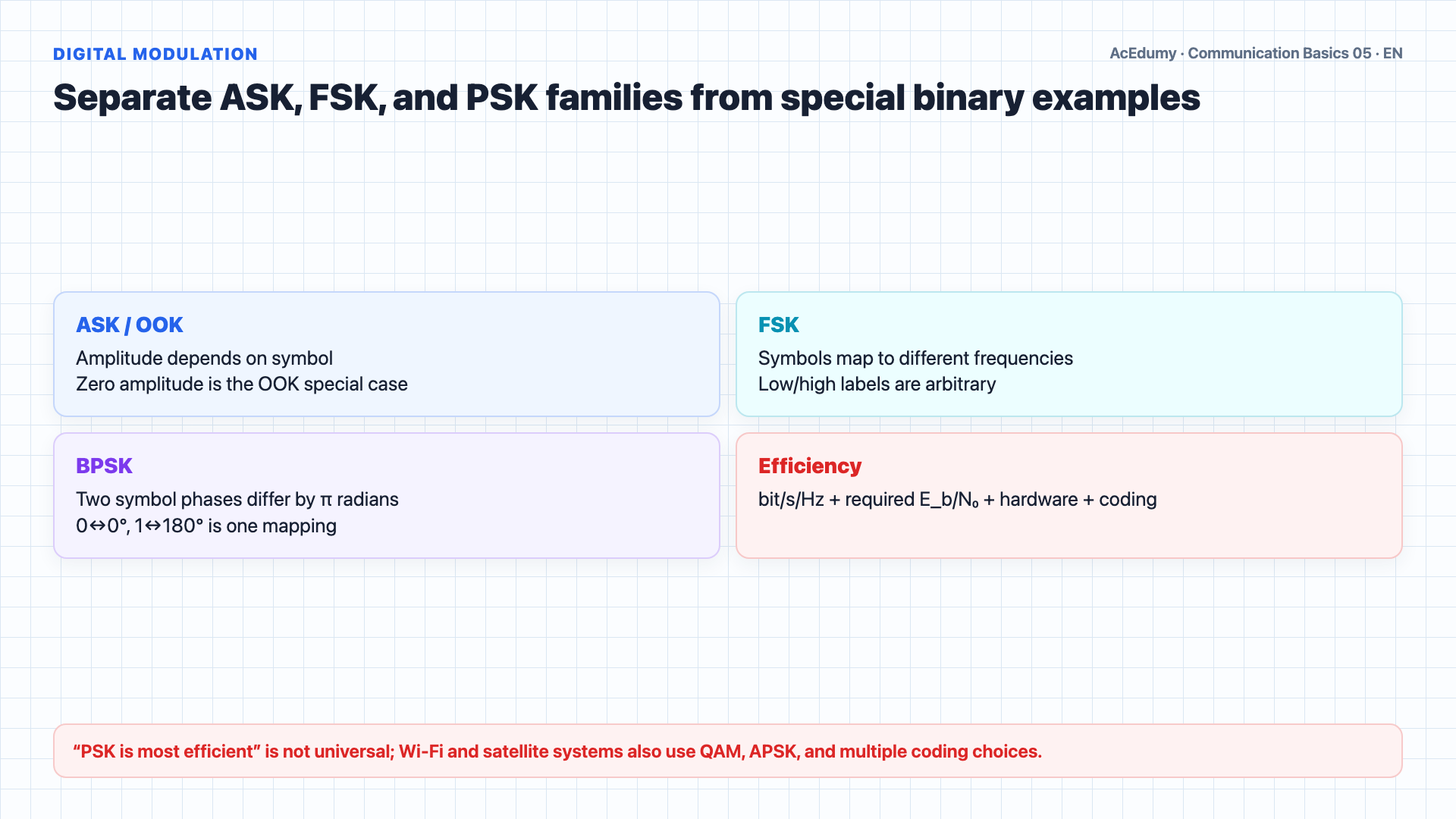
Analog/digital representation, modulation family, media coding, and communication direction are separate engineering choices. Digital modulation maps binary data — zeros and ones — onto an analog carrier.The three basic techniques mirror analog modulation.Amplitude Shift Keying, or ASK, varies the carrier's amplitude based on the digital data.Carrier-on for 1 and zero amplitude for 0 is the OOK special case of ASK; general ASK can use multiple nonzero amplitudes.ASK error performance depends on receiver, threshold, channel, and SNR; sensitivity to amplitude distortion is a design trade-off.Frequency Shift Keying, or FSK, uses two different frequencies for binary 0 and binary 1.BFSK maps two symbols to two frequencies; assignment of a low or high frequency to either bit is a mapping choice.FSK-versus-ASK error and bandwidth efficiency depends on coherence, tone spacing, SNR, channel, and receiver; there is no universal ordering.Phase Shift Keying, or PSK, changes the phase of the carrier for each bit.BPSK maps two symbols to phases separated by π radians; 0↔0° and 1↔180° is one bit labeling.There is no universally most-efficient modulation; compare bit/s/Hz, required Eb/N₀, coding, and hardware. Wi‑Fi and satellite systems also use QAM/APSK families.Narration transcript
Digital modulation maps binary data — zeros and ones — onto an analog carrier. The three basic techniques mirror analog modulation. Amplitude Shift Keying, or ASK, varies the carrier's amplitude based on the digital data. A binary 1 produces a full-amplitude carrier, and a binary 0 produces zero amplitude — silence. ASK is simple but highly susceptible to noise. Frequency Shift Keying, or FSK, uses two different frequencies for binary 0 and binary 1. The amplitude stays constant, switching between a low frequency for 0 and a high frequency for 1. FSK is more robust against noise than ASK. Phase Shift Keying, or PSK, changes the phase of the carrier for each bit. In binary PSK, a 0 produces a wave at 0 degrees and a 1 produces a wave shifted by 180 degrees. PSK is the most efficient of the three and is widely used in modern digital communications, including Wi-Fi and satellite links.
4. Separate modem, codec, and duplex functions
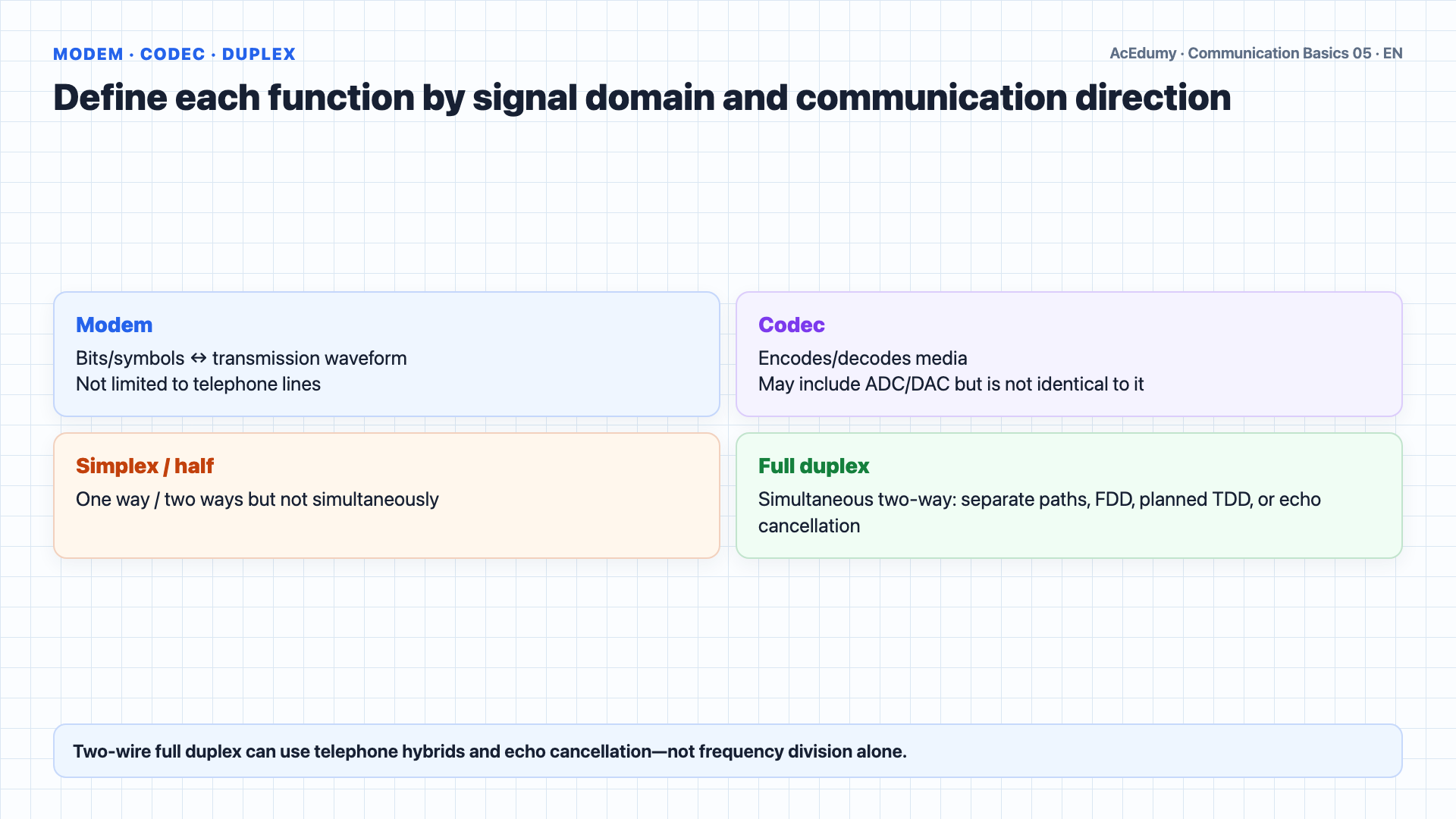
Analog/digital representation, modulation family, media coding, and communication direction are separate engineering choices. Analog dial-up lines are a historical modem example; modems also map digital symbols to transmission waveforms for cable, radio, and other media.A modem — short for Modulator Demodulator — converts digital data to analog for transmission over phone lines, and converts received analog signals back to digital.At the transmitting side, the modem modulates the amplitude, frequency, or phase of a carrier.At the receiving side, it demodulates the signal back to digital pulses.A codec encodes and decodes media; it is not the ‘opposite’ of a modem and may include—but is not identical to—ADC/DAC.It converts analog signals like voice into digital form, and digital signals back to analog.Codecs are essential in digital telephony.Communication can flow in three modes.Simplex: signals travel in one direction only, like a broadcast.Half duplex: signals can go both ways, but not simultaneously — like a walkie-talkie.Full duplex: signals travel in both directions at the same time — like a phone call.Two-wire full duplex can use FDD, telephone hybrids, or echo cancellation; TDD instead schedules the two directions in time.Narration transcript
Since most phone lines are analog but computers output digital signals, we need devices to convert between the two. A modem — short for Modulator Demodulator — converts digital data to analog for transmission over phone lines, and converts received analog signals back to digital. At the transmitting side, the modem modulates the amplitude, frequency, or phase of a carrier. At the receiving side, it demodulates the signal back to digital pulses. A codec — short for Coder Decoder — does the opposite job. It converts analog signals like voice into digital form, and digital signals back to analog. Codecs are essential in digital telephony. Communication can flow in three modes. Simplex: signals travel in one direction only, like a broadcast. Half duplex: signals can go both ways, but not simultaneously — like a walkie-talkie. Full duplex: signals travel in both directions at the same time — like a phone call. Full duplex on a two-wire line is achieved by splitting the channel into two sub-channels using frequency division.
5. Summarize representation, carrier, conversion, and direction
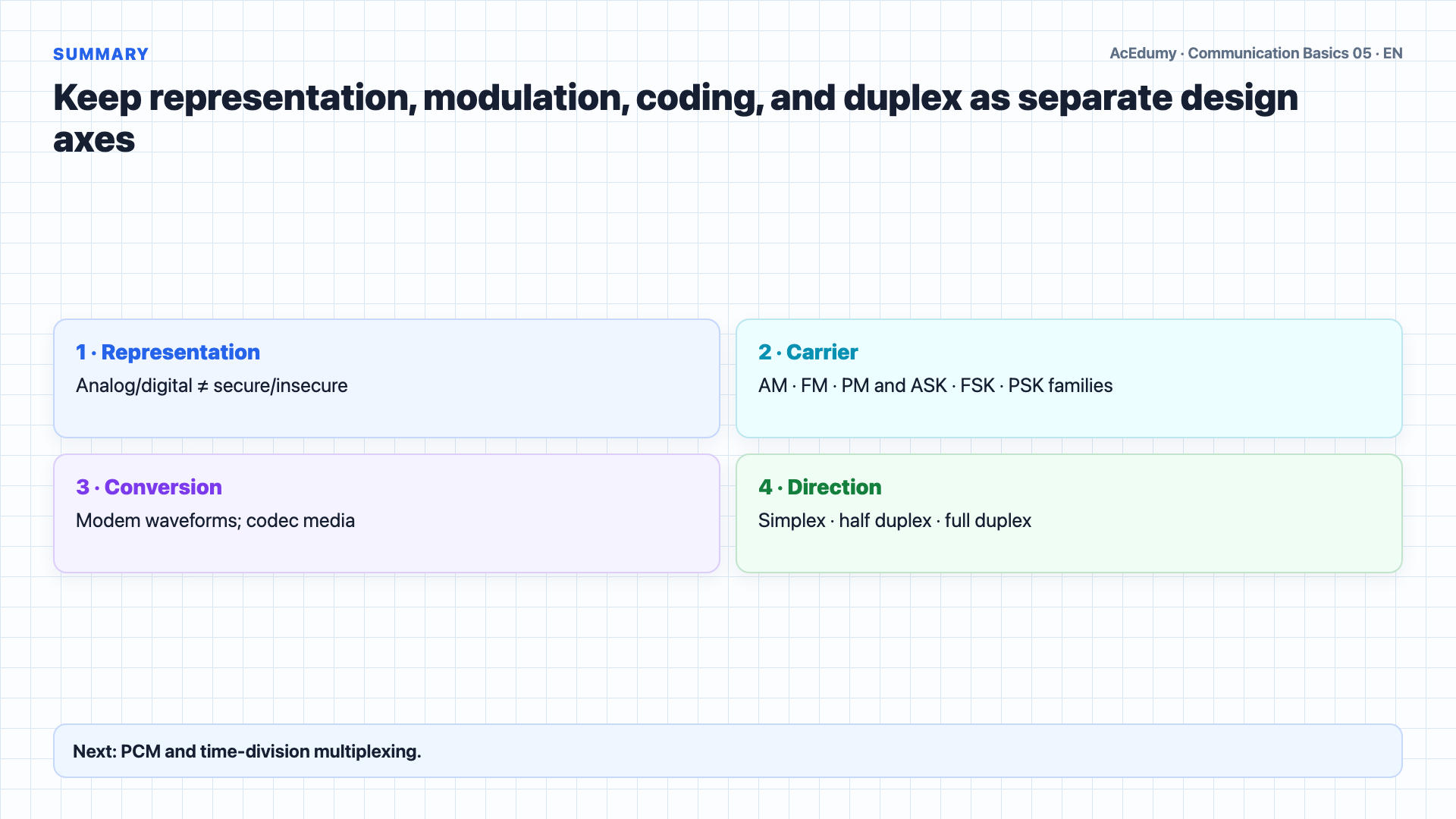
Analog/digital representation, modulation family, media coding, and communication direction are separate engineering choices. Let us review.Analog amplification can also amplify noise; distance and error/distortion performance depend on the channel and system design.Digital regeneration can limit accumulated noise; fiber BER is not a fixed 10⁻¹¹ value and follows link budget, modulation, coding, and receiver.Analog modulation comes in three forms: AM, FM, and PM — each modifying amplitude, frequency, or phase of the carrier.ASK, FSK, and PSK are digital-modulation families; efficiency ordering depends on spectral efficiency, energy, error target, coding, and hardware.A modem maps symbols and transmission waveforms; a codec encodes/decodes media representation and is not identical to ADC/DAC.Communication modes are simplex, half duplex, and full duplex.In the next lesson, we will explore multiplexing — how PCM and Time Division Multiplexing combine multiple signals onto one channel.Narration transcript
Let us review. Analog transmission suffers from noise accumulation, short repeater distances, and high error rates. Digital transmission uses regenerative repeaters for longer distances and error rates as low as 10 to the minus 11 over fiber. Analog modulation comes in three forms: AM, FM, and PM — each modifying amplitude, frequency, or phase of the carrier. Their digital counterparts are ASK, FSK, and PSK, with PSK being the most efficient for modern communications. Modems convert between digital and analog, codecs convert between analog and digital. Communication modes are simplex, half duplex, and full duplex. In the next lesson, we will explore multiplexing — how PCM and Time Division Multiplexing combine multiple signals onto one channel.
Source video: Communication Basics #05 Analog vs Digital Transmission (5:38)