Antenna Theory · Four-element broadside array
#14 Problem Solving 02 | 4-Element Broadside Array
Corrected solution notes. The audio is the original recording and may contain errors or incomplete phrases. Where they differ, use the corrected written solution.
Question
Corrected solution notes. The audio is the original recording and may contain errors or incomplete phrases. Where they differ, use the corrected written solution. Antenna Theory PS#02 | 4-Element Broadside Array
Written solution and narration transcript(shows the full solution)
Below are all the lines written in the notebook together with the full narration transcript.
1. Four-element broadside array
Corrected solution notes. The audio is the original recording and may contain errors or incomplete phrases. Where they differ, use the corrected written solution.N=4, d=λ/2 and progressive phase β=0. The array axis is z; θ is measured from that axis.Find the normalized array-factor magnitude, all nulls on 0°–180°, and the broadside half-power width.Narration transcript
Here's our second problem. A four-element uniform linear array is placed along the z-axis with spacing d equals lambda over two. All elements have equal amplitude and zero progressive phase shift, which means broadside operation. We need to find the array factor, all null angles, the half-power beamwidth, and sketch the pattern. Let's follow our five-step method.
2. Phase parameter
k=2π/λ and ψ=kd cosθ+β=π cosθ.At θ=90°, all four element contributions add in phase.Narration transcript
Step one: identify the parameters. We have N equals four elements, spacing d equals lambda over two, and beta equals zero because all elements are fed in phase. That means broadside — maximum radiation perpendicular to the array. Now we need the phase parameter psi. It equals k-d-cosine-theta plus beta. k is two-pi over lambda, d is lambda over two, and beta is zero. Multiply: two-pi over lambda times lambda over two gives pi. So psi equals pi-cosine-theta. This single expression is the key to everything that follows.
3. Normalized factor
The magnitude is abs(sin(2ψ)/(4sin(ψ/2))). Use the limiting value one at ψ=0.Equivalently, take the magnitude of the sum of exp(jnψ) for n from zero through three, then divide by four. An omitted overall phase factor does not affect the magnitude.Narration transcript
Step two: write the array factor. The general N-element formula from d12 is sine of N-psi-over-two divided by sine of psi-over-two. We substitute N equals four and psi equals pi-cosine-theta. The numerator becomes sine of two-pi-cosine-theta, the denominator becomes sine of pi-cosine-theta-over-two. To normalize, we divide by N equals four. Quick check at theta equals ninety degrees: psi goes to zero, and by L'Hopital's rule, the ratio approaches N, so AF-normalized equals one. Good — the maximum is at broadside.
4. Correct all nulls
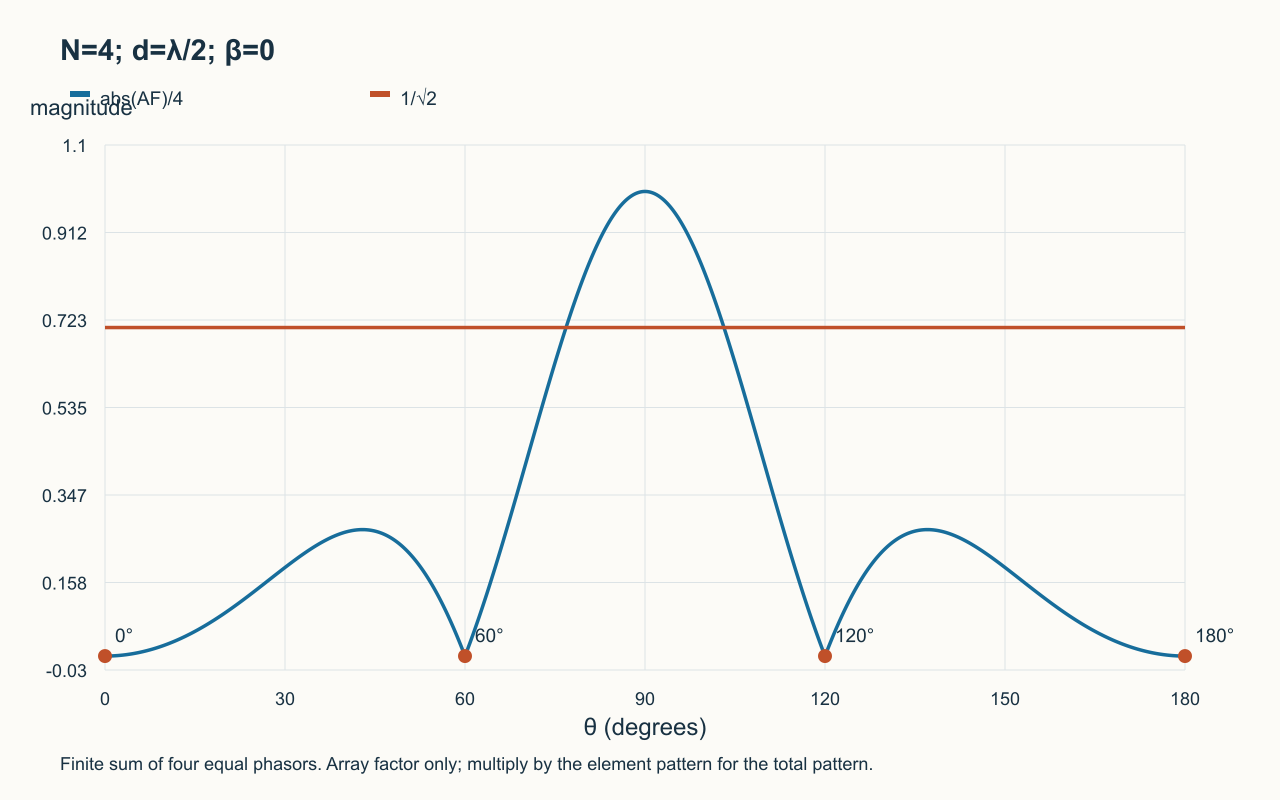
Numerator roots give cosθ=m/2. The visible nonzero values m=−2,−1,1,2 give θ=180°,120°,60°,0°.At the endpoints, the normalized denominator is respectively −4 and +4, so these are genuine nulls, not peaks.The m=0 point is the removable broadside maximum at 90°.Narration transcript
Step three: find the null angles. The array factor is zero when the numerator is zero but the denominator is not. Sine of N-psi-over-two equals zero means N-psi-over-two equals m-pi, where m is plus-or-minus one, two, three, and so on. Substituting our values, we get cosine-theta equals m over two. Now we check each m. For m equals plus-or-minus two, cosine-theta equals plus-or-minus one, which gives theta equals zero and one-eighty degrees. But at those angles the denominator is also zero, so these are main beam peaks, not nulls. For m equals plus-or-minus one, cosine-theta equals plus-or-minus one-half, giving theta equals sixty and one-twenty degrees. The denominator is not zero here — these are true nulls. For m equals plus-or-minus three, cosine-theta would need to be plus-or-minus three-halves, which is impossible since cosine is bounded by one. So the nulls are at sixty degrees and one-twenty degrees.
5. Half-power width
Solve the normalized magnitude equal to 1/√2 around the main lobe.The crossings are 76.838524° and 103.161476°, giving HPBW≈26.322952°.This is the array-factor width; an actual element pattern may change the total radiation pattern.Narration transcript
Step four: find the H-P-B-W. We set the normalized array factor magnitude equal to one over root-two, which is zero-point-seven-oh-seven. Looking at the graph, the array factor curve crosses the half-power line at approximately seventy-six-point-eight degrees and one-hundred-three-point-two degrees. The half-power beamwidth is the difference: about twenty-six-point-three degrees. Notice how much narrower this is compared to the half-wave dipole's seventy-eight degrees. Four elements already give a dramatic beam narrowing.
6. Pattern sketch
Mark the peak at 90° and nulls at 0°,60°,120°,180°.The magnitude is symmetric about broadside, with smaller side lobes outside the main-lobe nulls.Narration transcript
Step five: sketch the pattern. The polar plot shows the main beam at theta equals ninety degrees, pointing broadside. Nulls appear at sixty and one-twenty degrees, exactly where we calculated. Between the nulls and the endfire directions, small side lobes appear. The pattern is symmetric about theta equals ninety degrees because the array is broadside. Notice the figure-of-eight shape of the main lobe is much narrower than a single dipole — this is the power of arrays.
7. Three-dimensional interpretation
Rotating the axisymmetric array factor around z gives a broadside belt and null cones at 60° and 120°, plus axial zeros.For real dipoles, multiply by the specified element pattern before claiming a total-pattern beamwidth.Narration transcript
Here's the three-D view. Four dipoles along the z-axis create a narrow pancake-shaped beam in the broadside plane. The null cone at sixty degrees is clearly visible. With just four elements and half-wave spacing, we already achieve a twenty-six degree beamwidth and two distinct null angles.
8. Corrected result
Corrected mathematical reference; use with the written derivation. ψ=π cosθ; normalized magnitude abs(sin(2ψ)/(4sin(ψ/2))).Nulls: 0°,60°,120°,180°; peak: 90°; array-factor HPBW≈26.323°.Narration transcript
Let's box our answers. Part a: the normalized array factor is one over four times sine of two-pi-cosine-theta divided by sine of pi-cosine-theta-over-two. Part b: nulls at sixty degrees and one-twenty degrees, from cosine-theta equals plus-or-minus one-half. Part c: H-P-B-W approximately twenty-six degrees. Part d: the polar pattern shows a narrow broadside beam with two nulls and small side lobes. Arrays are how you shape beams — more elements, narrower beam, more nulls.
Source video: Antenna Theory PS#02 | 4-Element Broadside Array (5:36)