Antenna Theory · Steer the same array
#15 Problem Solving 03 | Beam Steering to 60 Degrees
Corrected solution notes. The audio is the original recording and may contain errors or incomplete phrases. Where they differ, use the corrected written solution.
Question
Corrected solution notes. The audio is the original recording and may contain errors or incomplete phrases. Where they differ, use the corrected written solution. Antenna Theory #15 | Beam Steering to 60 Degrees — Problem Solving 3
Written solution and narration transcript(shows the full solution)
Below are all the lines written in the notebook together with the full narration transcript.
1. Steer the same array
Corrected solution notes. The audio is the original recording and may contain errors or incomplete phrases. Where they differ, use the corrected written solution.Keep N=4 and d=λ/2 with equal amplitudes. Set the desired beam angle to 60° from the z axis.This is a scanned beam, not endfire operation.Narration transcript
Here's our third problem, and it builds directly on problem two. Same four-element array, same half-wave spacing, same uniform amplitude. But now instead of broadside, we want to steer the main beam to theta-zero equals sixty degrees. We need to find the required phase shift beta, write the new array factor, find the null angles, and compare the pattern with broadside. Let's see what changing just one parameter does.
2. Required phase
Setting ψ=π cosθ+β to zero at 60° gives β=−π/2.Thus ψ=π(cosθ−1/2), and the normalized magnitude reaches one at 60°.Narration transcript
Step one: find beta. The beam points in the direction where psi equals zero — that's where all element phasors add in phase. psi equals k-d-cosine-theta plus beta. We want psi equals zero at theta-zero equals sixty degrees. Setting up the equation: zero equals k-d-cosine-sixty plus beta. We already know from problem two that k-d equals pi. So zero equals pi times cosine-sixty plus beta. Cosine of sixty is one-half. Zero equals pi-over-two plus beta. Therefore beta equals minus pi-over-two, which is about minus ninety degrees. Our new phase parameter becomes psi equals pi times the quantity cosine-theta minus one-half.
3. Correct factor and nulls
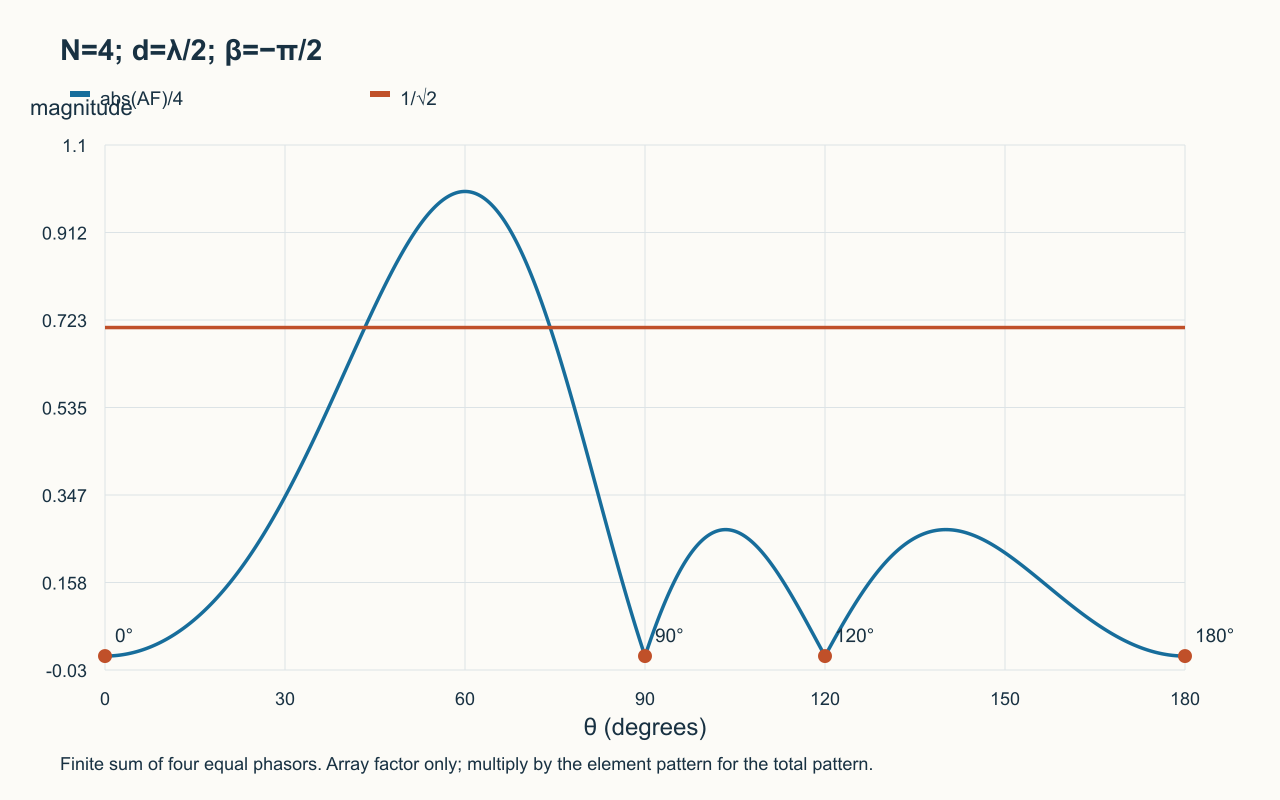
The normalized magnitude is abs(sin(2ψ)/(4sin(ψ/2))).Numerator roots satisfy cosθ=(m+1)/2. Visible m values are −3,−2,−1,0,1.m=0 is the removable peak at 60°; the other values give nulls at 180°,120°,90°,0°. At 0°, sin(ψ/2)=sin(π/4), which is nonzero.Narration transcript
Step two: write the steered array factor and find the nulls. The formula is identical to problem two — we just replace psi with the new expression. Quick check: at theta equals sixty degrees, cosine-theta minus one-half equals zero, so psi goes to zero and AF-normalized goes to one. Good — the beam is at sixty degrees. For nulls, we set the numerator to zero: N-psi-over-two equals m-pi. Substituting, we get cosine-theta equals m-plus-one over two. Now check each m. m equals plus one gives cosine-theta equals one, theta equals zero — but the denominator is also zero, so this is a peak, not a null. m equals minus one gives cosine-theta equals zero, theta equals ninety degrees — true null. m equals minus two gives cosine-theta equals minus one-half, theta equals one-twenty degrees — true null. m equals plus two gives cosine-theta equals three-halves — impossible. So nulls at ninety and one-twenty degrees.
4. Compare with broadside
Broadside nulls are 0°,60°,120°,180°; steered nulls are 0°,90°,120°,180°.The peak moves from 90° to 60°. For this array factor the main beam broadens from about 26.3° to about 31°.Narration transcript
Step three: compare with broadside. The graph shows both patterns on the same axes. The gray curve is our broadside pattern from problem two — peak at ninety degrees. The blue curve is the steered pattern — peak shifted to sixty degrees. Notice: the nulls moved from sixty and one-twenty in broadside to ninety and one-twenty in the steered case. Also, the beam is slightly wider — about thirty-one degrees instead of twenty-six. This is normal: beams broaden when steered away from broadside.
5. Polar interpretation
Changing only the progressive phase steers the array-factor peak.Mark all four nulls and the 60° peak; do not mark 0° as a removable maximum.Narration transcript
Step four: the polar pattern comparison makes it crystal clear. On the left, the broadside pattern with its beam at ninety degrees. On the right, the steered pattern with beam at sixty degrees. Same array, same elements — only beta changed from zero to minus pi-over-two. This is the power of phased arrays: electronic beam steering with no moving parts. Change the phase shifts, and the beam follows.
6. Three-dimensional interpretation
A linear array's array factor depends on θ and is azimuthally symmetric. Its maximum at 60° forms a conical locus around the axis.The actual element pattern must be included to determine the full antenna pattern.Narration transcript
Here's the three-D view of our steered array. The beam now tilts toward sixty degrees instead of being perpendicular. Four elements, half-wave spacing, just a ninety-degree phase shift between elements — and the beam steers thirty degrees.
7. Corrected result
Corrected mathematical reference; use with the written derivation. Required phase is −π/2; ψ=π(cosθ−1/2).Peak 60°; all visible nulls 0°,90°,120°,180°. The scan is 30° away from broadside.Narration transcript
Let's box our answers. Part a: beta equals minus pi-over-two to steer to sixty degrees. Part b: the array factor uses the same formula with psi equals pi times cosine-theta minus one-half. Part c: nulls at ninety and one-twenty degrees. Part d: compared to broadside, the beam shifted from ninety to sixty degrees, widened slightly from twenty-six to thirty-one degrees, and the null positions changed. The takeaway: beta is your steering knob — everything else follows from that single parameter.
Source video: Antenna Theory #15 | Beam Steering to 60 Degrees — Problem Solving 3 (4:46)