Electromagnetic Theory · Applications of Ampère's Law
#20 Applying Ampère's circuit law to an infinite current sheet, a three-region coaxial cable, and a long solenoid
Match an Amperian loop to the symmetry and derive the fields of an infinite sheet, a coaxial cable, and a long solenoid in a few lines.
Question

Apply Ampère's circuit law to an infinite current sheet, a three-region coaxial cable, and a long solenoid; explain the symmetry, enclosed current, and magnetic field intensity for each geometry.
Written solution and narration transcript(shows the full solution)
Below are all the lines written in the notebook together with the full narration transcript.
1. Review the four-step Ampère recipe
A symmetry-matched Amperian loop reduces the field integral to the enclosed current. In the last video we introduced Ampere's circuit law: the closed line integral of H around any loop equals the current enclosed.The four-step recipe was simple: find the symmetry, pick an Amperian loop, evaluate the integral, then count the enclosed current and solve.Today we apply that recipe to three classic geometries you will meet again and again: the infinite sheet of current, the coaxial cable, and the solenoid.Narration transcript
In the last video we introduced Ampere's circuit law: the closed line integral of H around any loop equals the current enclosed. The four-step recipe was simple: find the symmetry, pick an Amperian loop, evaluate the integral, then count the enclosed current and solve. Today we apply that recipe to three classic geometries you will meet again and again: the infinite sheet of current, the coaxial cable, and the solenoid.
2. Find the infinite-sheet field
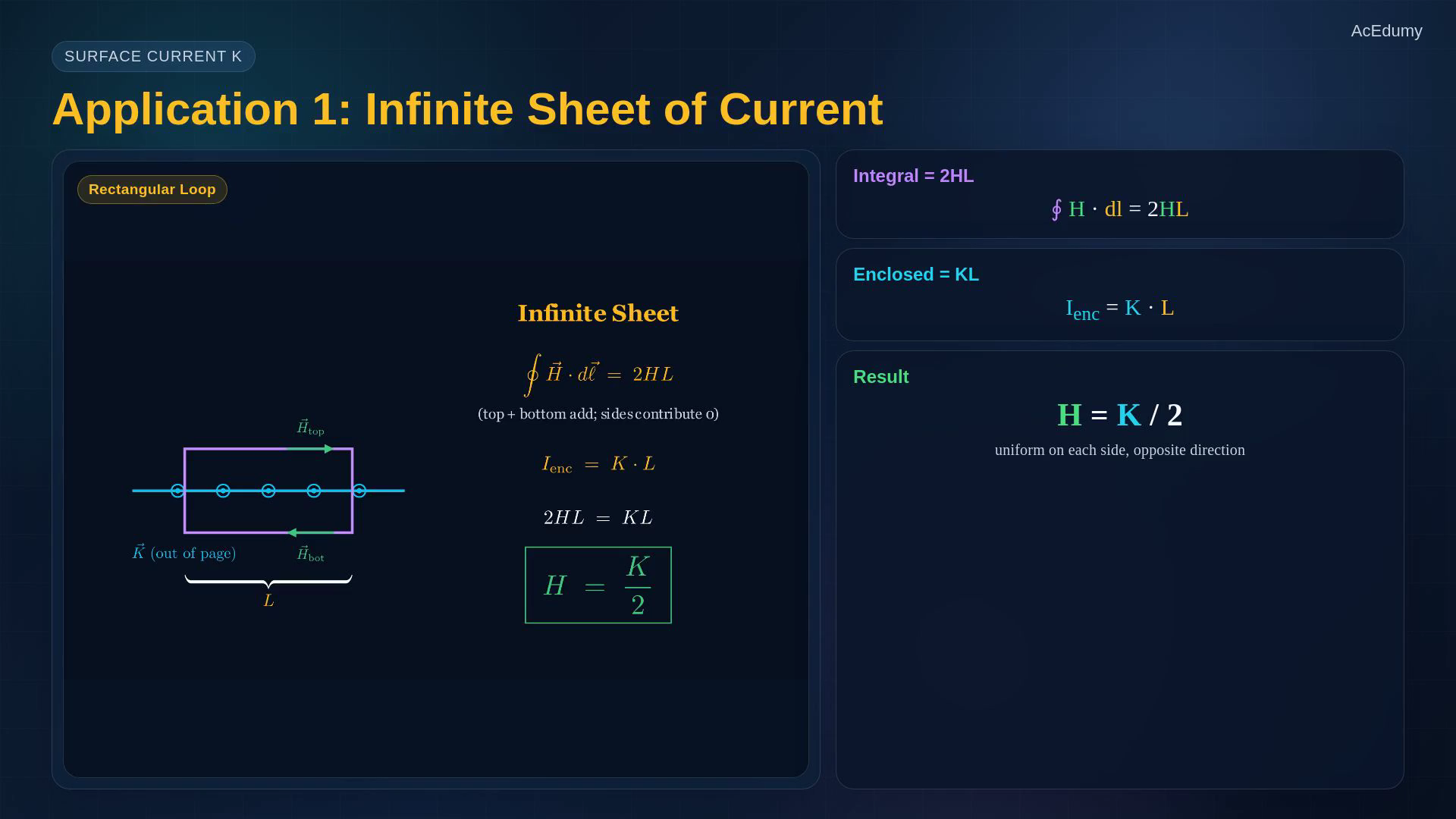
A symmetry-matched Amperian loop reduces the field integral to the enclosed current. First, an infinite sheet of current in the x-y plane, carrying a surface current density K in the x direction, with units of amperes per meter.By symmetry, H must be parallel to the sheet, perpendicular to K, and reverse direction above versus below.For the Amperian loop, pick a rectangle straddling the sheet, with length L along the y direction.On the top and bottom sides, H dotted with dl adds up; on the vertical sides, H is perpendicular to dl, so those contribute nothing.∮H·dl = 2HL.The enclosed current is Ienc = KL.2HL = KL.The field is uniform in magnitude on either side of the sheet, and reverses direction as you cross it.Narration transcript
First, an infinite sheet of current in the x-y plane, carrying a surface current density K in the x direction, with units of amperes per meter. By symmetry, H must be parallel to the sheet, perpendicular to K, and reverse direction above versus below. For the Amperian loop, pick a rectangle straddling the sheet, with length L along the y direction. On the top and bottom sides, H dotted with d l adds up; on the vertical sides, H is perpendicular to d l, so those contribute nothing. The total line integral is 2 H times L. The enclosed current is the strip of sheet captured by the loop, which is K times L. Setting them equal: 2 H L equals K L. Solve: H equals K over 2. The field is uniform in magnitude on either side of the sheet, and reverses direction as you cross it.
3. Separate the three coaxial regions
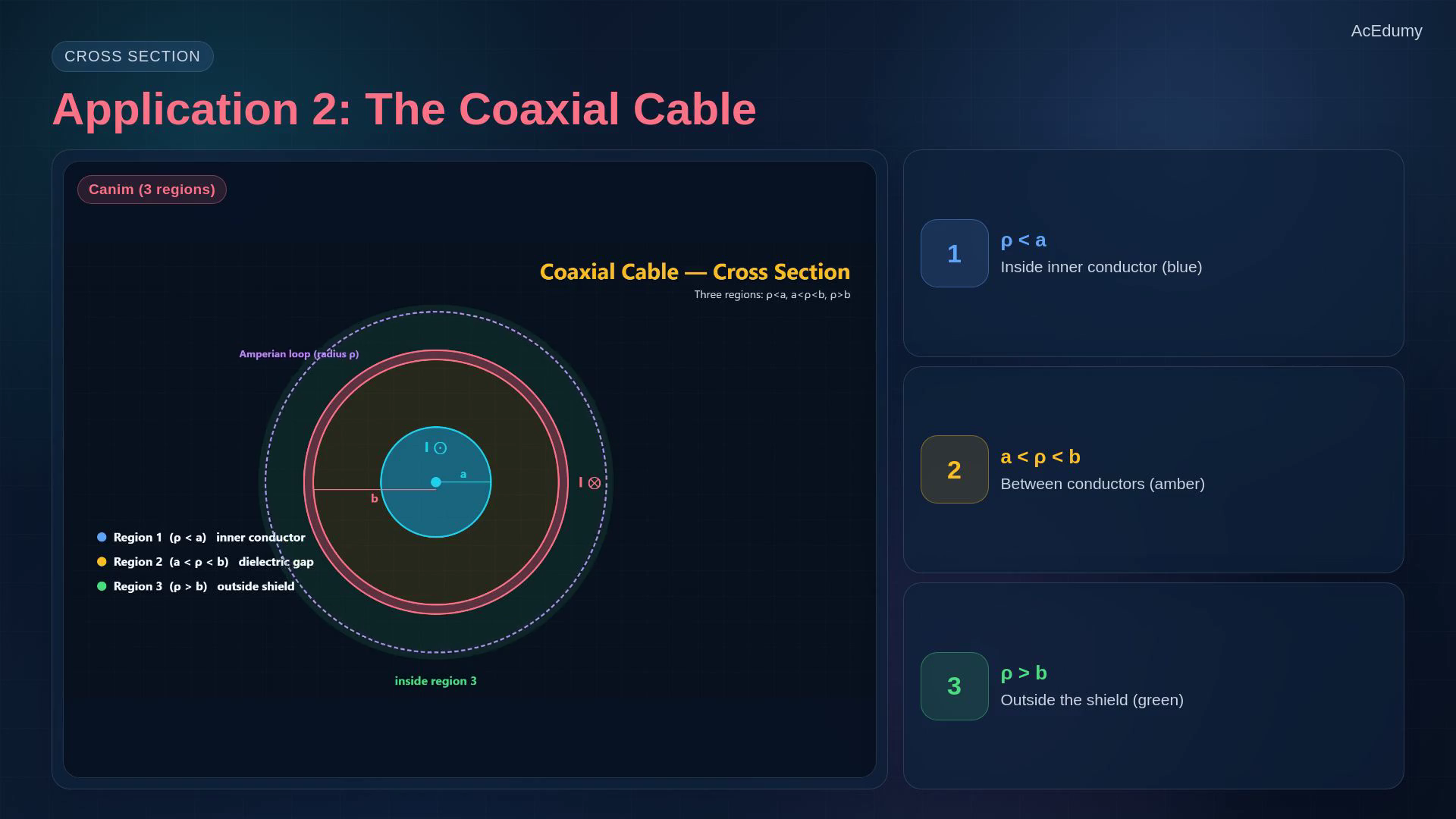
A symmetry-matched Amperian loop reduces the field integral to the enclosed current. Next, the coaxial cable.Think of a cross-section: a solid inner conductor of radius a carrying current I out of the page, and a thin outer shield at radius b carrying the same current I back into the page.We want H at every radial distance ρ.There are three regions to consider: inside the inner conductor, between the two conductors, and outside the shield.Each region uses the same circular Amperian loop, but a different enclosed current.Narration transcript
Next, the coaxial cable. Think of a cross-section: a solid inner conductor of radius a carrying current I out of the page, and a thin outer shield at radius b carrying the same current I back into the page. We want H at every radial distance rho. There are three regions to consider: inside the inner conductor, between the two conductors, and outside the shield. Each region uses the same circular Amperian loop, but a different enclosed current.
4. Derive H in all three regions
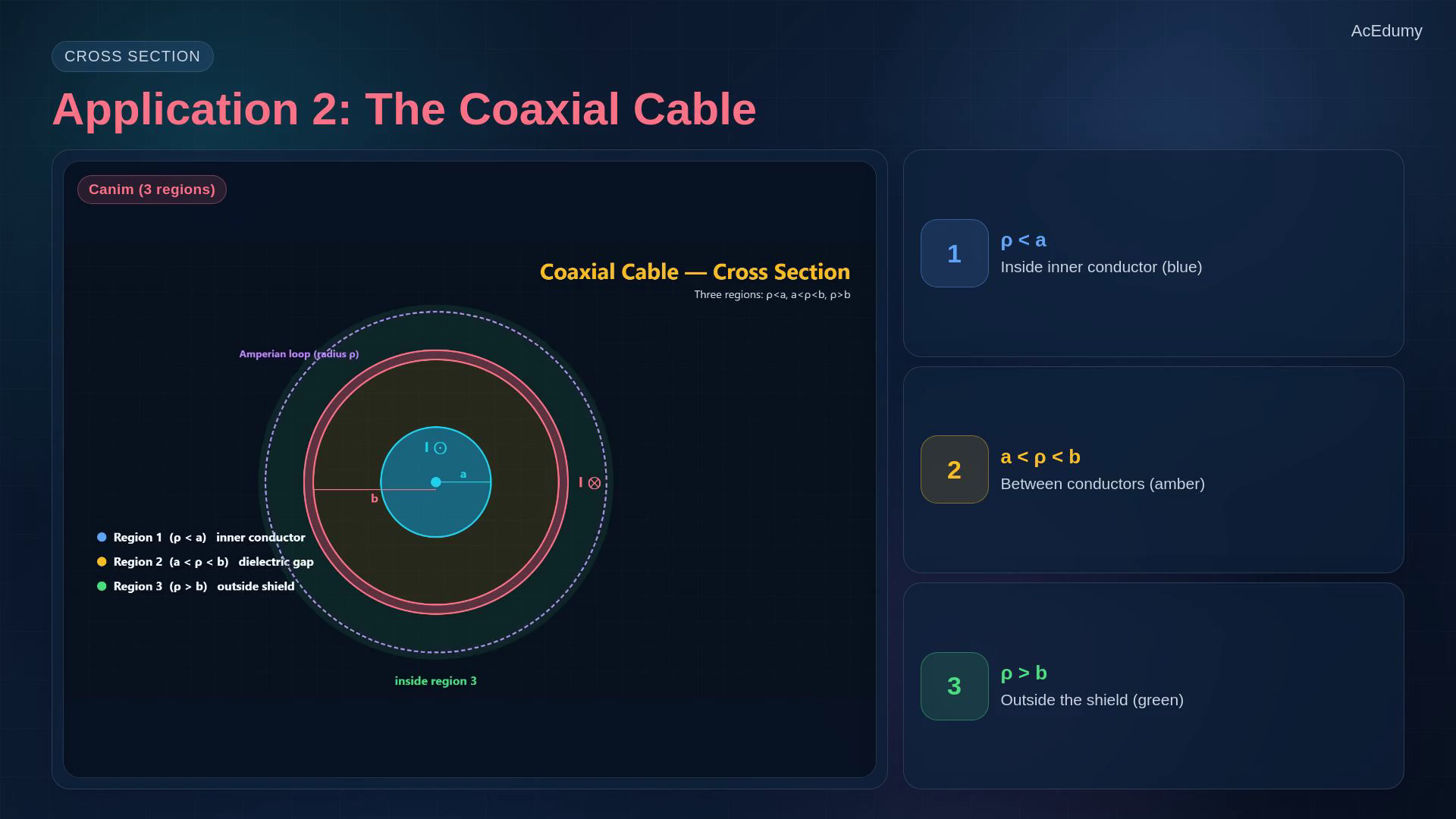
A symmetry-matched Amperian loop reduces the field integral to the enclosed current. Region one: ρ less than a, inside the inner conductor.By symmetry we pick a circular loop of radius ρ.Assuming uniform current density in the inner conductor, Ienc = Iρ²/a².The field grows linearly from zero at the center to I over 2 π a at the conductor's surface.Region two: a less than ρ less than b, in the dielectric between the conductors.The Amperian loop encloses the full inner current I, and nothing from the outer shield yet.This is exactly the infinite-wire result, as expected.Region three: ρ greater than b, outside the shield.Now the loop encloses plus I from the inner conductor and minus I from the shield.Ienc = I - I = 0, so H = 0.That's why coaxial cables do not leak magnetic field — a crucial property for low-noise signal transmission.Narration transcript
Region one: rho less than a, inside the inner conductor. By symmetry we pick a circular loop of radius rho. The current enclosed is not the full I but only the fraction that flows through our loop's cross-section, which is I times rho squared over a squared. So H times 2 pi rho equals I rho squared over a squared. Solving gives H equals I rho over 2 pi a squared. The field grows linearly from zero at the center to I over 2 pi a at the conductor's surface. Region two: a less than rho less than b, in the dielectric between the conductors. The Amperian loop encloses the full inner current I, and nothing from the outer shield yet. So H equals I over 2 pi rho. This is exactly the infinite-wire result, as expected. Region three: rho greater than b, outside the shield. Now the loop encloses plus I from the inner conductor and minus I from the shield. They cancel exactly, so the enclosed current is zero, and therefore H is zero. That's why coaxial cables do not leak magnetic field — a crucial property for low-noise signal transmission.
5. Calculate the long-solenoid field

A symmetry-matched Amperian loop reduces the field integral to the enclosed current. Finally, the solenoid: a long cylinder wrapped with n turns per unit length, each carrying current I.Inside, the field is uniform and parallel to the axis; outside, it is approximately zero.Pick a rectangular Amperian loop with one side of length L inside the solenoid and the opposite side outside.The side outside contributes zero.The two perpendicular sides contribute nothing because H is perpendicular to dl there.Only the inside side contributes: ∮H·dl = HL.The enclosed current is the number of turns threading the loop, which is n times L, each carrying I.The total enclosed current is Ienc = nLI.HL = nLI, so H = nI.Simple and powerful — the solenoid is the magnetic analogue of a parallel-plate capacitor: nearly uniform field inside, almost none outside.Narration transcript
Finally, the solenoid: a long cylinder wrapped with n turns per unit length, each carrying current I. Inside, the field is uniform and parallel to the axis; outside, it is approximately zero. Pick a rectangular Amperian loop with one side of length L inside the solenoid and the opposite side outside. The side outside contributes zero. The two perpendicular sides contribute nothing because H is perpendicular to d l there. Only the inside side counts, contributing H times L. The enclosed current is the number of turns threading the loop, which is n times L, each carrying I. So total enclosed current is n L times I. Setting H L equals n L I gives H equals n I. Simple and powerful — the solenoid is the magnetic analogue of a parallel-plate capacitor: nearly uniform field inside, almost none outside.
6. Review four classic Ampère results

A symmetry-matched Amperian loop reduces the field integral to the enclosed current. Let's collect the four classic results.Infinite wire:Infinite current sheet:Coaxial cable: H = I/(2πρ) for a < ρ < b, and H = 0 for ρ > b.Inside a long solenoid, H = nI.Each of these took only a few lines with Ampere's law — none of them would be easy with Biot-Savart.Next: magnetic flux density B, B = μ₀H, and Maxwell's equations for magnetostatics.Narration transcript
Let's collect the four classic results. For an infinite wire, H equals I over 2 pi rho. For an infinite sheet, H equals K over 2. Inside a coaxial cable, H equals I over 2 pi rho between the conductors, and zero outside the shield. Inside a solenoid, H equals n I. Each of these took only a few lines with Ampere's law — none of them would be easy with Biot-Savart. In the next video we move on to the magnetic flux density B, the relationship B equals mu zero H, and Maxwell's equations for magnetostatics.
Source video: Electromagnetic Theory (v2) #20 | Applications of Ampère's Law (5:25)