Communication Basics · ASK/OOK, BFSK, and Two-Phase PSK at Microsecond Scale
#20 place 11110001 on a 1-µs bit grid, derive 3/2-MHz carriers and cycles per bit, draw OOK/BFSK/sine-cosine PSK with an explicit phase policy, and bound 1-Mbit/s application claims
Place 11110001 on a 1-µs grid, then draw OOK, BFSK, and two-phase PSK using the correct 3/2-MHz cycle and phase assumptions.
Question
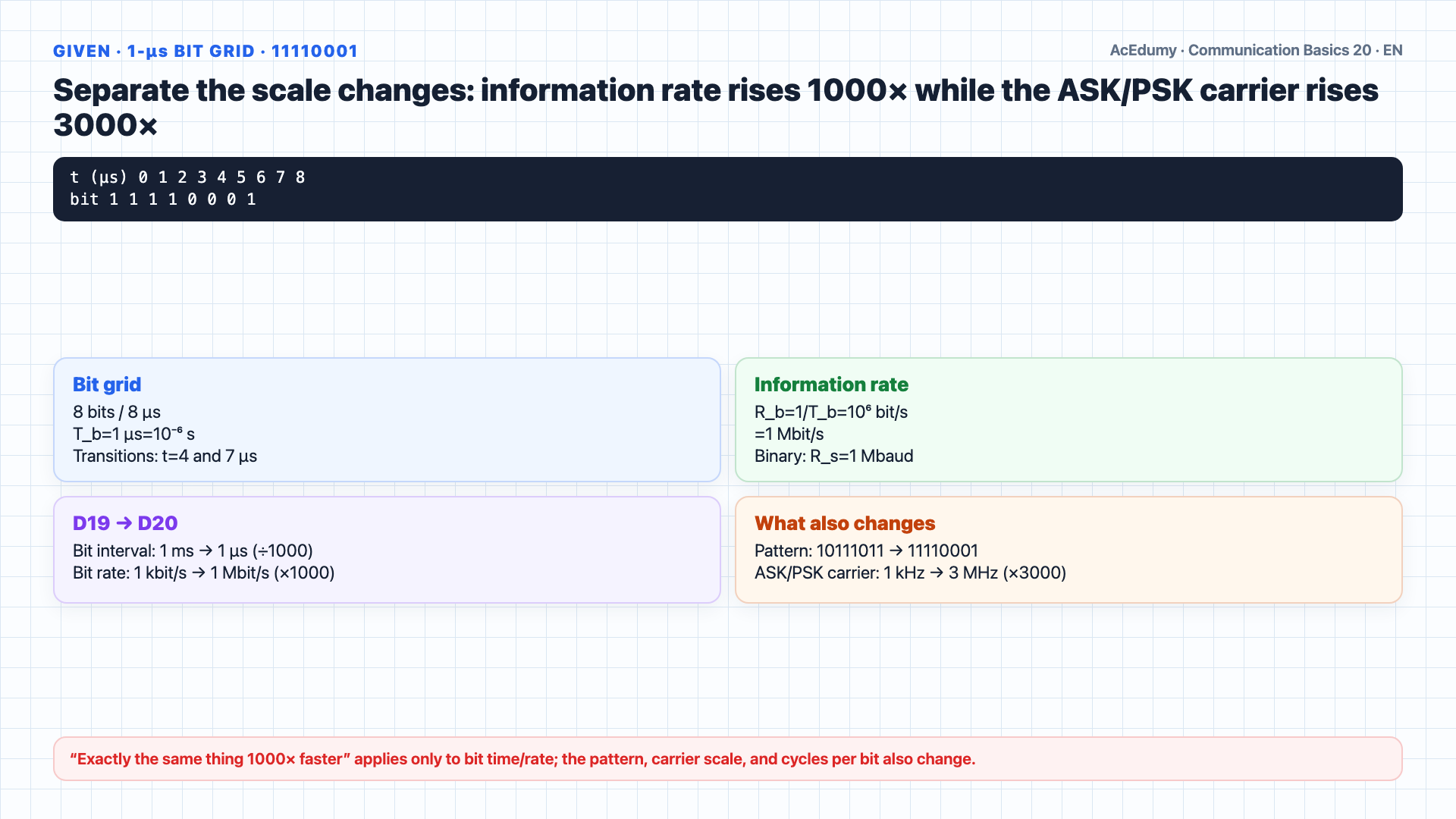
Place 11110001 across eight 1-µs intervals and derive the 1-Mbit/s information rate; obtain 3 and 2 MHz from sin(6×10^6πt) and sin(4×10^6πt), then 3 and 2 cycles per bit; identify the stated ASK as OOK; declare the BFSK boundary-phase policy; distinguish sine/cosine 90° separation from conventional 180° BPSK; bound the 64-kbit/s voice and 96-Mbit/s video claims by codec, framing, and quality assumptions.
Written solution and narration transcript(shows the full solution)
Below are all the lines written in the notebook together with the full narration transcript.
1. Set up the 11110001 bit grid and microsecond scale
Compute frequency and cycles per bit first; declare the mapping and phase-continuity policy before drawing each waveform. Welcome.In the previous video we drew ASK, FSK, and PSK at a millisecond timescale with a one kilohertz carrier.Relative to D19, the bit interval falls from 1 ms to 1 µs and the information rate rises 1000×; this problem also changes the carrier from 1 kHz to 3 MHz (3000×) and uses a different bit pattern.The time axis is now in microseconds.The carriers are in megahertz.Tb=1 µs gives Rb=1/Tb=106 bit/s=1 Mbit/s; for binary keying the symbol rate is also 1 Mbaud.Here is our digital signal x(t).Eight bits in eight microseconds.The given eight-bit pattern is 11110001; boundaries are t=0,1,…,8 µs and the value changes at t=4 µs and t=7 µs.Four ones, then three zeros, then one final one.Our job: draw ASK, FSK, and PSK for this signal.Narration transcript
Welcome. In the previous video we drew A S K, F S K, and P S K at a millisecond timescale with a one kilohertz carrier. Today we do exactly the same thing, but one thousand times faster. The time axis is now in microseconds. The carriers are in megahertz. And the data rate jumps from one kilobit per second to one megabit per second. Here is our digital signal x of t. Eight bits in eight microseconds. The pattern is one, one, one, one, zero, zero, zero, one. Four ones, then three zeros, then one final one. Our job: draw A S K, F S K, and P S K for this signal.
2. Derive carrier frequencies and cycles per bit
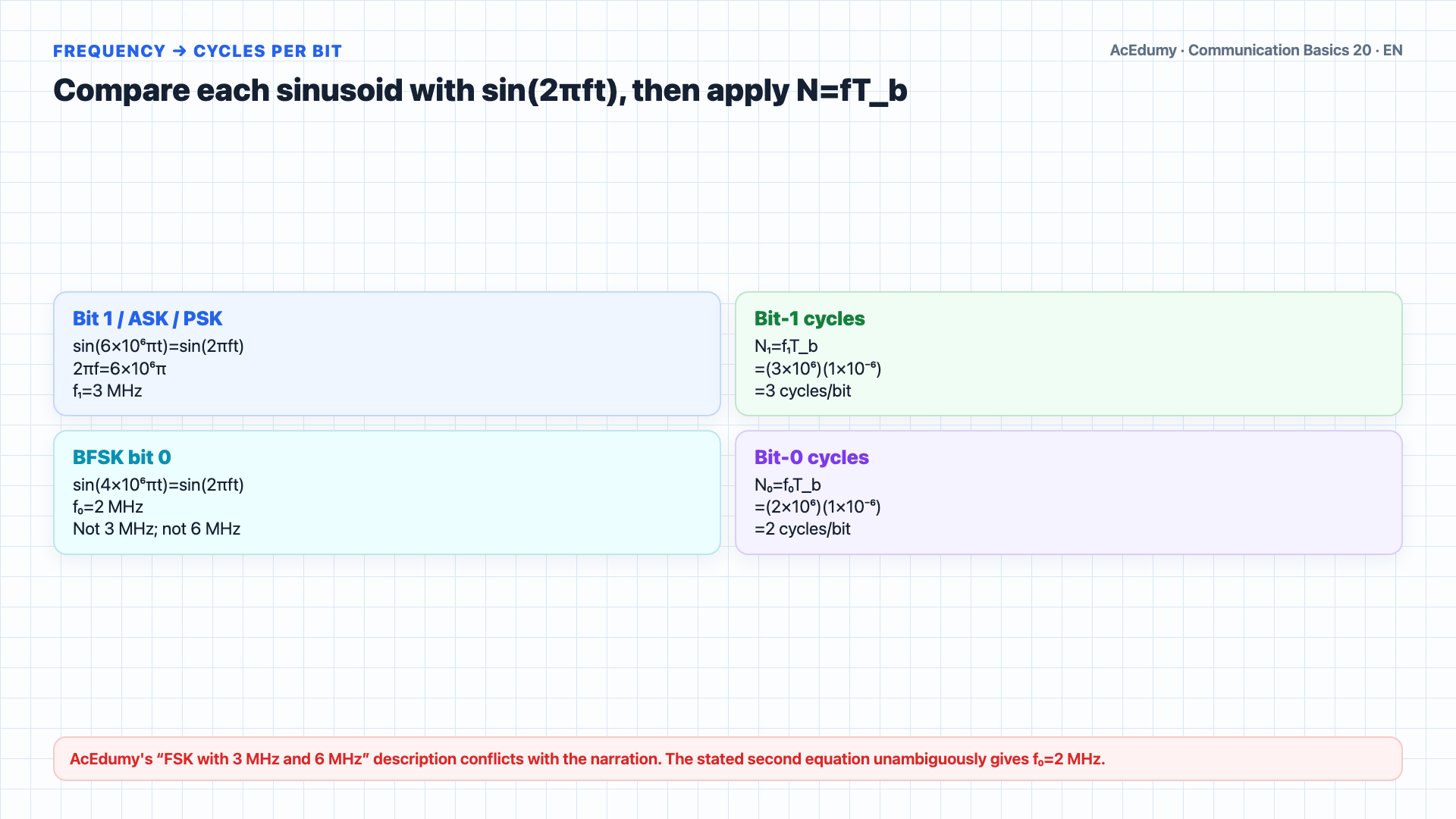
Compute frequency and cycles per bit first; declare the mapping and phase-continuity policy before drawing each waveform. Before we start drawing, let us figure out how many cycles fit in one bit.s1(t)=sin(6×10⁶πt)=sin(2π·3×106t), so f1=3 MHz.To find the frequency, compare this with the standard form: sine of two pi f t.Setting two pi f equal to six times ten to the six pi, we divide both sides by two pi, and get f equals three times ten to the six, which is three megahertz.Now, one bit lasts one microsecond, which is ten to the minus six seconds.N1=f1Tb=(3×10⁶)(1×10⁻⁶)=3 cycles/bit.So we draw three complete sine waves in every one bit slot.The BFSK zero tone is s0(t)=sin(4×10⁶πt)=sin(2π·2×106t): f0=2 MHz and N0=f0Tb=2 cycles/bit.Narration transcript
Before we start drawing, let us figure out how many cycles fit in one bit. The carrier is written as sine of six times ten to the six pi t. To find the frequency, compare this with the standard form: sine of two pi f t. Setting two pi f equal to six times ten to the six pi, we divide both sides by two pi, and get f equals three times ten to the six, which is three megahertz. Now, one bit lasts one microsecond, which is ten to the minus six seconds. The number of cycles in one bit is frequency times bit duration: three times ten to the six multiplied by ten to the minus six equals exactly three. So we draw three complete sine waves in every one bit slot. For the F S K zero carrier, sine of four times ten to the six pi t, the same calculation gives f equals two megahertz, which means two cycles per bit.
3. Draw the OOK waveform at 3 cycles per bit
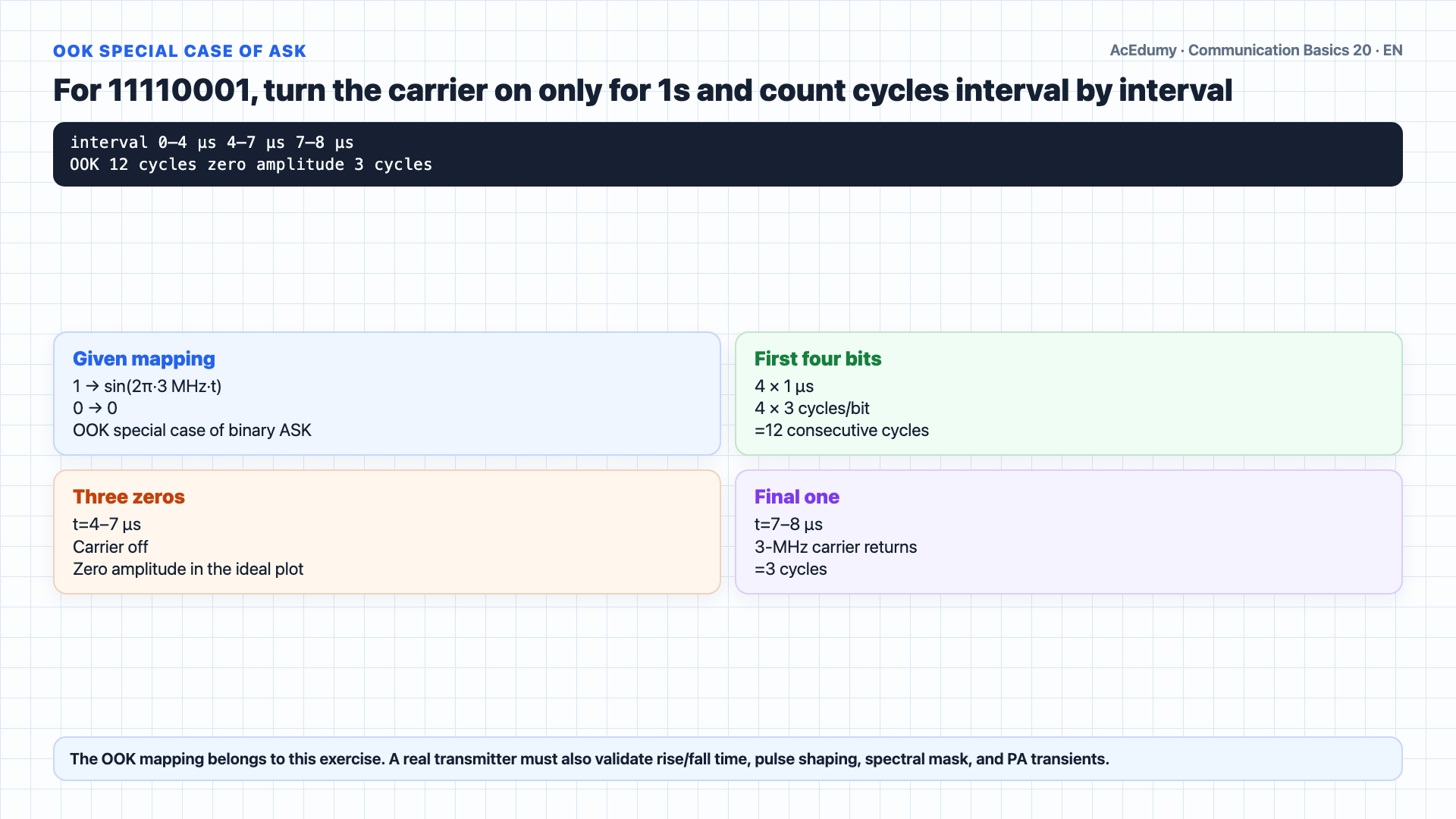
Compute frequency and cycles per bit first; declare the mapping and phase-continuity policy before drawing each waveform. Let us start with ASK.The carrier is sine of six times ten to the six pi t.That is three megahertz, which means three full cycles per microsecond.The ASK in this problem is OOK: 1→3-MHz carrier on and 0→zero amplitude; this mapping is not universal.Bits one through four are all ones.Draw 4 bits × 3 cycles/bit = 12 cycles over t=0–4 µs, zero amplitude over t=4–7 µs, and 3 cycles over t=7–8 µs.Bits five, six, seven are zeros.The signal drops to zero for three microseconds.No oscillation at all.Bit eight is a one, so we draw three more cycles of sine in the last microsecond.Compare this to our previous video.There we had one cycle per bit at one kilohertz.Here we have three cycles per bit at three megahertz.The waveform looks much denser, but the principle is identical.Narration transcript
Let us start with A S K. The carrier is sine of six times ten to the six pi t. That is three megahertz, which means three full cycles per microsecond. A S K rule: carrier on for a one, off for a zero. Bits one through four are all ones. So we draw twelve cycles of sine back to back, three per microsecond, four microseconds. Bits five, six, seven are zeros. The signal drops to zero for three microseconds. No oscillation at all. Bit eight is a one, so we draw three more cycles of sine in the last microsecond. Compare this to our previous video. There we had one cycle per bit at one kilohertz. Here we have three cycles per bit at three megahertz. The waveform looks much denser, but the principle is identical.
4. Draw BFSK tones with an explicit boundary-phase policy
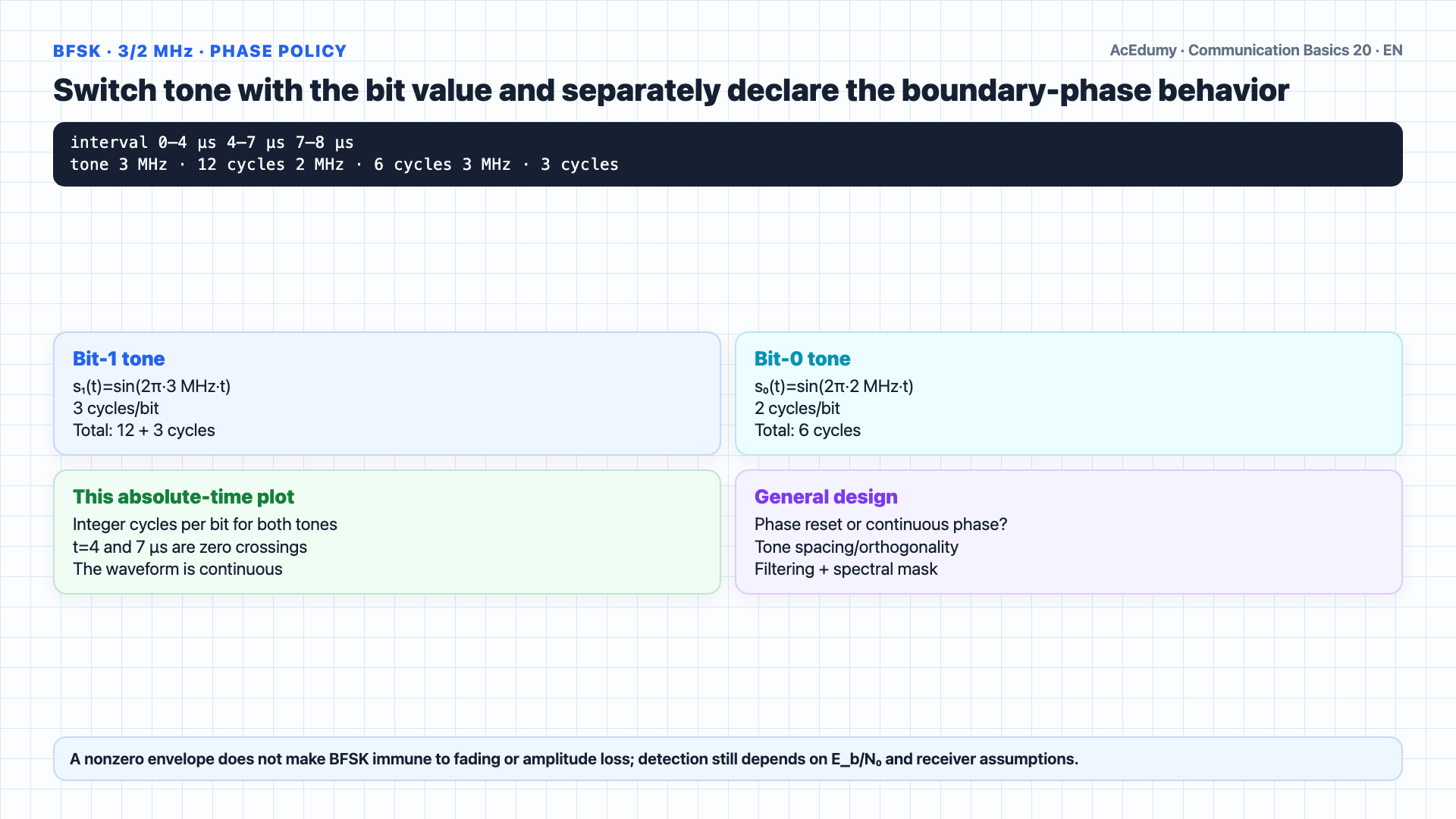
Compute frequency and cycles per bit first; declare the mapping and phase-continuity policy before drawing each waveform. Now FSK.This problem defines BFSK mapping 1→3 MHz and 0→2 MHz; AcEdumy's 3/6-MHz description conflicts with the source narration.Three cycles per microsecond for a one, two cycles per microsecond for a zero.Walk along x(t).Bits one through four are ones.Twelve cycles of the fast tone over four microseconds.Bits five, six, seven are zeros.Six cycles of the slow tone over three microseconds.Bit eight is a one.Three cycles of the fast tone in the last microsecond.The ideal BFSK plot does not switch amplitude to zero; real transitions depend on pulse shaping, filtering, and the phase-continuity policy.During the zero bits you still see oscillation, just at a lower frequency.With absolute-time sin(2πft) and integer cycles, the t=4 and 7 µs boundaries are continuous zero crossings; still declare whether the implementation resets or preserves phase.That density change is the information.Narration transcript
Now F S K. The rule is: a one is sent as sine of six times ten to the six pi t, three megahertz, and a zero is sent as sine of four times ten to the six pi t, two megahertz. Three cycles per microsecond for a one, two cycles per microsecond for a zero. Walk along x of t. Bits one through four are ones. Twelve cycles of the fast tone over four microseconds. Bits five, six, seven are zeros. Six cycles of the slow tone over three microseconds. Bit eight is a one. Three cycles of the fast tone in the last microsecond. Notice: the carrier never stops. During the zero bits you still see oscillation, just at a lower frequency. The transition points at four microseconds and seven microseconds show a visible change in oscillation density. That density change is the information.
5. Separate sine/cosine 90° PSK from conventional BPSK
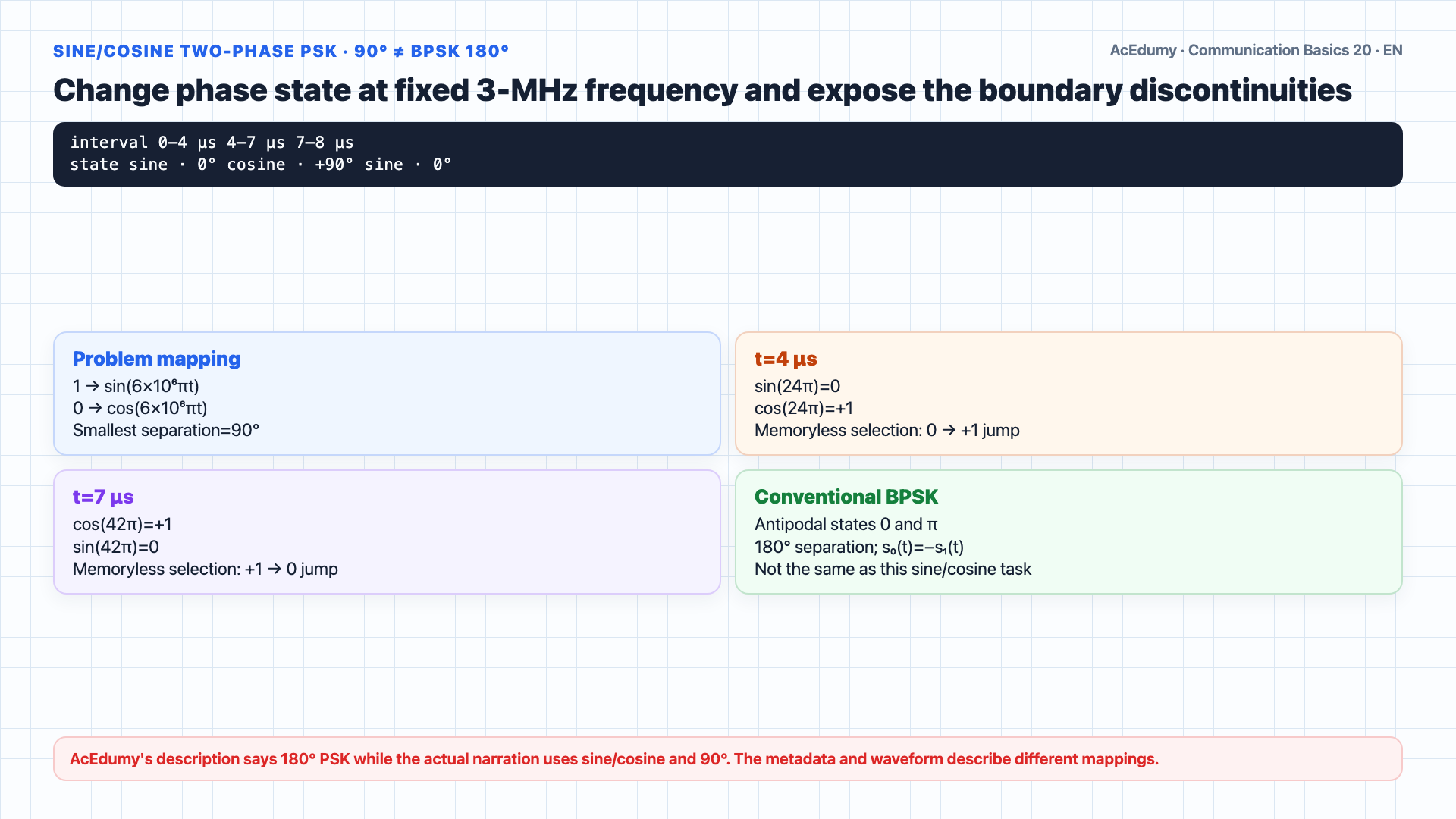
Compute frequency and cycles per bit first; declare the mapping and phase-continuity policy before drawing each waveform. Finally PSK.The problem defines 1→sin(6×10⁶πt) and 0→cos(6×10⁶πt), a 90° separation. Conventional antipodal BPSK uses 0 and π, a 180° separation.Both are three megahertz.The frequency never changes.Only the phase does.Cosine is sine shifted by ninety degrees.Bits one through four are ones.Twelve cycles of sine over four microseconds.At t=4 µs the sine state is 0 while the cosine state is +1; memoryless absolute-time selection creates an amplitude discontinuity at this boundary.The waveform switches to cosine.Same frequency, but the wave now starts at its peak instead of at zero.That is the phase jump.Bits five, six, seven are zeros.Nine cycles of cosine over three microseconds.At t=7 µs cosine is +1 and sine is 0; the second 90° state change also creates an amplitude discontinuity.Another phase jump, back to sine.Three final cycles.Only two transitions in this pattern, at four and seven microseconds.Each one shows an abrupt break in the waveform.Narration transcript
Finally P S K. A one is sent as sine of six times ten to the six pi t and a zero is sent as cosine of six times ten to the six pi t. Both are three megahertz. The frequency never changes. Only the phase does. Cosine is sine shifted by ninety degrees. Bits one through four are ones. Twelve cycles of sine over four microseconds. At four microseconds the bit flips to zero. The waveform switches to cosine. Same frequency, but the wave now starts at its peak instead of at zero. That is the phase jump. Bits five, six, seven are zeros. Nine cycles of cosine over three microseconds. At seven microseconds the bit flips back to one. Another phase jump, back to sine. Three final cycles. Only two transitions in this pattern, at four and seven microseconds. Each one shows an abrupt break in the waveform.
6. Interpret 1 Mbit/s through voice, video, and feasibility gates
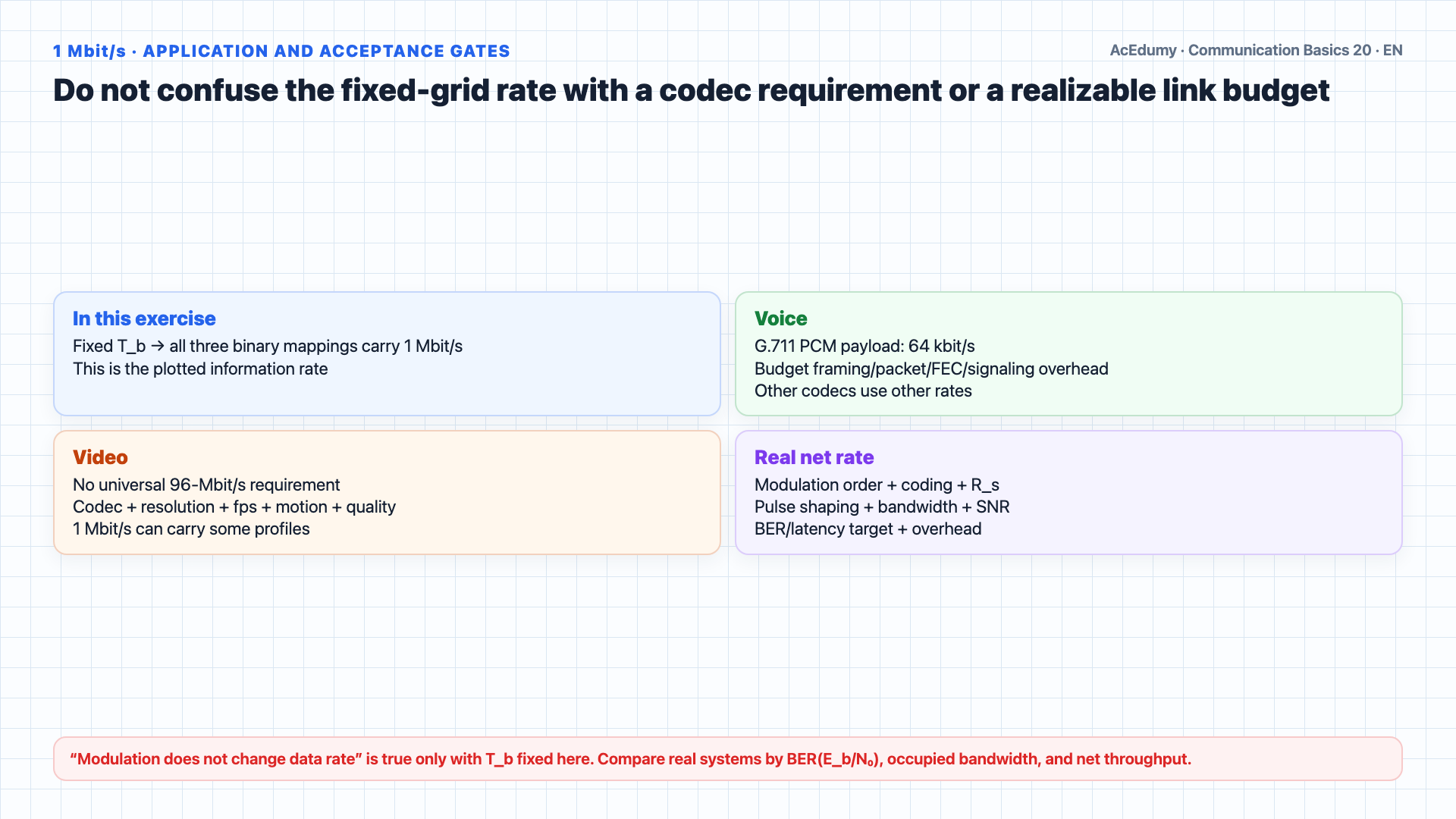
Compute frequency and cycles per bit first; declare the mapping and phase-continuity policy before drawing each waveform. Let us summarize and compare the two scales.In the previous video, one kilohertz, one cycle per bit, one kilobit per second.D20 uses 3 MHz and 3 cycles/bit for ASK/PSK, while the other BFSK tone is 2 MHz and 2 cycles/bit; the information rate is 1 Mbit/s.One thousand times faster, but the exact same three modulation rules.ASK: amplitude on or off.FSK: fast frequency or slow frequency.PSK: sine phase or cosine phase.A 1-Mbit/s channel can carry a 64-kbit/s G.711 PCM payload; budget framing, packet, FEC, and signaling overhead separately, and note that other codecs use different rates.Video has no universal 96-Mbit/s requirement; bitrate depends on codec, resolution, frame rate, motion, quality, and latency. A 1-Mbit/s channel can carry some compressed-video profiles and not others.That is the practical context.With Tb fixed in this exercise, all three binary mappings carry 1 Mbit/s; in a real system, achievable net rate depends jointly on modulation order, coding, symbol rate, pulse shaping, bandwidth, SNR, and error target.Compare BER(Eb/N0), occupied bandwidth/spectral mask, PA needs, synchronization, detector, and implementation complexity; avoid a universal ranking.Narration transcript
Let us summarize and compare the two scales. In the previous video, one kilohertz, one cycle per bit, one kilobit per second. Today, three megahertz, three cycles per bit, one megabit per second. One thousand times faster, but the exact same three modulation rules. A S K: amplitude on or off. F S K: fast frequency or slow frequency. P S K: sine phase or cosine phase. At one megabit per second, this signal can comfortably carry a digital voice channel, which only needs sixty four kilobits per second. But it cannot carry a digital video channel, which needs roughly ninety six megabits per second. That is the practical context. The modulation scheme you choose does not change the data rate. It changes how robust, how bandwidth efficient, and how complex your receiver needs to be.
Source video: Communication Basics #20 Worked Example: ASK/FSK/PSK Plot (microsec) (6:09)