Communication Basics · ASK/OOK, BFSK, and Two-Phase PSK Waveform Solution
#19 decode 10111011 from an OOK envelope on 1-ms intervals, derive 1 kbit/s, draw 1/2-kHz BFSK tones, distinguish the stated 90° sine/cosine phase mapping from antipodal BPSK, and compare modulation with explicit engineering gates
Decode the bits and rate from the given on–off ASK envelope, then draw the same message as BFSK and two-phase PSK with explicit cycle and phase assumptions.
Question
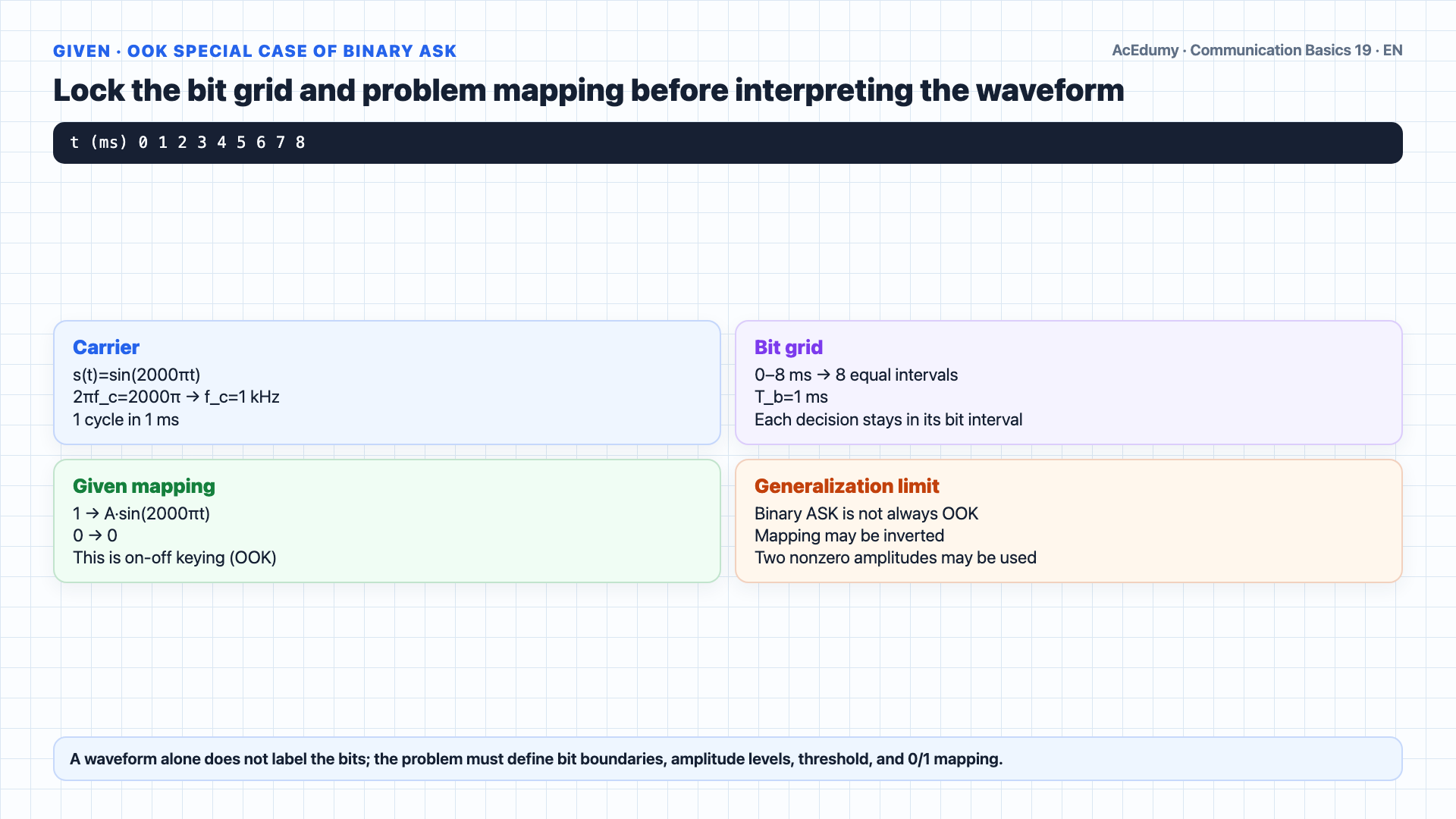
State that the given ASK is the on-off-keying special case and that 1→carrier/0→off is a problem mapping; recover 10111011 and 1 kbit/s from eight 1-ms intervals; draw BFSK with 1→1 kHz and 0→2 kHz while declaring the bit-boundary phase policy; distinguish the stated sine/cosine 90° separation from conventional 180° antipodal BPSK; bind bandwidth, noise robustness, and receiver-complexity rankings to detection, energy, tone spacing, pulse shaping, and channel assumptions.
Written solution and narration transcript(shows the full solution)
Below are all the lines written in the notebook together with the full narration transcript.
1. Define the given waveform, bit grid, and mapping assumptions
Waveform plots require a mapping, bit grid, and phase policy; compare bandwidth and noise performance only under common energy, filtering, and detector assumptions. Welcome.Today we tackle a classic exam problem on digital modulation.Here is what we are given.The given waveform uses one nonzero and one zero amplitude over 0–8 ms, so it is the on-off-keying (OOK) special case of binary ASK.The carrier is s(t)=sin(2000πt)=sin(2π·1000t): fc=1 kHz and one carrier cycle per 1-ms bit interval.Our job is in three parts.First, find the digital information signal x(t) that produced this ASK.Second, take that same x(t) and re-draw it as Frequency Shift Keying.Third, re-draw it again as Phase Shift Keying.Three modulations, one underlying message.Narration transcript
Welcome. Today we tackle a classic exam problem on digital modulation. Here is what we are given. An Amplitude Shift Keying signal — A S K for short — drawn against a millisecond time axis from zero to eight milliseconds. The carrier is a sine wave at one kilohertz, written as sine of two thousand pi t. Our job is in three parts. First, find the digital information signal x of t that produced this A S K. Second, take that same x of t and re-draw it as Frequency Shift Keying. Third, re-draw it again as Phase Shift Keying. Three modulations, one underlying message.
2. Decode 10111011 and 1 kbit/s from the OOK envelope
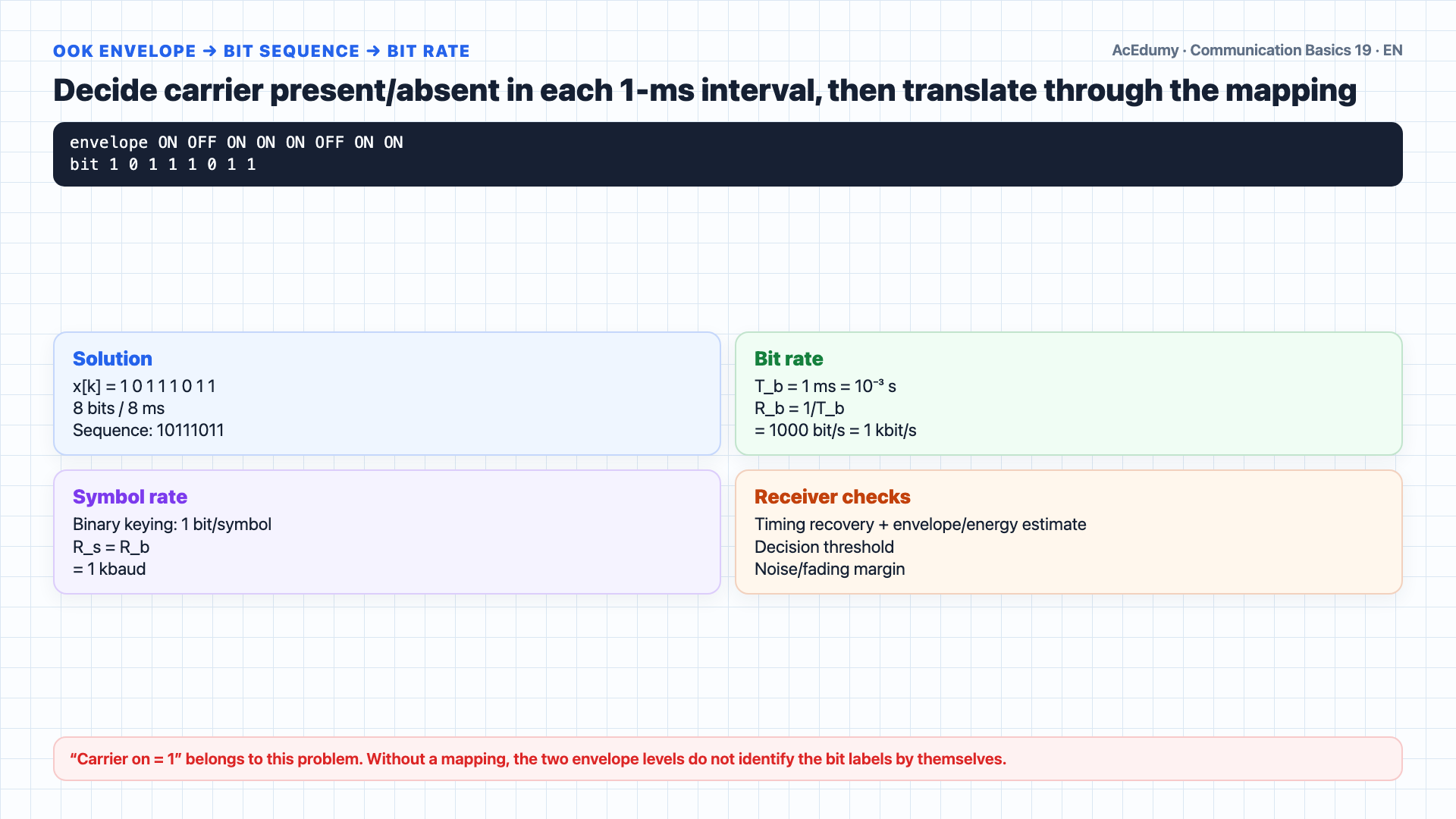
Waveform plots require a mapping, bit grid, and phase policy; compare bandwidth and noise performance only under common energy, filtering, and detector assumptions. Let us decode the ASK.The rule is simple.This problem defines OOK mapping 1→carrier on and 0→zero amplitude; binary ASK may use an inverted mapping or two nonzero amplitudes.Partition the bit grid into 1-ms intervals, threshold the envelope in each interval, and translate carrier-present/absent through this problem's mapping.Look at the first millisecond, from zero to one.We see exactly one full cycle of sine.The carrier is on, so this bit is a one.From one to two, the line is flat.The carrier is off, so this bit is a zero.From two to five we see three full cycles, three milliseconds in a row of carrier on.So bits three, four, and five are all ones.From five to six, flat again.Bit six is a zero.And from six to eight, two more full cycles.Bits seven and eight are both ones.The bit pattern is one, zero, one, one, one, zero, one, one.Eight bits in eight milliseconds.Tb=1 ms gives Rb=1/Tb=1000 bit/s=1 kbit/s; for binary keying the symbol rate is also 1 kbaud.This is the digital signal that the ASK is carrying.Narration transcript
Let us decode the A S K. The rule is simple. A S K turns the carrier on for a one and turns it off for a zero. So we walk along the time axis one millisecond at a time and ask, do we see a sine cycle here, yes or no? Look at the first millisecond, from zero to one. We see exactly one full cycle of sine. The carrier is on, so this bit is a one. From one to two, the line is flat. The carrier is off, so this bit is a zero. From two to five we see three full cycles, three milliseconds in a row of carrier on. So bits three, four, and five are all ones. From five to six, flat again. Bit six is a zero. And from six to eight, two more full cycles. Bits seven and eight are both ones. The bit pattern is one, zero, one, one, one, zero, one, one. Eight bits in eight milliseconds. The bit duration is exactly one millisecond, so the rate of x of t is one bit per millisecond, which equals one kilobit per second. This is the digital signal that the A S K is carrying.
3. Draw BFSK tones with cycles per bit and an explicit phase policy
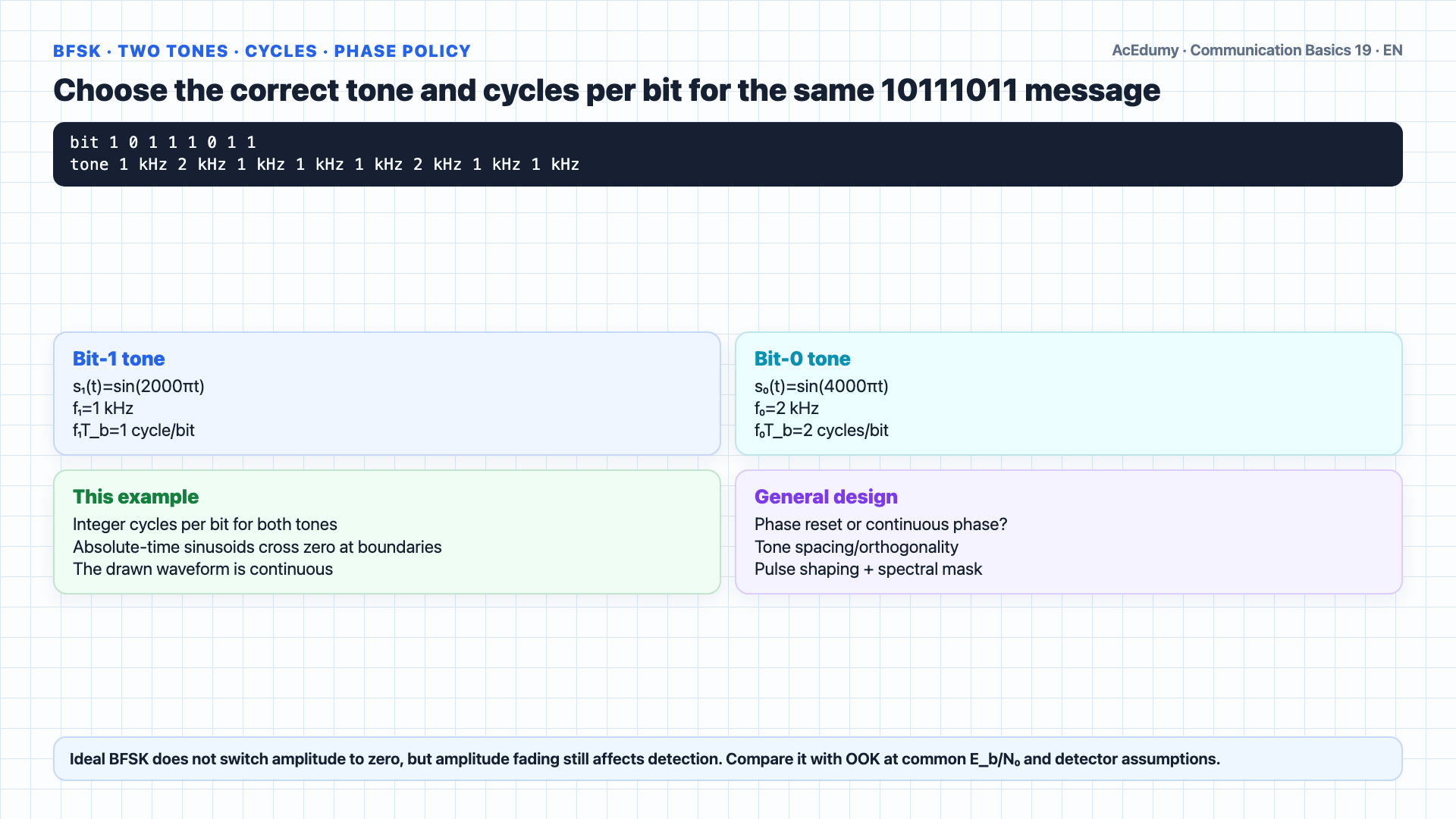
Waveform plots require a mapping, bit grid, and phase policy; compare bandwidth and noise performance only under common energy, filtering, and detector assumptions. Now we draw FSK.FSK stands for Frequency Shift Keying.Instead of switching the carrier on and off, we switch between two different frequencies.This BFSK problem defines 1→sin(2000πt), f1=1 kHz=1 cycle/bit, and 0→sin(4000πt), f0=2 kHz=2 cycles/bit.We just walk along x(t) and pick the right tone for each bit.Bit one is a one, so we draw one cycle of the slow tone.Bit two is a zero, so we draw two cycles of the fast tone.Bits three, four, five are ones, so three cycles of the slow tone in a row.Bit six is a zero, so two cycles of fast.Bits seven and eight are ones, so two more cycles of slow.Notice the visual signature.Where the bit is zero, the wave looks visibly tighter.Where the bit is one, it looks more spaced out.The ideal BFSK plot does not switch amplitude to zero; real tone transitions may create transients depending on filtering and the phase-continuity policy.The frequency is what carries the information.Compare BFSK and OOK error performance only at common Eb/N0 with stated tone spacing, coherent/noncoherent detector, threshold, fading, and filtering; BFSK is not immune to amplitude loss.Narration transcript
Now we draw F S K. F S K stands for Frequency Shift Keying. Instead of switching the carrier on and off, we switch between two different frequencies. For our problem, the rule is, a one is sent as sine of two thousand pi t — that is one kilohertz, one cycle per millisecond — and a zero is sent as sine of four thousand pi t — that is two kilohertz, two cycles per millisecond. We just walk along x of t and pick the right tone for each bit. Bit one is a one, so we draw one cycle of the slow tone. Bit two is a zero, so we draw two cycles of the fast tone. Bits three, four, five are ones, so three cycles of the slow tone in a row. Bit six is a zero, so two cycles of fast. Bits seven and eight are ones, so two more cycles of slow. Notice the visual signature. Where the bit is zero, the wave looks visibly tighter. Where the bit is one, it looks more spaced out. The carrier never stops. The frequency is what carries the information. F S K is more robust against amplitude noise than A S K, because the receiver only needs to recognize which of the two tones is present, not how strong it is.
4. Separate the stated 90° sine/cosine mapping from conventional 180° BPSK
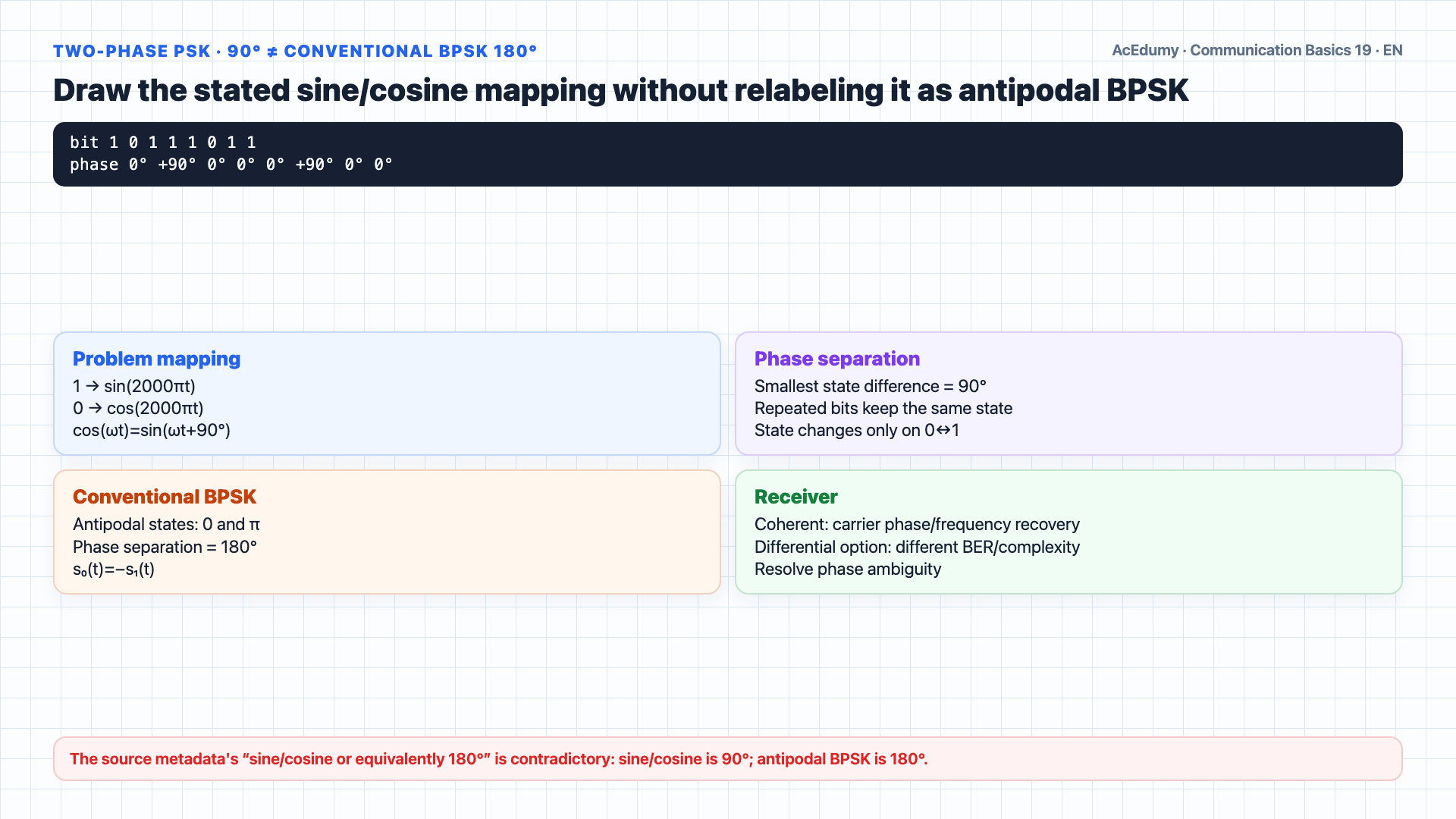
Waveform plots require a mapping, bit grid, and phase policy; compare bandwidth and noise performance only under common energy, filtering, and detector assumptions. Finally draw the problem's two-phase PSK mapping and distinguish it from conventional antipodal BPSK.PSK stands for Phase Shift Keying.Now we keep the frequency fixed and switch the phase.The problem defines 1→sin(2000πt) and 0→cos(2000πt), a 90° separation. Conventional antipodal BPSK uses phase states 0 and π, a 180° separation.cos(ωt)=sin(ωt+90°); sign/direction depends on the chosen reference, while the smallest phase separation is 90°.So when the bit is zero, the wave starts at its maximum value instead of starting at zero.We walk along x(t) and pick the right wave for each bit.Bit one is a one, sine.Bit two is a zero, cosine.Bits three, four, five are ones, sine again for three milliseconds.Bit six is a zero, cosine.Bits seven and eight are ones, sine for two more milliseconds.In this memoryless sine/cosine plot, phase state changes only at boundaries where the bit value changes; repeated bits keep the same state.Both states use fc=1 kHz and one cycle/bit; absolute-time sine/cosine selection may be discontinuous at a bit transition, while continuous phase is a separate design constraint.An ideal unmodulated carrier is not a valid occupied-bandwidth baseline; PSK bandwidth follows symbol rate, pulse shape, roll-off, and spectral mask.Coherent PSK requires carrier phase/frequency recovery; differential/noncoherent variants trade performance against synchronization complexity.Narration transcript
Finally we draw P S K. P S K stands for Phase Shift Keying. Now we keep the frequency fixed and switch the phase. For this problem, a one is sent as sine of two thousand pi t and a zero is sent as cosine of two thousand pi t. Cosine is just sine shifted by ninety degrees, or one quarter of a cycle. So when the bit is zero, the wave starts at its maximum value instead of starting at zero. We walk along x of t and pick the right wave for each bit. Bit one is a one, sine. Bit two is a zero, cosine. Bits three, four, five are ones, sine again for three milliseconds. Bit six is a zero, cosine. Bits seven and eight are ones, sine for two more milliseconds. The visual signature of P S K is the abrupt break at every bit boundary where the phase changes. The number of cycles per millisecond stays constant at one, but at each transition between zero and one or one and zero, the wave jumps. P S K uses the same bandwidth as the original carrier, which is why it is bandwidth efficient. The price is that the receiver needs to know the carrier phase precisely to decode it.
5. Compare ASK/OOK, BFSK, and PSK through measurable channel and receiver gates
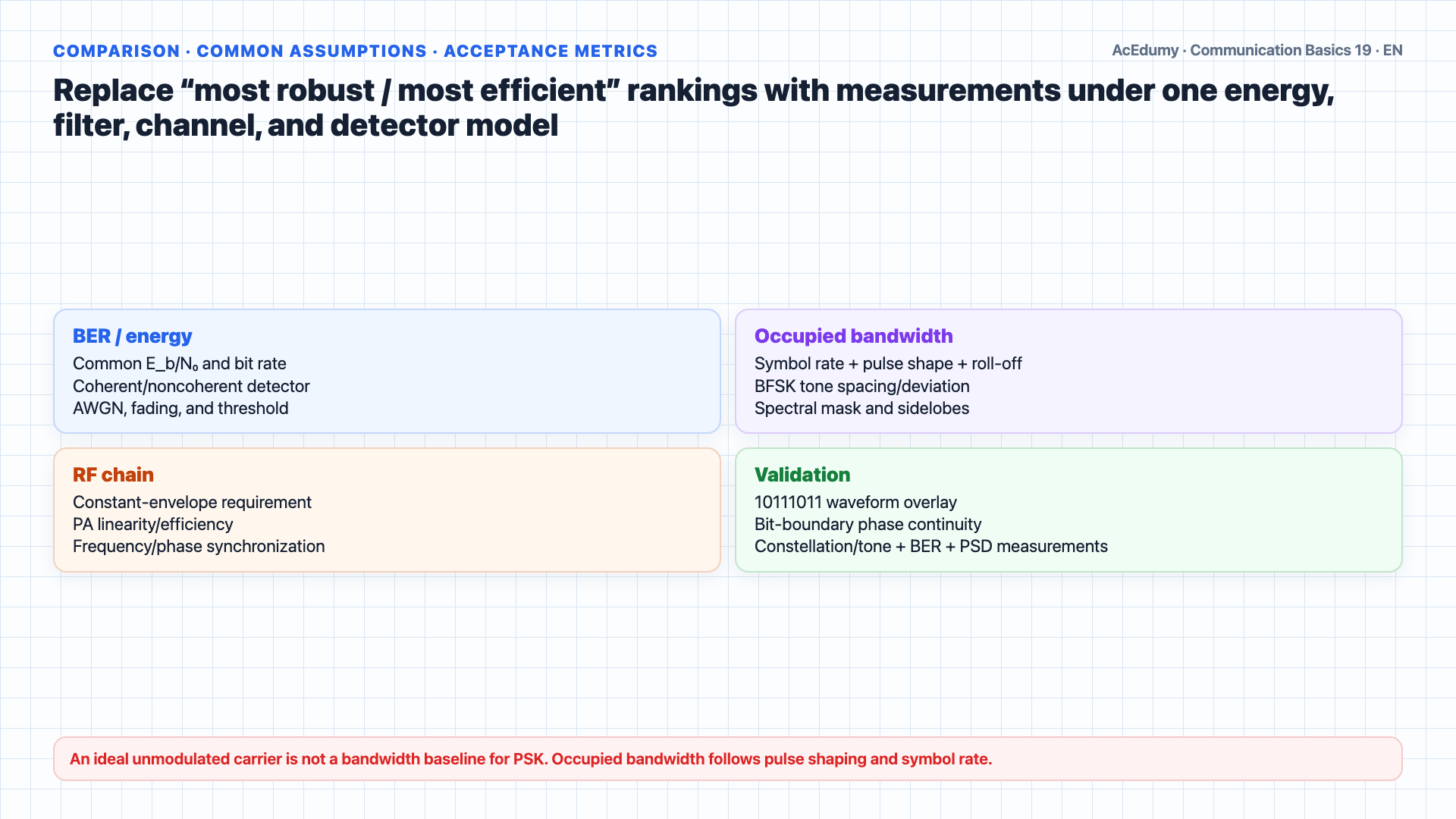
Waveform plots require a mapping, bit grid, and phase policy; compare bandwidth and noise performance only under common energy, filtering, and detector assumptions. Let us summarize.We started with one digital signal, eight bits long, the pattern one zero one one one zero one one.We sent the same information three different ways.The ASK in this problem is OOK: carrier on for 1 and zero amplitude for 0.FSK changes the frequency — slow tone for a one, fast tone for a zero.This problem uses sine/cosine two-state PSK with 90° separation; do not label it conventional 180° BPSK.All three carry the same one kilobit per second of data.Compare BER(Eb/N0), occupied bandwidth/spectral mask, PA/constant-envelope needs, synchronization, and receiver complexity.OOK implementation may be simple; error performance depends on threshold, coherent/noncoherent detection, fading, and energy normalization.BFSK robustness and bandwidth depend on tone spacing, orthogonality, phase continuity, filtering, and detector choice; there is no universal ranking.PSK spectral/energy efficiency depends on modulation order and pulse shaping; coherent variants need phase recovery, but no single scheme is universally 'most efficient'.That is the foundation.In the next video we will run the same three keying schemes at a microsecond timescale.Narration transcript
Let us summarize. We started with one digital signal, eight bits long, the pattern one zero one one one zero one one. We sent the same information three different ways. A S K changes the amplitude — carrier on for a one, off for a zero. F S K changes the frequency — slow tone for a one, fast tone for a zero. P S K changes the phase — sine for a one, cosine for a zero. All three carry the same one kilobit per second of data. The differences show up in noise tolerance, bandwidth use, and receiver complexity. A S K is the simplest but the most fragile. F S K is the most robust but uses extra bandwidth. P S K is the most efficient but needs careful phase recovery at the receiver. That is the foundation. In the next video we will run the same three keying schemes at a microsecond timescale.
Source video: Communication Basics #19 Worked Example: ASK/FSK/PSK Plot (msec) (6:24)