Circuit Theory 1 · Energy Storage Elements
#37 Energy Storage Elements #37 — Capacitor and inductor fundamentals
Compares the physical models, differential relations, stored energy, continuity rules, and DC behavior of capacitors and inductors.
Question
Derive the charge/flux, voltage-current, integral, and energy relations for capacitors and inductors; explain their DC steady-state equivalents and identify which state variable cannot change instantaneously.
Written solution and narration transcript(shows the full solution)
Below are all the lines written in the notebook together with the full narration transcript.
1. Capacitor structure
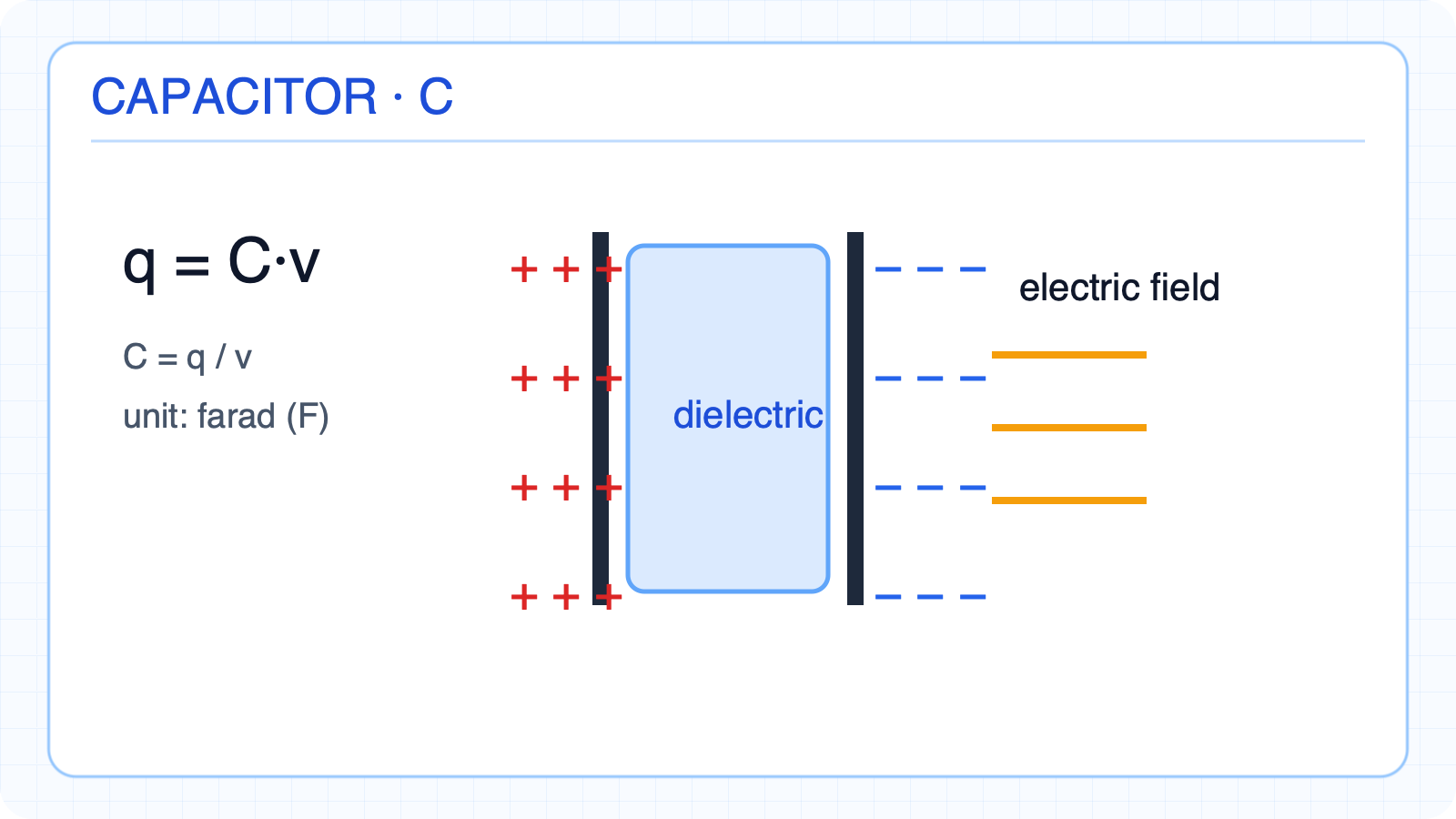
The fundamental charge-voltage relation q=Cv and the farad unit. Capacitor: stores energy in an electric fieldTwo conducting plates + dielectricq=CvUnit: farad (F)Practical values: µF, nF, pFC measures charge stored per voltNarration transcript
Up until now, we've only worked with resistors and op-amps. But real circuits need elements that can store energy. The first of these is the capacitor. A capacitor is made of two conducting plates separated by an insulating material called a dielectric. The charge stored is proportional to voltage: q equals C times V, where C is the capacitance measured in Farads. Typical values range from picofarads to microfarads — a one-Farad capacitor is enormous.
2. Capacitor voltage-current relation
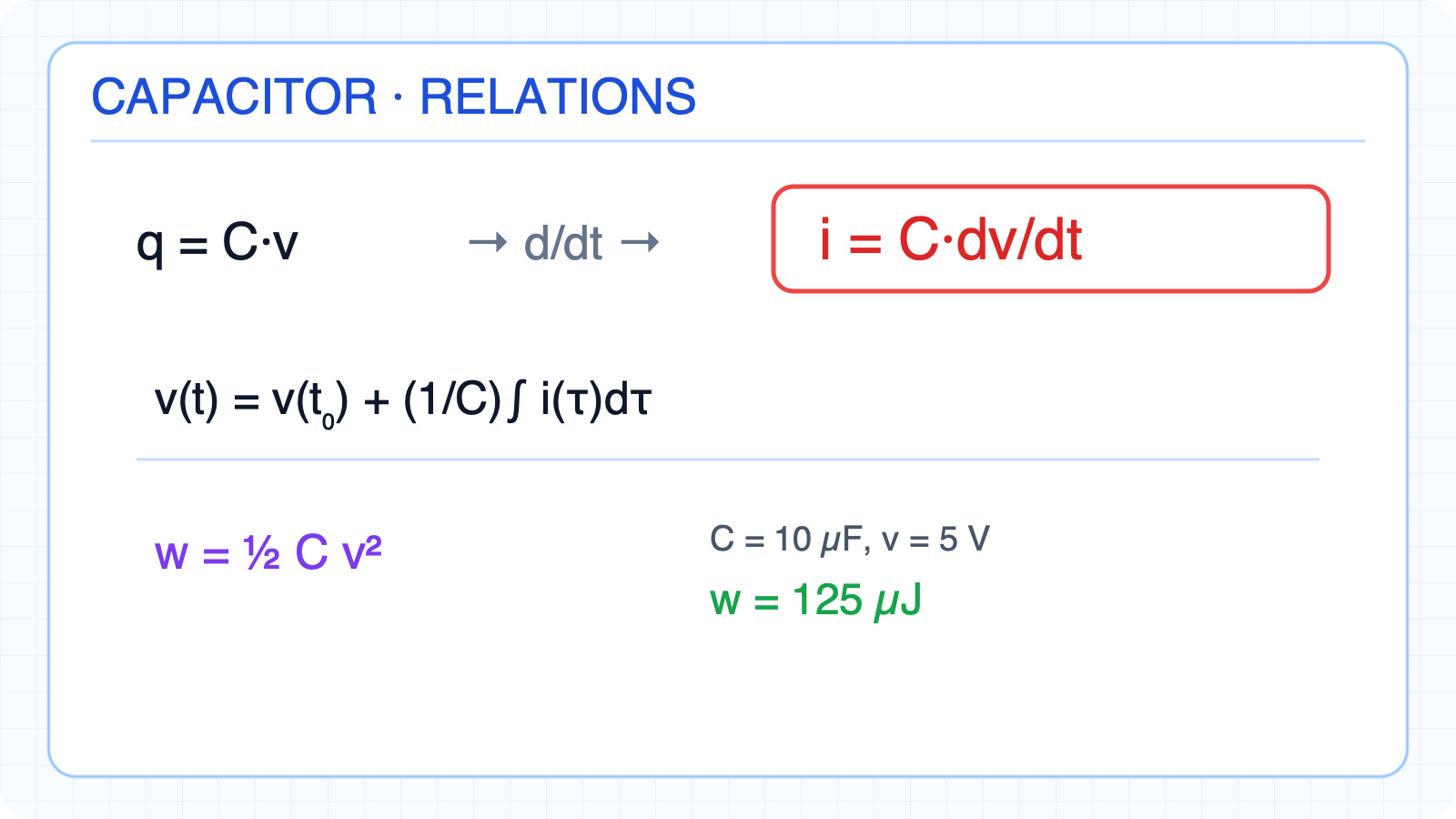
The relation q=Cv gives i=C·dv/dt and w=½Cv². Differentiate q=Cv with respect to timedq/dt=ii=C·dv/dtConstant voltage ⇒ dv/dt=0 ⇒ i=0Current accumulates capacitor voltage over timeThe passive sign convention is assumedNarration transcript
Let's derive the voltage-current relationship. Starting from q equals C V, we differentiate both sides with respect to time. Since d q d t is current, we get the fundamental equation: i equals C times d V d t. This tells us something very important — current flows through a capacitor only when voltage is changing. If the voltage is constant, the current is zero. The inverse relationship says: voltage equals the initial voltage plus one over C times the integral of current. This means voltage across a capacitor accumulates over time as current flows through it.
3. Energy in a capacitor
The relation q=Cv gives i=C·dv/dt and w=½Cv². Capacitor power and energyp=vi=vC·dv/dtw=∫pdt=C∫v·dvwC=½Cv²Narration transcript
Now let's find the energy stored. Power absorbed by the capacitor is P equals V times i, which is V times C times d V d t. Integrating power over time gives us energy: W equals one-half C V squared. Notice that energy depends only on the voltage, not on how we got there. Capacitors are lossless energy storage elements — they store energy in the electric field between the plates. As a quick example: a 10 microfarad capacitor charged to 5 volts stores one-half times 10 micro times 25, which equals 125 microjoules.
4. DC behavior and continuity
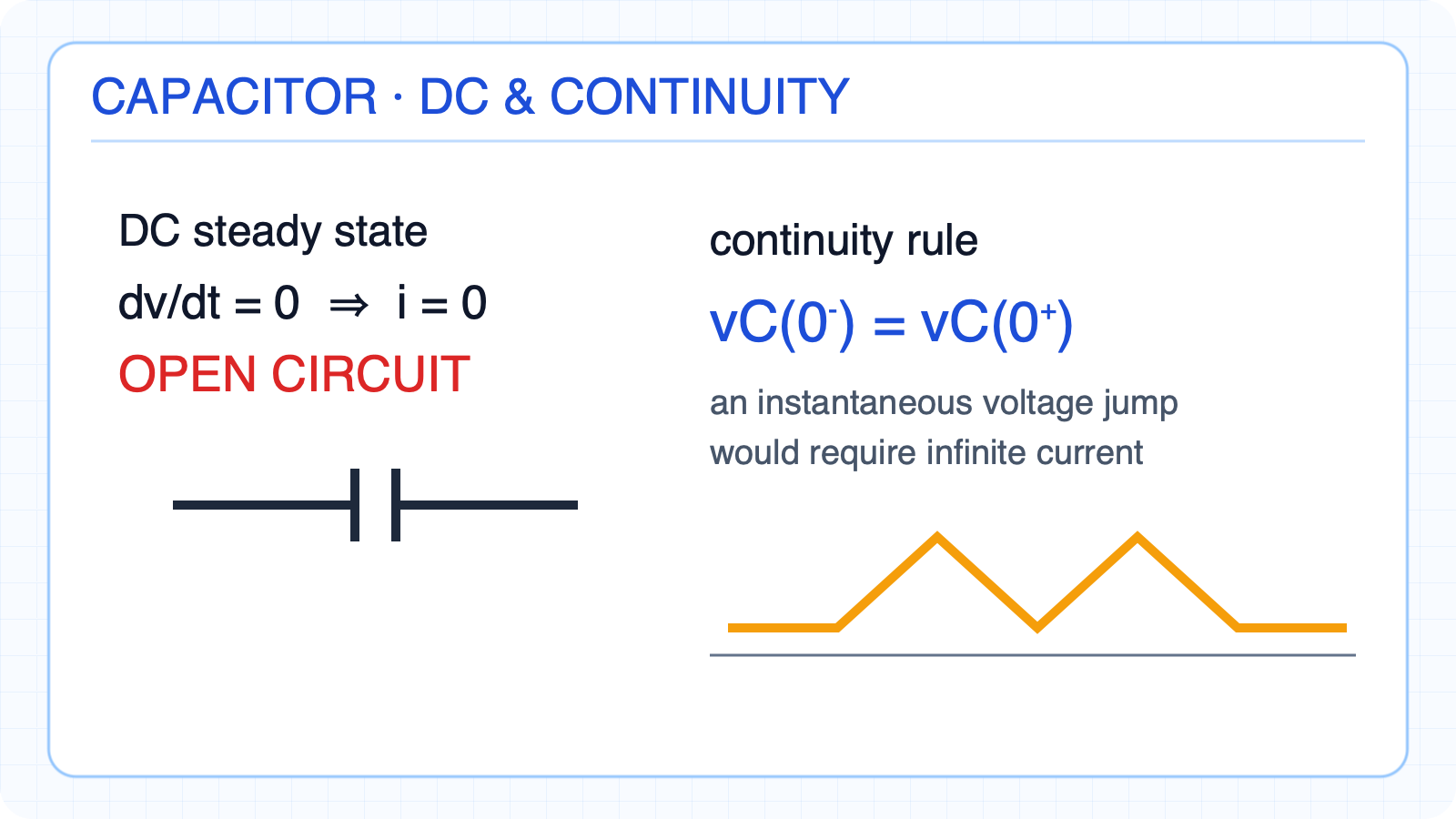
It is open at DC and preserves v_C(0−)=v_C(0+). Capacitor at DC steady statedv/dt=0 ⇒ i=0An ideal capacitor is an open circuitVoltage cannot jump instantaneouslyA jump would require infinite currentThis continuity rule anchors switching analysisNarration transcript
Two critical rules for capacitors. First: in DC steady state, d V d t is zero, so current is zero. This means a capacitor acts as an open circuit at DC. Second, and most importantly: capacitor voltage cannot change instantaneously. V at time zero-minus equals V at time zero-plus. This is the continuity condition, and it will be essential when we analyze switching circuits. Physically, changing voltage instantly would require infinite current, which is impossible.
5. Inductor structure
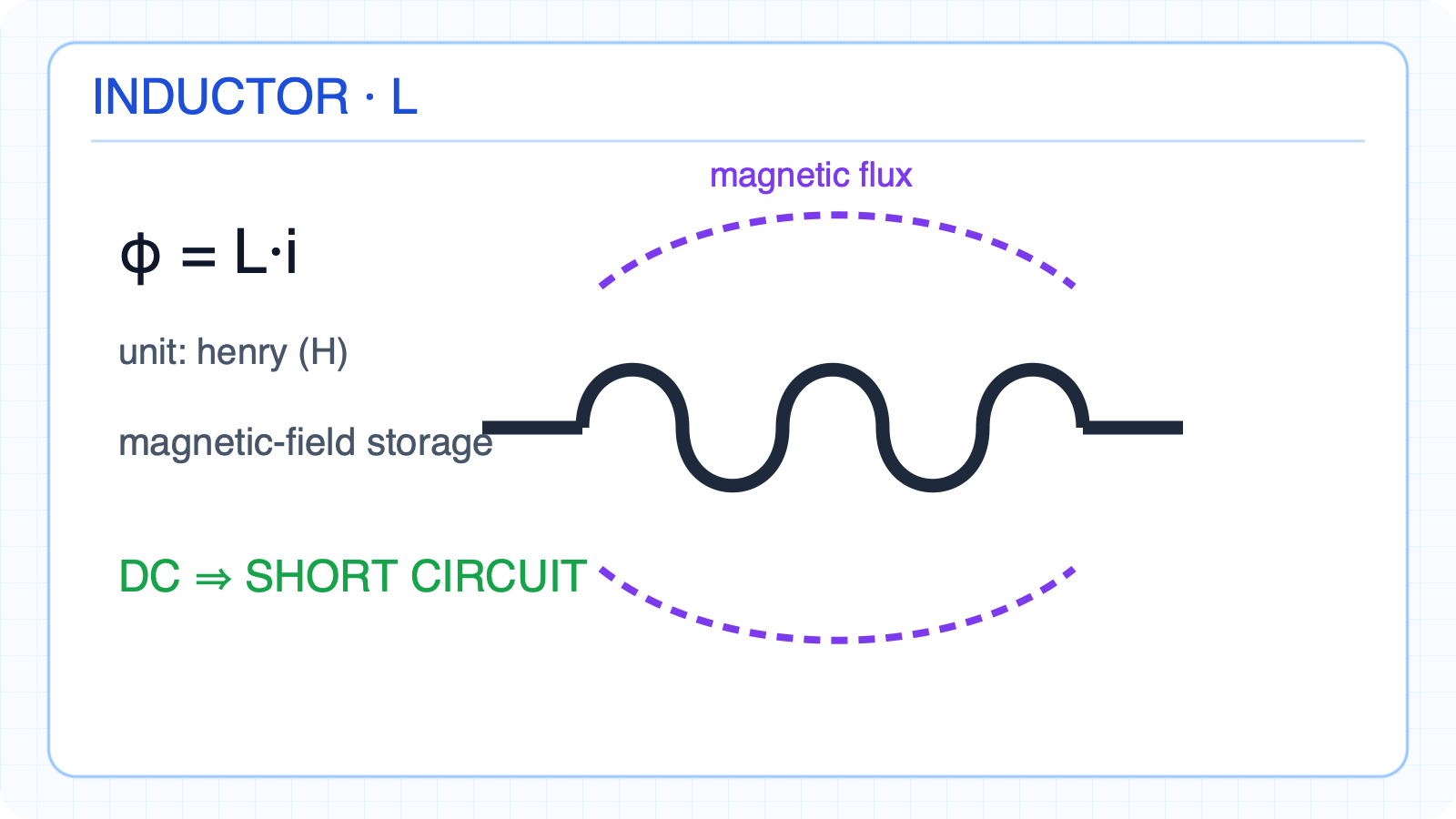
Flux linkage φ=Li; an ideal inductor is a short at DC steady state. Inductor: stores energy in a magnetic fieldBasic structure: a conducting coilFlux linkage φ=LiL: inductanceUnit: henry (H)Practical values: mH and µHAn ideal inductor is a short at DC steady stateNarration transcript
The second energy storage element is the inductor. An inductor is a coil of wire that stores energy in its magnetic field. The magnetic flux linkage is proportional to current: phi equals L times I, where L is the inductance measured in Henrys. Typical values range from microhenrys to millihenrys. Its impedance increases with frequency: X L equals 2 pi f L. At DC, the impedance is zero — meaning the inductor acts as a short circuit.
6. Inductor relations and energy
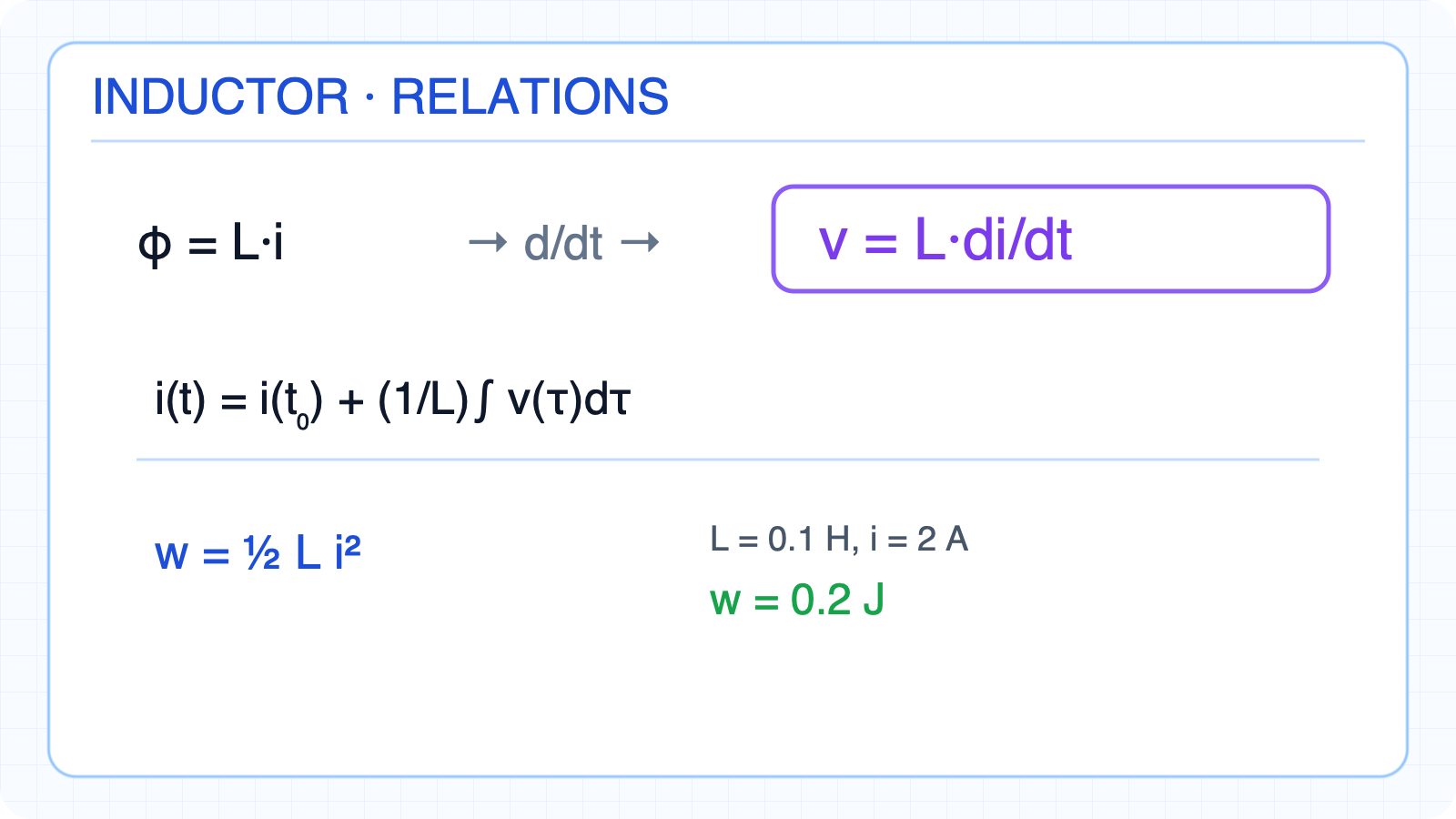
The relation φ=Li gives v=L·di/dt and w=½Li². Faraday's law and φ=Liv=dφ/dt=L·di/dtConstant current ⇒ di/dt=0 ⇒ v=0wL=½Li²Narration transcript
By Faraday's law of electromagnetic induction, the voltage across an inductor equals the rate of change of flux. Since phi equals L I, we get: V equals L times d I d t. This is the mirror image of the capacitor equation. Voltage appears across an inductor only when current is changing. If the current is constant, the voltage is zero. The inverse relationship is: current equals the initial current plus one over L times the integral of voltage. Current through an inductor accumulates as voltage is applied across it. For energy, power is P equals V times I, which gives L times I times d I d t. Integrating: W equals one-half L I squared. Energy depends only on the current, not on how we got there. Inductors store energy in the magnetic field around the coil. Example: an inductor of 0.1 Henry carrying 2 amps stores one-half times 0.1 times 4, which equals 0.2 joules, or 200 millijoules.
7. Capacitor-inductor duality
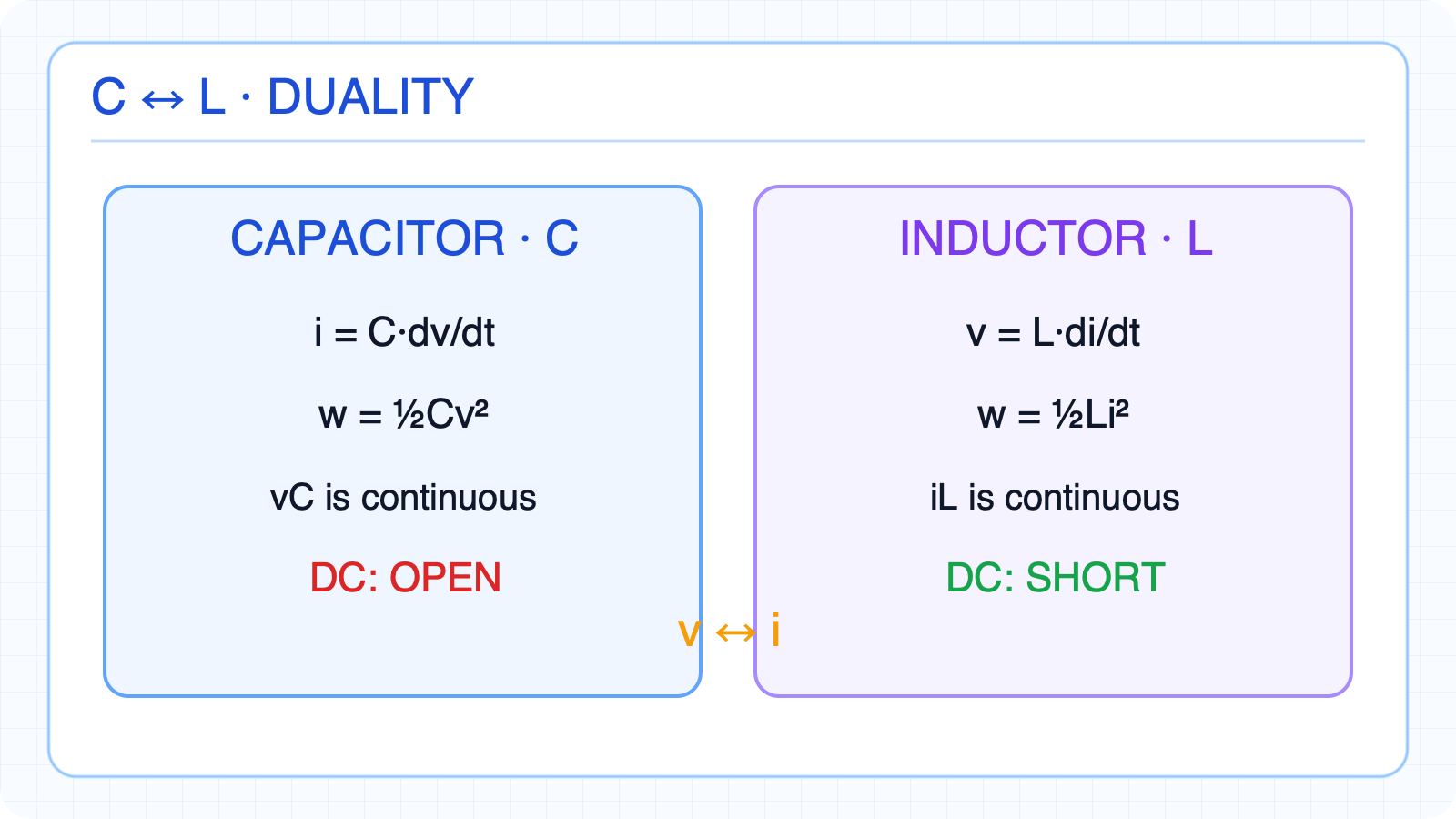
Voltage-current, energy, continuity, and DC behavior side by side. Capacitors and inductors are dualsv ↔ iC ↔ Li=C·dv/dt ↔ v=L·di/dt½Cv² ↔ ½Li²vC is continuous ↔ iL is continuousDC: capacitor open ↔ inductor shortNarration transcript
Capacitors and inductors are beautiful duals of each other. Every capacitor equation has a mirror inductor equation. Swap voltage and current, swap C and L, and every formula transforms perfectly. The capacitor stores energy in an electric field as one-half C V squared. The inductor stores energy in a magnetic field as one-half L I squared. Capacitor voltage is continuous — it cannot jump. Inductor current is continuous — it cannot jump. At DC, the capacitor becomes an open circuit while the inductor becomes a short circuit. These dual relationships will appear again and again throughout circuit analysis.
8. Summary and analysis rules
Voltage-current, energy, continuity, and DC behavior side by side. Energy-storage-element summaryA capacitor produces current against voltage changeAn inductor produces voltage against current changewC=½Cv²wL=½Li²State variables: vC and iLContinuity + DC equivalents start transient analysisNarration transcript
Let's summarize. A capacitor obeys i equals C d V d t, storing energy as one-half C V squared. An inductor obeys V equals L d I d t, storing energy as one-half L I squared. Capacitor voltage and inductor current are always continuous — they cannot change instantaneously. At DC steady state, capacitors are open circuits and inductors are short circuits. In the next lecture, we'll explore typical waveforms like the unit step, ramp, and impulse functions that we'll use to analyze these circuits.