Electromagnetic Theory · Cartesian Coordinate System
#02 Unit vectors, position vector, and differential line, surface, and volume elements
Build the Cartesian axes and the dl, dS, and dV elements that underpin electromagnetic field integrals.
Question

Explain the Cartesian unit vectors and right-hand rule; write the position vector, differential line element dl, oriented surface element dS, and volume element dV.
Written solution and narration transcript(shows the full solution)
Below are all the lines written in the notebook together with the full narration transcript.
1. Map the lesson building blocks
In Cartesian coordinates, dl is a vector displacement, dS is an oriented area, and dV is a scalar volume element. In the previous lesson, we introduced electromagnetic theory, distinguished scalar from vector fields, and previewed the three coordinate systems we will use.Now let's dive into the first one: the Cartesian coordinate system.We'll define the axes, the unit vectors, and the three differential elements that appear everywhere in EM theory: line, surface, and volume.Narration transcript
In the previous lesson, we introduced electromagnetic theory, distinguished scalar from vector fields, and previewed the three coordinate systems we will use. Now let's dive into the first one: the Cartesian coordinate system. We'll define the axes, the unit vectors, and the three differential elements that appear everywhere in EM theory: line, surface, and volume.
2. Build the axes and unit vectors
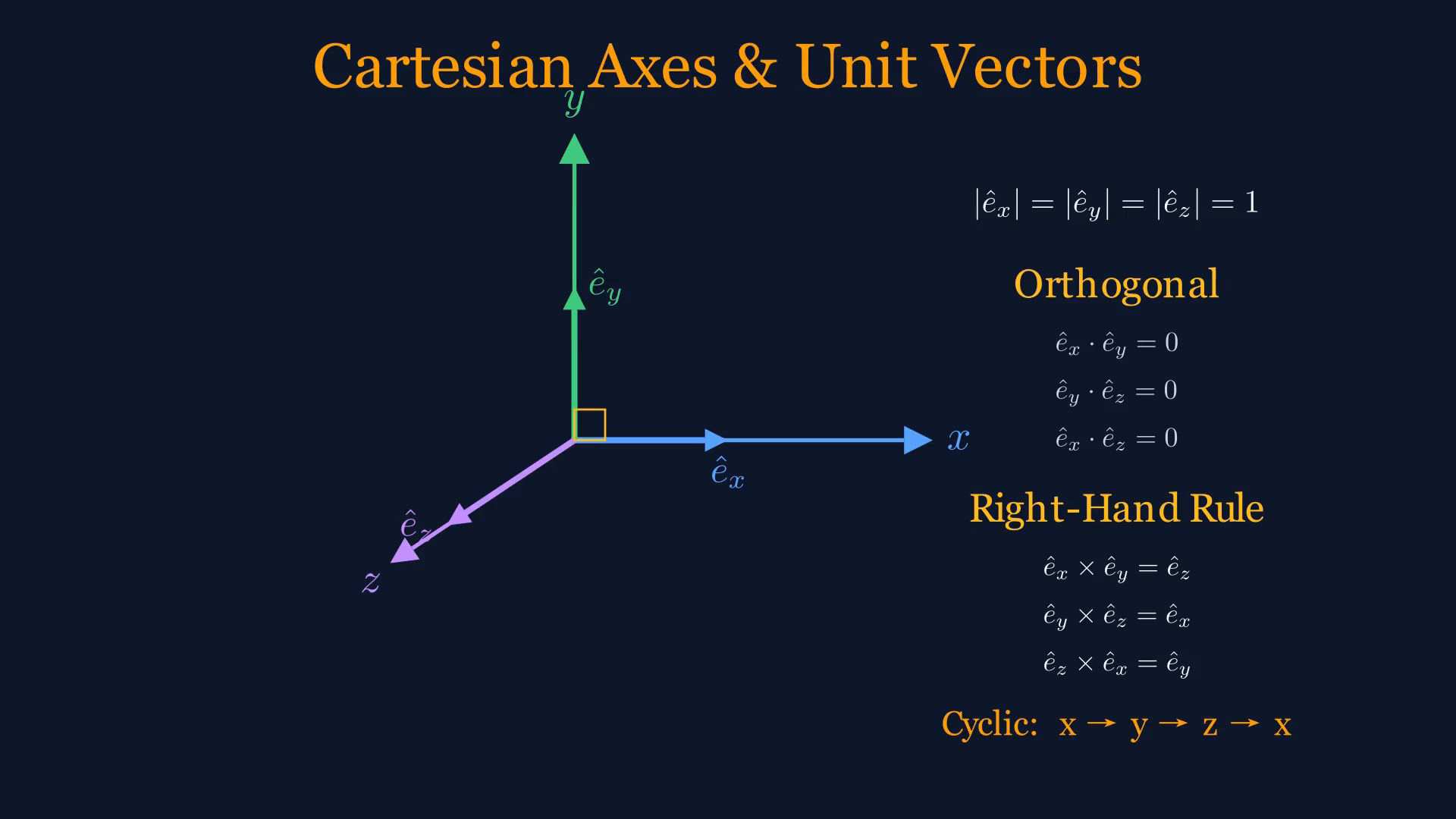
In Cartesian coordinates, dl is a vector displacement, dS is an oriented area, and dV is a scalar volume element. The Cartesian coordinate system uses three mutually perpendicular axes: x, y, and z.At any point in space, we define three unit vectors: eₓ pointing in the x direction, eᵧ in the y direction, and ez in the z direction.Each has a magnitude of exactly one.These unit vectors are orthogonal, meaning the dot product of any two different ones is zero.And they obey the right-hand rule: eₓ × eᵧ gives ez, eᵧ × ez gives eₓ, and ez × eₓ gives eᵧ.This cyclic relationship is fundamental.Narration transcript
The Cartesian coordinate system uses three mutually perpendicular axes: x, y, and z. At any point in space, we define three unit vectors: e x pointing in the x direction, e y in the y direction, and e z in the z direction. Each has a magnitude of exactly one. These unit vectors are orthogonal, meaning the dot product of any two different ones is zero. And they obey the right-hand rule: e x cross e y gives e z, e y cross e z gives e x, and e z cross e x gives e y. This cyclic relationship is fundamental.
3. Write the position vector
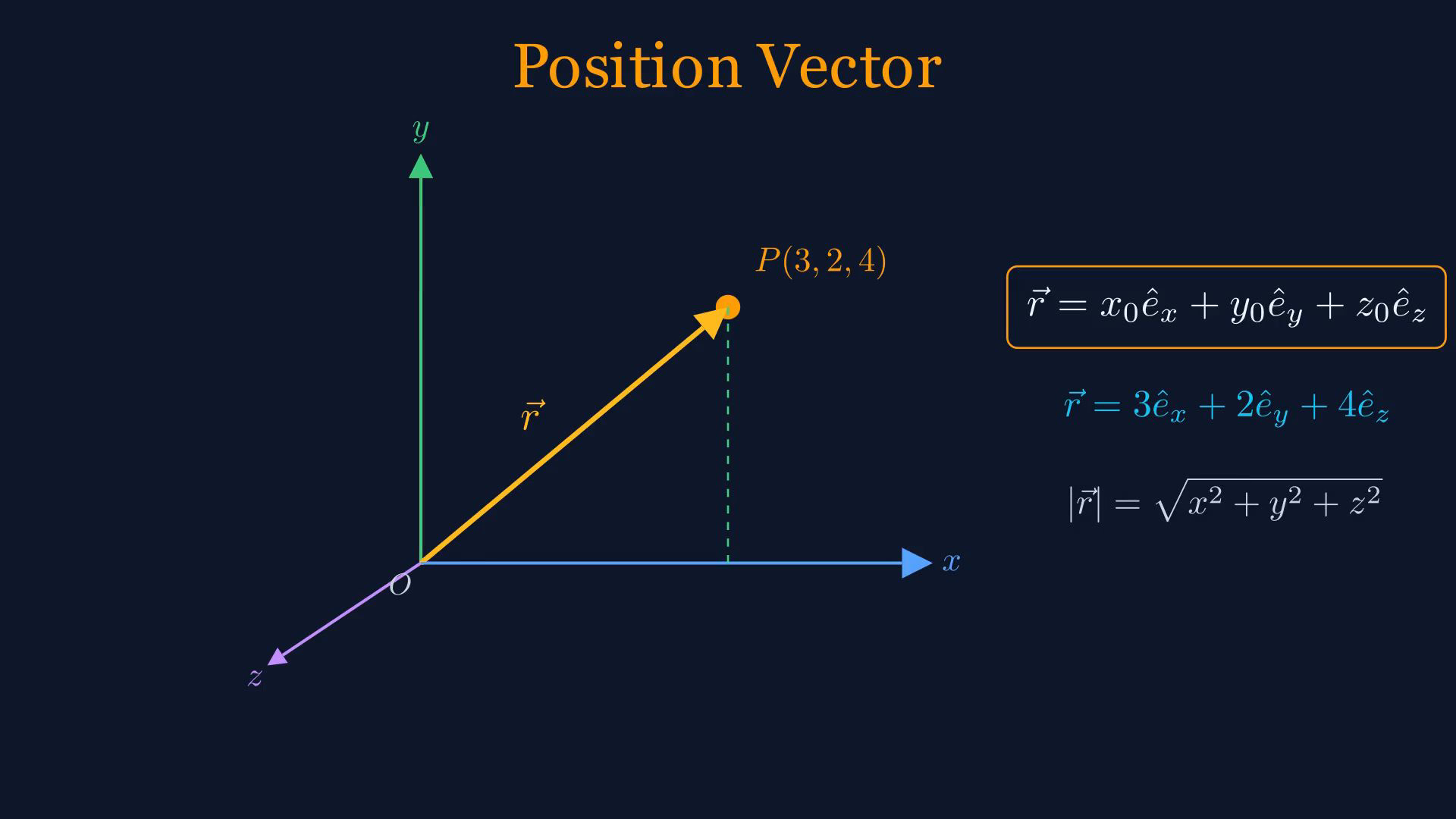
In Cartesian coordinates, dl is a vector displacement, dS is an oriented area, and dV is a scalar volume element. Any point P in space is specified by three coordinates: x₀, y₀, and z₀.The position vector r points from the origin to P and is written as:For example, the point P at 3, 2, 4 has the position vector r = 3 eₓ + 2 eᵧ + 4 ez.The magnitude of r gives us the distance from the origin: the square root of x squared + y squared + z squared.Narration transcript
Any point P in space is specified by three coordinates: x zero, y zero, and z zero. The position vector r points from the origin to P and is written as: r equals x zero e x, plus y zero e y, plus z zero e z. For example, the point P at 3, 2, 4 has the position vector r equals 3 e x plus 2 e y plus 4 e z. The magnitude of r gives us the distance from the origin: the square root of x squared plus y squared plus z squared.
4. Construct the differential line element
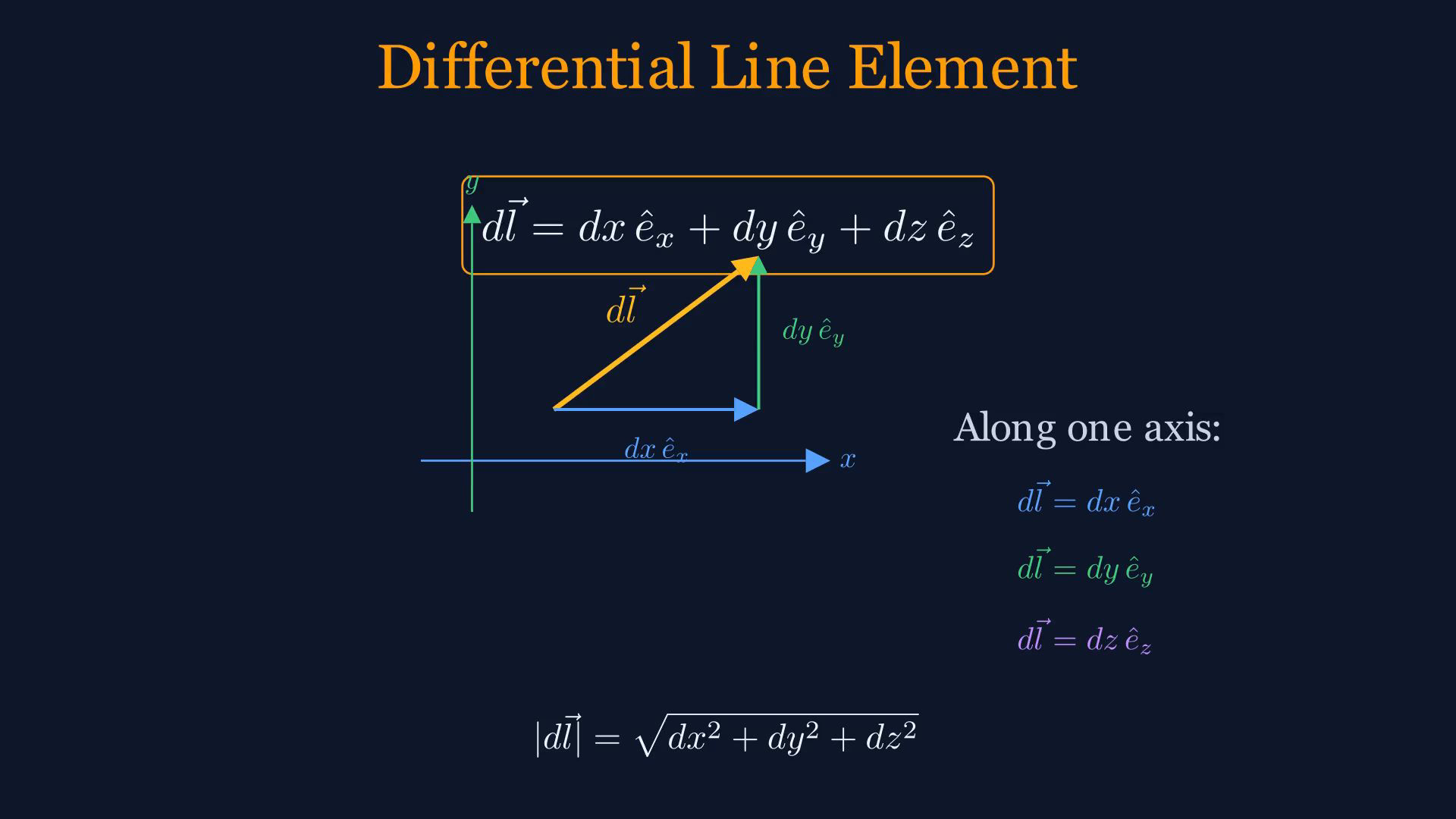
In Cartesian coordinates, dl is a vector displacement, dS is an oriented area, and dV is a scalar volume element. The differential line element dl represents an infinitesimal displacement in space.In Cartesian coordinates, it is: dl = dx eₓ + dy eᵧ + dz ez.When we move only along the x axis, dl simplifies to dx eₓ.Along the y axis, dy eᵧ.Along the z axis, dz ez.The magnitude of dl is the square root of dx squared + dy squared + dz squared.We will use dl extensively when computing line integrals of fields.Narration transcript
The differential line element dl represents an infinitesimal displacement in space. In Cartesian coordinates, it is: dl equals dx e x plus dy e y plus dz e z. When we move only along the x axis, dl simplifies to dx e x. Along the y axis, dy e y. Along the z axis, dz e z. The magnitude of dl is the square root of dx squared plus dy squared plus dz squared. We will use dl extensively when computing line integrals of fields.
5. Determine oriented surface elements
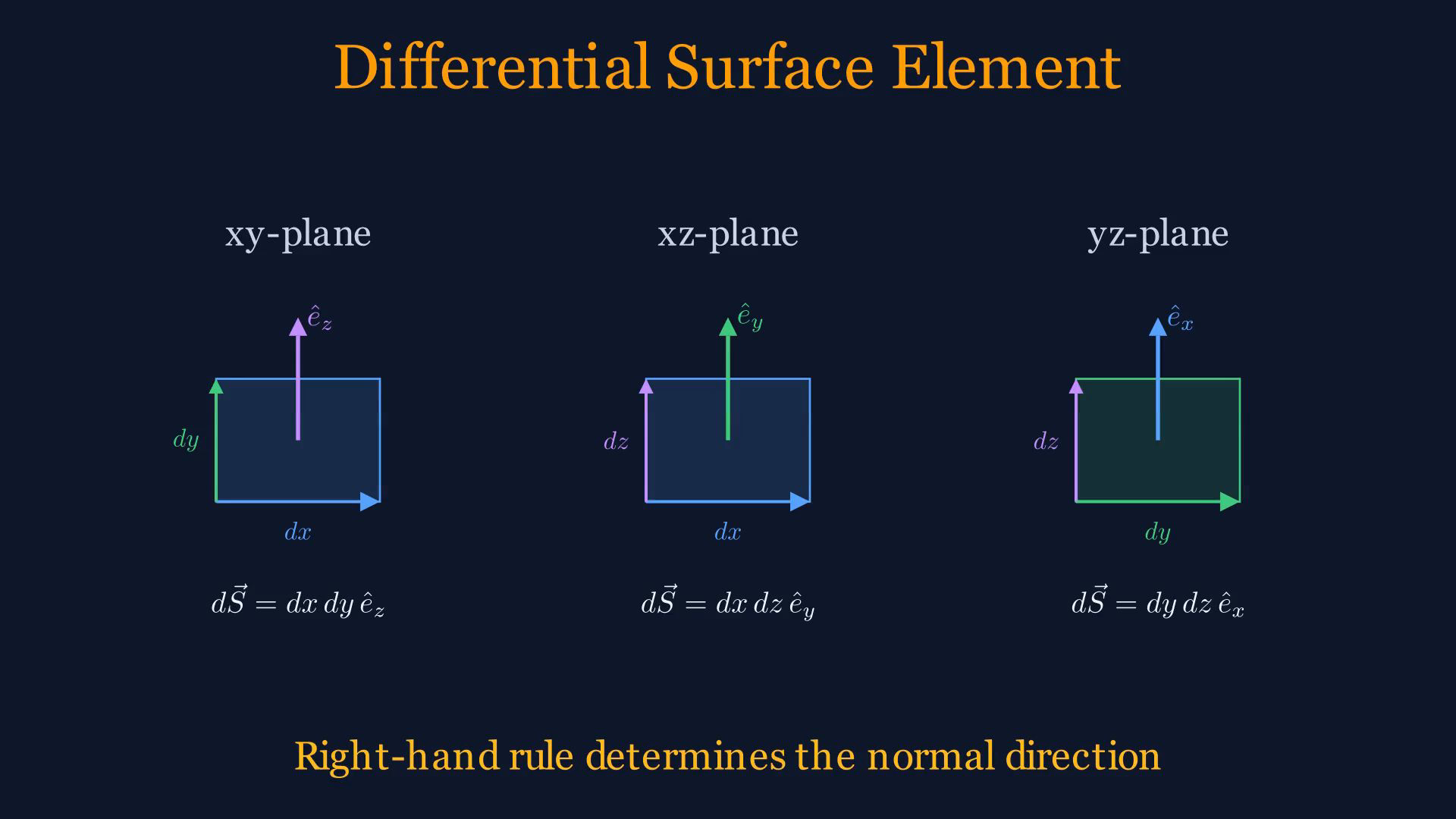
In Cartesian coordinates, dl is a vector displacement, dS is an oriented area, and dV is a scalar volume element. The differential surface element dS represents an infinitesimal patch of area, with a direction given by the outward normal.In the xy plane, the normal points in the z direction, so dS = dx dy ez.In the xz plane, the normal is in the y direction: dS = dx dz eᵧ.In the yz plane, the normal is in the x direction: dS = dy dz eₓ.To remember the sign, use the right-hand rule: curl your fingers from the first axis to the second, and your thumb points in the direction of the normal.This gives us the positive orientation.Narration transcript
The differential surface element dS represents an infinitesimal patch of area, with a direction given by the outward normal. In the x y plane, the normal points in the z direction, so dS equals dx dy e z. In the x z plane, the normal is in the y direction: dS equals dx dz e y. In the y z plane, the normal is in the x direction: dS equals dy dz e x. To remember the sign, use the right-hand rule: curl your fingers from the first axis to the second, and your thumb points in the direction of the normal. This gives us the positive orientation.
6. Write the differential volume element
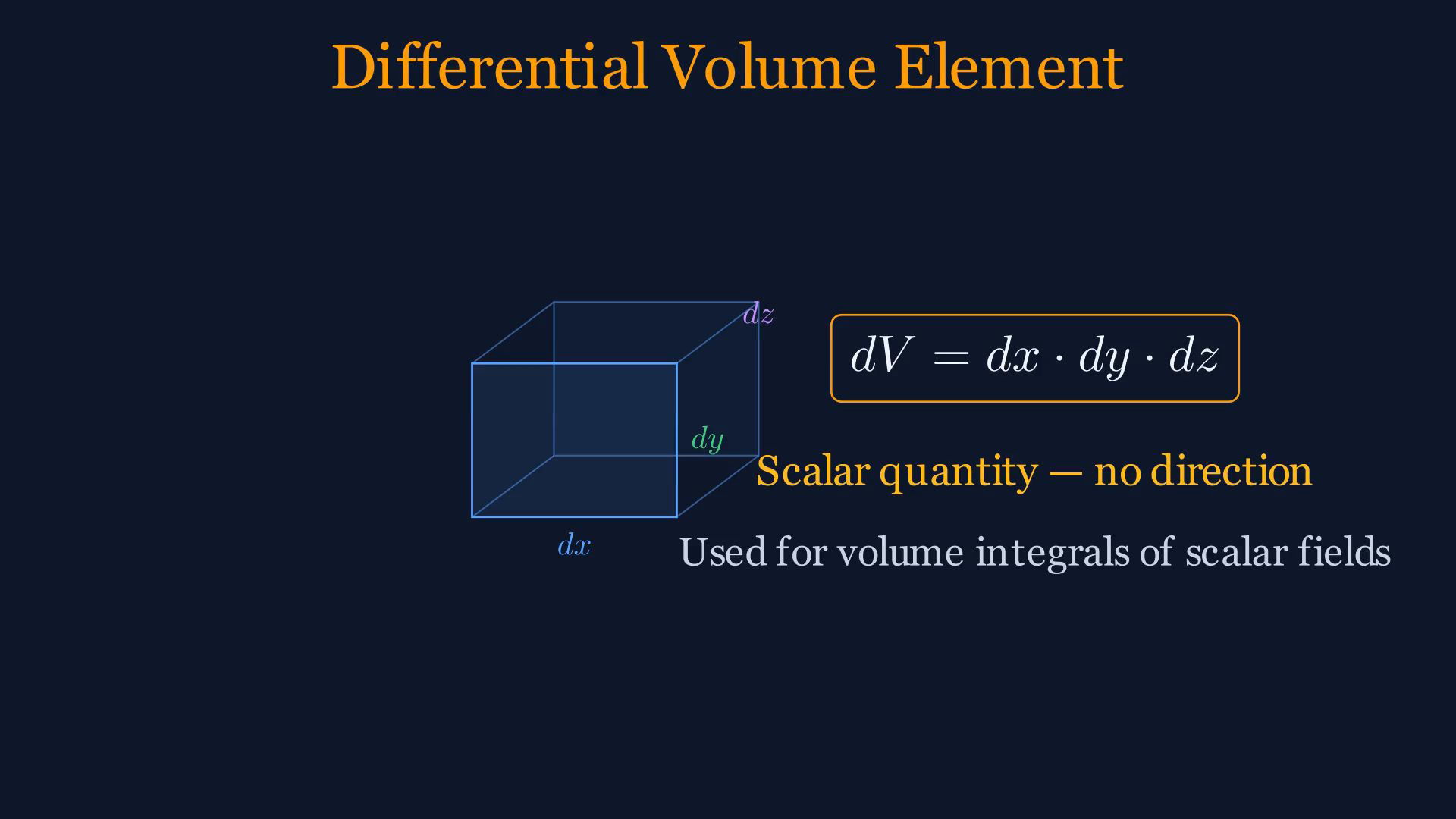
In Cartesian coordinates, dl is a vector displacement, dS is an oriented area, and dV is a scalar volume element. The differential volume element is the simplest of the three.It is a scalar quantity: dV = dx × dy × dz.This represents the volume of an infinitesimal rectangular box.Unlike dl and dS, the volume element has no direction.We use it whenever we integrate a scalar field over a volume, for example when computing total charge from a charge density.Narration transcript
The differential volume element is the simplest of the three. It is a scalar quantity: dV equals dx times dy times dz. This represents the volume of an infinitesimal rectangular box. Unlike dl and dS, the volume element has no direction. We use it whenever we integrate a scalar field over a volume, for example when computing total charge from a charge density.
7. Summarize the Cartesian elements
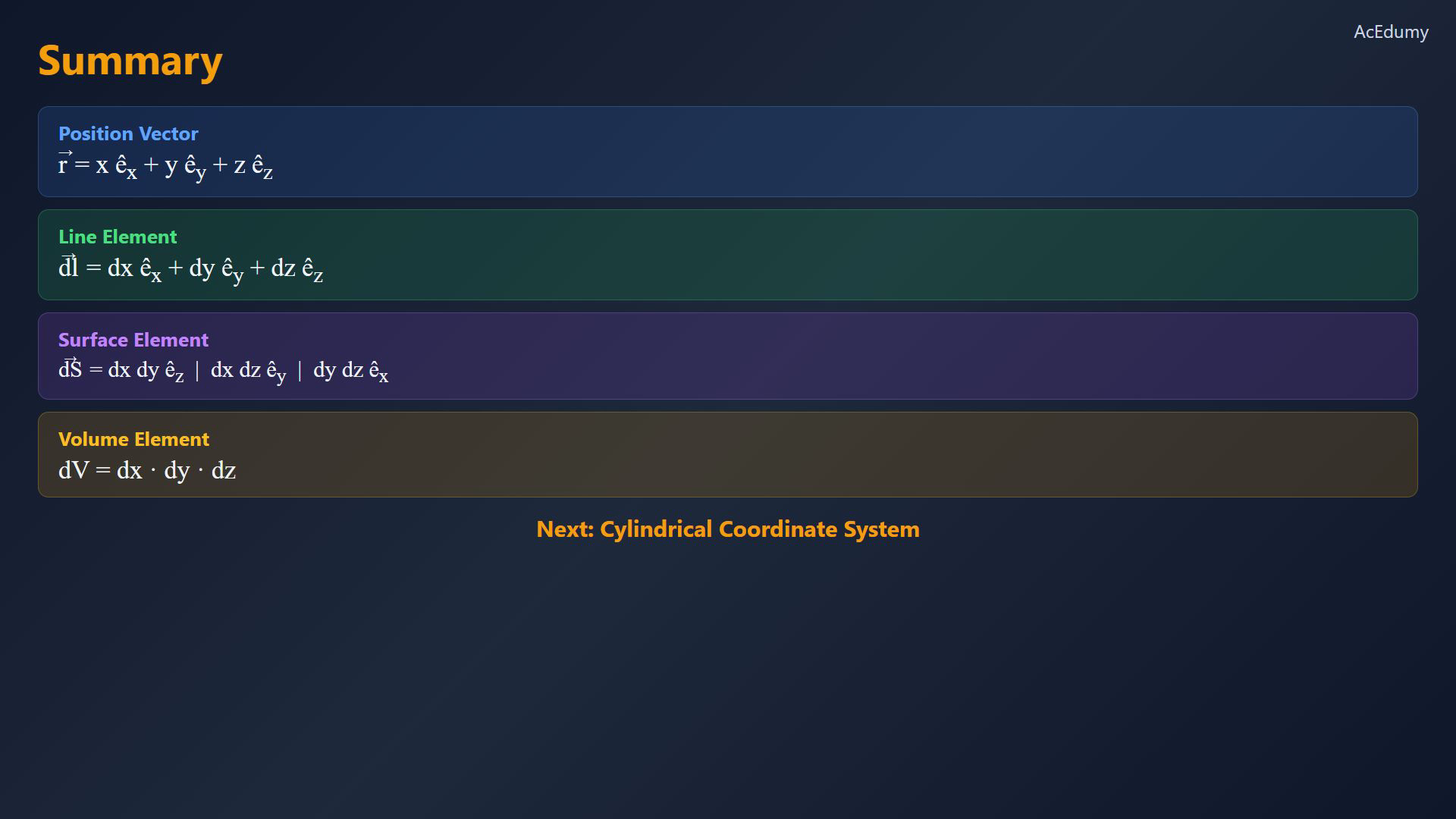
In Cartesian coordinates, dl is a vector displacement, dS is an oriented area, and dV is a scalar volume element. Let's review.In the Cartesian coordinate system, the position vector is r = x eₓ + y eᵧ + z ez.The line element is dl = dx eₓ + dy eᵧ + dz ez.The surface element dS depends on which plane we are on, and the right-hand rule determines its sign.The volume element is simply dV = dx dy dz.In the next lesson, we move to cylindrical coordinates, where the geometry becomes circular.Narration transcript
Let's review. In the Cartesian coordinate system, the position vector is r equals x e x plus y e y plus z e z. The line element is dl equals dx e x plus dy e y plus dz e z. The surface element dS depends on which plane we are on, and the right-hand rule determines its sign. The volume element is simply dV equals dx dy dz. In the next lesson, we move to cylindrical coordinates, where the geometry becomes circular.
Source video: Electromagnetic Theory (v2) #02 Cartesian Coordinate System (4:11)