Communication Basics · Circuit Switching, Packet Switching, and QoS
#15 Connection semantics, circuit resource allocation, packet-layer responsibilities, delay variation, DiffServ/MPLS, and modern voice networks
Compare circuit and packet switching through service semantics, resource allocation, layer responsibilities, SLAs, and resilience—not slogans.
Question
Separate connection-oriented and connectionless service semantics from circuit and packet switching; define circuit resources and three phases; assign packet sequencing, error checking, and retransmission to their proper layers; compare delay variation, loss, DiffServ/MPLS, and modern voice transport through measurable quality gates.
Written solution and narration transcript(shows the full solution)
Below are all the lines written in the notebook together with the full narration transcript.
1. Separate connection semantics from circuit and packet switching techniques
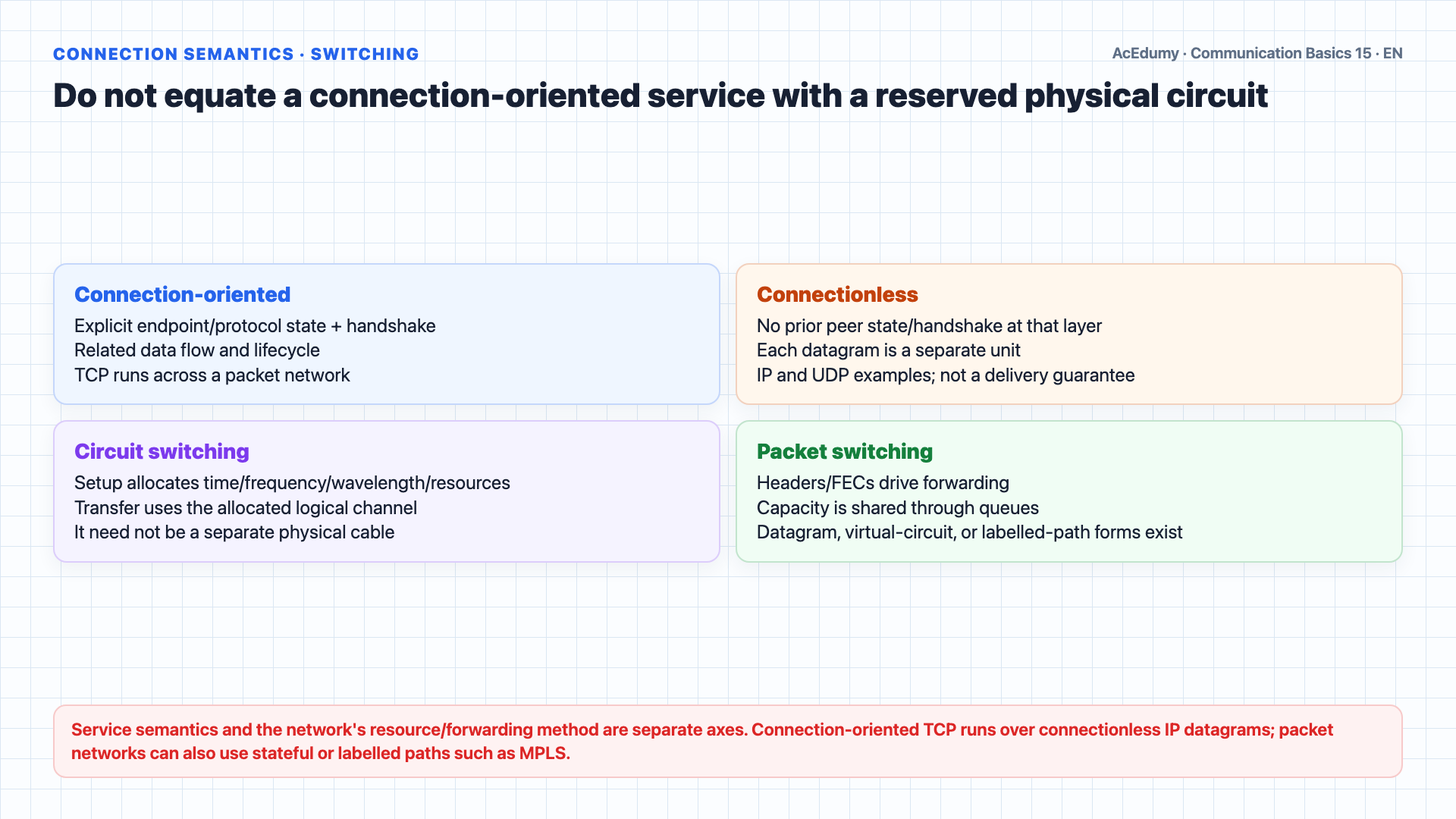
Connection state, resource allocation, and reliability belong to different layers and axes; verify performance for the protocol, load, path, and SLA. Welcome back.In the previous lessons we covered all the major transmission media: twisted pair, coaxial cable, microwave, satellite, and fiber optics.Now comes a fundamental question: once we have these physical links, how do we actually establish a communication channel between two endpoints?There are two fundamental networking modes: connection-oriented and connectionless.A connection-oriented service establishes protocol/endpoint state before data; it does not require a reserved physical path or bandwidth.Connection state may persist for the session while the transport path can change and resources can remain shared.Think of it like a phone call: you dial, the connection is set up, you talk, and then you hang up.In connectionless communication, there is no pre-established path.Each data unit, called a packet, is sent independently and may take a different route through the network.Think of it like sending letters through the postal system.Each letter finds its own way.Service semantics and switching technique are separate axes: connection-oriented TCP operates over packet-switched IP.Narration transcript
Welcome back. In the previous lessons we covered all the major transmission media: twisted pair, coaxial cable, microwave, satellite, and fiber optics. Now comes a fundamental question: once we have these physical links, how do we actually establish a communication channel between two endpoints? There are two fundamental networking modes: connection-oriented and connectionless. In connection-oriented communication, a dedicated path is established before any data flows. The path remains reserved for the entire session. Think of it like a phone call: you dial, the connection is set up, you talk, and then you hang up. In connectionless communication, there is no pre-established path. Each data unit, called a packet, is sent independently and may take a different route through the network. Think of it like sending letters through the postal system. Each letter finds its own way. These two modes lead us to the two major switching techniques: circuit switching and packet switching.
2. Build circuit switching from three phases and explicit resource allocation
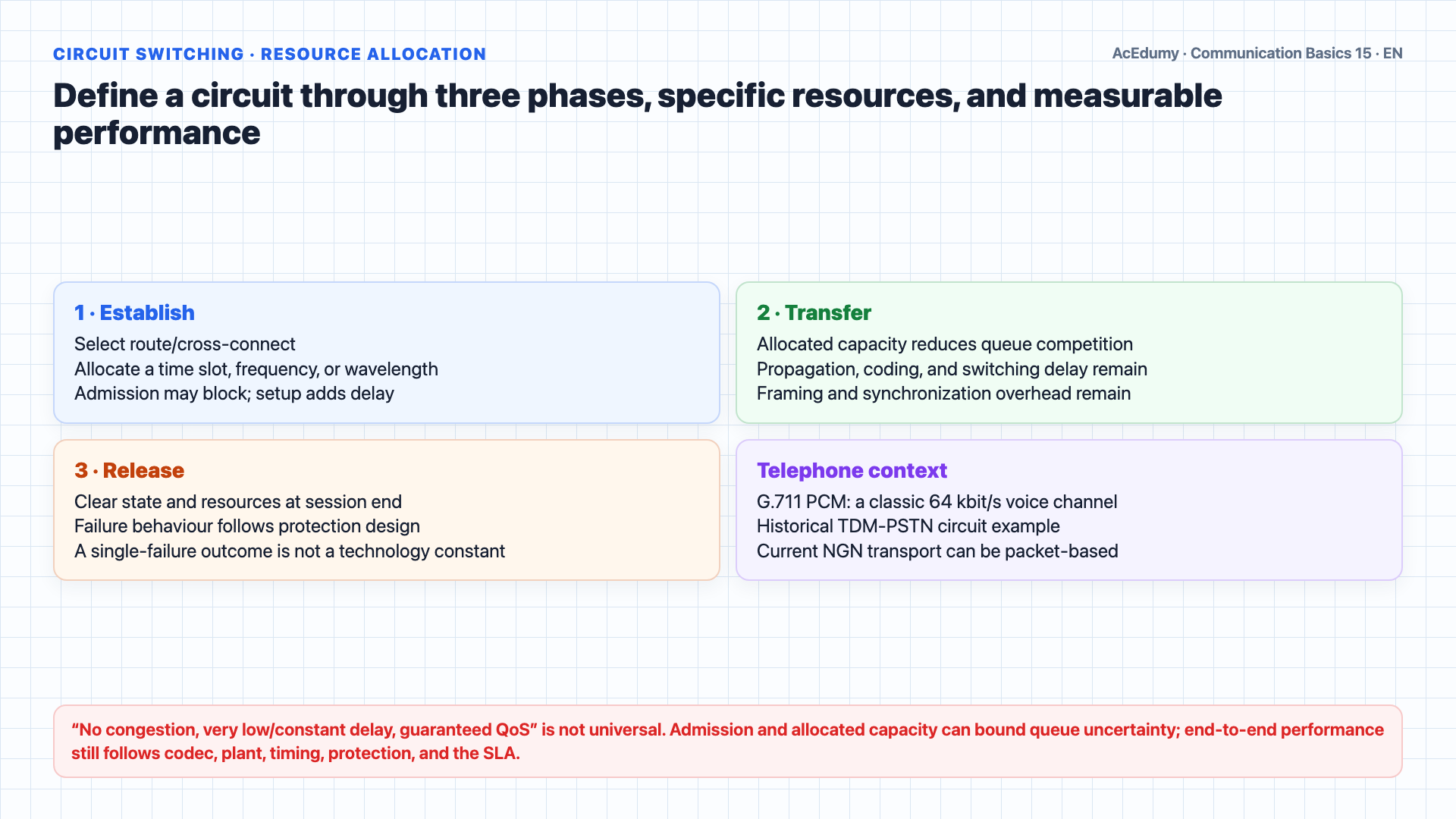
Connection state, resource allocation, and reliability belong to different layers and axes; verify performance for the protocol, load, path, and SLA. Let us start with circuit switching.Circuit setup allocates logical resources such as time slots, frequency, wavelength, or cross-connects; a separate physical cable is not required.Allocated channel resources may remain unavailable to other traffic for the session; sharing and protection depend on the circuit technology.The process has three phases.First, circuit establishment: the network finds and reserves a complete path from source to destination.Second, data transfer: information flows continuously along the reserved path.Third, circuit disconnect: when the session ends, all resources along the path are released.Historical TDM-PSTN is a classic circuit example; current NGN voice transport can also be packet-based.G.711 PCM classically uses a 64 kbit/s voice channel; codecs, access, and core transport can differ in current telephone networks.Circuit switching has important advantages.After successful admission, allocated capacity reduces queue competition; call blocking, plant faults, and end-to-end performance still depend on design.A circuit can bound queue-delay variation; propagation, codec, framing, and switching delay remain.Resource allocation supports predictability; end-to-end QoS is guaranteed only when capacity, timing, protection, and SLA conditions all hold.An established circuit may avoid a network address on every data unit, while framing, synchronization, and signalling overhead remain.However, circuit switching also has significant drawbacks.Fixed allocated capacity can be underused for bursty or silent traffic; this is not the one universal or largest problem of every circuit application.A classic fixed TDM channel can keep its slot during silence; voice-activity suppression and packet voice handle this differently.Voice activity varies with codec, language, users, and measurement method; one percentage is not a universal design input.Setup time is required before communication can begin.An unprotected circuit may fail with its path; protection switching, a backup circuit, or re-establishment can change the outcome.Narration transcript
Let us start with circuit switching. In circuit switching, a dedicated physical path is established between the sender and receiver before communication begins. This path, called a circuit, remains exclusively reserved for the entire duration of the call or session. The process has three phases. First, circuit establishment: the network finds and reserves a complete path from source to destination. Second, data transfer: information flows continuously along the reserved path. Third, circuit disconnect: when the session ends, all resources along the path are released. The traditional telephone network, the P S T N, is the classic example. When you make a phone call, switches in the network create a dedicated 64 kilobits per second channel from your phone to the other phone. Circuit switching has important advantages. It provides guaranteed bandwidth with no congestion during the call. Latency is very low and constant, which is ideal for real-time voice. Quality of Service is guaranteed because the path is dedicated. There is no overhead for addressing each piece of data. However, circuit switching also has significant drawbacks. The biggest problem is bandwidth waste. During silence periods in a voice call, the circuit remains reserved but carries no useful data. Studies show that in a typical phone call, each direction is silent about 50 percent of the time. Setup time is required before communication can begin. And the circuit is vulnerable: if any link in the path fails, the entire connection drops.
3. Assign packet headers, order, errors, and retransmission to the correct layers
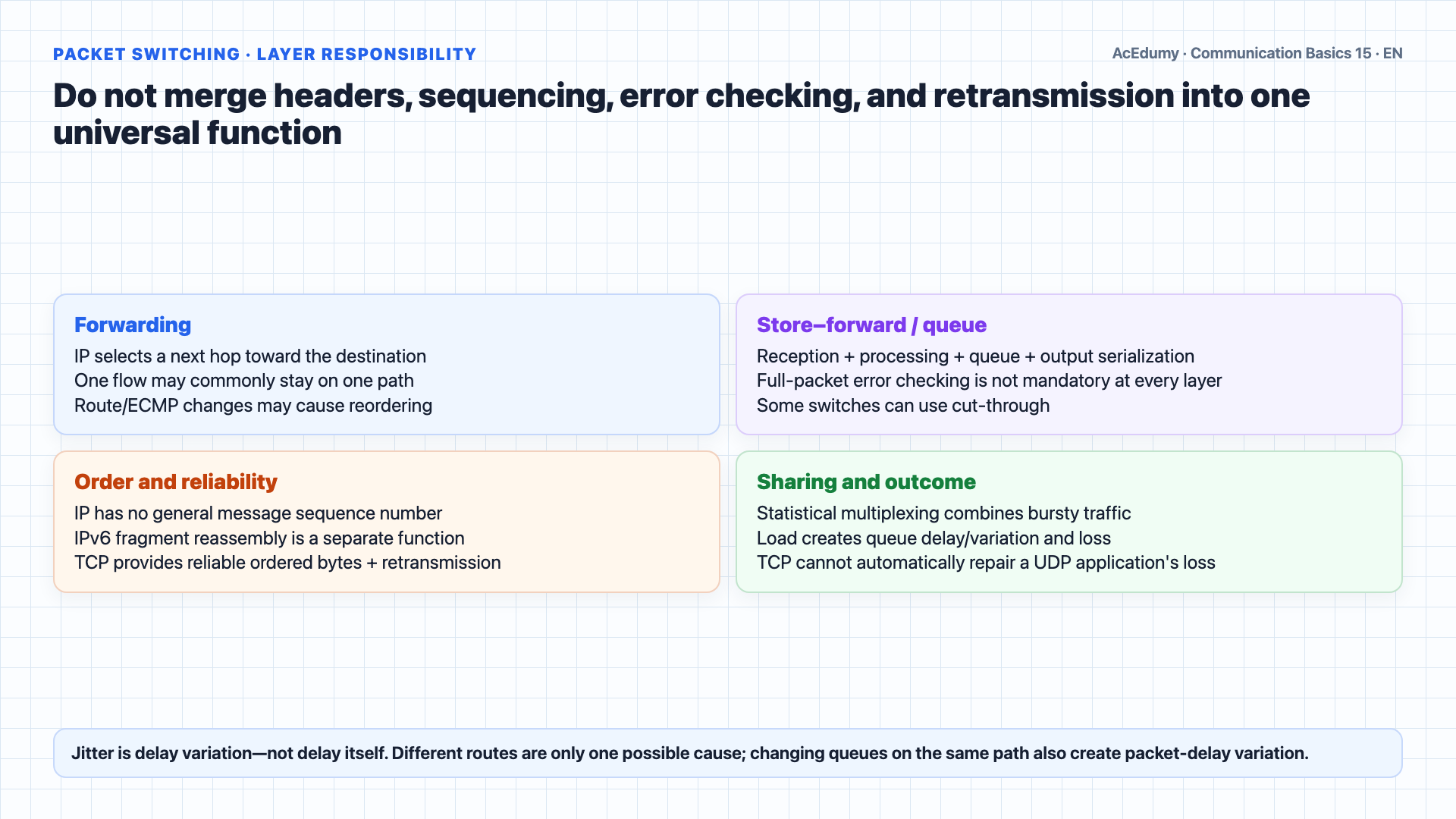
Connection state, resource allocation, and reliability belong to different layers and axes; verify performance for the protocol, load, path, and SLA. Now let us explore packet switching.In packet switching, data is divided into small units called packets.Packet-header fields are protocol-specific; IP has no universal message sequence number, and order/reliability usually belong to transport or application protocols.Packets are sent independently through the network.IP routers select a next hop using the destination prefix and forwarding table; not every network node is a router.Store-and-forward includes reception, processing, queuing, and output serialization; full-packet error checking is not universal at every hop, and some switches use cut-through.Packets may take different paths, while flow-based load balancing often keeps a flow on one path; route or ECMP changes can cause reordering.IP fragment reassembly and application-message/stream ordering are different functions; TCP provides reliable ordered bytes, while UDP does not.The key advantage of packet switching is statistical multiplexing.Multiple users share the same network links.When one user is not sending data, others can use that bandwidth.At the target service level and load, statistical multiplexing can yield higher utilization for bursty web, email, and file traffic than fixed allocation.However, packet switching introduces its own challenges.Jitter is packet-delay variation, not delay itself; changing queues on one path or route changes can cause it.During congestion, routers may drop packets if their buffers overflow.Loss recovery depends on the protocol: TCP retransmits; a UDP application may choose FEC, retransmission, or loss concealment.There is also overhead: each packet carries header information, which reduces the effective data throughput.Narration transcript
Now let us explore packet switching. In packet switching, data is divided into small units called packets. Each packet contains a header with the destination address, sequence number, and other control information. Packets are sent independently through the network. Each node, called a router, examines the packet header and forwards it to the next node based on routing tables. This is called store-and-forward: the router receives the entire packet, stores it briefly, checks for errors, and then forwards it. Different packets from the same message may take different paths and arrive out of order. The destination reassembles them correctly using the sequence numbers. The key advantage of packet switching is statistical multiplexing. Multiple users share the same network links. When one user is not sending data, others can use that bandwidth. This makes packet switching far more efficient than circuit switching for bursty data traffic like web browsing, email, and file transfers. However, packet switching introduces its own challenges. Packets may experience variable delay, called jitter, because each packet may take a different route or wait in different queues. During congestion, routers may drop packets if their buffers overflow. Lost packets must be retransmitted, which T C P handles at the transport layer. There is also overhead: each packet carries header information, which reduces the effective data throughput.
4. Compare circuits, packets, DiffServ, and MPLS through traffic and SLA objectives
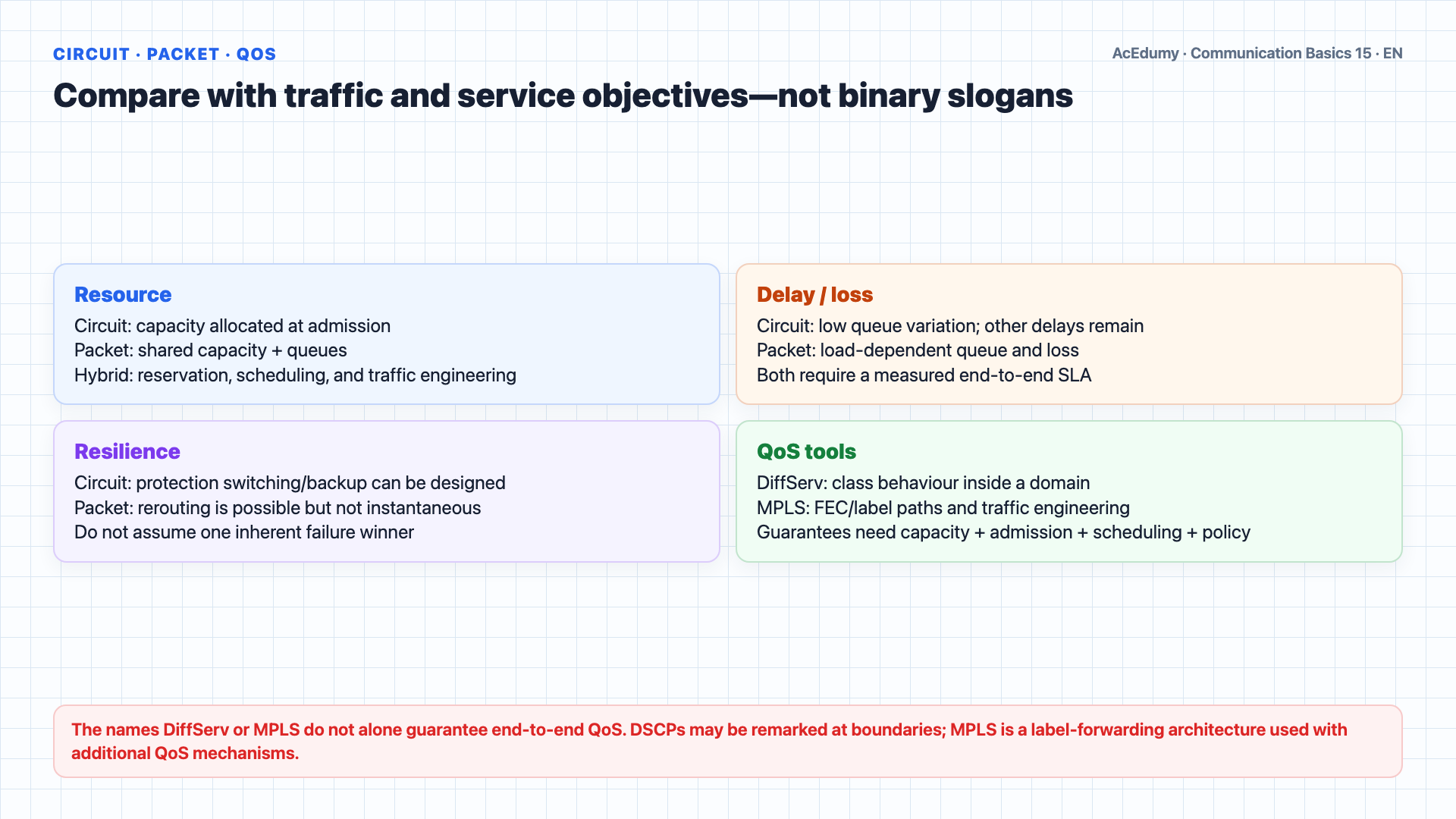
Connection state, resource allocation, and reliability belong to different layers and axes; verify performance for the protocol, load, path, and SLA. Let us now compare circuit switching and packet switching side by side.A circuit allocates a channel/path at setup; datagram routes can change, while packet flows can also use stable or labelled paths.Bandwidth usage: circuit switching reserves bandwidth even during silence; packet switching shares bandwidth dynamically through statistical multiplexing.Allocated circuits can reduce queue variation; packet queue delay depends on load. Propagation and processing delay must be measured for both.Resilience follows topology and protection: circuits can protection-switch and packets can reroute; neither is inherently instantaneous or lossless.QoS needs resources, admission, scheduling, and policy; DiffServ supplies class behaviour and MPLS supplies label paths/TE, but their names alone are not end-to-end guarantees.Resource-allocated circuits suit some real-time services that need predictable capacity; selection follows codec, load, SLA, and plant.Packet switching is flexible for bursty data and multiservice networks; real-time traffic can also run on packets with adequate capacity, queues, and endpoint mechanisms.The modern internet uses packet switching.VoIP uses packet transport with codecs, playout/jitter buffers, loss handling, and where needed domain QoS tools; markings alone do not guarantee low delay.Modern networks combine packet transport with resource allocation, traffic engineering, protection, and buffering according to requirements; a single-winner summary is incomplete.Narration transcript
Let us now compare circuit switching and packet switching side by side. In terms of path: circuit switching uses a dedicated, fixed path; packet switching uses dynamic, potentially different routes for each packet. Bandwidth usage: circuit switching reserves bandwidth even during silence; packet switching shares bandwidth dynamically through statistical multiplexing. Delay characteristics: circuit switching provides constant, low delay; packet switching has variable delay depending on network load. Reliability: in circuit switching, a single link failure breaks the whole call; in packet switching, packets can be rerouted around failures. Quality of Service: circuit switching guarantees Q o S; packet switching requires additional mechanisms like Diff Serv or M P L S for Q o S. Best use cases: circuit switching is ideal for real-time voice where constant delay and guaranteed bandwidth matter. Packet switching is ideal for data applications where efficiency and flexibility are more important than constant delay. The modern internet uses packet switching. But modern voice calls over the internet, V o I P, use packet switching with special Q o S mechanisms to achieve the low delay that voice requires. So the trend is clear: packet switching has won, but circuit-like guarantees are layered on top when needed.
5. Summarize modern voice through semantics, traffic, resource, and resilience gates
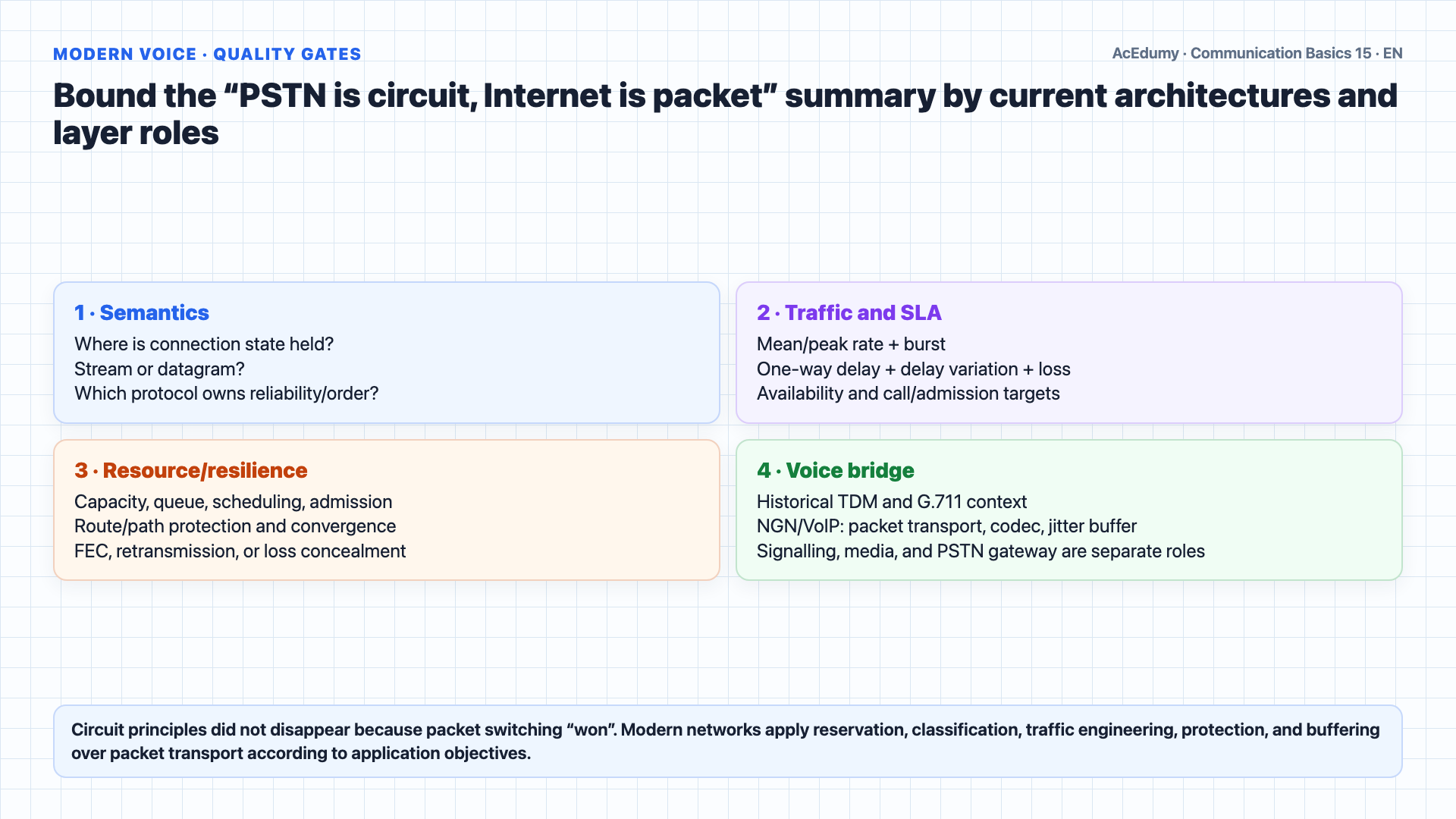
Connection state, resource allocation, and reliability belong to different layers and axes; verify performance for the protocol, load, path, and SLA. Let us summarize today's lesson.Connection-oriented communication establishes protocol state before data; a reserved network path is not required.Connectionless communication sends each packet independently.Circuit switching allocates defined channel resources for a session; they need not be a separate physical path.Circuit allocation can provide predictable capacity and low queue variation; end-to-end delay and congestion outcomes depend on admission and plant design.Circuits can suffer underutilization and setup blocking; failure impact depends on protection and redundancy architecture.Packet switching divides data into packets that travel independently.Packet networks statistically multiplex bursty traffic and can reroute; efficiency and resilience depend on load, protocol, and topology.Packet networks can add load-dependent delay, delay variation, loss, and header overhead; queue and protocol design manage the targets.Historical PSTN used TDM circuits; current telephone services also use packet-based NGN/IMS cores and gateways.The internet uses packet switching.Modern networks combine packet transport, reservation, scheduling, traffic engineering, and protection for a target SLA; this does not automatically confer every advantage.In the next lesson, we will explore the P S T N infrastructure in detail: the hierarchy of switching offices, local loops, trunks, and signaling systems that make telephone calls possible.Narration transcript
Let us summarize today's lesson. Connection-oriented communication establishes a path before data flows. Connectionless communication sends each packet independently. Circuit switching creates a dedicated path for the entire session. Advantages: guaranteed bandwidth, low constant delay, no congestion. Disadvantages: bandwidth waste during silence, setup time, single point of failure. Packet switching divides data into packets that travel independently. Advantages: efficient bandwidth sharing through statistical multiplexing, resilience to link failures, flexibility. Disadvantages: variable delay and jitter, possible packet loss, header overhead. The P S T N uses circuit switching. The internet uses packet switching. Modern networks combine both approaches to get the best of both worlds. In the next lesson, we will explore the P S T N infrastructure in detail: the hierarchy of switching offices, local loops, trunks, and signaling systems that make telephone calls possible.
Source video: Communication Basics #15 — Circuit Switching & Packet Switching (7:25)