Circuit Theory 1 · Course Summary and Bridge
#53 Circuit Theory 1 #53 — Wrap-up and bridge to Circuit Theory 2
Summarizes the path from core DC tools to second-order transients and builds the natural bridge into frequency-domain analysis.
Question
Summarize the recurring solution principles of Circuit Theory 1, compare first- and second-order thinking, and build the bridge to Circuit Theory 2.
Written solution and narration transcript(shows the full solution)
Below are all the lines written in the notebook together with the full narration transcript.
1. Read the Circuit Theory 1 path in reverse
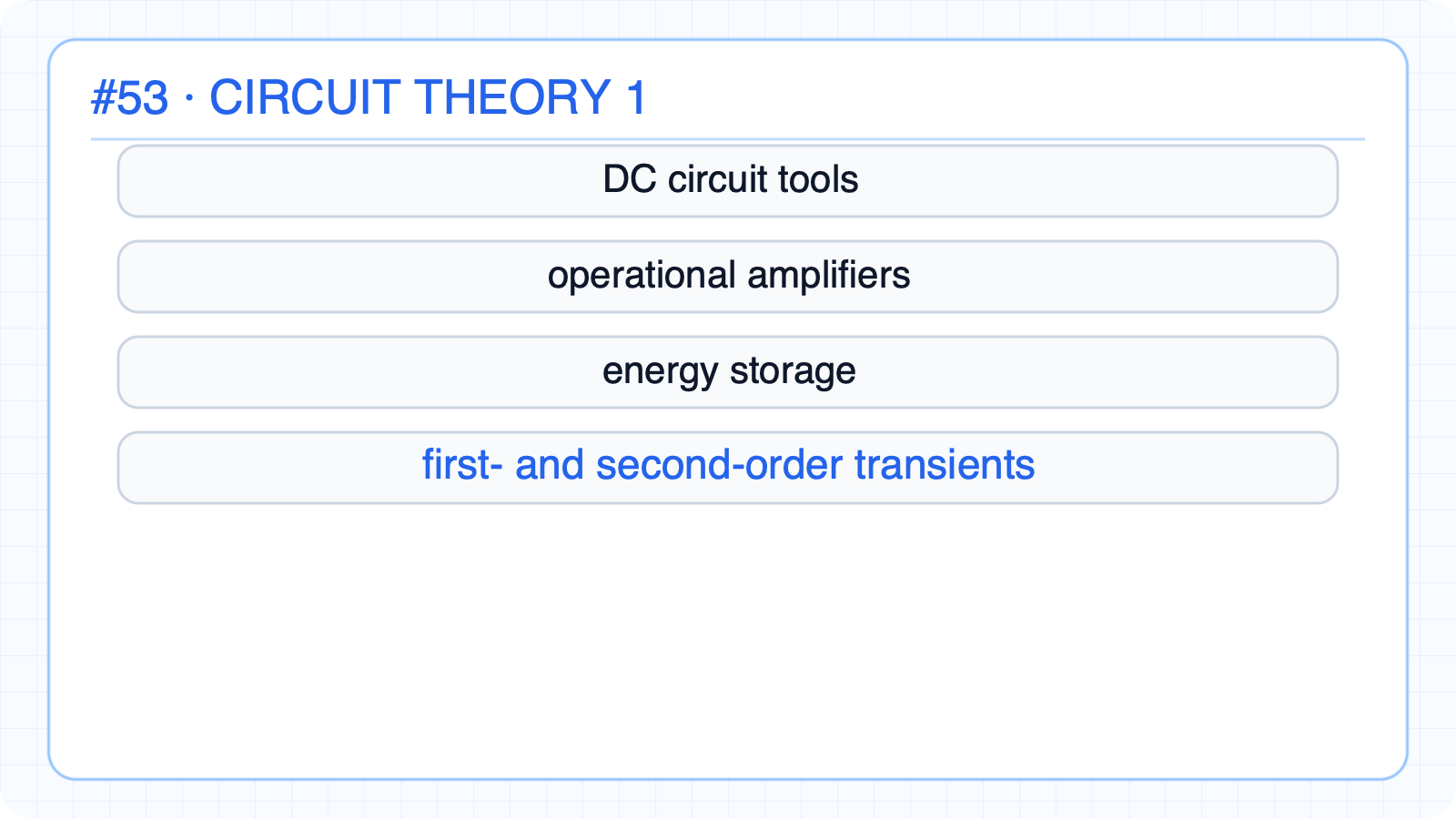
Circuit Theory 1 #53 · Read the Circuit Theory 1 path in reverse We began with the core DC toolsOhm's law, Kirchhoff's laws, and equivalent resistanceSource transformations and systematic circuit solvingBlock thinking through ideal operational amplifiersStored energy through capacitors and inductorsEnergy storage → transient analysisWe reached first- and second-order responsesNarration transcript
Let us zoom out and look at the whole first circuit theory path. We started with the core D C tools: Ohm's law, Kirchhoff's laws, equivalent resistance, and source transformations. Then we moved to operational amplifiers, where ideal rules helped us think in blocks instead of only in raw equations. After that, capacitors and inductors introduced stored energy into the story. That is what opened the door to transient analysis.
2. Extract the recurring core ideas
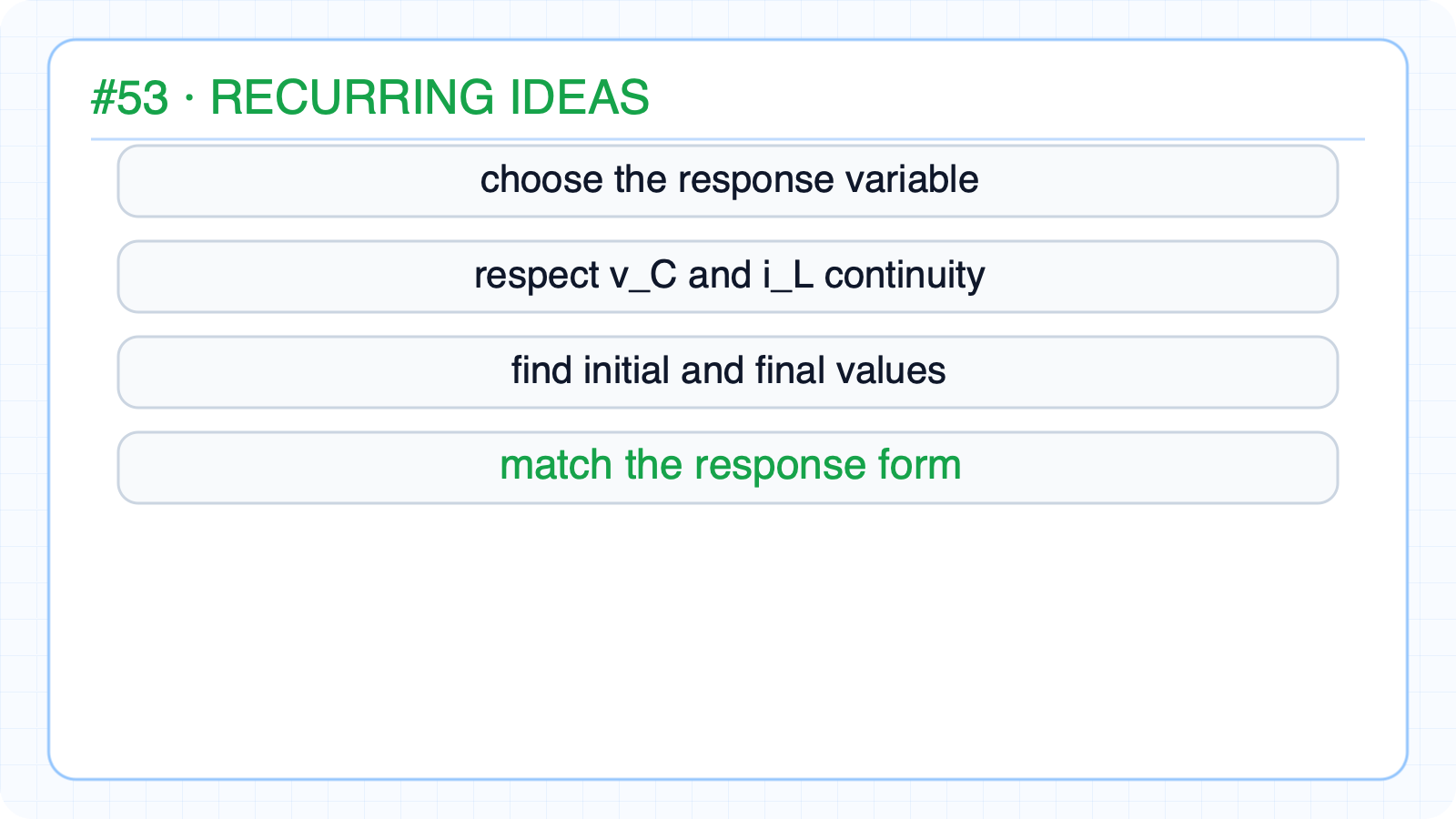
Circuit Theory 1 #53 · Extract the recurring core ideas Choose the right variableNode voltage, loop current, vC, or iLRespect continuity: vC and iL cannot jumpIdentify initial and final valuesChoose the mathematical form that matches circuit orderResistive circuit: immediate settlingFirst order: one time constantSecond order: poles and damping classNarration transcript
Although the topics looked different, the same few ideas kept repeating. First, choose the right variable: a node voltage, a loop current, a capacitor voltage, or an inductor current. Second, respect physical continuity: capacitor voltage cannot jump, and inductor current cannot jump. Third, identify the initial and final values. And fourth, use the correct mathematical shape: resistance-only circuits settle instantly, first-order circuits use one time constant, and second-order circuits depend on their poles.
3. Move from first order to second order
Circuit Theory 1 #53 · Move from first order to second order One energy-storage element → one stateFirst order → one exponential modeTwo independent storage elements → two statesSecond order → two polesOverdamped, critical, underdamped, or undampedThe same core workflow still worksFind the form → apply conditions → solve constantsNarration transcript
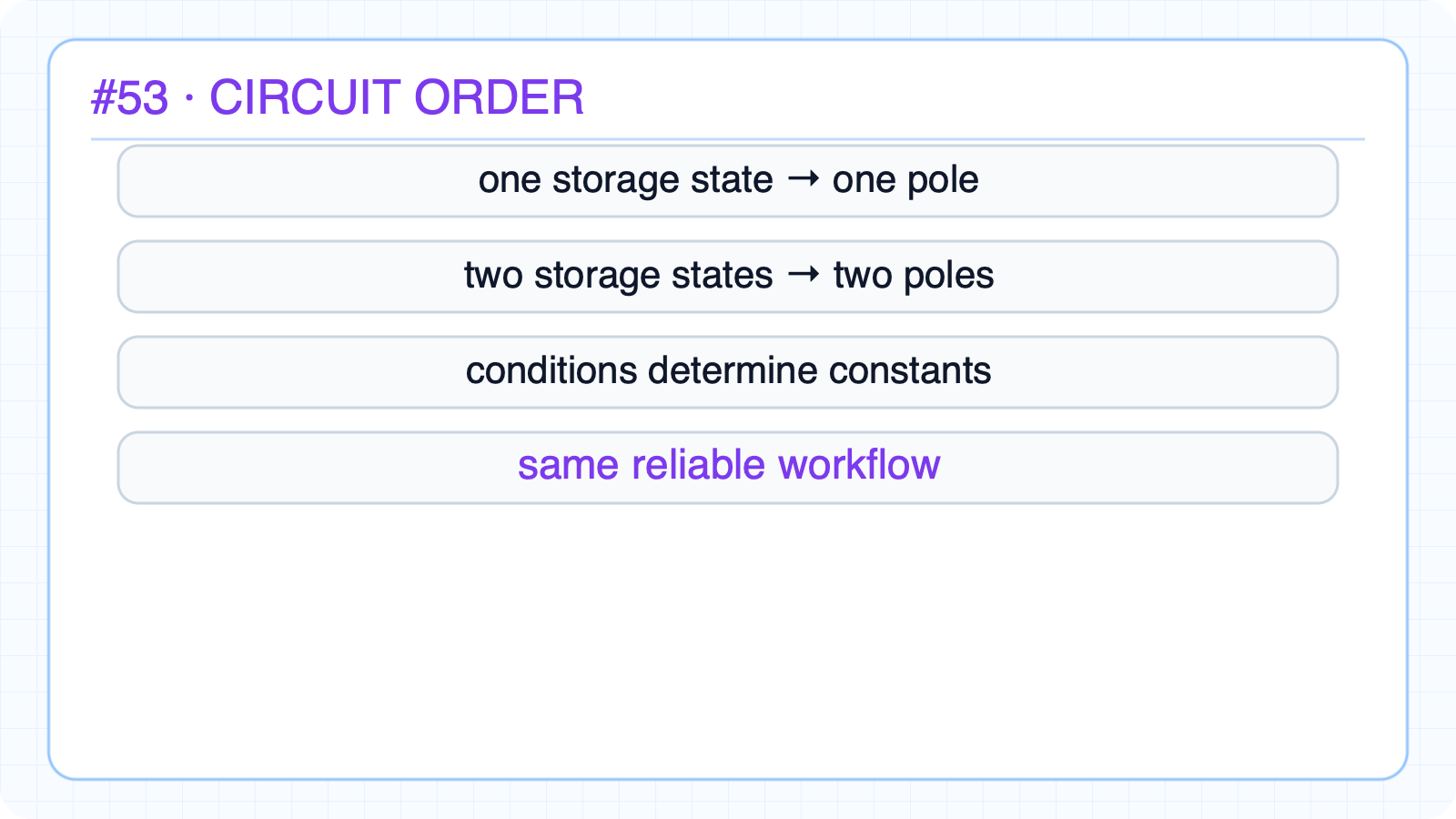
The real conceptual climb in D T 1 was the transition from first-order to second-order thinking. In first-order circuits, one storage element gives one state and one exponential mode. In second-order circuits, two storage elements give richer motion: overdamped, critical, underdamped, or undamped. But the workflow still stayed manageable. Find the form, use the conditions, and solve the constants. So second-order analysis is not a different universe; it is a direct extension of the first-order method.
4. Why do we need Circuit Theory 2?
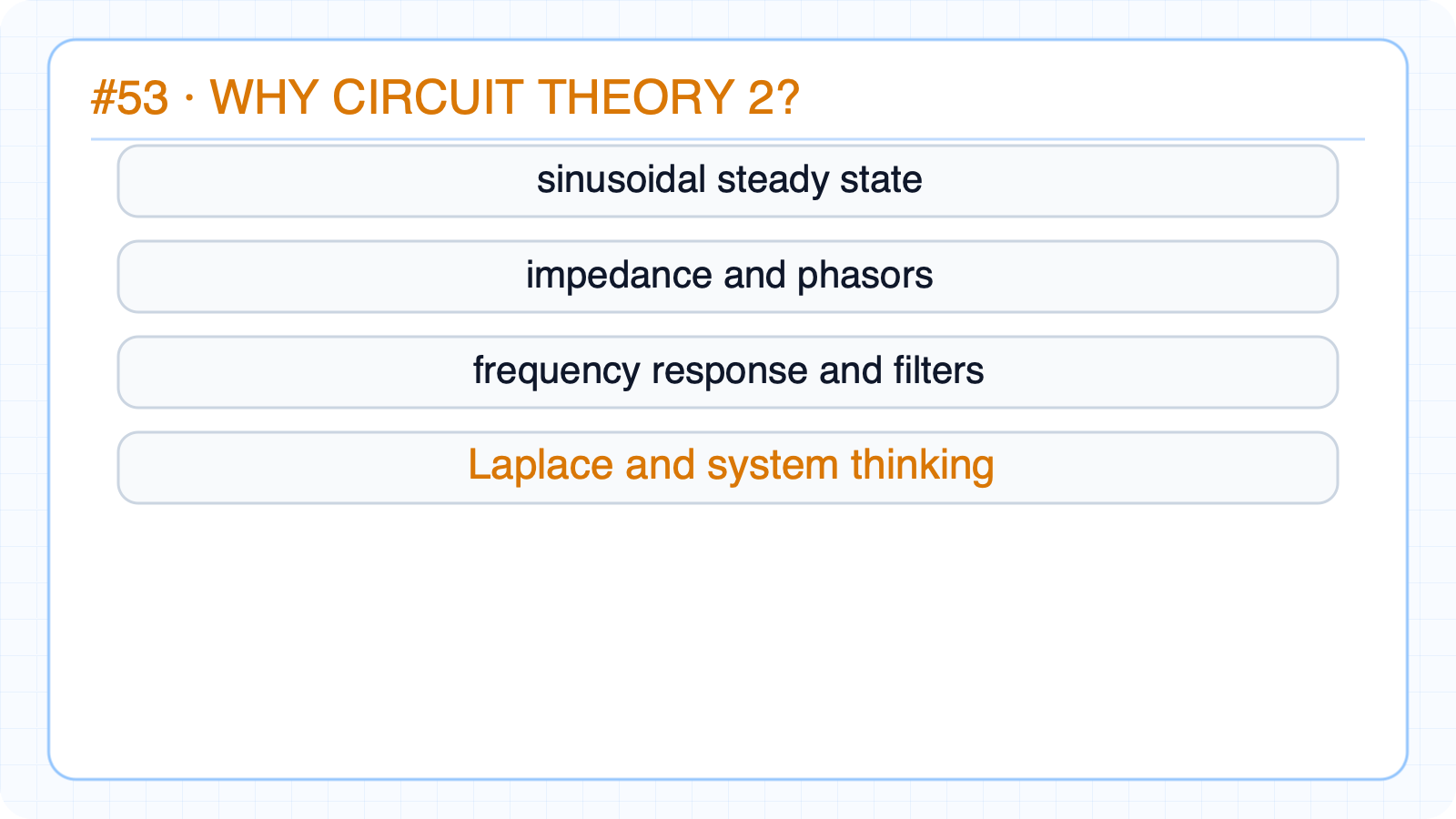
Circuit Theory 1 #53 · Why do we need Circuit Theory 2? Switching and the time domain are half of the big pictureSinusoidal steady state opens new questionsComplex impedance and phasorsFrequency response and filtersLaplace-based system thinkingThe question changes: how does a circuit behave across frequency?How are signals selected, attenuated, or shaped?Narration transcript
So why do we need a second course? Because time-domain switching is only one half of the big picture. In D T 2, we want to analyze sinusoidal steady state, complex impedance, phasors, frequency response, filters, and Laplace-based system thinking. Those topics let us answer a different class of questions: not only what happens after a switch, but also how a circuit behaves across frequencies and how it processes signals.
5. Build the natural bridge to Circuit Theory 2
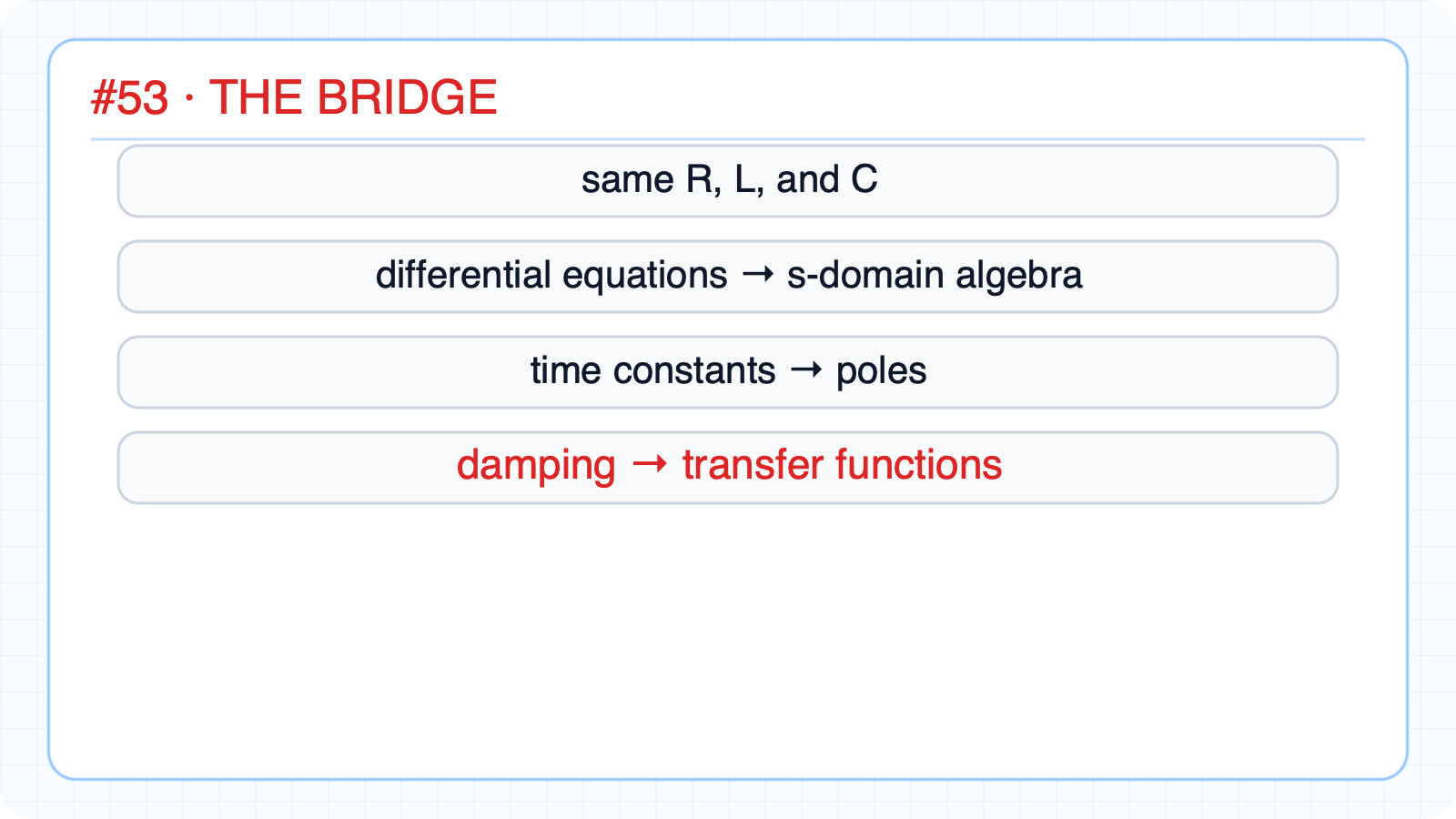
Circuit Theory 1 #53 · Build the natural bridge to Circuit Theory 2 The components and physical laws stay the sameR, L, and C now appear in impedance modelsDifferential equations become algebra in the s domainTime-constant intuition reappears in polesDamping intuition explains transfer functionsFrequency response reveals filter behaviorA new lens on the same physical foundationNarration transcript
The bridge is very natural. D T 1 taught us the components and the physical laws. D T 2 keeps the same components, but changes the lens. Resistors, capacitors, and inductors will now appear inside impedance models. Differential equations will connect to algebra in the s domain. And the intuition you built about time constants and damping will reappear in poles, transfer functions, and filter behavior.
6. Complete the Circuit Theory 1 foundation
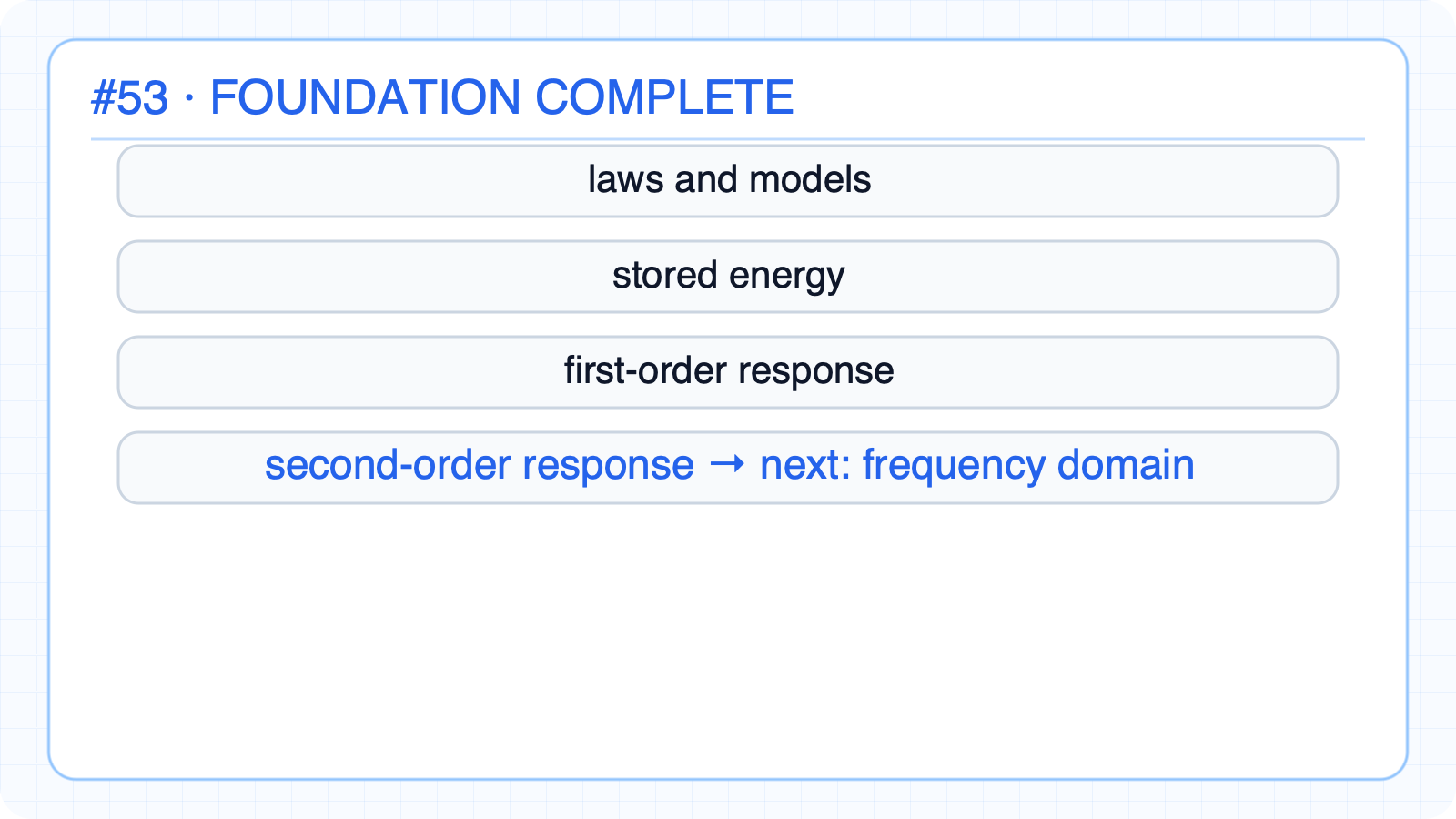
Circuit Theory 1 #53 · Complete the Circuit Theory 1 foundation Circuit laws and systematic solutionIdeal operational-amplifier modelsCapacitors, inductors, and energy storageFirst-order transientsSecond-order transientsInitial value, final value, poles, and response form now connectCircuit Theory 1 completeNext series: frequency-domain and system toolsNarration transcript
That completes the D T 1 path. You now have the foundation: circuit laws, ideal op-amp models, energy storage, first-order transients, and second-order transients. In the next series, we build on the same physics and move into frequency-domain analysis and system-level tools.