Communication Basics · Coaxial Cable & HFC Networks
#09 Coax geometry and impedance, screening limits, CATV plans, HFC optical-node architecture, DOCSIS 3.1/4.0 spectrum, and media comparison
Analyze coax, HFC, and DOCSIS without reducing them to fixed 1 GHz, 6 MHz, or 1 Gbit/s labels; keep geometry, spectrum, sharing, and plant conditions explicit.
Question
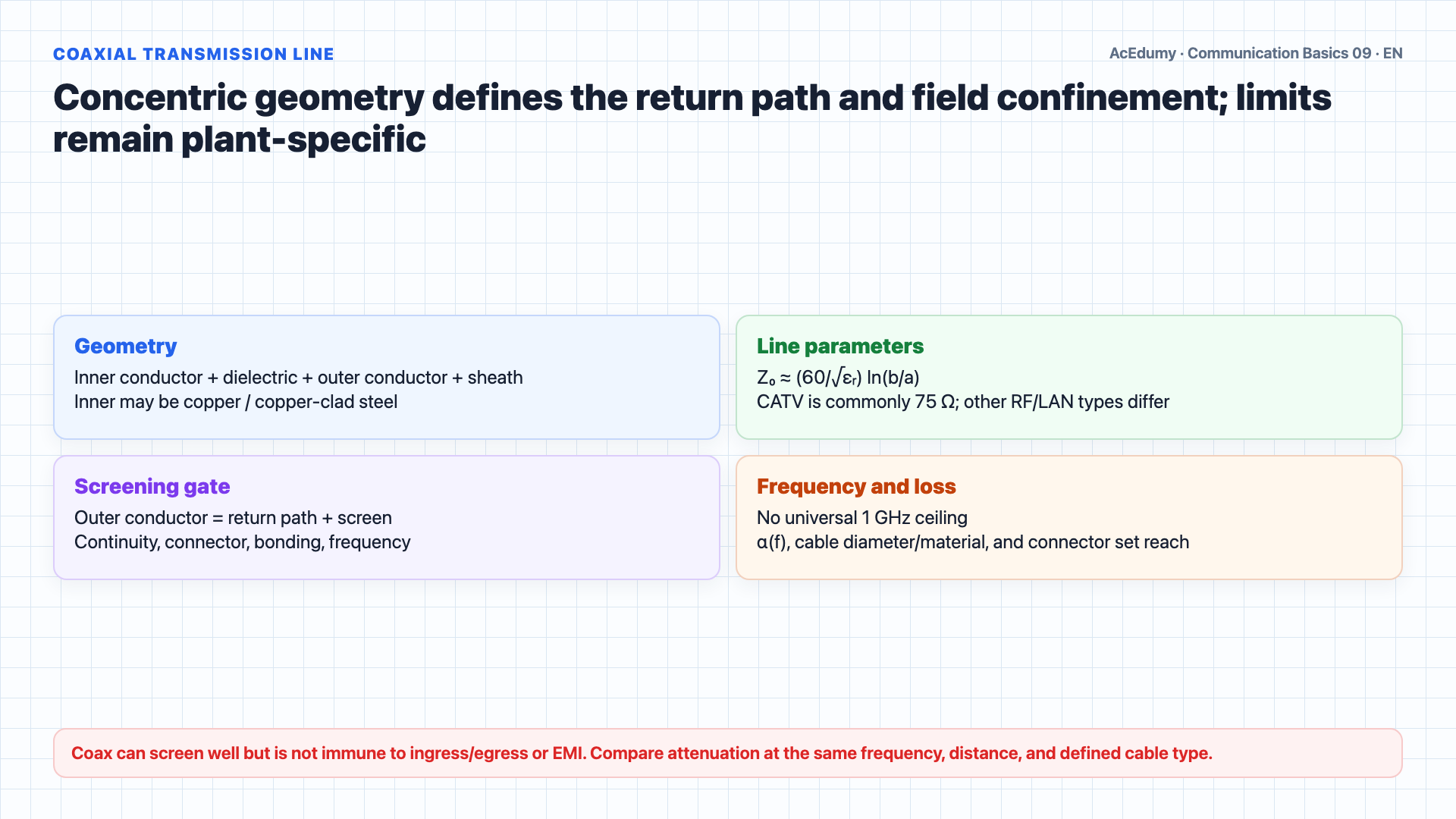
Build coax as a concentric transmission line with impedance and attenuation; move CATV/HFC spectrum from historical analog channels to DOCSIS OFDM/OFDMA; bind comparison with twisted pair to application and frequency conditions.
Written solution and narration transcript(shows the full solution)
Below are all the lines written in the notebook together with the full narration transcript.
1. Build coax geometry, impedance, and screening limits
Coax and HFC are evaluated with geometry, screen continuity, spectrum plan, shared segment, and DOCSIS version explicit. Coaxial cable, or coax, is a transmission medium built for high frequency signals.Its structure consists of four concentric layers.The centre conductor may be solid/stranded copper or copper-clad steel; diameter and material depend on cable type, frequency, attenuation, and power requirements.Surrounding it is an insulating layer, usually plastic, that separates the center conductor from the outer shield.The outer conductor forms the signal-return path and screen and may use foil/braid layers. Effectiveness depends on continuity, connector, bonding, and frequency; it does not absolutely block interference.Finally, a protective cable sheath covers everything.This concentric design gives coax two key advantages.Coax has no universal 1 GHz upper limit; usable frequency depends on cable/connector loss and system plan. A DOCSIS 3.1 plant may reach 1.218 GHz and DOCSIS 4.0 ESD 1.8 GHz.A concentric outer conductor can screen well, but leakage, ingress/egress, and EMI depend on connectors, screen integrity, bonding, and frequency. Balanced pair also rejects common-mode interference.Attenuation must be compared at stated geometry, material, and frequency; coax is not universally 'much lower loss' than every balanced pair over every band and distance.Coax can serve CATV/HFC distribution; current structured-LAN examples use Cat 5e/6/6A balanced cabling. Installed-media share depends on country, building, and date.Narration transcript
Coaxial cable, or coax, is a transmission medium built for high frequency signals. Its structure consists of four concentric layers. At the center is a thick solid copper conductor that carries the data signal. Surrounding it is an insulating layer, usually plastic, that separates the center conductor from the outer shield. The outer shield is a layer of metal foil or braided mesh that serves as the return path for the signal and blocks external interference. Finally, a protective cable sheath covers everything. This concentric design gives coax two key advantages. First, it supports very high frequencies, up to about 1 gigahertz. Second, the outer shield makes it largely immune to EMI, Electromagnetic Interference, unlike twisted pair which is highly susceptible. The thick center conductor supports high frequency signals with much lower attenuation than twisted pair over the same distance. Today, coax is still widely used in cable television networks and the last mile connection to homes, though in LANs it has been largely replaced by UTP Category 5 and 6 cables.
2. Build CATV/HFC topology and DOCSIS spectrum
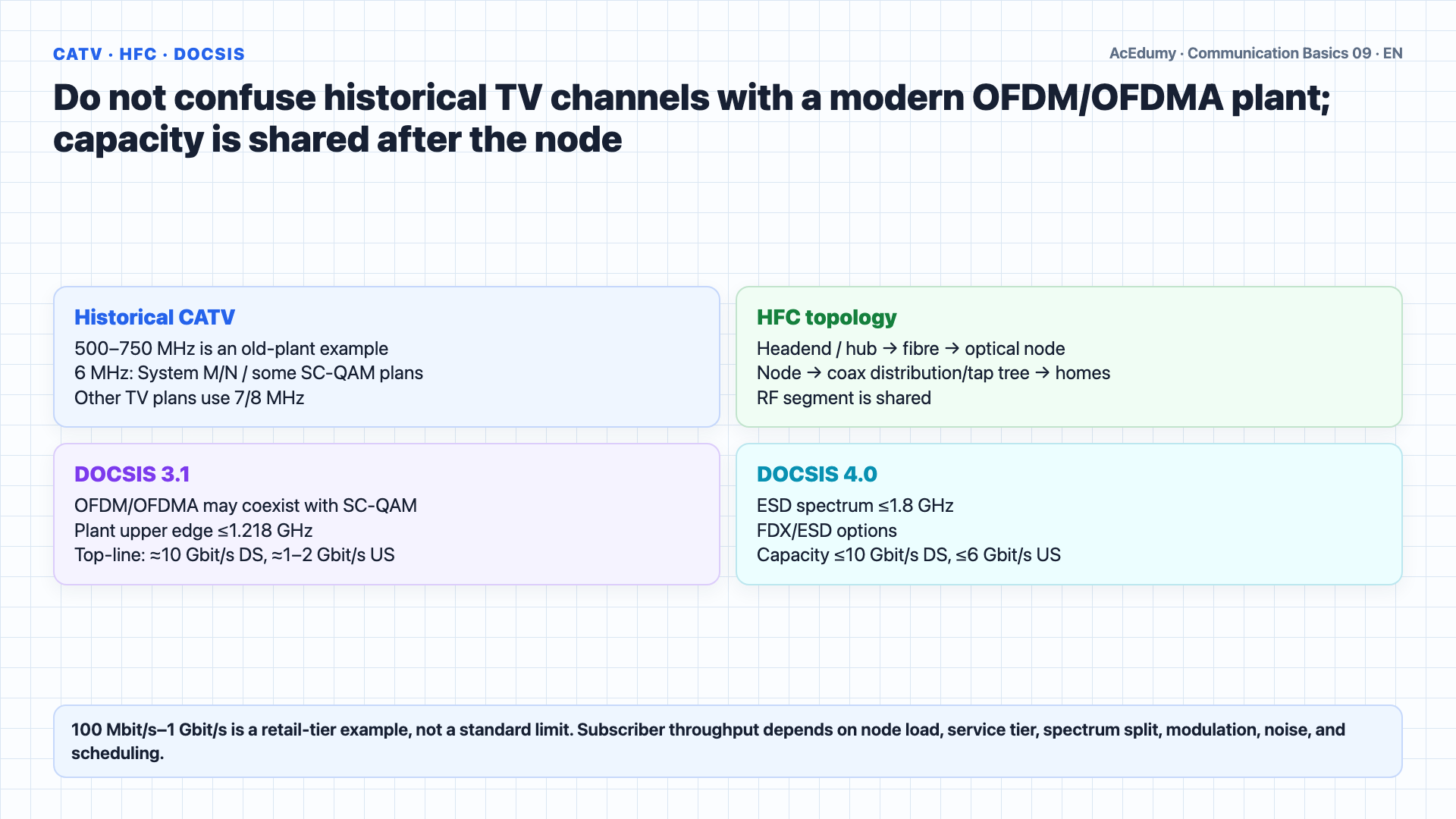
Coax and HFC are evaluated with geometry, screen continuity, spectrum plan, shared segment, and DOCSIS version explicit. One of the most important applications of coaxial cable is CATV, which stands for Community Antenna Television, or simply cable TV.500–750 MHz is a historical CATV-plant example; modern HFC upper edges may be 1.002/1.218 GHz and DOCSIS 4.0 ESD can extend to 1.8 GHz.Six-megahertz channels belong to historical System M/N analog TV and some SC-QAM plans; other TV systems use 7/8 MHz, while DOCSIS 3.1 uses wide OFDM/OFDMA blocks and subcarriers.This is actually Frequency Division Multiplexing in action, the same concept we learned earlier.Interactive CATV systems also include channels of various widths for two way data and even voice transmission.Modern cable networks use a Hybrid Fiber Coax architecture, known as HFC.In HFC, fibre can connect headend/hub to an optical node; the node is an RF/optical or Remote-PHY boundary, not a generic access point.After the optical node, a coax distribution/tap tree can provide a shared RF segment to multiple homes; topology varies with fibre-deep, node+0, or FTTH migration.HFC combines a fibre access section with a coax RF plant; endpoint capacity is shared according to node segment, spectrum split, modulation, noise, scheduling, and concurrent users.HFC supports services like digital TV, high speed internet, and Voice over IP telephony, all delivered simultaneously over the same network.100 Mbit/s–1 Gbit/s is a service-tier example, not a fixed DOCSIS 3.1 limit; CableLabs scopes top-line capacity near 10 Gbit/s downstream and roughly 1–2 Gbit/s upstream.Narration transcript
One of the most important applications of coaxial cable is CATV, which stands for Community Antenna Television, or simply cable TV. CATV systems traditionally use coax to deliver signals at frequencies as high as 500 to 750 megahertz over considerable distances. The total bandwidth is subdivided into 6 megahertz channels, each carrying one analog television program. This is actually Frequency Division Multiplexing in action, the same concept we learned earlier. Interactive CATV systems also include channels of various widths for two way data and even voice transmission. Modern cable networks use a Hybrid Fiber Coax architecture, known as HFC. In HFC, fiber optic cables form the backbone carrying signals from the head end to neighborhood access points. From the access point to individual homes, coaxial cable covers the last mile. This hybrid approach combines the massive bandwidth of fiber with the existing coax infrastructure already installed in homes. HFC supports services like digital TV, high speed internet, and Voice over IP telephony, all delivered simultaneously over the same network. Cable internet using HFC typically provides speeds from 100 megabits per second up to 1 gigabit per second with DOCSIS 3.1.
3. Compare twisted pair and coax under matching conditions
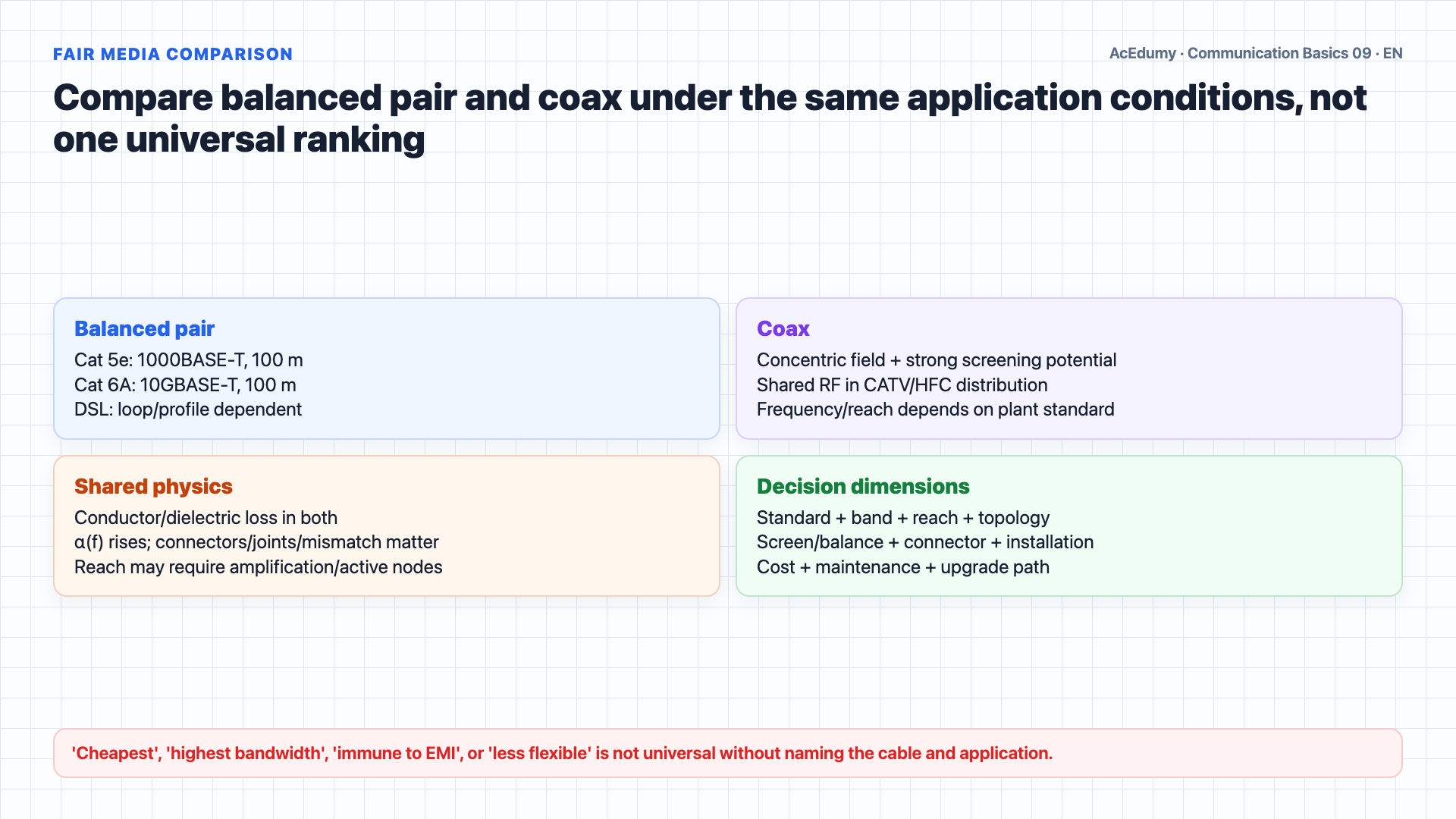
Coax and HFC are evaluated with geometry, screen continuity, spectrum plan, shared segment, and DOCSIS version explicit. Let us compare the wired transmission media we have covered.Cost, installation, and interference performance depend on cabling class, screen, distance, connectors, labour, and application; balanced pair is not universally the lowest-bandwidth or most-susceptible medium.Cat 5 is historical; a current example is Cat 5e for 1000BASE-T and Cat 6A for 10GBASE-T over a 100 m channel. Cabling category alone does not guarantee application rate.Typical reach is 100 meters for LAN and several kilometers for DSL in the local loop.Coax may offer screening and spectrum advantages; upper frequency, cost, and installation flexibility must be compared for a stated cable, connector, frequency, reach, and plant standard.It is primarily used for cable television and HFC internet access.Both twisted pair and coax are copper based and share the fundamental limitation of signal attenuation over distance.In the next lecture group, we will explore wireless transmission: microwave links with their Free Space Loss calculations, and technologies like MMDS, LMDS, and WLAN.Later, we will also cover satellite and fiber optic communications, completing our survey of all major transmission media.Narration transcript
Let us compare the wired transmission media we have covered. Twisted pair is the cheapest and easiest to install, but it has the lowest bandwidth and highest susceptibility to interference. Its maximum data rate ranges from 100 megabits per second for Cat 5 to 10 gigabits per second for Cat 6a and Cat 7. Typical reach is 100 meters for LAN and several kilometers for DSL in the local loop. Coaxial cable offers higher bandwidth up to 1 gigahertz with good EMI immunity thanks to its shielding, but it is more expensive and less flexible than twisted pair. It is primarily used for cable television and HFC internet access. Both twisted pair and coax are copper based and share the fundamental limitation of signal attenuation over distance. In the next lecture group, we will explore wireless transmission: microwave links with their Free Space Loss calculations, and technologies like MMDS, LMDS, and WLAN. Later, we will also cover satellite and fiber optic communications, completing our survey of all major transmission media.
4. Summarize coax, HFC, spectrum, and capacity
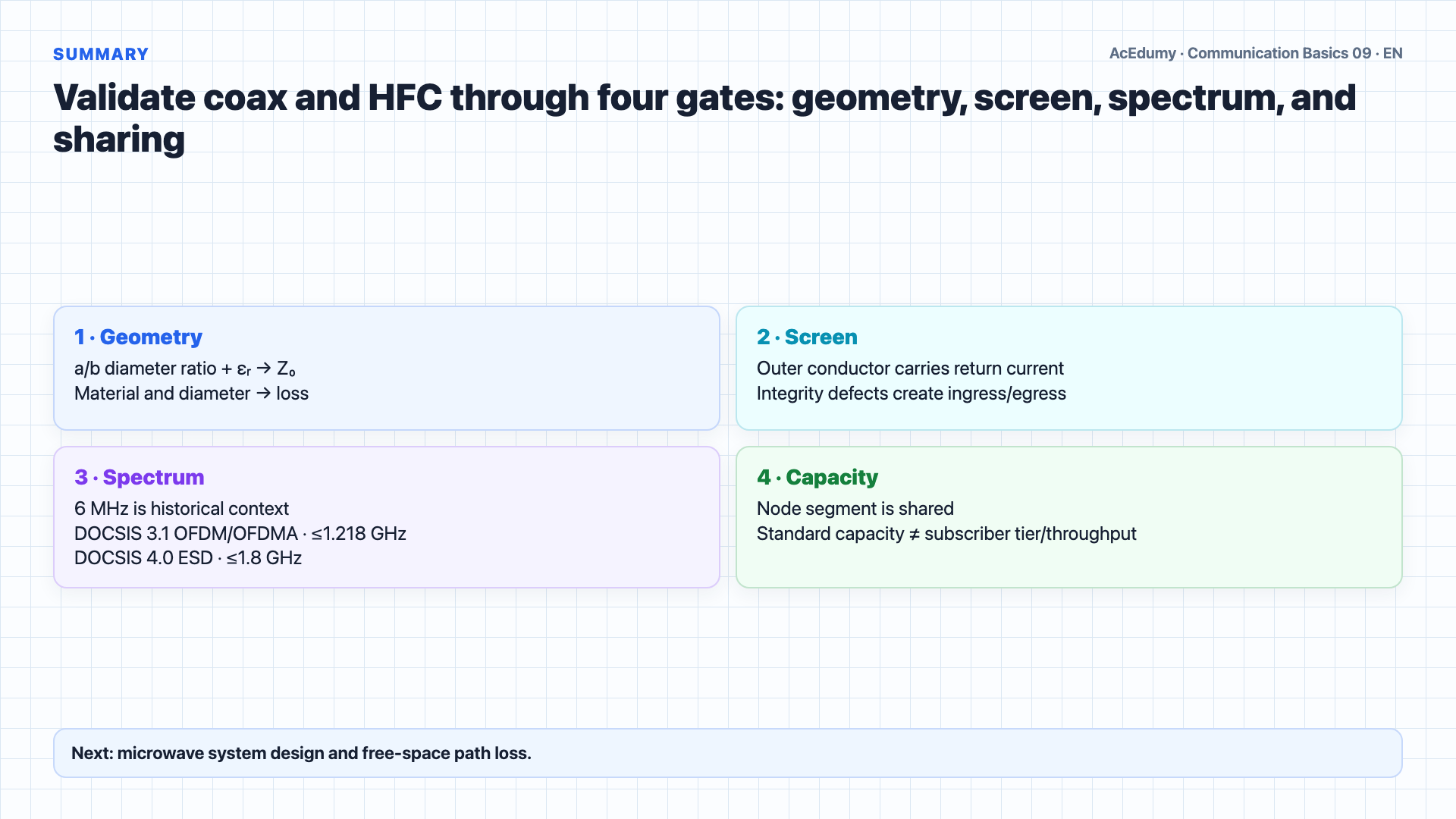
Coax and HFC are evaluated with geometry, screen continuity, spectrum plan, shared segment, and DOCSIS version explicit. Let us review.Coaxial cable has four layers: center conductor, insulator, shield, and sheath.Coax upper frequency depends on system and cable; screening can be strong but is not immune to ingress/egress, connector, or bonding defects.CATV/HFC is a frequency-divided RF plant; 6 MHz is one historical plan/SC-QAM example, and DOCSIS 3.1 also uses OFDM/OFDMA blocks.HFC, Hybrid Fiber Coax, combines fiber backbone with coax last mile, delivering TV, internet, and voice over one network.1 Gbit/s is a retail-service example; DOCSIS 3.1 shared-plant capacity can be multi-gigabit, while subscriber throughput varies with tier, profile, and load.Coax versus balanced pair is not a universal ranking; specify band, standard, reach, screen/balance, connector, cost, and installation scenario.In the next lesson, we will enter the wireless domain with microwave system design and Free Space Loss calculations.Narration transcript
Let us review. Coaxial cable has four layers: center conductor, insulator, shield, and sheath. It supports frequencies up to 1 gigahertz and is largely immune to EMI. CATV uses coax with FDM, dividing the band into 6 megahertz TV channels. HFC, Hybrid Fiber Coax, combines fiber backbone with coax last mile, delivering TV, internet, and voice over one network. Cable internet via DOCSIS 3.1 now reaches 1 gigabit per second. Compared to twisted pair, coax offers higher bandwidth and better shielding but at higher cost and lower flexibility. In the next lesson, we will enter the wireless domain with microwave system design and Free Space Loss calculations.
Source video: Communication Basics #09 Coaxial Cable & HFC Networks (5:20)