Signals and Systems · Combined discrete-time transforms and periodic sequences
#06 Integer index mapping, shift then scale and periodic extension
Compose shifts and integer scaling, track the origin pointer, and distinguish the shown period-five zero gaps from the general definition of a discrete-time signal.
Question
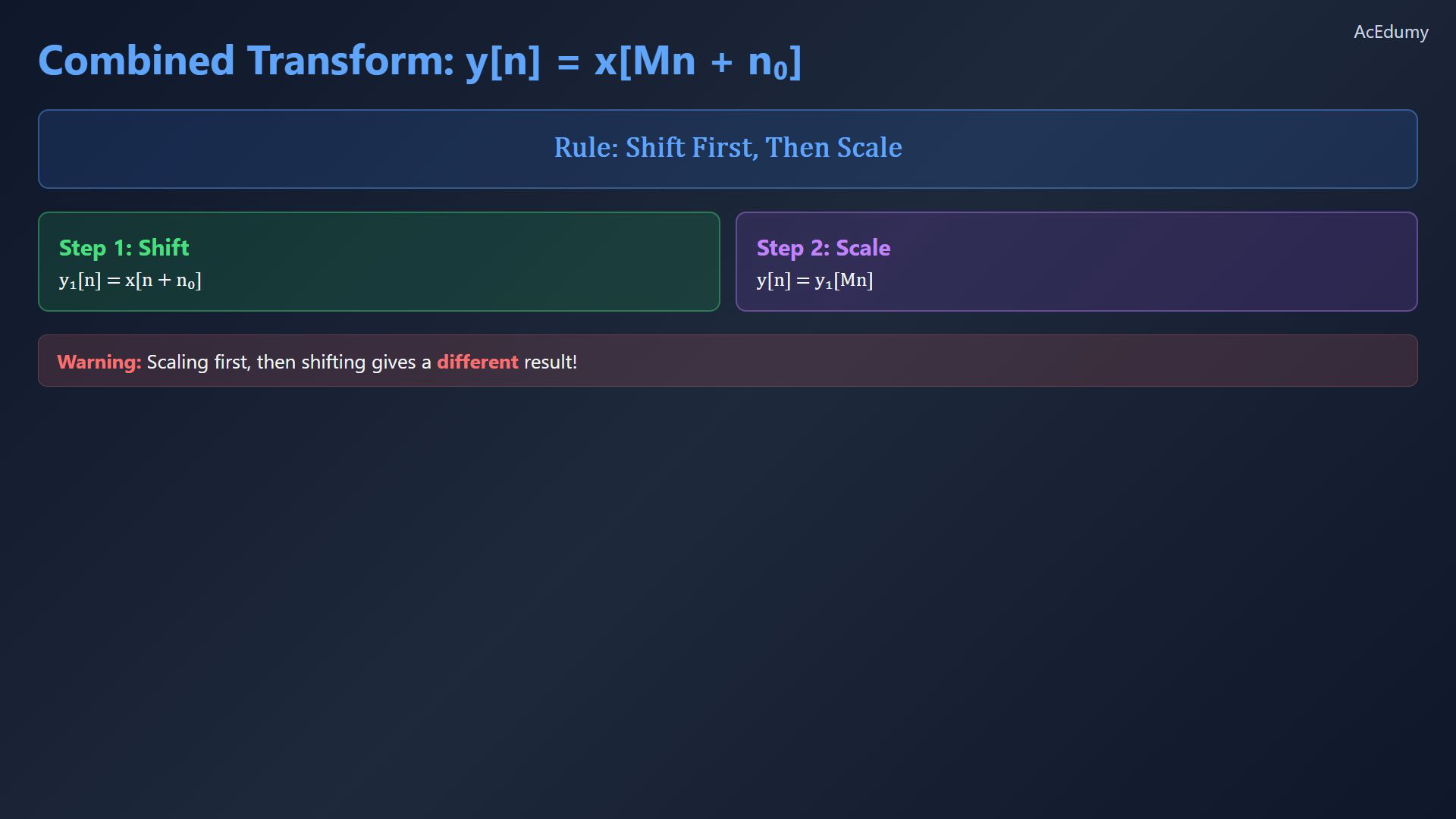
Use sequences defined on every integer index. A noninteger time is outside this domain, not an implicit zero. Whenever a finite vector specifies a sequence, state its first index and zero value outside the listed support. Distinguish sample index n, nonzero integer scaling M, integer shift n0 and positive integer period N. For y[n]=x[M*n+n0], define v[n]=x[n+n0] and then y[n]=v[M*n]. M greater than one performs decimation; negative M also reverses order. The worked example uses M=2 and n0=1. Reversing the same unchanged operations instead gives x[M*n+M*n0] in general. Equality may occur for zero shift, identity scaling, a zero sequence or special signal symmetry. Scaling first can produce the intended result with a compensating integer shift n0/M when that ratio is integral; a fractional shift of an ordinary sequence must not be assumed defined. The source's warning is a general noncommutation warning, not an assertion that every special case differs. No interpolation or reconstruction is implied. The existing worked graphic uses x[-3..3]=[1,-1,2,0.5,-0.5,1.5,1], zero elsewhere. Under v[n]=x[n+1], its values keep their order and have indices -4 through 2. The origin pointer moves one position right within the fixed value list, from the 0.5 entry to the -0.5 entry; on an n-axis the signal moves left by one. These are compatible descriptions. To form y[n]=v[2*n], keep v indices -4,-2,0,2 and divide those indices by two. The result is [1,2,-0.5,1] at n=-2,-1,0,1, zero elsewhere. Equivalently select original x indices -3,-1,1,3. The discarded values do not get interpolated into the result. A sequence is periodic when y[n+N]=y[n] for every integer n with some positive integer N. This N need not be its fundamental period; the fundamental period is the smallest positive integer period. For a finite-support base x, y[n]=sum over all integer k of x[n-k*N] is well defined because only finitely many terms contribute at each n. Reindexing k proves N-periodicity. Copies may overlap when the support is wider than the spacing; then they add. Do not assume zero gaps or nonoverlap in the general construction. The specific base in the periodic example is x[0]=1, x[1]=2, x[2]=-1 and zero elsewhere. With N=5, its periodic extension has values [1,2,-1,0,0] at residues 0 through 4 modulo five. Copies at k=-1,0,1 occupy indices [-5,-4,-3], [0,1,2] and [5,6,7]. The two intervening integer samples have zero value because this three-sample support is shorter than the five-sample spacing. Five is also the fundamental period for this nonconstant pattern. The same pattern is used in the lower comparison plot. Explicitly identify the narration's zero-gap statement as referring to this displayed example; it is not a general DT-versus-CT distinction. A base [1,2] repeated with period two has no zero sample at all. A continuous-time periodic pulse train can have zero-valued intervals, so such gaps do not distinguish the domains. Continuous-time periodicity uses x(t+T)=x(t) for all real t and a positive real T. Discrete-time periodicity uses a positive integer sample count N. The continuous-time comparison plot is sin(pi*t), with fundamental period two; the lower plot is the specific five-sample sequence above. A given fixed signal cannot be assigned an arbitrary period: the positive-real versus positive-integer statements describe allowed period types across signals. A constant continuous-time signal has all positive periods and no smallest positive period. Keep these conventions separate from the source's summary of sampling, reversal, decimation, upsampling and elementary sequences.
Written solution and narration transcript(shows the full solution)
Below are all the lines written in the notebook together with the full narration transcript.
1. Compose shift and integer scaling
Same-source reference. Reversing the same shift and scale generally changes the result. The two zero samples per period belong to the displayed three-value, period-five pattern; they are not required by the discrete-time domain. Work with integer-indexed sequences; combine the shifts, scaling and reversal introduced earlier.Each operation acts on the index; keep its order and integer-domain conditions explicit.Let M be a nonzero integer and n₀ an integer; the target is:A valid decomposition for this target is to shift first, then apply integer scaling.Define the shifted intermediate sequence:Evaluate that intermediate sequence at the scaled index:These two operations generally do not commute.Reversing the same unchanged operations generally gives a different argument:Use the stated decomposition; zero shift, identity scaling or special signal symmetry can make the two orders coincide.Narration transcript
In the previous two lessons, we learned shifting, scaling, and reversal for discrete-time signals separately. Now we combine them. Given y of n equals x of M n plus n zero, how do we draw this? The key rule is: shift first, then scale. Step one: compute y one of n equals x of n plus n zero, which shifts the signal. Step two: compute y of n equals y one of M n, which scales the result. This order matters. If you scale first and then shift, you get a different result. Always shift first, then apply the scaling operation.
2. Track the origin and selected samples
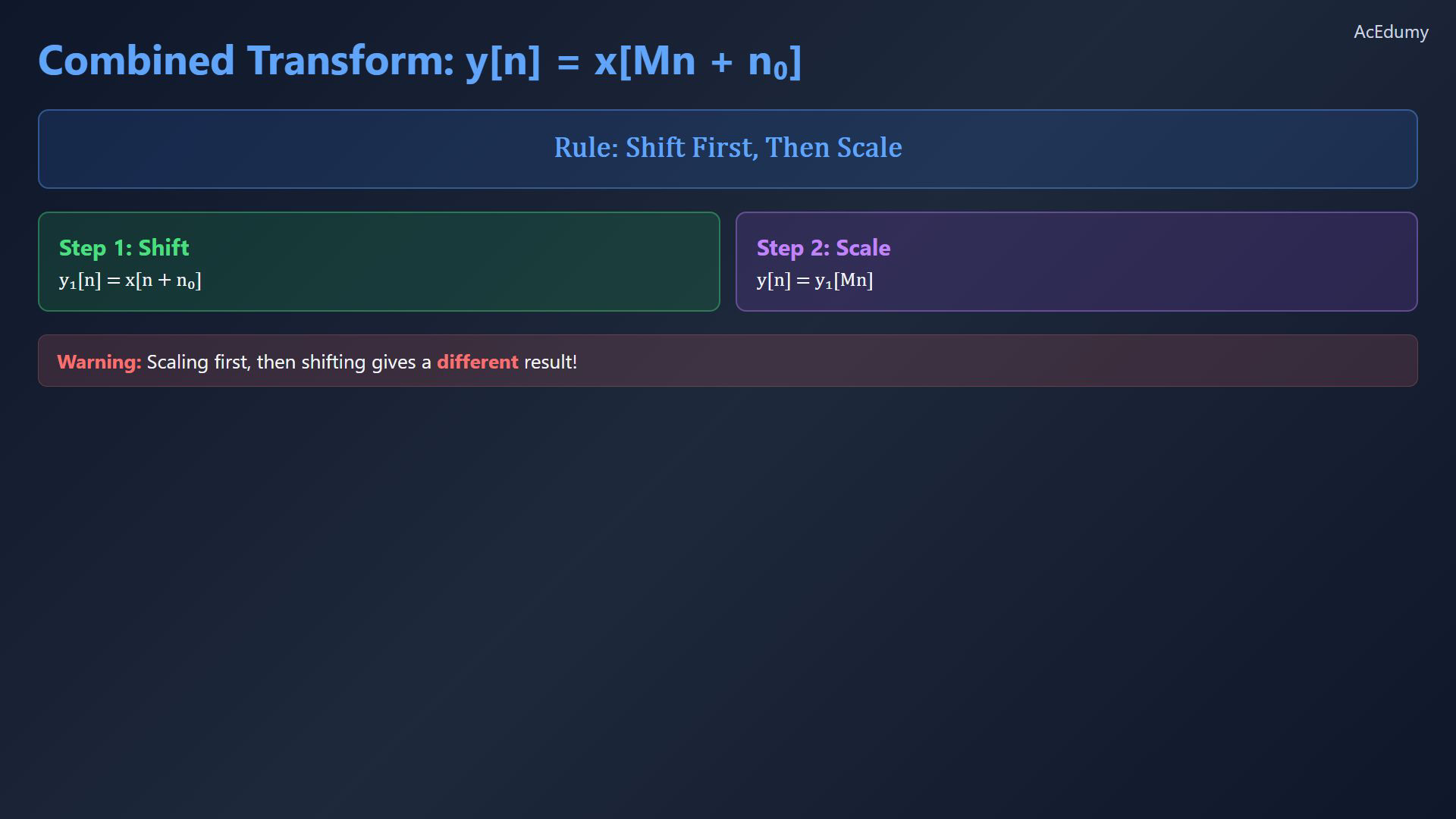
Same-source reference. Reversing the same shift and scale generally changes the result. The two zero samples per period belong to the displayed three-value, period-five pattern; they are not required by the discrete-time domain. The worked source uses seven values at indices −3 through 3, zero elsewhere:The requested transform is:First apply the one-sample advance.The intermediate sequence is:The fixed value list keeps its order; its origin pointer moves one position right, while the signal on the index axis shifts one sample left.Next apply decimation by two.Evaluate the intermediate sequence only at even indices:Use the divide-and-check rule on the intermediate indices, which run from −4 through 2.Divide each intermediate index m by two to find its candidate output index:Keep only integer results: intermediate indices −4, −2, 0 and 2 become output indices −2, −1, 0 and 1.Discard the intermediate odd indices; no interpolation is part of this decimation.The surviving values form the output, with zero elsewhere:Narration transcript
Let us work through a concrete example. Given x of n, find y of n equals x of two n plus one. Step one: shift. Compute y one of n equals x of n plus one. This shifts the n equals zero pointer one position to the right in vector notation. Step two: scale. Compute y of n equals y one of two n. Apply the divide-and-check method to y one of n. For each index in y one, divide by two. If the result is an integer, keep that value. Otherwise, discard it. The surviving values give us y of n equals x of two n plus one.
3. Define a periodic extension
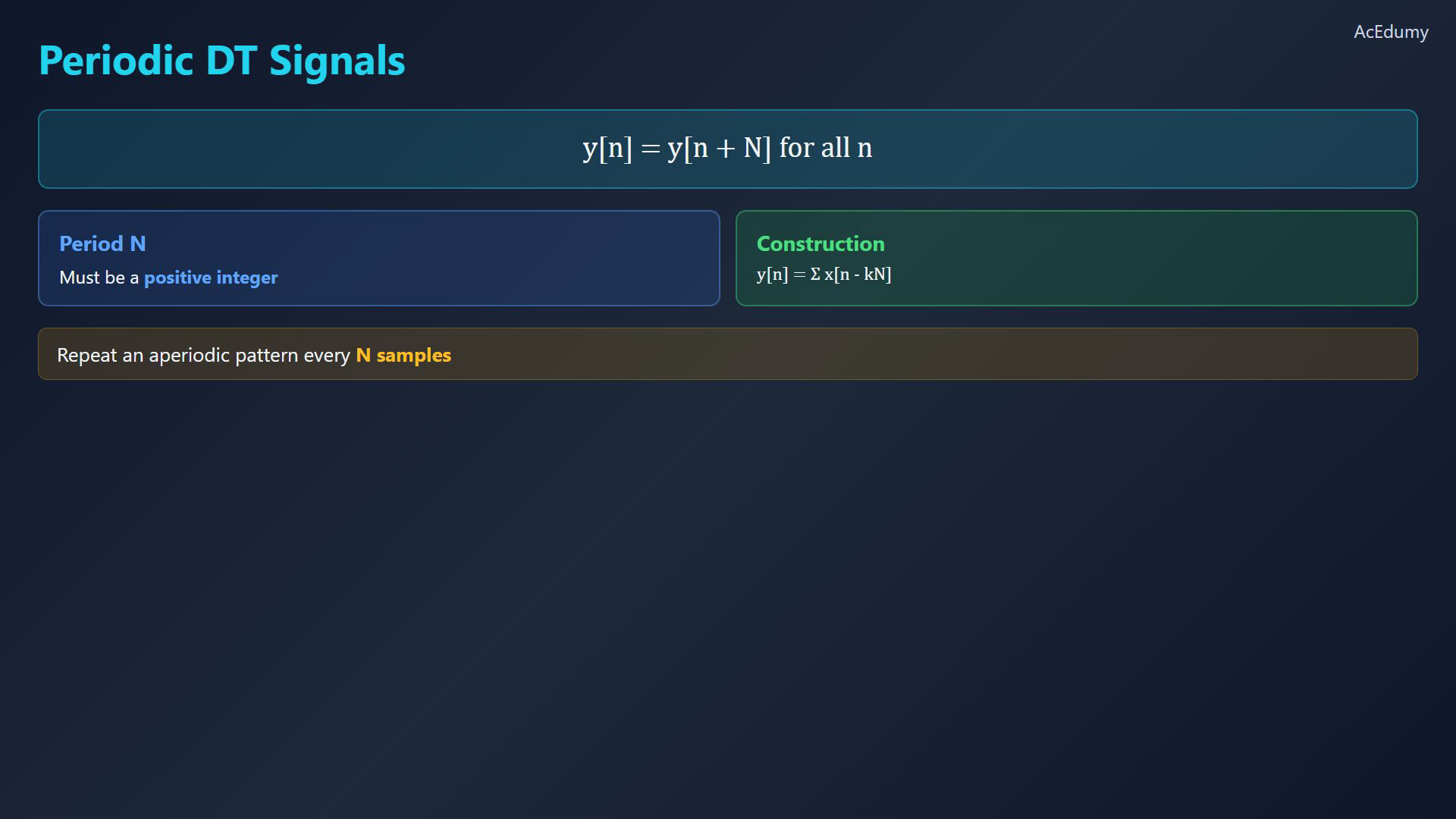
Same-source reference. Reversing the same shift and scale generally changes the result. The two zero samples per period belong to the displayed three-value, period-five pattern; they are not required by the discrete-time domain. A periodic discrete-time signal repeats on the integer index domain.For some positive integer N, require the equality at every integer index:Repeat a finite-support base every N samples. N is a period; it need not be the smallest possible period.The periodic extension adds all integer-shifted copies; finite support makes each pointwise sum finite:Each copy shifts by a multiple of N. Overlapping copies add; the general construction does not require a zero gap.Narration transcript
Now let us discuss periodic discrete-time signals. A discrete-time signal y of n is periodic with period N if y of n equals y of n plus N for all n, where N is a positive integer. We can construct a periodic signal from a finite-length aperiodic signal x of n by repeating it every N samples. Mathematically, y of n equals the sum of x of n minus k N for all integers k. Each copy of x of n is shifted by a multiple of N.
4. Three-sample pattern with period five
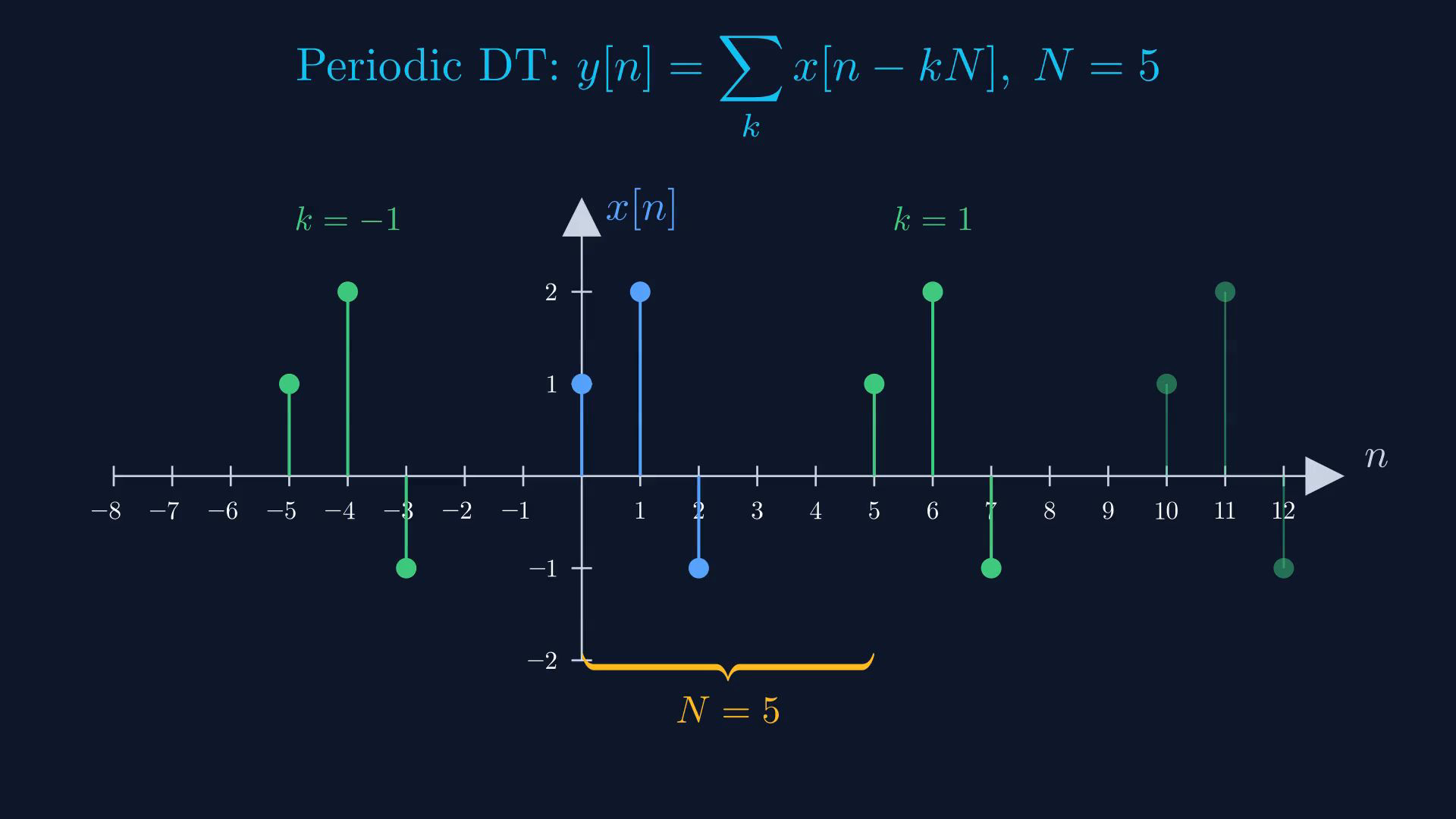
Same-source reference. Reversing the same shift and scale generally changes the result. The two zero samples per period belong to the displayed three-value, period-five pattern; they are not required by the discrete-time domain. Consider the specific three-sample base, with zero outside indices 0, 1 and 2.Its nonzero values are:Place this pattern at every multiple of five:The original copy occupies indices 0, 1 and 2.The next copy occupies indices 5, 6 and 7.The copy one period to the left occupies indices −5, −4 and −3.For this three-sample pattern with spacing five, the two intervening integer samples are zero:One period is the following five values; this pattern also has fundamental period five:Narration transcript
Let us see this with an example. Take x of n with three values: one at n equals zero, two at n equals one, and negative one at n equals two. To create a periodic signal with period N equals five, we place copies of x of n at every multiple of five. The first copy sits at n equals zero, one, two. The next copy at n equals five, six, seven. Another at n equals negative five, negative four, negative three. Between copies, the signal is zero. The result repeats every five samples, making it periodic with period five.
5. Domain and example-specific zero gaps
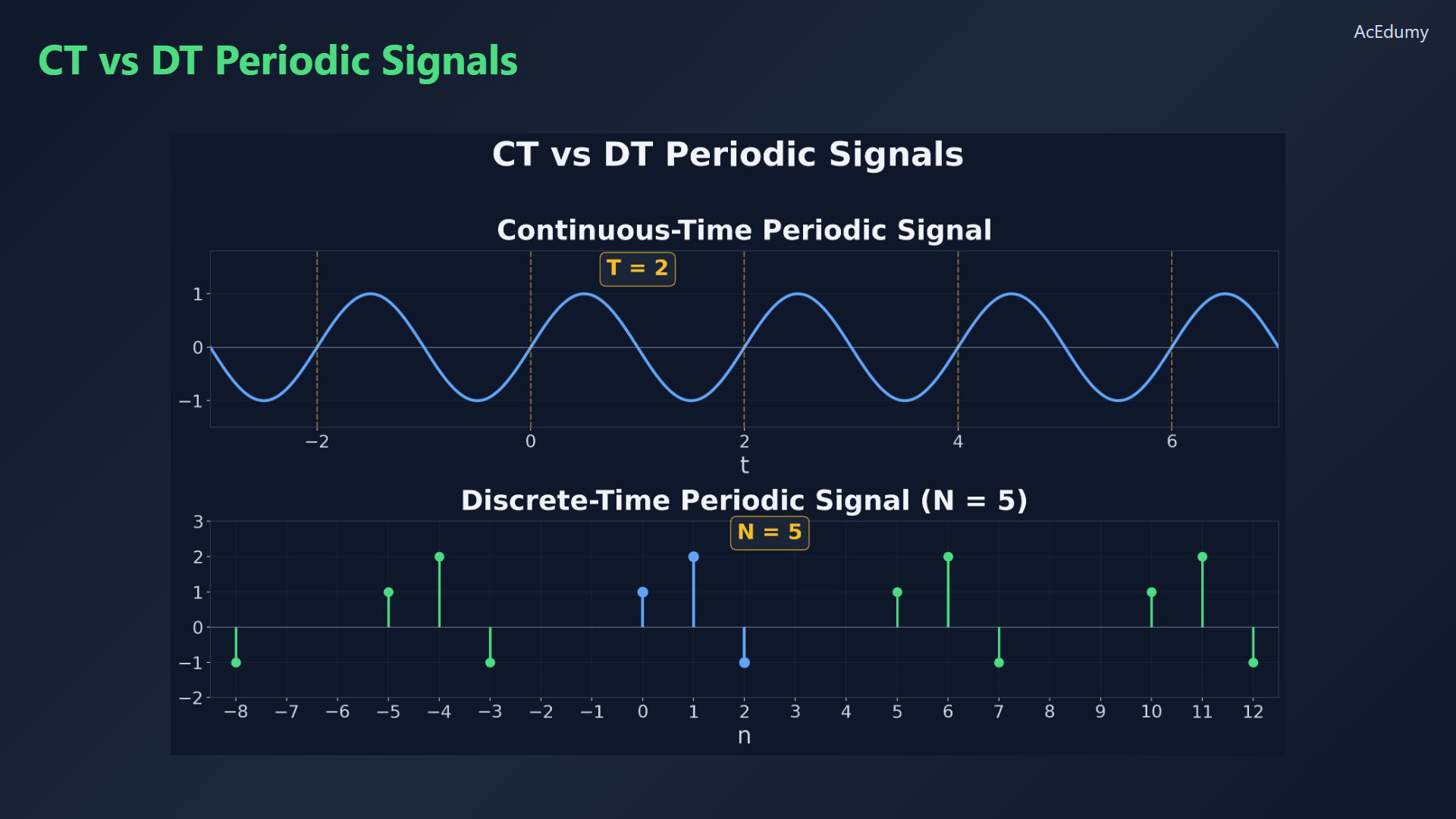
Same-source reference. Reversing the same shift and scale generally changes the result. The two zero samples per period belong to the displayed three-value, period-five pattern; they are not required by the discrete-time domain. Compare the domains and allowed period types using the displayed continuous-time and discrete-time examples.A continuous-time period is a positive real duration satisfying the periodicity condition for that signal.A discrete-time period is a positive integer number of samples satisfying its periodicity condition.Continuous-time periodicity holds for every real time:Discrete-time periodicity holds for every integer index:Both constructions repeat a pattern regularly; overlapping copies must be added.The zero gaps in this comparison belong to the displayed three-value pattern repeated every five samples. Other periodic sequences can have no zeros; noninteger times are outside a sequence’s domain, not implicit zeros.Narration transcript
How do periodic discrete-time signals compare to periodic continuous-time signals? For continuous-time, the period T can be any positive real number. For discrete-time, the period N must be a positive integer. In continuous-time, we used x of t equals x of t plus T. In discrete-time, we use x of n equals x of n plus N. The construction method is the same: take a basic pattern and repeat it at regular intervals. But in discrete-time, between the non-zero values, the signal is exactly zero, creating a clear separation between copies.
6. Summary

Same-source reference. Reversing the same shift and scale generally changes the result. The two zero samples per period belong to the displayed three-value, period-five pattern; they are not required by the discrete-time domain. Review the discrete-time operations from Lecture Two.Track the integer domain, vector origin, sampling convention and shift direction.Distinguish reversal, decimation and explicitly defined upsampling.Compose shift and scale in the stated order; periodic extension repeats and adds the finite pattern without requiring zero gaps in general.The next lecture introduces the unit impulse, unit step and exponential sequences.Narration transcript
Let us review everything from Lecture Two. In lesson four, we defined discrete-time signals, learned vector notation, sampling from continuous-time, and time shifting. In lesson five, we covered time reversal and time scaling, including decimation and upsampling. In this lesson, we combined shift and scale using the shift-first-then-scale rule, and we constructed periodic discrete-time signals by repeating aperiodic patterns. In the next lecture, we will study elementary discrete-time signals like the unit impulse, unit step, and exponential sequences.
Source video: Signals & Systems #06 | Combined DT Transforms & Periodic Discrete-Time Signals (4:03)