Circuit Theory 1 · Second-Order Transients
#50 Transient Analysis #50 — Complete response of a driven parallel RLC
Combines forced and natural response, separating the roles of the source, poles, and initial conditions in a full second-order response.
Question
Build the complete response of a parallel RLC driven by a DC current step; show the final value, transient form, and role of the two initial conditions.
Written solution and narration transcript(shows the full solution)
Below are all the lines written in the notebook together with the full narration transcript.
1. Separate natural and full response
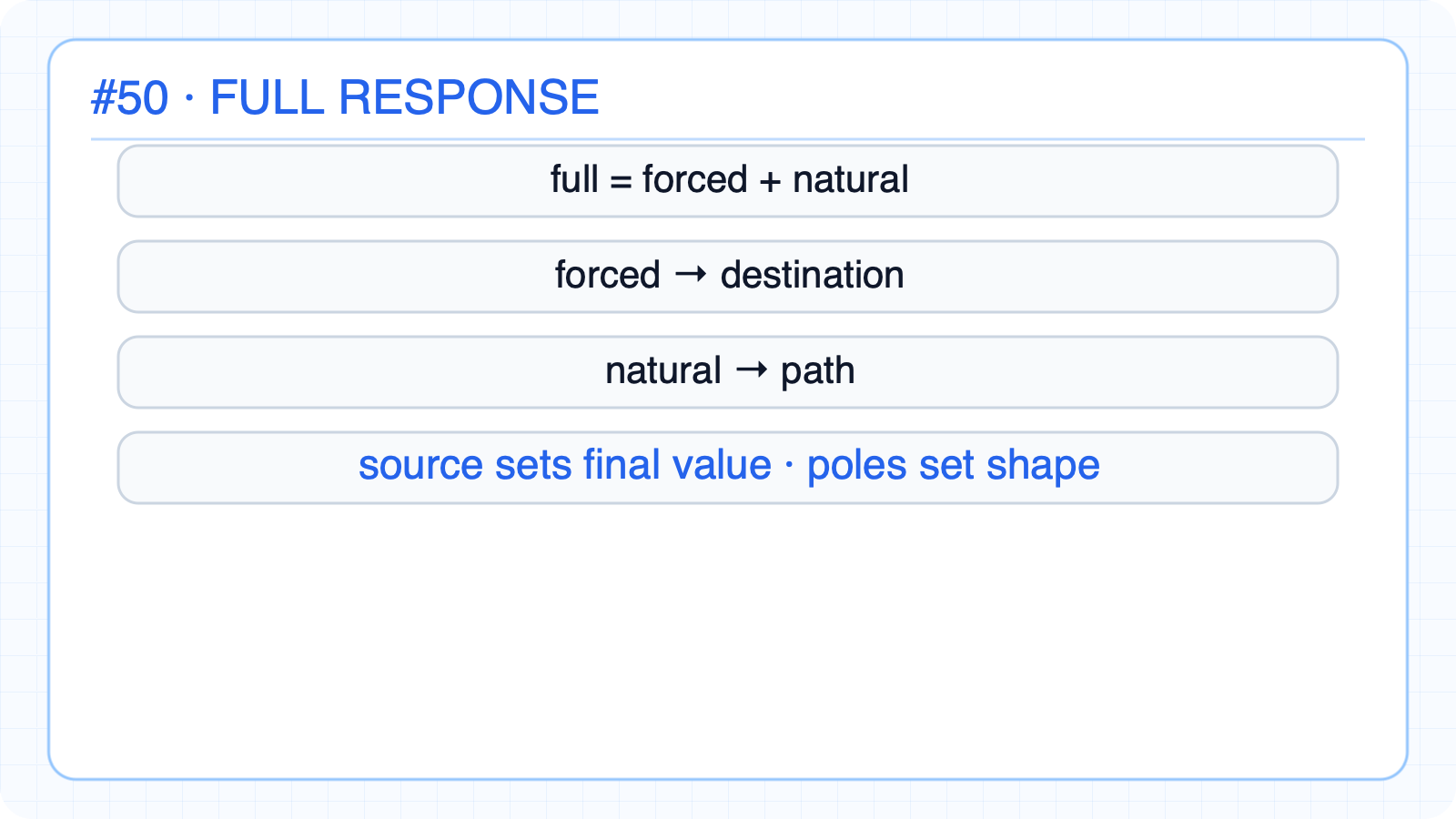
Circuit Theory 1 #50 · Separate natural and full response Natural response comes only from stored energyAn external source adds a forced responseFull response = forced response + natural responseThe forced part says where the circuit will settleThe natural part says how it gets thereThe source sets the destination; the poles set the pathNarration transcript
So far, we studied natural response. That means the circuit was moving only because of stored energy. Full response is different. Now an external source drives the circuit, so the total response becomes the sum of two parts: the forced response and the natural response. The forced part tells us where the circuit wants to settle because of the source. The natural part tells us how the circuit gets there.
2. Parallel RLC driven by a current step
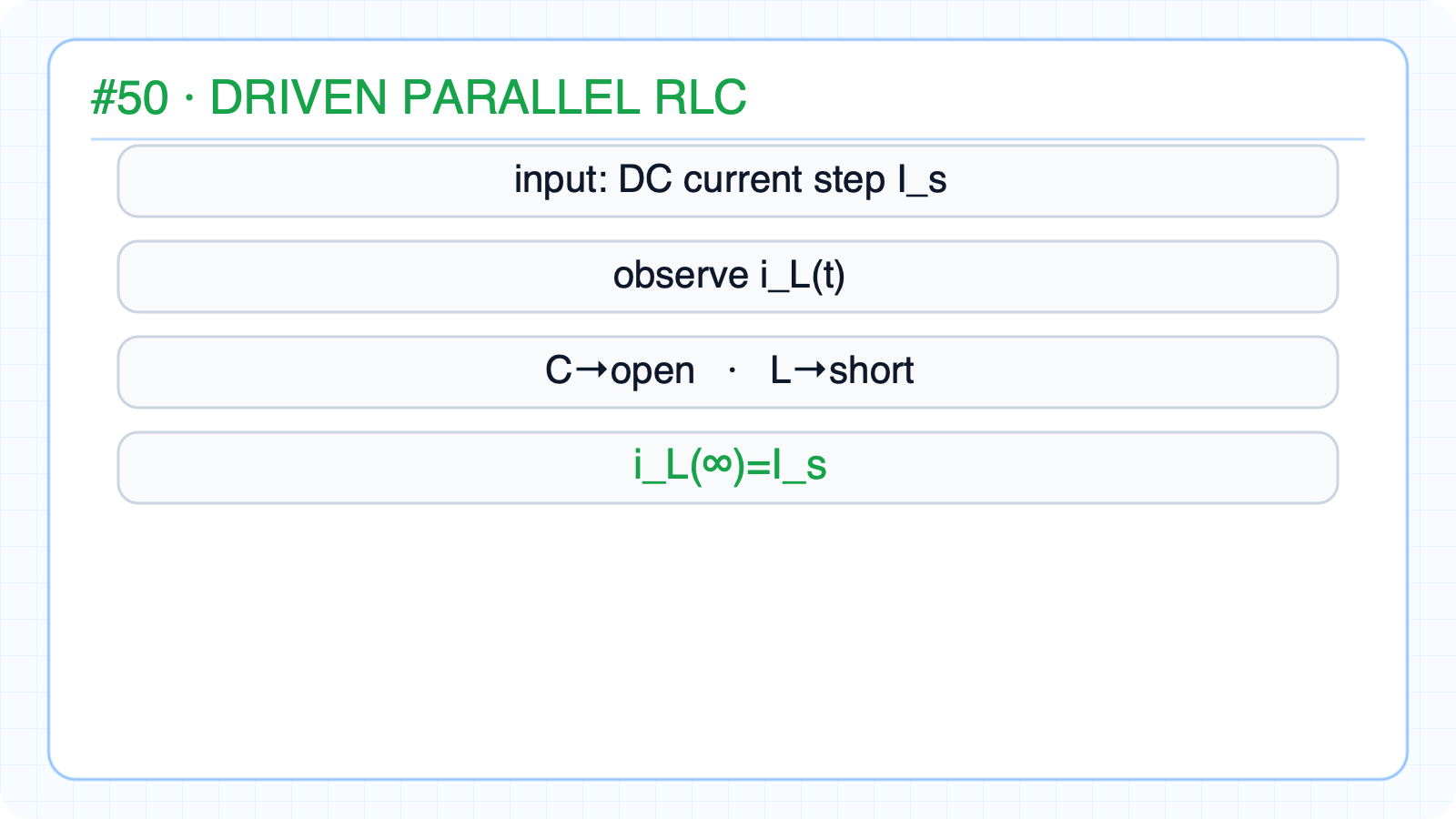
Circuit Theory 1 #50 · Parallel RLC driven by a current step Apply a DC current step Is to a parallel RLCResponse variable: iL(t)As t→∞, C behaves as an open circuitAs t→∞, L behaves as a short circuitv(∞)=0 and iR(∞)=0The final value is the constant forced componentNarration transcript
Consider a parallel R L C circuit driven by a D C current step source. We will observe the inductor current i sub L of t. At long time, the capacitor behaves like an open circuit and the inductor behaves like a short circuit. That means the node voltage goes to zero, the resistor current goes to zero, and the entire source current flows through the inductor. So the final value is i sub L of infinity equals I sub s.
3. Write the full-response forms
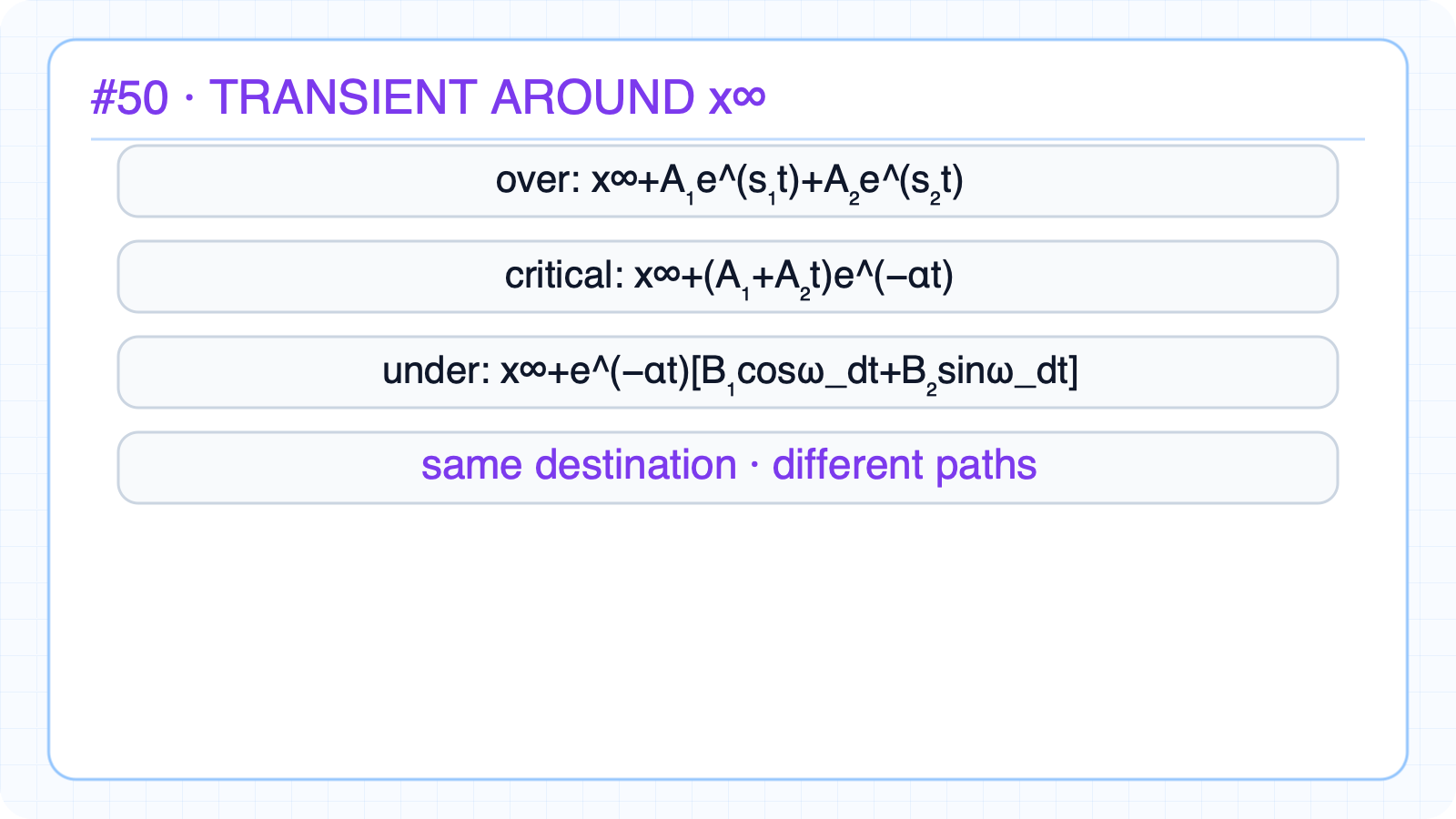
Circuit Theory 1 #50 · Write the full-response forms Start with the common final value x(∞)Overdamped:Critical:Underdamped:Pole type selects the transient shapeThe source usually determines x∞All transient terms decay to zeroNarration transcript
The key idea is simple: keep the same final value, then add the transient shape around it. For an overdamped case, x of t equals x infinity plus two real exponential terms. For the critically damped case, x of t equals x infinity plus a linear term times e to the minus alpha t. For the underdamped case, x of t equals x infinity plus e to the minus alpha t times a sinusoidal combination. So the pole type still controls the transient shape. The source mainly sets the steady final value.
4. Find the two constants from initial conditions
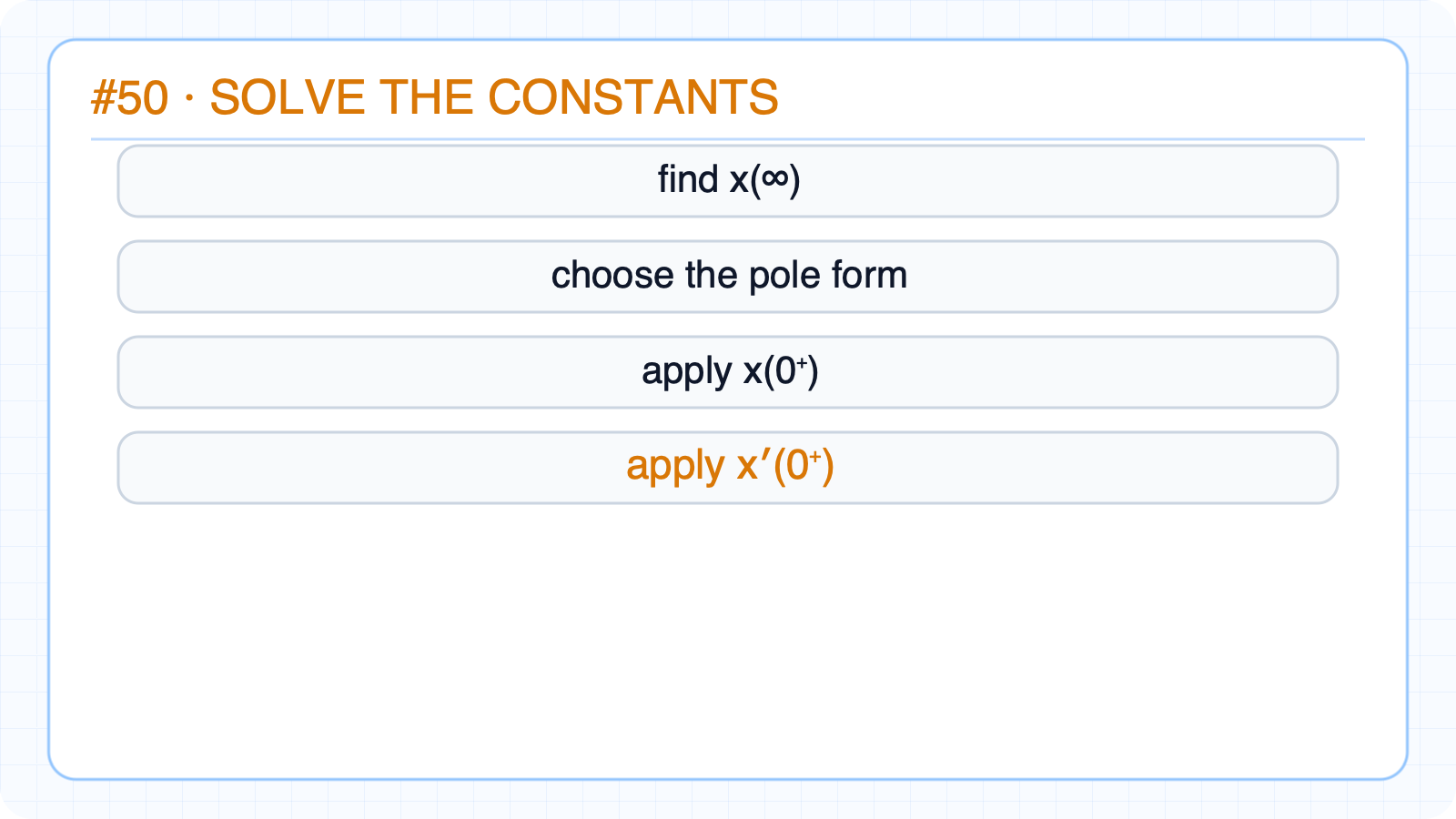
Circuit Theory 1 #50 · Find the two constants from initial conditions A second-order response needs two independent conditionsCondition 1: x(0⁺)Condition 2: x′(0⁺)Continuity laws provide x(0⁺)KCL or KVL provides the initial derivativex∞ → correct form → two conditions → constantsRecheck both initial and final values in the resultNarration transcript
How do we find the constants? Exactly the same way as before: use the initial conditions. For a second-order response, we need two independent conditions, typically x of zero plus and x prime of zero plus. Those two conditions determine the coefficients in the transient term. So the full response structure is easy: first find x of infinity, then choose the correct transient form, then solve the constants from the initial conditions.
5. Interpret an underdamped full response
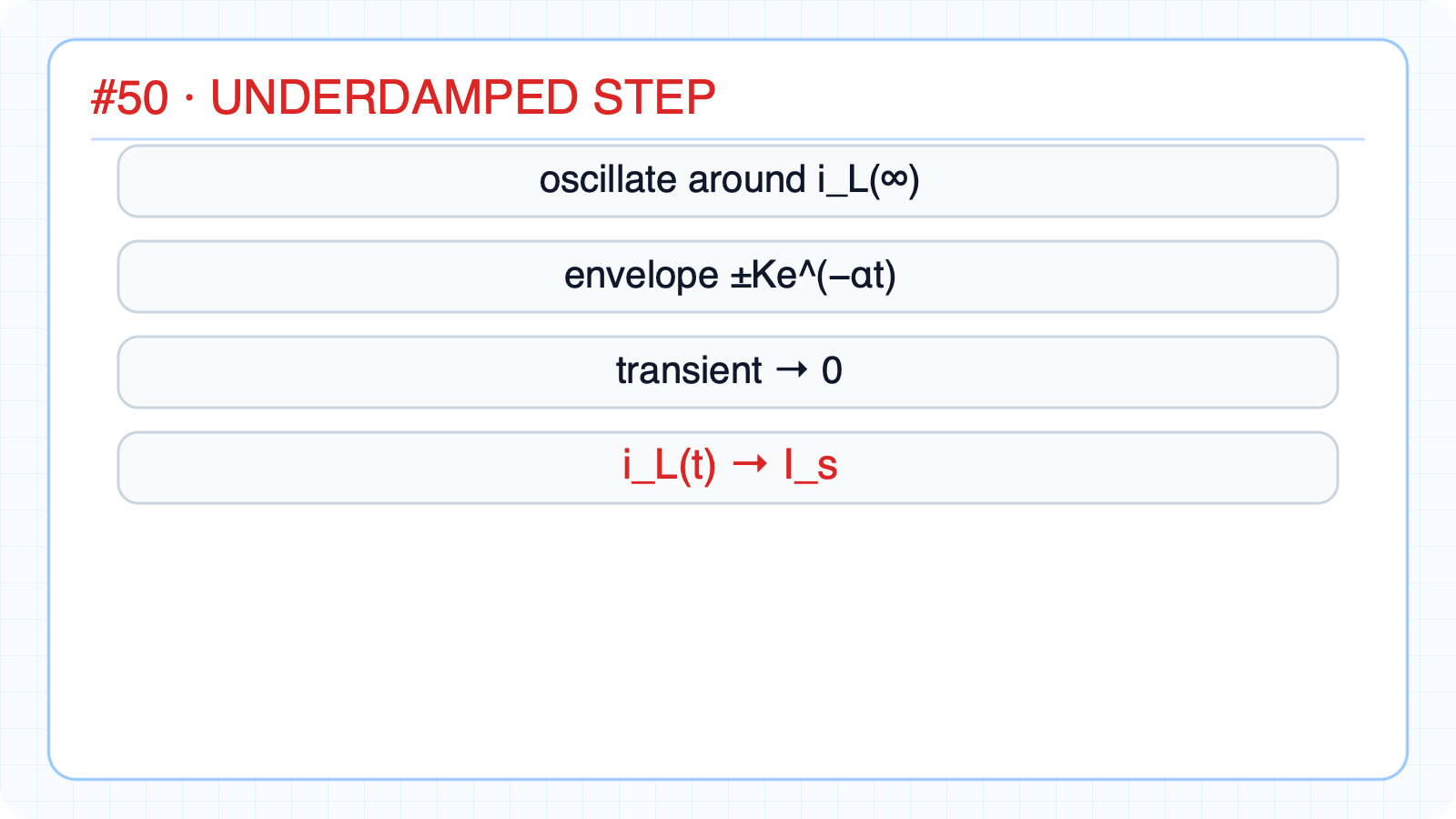
Circuit Theory 1 #50 · Interpret an underdamped full response Let the current settle to a nonzero iL(∞)Complex poles create a transient oscillationThe waveform rings around the final valueThe ±Ke−αt envelopes bound the oscillationAs t→∞, the transient term vanishesResult:Narration transcript
Here is one underdamped full-response example. The current settles to a non-zero final value, but it does not go there directly. Instead, it oscillates around the final value while the envelope decays. This picture is the most important intuition for the full second-order step response: the source fixes the destination, and the poles decide the path.
6. Summarize the full second-order response
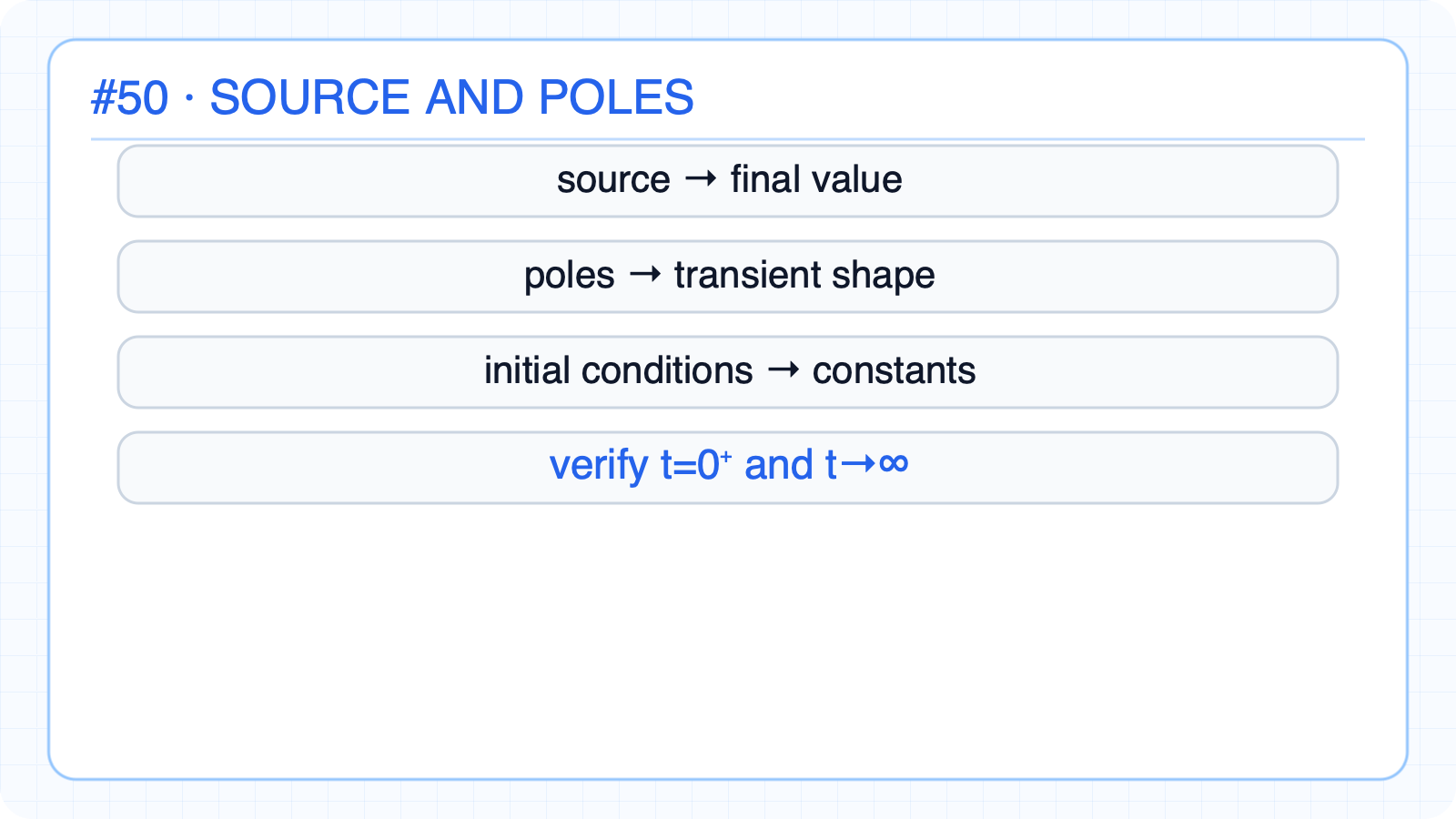
Circuit Theory 1 #50 · Summarize the full second-order response Full response = forced + naturalFor a DC step, the forced response is often a constant final valuePoles produce an over-, critical-, or underdamped pathTwo conditions determine the transient constants1) x∞ 2) form 3) x(0⁺),x′(0⁺)The full response starts at the initial state and ends at the forced stateNext: series RLC and circuit dualityNarration transcript
Let us summarize. Full response equals forced response plus natural response. In a D C step problem, the forced response often becomes the steady final value. The transient part still follows the same second-order cases we already learned: overdamped, critical, or underdamped. To solve any full response, find x infinity, choose the transient form from the poles, and compute the constants from the initial conditions. Next lesson, we connect this idea to the series R L C form and duality.