Control Theory · Understanding Components in Control
#02 Manipulated input, controlled output, disturbances and the desired value
Identify what is manipulated, what is measured and which outside effects influence car speed and room temperature.
Question
For each example, first choose the system boundary and desired behavior. Identify the manipulated input signal, the actual output quantity and external disturbances. The named gas pedal and radiator valve are devices; the input signals are their commanded position or opening. For a finer plant boundary, actuator force or heat flow may instead be the plant input. The reference or desired value is separate from the measured output: a room target of 20 degrees Celsius does not mean the actual temperature already equals it. The selected illustration reads19 degrees Celsius and shows the target separately. In the car example, speed is the output and increasing it is the goal; pedal position is the manipulated input. Opposing wind and resisting friction are disturbances under the stated driving conditions; wind direction can also assist motion, and modeled nominal friction may be part of the plant rather than an unknown external input. In the room example, the radiator valve opening controls heating, room temperature is the output, and heat from people and sunlight is treated as disturbance. These introductory questions identify roles; they do not alone specify controller dynamics, sensors, feedback architecture, stability or guaranteed tracking. A signal-role mistake invalidates a model of the intended system even if later algebra is internally consistent. Treat the arrows between the three question cards as a reading order, not a physical causal chain from output to disturbance. The animated temperature and moving car are illustrations, not computed system responses.
Written solution and narration transcript(shows the full solution)
Below are all the lines written in the notebook together with the full narration transcript.
1. Identify the lesson
The input is the manipulated setting, such as pedal position or valve opening; the output is speed or temperature. The room target is 20 °C, while the illustrated reading is 19 °C. The target and actual output are separate quantities. These are role-identification illustrations, not a simulated closed-loop performance result. Introduce Control Theory.Identify Lesson 2.Identify components in a control problem.Narration transcript
Welcome to Control Theory. Lesson 2. Understanding components in control.
2. Identify three signal roles
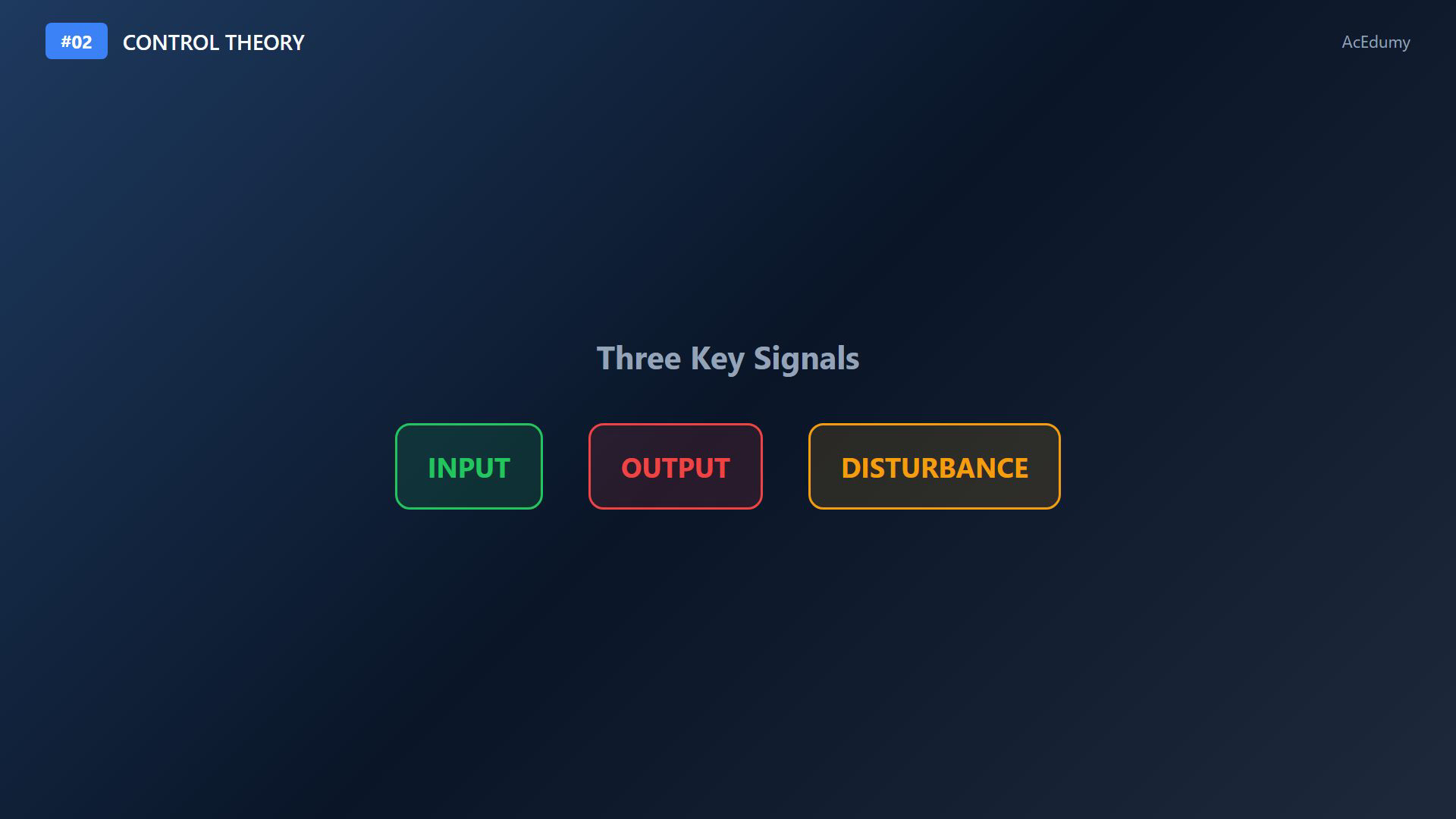
The input is the manipulated setting, such as pedal position or valve opening; the output is speed or temperature. The room target is 20 °C, while the illustrated reading is 19 °C. The target and actual output are separate quantities. These are role-identification illustrations, not a simulated closed-loop performance result. Identify three signal roles.Name the manipulated input, actual output and disturbance.Decide which quantity plays each role.Narration transcript
In any control system, we need to identify three key signals. Input, output, and disturbance. But how do we determine which is which?
3. Ask three questions
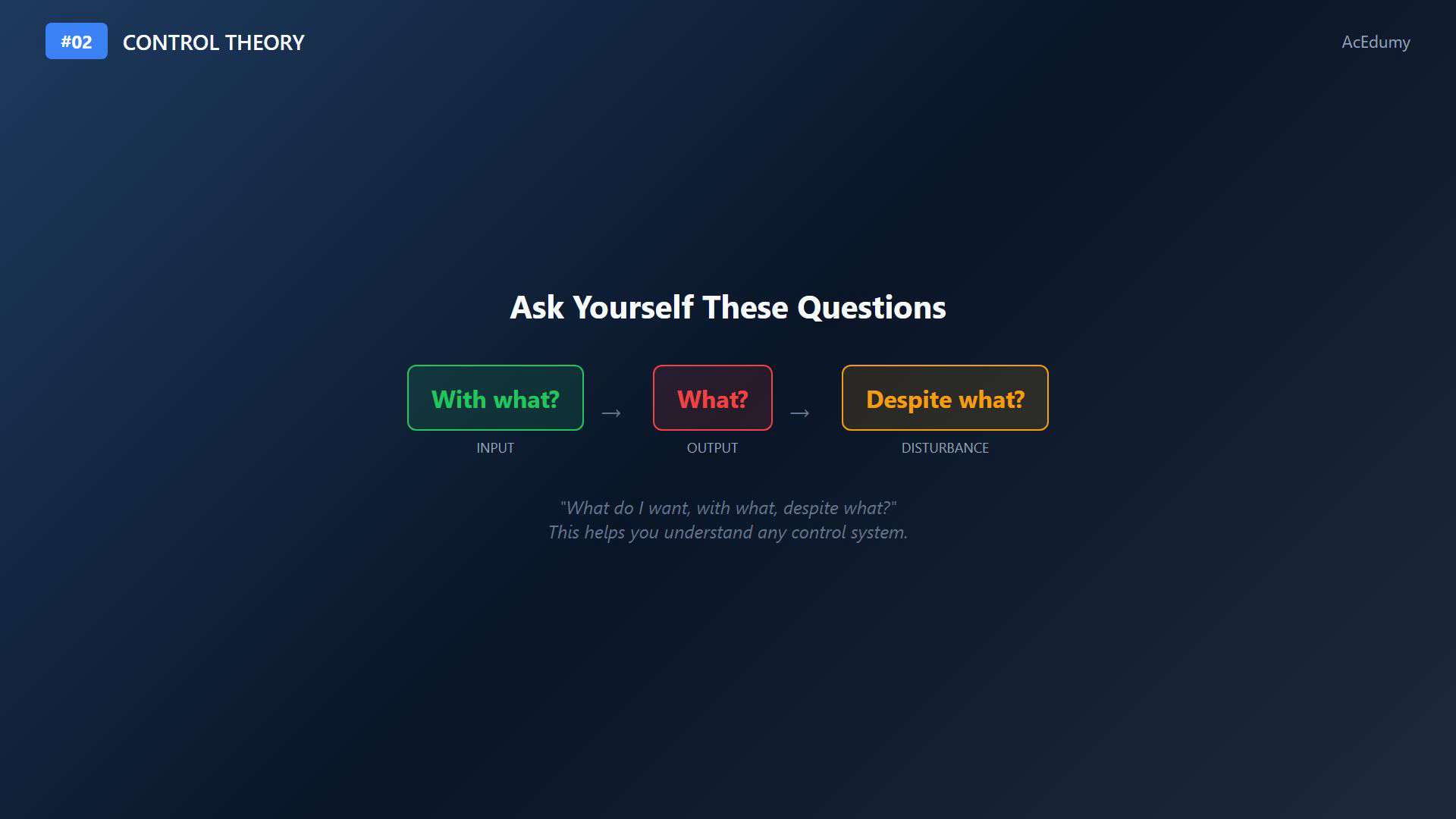
The input is the manipulated setting, such as pedal position or valve opening; the output is speed or temperature. The room target is 20 °C, while the illustrated reading is 19 °C. The target and actual output are separate quantities. These are role-identification illustrations, not a simulated closed-loop performance result. Ask three questions about the chosen system.Identify what you manipulate.That manipulated quantity is the input.Identify the quantity you want to control.That physical quantity is the output; its desired value is a separate reference.Identify outside influences on the result.Those influences are disturbances in the chosen model.State the desired behavior.State the manipulated input.State the disturbances.Use the questions to organize the system model.Narration transcript
Ask yourself these three questions. With what am I controlling? That is your input. What I want to achieve? That is your output. Despite what am I trying to achieve this? That is your disturbance. Think, what do I want? With what? Despite what? This helps you understand any control system.
4. Apply the roles to car speed
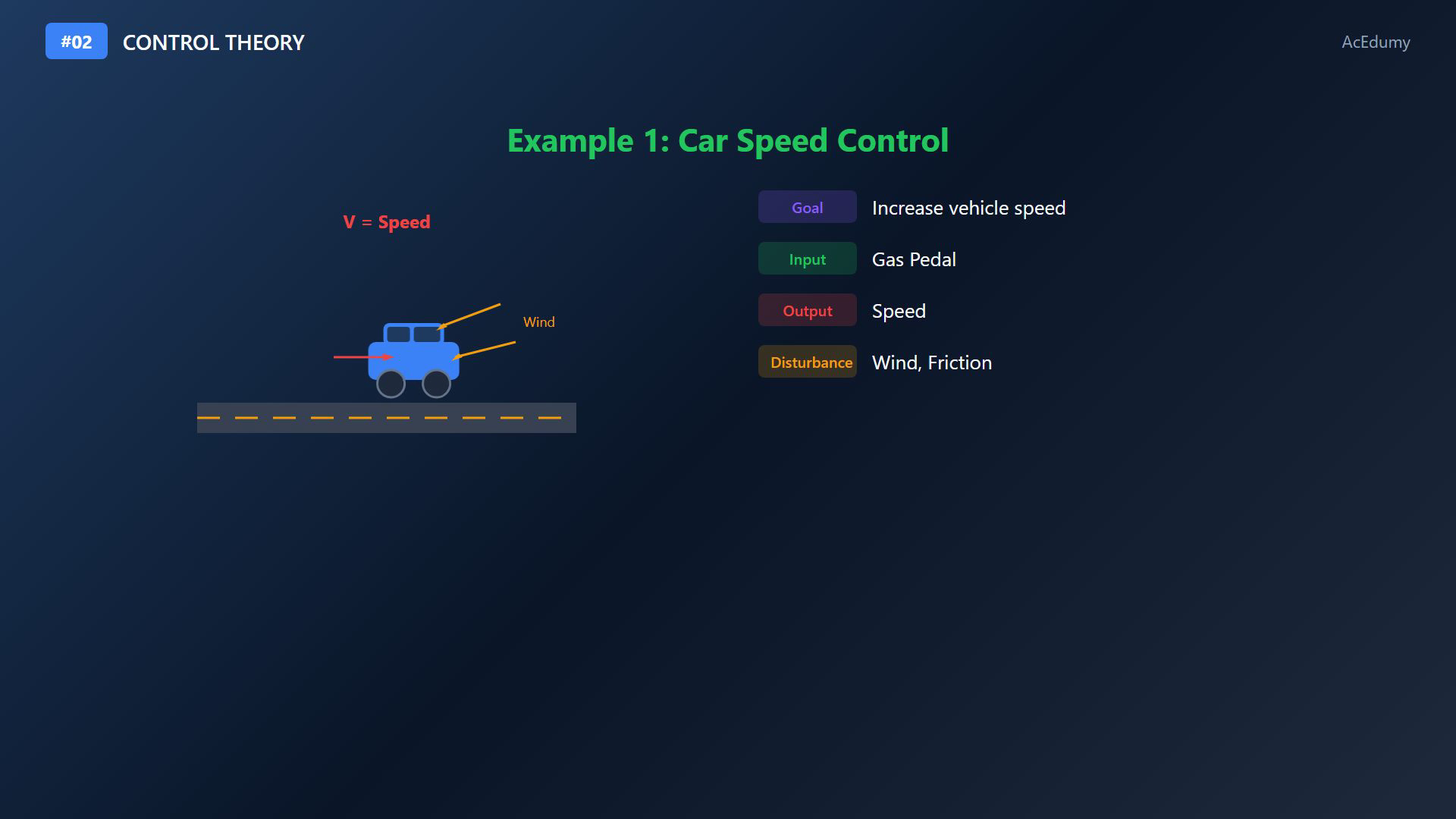
The input is the manipulated setting, such as pedal position or valve opening; the output is speed or temperature. The room target is 20 °C, while the illustrated reading is 19 °C. The target and actual output are separate quantities. These are role-identification illustrations, not a simulated closed-loop performance result. Apply the roles to car speed control.Set the goal of increasing vehicle speed.Choose how to influence speed.Use the gas pedal.Pedal position is the manipulated input signal.Identify the controlled output quantity.The quantity is speed.Vehicle speed is the output.Identify effects opposing the intended motion.Opposing wind and resisting friction slow the vehicle in this example.Treat these wind and friction effects as disturbances.Narration transcript
Let us apply this to our first example, car speed control. Our goal is to increase the speed of the vehicle. With what can I control the speed? The gas pedal. So input is the gas pedal. What do I want to achieve? Speed. So output is speed. Despite what factors? Wind and friction slow us down. So, disturbances, wind and friction.
5. Apply the roles to room temperature
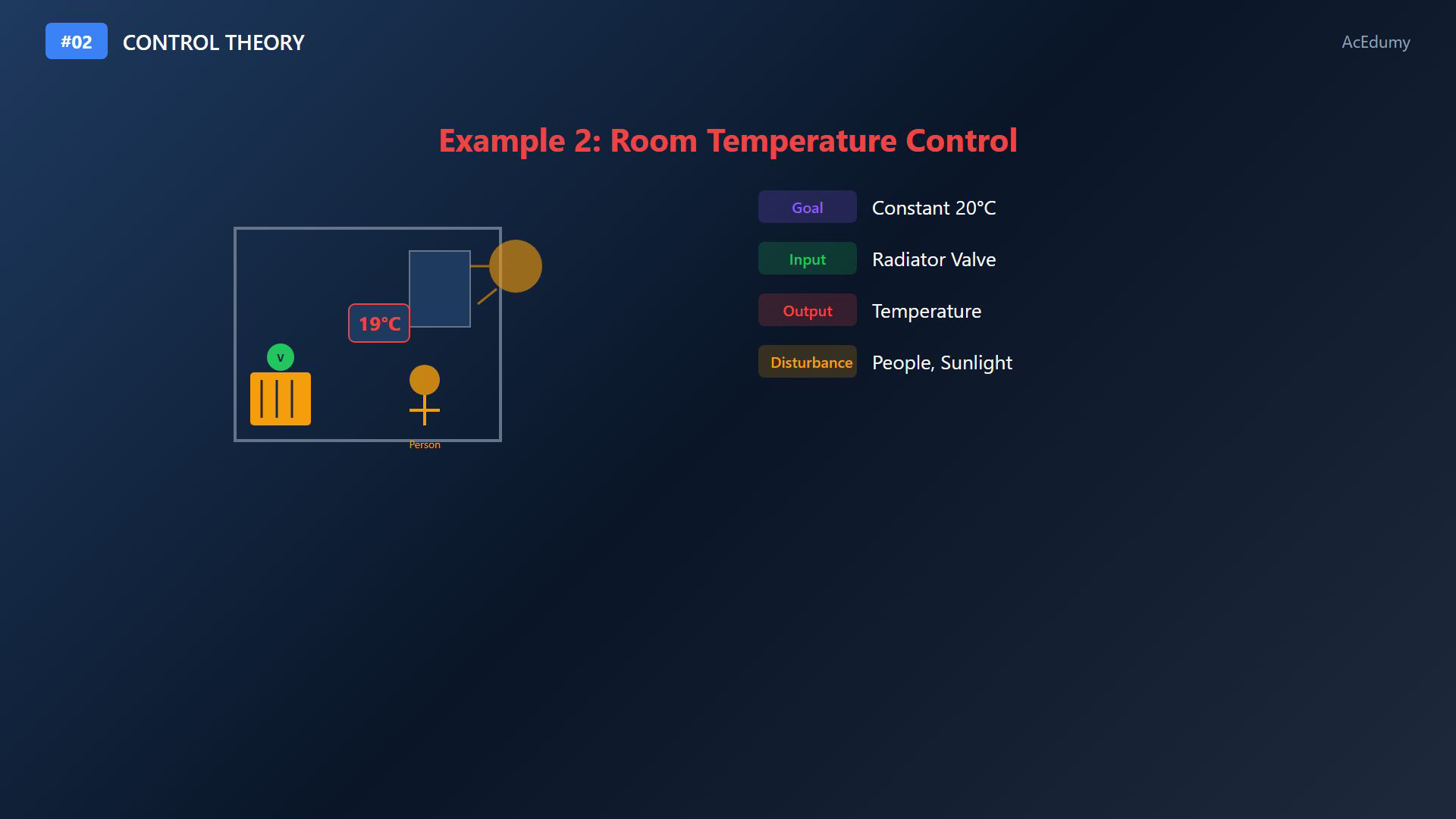
The input is the manipulated setting, such as pedal position or valve opening; the output is speed or temperature. The room target is 20 °C, while the illustrated reading is 19 °C. The target and actual output are separate quantities. These are role-identification illustrations, not a simulated closed-loop performance result. Introduce the second example.Consider room temperature control.Set the target temperature to 20 °C.Choose how to influence temperature.Use the radiator valve.Valve opening is the manipulated input signal.State the desired behavior.Seek a constant target temperature.Actual room temperature is the output.State the disturbances.People release heat and sunlight changes the thermal balance.Treat heat from people and sunlight as disturbances.Narration transcript
Example 2. Room temperature control. Our goal is to keep the room at a constant 20 degrees Celsius. With what can I control the temperature? The radiator valve. So, input is the valve. What do I want? A constant temperature. So, output is temperature. Despite what? People in the room generate heat and sunlight affects temperature. So, disturbance is people and sunlight.
6. Review the signal roles
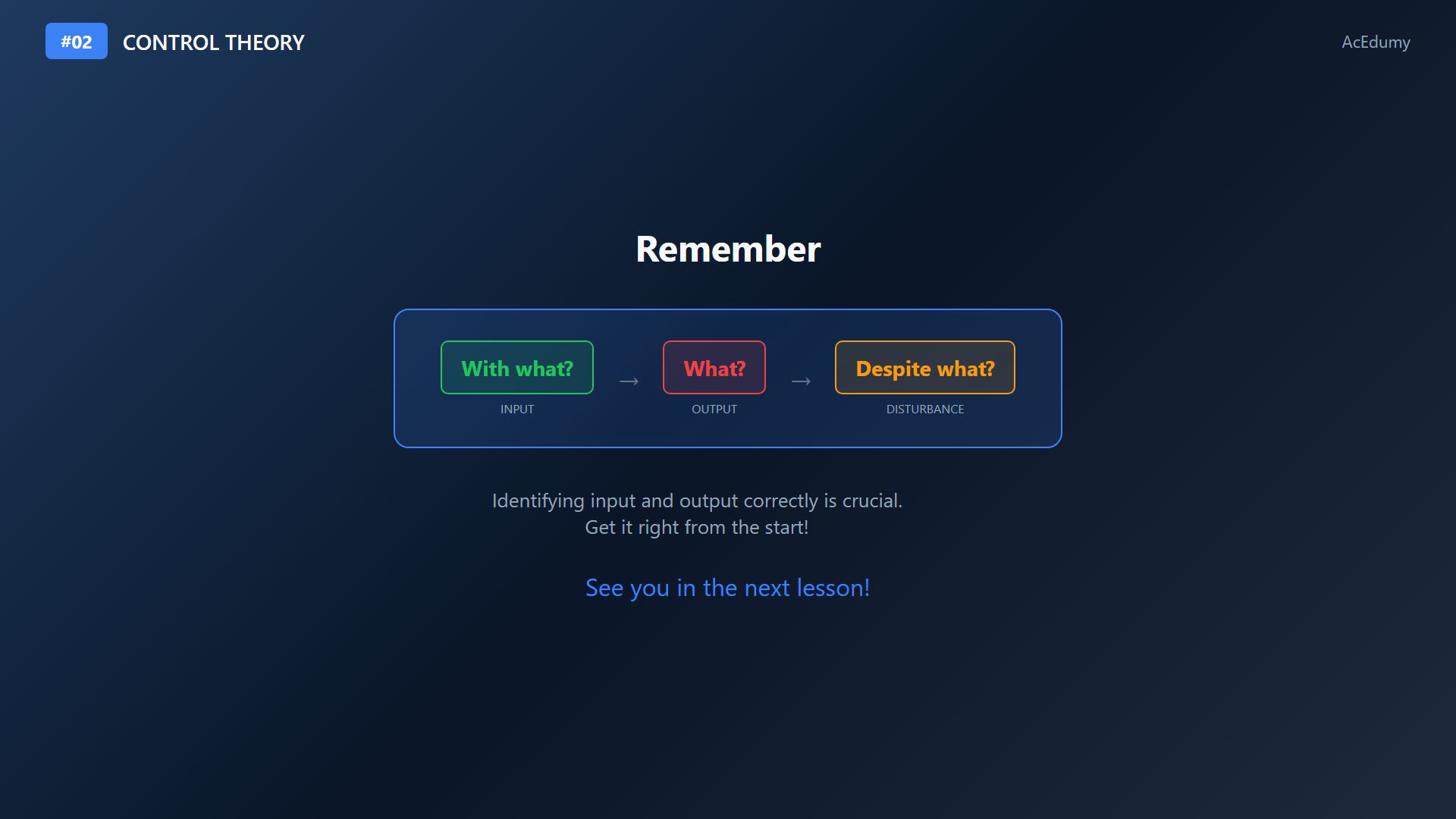
The input is the manipulated setting, such as pedal position or valve opening; the output is speed or temperature. The room target is 20 °C, while the illustrated reading is 19 °C. The target and actual output are separate quantities. These are role-identification illustrations, not a simulated closed-loop performance result. Review the input, output and disturbance questions.Assign signal roles before building a model.An incorrect role assignment can invalidate the intended model.Practice identifying the roles in real examples.Carry the signal-role framework into the next lesson.Narration transcript
Remember, with what, what, despite what. Identifying input and output correctly is crucial. If you get it wrong at the start, your entire solution will be wrong. Practice with real examples and you will master this quickly. See you in the next lesson.
Source video: Control Theory #02 - Understanding Components in Control (Input, Output, Disturbance) (1:51)