Control Theory · Given four systems
#40 Control Theory #40 — Dominant Pole + Over/Undershoot from the s-Plane (Worked Example 17)
Corrected solution notes. The audio is the original recording and may contain errors or incomplete phrases. Where they differ, use the corrected written solution.
Question
Corrected solution notes. The audio is the original recording and may contain errors or incomplete phrases. Where they differ, use the corrected written solution. Control Theory #40 — Dominant Pole + Over/Undershoot from the s-Plane (Worked Example 17)
Written solution and narration transcript(shows the full solution)
Below are all the lines written in the notebook together with the full narration transcript.
1. Given four systems
Corrected solution notes. The audio is the original recording and may contain errors or incomplete phrases. Where they differ, use the corrected written solution.Determine the actual nonzero modes and step-response direction.Narration transcript
Here is the problem. We are given four transfer functions. G one of s equals s plus 3.5 times s plus 4, divided by s plus 3 times s plus 10. G two of s equals s plus 8, divided by s minus 3 times s plus 200. G three of s equals s minus 4, divided by s plus 4 times the quadratic s squared plus 3 s plus 3. G four of s equals s plus 2, divided by s plus 10 times s plus 20. Three questions. Part a — for each transfer function, determine the dominant pole and justify the choice. Part b — which transfer function leads to undershoot in the step response? Part c — which transfer function leads to overshoot? Notice the goal — we are not computing the full step response. We just look at where the poles and zeros sit in the s-plane and read off the answer. The whole problem is a pole-zero map exercise.
2. Dominance and cancellation
Among nonzero modes, the largest real part determines asymptotic dominance.Near cancellation reduces a residue but does not erase it. A finite-time approximation needs an explicit interval and error tolerance.Gain, direct feedthrough and relative degree also affect the response shape.Narration transcript
Quick strategy. Five rules let us answer all three parts without a single time-domain calculation. Rule one — the dominant pole is the pole with the smallest absolute real part, in other words the pole closest to the imaginary axis. That is the slowest mode, so it dominates the long-term decay. Rule two — if any pole sits in the right half plane, the system is unstable. That right-half-plane pole automatically dominates because the response grows exponentially and overwhelms every stable mode. Rule three — a pair of complex-conjugate poles, with negative real part but small magnitude, can dominate over a more distant real pole. Compare the real parts, not the magnitudes. Rule four — pole-zero cancellation. If a zero sits very close to a stable pole, that pole is suppressed and the dominant pole becomes the next slowest one. Rule five — the over and undershoot rules. A zero in the right half plane forces the step response to dip below zero before climbing — that is undershoot. A zero in the left half plane that is closer to the imaginary axis than the dominant pole amplifies the transient and produces overshoot. Five rules, four transfer functions. Now read each one in turn.
3. G1: retain the slow pole
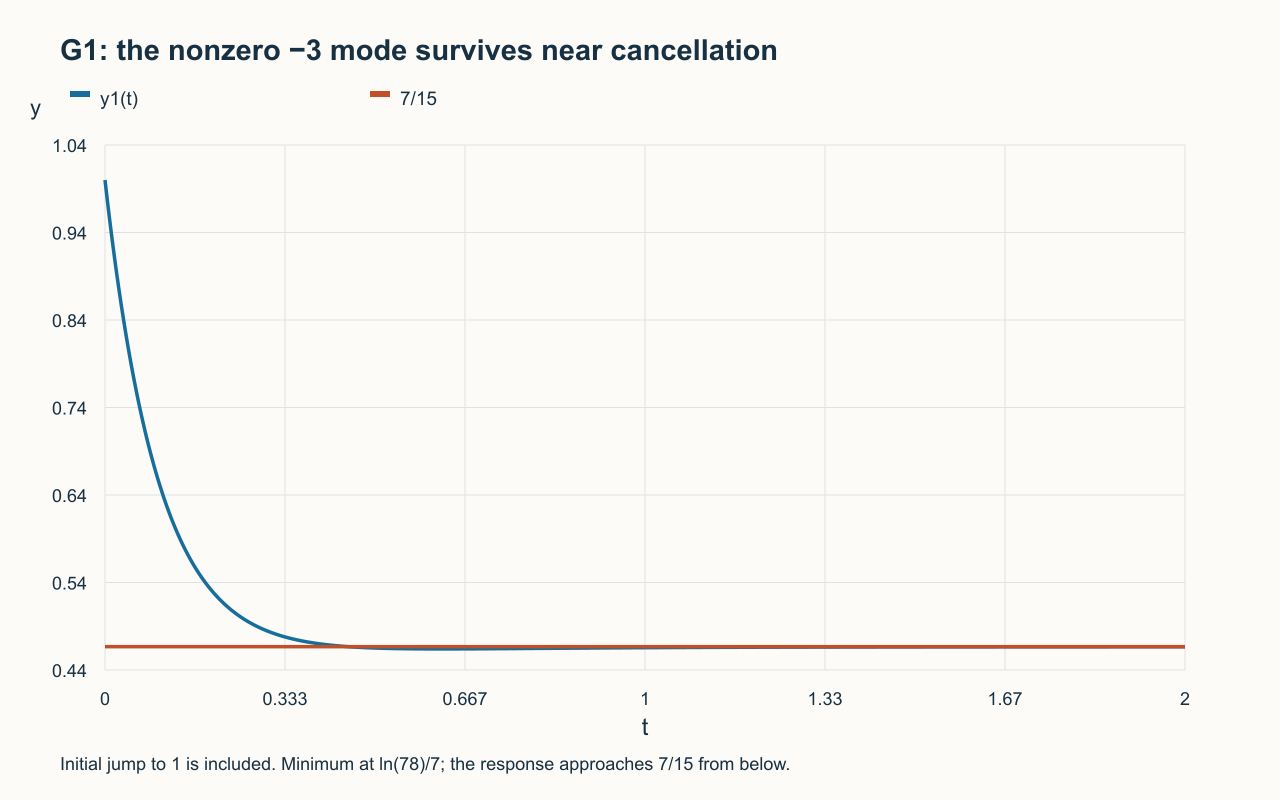
The residue at −3 is nonzero, so −3 is asymptotically dominant. The absolute slow/fast ratio is (5/117)exp(7t).Direct feedthrough makes y1(0+)=1. It decreases, reaches a minimum at ln(78)/7, and approaches 7/15 from below.Narration transcript
G one of s equals s plus 3.5 times s plus 4, divided by s plus 3 times s plus 10. Poles at minus 3 and minus 10. Zeros at minus 3.5 and minus 4. All in the left half plane, so the system is stable. Naive answer — the smallest absolute value pole is at minus 3. So minus 3 should be dominant. But look one inch to the left. The zero at minus 3.5 sits only 0.5 units away from the pole at minus 3. That is near cancellation. The two factors almost annihilate each other, and the contribution of the minus 3 mode to the step response is suppressed. The next slowest pole is at minus 10. With the minus 3 mode killed by the nearby zero, minus 10 takes over. Answer for G one — the dominant pole is at s equals minus 10.
4. G2: unstable dominance
The uncanceled pole +3 contributes a growing exponential and dominates the stable −200 mode.The unit-step response is unbounded; no finite steady-state limit is available.Narration transcript
G two of s equals s plus 8, divided by s minus 3 times s plus 200. Look at the denominator. The factor s minus 3 has a root at s equals plus 3. That is a pole in the right half plane. Right-half-plane pole means the system is unstable. The mode e to the plus 3 t grows exponentially, while the other mode at minus 200 decays almost instantly. The unstable mode wins by a landslide. Notice the asymmetry — minus 200 is much further from the imaginary axis than plus 3, so by the closest-to-jω rule it is far away from dominance anyway. But even if the magnitudes were comparable, an unstable pole would still dominate, because exponential growth always overtakes exponential decay. Answer for G two — the dominant pole is at s equals plus 3, and the system is unstable.
5. G3: inverse motion and ringing
The dominant pair is −1.5±j√3/2; the other pole is −4.Initial value and slope are zero, but the initial second derivative is +1. The output first moves positive while its final value is −1/3.This is inverse motion; it is not an initial negative dip.Narration transcript
G three of s equals s minus 4, divided by s plus 4 times the quadratic s squared plus 3 s plus 3. Two things to notice. First, the quadratic s squared plus 3 s plus 3. Its discriminant is 9 minus 12, equal to negative 3. Negative discriminant means complex roots. Solving, the poles are minus 1.5 plus or minus root 3 over 2 times j, approximately minus 1.5 plus or minus 0.87 j. Compare real parts. The real pole is at minus 4. The complex pair has real part minus 1.5. Since 1.5 is smaller than 4, the complex pair sits closer to the imaginary axis. The complex pair dominates. Second, the numerator. s minus 4 is zero at s equals plus 4 — a right-half-plane zero. By rule five, a right-half-plane zero forces undershoot in the step response. The output dips below zero before climbing back up. Answer for G three — the dominant poles are the complex pair at minus 1.5 plus or minus 0.87 j, and G three exhibits undershoot because of the right-half-plane zero at plus 4.
6. G4: overshoot
The dominant pole is −10.Its maximum is 1/36 at ln(9/4)/10, above the final value 1/100.Narration transcript
G four of s equals s plus 2, divided by s plus 10 times s plus 20. Two real poles, both stable, at minus 10 and minus 20. The closer one to the imaginary axis is minus 10, so the dominant pole is at minus 10. Now check the zero. It is at s equals minus 2. Compare absolute values. The dominant pole is at minus 10, absolute value ten. The zero is at minus 2, absolute value two. The zero sits at one fifth of the distance of the dominant pole — five times closer to the imaginary axis. By rule five, when a stable zero sits closer to the imaginary axis than the dominant pole, it amplifies the transient and produces overshoot. The step response of G four shoots above its final value before settling. Answer for G four — the dominant pole is at s equals minus 10, and G four exhibits overshoot because of the slow left-half-plane zero at minus 2.
7. Verify the full shape
G1 is not monotonic and its initial jump must remain visible. G2 is unstable.G3 has inverse positive initial motion relative to its negative final value; G4 has positive overshoot.A restricted vertical plotting range can hide decisive behavior.Narration transcript
Now verify by plotting the four step responses, computed from the actual transfer functions. G one — top left. Stable, monotonic, settles quickly. The minus 10 mode drives the early transient, the minus 3 mode would have lingered but the nearby zero at minus 3.5 cancels its contribution. Final value matches G one of zero, equal to fourteen over thirty, about 0.467. G two — top right. Note the vertical scale. The response runs off to infinity as the unstable pole at plus 3 takes over. We have to truncate the plot or the curve will leave the page. Confirms instability. G three — bottom left. The output dips below zero in the first second — that is the undershoot caused by the right-half-plane zero at plus 4. Then it climbs and oscillates around the final value because of the complex pole pair at minus 1.5 plus or minus 0.87 j. Final value matches G three of zero, equal to minus 4 divided by 12, about minus 0.333. G four — bottom right. Smooth rise, peak above the final value, then decay back. That is the overshoot caused by the slow zero at minus 2. Final value G four of zero equals 2 divided by 200, equal to 0.01. Four transfer functions, four signatures, four step responses.
8. Review
Corrected mathematical reference; use with the written derivation. Asymptotically dominant poles: G1 −3; G2 +3; G3 −1.5±j√3/2; G4 −10.The near zero does not cancel G1's slow pole exactly. Determine qualitative features from residues and initial/final values, not geometry alone.Narration transcript
Summary. Dominant poles. G one — minus 10, after the nearby zero suppresses the minus 3 pole. G two — plus 3, the unstable pole. G three — complex pair at minus 1.5 plus or minus 0.87 j. G four — minus 10, with the minus 20 pole twice as far away. Undershoot — only G three, because of its right-half-plane zero at plus 4. Overshoot — only G four, because the zero at minus 2 sits five times closer to the imaginary axis than its dominant pole. The big picture. The s-plane geometry tells you everything. The pole closest to the imaginary axis dominates the decay rate. A right-half-plane pole wrecks stability. A right-half-plane zero forces a dip below zero. A slow left-half-plane zero amplifies the transient. And a zero near a pole cancels it, shifting dominance to the next pole over. Five rules, infinite systems, no simulator required.
Source video: Control Theory #40 — Dominant Pole + Over/Undershoot from the s-Plane (Worked Example 17) (10:55)