Control Theory · Tasks and Control Schemes
#03 Engineering objectives, feedforward, negative feedback and solution procedure
Compare reference-based feedforward with output feedback, then organize modeling, analysis, design and testing.
Question
Identify the control objective and follow each signal through the chosen plant boundary. The reference or desired output is distinct from the controller output that drives the plant. The feedforward diagram illustrates a reference-based open loop without output feedback; it does not exhaust feedforward designs, which can also use measured disturbances or be combined with feedback. An open-loop controller needs an adequate plant model and operating assumptions to achieve the intended result. In the feedback diagram, a sensor measures the output and the comparator subtracts that measured value from the reference. The displayed reference-minus-output error assumes an ideal calibrated measurement on the same scale and with compatible units; a nonideal sensor requires its measured signal in the comparison. Interpret the return line as passing through the sensor. The controller then adjusts the manipulated input in an attempt to reduce the error. Continuous correction describes the action of feedback, not automatic stability, complete disturbance rejection or exact tracking; the narration explicitly says tries and allows disturbances to prevent the exact desired output. Stability, limitations, modeling uncertainty, measurement noise and actuator constraints must be evaluated for an actual design. The four engineering stages are plant modeling, understanding plant behavior, controller design and simulation plus real-system testing. This course emphasizes the first three stages; that scope does not make verification unnecessary. SISO means one selected manipulated input and one selected controlled output, with disturbances modeled separately as exogenous influences. The check mark and diagrams illustrate engineering objectives and topology, not measured or simulated performance.
Written solution and narration transcript(shows the full solution)
Below are all the lines written in the notebook together with the full narration transcript.
1. Introduce the control schemes
Read reference, controller output (plant input) and plant output as different signals. The feedforward diagram shows a reference-based open loop. The feedback diagram returns the measured output through a sensor and subtracts it from the reference. Its error expression assumes measurement and reference use the same calibrated scale. Continuous correction is an intended action, not a guarantee of stability or zero error. Introduce Control Theory, Lesson 3.Compare the main tasks, feedforward and feedback.Narration transcript
Welcome to Control Theory, Lesson 3. Today, we'll explore the main tasks in control engineering and learn about two fundamental control schemes, feed-forward and feedback control.
2. State the engineering tasks
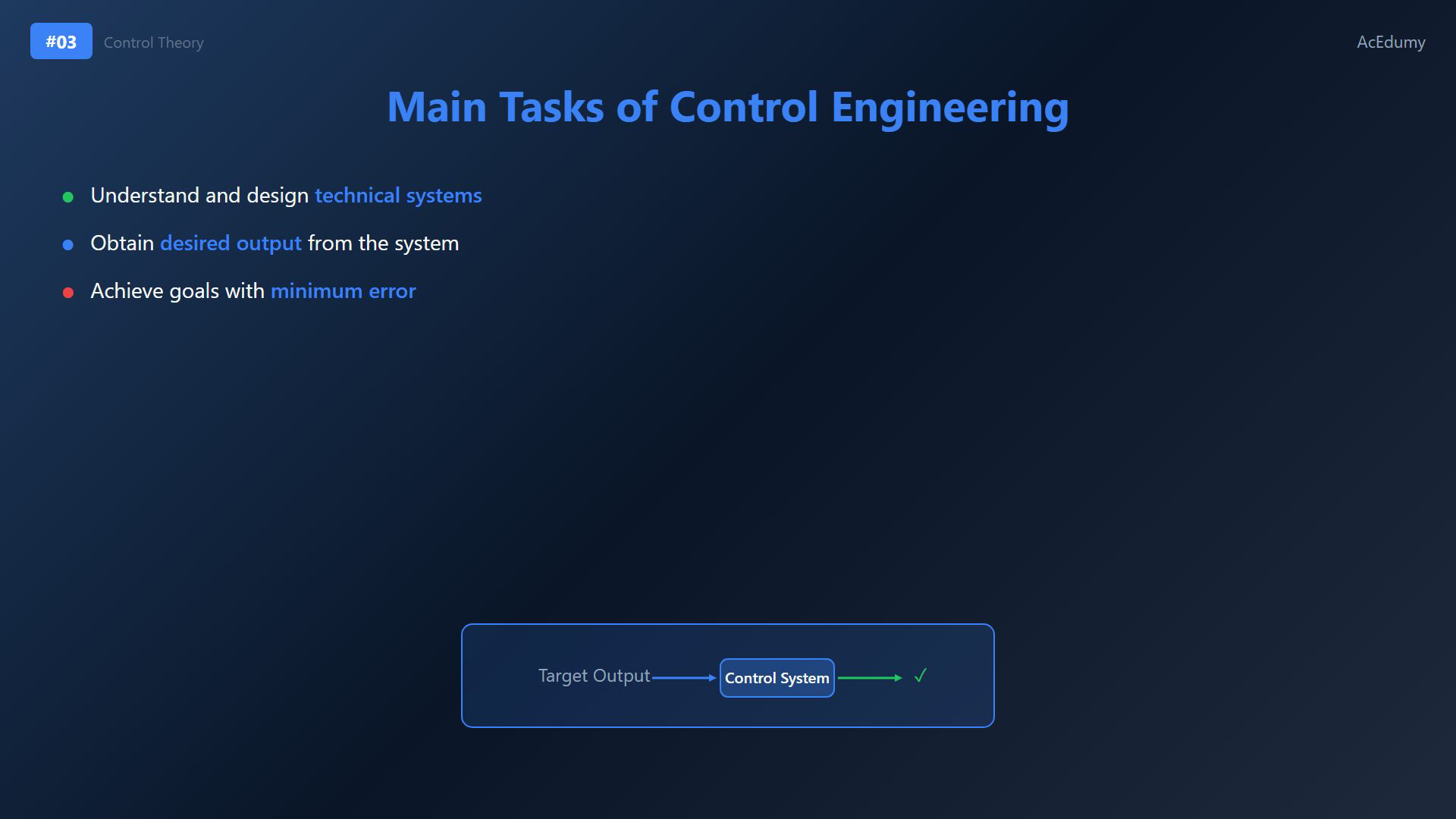
Read reference, controller output (plant input) and plant output as different signals. The feedforward diagram shows a reference-based open loop. The feedback diagram returns the measured output through a sensor and subtracts it from the reference. Its error expression assumes measurement and reference use the same calibrated scale. Continuous correction is an intended action, not a guarantee of stability or zero error. Understand and design technical systems.Seek the desired output with minimum error.Treat accurate target tracking as the design objective.Narration transcript
The main goal of a control engineer is to understand and design technical systems. We want to obtain the desired output from our system with minimum error. In other words, we have a target output and we're trying to create a control system that achieves it as accurately as possible.
3. Follow the open-loop signal path
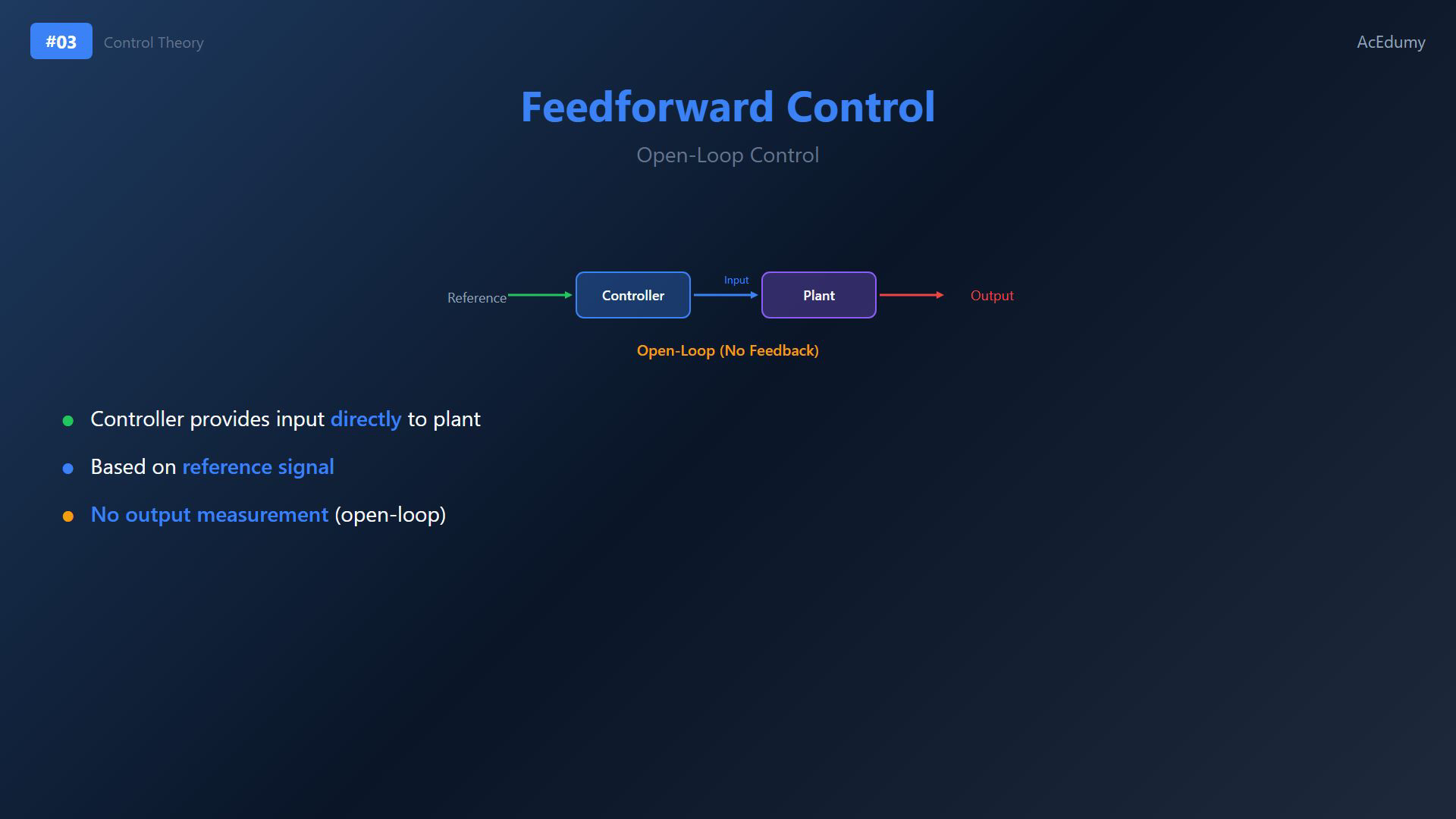
Read reference, controller output (plant input) and plant output as different signals. The feedforward diagram shows a reference-based open loop. The feedback diagram returns the measured output through a sensor and subtracts it from the reference. Its error expression assumes measurement and reference use the same calibrated scale. Continuous correction is an intended action, not a guarantee of stability or zero error. Introduce reference-based feedforward control.The controller supplies the plant input from the reference.The illustrated scheme does not measure output for correction.The shown architecture is an open loop.Narration transcript
The first control scheme is feed-forward control. In this approach, the feed-forward controller provides an appropriate input directly to the plant based on the reference signal. The controller calculates what input is needed to achieve the desired output without measuring the actual output. This is also called open-loop control.
4. Close the feedback loop
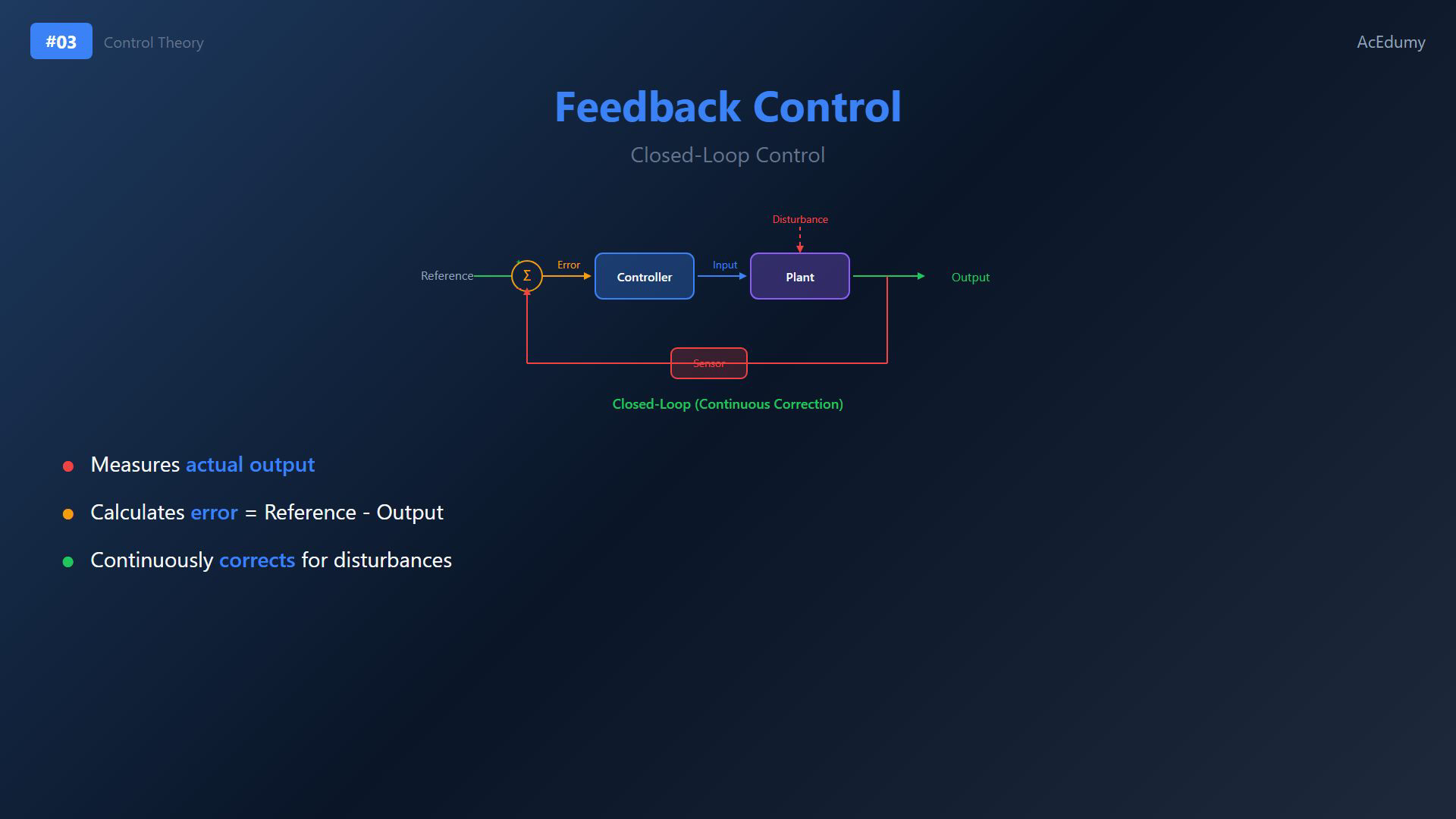
Read reference, controller output (plant input) and plant output as different signals. The feedforward diagram shows a reference-based open loop. The feedback diagram returns the measured output through a sensor and subtracts it from the reference. Its error expression assumes measurement and reference use the same calibrated scale. Continuous correction is an intended action, not a guarantee of stability or zero error. Introduce feedback or closed-loop control.Measure the output and compare it with the reference.For an ideal calibrated measurement:Adjust the plant input to try to reduce the error.Disturbances can prevent exact target tracking.Feedback provides a mechanism for correction.Continuous correction does not guarantee zero error or stability.Narration transcript
The second scheme is feedback control, also known as closed-loop control. Here, the controller measures the actual output and compares it with the reference signal. The difference between them is called the error. The feedback controller continuously tries to minimize this error by adjusting the input. However, disturbances can affect our system and prevent us from getting the exact output we want. That's why feedback control is powerful. It continuously corrects for these disturbances.
5. Follow the solution procedure
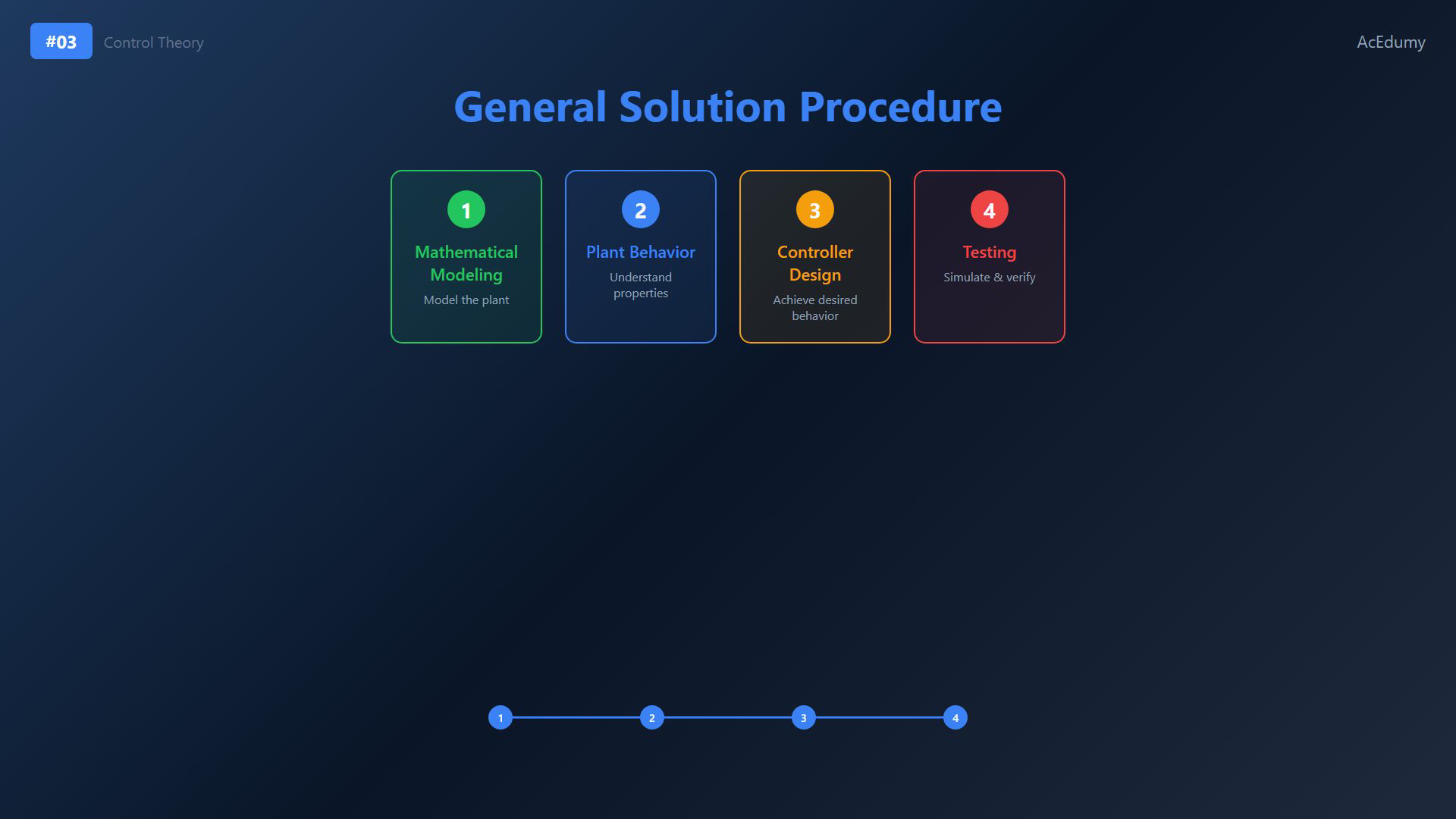
Read reference, controller output (plant input) and plant output as different signals. The feedforward diagram shows a reference-based open loop. The feedback diagram returns the measured output through a sensor and subtracts it from the reference. Its error expression assumes measurement and reference use the same calibrated scale. Continuous correction is an intended action, not a guarantee of stability or zero error. Organize the control engineering procedure.Use four engineering stages.First: model the plant mathematically.Second: understand the plant behavior and properties.Third: design the controller for the objectives.Fourth: simulate and test the real system.Verify whether the design meets its objectives.Narration transcript
What is the general solution procedure in control engineering? There are four main steps. First, mathematical modeling of the plant. Second, understanding the plant behavior and its properties. Third, designing the controller to achieve the desired behavior. And fourth, simulation and testing on the real system. This final step verifies whether our design meets the objectives.
6. Review the course scope
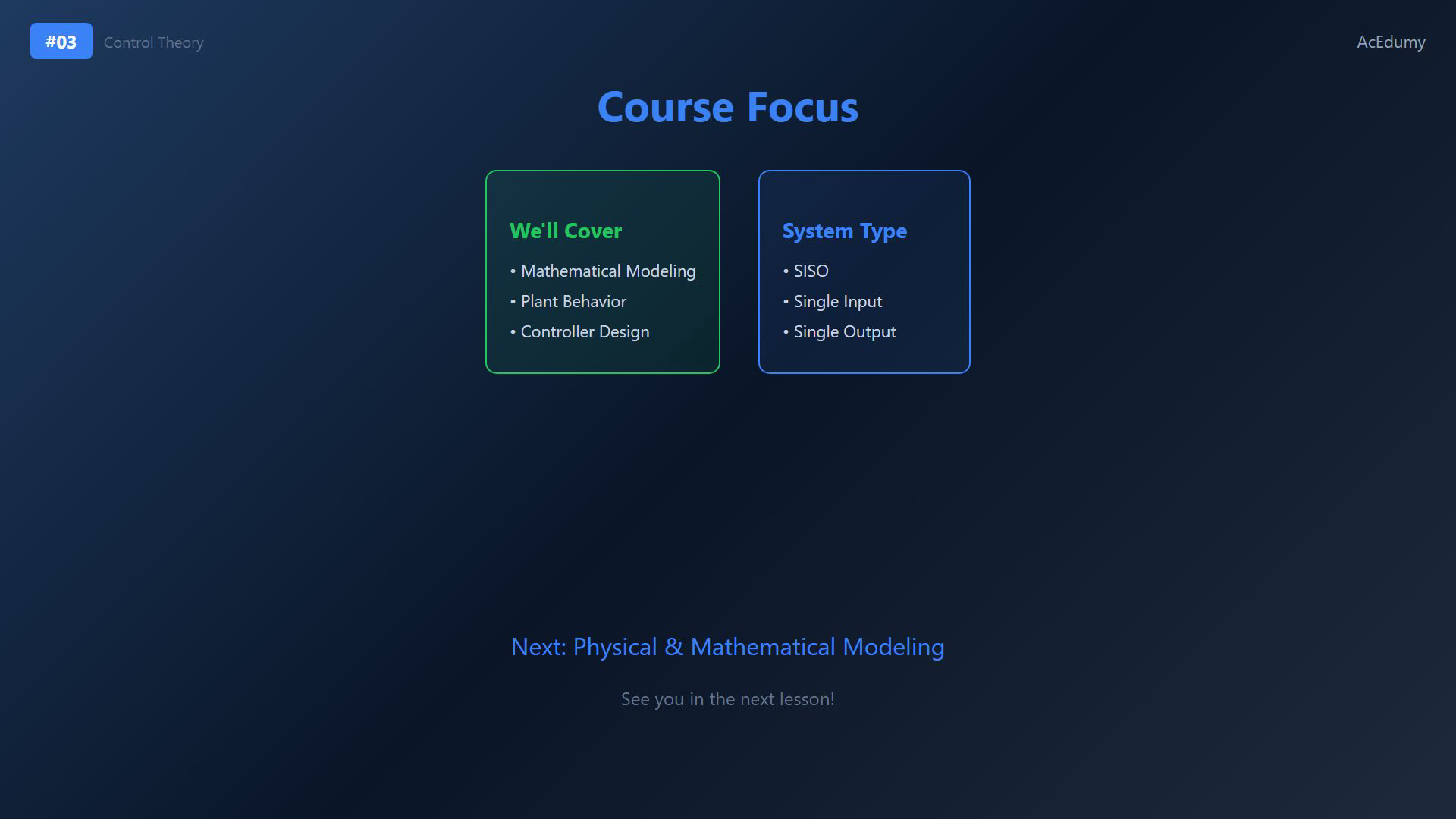
Read reference, controller output (plant input) and plant output as different signals. The feedforward diagram shows a reference-based open loop. The feedback diagram returns the measured output through a sensor and subtracts it from the reference. Its error expression assumes measurement and reference use the same calibrated scale. Continuous correction is an intended action, not a guarantee of stability or zero error. This course emphasizes the first three stages and SISO systems.Next: introduce physical and mathematical modeling.Continue to the next lesson.Narration transcript
In this course, we'll focus on the first three steps, working with single input, single output systems, or SISO. In the upcoming lessons, we'll gradually introduce physical and mathematical modeling. See you in the next lesson.
Source video: Control Theory #03 - Feedforward vs Feedback Control | Control Schemes Explained (1:58)