Electromagnetic Theory · Coulomb's Law and Electric Field
#08 Force between point charges, the electric-field definition, and superposition
Move from point-charge force to electric field and simplify superposition with symmetry.
Question
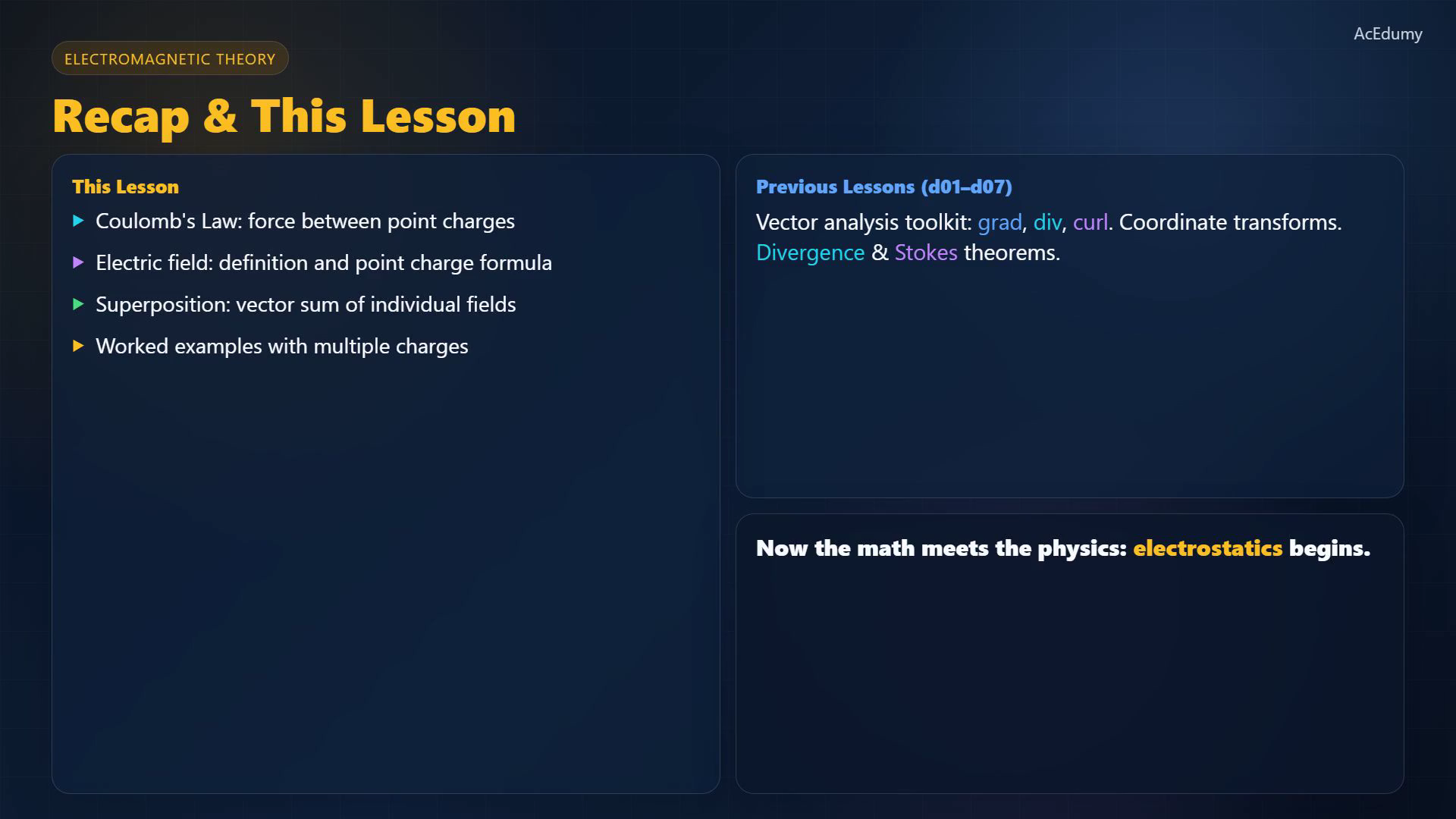
Explain Coulomb's law with direction and units, define electric field as force per unit charge, and calculate the field of multiple point charges using superposition.
Written solution and narration transcript(shows the full solution)
Below are all the lines written in the notebook together with the full narration transcript.
1. Set up the transition to electrostatics
Coulomb force follows an inverse-square law, and electric fields add vectorially by superposition. In the previous lessons, we built the mathematical toolkit for electromagnetic theory.Gradient, divergence, curl, coordinate transformations, and the divergence and Stokes theorems.Now we begin electrostatics — the study of electric charges at rest and the fields they create.In this lesson: Coulomb's Law, the electric field concept, and the superposition principle.Narration transcript
In the previous lessons, we built the mathematical toolkit for electromagnetic theory. Gradient, divergence, curl, coordinate transformations, and the divergence and Stokes theorems. Now we begin electrostatics — the study of electric charges at rest and the fields they create. In this lesson: Coulomb's Law, the electric field concept, and the superposition principle.
2. Calculate Coulomb force and direction
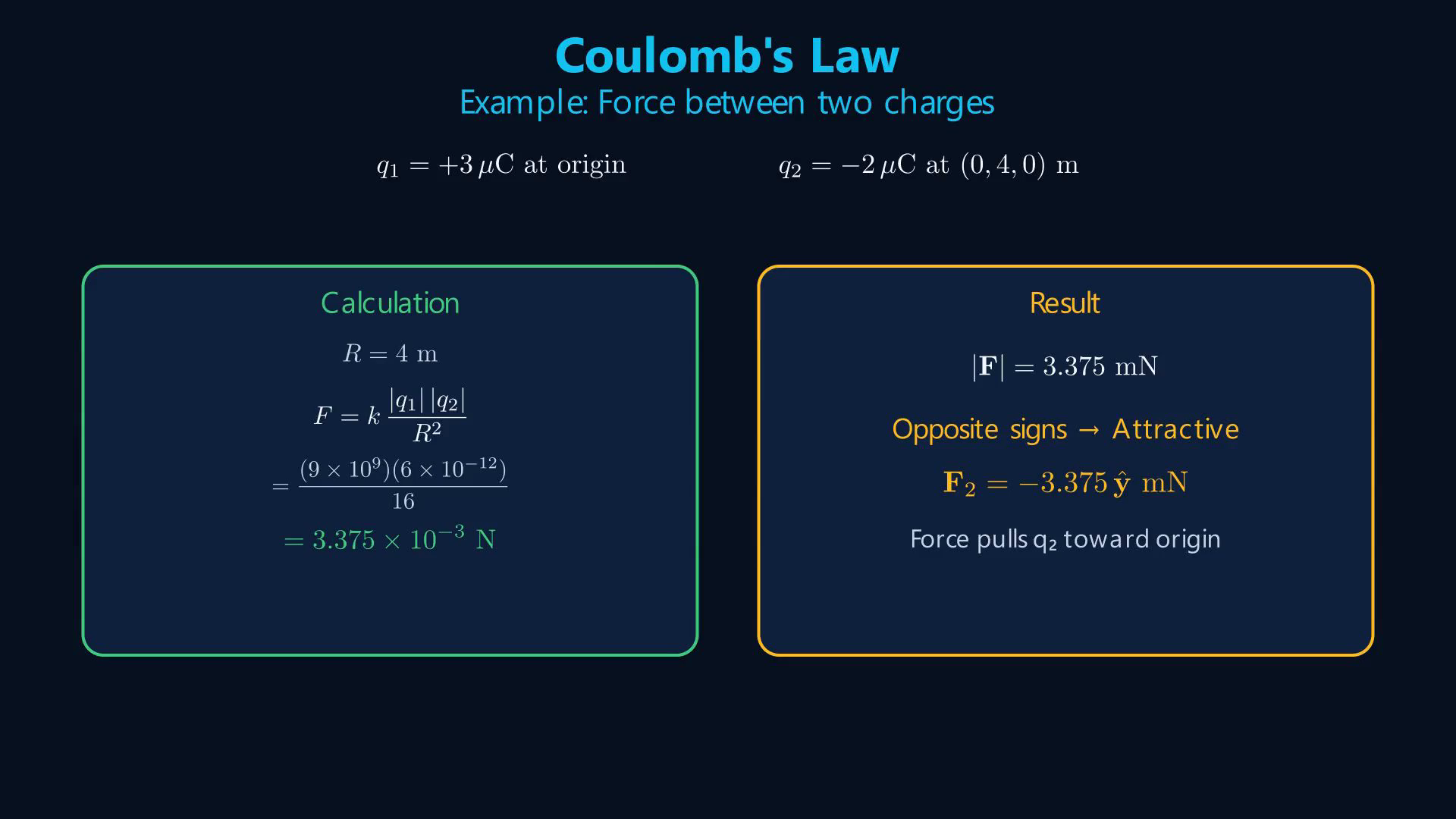
Coulomb force follows an inverse-square law, and electric fields add vectorially by superposition. Coulomb's Law describes the electrostatic force between two point charges.If q₁ is at the origin and q₂ at R, the force on q₂ is F = [q₁q₂/(4πε₀R²)]eR.The permittivity of free space is ε₀ = 8.854×10⁻¹² F/m.The Coulomb constant is k = 1/(4πε₀) ≈ 9×10⁹ N·m²/C².If both charges have the same sign, the force is repulsive.If they have opposite signs, it is attractive.Let us compute a quick example.q₁ = +3 μC at the origin.q₂ = −2 μC at (0,4,0) m.The separation R is 4 meters.The force magnitude is |F| = k|q₁q₂|/R².That gives 9 times 10 to the 9 times 6 times 10 to the minus 12, all divided by 16.The result is 3.375 millinewtons.Since the charges have opposite signs, the force on q₂ is attractive — it points toward q₁, in the minus ey direction.Narration transcript
Coulomb's Law describes the electrostatic force between two point charges. If charge q one sits at the origin and charge q two sits at position R, the force on q two is: F equals q one q two, divided by four pi epsilon zero R squared, in the direction of e hat R, from q one toward q two. Epsilon zero is the permittivity of free space: 8.854 times 10 to the minus 12 farads per meter. The constant k equals one over four pi epsilon zero, approximately 9 times 10 to the 9 newton meters squared per coulomb squared. If both charges have the same sign, the force is repulsive. If they have opposite signs, it is attractive. Let us compute a quick example. Charge q one equals plus 3 microcoulombs at the origin. Charge q two equals minus 2 microcoulombs at position 0, 4, 0 meters. The separation R is 4 meters. The force magnitude: F equals k times the product of the charge magnitudes, divided by R squared. That gives 9 times 10 to the 9 times 6 times 10 to the minus 12, all divided by 16. The result is 3.375 millinewtons. Since the charges have opposite signs, the force on q two is attractive — it points toward q one, in the minus y hat direction.
3. Apply electric field and superposition
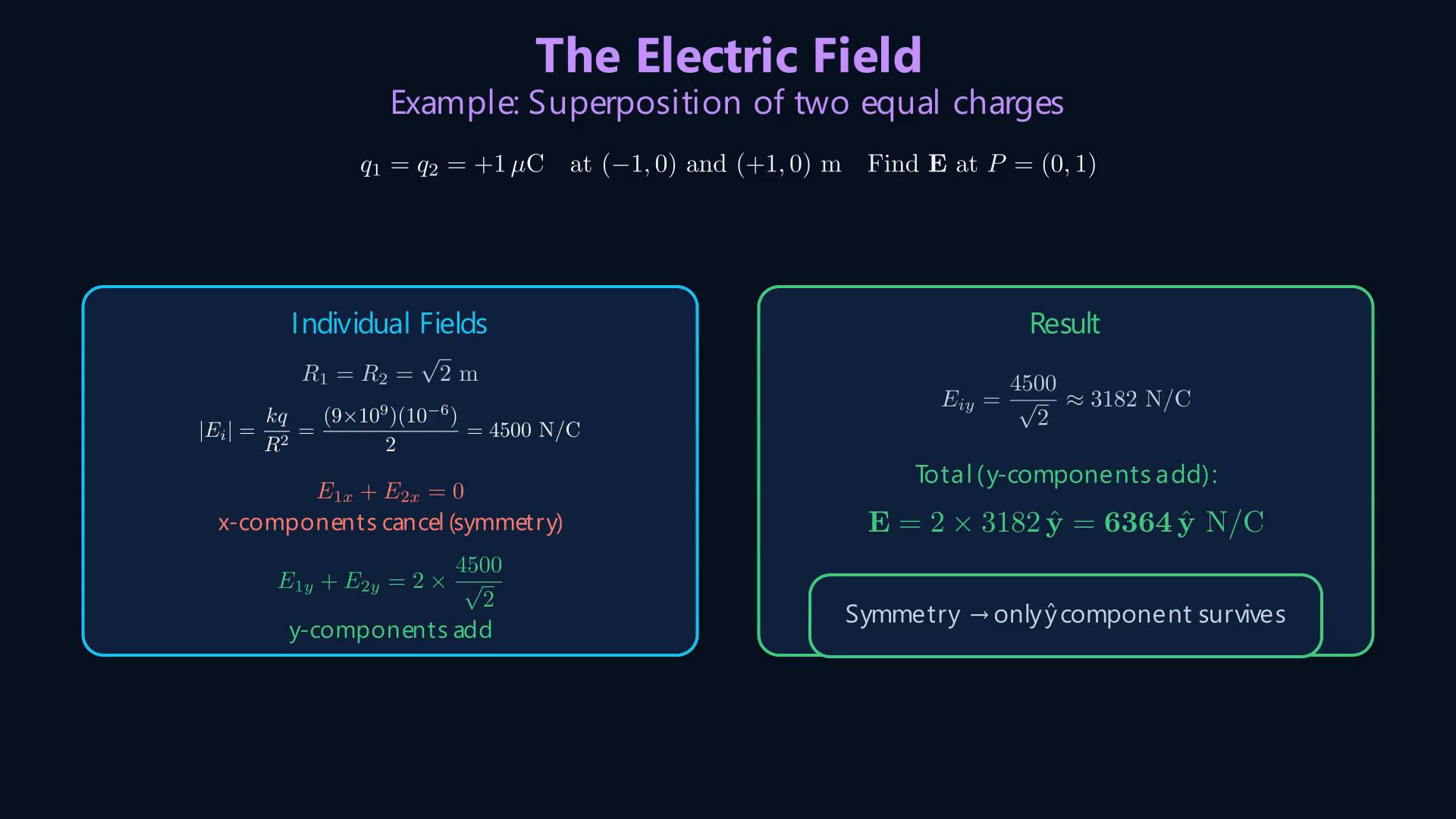
Coulomb force follows an inverse-square law, and electric fields add vectorially by superposition. Now we define the electric field.Place a tiny positive test charge q at some point in space.It feels a force F from all the source charges.The electric field is E = F/q.The electric field tells us the force per unit charge.It exists everywhere in space, whether or not we place a test charge there.For a point charge Q at the origin, E = [Q/(4πε₀r²)]er.If Q is positive, E points radially outward.If Q is negative, E points radially inward.The magnitude drops off as one over r squared.The superposition principle states: the total electric field from multiple charges is the vector sum of the individual fields.For N point charges, Etotal = Σᵢ[qi/(4πε₀Ri²)]eRi.Let us verify with an example.Two equal charges, each plus 1 microcoulomb, placed at minus 1 comma 0 and plus 1 comma 0 meters.Find E at point P equals 0 comma 1.The distance from each charge to P is the square root of 2 meters.Each field has magnitude k times 10 to the minus 6 over 2, which is 4500 newtons per coulomb.By symmetry, the horizontal components point in opposite directions and cancel exactly.The vertical components both point upward and add.The vertical component of each is 4500 over root 2, approximately 3182 newtons per coulomb.Total:Symmetry simplified the entire calculation.Narration transcript
Now we define the electric field. Place a tiny positive test charge q at some point in space. It feels a force F from all the source charges. The electric field at that point is E equals F divided by q. The electric field tells us the force per unit charge. It exists everywhere in space, whether or not we place a test charge there. For a single point charge Q at the origin, the electric field at distance r is: E equals Q divided by four pi epsilon zero r squared, times e hat r. If Q is positive, E points radially outward. If Q is negative, E points radially inward. The magnitude drops off as one over r squared. The superposition principle states: the total electric field from multiple charges is the vector sum of the individual fields. For N point charges, E total equals the sum from i equals 1 to N of q i over four pi epsilon zero R i squared, times e hat R i. Let us verify with an example. Two equal charges, each plus 1 microcoulomb, placed at minus 1 comma 0 and plus 1 comma 0 meters. Find E at point P equals 0 comma 1. The distance from each charge to P is the square root of 2 meters. Each field has magnitude k times 10 to the minus 6 over 2, which is 4500 newtons per coulomb. By symmetry, the horizontal components point in opposite directions and cancel exactly. The vertical components both point upward and add. The vertical component of each is 4500 over root 2, approximately 3182 newtons per coulomb. Total: E equals 6364 e hat y newtons per coulomb. Symmetry simplified the entire calculation.
4. Review the force and field relations

Coulomb force follows an inverse-square law, and electric fields add vectorially by superposition. Let us review.Coulomb's Law: F = (kq₁q₂/R²)eR.The electric field is E = F/q.For a point charge, E = kQ/r² er.The superposition principle lets us find the total field from multiple charges by vector addition.In the next lesson, we extend these ideas to continuous charge distributions — lines, surfaces, and volumes of charge.Narration transcript
Let us review. Coulomb's Law: F equals k q one q two over R squared, in the e hat R direction. The electric field: E equals F over q. For a point charge, E equals k Q over r squared, e hat r. The superposition principle lets us find the total field from multiple charges by vector addition. In the next lesson, we extend these ideas to continuous charge distributions — lines, surfaces, and volumes of charge.
Source video: Electromagnetic Theory (v2) #08 Coulomb's Law & Electric Field (4:37)