Antenna Theory · Current Density, Point Source, and Dipole
#05 Moving from total current to vector current density J, then modeling a point source, delta localization, and a thin-dipole source
Use J, the delta function, and the dipole model to describe where a source exists, how concentrated it is, and which way it points.
Question

Distinguish current density J from total current; model a small source region as a delta-localized point source and explain why thin-dipole current density follows the wire and antenna axis.
Written solution and narration transcript(shows the full solution)
Below are all the lines written in the notebook together with the full narration transcript.
1. Move from the observer to the source model
J carries source position and direction, the delta function localizes it, and dipole geometry confines it to the wire. In the previous lesson, we chose the observation point and explained why the vector potential A appears in antenna theory.But A still needs a source description to work with.That source description is current density J.So this lesson asks a new question.If the observer is already chosen, how do we write the source in a clean mathematical form?Narration transcript
In the previous lesson, we chose the observation point and explained why the vector potential A appears in antenna theory. But A still needs a source description to work with. That source description is current density J. So this lesson asks a new question. If the observer is already chosen, how do we write the source in a clean mathematical form?
2. Distinguish current density J from total current
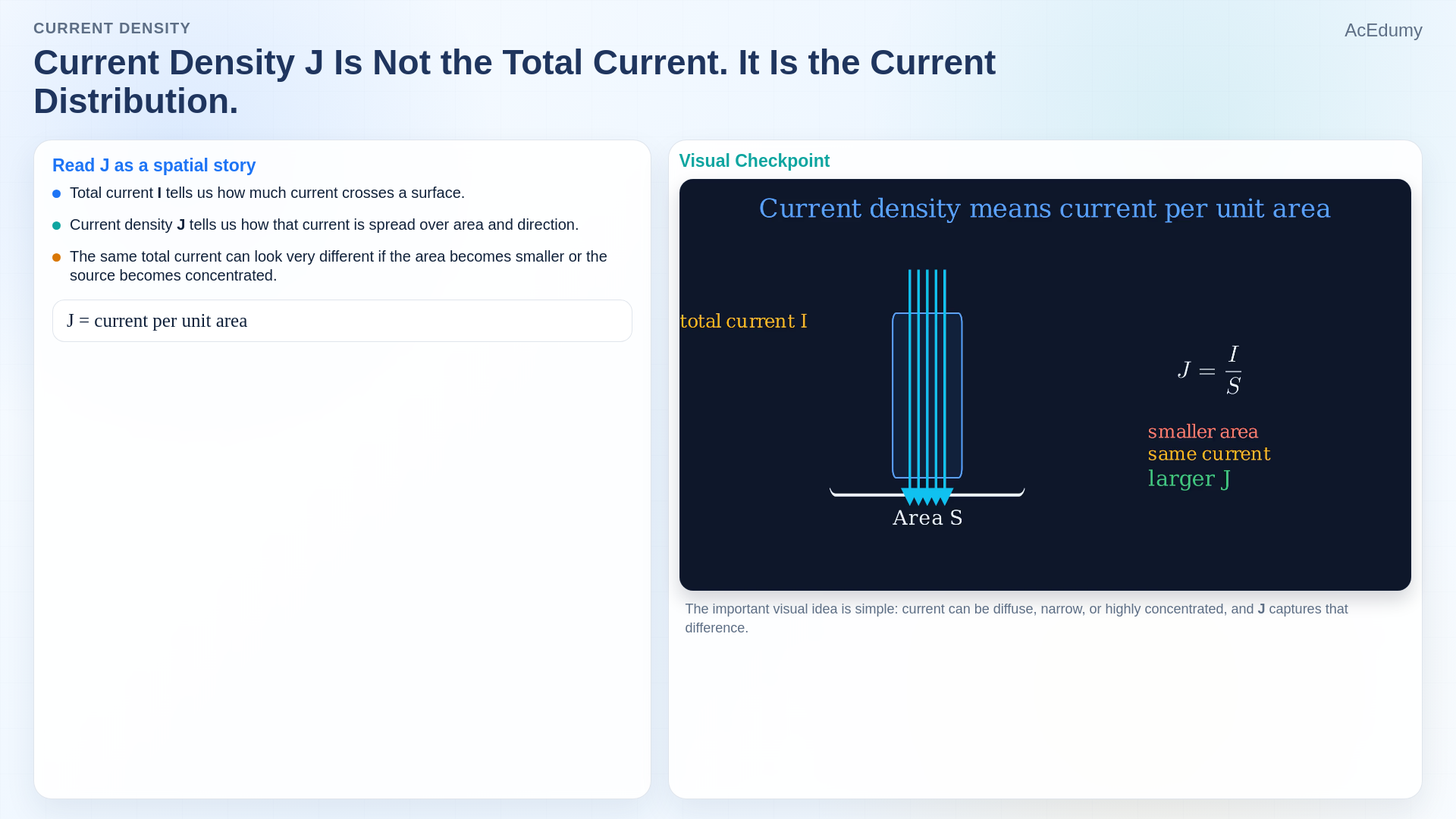
J carries source position and direction, the delta function localizes it, and dipole geometry confines it to the wire. Current density is not the same thing as total current.Total current tells us how much current crosses a surface.Current density tells us how that current is distributed over area and direction.This is the first important shift.We are no longer satisfied with saying current exists.We now want to say where it exists, how concentrated it is, and which way it points.Narration transcript
Current density is not the same thing as total current. Total current tells us how much current crosses a surface. Current density tells us how that current is distributed over area and direction. This is the first important shift. We are no longer satisfied with saying current exists. We now want to say where it exists, how concentrated it is, and which way it points.
3. Idealize a small source region as a point source
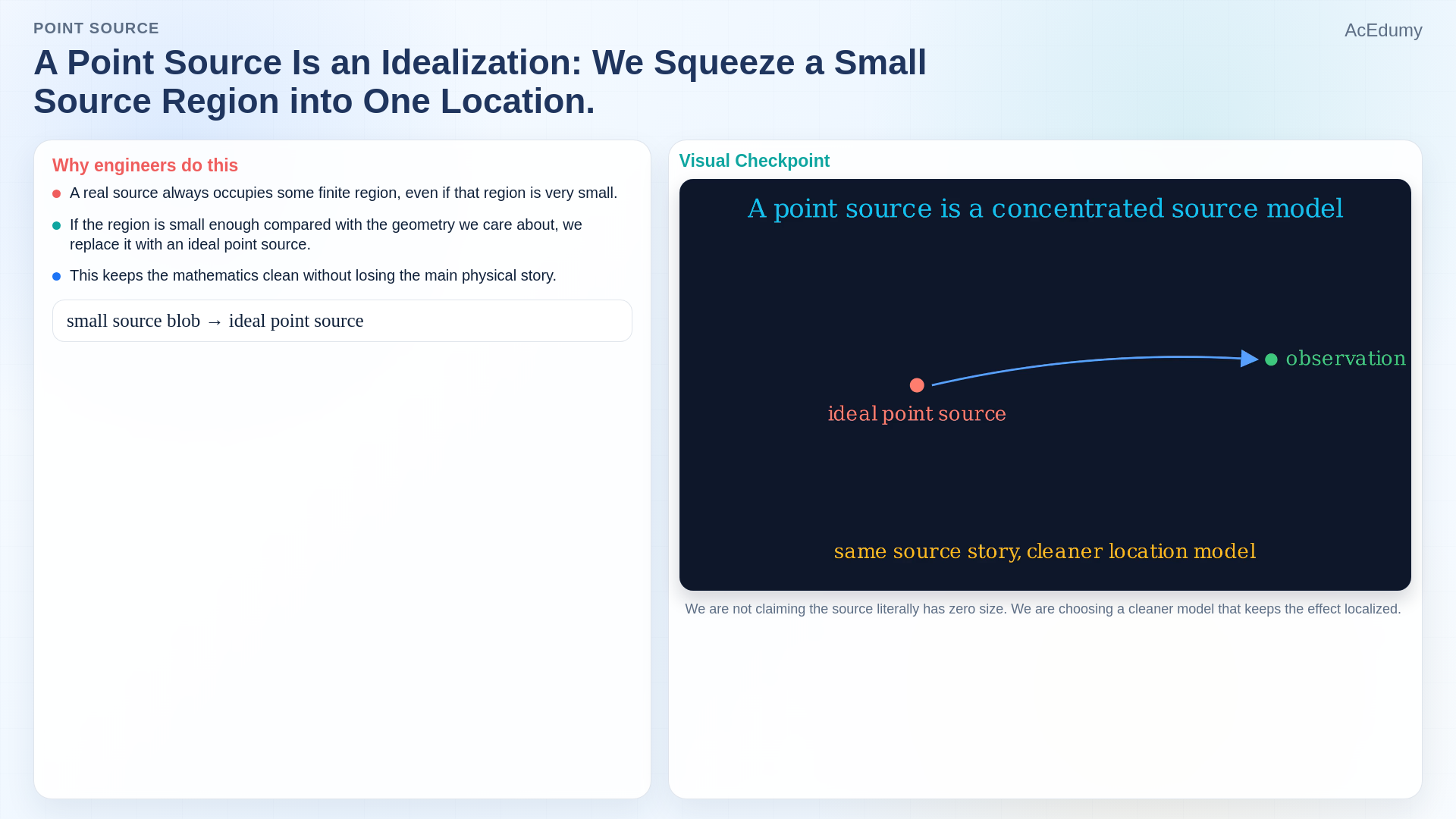
J carries source position and direction, the delta function localizes it, and dipole geometry confines it to the wire. Suppose the real source occupies a very small region in space.If that region is small enough compared with the geometry we care about, we often replace it with an ideal point source.This does not mean the source literally has zero size.It means we choose a cleaner model that keeps the source localized at one place while preserving the main physical effect.Narration transcript
Suppose the real source occupies a very small region in space. If that region is small enough compared with the geometry we care about, we often replace it with an ideal point source. This does not mean the source literally has zero size. It means we choose a cleaner model that keeps the source localized at one place while preserving the main physical effect.
4. Read the delta function as a localization tool
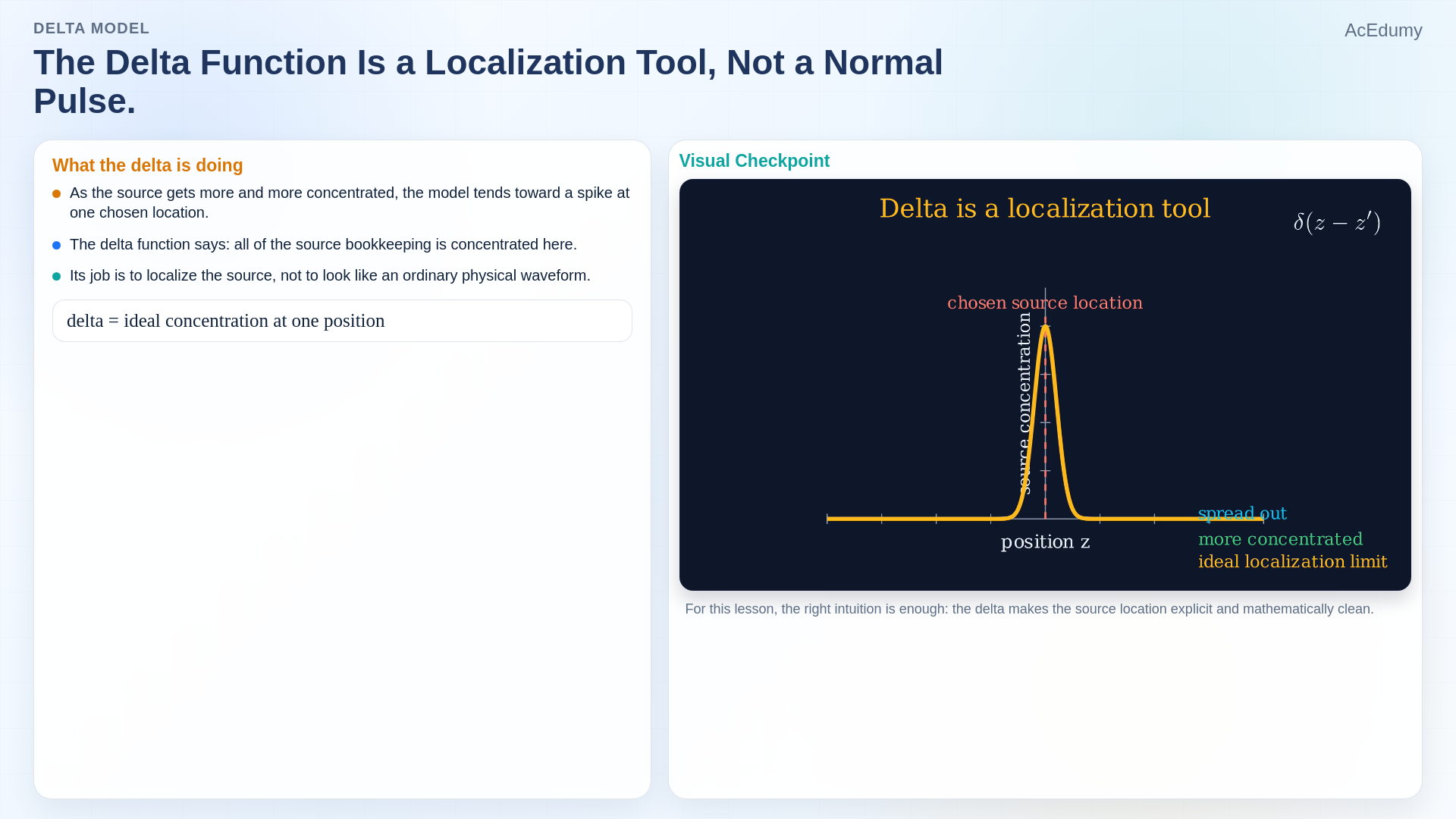
J carries source position and direction, the delta function localizes it, and dipole geometry confines it to the wire. That is where the delta function enters the story.You should not read it as an ordinary pulse.You should read it as a localization tool.It tells us that the source bookkeeping is concentrated at one chosen position.So the delta is not visual decoration.It is the mathematical way of saying: the source lives here.Narration transcript
That is where the delta function enters the story. You should not read it as an ordinary pulse. You should read it as a localization tool. It tells us that the source bookkeeping is concentrated at one chosen position. So the delta is not visual decoration. It is the mathematical way of saying: the source lives here.
5. Tie dipole current density to the wire and antenna axis
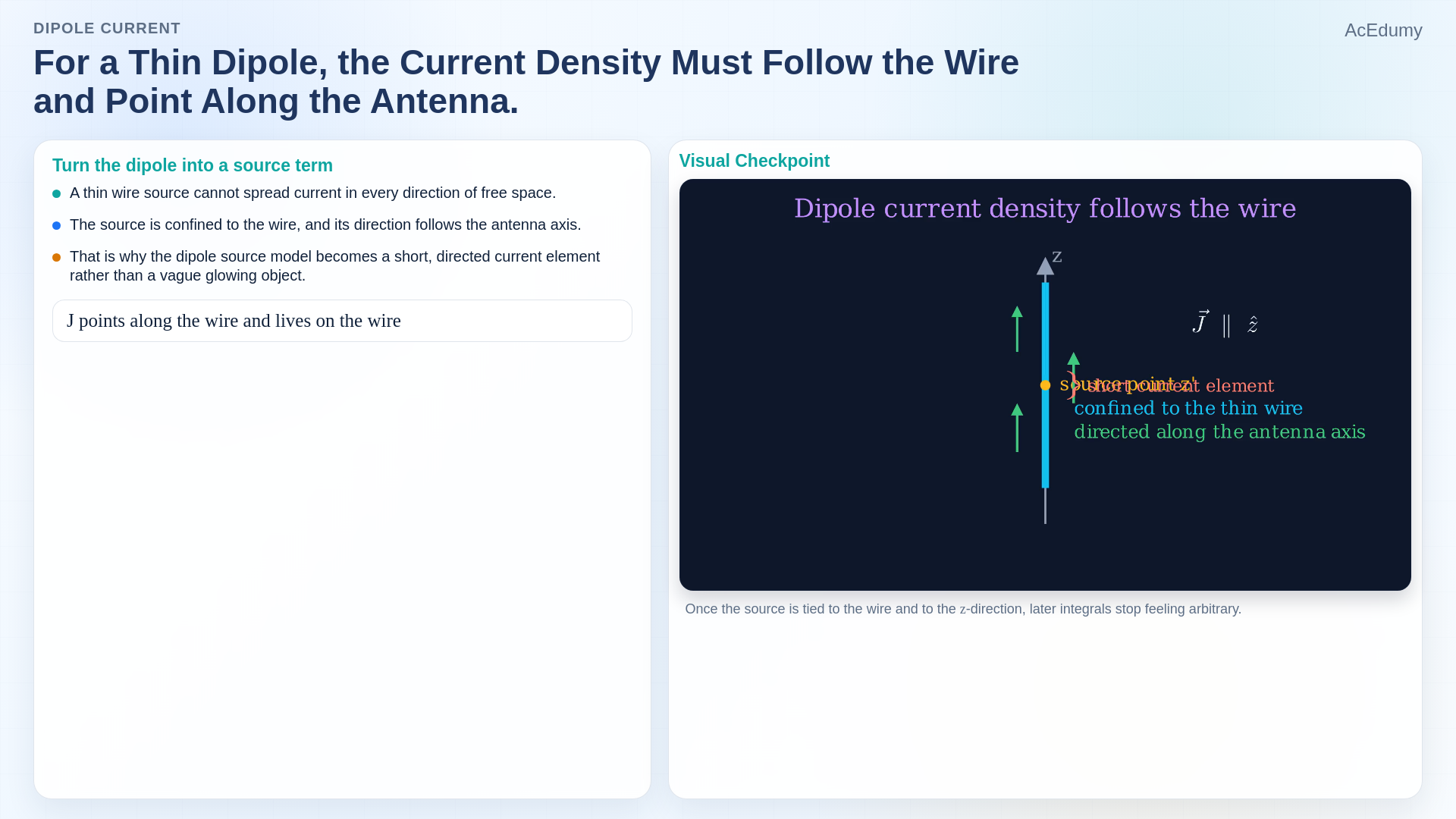
J carries source position and direction, the delta function localizes it, and dipole geometry confines it to the wire. Now think about a thin dipole.Its current density cannot spread through all of free space.It must stay on the wire, and its direction must follow the antenna axis.This is why the dipole source model becomes a short directed current element rather than a vague glowing blob.The geometry of the wire now begins to control the source term directly.Narration transcript
Now think about a thin dipole. Its current density cannot spread through all of free space. It must stay on the wire, and its direction must follow the antenna axis. This is why the dipole source model becomes a short directed current element rather than a vague glowing blob. The geometry of the wire now begins to control the source term directly.
6. Move from J to vector potential A

J carries source position and direction, the delta function localizes it, and dipole geometry confines it to the wire. Once J is written clearly, the vector potential A finally has something concrete to integrate.That is the real payoff of this lesson.The source term is no longer mysterious.It carries a spatial story, a direction story, and a localization story.Because of that, later derivations start to feel motivated instead of arbitrary.Narration transcript
Once J is written clearly, the vector potential A finally has something concrete to integrate. That is the real payoff of this lesson. The source term is no longer mysterious. It carries a spatial story, a direction story, and a localization story. Because of that, later derivations start to feel motivated instead of arbitrary.
7. Summarize the four source-model ideas

J carries source position and direction, the delta function localizes it, and dipole geometry confines it to the wire. So keep four ideas in your head.J is a source distribution, not just a total current.A point source is an ideal concentration of a small source region.The delta function is a localization tool.And for a dipole, the current density follows the wire and points along the antenna.That is the source model that prepares the next layer of antenna mathematics.Narration transcript
So keep four ideas in your head. J is a source distribution, not just a total current. A point source is an ideal concentration of a small source region. The delta function is a localization tool. And for a dipole, the current density follows the wire and points along the antenna. That is the source model that prepares the next layer of antenna mathematics.
Source video: Antenna Theory #05 | Current Density | Point Source and Dipole (3:09)