Electromagnetic Theory · Currents and Conductors
#13 Material conductivity, convection and conduction current, point-form Ohm's law, resistance, Joule power, and conductors in electrostatic equilibrium
Build current density from microscopic motion, reduce field-form Ohm's law to the circuit form, and analyze conductor equilibrium.
Question

Classify materials by conductivity; define current and current density, connect J = σE to circuit Ohm's law, derive conductor properties in electrostatic equilibrium, and solve the wire example.
Written solution and narration transcript(shows the full solution)
Below are all the lines written in the notebook together with the full narration transcript.
1. Move from field energy to current in materials
Conduction current obeys J = σE, and the field inside a conductor vanishes in electrostatic equilibrium. Previously we established the dipole, field energy, and wE = ½ε₀E².Today we move to Chapter 5 — electric fields in material space.We will classify materials by their conductivity, define convection and conduction current densities, derive the point form of Ohm's law, and examine how conductors behave in static electric fields.Narration transcript
In the previous lesson we completed our study of electrostatics in free space — we defined the electric dipole, derived the energy stored in charge assemblies, and introduced the energy density w-E equals one-half epsilon-zero E-squared. Today we move to Chapter 5 — electric fields in material space. We will classify materials by their conductivity, define convection and conduction current densities, derive the point form of Ohm's law, and examine how conductors behave in static electric fields.
2. Classify materials by conductivity
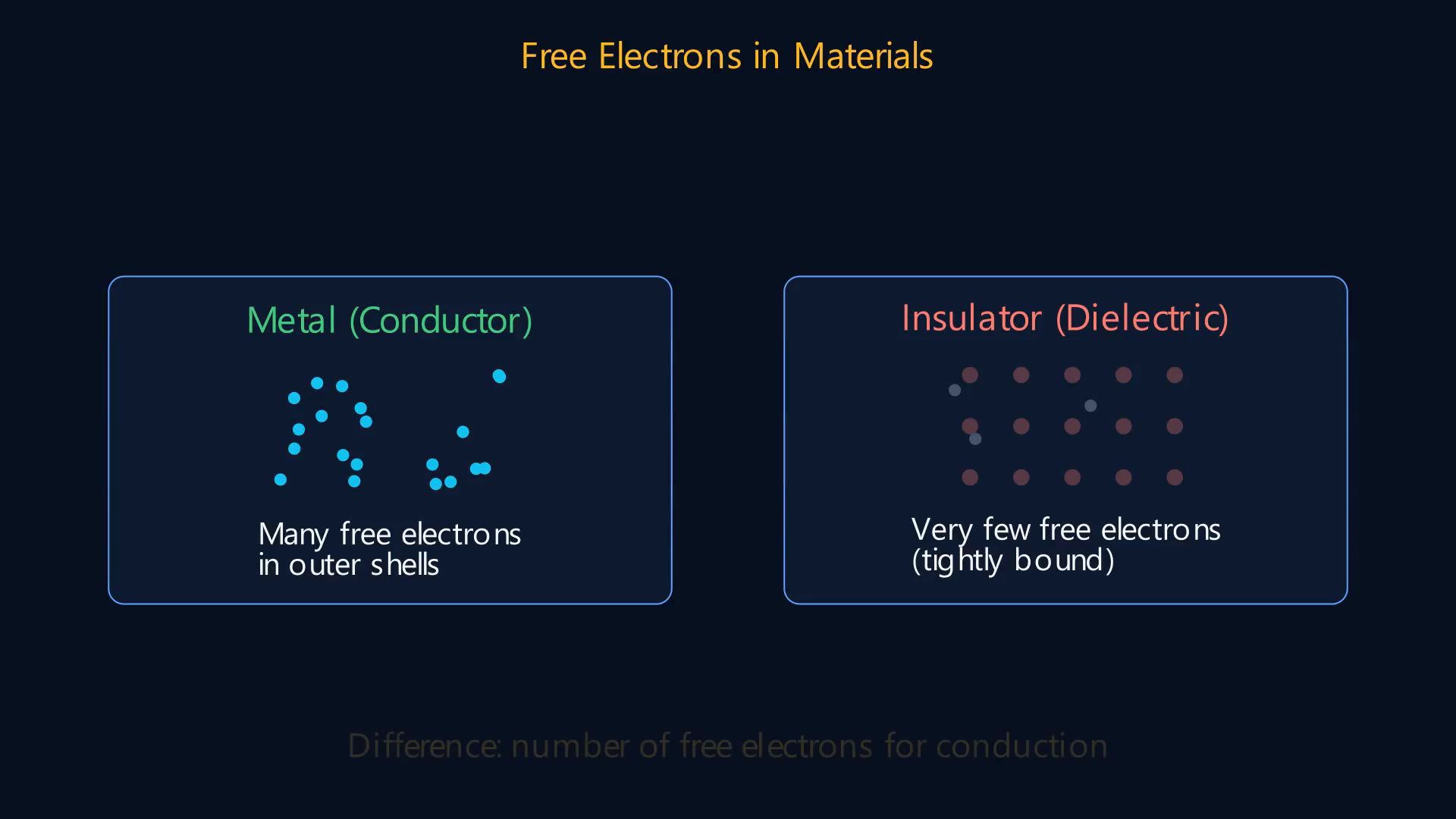
Conduction current obeys J = σE, and the field inside a conductor vanishes in electrostatic equilibrium. So far we have studied electric fields in free space — a vacuum with no material present.But real engineering involves conductors, insulators, and semiconductors.How do we classify them?The key property is conductivity σ [S/m].A material with σ ≫ 1 is a conductor.Copper has σ around five point eight times ten to the seventh.A material with σ ≪ 1 is an insulator or dielectric.Glass has σ around ten to the minus twelve.Materials in between — like silicon and germanium — are semiconductors.At the atomic level, the difference lies in the number of free electrons available for conduction.Metals have an abundance of free electrons in the outermost shells.Insulators have very few.Semiconductors can be engineered to have a controlled number through doping.Narration transcript
So far we have studied electric fields in free space — a vacuum with no material present. But real engineering involves conductors, insulators, and semiconductors. How do we classify them? The key property is conductivity, sigma, measured in siemens per meter. A material with high conductivity — sigma much greater than one — is a metal, or conductor. Copper has sigma around five point eight times ten to the seventh. A material with low conductivity — sigma much less than one — is an insulator, also called a dielectric. Glass has sigma around ten to the minus twelve. Materials in between — like silicon and germanium — are semiconductors. At the atomic level, the difference lies in the number of free electrons available for conduction. Metals have an abundance of free electrons in the outermost shells. Insulators have very few. Semiconductors can be engineered to have a controlled number through doping.
3. Define convection and conduction current
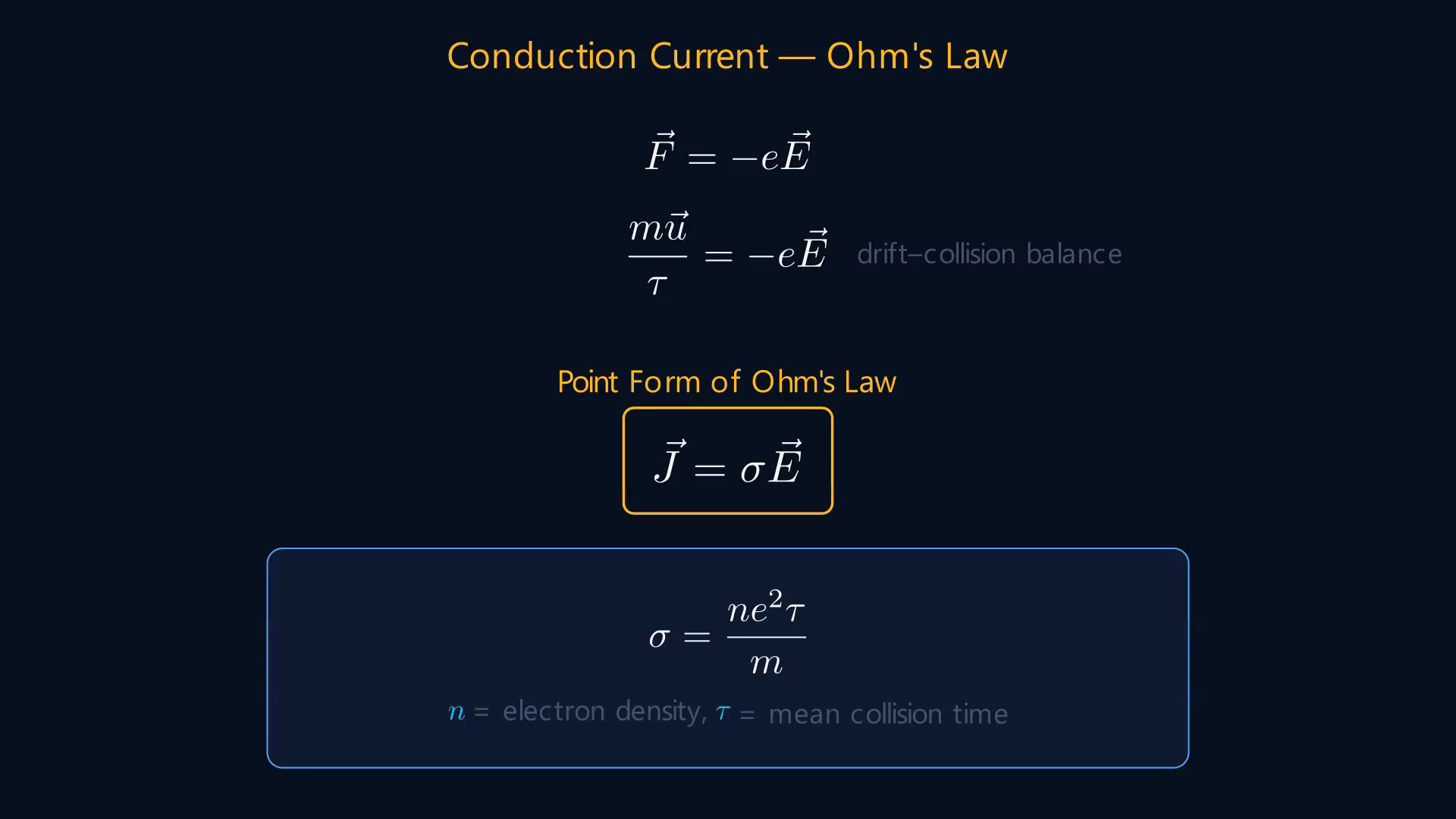
Conduction current obeys J = σE, and the field inside a conductor vanishes in electrostatic equilibrium. Before studying how materials respond to electric fields, we need to define electric current precisely.Current is I = dQ/dt, measured in amperes.The current density J is a vector: the current per unit area.The total current through S is I = ∫ₛJ·dS.There are two types of current density we consider now.First, convection current.This occurs when charge moves through free space — no conductor is needed.For convection current, J = ρvu.A beam of electrons in a vacuum tube is a convection current.This does not obey Ohm's law.Second, conduction current.This occurs in conductors.When an electric field E is applied, the free electrons drift with an average velocity proportional to E.The force on an electron is F = −eE.For conduction current, J = σE.This is the point form of Ohm's law — it relates the current density at a point to the electric field at that same point.Conductivity is σ = ne²τ/m; n is electron density and τ is mean collision time.Narration transcript
Before studying how materials respond to electric fields, we need to define electric current precisely. Current I is the rate at which charge passes through a surface: I equals d-Q over d-t, in amperes. The current density J is a vector: the current per unit area. The total current through a surface S is: I equals the integral of J dot d-S. There are two types of current density we consider now. First, convection current. This occurs when charge moves through free space — no conductor is needed. If charge density rho-v moves with velocity u, then J equals rho-v times u. A beam of electrons in a vacuum tube is a convection current. This does not obey Ohm's law. Second, conduction current. This occurs in conductors. When an electric field E is applied, the free electrons drift with an average velocity proportional to E. The force on an electron is F equals minus e-E. Balancing drift against collisions gives J equals sigma E. This is the point form of Ohm's law — it relates the current density at a point to the electric field at that same point. Sigma equals n-e-squared-tau over m, where n is the electron density and tau is the mean time between collisions.
4. Derive resistance and Joule power
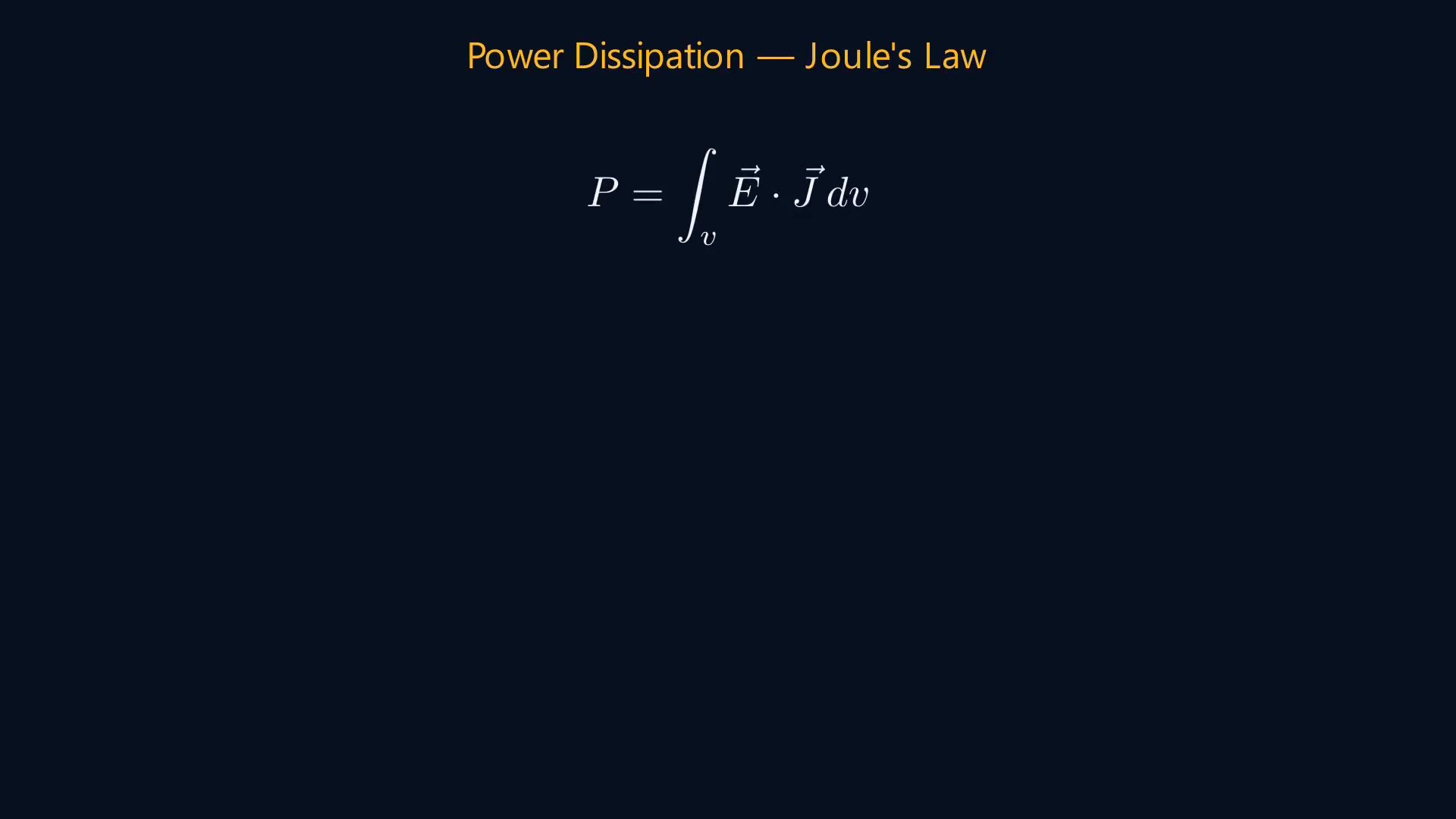
Conduction current obeys J = σE, and the field inside a conductor vanishes in electrostatic equilibrium. The point form of Ohm's law is J = σE.Connect it to the circuit form V = IR.Consider a conductor of length ℓ, uniform cross-sectional area S, and conductivity σ, with a potential difference V applied across its ends.For a uniform conductor, E = V/ℓ.Current density is J = I/S.Substitution gives I/S = σV/ℓ.Rearranging gives V/I = ℓ/(σS).Resistance is R = ℓ/(σS) = ρcℓ/S, with ρc = 1/σ.The general field definition is R = ∫E·dl / ∫σE·dS.This is the field-based definition of resistance.Power dissipation is P = ∫E·J dv.For a uniform conductor, P = VI = I²R = V²/R.Narration transcript
The point form J equals sigma E is the microscopic version of Ohm's law. Let us connect it to the familiar circuit form V equals I-R. Consider a conductor of length ell, uniform cross-sectional area S, and conductivity sigma, with a potential difference V applied across its ends. The electric field inside is uniform: E equals V over ell. The current density is J equals I over S. Substituting into J equals sigma E: I over S equals sigma times V over ell. Rearranging: V over I equals ell over sigma S. This gives us the resistance: R equals ell over sigma S, or equivalently R equals rho-c times ell over S, where rho-c equals one over sigma is the resistivity. For a conductor with non-uniform cross section, we use the more general formula: R equals the integral of E dot d-l, divided by the integral of sigma E dot d-S. This is the field-based definition of resistance. Power dissipation follows from P equals the integral of E dot J d-v. For a uniform conductor, this reduces to P equals V-I equals I-squared R — Joule's law.
5. Analyze a conductor in electrostatic equilibrium
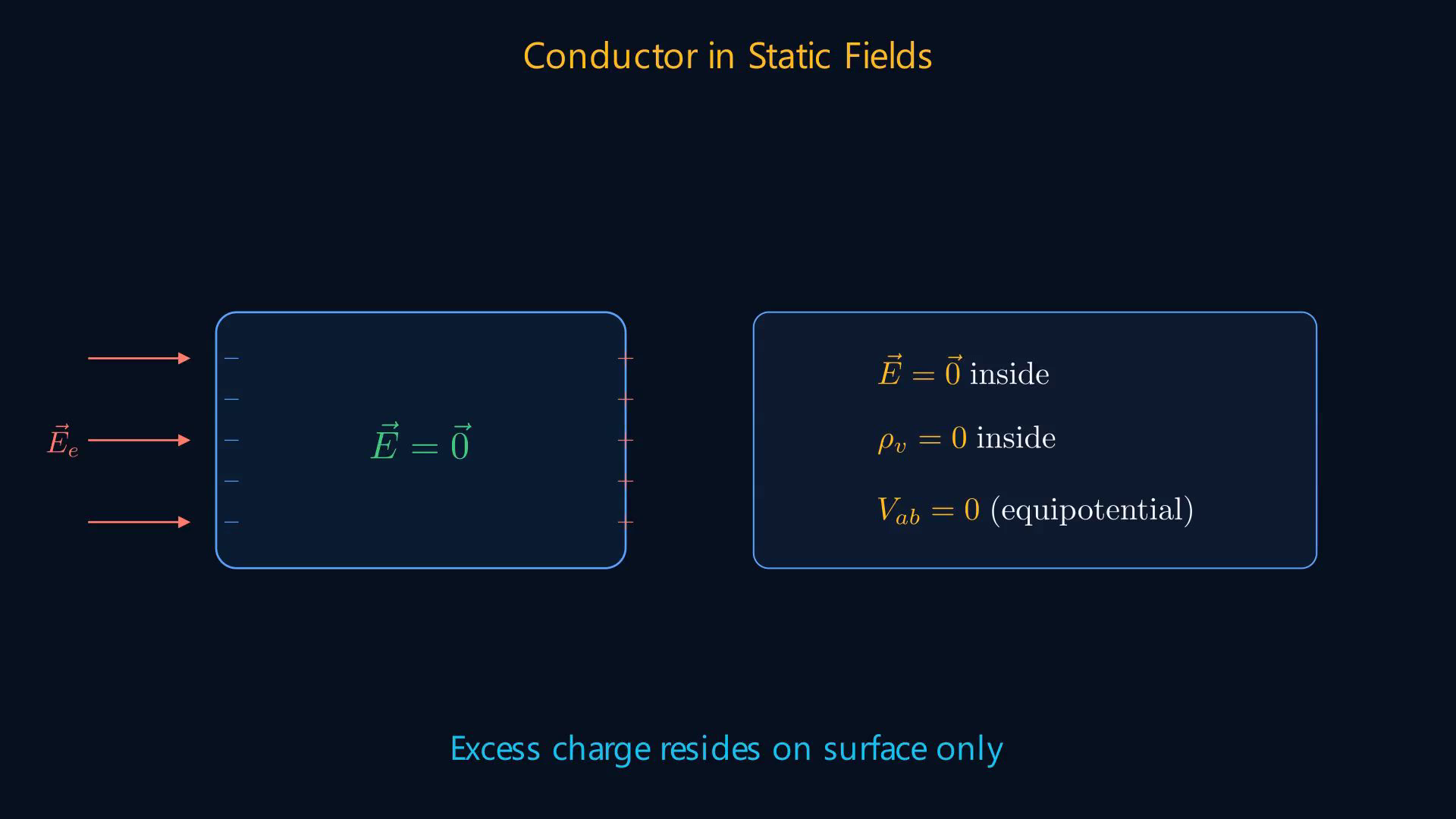
Conduction current obeys J = σE, and the field inside a conductor vanishes in electrostatic equilibrium. Now let us examine how a conductor behaves when placed in an electrostatic field.Consider an isolated conductor — not connected to any source.When an external field Ee is applied, the free charges inside the conductor redistribute almost instantly.Positive charges shift in the direction of Ee, negative charges shift opposite.This redistribution creates an internal field Ei that opposes the applied field.Equilibrium is reached when Ei exactly cancels Ee, so the total field inside the conductor is zero.This leads to three fundamental properties of a conductor under static conditions.In electrostatic equilibrium, E = 0 inside a conductor.Because E = −∇V = 0, the conductor is equipotential.Inside, D = 0 and ∇·D = ρv imply ρv = 0.Any excess charge must reside on the surface.These are not assumptions — they are direct consequences of the abundance of free charges and the static equilibrium condition.Narration transcript
Now let us examine how a conductor behaves when placed in an electrostatic field. Consider an isolated conductor — not connected to any source. When an external field E-e is applied, the free charges inside the conductor redistribute almost instantly. Positive charges shift in the direction of E-e, negative charges shift opposite. This redistribution creates an internal field E-i that opposes the applied field. Equilibrium is reached when E-i exactly cancels E-e, so the total field inside the conductor is zero. This leads to three fundamental properties of a conductor under static conditions. First: E equals zero inside the conductor. Second: since E equals negative nabla V equals zero, the potential is the same everywhere — the conductor is an equipotential body. Third: since nabla dot D equals rho-v and D equals zero inside, there can be no net charge density inside — rho-v equals zero. Any excess charge must reside on the surface. These are not assumptions — they are direct consequences of the abundance of free charges and the static equilibrium condition.
6. Calculate current and drift velocity in a wire
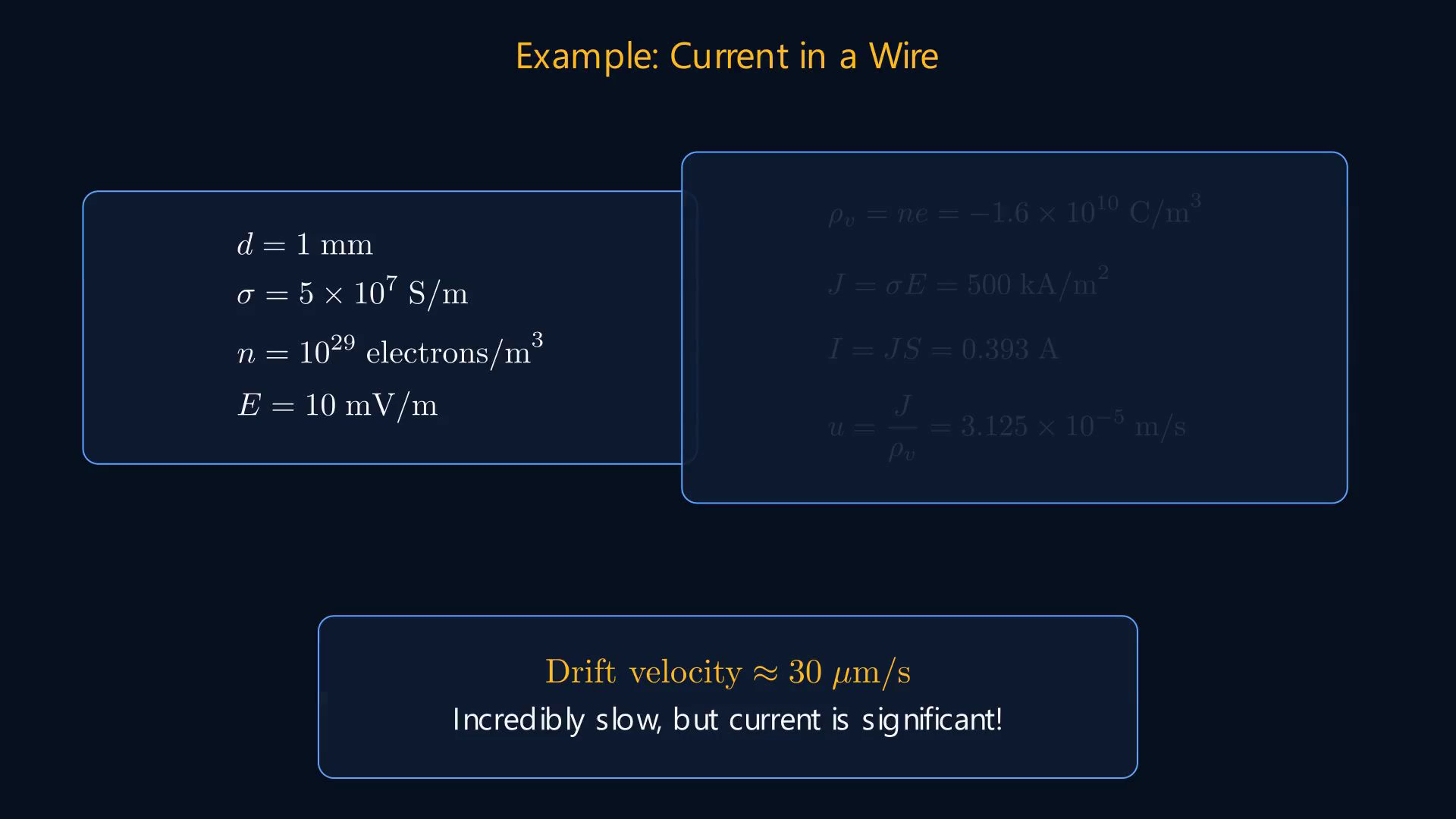
Conduction current obeys J = σE, and the field inside a conductor vanishes in electrostatic equilibrium. Let us work through Example 5.3 from Sadiku.A wire of diameter one millimeter has conductivity five times ten to the seventh siemens per meter and ten to the twenty-nine free electrons per cubic meter.An electric field of ten millivolts per meter is applied.Find the charge density, current density, current, and electron drift velocity.ρv = ne = −1.6×10¹⁰ C/m³.J = σE = 5×10⁵ A/m² = 500 kA/m².Current is I = JS.The area is S = πd²/4 = (π/4)×10⁻⁶ m².Thus I ≈ 0.393 A.The drift-speed magnitude is |u| = |J/ρv| = 3.125×10⁻⁵ m/s.Notice how incredibly slow the drift velocity is — about thirty micrometers per second — even though the current is significant.Narration transcript
Let us work through Example 5.3 from Sadiku. A wire of diameter one millimeter has conductivity five times ten to the seventh siemens per meter and ten to the twenty-nine free electrons per cubic meter. An electric field of ten millivolts per meter is applied. Find the charge density, current density, current, and electron drift velocity. The free charge density is rho-v equals n-e, which is ten to the twenty-nine times minus one point six times ten to the minus nineteen, giving minus one point six times ten to the tenth coulombs per cubic meter. The current density is J equals sigma E equals five times ten to the seventh times ten to the minus two, which is five hundred kilo-amperes per square meter. The current is I equals J times S. The cross-sectional area is pi d-squared over four equals pi over four times ten to the minus six. So I equals approximately zero point three nine three amperes. The drift velocity is u equals J over rho-v, which is five times ten to the fifth divided by one point six times ten to the tenth, giving three point one two five times ten to the minus fifth meters per second. Notice how incredibly slow the drift velocity is — about thirty micrometers per second — even though the current is significant.
7. Review current and conductor relations

Conduction current obeys J = σE, and the field inside a conductor vanishes in electrostatic equilibrium. Let us summarize today's key results.Materials are classified by conductivity σ: conductors have high σ, insulators have low σ, semiconductors are in between.Convection current:Conduction current:Resistance:Inside a conductor under static conditions: E equals zero, the conductor is equipotential, and any excess charge sits on the surface.In the next lesson, we will study polarization in dielectrics and derive the modified form of Gauss's law for materials.Narration transcript
Let us summarize today's key results. Materials are classified by conductivity sigma: conductors have high sigma, insulators have low sigma, semiconductors are in between. Convection current density is J equals rho-v u. Conduction current density follows Ohm's law: J equals sigma E. Resistance is R equals ell over sigma S. Inside a conductor under static conditions: E equals zero, the conductor is equipotential, and any excess charge sits on the surface. In the next lesson, we will study polarization in dielectrics and derive the modified form of Gauss's law for materials.
Source video: Electromagnetic Theory (v2) #13 Currents & Conductors (8:41)