Electromagnetic Theory · Cylindrical Coordinate System
#03 Definition, Cartesian transformation, and differential elements in cylindrical coordinates
Trace the cylindrical metric factor ρ from coordinate transformations through line, surface, and volume elements.
Question

Define the cylindrical variables ρ, φ, z and their unit vectors; write the Cartesian transformations, position vector, and differential dl, dS, and dV elements with the metric factor ρ.
Written solution and narration transcript(shows the full solution)
Below are all the lines written in the notebook together with the full narration transcript.
1. Set up the move to cylindrical coordinates
In cylindrical coordinates an angular increment dφ spans the true length ρ dφ; the same metric factor enters the related area and volume elements. In the previous lesson, we defined the Cartesian coordinate system with its three axes, unit vectors, and differential elements.Now let's move to the second coordinate system: cylindrical coordinates.We'll define the coordinates ρ, φ, and z, show how they relate to Cartesian, and derive the differential elements dl, dS, and dV.Narration transcript
In the previous lesson, we defined the Cartesian coordinate system with its three axes, unit vectors, and differential elements. Now let's move to the second coordinate system: cylindrical coordinates. We'll define the coordinates rho, phi, and z, show how they relate to Cartesian, and derive the differential elements dl, dS, and dV.
2. Define the ρ, φ, z coordinates
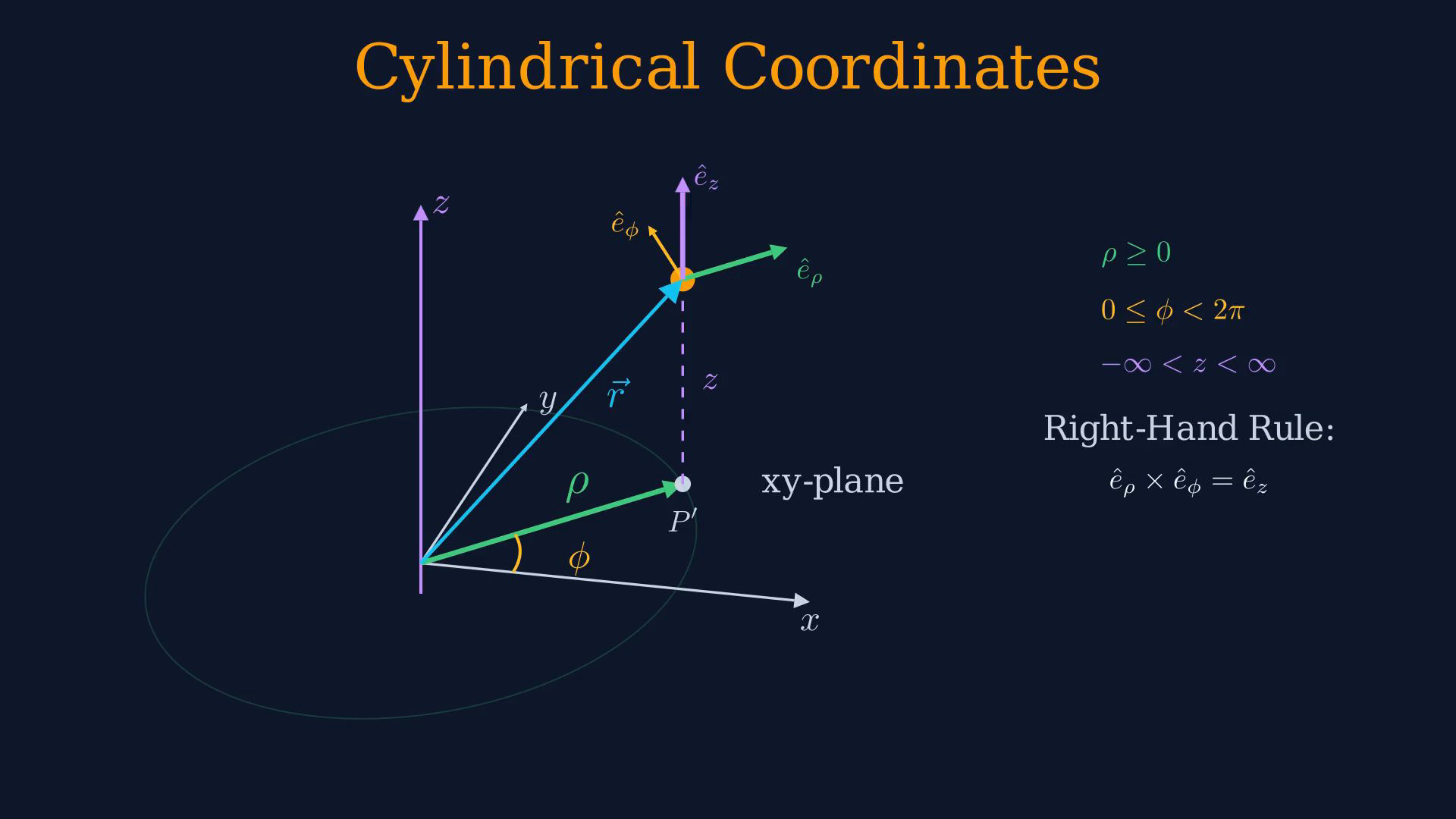
In cylindrical coordinates an angular increment dφ spans the true length ρ dφ; the same metric factor enters the related area and volume elements. The cylindrical coordinate system uses three variables: ρ, φ, and z.Let's start in the xy-plane.A point P prime in this plane sits at a distance ρ from the origin.The angle φ is measured from the positive x-axis to the line from the origin to P prime.So ρ and φ together locate a point in the xy-plane, just like polar coordinates.Now extend to three dimensions.Add a vertical z-axis, perpendicular to the xy-plane.Our point P sits at height z above P prime.The cylindrical coordinates of P are ρ, φ, and z.Here is a crucial distinction.Rho is the perpendicular distance from the z-axis, the horizontal distance, the projection onto the xy-plane.The position vector r, from the origin to P, is a different quantity.It is the diagonal distance.Do not confuse ρ with r.At every point, we define three mutually orthogonal unit vectors: eρ pointing radially outward from the z-axis, eφ pointing in the direction of increasing φ, and ez pointing straight up.These follow the right-hand rule.Narration transcript
The cylindrical coordinate system uses three variables: rho, phi, and z. Let's start in the xy-plane. A point P prime in this plane sits at a distance rho from the origin. The angle phi is measured from the positive x-axis to the line from the origin to P prime. So rho and phi together locate a point in the xy-plane, just like polar coordinates. Now extend to three dimensions. Add a vertical z-axis, perpendicular to the xy-plane. Our point P sits at height z above P prime. The cylindrical coordinates of P are rho, phi, and z. Here is a crucial distinction. Rho is the perpendicular distance from the z-axis, the horizontal distance, the projection onto the xy-plane. The position vector r, from the origin to P, is a different quantity. It is the diagonal distance. Do not confuse rho with r. At every point, we define three mutually orthogonal unit vectors: e-hat rho pointing radially outward from the z-axis, e-hat phi pointing in the direction of increasing phi, and e-hat z pointing straight up. These follow the right-hand rule.
3. Write the Cartesian transformations
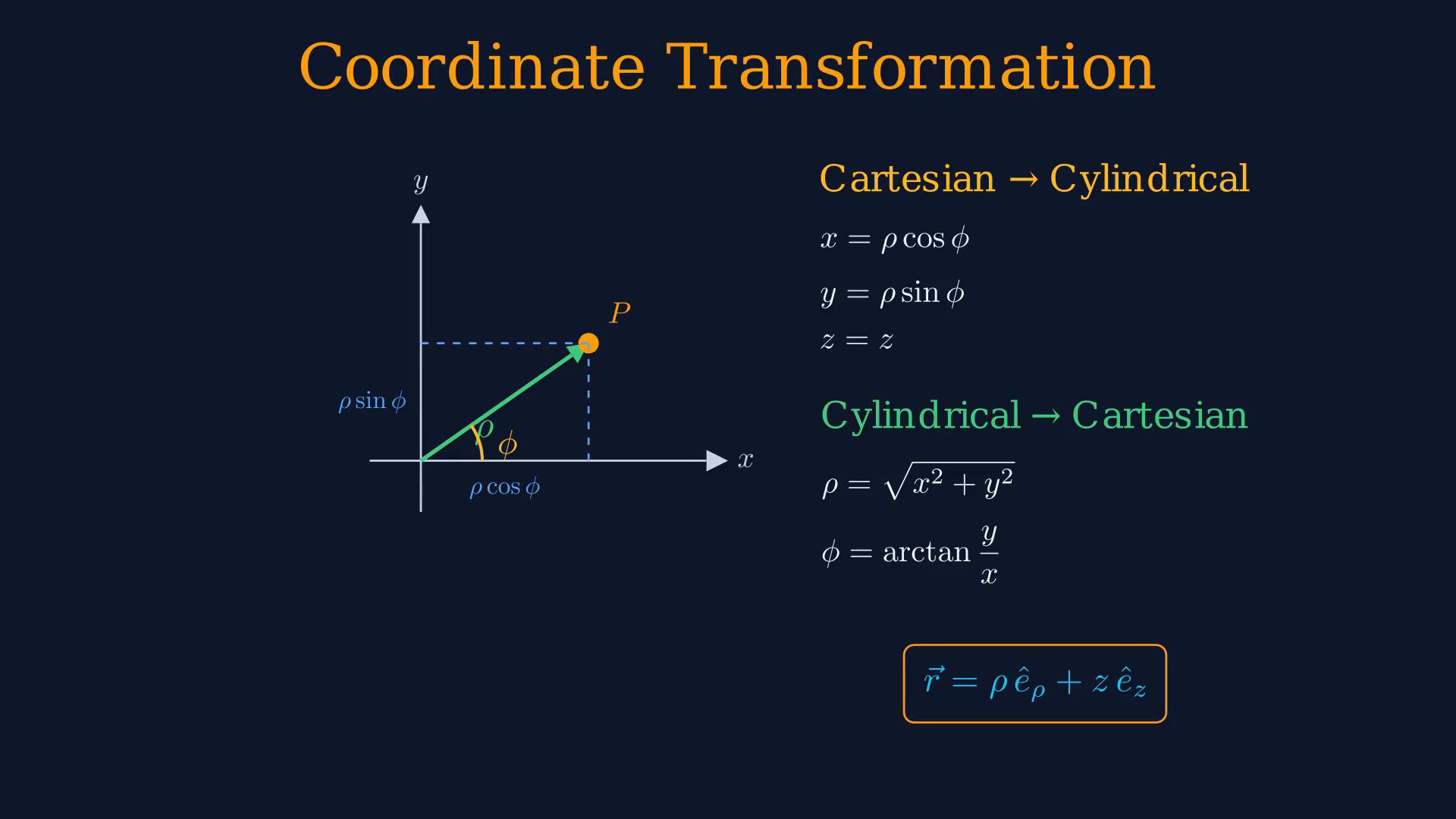
In cylindrical coordinates an angular increment dφ spans the true length ρ dφ; the same metric factor enters the related area and volume elements. To convert between cylindrical and Cartesian, we use simple trigonometry.Looking at the xy-plane, ρ and φ form a right triangle.The x coordinate = ρ cosine φ, and the y coordinate = ρ sine φ.The z coordinate stays the same.Going the other way, ρ = the square root of x squared + y squared, and φ = the arctangent of y over x.The position vector in cylindrical coordinates can be written as r = ρ eρ + z ez.Notice there is no φ term in the position vector, because eρ already encodes the angular information.Narration transcript
To convert between cylindrical and Cartesian, we use simple trigonometry. Looking at the xy-plane, rho and phi form a right triangle. The x coordinate equals rho cosine phi, and the y coordinate equals rho sine phi. The z coordinate stays the same. Going the other way, rho equals the square root of x squared plus y squared, and phi equals the arctangent of y over x. The position vector in cylindrical coordinates can be written as r equals rho e-rho plus z e-z. Notice there is no phi term in the position vector, because e-rho already encodes the angular information.
4. Derive the cylindrical line element
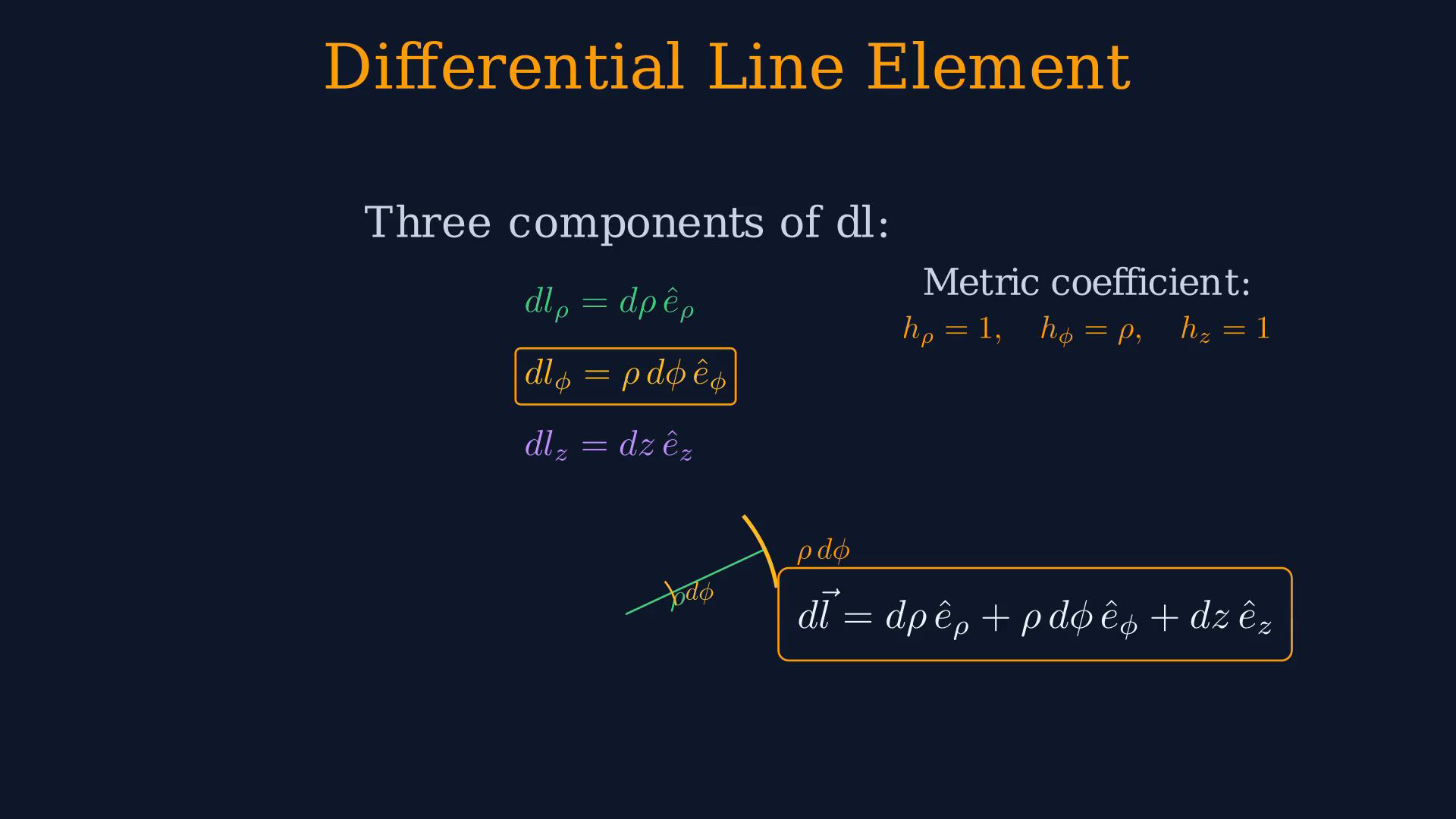
In cylindrical coordinates an angular increment dφ spans the true length ρ dφ; the same metric factor enters the related area and volume elements. Now let's derive the differential line element dl.In cylindrical coordinates, a small displacement has three components.In the ρ direction, a change dρ gives dlρ = dρ eρ.In the φ direction, an angular change dφ corresponds to an arc length of ρ dφ, so dlφ = ρ dφ eφ.Notice the factor of ρ: this is the metric coefficient for φ.In the z direction, dlz = dz ez, just like Cartesian.The total line element is: dl = dρ eρ + ρ dφ eφ + dz ez.Narration transcript
Now let's derive the differential line element dl. In cylindrical coordinates, a small displacement has three components. In the rho direction, a change d-rho gives dl-rho equals d-rho e-rho. In the phi direction, an angular change d-phi corresponds to an arc length of rho d-phi, so dl-phi equals rho d-phi e-phi. Notice the factor of rho: this is the metric coefficient for phi. In the z direction, dl-z equals dz e-z, just like Cartesian. The total line element is: dl equals d-rho e-rho plus rho d-phi e-phi plus dz e-z.
5. Build the cylindrical surface elements
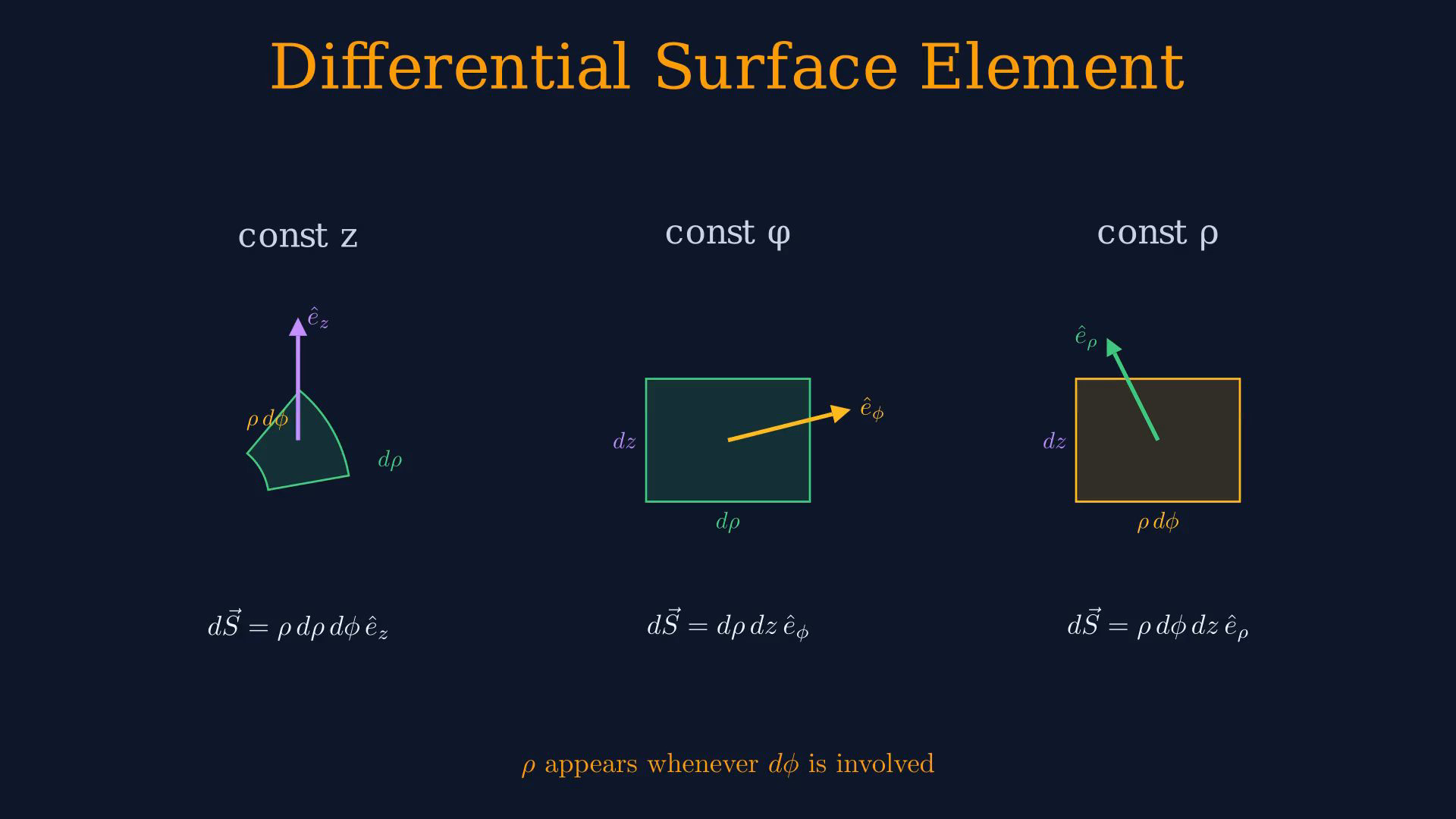
In cylindrical coordinates an angular increment dφ spans the true length ρ dφ; the same metric factor enters the related area and volume elements. The differential surface element dS is formed by combining two of the three differential lengths.On a surface of constant z, we have dS = ρ dρ dφ ez.The factor of ρ appears because the φ direction has a metric coefficient of ρ.On a surface of constant φ, dS = dρ dz eφ.On a surface of constant ρ, dS = ρ dφ dz eρ.Again, notice that ρ appears whenever dφ is involved, because an angular increment dφ spans an arc length of ρ dφ.Narration transcript
The differential surface element dS is formed by combining two of the three differential lengths. On a surface of constant z, we have dS equals rho d-rho d-phi e-z. The factor of rho appears because the phi direction has a metric coefficient of rho. On a surface of constant phi, dS equals d-rho dz e-phi. On a surface of constant rho, dS equals rho d-phi dz e-rho. Again, notice that rho appears whenever d-phi is involved, because an angular increment d-phi spans an arc length of rho d-phi.
6. Derive the cylindrical volume element
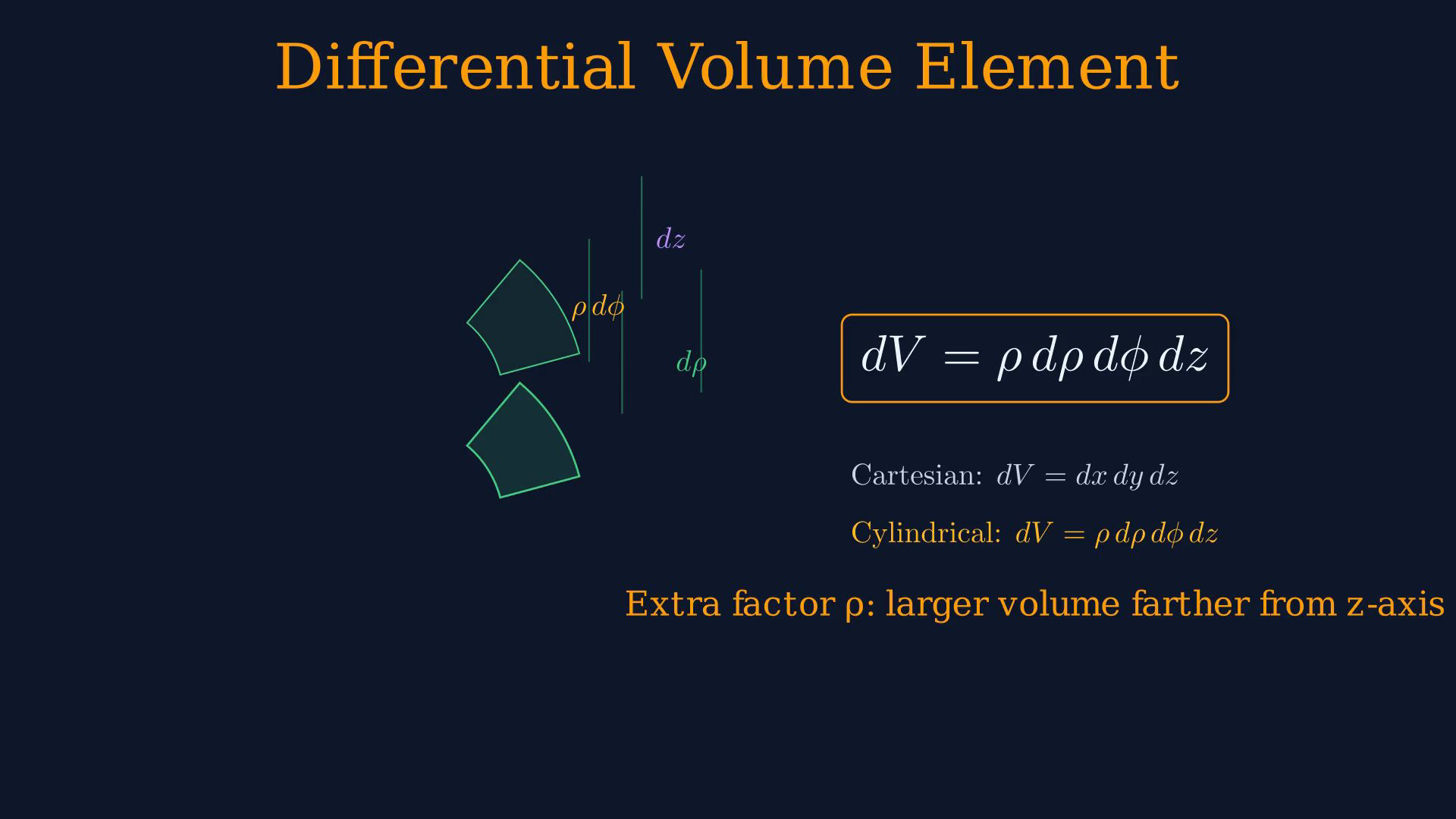
In cylindrical coordinates an angular increment dφ spans the true length ρ dφ; the same metric factor enters the related area and volume elements. The differential volume element combines all three differential lengths.dV = dρ × ρ dφ × dz, which simplifies to ρ dρ dφ dz.Compared to the Cartesian dV = dx dy dz, the cylindrical volume element has an extra factor of ρ.This makes sense geometrically: elements farther from the z-axis sweep out larger volumes for the same angular increment.Narration transcript
The differential volume element combines all three differential lengths. dV equals d-rho times rho d-phi times dz, which simplifies to rho d-rho d-phi dz. Compared to the Cartesian dV equals dx dy dz, the cylindrical volume element has an extra factor of rho. This makes sense geometrically: elements farther from the z-axis sweep out larger volumes for the same angular increment.
7. Summarize the metric factor ρ

In cylindrical coordinates an angular increment dφ spans the true length ρ dφ; the same metric factor enters the related area and volume elements. Let's review.In cylindrical coordinates, the three variables are ρ, φ, and z.Remember: ρ is the distance from the z-axis, not from the origin.The position vector r = ρ eρ + z ez.The line element is dl = dρ eρ + ρ dφ eφ + dz ez.The key difference from Cartesian is the metric coefficient ρ that multiplies dφ.The surface elements involve ρ whenever dφ appears.The volume element is dV = ρ dρ dφ dz.In the next lesson, we move to spherical coordinates, where both angular directions carry metric coefficients.Narration transcript
Let's review. In cylindrical coordinates, the three variables are rho, phi, and z. Remember: rho is the distance from the z-axis, not from the origin. The position vector r equals rho e-rho plus z e-z. The line element is dl equals d-rho e-rho plus rho d-phi e-phi plus dz e-z. The key difference from Cartesian is the metric coefficient rho that multiplies d-phi. The surface elements involve rho whenever d-phi appears. The volume element is dV equals rho d-rho d-phi dz. In the next lesson, we move to spherical coordinates, where both angular directions carry metric coefficients.
Source video: Electromagnetic Theory (v2) #03 Cylindrical Coordinate System (5:42)