Circuit Theory 1 · Circuit Analysis Fundamentals
#07 Delta–Y transformation — two worked examples
Converts Delta and Y networks with consistent node mapping, then finds equivalent resistance, current, voltage, and power in two circuits.
Question
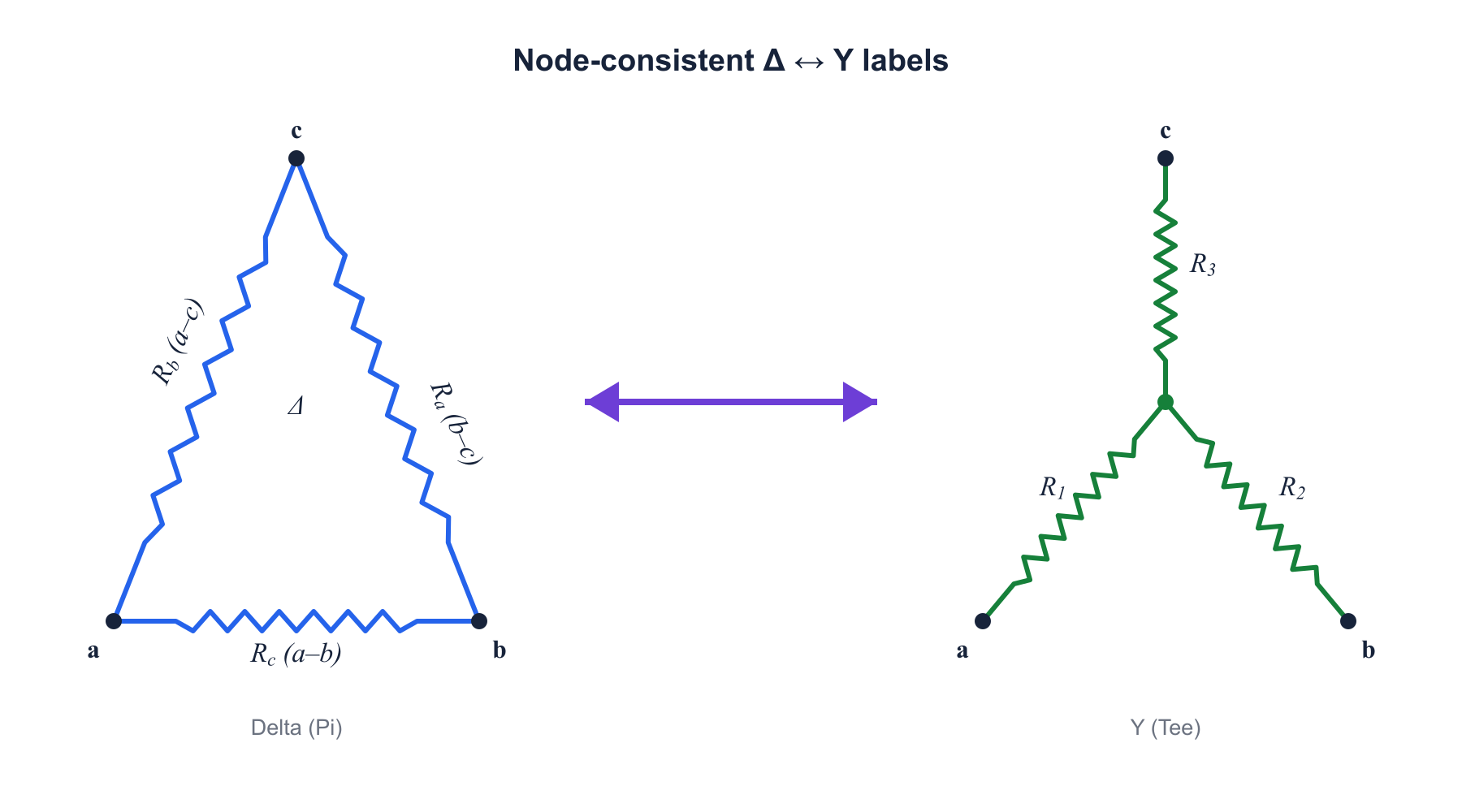
Establish the Delta–Y and Y–Delta formulas from the node labels. In example one find equivalent resistance, source current, and power; in example two find the source voltage V.
Written solution and narration transcript(shows the full solution)
Below are all the lines written in the notebook together with the full narration transcript.
1. Why Delta and Y transformations?
R_a is the b–c edge opposite node a; Y arms R_1, R_2, and R_3 connect to nodes a, b, and c respectively. Delta / Pi: triangular resistor networkY / Tee: three arms meeting at a centerExternal terminals a, b, and c are preservedGoal: expose series-parallel combinationsNarration transcript
Some circuits contain resistors arranged in a triangle, called a Delta or Pi configuration. Others have resistors meeting at a central point, called a Y or Tee configuration. When a circuit has a Delta or Y that can't be simplified using series or parallel rules, we can convert one into the other. Delta to Y, or Y to Delta. After the conversion, the circuit usually simplifies into simple series and parallel combinations. Let's learn the conversion formulas and see two examples.
2. Conversion formulas
R_a is the b–c edge opposite node a; Y arms R_1, R_2, and R_3 connect to nodes a, b, and c respectively. Narration transcript
Here are the formulas. In the Delta configuration, we have three resistors: R a between nodes b and c, R b between nodes a and c, and R c between nodes a and b. In the Y configuration, R 1 connects from node a to the center, R 2 from node b to the center, and R 3 from node c to the center. To convert from Delta to Y: R 1 equals R b times R c, divided by R a plus R b plus R c. R 2 equals R a times R c, divided by R a plus R b plus R c. R 3 equals R a times R b, divided by R a plus R b plus R c. The mnemonic: each Y resistor equals the product of its two neighboring Delta resistors, divided by the sum of all three Delta resistors. For the reverse, Y to Delta: R a equals R 1 R 2 plus R 2 R 3 plus R 1 R 3, all divided by R 1. R b uses the same numerator, divided by R 2. R c uses the same numerator, divided by R 3. The numerator is always the sum of all pairwise products.
3. Example 1 — read the circuit
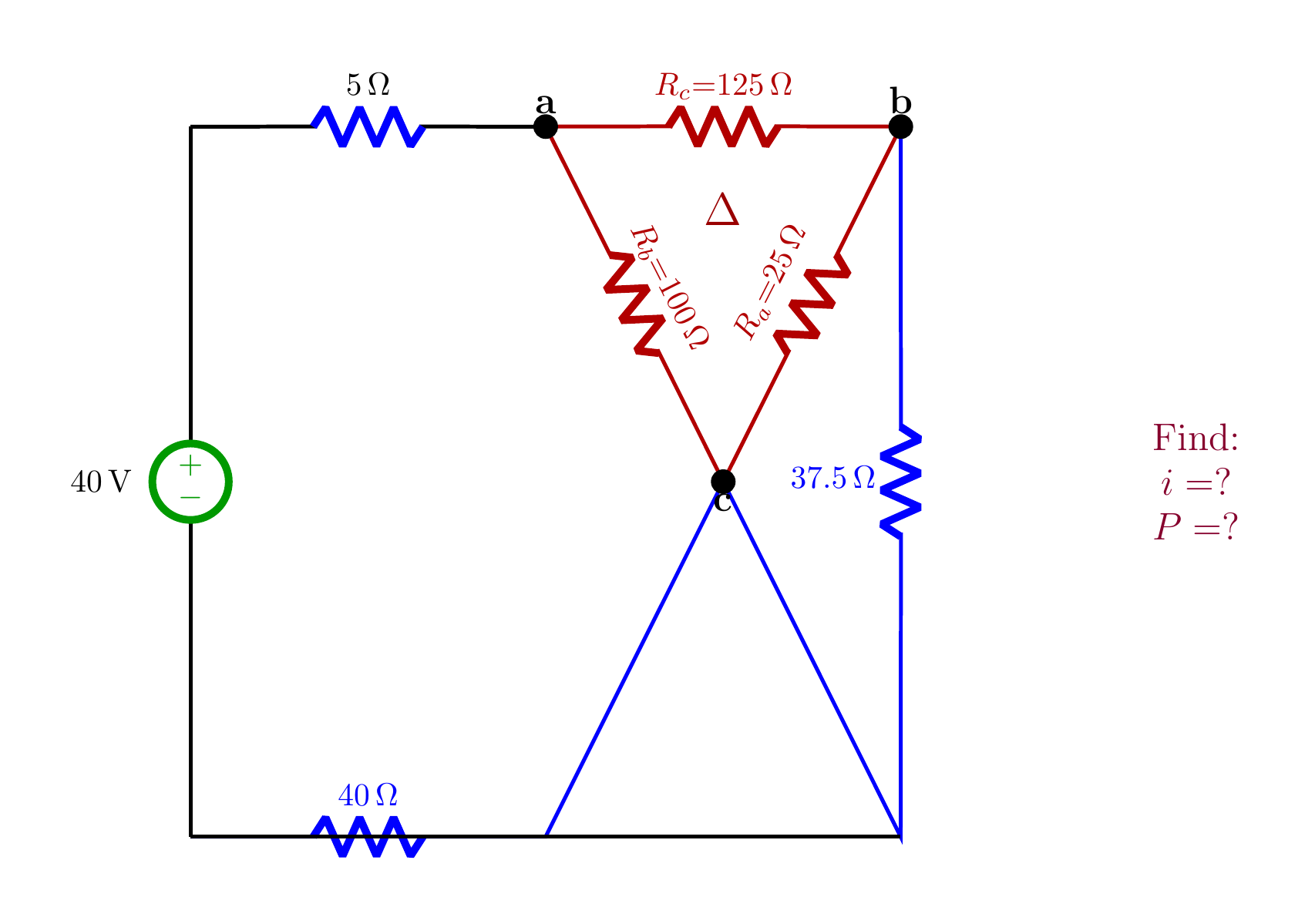
Original bridge network before the Delta transformation. External arms: 5 Ω, 40 Ω, 37.5 ΩFind: Req, i, and PNarration transcript
Example one: Delta to Y. We have a 40 volt source on the left. At the top, a 5 ohm resistor connects to a bridge network. The bridge has a Delta formed by three resistors: R a equals 25 ohms at the bottom, R b equals 100 ohms on the upper left, and R c equals 125 ohms on the upper right. Below the Delta, we have 40 ohms on the lower left and 37.5 ohms on the lower right. This bridge can't be simplified directly with series parallel rules. So we'll convert the Delta to a Y.
4. Example 1 — Delta to Y
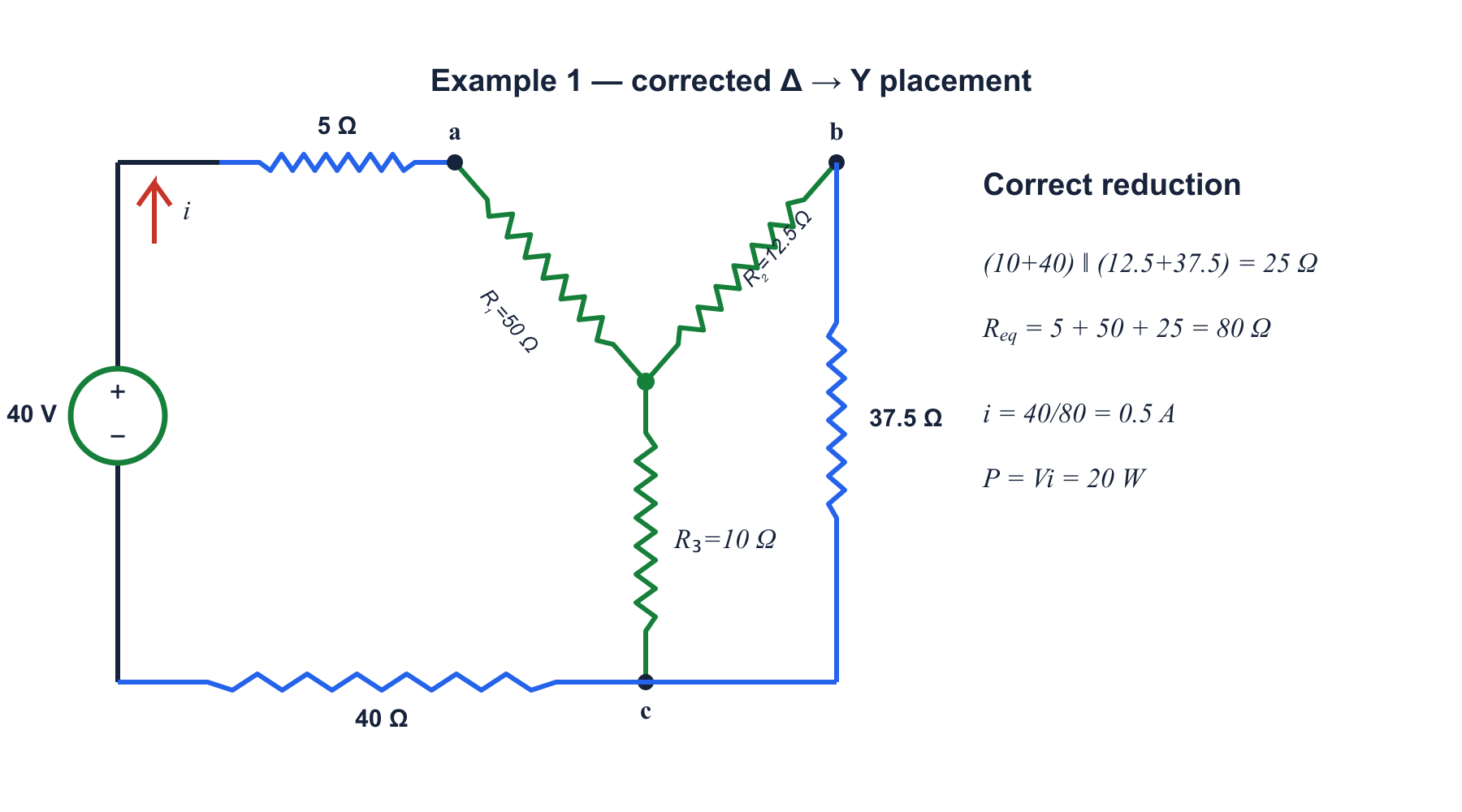
After reduction, R_eq=80 Ω, i=0.5 A, and P=20 W. Narration transcript
The sum of all Delta resistors is R a plus R b plus R c, which is 25 plus 100 plus 125, giving 250 ohms. With R a opposite node a, R b opposite node b, and R c opposite node c, the Y arm at node a is R 1 equals R b times R c over 250: 100 times 125 over 250 equals 50 ohms. The arm at node b is R 2 equals R a times R c over 250: 25 times 125 over 250 equals 12.5 ohms. The arm at node c is R 3 equals R a times R b over 250: 25 times 100 over 250 equals 10 ohms. Now follow the nodes. From the center to the lower terminal through node c, 10 plus 40 gives 50 ohms. Through node b, 12.5 plus 37.5 also gives 50 ohms. Those two branches are in parallel, so they become 25 ohms. The node-a arm of 50 ohms is in series with that result, and the external 5 ohm resistor is also in series. Therefore R equivalent is 5 plus 50 plus 25, or 80 ohms. The source current is 40 divided by 80, which is 0.5 amperes, and the source power is 40 times 0.5, or 20 watts.
5. Example 2 — read the circuit
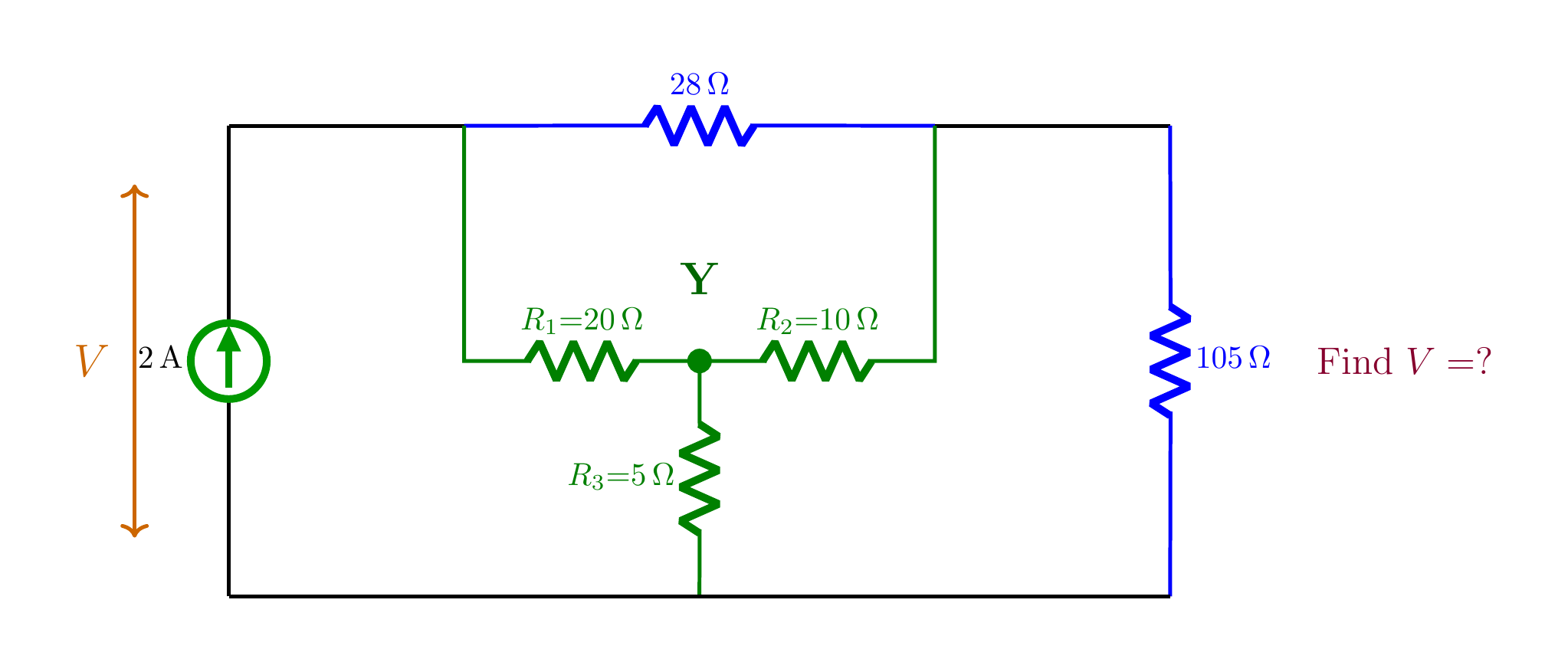
The source voltage V is found by a Y-to-Delta transformation. Y:External resistors: 28 Ω and 105 ΩFind: VNarration transcript
Example two: Y to Delta. This time we have a 2 ampere current source on the left, with voltage V across it. In the middle, a Y network with R 1 equals 20 ohms going left, R 2 equals 10 ohms going right, and R 3 equals 5 ohms going down. There's also a 28 ohm resistor across the top and 105 ohms on the right side. We need to find V. The Y network prevents simple series parallel reduction, so we'll convert it to Delta.
6. Example 2 — Y to Delta
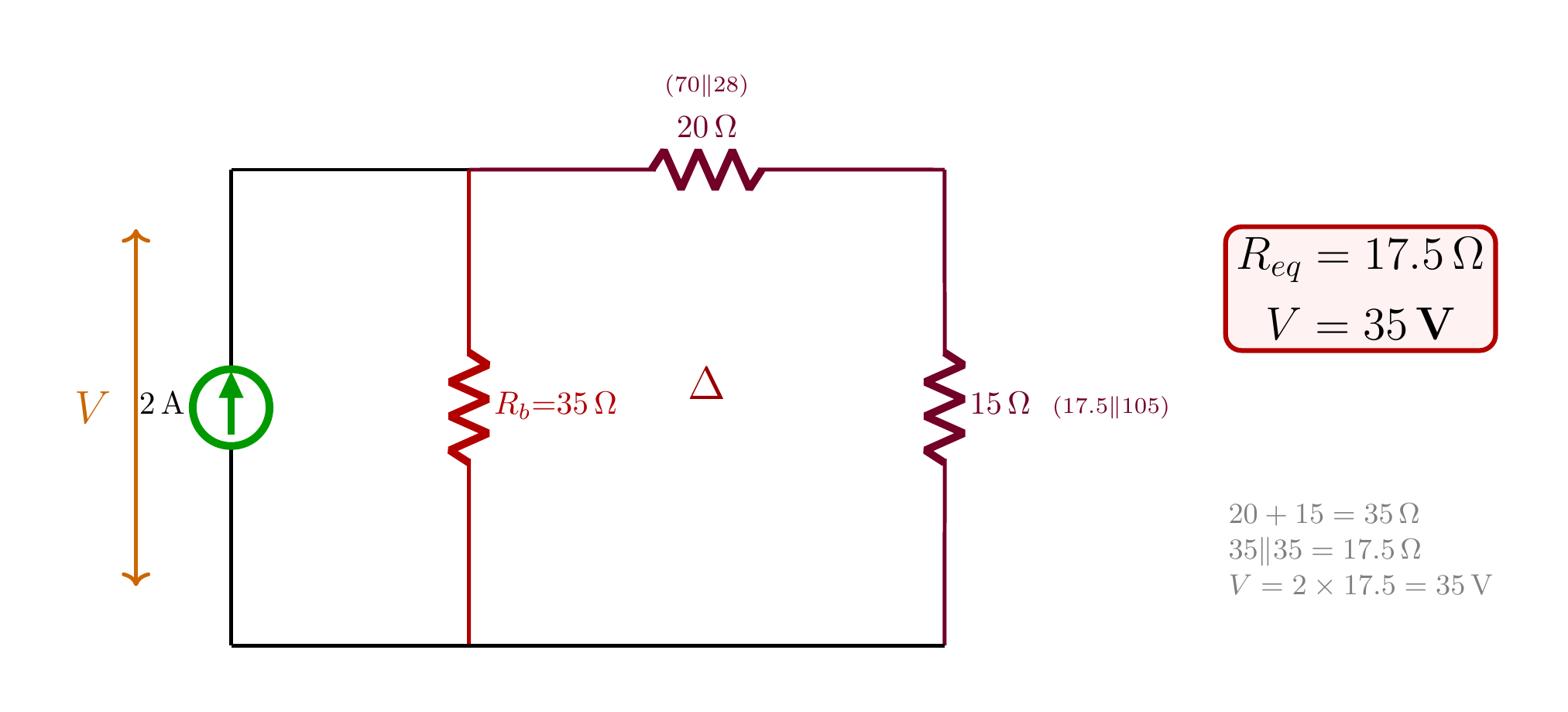
The final results are R_eq=17.5 Ω and V=35 V. Narration transcript
For Y to Delta, first calculate the numerator. R 1 R 2 plus R 2 R 3 plus R 1 R 3 equals 20 times 10, plus 10 times 5, plus 20 times 5. That's 200 plus 50 plus 100, which equals 350. Now divide by each Y resistor. R a equals 350 over R 1, that's 350 over 20, giving 17.5 ohms. R b equals 350 over R 2, that's 350 over 10, giving 35 ohms. R c equals 350 over R 3, that's 350 over 5, giving 70 ohms. Now we simplify. R c of 70 ohms is in parallel with the 28 ohm resistor. 70 times 28 over 70 plus 28 equals 1960 over 98, which is 20 ohms. R a of 17.5 ohms is in parallel with 105 ohms. 17.5 times 105 over 17.5 plus 105 equals 1837.5 over 122.5, which is 15 ohms. These 20 and 15 ohm resistors are in series: 20 plus 15 equals 35 ohms. This 35 ohm combination is in parallel with R b of 35 ohms. 35 parallel 35 equals 17.5 ohms. Finally, V equals I times R equivalent, which is 2 times 17.5, giving us 35 volts.
7. Method summary
1) Label nodes and opposite edges2) Apply the required transformation3) Reduce the new series-parallel network4) Check units and limiting behaviorNarration transcript
Let's recap. Delta to Y conversion: each Y resistor equals the product of its two neighboring Delta resistors, divided by the sum of all three. Y to Delta: each Delta resistor equals the sum of all pairwise products, divided by the opposite Y resistor. Use Delta to Y when the Delta blocks series parallel simplification. Use Y to Delta when the Y is the bottleneck. In the next lesson, we'll explore mesh analysis.
Source video: Circuit Theory #07 | Delta-Y Transformation — Pi-Tee Equivalent Circuits (7:24)