Circuit Theory 1 · Supermesh Analysis
#19 Supermesh #19 — dependent current source: find V_a
Relates the dependent current source to the mesh variables, then combines source constraints with outer-supermesh KVL to find V_a.
Question
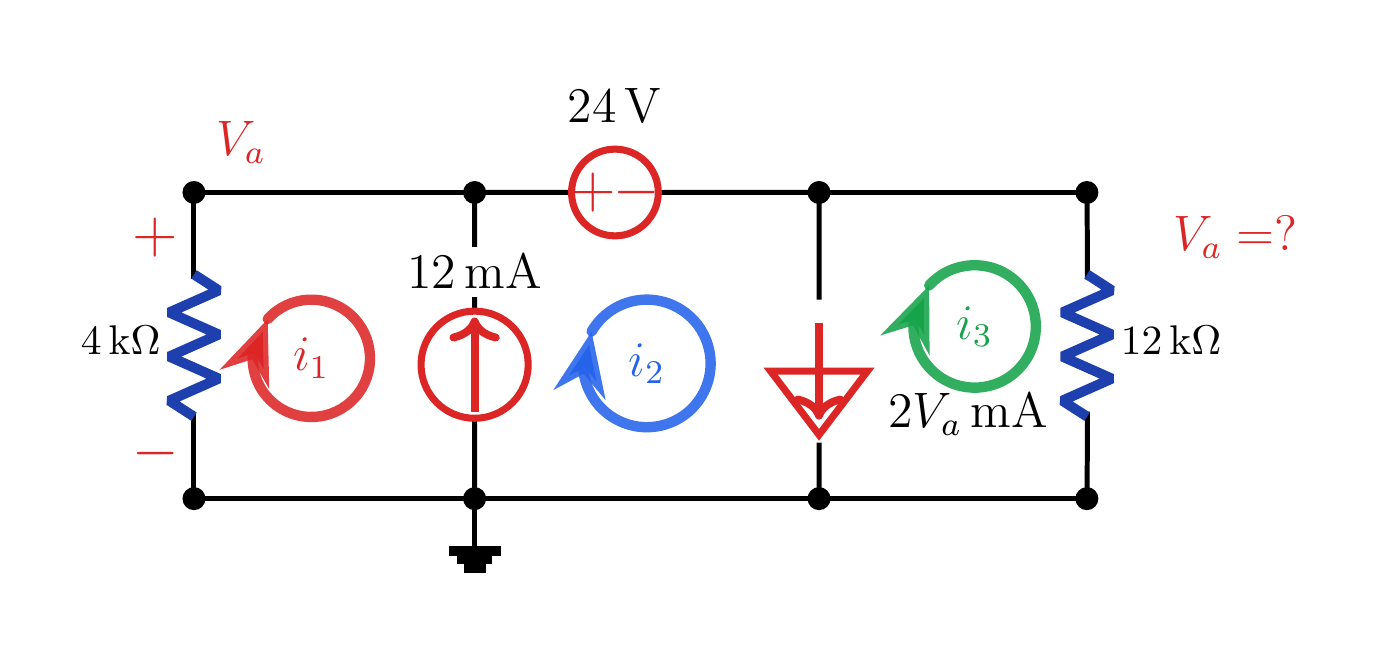
Use supermesh analysis to find voltage V_a in the circuit containing an independent and a dependent current source.
Written solution and narration transcript(shows the full solution)
Below are all the lines written in the notebook together with the full narration transcript.
1. Dependent-source recap
Clockwise mesh currents i_1, i_2 and i_3, the V_a polarity, and the 2V_a mA dependent source are shown. Dependent-source supermeshSame method; one extra dependency relationFind: VaNarration transcript
We have now used supermesh analysis when a current source blocks a direct K V L path. The next twist is a dependent current source. The method is the same, but one source value is not a fixed number. It depends on a circuit variable, so we must write one extra relation before solving.
2. Read the circuit
Clockwise mesh currents i_1, i_2 and i_3, the V_a polarity, and the 2V_a mA dependent source are shown. 4 kΩ | 12 kΩ | 24 VIndependent source: 12 mA ↑Dependent source: 2Va mA ↓i1, i2, i3: clockwiseNarration transcript
In this circuit, the target is V a. The left resistor is 4 kilo ohms, the right resistor is 12 kilo ohms, and the top voltage source is 24 volts with plus on the V a side. The left current source is 12 milliamps upward. The middle diamond source points downward and has value 2 times V a milliamps. We choose clockwise mesh currents i one, i two, and i three.
3. Build and solve the equations
Clockwise mesh currents i_1, i_2 and i_3, the V_a polarity, and the 2V_a mA dependent source are shown. Current-source constraintsi2−i1=12 mAi2−i3=2Va mAi1=−1.5 mA, i2=10.5 mA, i3=−1.5 mANarration transcript
Start with the two current-source constraints. For the 12 milliamp source, the shared-branch relation is i two minus i one equals 12 milliamps. For the dependent source, the relation is i two minus i three equals 2 V a milliamps. Now relate V a to the left mesh current. With the chosen polarity, V a equals negative 4 i one volts, because 4 kilo ohms times i one milliamps gives volts. Substituting this into the dependent-source constraint gives i two minus i three equals negative 8 i one, or 8 i one plus i two minus i three equals zero. The outer supermesh K V L equation skips the two current-source branches and gives negative 4 i one minus 12 i three equals 24. Solving these three equations gives i one equals negative 1.5 milliamps, i two equals 10.5 milliamps, and i three equals negative 1.5 milliamps. Finally, V a equals negative 4 times negative 1.5, so V a is 6 volts.
4. Method summary
Clockwise mesh currents i_1, i_2 and i_3, the V_a polarity, and the 2V_a mA dependent source are shown. Dependent source ⇒ extra relationCurrent constraints + outer-supermesh KVLNarration transcript
A dependent source does not change the supermesh workflow. It only adds one bookkeeping step: express the dependent source value using the chosen mesh variables. Here, the key link was V a equals negative 4 i one. After that, the current-source constraints and the outer K V L equation formed a normal three-equation system. The final answer is V a equals 6 volts.
Source video: Circuit Theory #19 | Dependent-Source Supermesh Analysis - Find Va (2:39)