Circuit Theory 1 · Circuit Analysis Fundamentals
#06 Dependent sources — two worked KVL and KCL examples
Classifies the four controlled-source types and solves dependent current- and voltage-source circuits with KCL, KVL, and Ohm's law.
Question
Classify the dependent-source types. In the first circuit find i_x, i_0, and V_0. In the second, use the electrically isolated controlling circuit to find i_x, i_0, and V_0.
Written solution and narration transcript(shows the full solution)
Below are all the lines written in the notebook together with the full narration transcript.
1. Four dependent-source types
Independent source: circleDependent source: diamondVCVS · CCVS · VCCS · CCCSIts value depends on another V or INarration transcript
So far, every source in our circuits has been independent. A battery supplies a fixed voltage regardless of what's happening elsewhere. But some sources depend on another voltage or current in the circuit. We call these dependent sources, also known as controlled sources. Their symbol is a diamond shape, unlike the circle used for independent sources. There are four types. A voltage-controlled voltage source, V C V S, produces a voltage proportional to another voltage. A current-controlled voltage source, C C V S, produces a voltage proportional to another current. A voltage-controlled current source, V C C S, produces a current proportional to another voltage. And a current-controlled current source, C C C S, produces a current proportional to another current. These show up everywhere in transistor models and amplifier circuits. Let's see how to handle them in KVL and KCL analysis.
2. Dependent current source
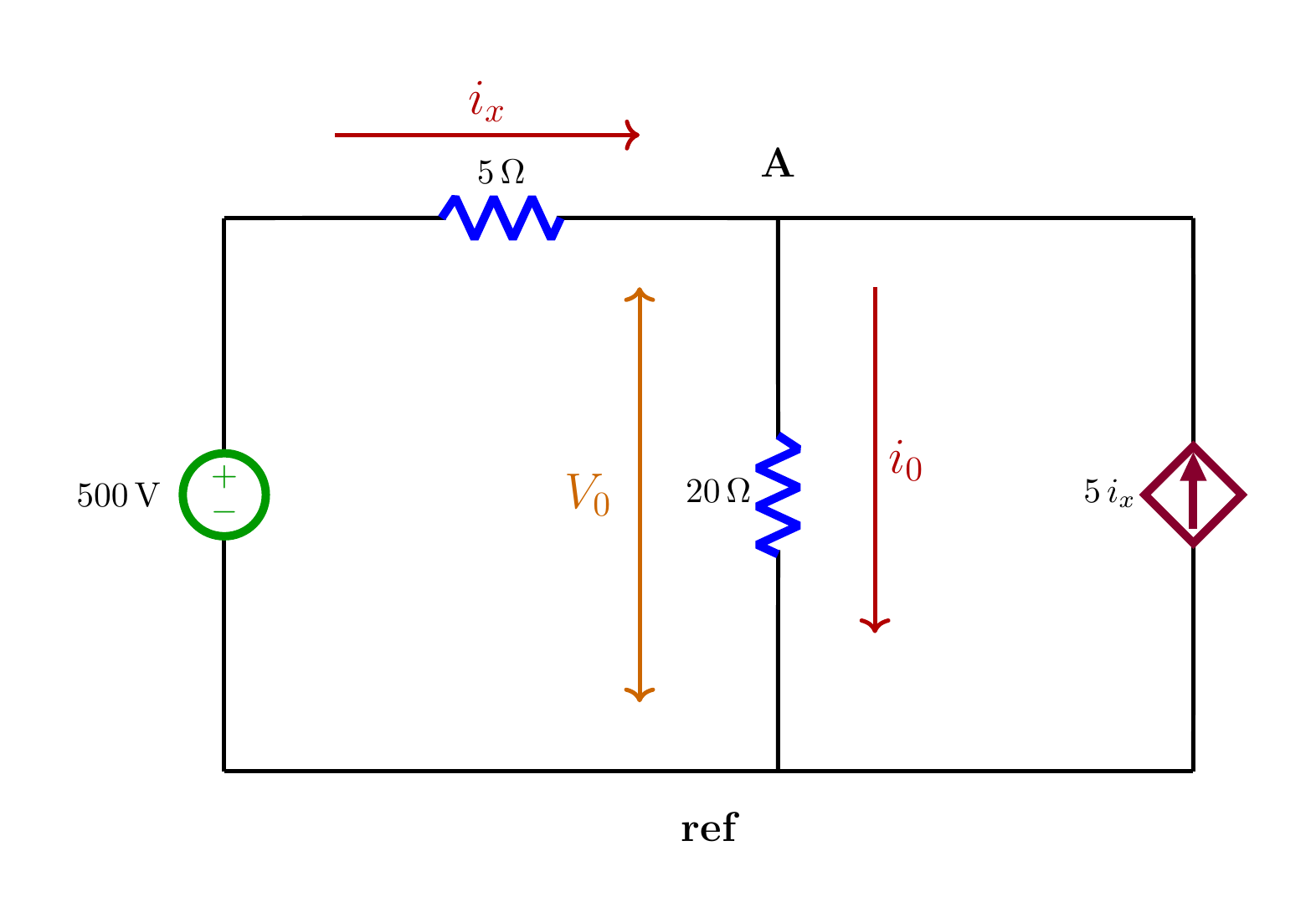
Apply KCL at the top node and KVL around the 500 V–5 Ω–20 Ω loop. Given: 500 V, 5 Ω, 20 Ω, 5ix ↑References: ix right, i0 downFind: ix, i0, V0Narration transcript
Here's our first example. On the left we have a five hundred volt voltage source. Along the top, a five ohm resistor carries a current i x flowing to the right. In the center, a twenty ohm resistor carries a current i zero flowing downward. The voltage across the twenty ohm resistor is V zero. On the right side, there's a dependent current source shown as a diamond. It produces a current equal to five times i x, directed upward. Our goal is to find i x, i zero, and V zero.
3. Solve example one
Apply KCL at the top node and KVL around the 500 V–5 Ω–20 Ω loop. KCL:KVL:Narration transcript
Let's solve this step by step. First, apply KCL at the top-right node. The current entering from the top is i x. The dependent source pushes five i x upward into the same node. The current leaving downward through the twenty ohm resistor is i zero. So i zero equals i x plus five i x, which simplifies to six i x. Next, apply KVL around the outer loop. Starting from the five hundred volt source: five hundred minus five times i x minus twenty times i zero equals zero. Now substitute i zero equals six i x. Five hundred minus five i x minus twenty times six i x equals zero. That's five hundred minus five i x minus one hundred and twenty i x. Combining: five hundred minus one hundred and twenty five i x equals zero. Solving: i x equals five hundred divided by one hundred and twenty five, which is four amperes. Back-substituting: i zero equals six times four, which is twenty four amperes. And V zero equals twenty times twenty four, giving us four hundred and eighty volts.
4. Dependent voltage source
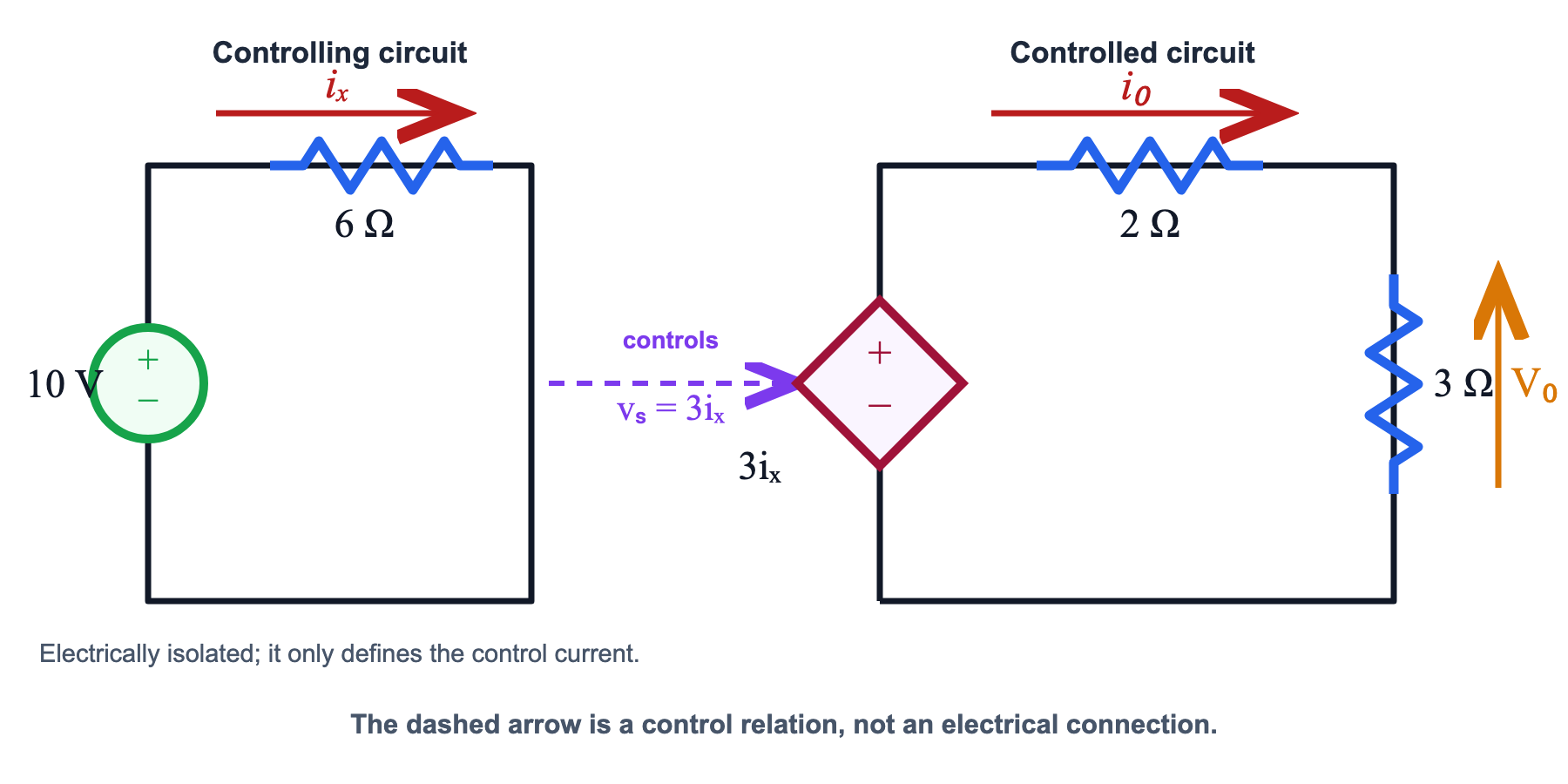
The dashed arrow represents a control relation, not an electrical connection between the circuits. Controlling circuit: 10 V and 6 ΩControlled source:Right loop: 2 Ω and 3 ΩThe dashed arrow is not an electrical connectionNarration transcript
Now for the second example with a dependent voltage source. In the left loop, we have a ten volt independent source and a six ohm resistor. The current i x flows clockwise through this loop. In the right loop, there's a dependent voltage source equal to three times i x, shown as a diamond with plus and minus signs. The right loop also has a two ohm resistor at the top carrying current i zero, and a three ohm resistor on the right side. V zero is the voltage across the three ohm resistor. We need to find i x, i zero, and V zero.
5. Solve example two
The dashed arrow represents a control relation, not an electrical connection between the circuits. Narration transcript
Let's solve the second example. Start with the left loop. By KVL: ten minus six times i x equals zero. So i x equals ten divided by six, which is five thirds of an ampere. Now calculate the dependent source voltage. Three times i x equals three times five thirds, which is five volts. Next, apply KVL around the right loop. The dependent source provides five volts. Going around: five minus two times i zero minus three times i zero equals zero. That simplifies to five minus five i zero equals zero. So i zero equals one ampere. Finally, V zero equals i zero times three, which is one times three, giving us three volts.
6. Method summary
1) Identify the controlling variable2) Express the source through that variable3) Apply KCL/KVL and Ohm's law4) Solve the equation systemNarration transcript
Let's recap what we learned. Dependent sources use a diamond symbol and their value depends on another circuit variable. There are four types: VCVS, CCVS, VCCS, and CCCS. When solving, treat the dependent source like any other source in KVL and KCL, but remember to express its value in terms of the controlling variable. Then substitute and solve the system of equations as usual. In the next lesson, we'll explore Delta-Y transformation.
Source video: Circuit Theory #06 | Dependent Sources — KVL/KCL with Controlled Sources (5:08)