Circuit Theory 1 · Circuit Analysis Fundamentals
#14 Dependent sources in nodal and supernode analysis
Solves a dependent-current-source nodal circuit and an extended supernode with a dependent voltage source, including sign checks.
Question
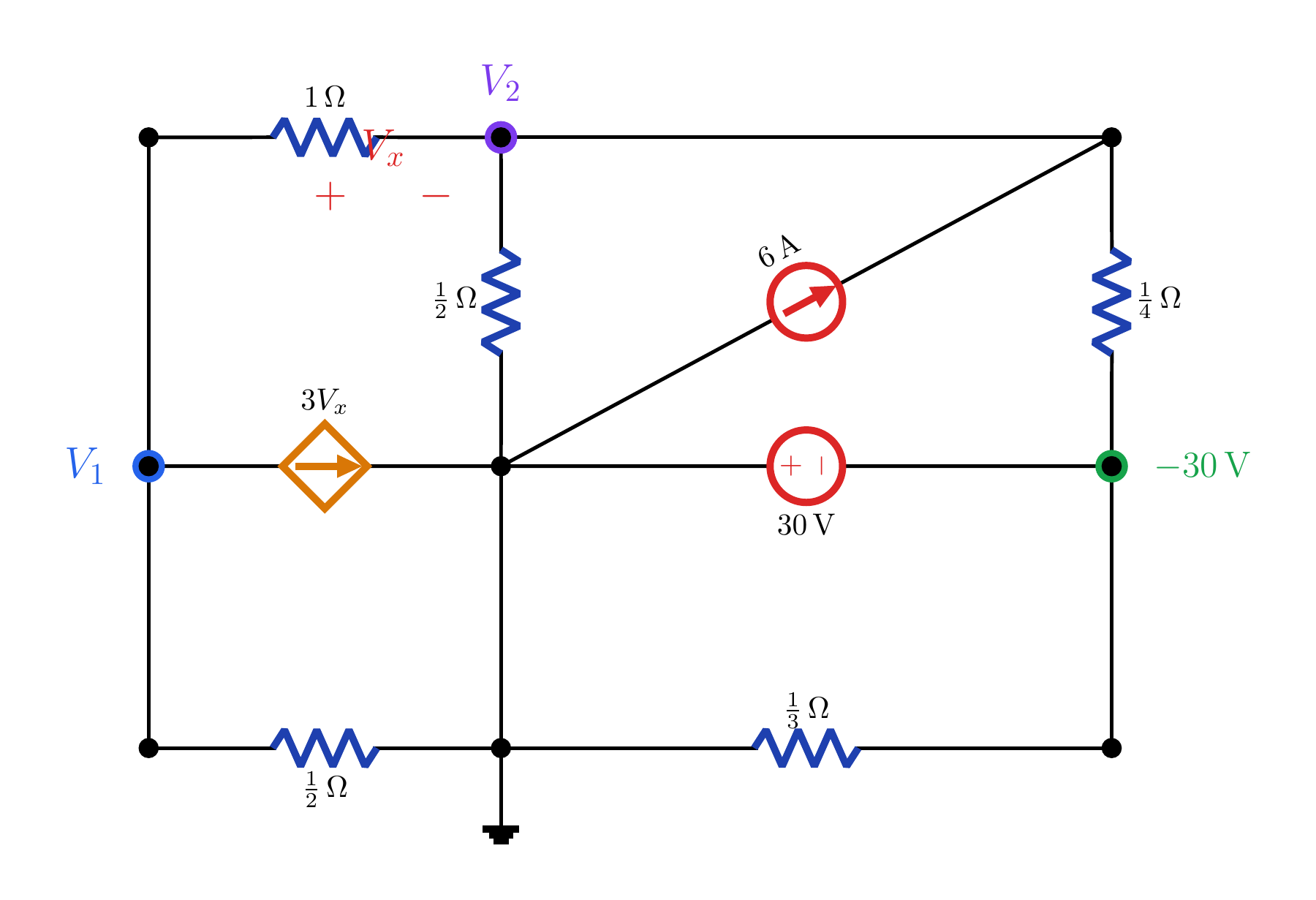
Solve both circuits with node voltages. Find V_x in Example 1 and V together with V_1 in Example 2, writing every controlling relation and source constraint explicitly.
Written solution and narration transcript(shows the full solution)
Below are all the lines written in the notebook together with the full narration transcript.
1. Dependent-source rule
V_x is defined positive-to-negative from left to right across the top 1 Ω resistor; 3V_x leaves V_1 for reference and 6 A enters V_2 from reference. Dependent source: its value follows another circuit variableKCL is unchanged; add the controlling relationTwo examples: nodal analysis + dependent-source supernodeNarration transcript
In the previous lesson, our supernode examples used only independent voltage sources. Today we keep the same nodal-analysis framework, but one source value now depends on another circuit variable. That changes one thing and only one thing: after writing Kirchhoff's Current Law, we must express the dependent source through its controlling voltage or current. Example 1 is a dependent-source nodal-analysis problem without a supernode. Example 2 extends the same idea to a dependent-source supernode.
2. Example 1 — read the circuit
V_x is defined positive-to-negative from left to right across the top 1 Ω resistor; 3V_x leaves V_1 for reference and 6 A enters V_2 from reference. Right node: −30 VFind: VxNarration transcript
Here is Example 1 from the Turkish lesson 23. Choose the center node as the reference. Call the left node voltage V one and the top node voltage V two. The controlling voltage V x is measured across the top one-ohm resistor, positive on the left and negative on the right, so V x will equal V one minus V two. The left node connects to that one-ohm resistor, a half-ohm resistor to reference, and a dependent current source of three V x pointing into the reference node. The top node connects to the one-ohm resistor, another half-ohm resistor to reference, a six-amp source coming up from the reference node, and a quarter-ohm resistor to the right node. Because the 30-volt source has its positive terminal at the reference side, the right node is fixed at minus 30 volts. Our goal is V x.
3. Example 1 — node equations
V_x is defined positive-to-negative from left to right across the top 1 Ω resistor; 3V_x leaves V_1 for reference and 6 A enters V_2 from reference. Narration transcript
Start with Kirchhoff's Current Law at the left node. The leaving currents are V one minus V two through the one-ohm resistor, 2 V one through the half-ohm resistor, and 3 V x through the dependent current source. So the equation is V one minus V two plus 2 V one plus 3 V x equals zero, which simplifies to 3 V one minus V two plus 3 V x equals zero. Now write Kirchhoff's Current Law at the top node. The leaving currents are V two minus V one through the one-ohm resistor, 2 V two through the vertical half-ohm resistor, and 4 times V two plus 30 through the quarter-ohm resistor. The 6-amp source enters the top node, so it contributes minus 6 in the leaving-current equation. This gives negative V one plus 7 V two equals negative 114. Finally, the controlling relation is V x equals V one minus V two.
4. Example 1 — result and check
V_x is defined positive-to-negative from left to right across the top 1 Ω resistor; 3V_x leaves V_1 for reference and 6 A enters V_2 from reference. Narration transcript
Use the constraint to remove V x from the first equation. Then 3 V one minus V two plus 3 times V one minus V two equals zero, so 6 V one minus 4 V two equals zero, or 3 V one minus 2 V two equals zero. Solve this with negative V one plus 7 V two equals negative 114. The result is V two equals negative 18 volts and V one equals negative 12 volts. Therefore V x equals V one minus V two, which is 6 volts. So even with a dependent current source, the nodal-analysis structure stays the same. We only add the controlling relation.
5. Example 2 — supernode and directions
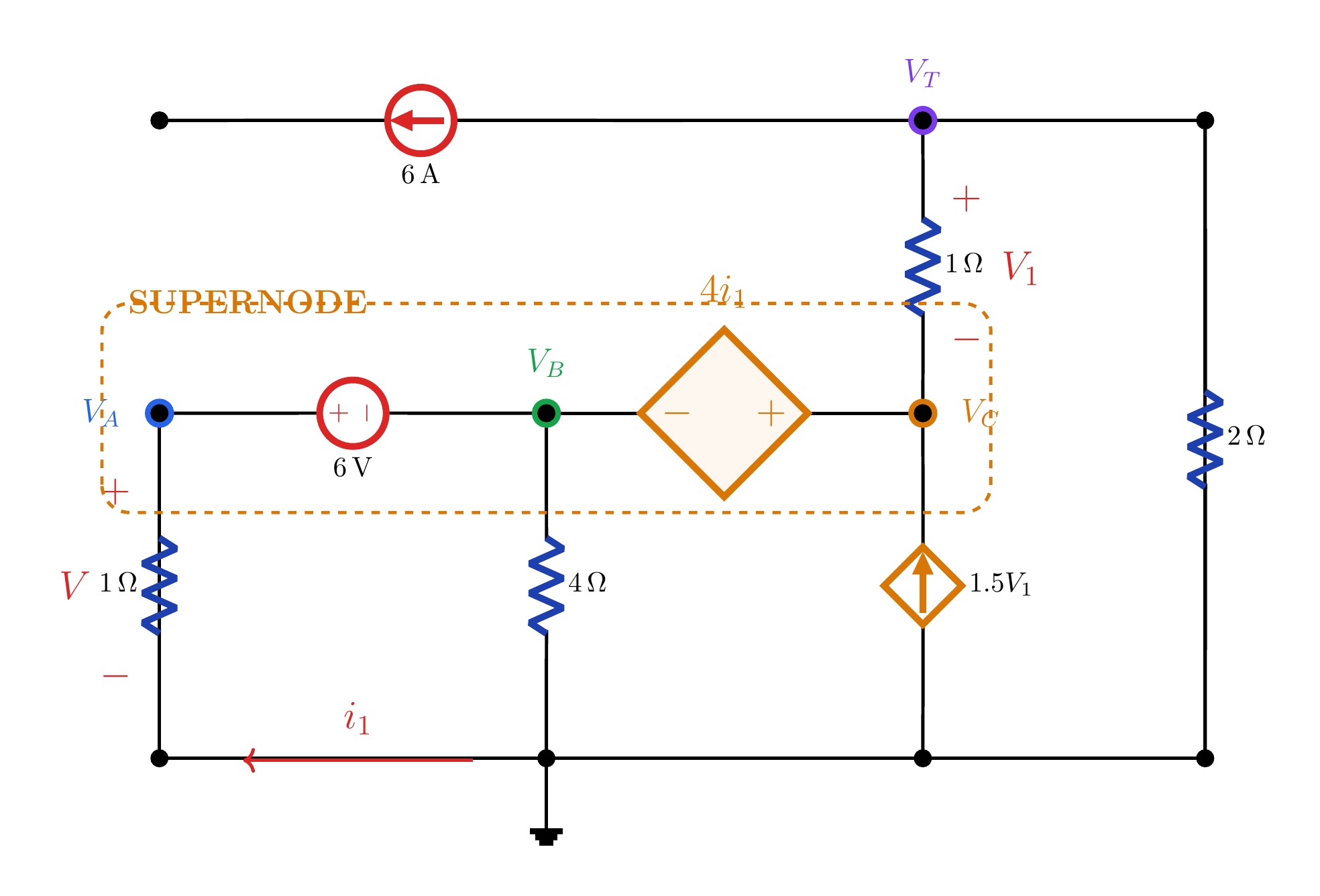
The 6 A source points left from V_T into the supernode; the 4i_1 source is negative at V_B and positive at V_C. The 6 A source points from VT into the supernodeNarration transcript
Now Example 2 from the Turkish lesson 24. Take the bottom wire as the reference. The left resistor voltage is labeled V, so the left node voltage is simply V. On the right, the one-ohm vertical resistor has voltage V one, positive at the top node and negative at the middle-right node. The current i one is defined leftward along the bottom wire, so through the left one-ohm resistor we have i one equals negative V. Two voltage sources connect the left, middle, and right nodes in one chain: a 6-volt independent source between the left and middle nodes, and a dependent voltage source of 4 i one between the middle and right nodes. That means those three nodes form one extended supernode. Outside the supernode, the top node connects through a 2-ohm resistor to reference and through a 6-amp source toward the left node. Our targets are V and V one.
6. Example 2 — constraints and KCL
The 6 A source points left from V_T into the supernode; the 4i_1 source is negative at V_B and positive at V_C. Narration transcript
First write the source constraints. From the 6-volt source, V A minus V B equals 6. From the dependent voltage source, V C minus V B equals 4 i one. But i one equals negative V, so this becomes V C minus V B equals negative 4 V. Now write Kirchhoff's Current Law at the top node. The leaving currents are V T over 2, V T minus V C through the one-ohm resistor, and 6 amperes through the source that points left. Since V one equals V T minus V C, this becomes V T over 2 plus V one plus 6 equals zero. Next apply Kirchhoff's Current Law to the whole supernode. The crossing currents are V through the left one-ohm resistor, V B over 4 through the 4-ohm resistor, V C minus V T through the upper one-ohm branch, negative 1.5 V one from the dependent current source because it enters the boundary, and negative 6 from the top current source because it also enters the boundary. So the supernode equation becomes V plus V B over 4 minus 2.5 V one minus 6 equals zero. Using the source constraints, we get V B equals V minus 6, and the top-node relation reduces to V one equals V minus 2.
7. Example 2 — result and check
The 6 A source points left from V_T into the supernode; the 4i_1 source is negative at V_B and positive at V_C. Narration transcript
Substitute V B equals V minus 6 and V one equals V minus 2 into the supernode equation. Then V plus V minus 6 over 4 minus 2.5 times V minus 2 minus 6 equals zero. Multiply by 4, simplify, and we get negative 5 V minus 10 equals zero. So V equals negative 2 volts. Then V one equals V minus 2, so V one equals negative 4 volts. The internal nodes are also easy to recover: V B equals negative 8 volts and V C equals zero volts. As a quick check, 1.5 times V one equals negative 6 amperes, so the dependent current source is effectively 6 amperes downward, which is consistent with the rest of the circuit.
8. Method summary
The 6 A source points left from V_T into the supernode; the 4i_1 source is negative at V_B and positive at V_C. 1) Write node or supernode KCL2) Add the controlling relation and source constraints3) Verify signs, then solve the systemNarration transcript
These two examples show the extra rule created by dependent sources. The Kirchhoff's Current Law structure does not change. What changes is the added relation between the dependent source and its controlling variable. In ordinary nodal analysis, that relation might be V x equals V one minus V two or i one equals negative V. In a supernode problem, we still count only currents that cross the boundary, but every dependent source inside the boundary must be translated into node-voltage relations before solving. So the workflow is: choose a reference, write Kirchhoff's Current Law, write the source constraints, express the controlling variable, and solve the algebra. In the next lesson, we will switch to mesh-current analysis.
Source video: Circuit Theory #14 | Dependent Sources in Nodal Analysis — Worked Examples (7:52)