Digital Design · Canonical forms
#05 Digital Design #05 | SOP, POS, Minterms, and Maxterms
Corrected solution notes. The audio is the original recording and may contain errors or incomplete phrases. Where they differ, use the corrected written solution.
Question
Corrected solution notes. The audio is the original recording and may contain errors or incomplete phrases. Where they differ, use the corrected written solution. Digital Design #05 | SOP, POS, Minterms, and Maxterms
Written solution and narration transcript(shows the full solution)
Below are all the lines written in the notebook together with the full narration transcript.
1. Canonical forms
Corrected solution notes. The audio is the original recording and may contain errors or incomplete phrases. Where they differ, use the corrected written solution.A truth table specifies every output row. Canonical SOP collects the one rows; canonical POS excludes the zero rows.Keep the input ordering A,B,C fixed when assigning row numbers.Narration transcript
After Boolean algebra, the next question is: how do we write a logic function in a systematic way? A truth table tells us exactly where the output is one, and where the output is zero. Standard forms turn that table into an expression recipe. Sum of products builds from the one rows. Product of sums builds from the zero rows. They look like opposite directions, but both describe the same truth table contract.
2. Minterms and SOP
A minterm is an AND of all inputs, each appearing once in direct or complemented form.At row 101 the matching minterm is A AND NOT B AND C, called m5. OR the minterms of all one rows.Narration transcript
Sum of products means: OR together several AND terms. Each AND term can be a product term. In the canonical version, each product term contains every input exactly once. That exact row-matching product term is called a minterm. For example, if A is one, B is zero, and C is one, the minterm is A AND NOT B AND C. It is true only for that single input row. A canonical SOP expression ORs the minterms for every row where the function output is one.
3. Maxterms and POS
A maxterm is an OR of all inputs that is false on exactly one row.M5 is NOT A OR B OR NOT C and is false at 101. M4 is NOT A OR B OR C and is false at 100.AND the maxterms of the zero rows; these two distinct maxterms must not be confused.Narration transcript
Product of sums goes the other way. It means: AND together several OR terms. In the canonical version, each OR term contains every input exactly once. That exact row-blocking OR term is called a maxterm. For the row A equals one, B equals zero, C equals one, the maxterm is NOT A OR B OR NOT C. That OR term is false only on that single row. A canonical POS expression ANDs the maxterms for every row where the function output is zero.
4. Worked table F=C
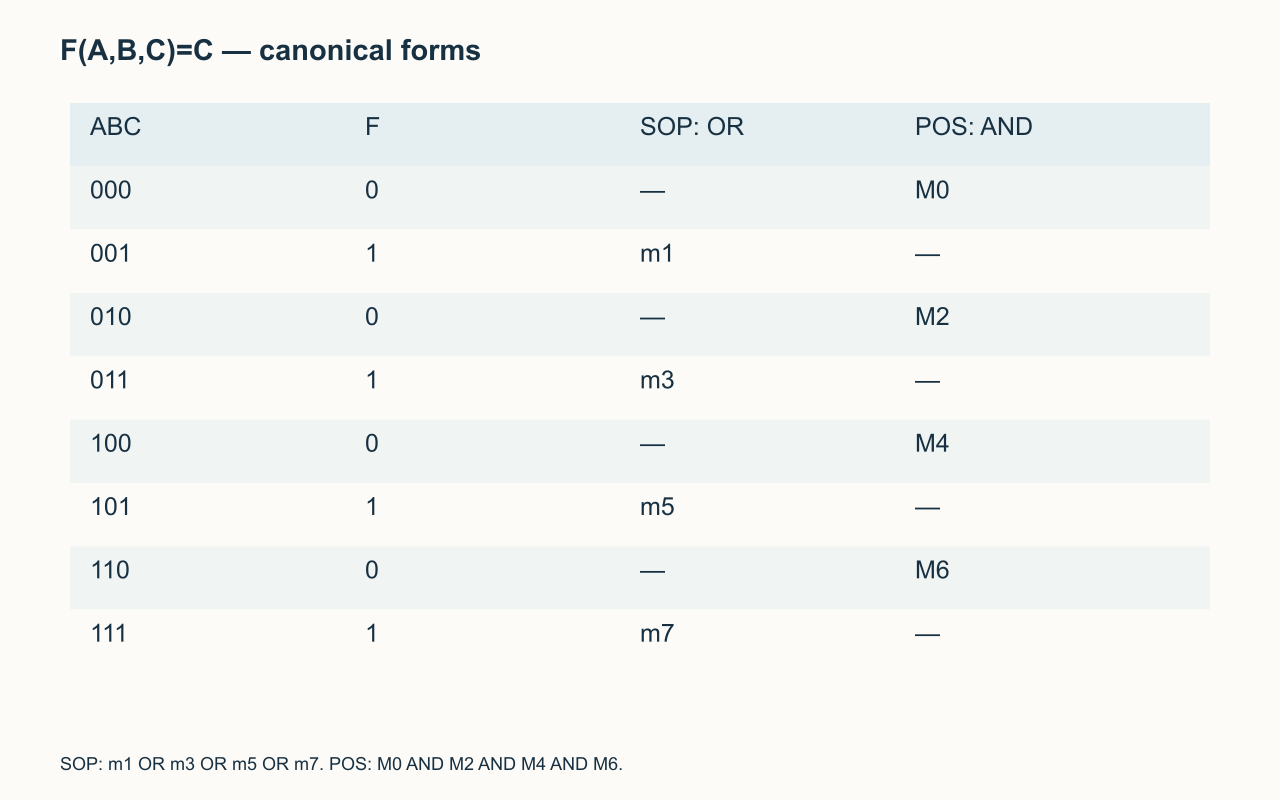
The one-row indices are 1,3,5,7; the zero-row indices are 0,2,4,6.SOP is m1 OR m3 OR m5 OR m7. POS is M0 AND M2 AND M4 AND M6.Both evaluate to C on all eight rows. OR or arithmetic addition cannot replace the AND in the POS expression.Narration transcript
Now build both forms from one table. Suppose F is one whenever C is one. In a three-input table, the one rows are zero zero one, zero one one, one zero one, and one one one. The canonical SOP is the OR of the four matching minterms. The zero rows are zero zero zero, zero one zero, one zero zero, and one one zero. The canonical POS is the AND of the four matching maxterms. The two expressions look very different, but they name the same output column.
5. Choose and simplify
Fewer one rows can make canonical SOP shorter; fewer zero rows can favor canonical POS.Canonical forms are exact but need not be minimal. Simplification must preserve every truth-table row.Narration transcript
Canonical forms are exact, but they are not always small. If a truth table has only a few one rows, SOP may be the shorter description. If it has only a few zero rows, POS may be shorter. The important idea is that we can go from table to expression without guessing. After that, Boolean algebra, and soon Karnaugh maps, can simplify the result.
6. Review
Corrected mathematical reference; use with the written derivation. Minterms match one rows and are combined by OR. Maxterms exclude zero rows and are combined by AND.The operation word AND and the row indices are explicit here to resolve the source pronunciation ambiguity.Narration transcript
Here is the mental model for lesson five. A minterm captures one row where the output is one. SOP collects those rows with OR. A maxterm excludes one row where the output is zero. POS collects those zero rows with AND. Canonical forms are a bridge between truth tables and circuits. In the next lesson, Karnaugh maps will turn that bridge into geometry, so we can group rows and remove variables visually.
Source video: Digital Design #05 | SOP, POS, Minterms, and Maxterms (3:28)