Analog Communication · DSB-SC and conventional AM
#02 Carrier and sidebands, modulation depth, envelope detection and power efficiency
Compare AM and DSB-SC with explicit carrier, sideband, modulation-depth and receiver conditions; distinguish ideal envelope limits from real detector distortion.
Question
Use a real zero-mean normalized message m_n with |m_n|≤1 and bandwidth W Hz. For the worked sinusoidal example m_n(t)=cos(ω_m t), ω_m=2πf_m, ω_c=2πf_c, f_c>W, f_m>0; the tone attains both ±1. Carrier amplitude A_c is positive and μ is nonnegative; s_A=A_c[1+μm_n]cos(ω_c t), s_D=A_c μm_n cos(ω_c t). Compare identical sideband amplitudes; changing normalization independently is not an equal-power comparison. The conventional carrier term is c(t)=A_c cos(ω_c t); s_A=c+s_D. DSB-SC requires zero DC message for no carrier-frequency discrete term: a DC offset leaves a carrier line. 'Carrier present all the time' means a spectral carrier term, not nonzero instantaneous voltage at every zero crossing. For one tone, s_D=(A_c μ/2)[cos((ω_c−ω_m)t)+cos((ω_c+ω_m)t)], positive tone lines f_c±f_m and their negative-frequency conjugates. These are relative voltage amplitudes, not power heights. For a general real message whose significant support reaches W, the positive occupied band [f_c−W,f_c+W] has width2W; a single ideal tone consists of discrete lines with span2f_m, not a filled band. Suppressing only the carrier does not halve this span. The negative-frequency mirror is not an extra physical RF bandwidth. Carrier peak voltage across R>0 gives P_c=A_c²/(2R). Each sinusoidal sideband power P_c μ²/4; together P_SB=P_c μ²/2 and conventional total P_T=P_c(1+μ²/2). Sideband fraction η=μ²/(2+μ²), maximum1/3 within0≤μ≤1 for this single-tone model. This is not universal arbitrary-message efficiency or DC-to-RF power-amplifier efficiency. In DSB-SC all transmitted signal power belongs to the sidebands for nonzero zero-mean message, but transmitter/receiver losses and synchronization remain. Define signed carrier amplitude a=A_c[1+μcos(ω_m t)] separately from magnitude envelope E=|a|. For0≤μ<1, a_min=A_c(1−μ)>0; μ1 just touches zero in the ideal model; μ1.3 gives a_min=−.3A_c and a_max=2.3A_c. Overmodulation causes phase reversals and a folded magnitude envelope, not a negative physical magnitude. For a symmetric normalized tone with0≤μ≤1, Emax=A_c(1+μ),Emin=A_c(1−μ), μ=(Emax−Emin)/(Emax+Emin). Do not apply this extrema formula above1 or to arbitrary asymmetric messages without the correct normalization. The source's 'without yet causing distortion at one' means the ideal non-crossing modulation boundary, not that a real diode/RC detector has zero error at μ1. Practical threshold, ripple and diagonal clipping require adequate carrier/message separation and tracking margin. DSB-SC's magnitude envelope A_c μ|m_n| loses sign. For A_c μ≠0, a coherent detector multiplies by 2/(A_c μ)cos(ω_c t+θ); matched frequency plus ideal low-pass yields y=m_n cosθ. The high-frequency product must be removed; θπ/2 suppresses this output. Frequency mismatch is time-varying phase and distorts recovery. Remove DC and normalize gain for a conventional envelope detector. No source audio or text overrides. 160-line EN SCENES,680-line ACD02,77-line ACRoot,161-line existing TR canonical and metadata were reviewed; generator not executed. Existing authenticated Bunny original169f19ed-3678-4a6a-9733-a4a0a76d46a9 is250.773333s/64,110,449bytes/SHAf30310f927ab69726573deda6d6d1b2448d666cefff15d83880dc2272179a839. Five existing original MP3s+timings have six Hetzner/local hashes; five original-MP3/final correlations.96828–.98221 at29–54ms match the video. The bounded Hetzner final search did not locate an independent final copy; no same-final-file SHA claim.37 real word-timed cues.9724–1 and all source/ASR/line intervals were reviewed. Five actual English final frames seen. The modulation-index source code uses positive .42+.34μ(env+1)/2 instead of1+μenv, so the displayed μ1 and μ1.3 curves never touch/cross zero; exclude that raster. Actual detector-flow frame has a line across the Product detector label and a gap before Baseband; exclude it. Both roles use the clean same-final summary. The intro AM trace is qualitative, not numerically normalized to its μ parameter. Spectrum line positions are readable; two small top labels overlap and relative heights are schematic, not calibrated μ/power. Preserve these limitations rather than treating raster as quantitative proof. Five roles/three unique same-final references. Same shared builder/math/row-store contracts; no legacy single-JSON import, paid TTS, model download, video render/upload, publication, access, security or egress changes. Unpublished technical draft, not full human listening, pedagogical, motion or publication approval. Three scenes were additionally transcribed with cached-small from original MP3 and independently cut direct-final audio: six full outputs read. Modulation-index .9896 and detection .9713 agree across both sources; spectrum .9741 writes 'single TILN' where the source and large say 'single tone'. All plus/minus sideband locations, twice-bandwidth and carrier/no-bandwidth-saving claims remain correct; this phonetic ASR spelling is not treated as proof of wrong narration or silently normalized. Full human fluency review remains outstanding.
Written solution and narration transcript(shows the full solution)
Below are all the lines written in the notebook together with the full narration transcript.
1. Distinguish conventional AM and suppressed-carrier modulation
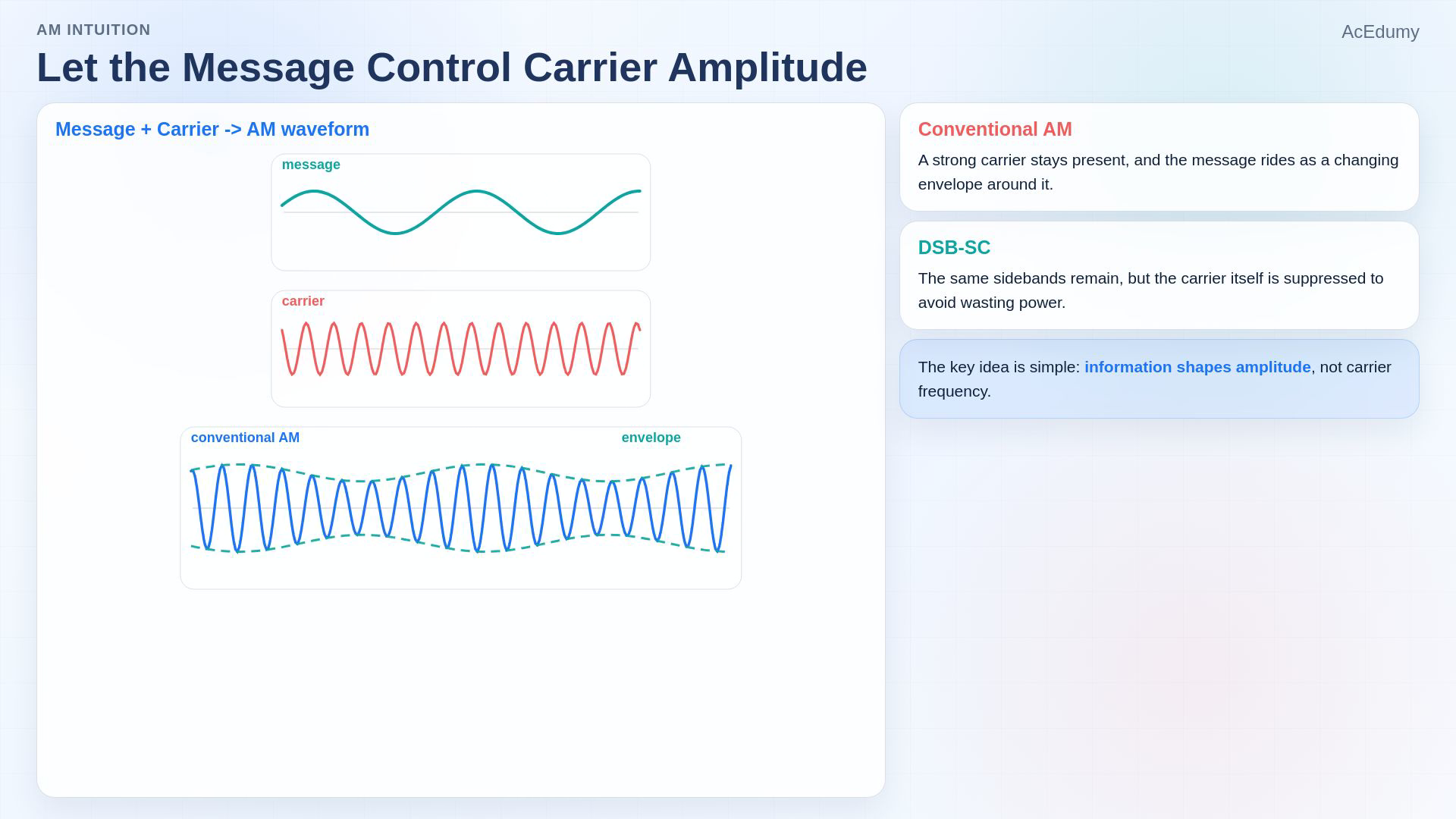
Original-video conceptual reference, not a calibrated waveform or power plot. The incorrect modulation-index curves and broken detector-flow frame are replaced with the same video's summary; exact conditions are written in the notebook. Choose a zero-mean normalized single-tone message:Conventional AM, with positive carrier amplitude and nonnegative depth:For positive modulation sensitivity and a nonnegative signed amplitude, a larger message raises the envelope.A smaller message lowers that signed amplitude; after a zero crossing its magnitude is not a faithful message copy.The conventional waveform includes this separate carrier term:Compare the same sidebands with the carrier removed:Keeping a carrier enables simple envelope reception under suitable conditions; removing it saves carrier power.Narration transcript
Now that we know why a carrier is useful, we can ask how the message is placed on that carrier. In amplitude modulation, the message controls the carrier amplitude. When the message grows, the carrier envelope expands. When the message falls, that envelope contracts. In conventional AM, a strong carrier remains present all the time, so the envelope is easy to observe. In double sideband suppressed carrier, or DSB-SC, the sidebands still exist but the carrier itself is removed. So both waveforms are closely related, yet one keeps the carrier for simplicity while the other suppresses it for better power efficiency.
2. Locate carrier and sidebands under a stated tone model
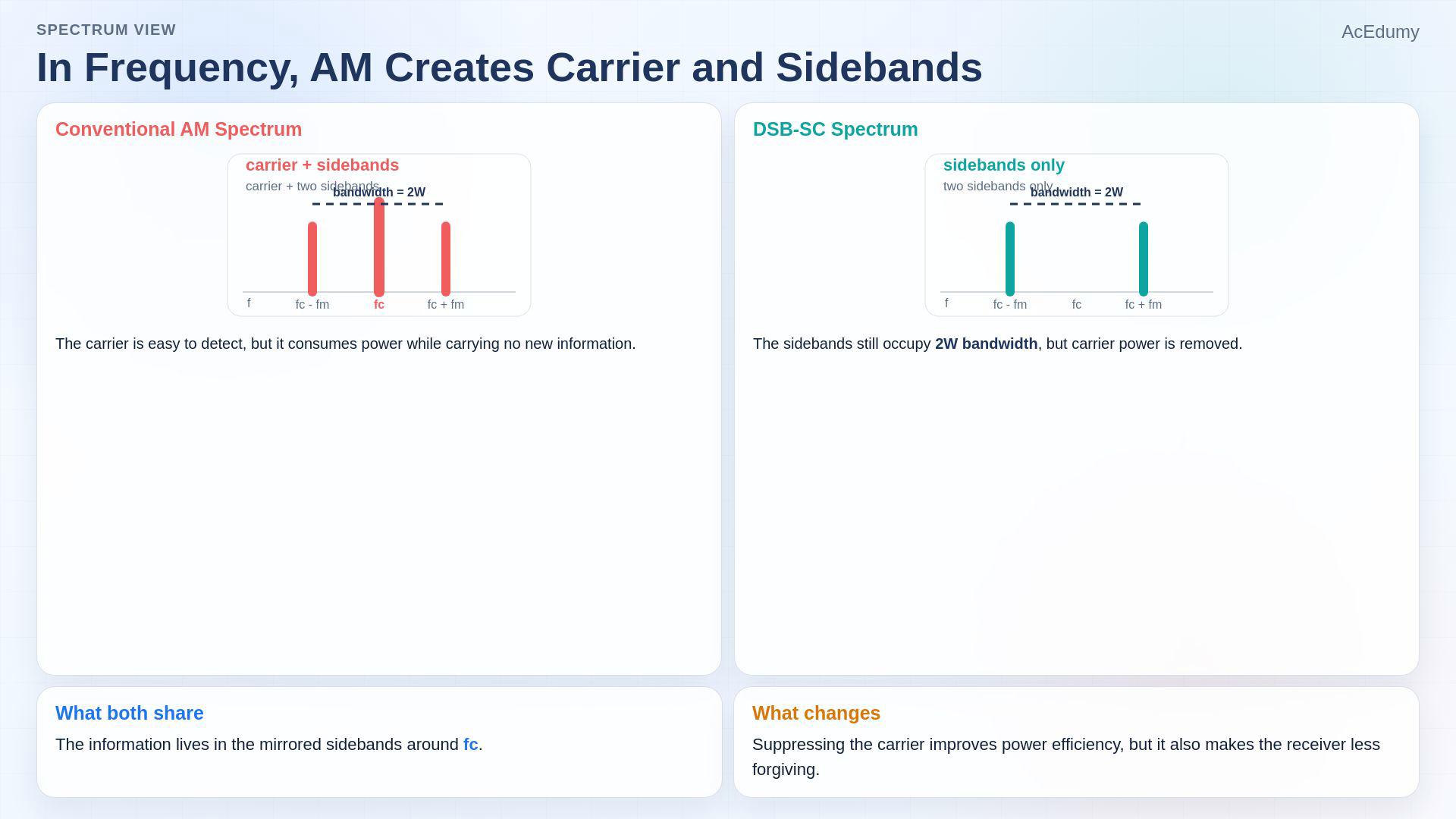
Original-video conceptual reference, not a calibrated waveform or power plot. The incorrect modulation-index curves and broken detector-flow frame are replaced with the same video's summary; exact conditions are written in the notebook. For the chosen tone, expand the product:The two positive-frequency tone locations are:Conventional AM adds a carrier at the centre:DSB-SC has no independent carrier term when the message has zero DC; it retains both sidebands.For a message limited to the band edge W and carrier above W:Removing only the carrier line does not remove either sideband or halve the occupied band.Carrier power for peak voltage amplitude across resistance R:Narration transcript
The frequency domain makes that relationship clearer. A single tone message creates two sidebands located at the carrier frequency plus and minus the message frequency. Conventional AM contains those two sidebands and also the carrier spike at the center. DSB-SC keeps the same mirrored sidebands but removes that center carrier. So the occupied bandwidth is still twice the message bandwidth in both cases. Suppressing the carrier does not save bandwidth. It mainly saves transmitter power because the carrier no longer burns energy without carrying new information.
3. Keep the signed envelope separate from its magnitude
Original-video conceptual reference, not a calibrated waveform or power plot. The incorrect modulation-index curves and broken detector-flow frame are replaced with the same video's summary; exact conditions are written in the notebook. Separate signed carrier amplitude from its nonnegative magnitude:For the normalized tone the signed amplitude stays positive when:At the ideal non-crossing boundary:An overmodulated example crosses zero:The measured magnitude envelope folds at a sign reversal:For a non-overmodulated symmetric tone, recover depth from envelope extrema:The ideal non-crossing limit is not a guarantee of distortion-free practical reception; diode threshold and RC tracking need margin.Narration transcript
For conventional AM, the modulation index tells us how strongly the message changes the envelope. If the modulation index is below one, the envelope stays clean and easy to follow. At exactly one, we are using the full envelope range without yet causing distortion. But if the modulation index rises above one, the envelope folds over itself. That condition is called over-modulation. At that point a simple envelope detector can no longer track the message correctly, because the apparent shape of the envelope is no longer a faithful copy of the original signal. So for basic AM reception, keeping the modulation index at or below one is a practical design rule.
4. Compare envelope and coherent detection with their conditions
Original-video conceptual reference, not a calibrated waveform or power plot. The incorrect modulation-index curves and broken detector-flow frame are replaced with the same video's summary; exact conditions are written in the notebook. Conventional AM can trade transmitted carrier power for a simpler receiver.A diode and RC detector must smooth carrier ripple while following the message; carrier and message time scales must be well separated.Remove the envelope's DC offset and account for its gain to recover the message.A simple magnitude detector loses the sign of a DSB-SC message:Use a local oscillator with the correct frequency and phase; a residual synchronization error matters.For nonzero modulation gain and ideal normalized coherent detection at matched frequency:A ninety-degree phase error suppresses this recovered signal; carrier removal saves transmitted power, not all receiver or hardware losses.The practical comparison includes synchronization, noise, detector distortion and implementation complexity.Narration transcript
This is why conventional AM became so attractive in early radio. If a carrier is transmitted and the envelope is well behaved, a very simple diode and RC filter can recover the message. The receiver only needs to trace the envelope. DSB-SC is different. Because the transmitted carrier is missing, the receiver must recreate a synchronized carrier locally before detection. That usually means coherent or synchronous detection. So DSB-SC is more power efficient at the transmitter, but it asks more from the receiver. This is the classic tradeoff between efficiency and implementation simplicity.
5. Separate carrier-power savings from occupied bandwidth
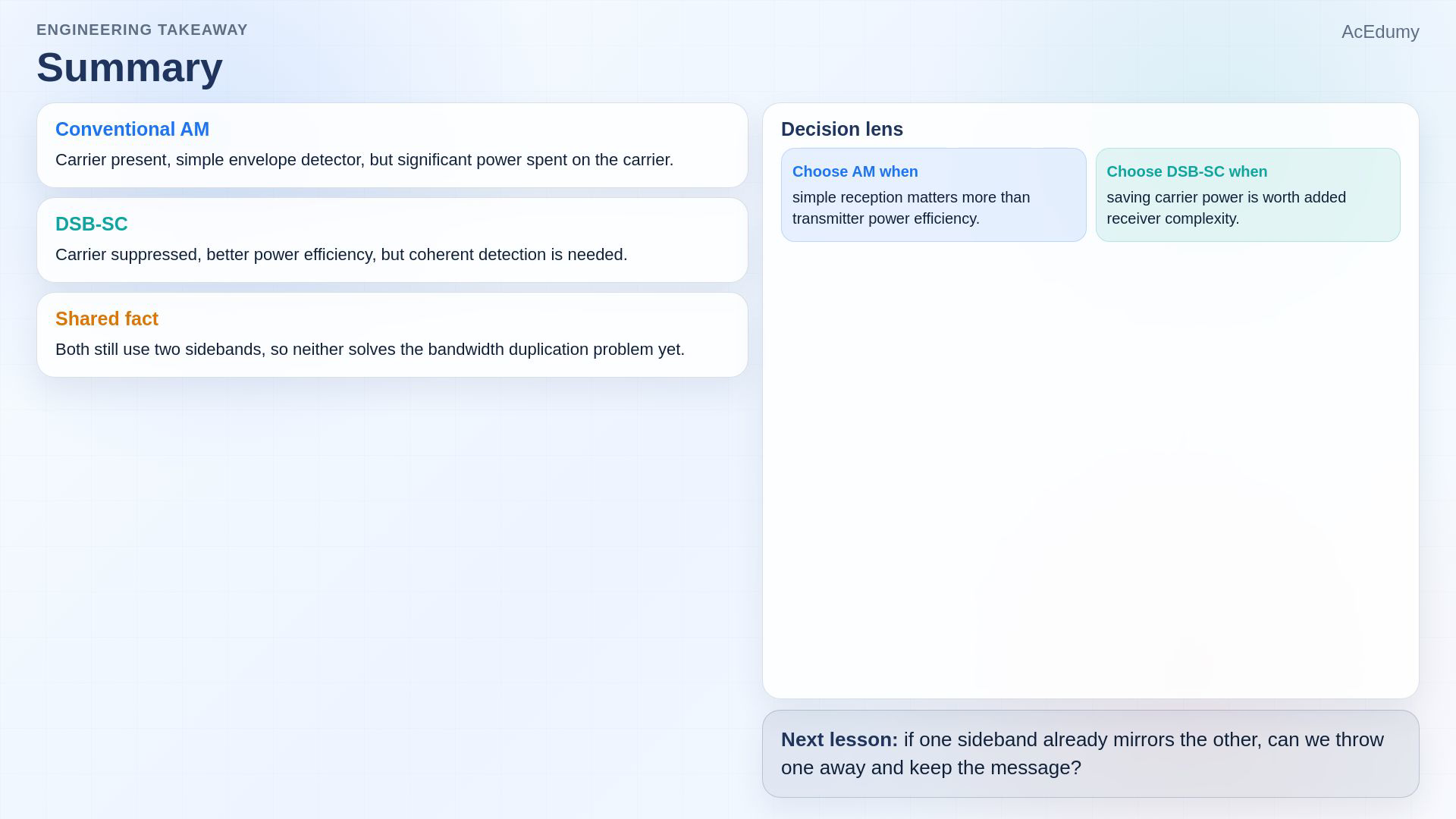
Original-video conceptual reference, not a calibrated waveform or power plot. The incorrect modulation-index curves and broken detector-flow frame are replaced with the same video's summary; exact conditions are written in the notebook. Compare occupied bandwidth, transmitted carrier power and receiver complexity separately.The two sidebands of a real message remain in both conventional AM and DSB-SC.For a single sinusoidal tone and a resistive load, total sideband power is:The conventional AM sideband-power fraction is:At full non-overmodulated single-tone depth:DSB-SC removes carrier power, but both sidebands still occupy the same band; sideband fraction is not DC-to-RF amplifier efficiency.For a real message, one sideband contains recoverable information under the appropriate coherent receiver assumptions.Next: single-sideband and vestigial-sideband methods, including their filtering and recovery conditions.Narration transcript
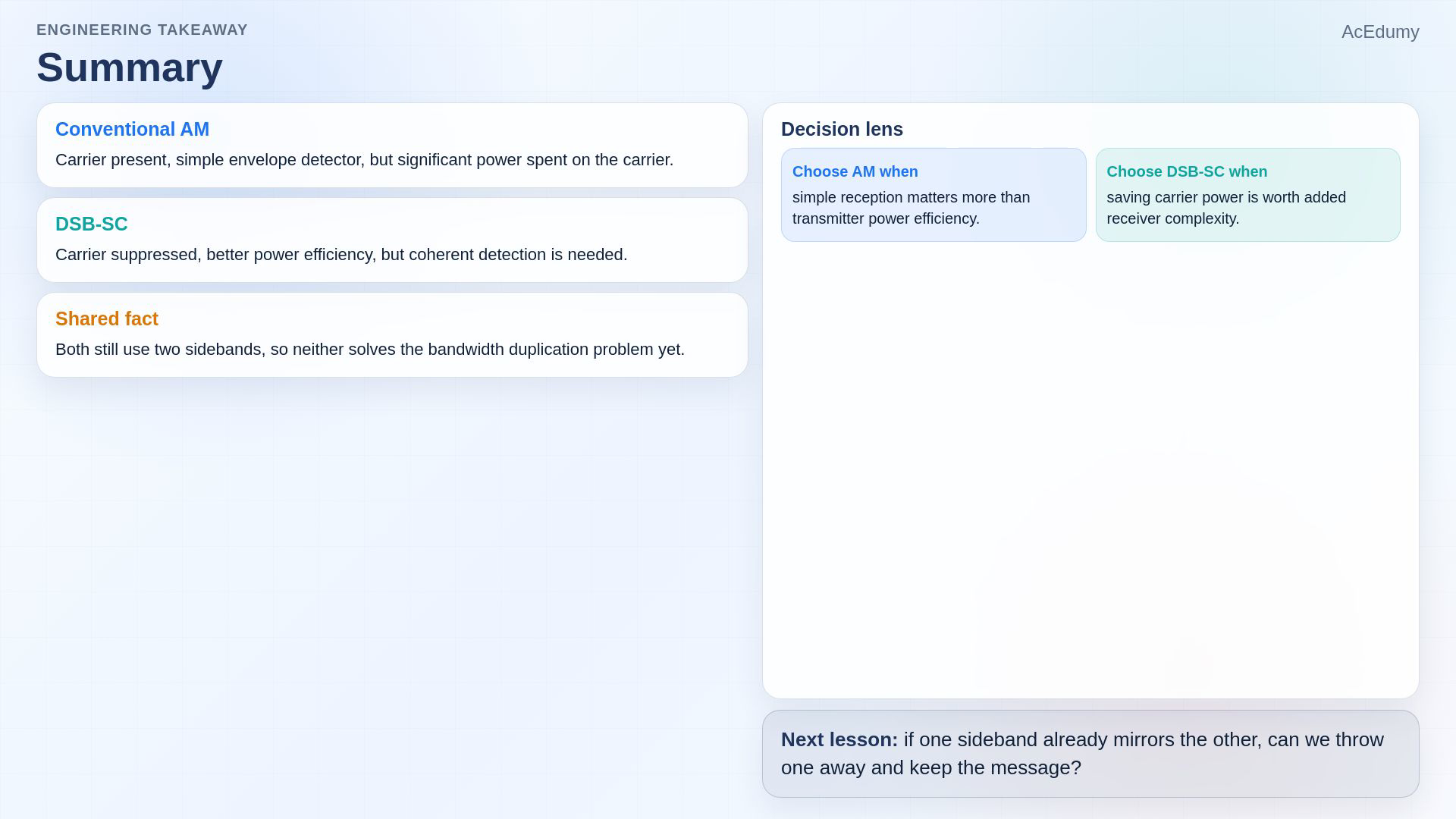
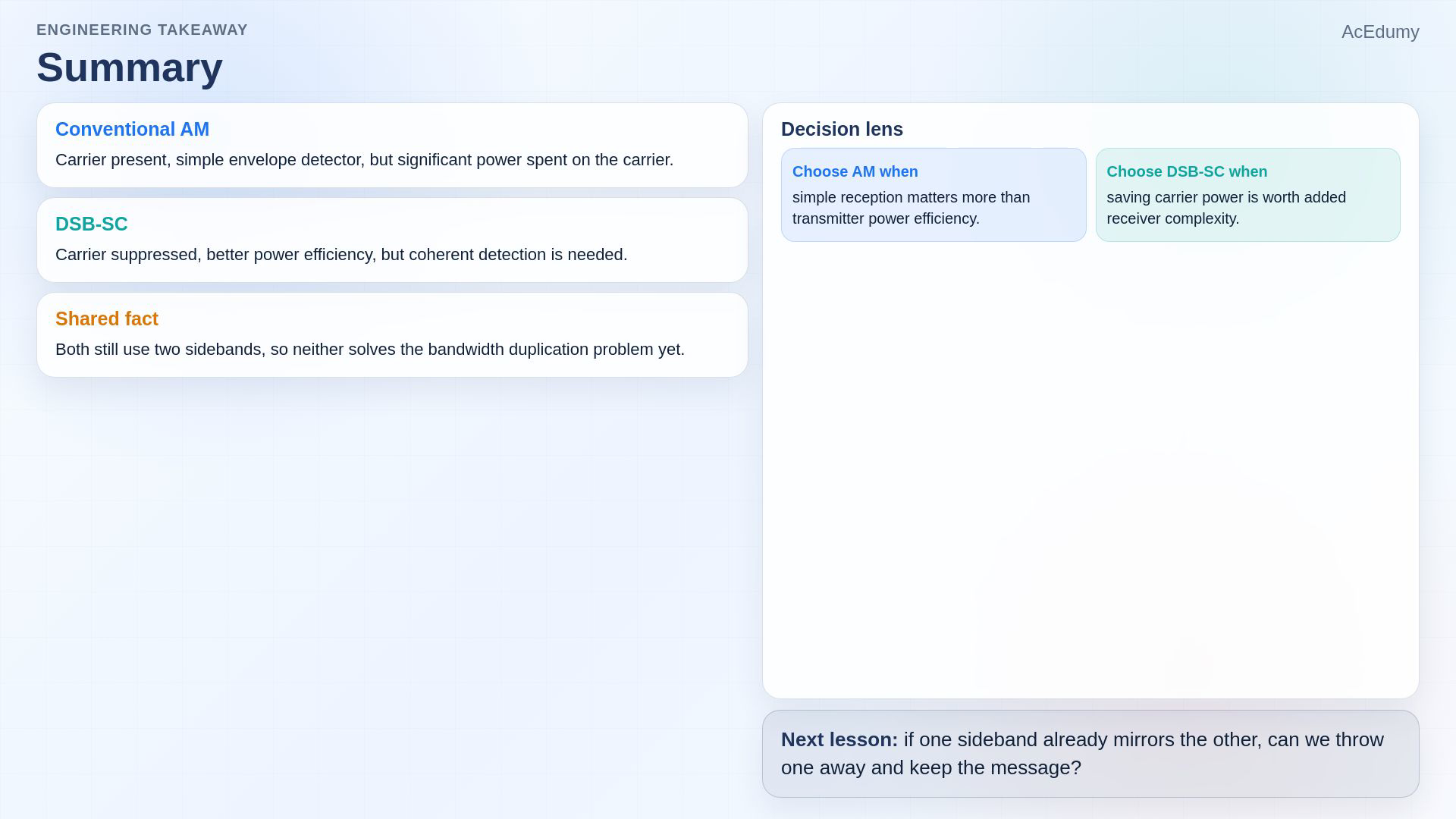
Let us summarize the engineering picture. Both conventional AM and DSB-SC place information into two sidebands around a carrier frequency. Conventional AM keeps the carrier, which makes envelope detection simple but wastes transmitter power. DSB-SC suppresses that carrier, which improves power efficiency but requires coherent detection at the receiver. Neither method removes the duplicated sideband structure, so the bandwidth cost is still there. That naturally leads to the next question. If one sideband already mirrors the other, can we remove one and transmit only what we truly need? That is exactly where single sideband and vestigial sideband modulation enter the story.
Source video: Analog Communication #02 | Double-Sideband Suppressed Carrier & Conventional AM (4:10)