Communication Basics · DWDM Library Download: Information Payload, Aggregate Rate, and Time
#22 calculate a synthetic library payload in decimal SI units, derive a 3.2-s lower bound from 100×10-Gbit/s DWDM channels, separate the 10,000-channel algebra for 32 ms from physical feasibility, and bound the V.90 and VDSL/VDSL2 comparisons
Derive the synthetic 3.2-Tbit library payload, then unit-check DWDM, 56K-modem, and xDSL times while separating ideal rates from physical and transport constraints.
Question
Derive 3.2×10^12 bits from the 10^7 books×100 pages×100 words×4 letters×8 bits model; calculate 100 channels×10 Gbit/s=1 Tbit/s and the ideal 3.2-s lower bound; interpret 10,000 channels for a 32-ms target as algebraic scaling only; derive 1.812 years at 56 kbit/s and about 52 Mbit/s from 17.094 hours; explicitly bound the result using V.90, G.993.1/G.993.2, DWDM grid, overhead, and endpoint bottlenecks.
Written solution and narration transcript(shows the full solution)
Below are all the lines written in the notebook together with the full narration transcript.
1. Fix the data model, decimal-SI units, and overhead assumptions
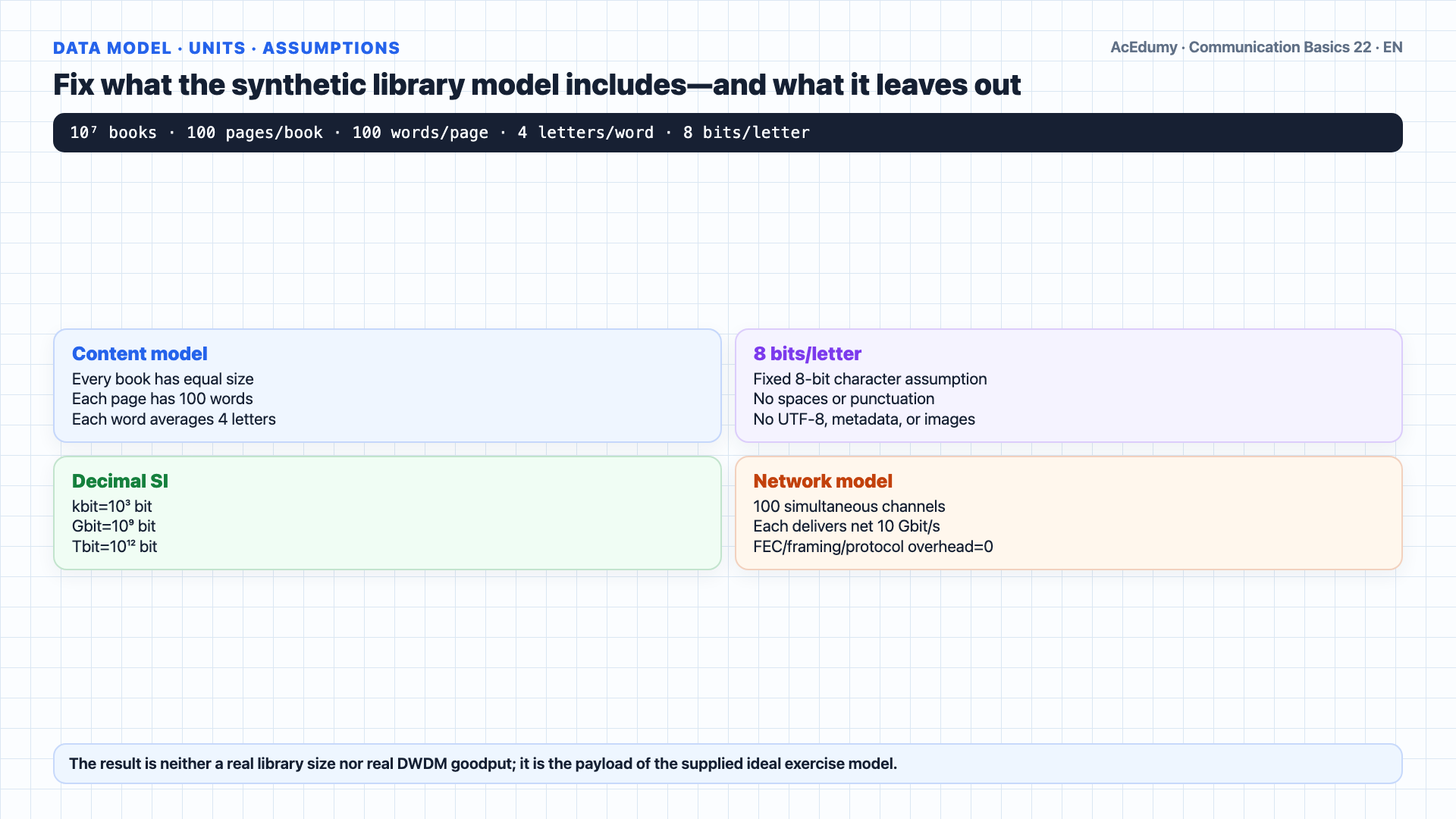
Fix decimal-SI units, distinguish line rate from net payload throughput, and do not turn channel-count algebra into a physical-feasibility claim. Welcome back.Today we tackle the classic DWDM library download problem.Here is the setup.A digital library contains ten million books.Each book has one hundred pages.Each page has one hundred words.Each word has four letters on average.The exercise models every letter as a fixed 8 bits; real character encoding, spaces, punctuation, and metadata are outside this product.A Dense Wavelength Division Multiplexing system with one hundred separate channels is used to download the information.Each channel's 10 Gbit/s is assumed to be simultaneous, usable net payload throughput.The problem sets framing, FEC, control, protocol overhead, and retransmission to zero; real line rate differs from payload rate.We have five questions to answer.Narration transcript
Welcome back. Today we tackle the classic D W D M library download problem. Here is the setup. A digital library contains ten million books. Each book has one hundred pages. Each page has one hundred words. Each word has four letters on average. Each letter is encoded with eight bits. A Dense Wavelength Division Multiplexing system with one hundred separate channels is used to download the information. Each channel is modulated at ten gigabits per second. There are no control bits or other redundancy. We have five questions to answer.
2. Calculate the synthetic 3.2-Tbit payload from the product chain
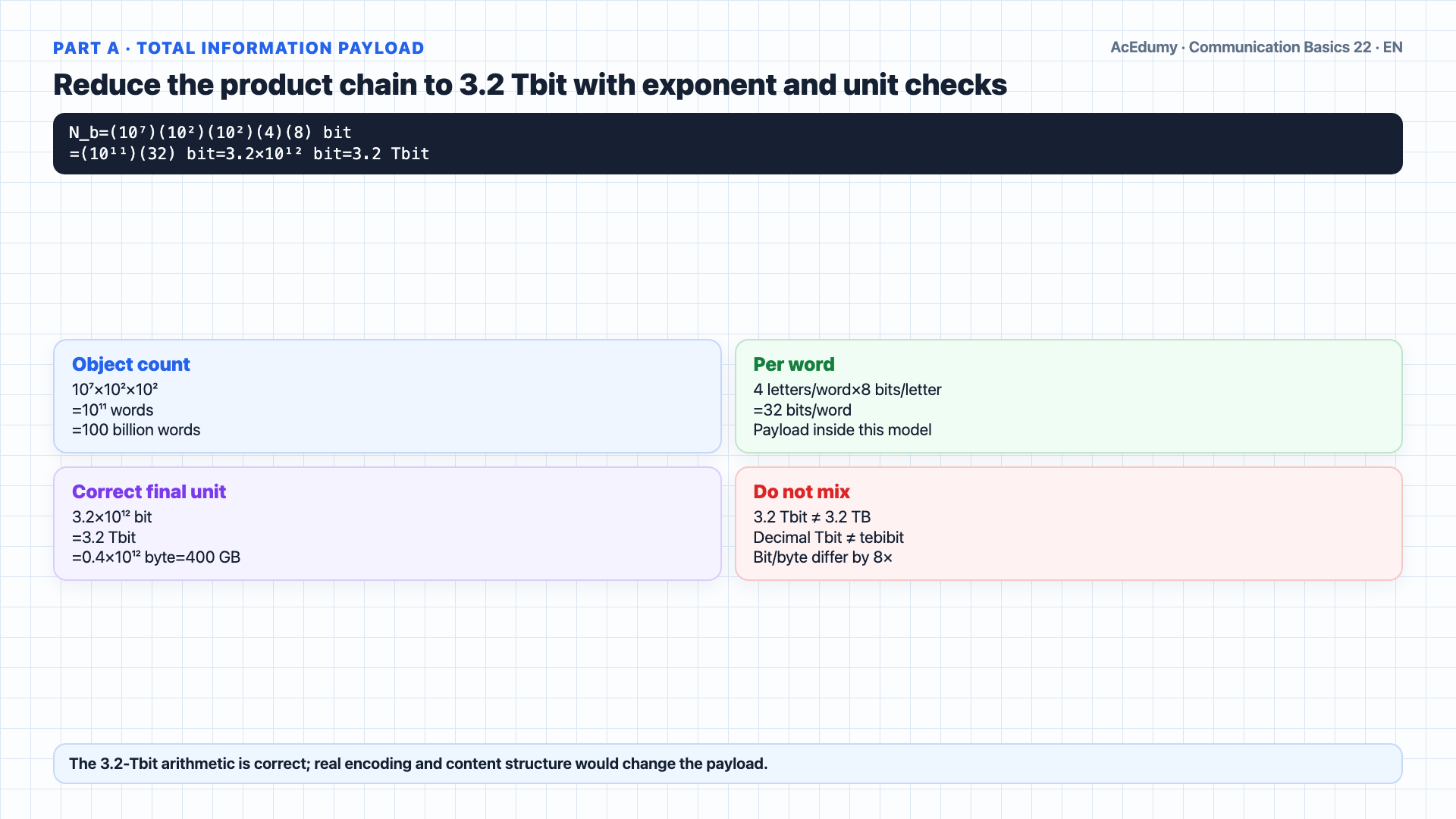
Fix decimal-SI units, distinguish line rate from net payload throughput, and do not turn channel-count algebra into a physical-feasibility claim. Part a: find the total number of bits in the library.We multiply the chain step by step.Ten million books, times one hundred pages per book, times one hundred words per page, times four letters per word, times eight bits per letter.Let us compute.Ten to the seven, times ten squared, times ten squared, times four, times eight.Ten to the seven times ten to the four gives ten to the eleven.Four times eight is thirty two.Thirty two times ten to the eleven equals three point two times ten to the twelve bits.In decimal SI, 3.2×1012 bit=3.2 Tbit of synthetic payload; do not confuse Tbit with Tbyte or Tibit.3.2 Tbit is only the result of the supplied 100×100×4×8 synthetic content model, not a claim about a real library's size.Narration transcript
Part a: find the total number of bits in the library. We multiply the chain step by step. Ten million books, times one hundred pages per book, times one hundred words per page, times four letters per word, times eight bits per letter. Let us compute. Ten to the seven, times ten squared, times ten squared, times four, times eight. Ten to the seven times ten to the four gives ten to the eleven. Four times eight is thirty two. Thirty two times ten to the eleven equals three point two times ten to the twelve bits. That is three point two terabits. Think about it: ten million books fit into three point two trillion bits.
3. Derive 1 Tbit/s and the ideal 3.2-s lower bound from 100 channels
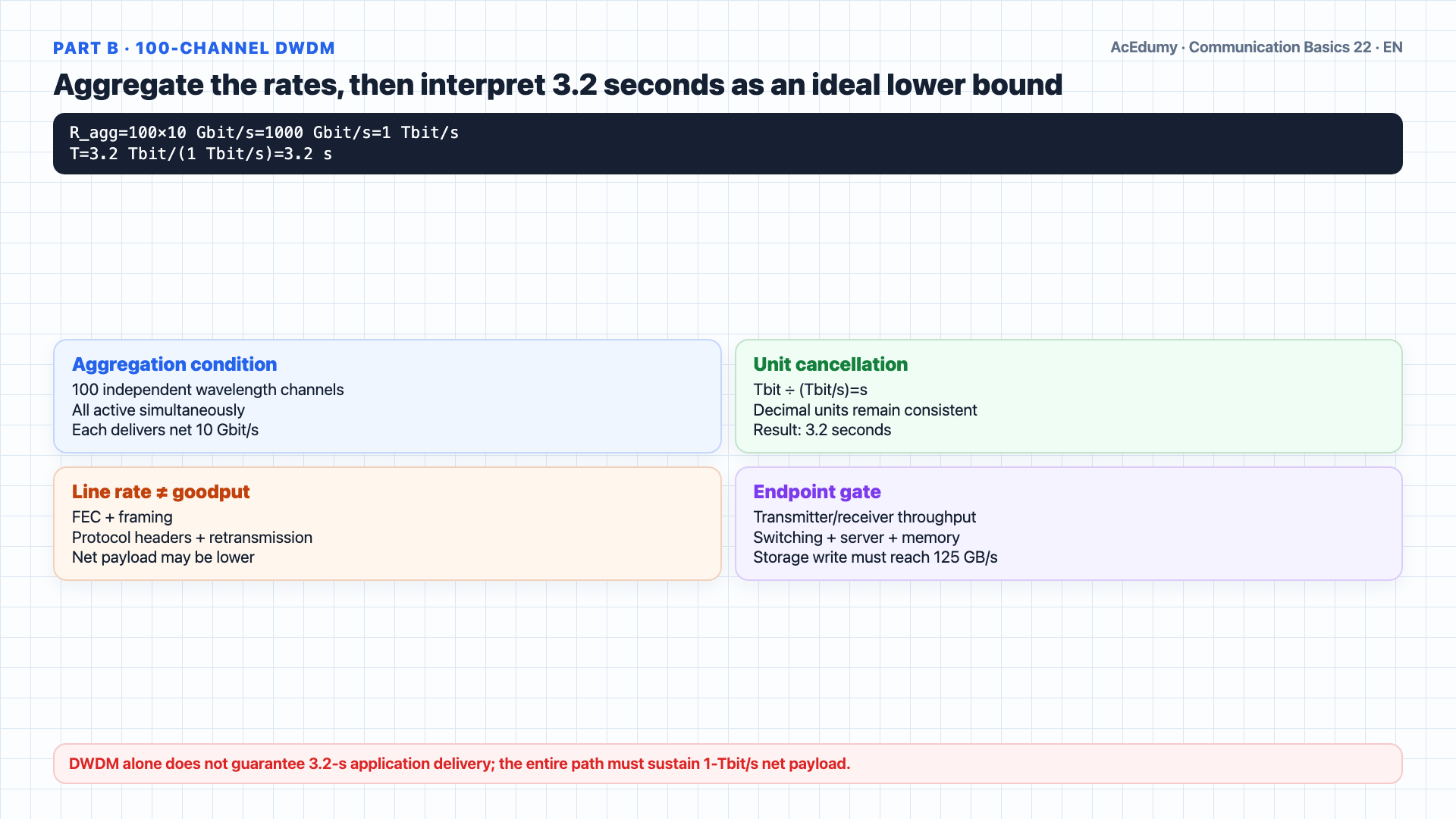
Fix decimal-SI units, distinguish line rate from net payload throughput, and do not turn channel-count algebra into a physical-feasibility claim. Part b: how long does the download take with the DWDM system?The system has one hundred channels, each running at ten gigabits per second.Ideal aggregate payload rate is 100×10 Gbit/s=1000 Gbit/s=1 Tbit/s, assuming all independent channels are simultaneously usable.Download time equals total bits divided by throughput.Three point two terabits divided by one terabit per second equals three point two seconds.3.2 Tbit/1 Tbit/s=3.2 s is an ideal lower bound only if transmitter, fiber, receiver, network, storage, and protocol sustain that net rate.This is not an application-rate guarantee from DWDM; it is the algebraic sum of the problem's channel count and assumed net channel rate.Narration transcript
Part b: how long does the download take with the D W D M system? The system has one hundred channels, each running at ten gigabits per second. Total throughput equals one hundred times ten gigabits per second, which is one thousand gigabits per second, or one terabit per second. Download time equals total bits divided by throughput. Three point two terabits divided by one terabit per second equals three point two seconds. The entire library, ten million books, downloaded in three point two seconds. That is the power of D W D M fiber optics.
4. Derive 10,000 channels for 32 ms and bound physical feasibility
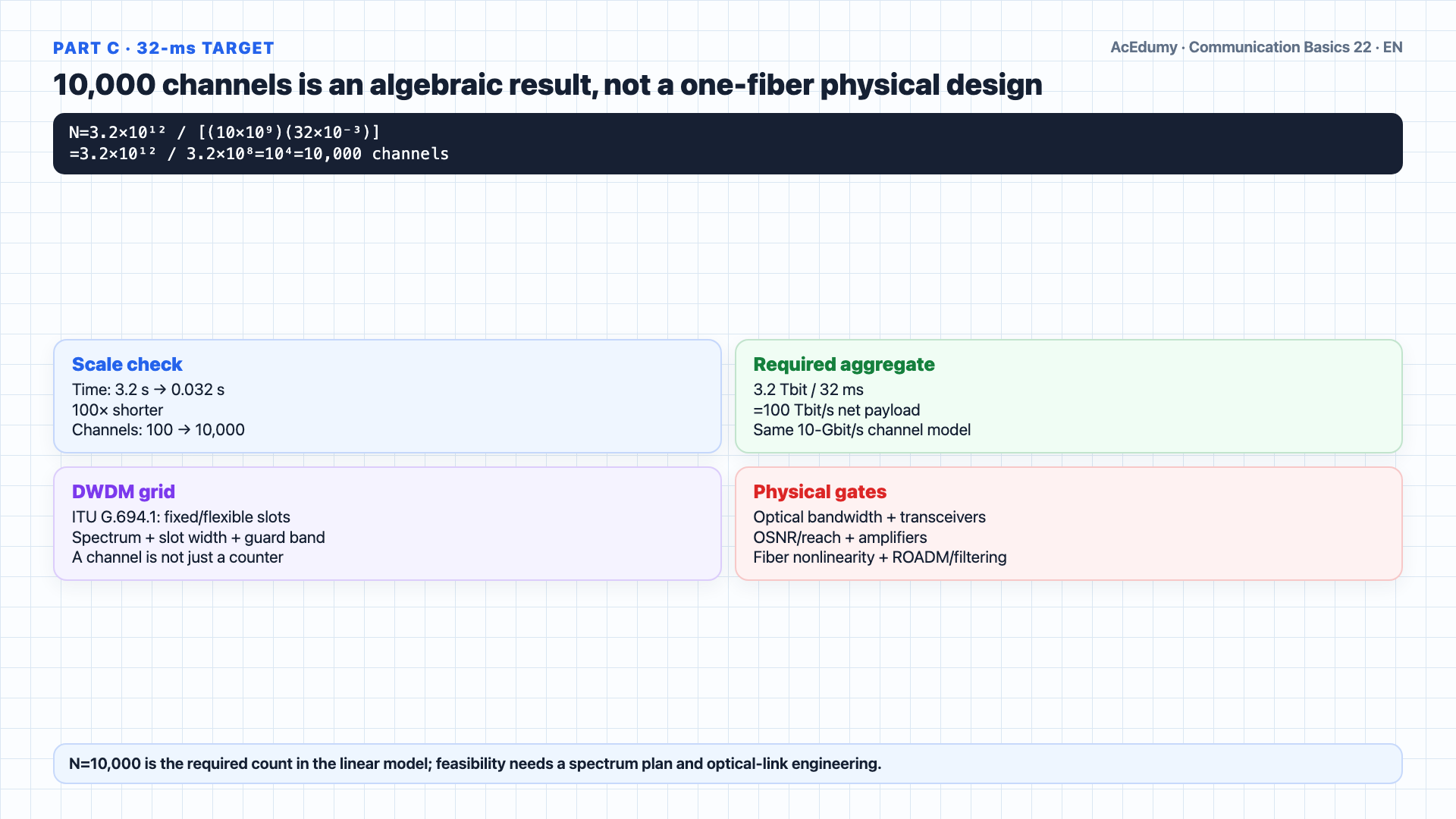
Fix decimal-SI units, distinguish line rate from net payload throughput, and do not turn channel-count algebra into a physical-feasibility claim. Part c: how many channels do we need to download everything in thirty two milliseconds?We rearrange the formula.Total bits equals throughput times time.Throughput equals number of channels times ten gigabits per second.So three point two terabits equals number of channels times ten gigabits per second times thirty two times ten to the minus three seconds.Solving for the number of channels: three point two times ten to the twelve divided by ten times ten to the nine times thirty two times ten to the minus three.The denominator is three point two times ten to the eight.Three point two times ten to the twelve divided by three point two times ten to the eight equals ten to the four.The algebra gives N=10,000 ideal 10-Gbit/s channels; it does not imply a physically realizable 10,000-wavelength DWDM design on one fiber.Narration transcript
Part c: how many channels do we need to download everything in thirty two milliseconds? We rearrange the formula. Total bits equals throughput times time. Throughput equals number of channels times ten gigabits per second. So three point two terabits equals number of channels times ten gigabits per second times thirty two times ten to the minus three seconds. Solving for the number of channels: three point two times ten to the twelve divided by ten times ten to the nine times thirty two times ten to the minus three. The denominator is three point two times ten to the eight. Three point two times ten to the twelve divided by three point two times ten to the eight equals ten to the four. We need ten thousand D W D M channels to achieve a thirty two millisecond download.
5. Convert the 56-kbit/s V.90 upper-bound time to seconds and years
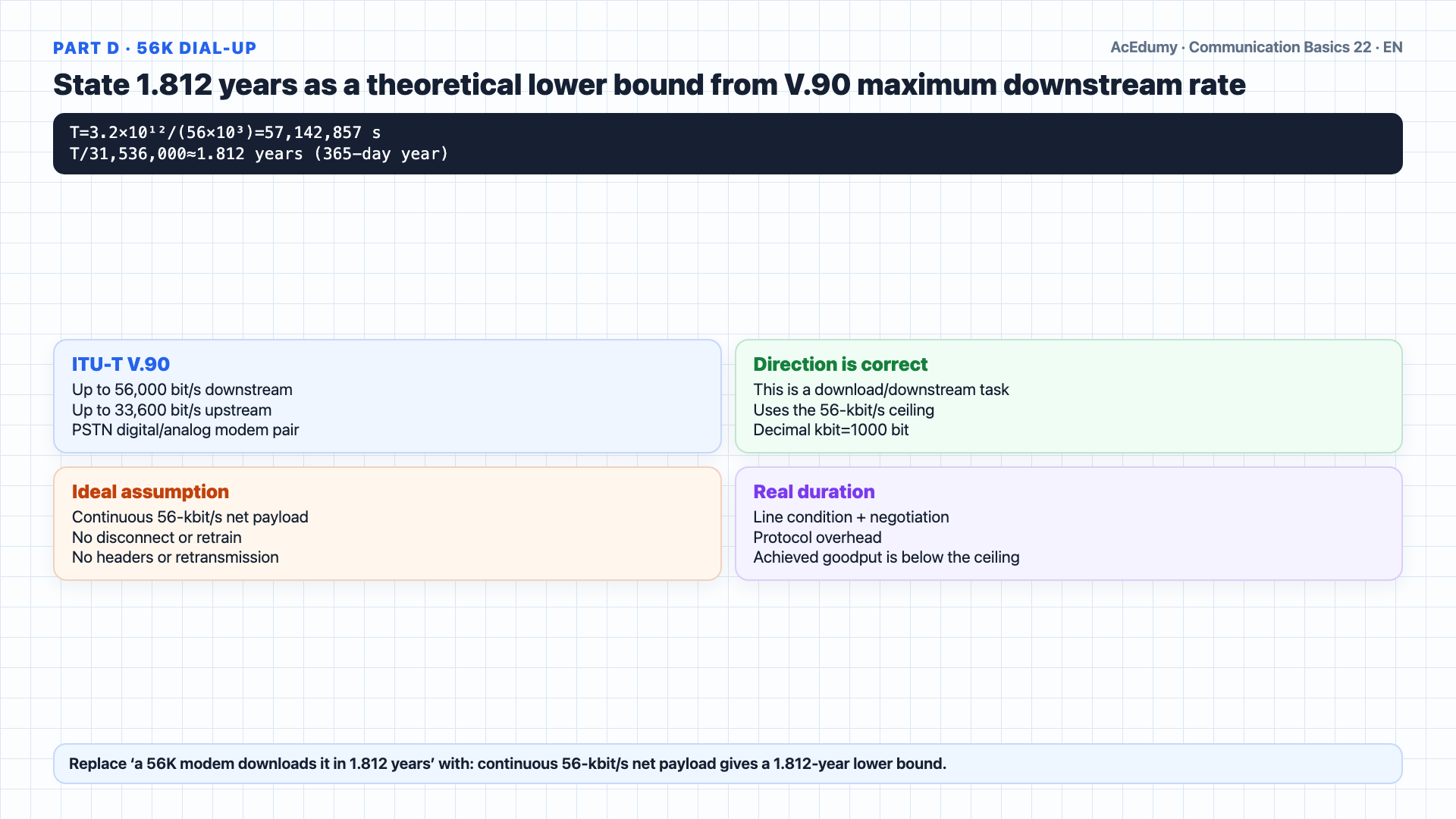
Fix decimal-SI units, distinguish line rate from net payload throughput, and do not turn channel-count algebra into a physical-feasibility claim. Part d: if the V.90 maximum 56-kbit/s downstream signalling rate is treated as ideal payload throughput, what is the time?Download time equals three point two terabits divided by fifty six kilobits per second.Three point two times ten to the twelve divided by fifty six times ten to the three equals approximately fifty seven million, one hundred forty three thousand seconds.Let us convert that to years.Fifty seven point one four three million seconds, divided by three hundred sixty five days times twenty four hours times sixty minutes times sixty seconds per year.That denominator is thirty one million, five hundred thirty six thousand seconds per year.The result is approximately one point eight one two years.At a continuous net 56 kbit/s the 1.812-year result is a theoretical lower bound; real modem, line, and protocol conditions can increase it.Compare that to three point two seconds with DWDM.Narration transcript
Part d: what if we use a standard fifty six kilobits per second dial-up modem instead? Download time equals three point two terabits divided by fifty six kilobits per second. Three point two times ten to the twelve divided by fifty six times ten to the three equals approximately fifty seven million, one hundred forty three thousand seconds. Let us convert that to years. Fifty seven point one four three million seconds, divided by three hundred sixty five days times twenty four hours times sixty minutes times sixty seconds per year. That denominator is thirty one million, five hundred thirty six thousand seconds per year. The result is approximately one point eight one two years. Nearly two years of nonstop downloading at full dial-up speed. Compare that to three point two seconds with D W D M.
6. Derive 52 Mbit/s from 17.094 hours and bound VDSL compatibility
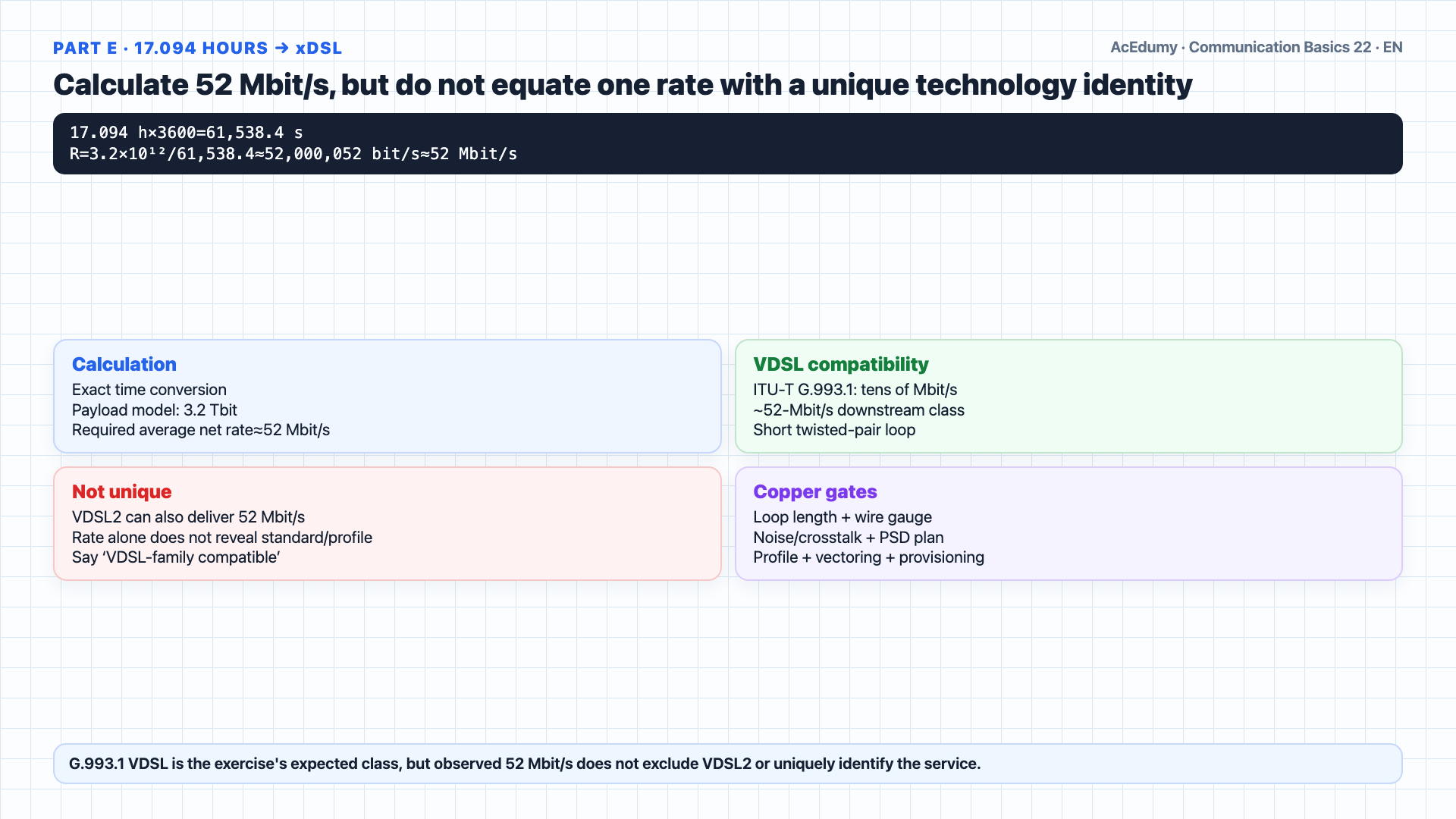
Fix decimal-SI units, distinguish line rate from net payload throughput, and do not turn channel-count algebra into a physical-feasibility claim. Part e: an xDSL technology downloads the same library in seventeen point zero nine four hours.Find the download rate and identify the xDSL type.Rate equals total bits divided by time.First, convert hours to seconds.Seventeen point zero nine four hours times sixty minutes per hour times sixty seconds per minute equals sixty one thousand, five hundred thirty eight point four seconds.Now divide.Three point two times ten to the twelve bits divided by sixty one thousand five hundred thirty eight point four seconds equals approximately fifty two times ten to the six bits per second, or fifty two megabits per second.Which xDSL technology supports fifty two megabits per second?About 52 Mbit/s is compatible with ITU-T G.993.1 VDSL; VDSL2 can also support it, so rate alone does not uniquely identify the technology.G.993.1 VDSL covers tens-of-Mbit/s service and the roughly 52-Mbit/s downstream class on short twisted-pair loops; attainable rate depends on loop length, profile, noise/crosstalk, and provisioning.Narration transcript
Part e: an x D S L technology downloads the same library in seventeen point zero nine four hours. Find the download rate and identify the x D S L type. Rate equals total bits divided by time. First, convert hours to seconds. Seventeen point zero nine four hours times sixty minutes per hour times sixty seconds per minute equals sixty one thousand, five hundred thirty eight point four seconds. Now divide. Three point two times ten to the twelve bits divided by sixty one thousand five hundred thirty eight point four seconds equals approximately fifty two times ten to the six bits per second, or fifty two megabits per second. Which x D S L technology supports fifty two megabits per second? That falls squarely in the V D S L range. V D S L, or Very high bit rate Digital Subscriber Line, supports downstream rates up to about fifty two to fifty five megabits per second over short copper distances.
7. Verify rate ratios and add end-to-end bottlenecks
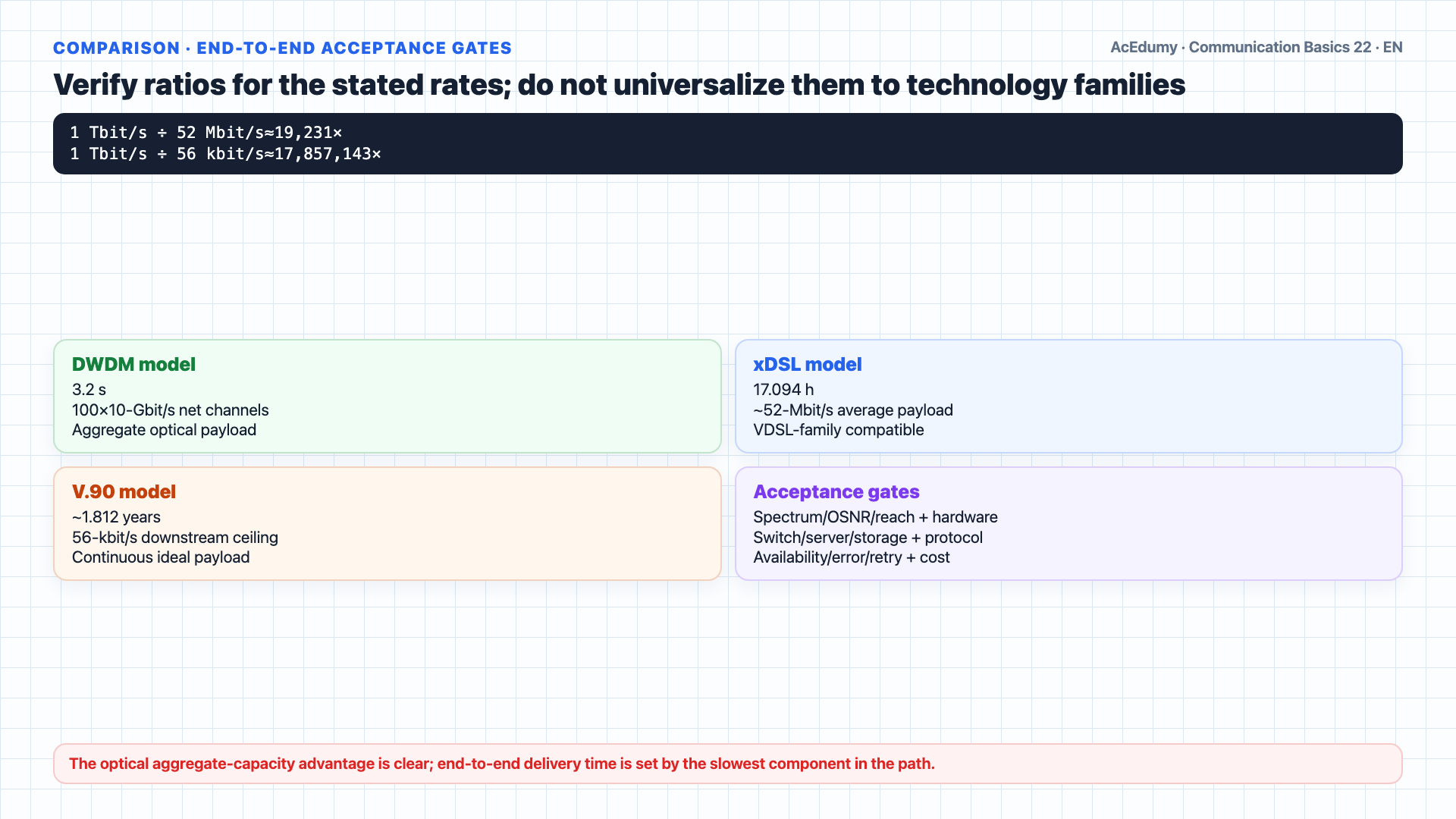
Fix decimal-SI units, distinguish line rate from net payload throughput, and do not turn channel-count algebra into a physical-feasibility claim. Let us see the full picture.Ten million books is three point two terabits.With a hundred channel DWDM system: three point two seconds.With VDSL at fifty two megabits per second: seventeen hours.With a fifty six K dial-up modem: nearly two years.Same data, three very different worlds.For the assumed rates, 1 Tbit/s / 52 Mbit/s≈19,231 and /56 kbit/s≈17,857,143; these are not universal speed ratios between technology families.The comparison shows optical aggregate-capacity advantage; end-to-end time also depends on transceivers, spectrum/grid, fiber reach/nonlinearity, switching, servers, storage, and protocol.Good luck on your midterm.Narration transcript
Let us see the full picture. Ten million books is three point two terabits. With a hundred channel D W D M system: three point two seconds. With V D S L at fifty two megabits per second: seventeen hours. With a fifty six K dial-up modem: nearly two years. Same data, three very different worlds. Fiber D W D M is roughly twenty thousand times faster than V D S L, and about eighteen million times faster than dial-up. This is the kind of comparison that makes fiber optics indispensable for large scale data transfer. Good luck on your midterm.
Source video: Communication Basics #22 Worked Example: DWDM Library Download (6:05)