Communication Basics · E-Carrier Selection: Capacity Planning for Voice and Video
#31 calculate 3.84-Mbit/s payload for 60 G.711 channels; obtain 96-Mbit/s video and 99.84-Mbit/s total only under an explicit real-low-pass 6-MHz, ideal 12-MS/s, 8-bit/sample model; select E4 as the first nominal raw-rate pass among the G.702 E1/E2/E3/E4 rates; do not treat the 39.424-Mbit/s difference or 71.69% ratio as usable headroom/utilization until mapping, framing, justification, signalling, protection, traffic/QoS, SLA, and lifecycle gates verify actual fit
Calculate a conditional 99.84-Mbit/s payload total, then keep E4's nominal line-rate comparison behind mapping, overhead, and SLA gates.
Question
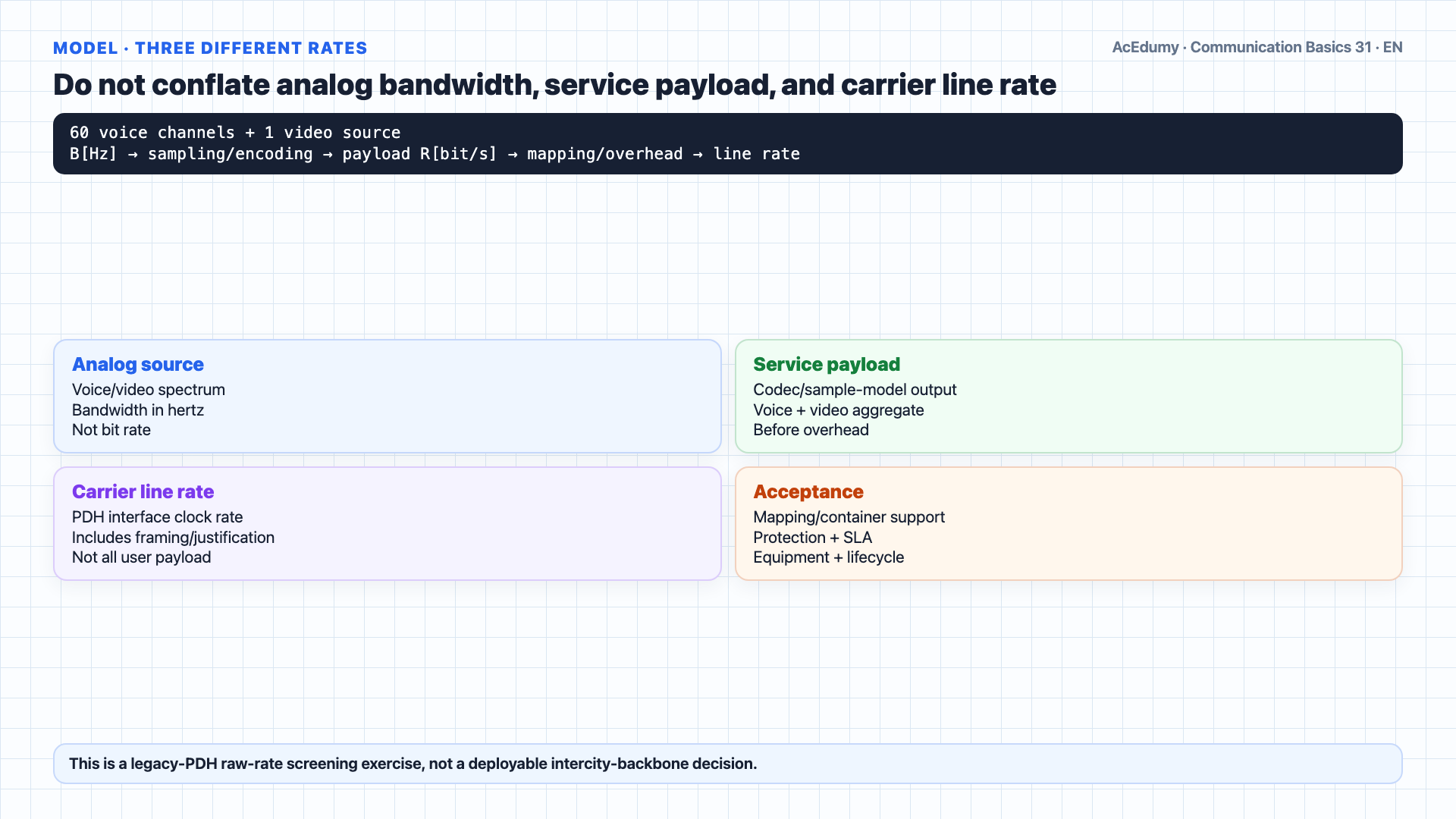
Separate analog bandwidth from digital bit rate and define 3.84 and 96 Mbit/s as service-payload assumptions; calculate 60×64 kbit/s=3.84 Mbit/s for 60 G.711 channels and state that 64 kbit/s is the ITU-T G.711 output from 8-kHz sampling with 8-bit A-law/µ-law PCM codewords rather than merely a Nyquist slogan; do not derive a universal 96-Mbit/s digital TV rate directly from 6-MHz analog RF channel bandwidth; only if the problem explicitly models a real low-pass B=6 MHz source sampled at the ideal f_s=2B=12 MS/s with 8 bit/sample does R=96 Mbit/s, while realizable filter guard and actual component/video formats remain separate; under that model total payload is 99.84 Mbit/s and video fraction 96/99.84≈96.15%; keep the G.702 hierarchy line rates E1=2.048, E2=8.448, E3=34.368, and E4=139.264 Mbit/s, and do not make higher levels a universal five-rung/top claim; do not call higher PDH rates exact arithmetic multiples or 120/480/1920 directly usable voice payload because multiplex framing and justification add overhead; in raw-line-rate screening E1/E2/E3 fail and E4 first passes; calculate raw difference 139.264−99.84=39.424 Mbit/s and nominal ratio 99.84/139.264≈71.69%, but do not call them usable headroom/utilization after mapping/framing/signalling/FEC/protection overhead; verify actual E4 fit through supported interface, tributary/container mapping, clocking/justification, overhead, equipment, protection, and SLA; reject a universal 60–80% healthy-utilization sweet spot, automatic queueing above 80%, waste below 60%, impossible custom rates, every-video-compressed, universal 4–5-Mbit/s codec output, and asymmetry-vanishes claims.
Written solution and narration transcript(shows the full solution)
Below are all the lines written in the notebook together with the full narration transcript.
1. Fix the model and separate bandwidth, payload rate, and line rate
E4 raw line rate exceeds the conditional 99.84-Mbit/s payload total; actual fit and usable headroom require mapping, framing, and protection design. Welcome back.Today we solve a simplified legacy-PDH screening exercise; a deployable intercity backbone also needs interface, mapping, resilience, SLA, and lifecycle design.Here is the setup.We are designing a backbone link between two cities.The traffic on this link consists of two streams.First: sixty voice telephone channels — point-to-point trunks for the local exchanges.Second: one full television channel — a continuous video broadcast feed riding the same link.Three questions.Part a: calculate aggregate payload bit rate under the stated encoding assumptions; do not equate analog bandwidth with digital bit rate.Part b: find the first listed legacy G.702 PDH line rate that passes raw-rate screening, then verify actual mapping fit separately.Part c: how much spare capacity is left over once we install that carrier?Narration transcript
Welcome back. Today a short, very practical engineering exercise — how to pick the right transmission carrier for a real backbone link. Here is the setup. We are designing a backbone link between two cities. The traffic on this link consists of two streams. First: sixty voice telephone channels — point-to-point trunks for the local exchanges. Second: one full television channel — a continuous video broadcast feed riding the same link. Three questions. Part a: how much total bandwidth do these two streams demand together? Part b: which member of the European E-carrier hierarchy is the smallest one that fits? Part c: how much spare capacity is left over once we install that carrier?
2. Establish G.702 PDH rates and the E1 frame/payload boundary
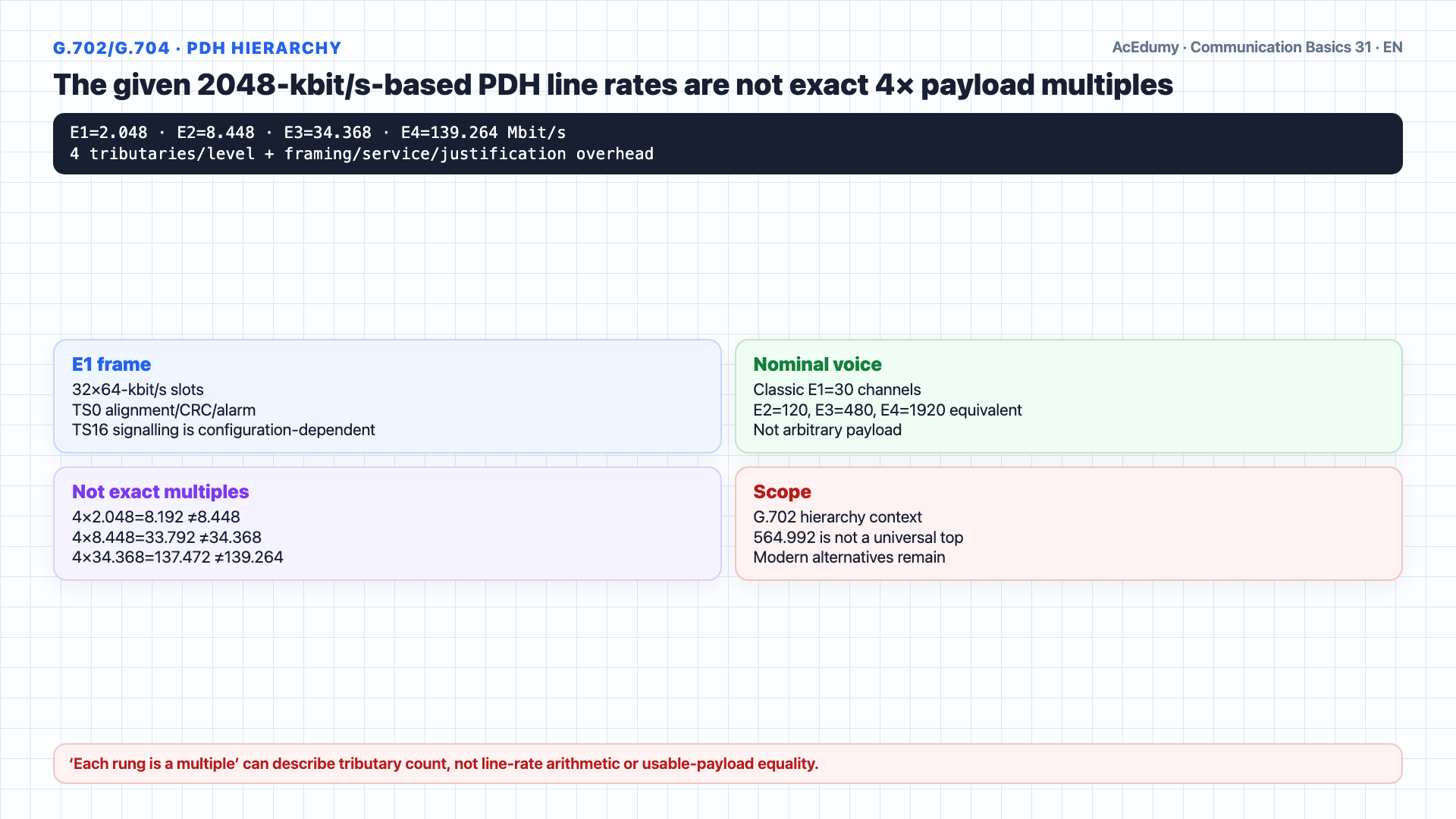
E4 raw line rate exceeds the conditional 99.84-Mbit/s payload total; actual fit and usable headroom require mapping, framing, and protection design. Before we start picking, let us put the E-carrier ladder on the table.Five rungs.E-1 — two point zero four eight megabits per second.An E1 2048-kbit/s frame has 32×64-kbit/s time slots; TS0 carries frame-alignment/CRC/alarm uses, TS16 signalling depends on CAS/CCS configuration, and classic nominal voice payload is often 30 channels.E2 line rate is 8.448 Mbit/s; four 2.048-Mbit/s tributaries are carried with plesiochronous multiplex framing and justification, so it is not exactly 4× the E1 line rate.120 is only 4×30 nominal voice-channel equivalent; directly usable payload depends on mapping, signalling, and framing.E3 line rate is 34.368 Mbit/s; 16×E1 tributary equivalence includes hierarchical multiplexing/overhead and is not an exact arithmetic line-rate multiple.480 is only 16×30 nominal voice-channel equivalent, not arbitrary user-payload capacity.E4 line rate is 139.264 Mbit/s; 64×E1 tributary equivalence includes framing/justification overhead and actual service mapping remains required.1920 is only 64×30 nominal voice-channel equivalent; not all 139.264 Mbit/s is usable service payload.Historical 564.992-kbit/s higher-order systems existed; do not call this a universal fifth G.702 rung or the top of all digital hierarchies.Each higher PDH level carries four lower-level tributaries; line rates are not exact arithmetic 4× multiples because framing, service, and justification overhead is added.This exercise selects among listed legacy interfaces; modern Ethernet/SDH/OTN/flexible-rate options and grooming/mapping choices depend on requirements.Narration transcript
Before we start picking, let us put the E-carrier ladder on the table. Five rungs. E-1 — two point zero four eight megabits per second. Thirty voice channels carrying sixty four kilobits each, plus one signalling channel and one synchronization channel — that is what fills the frame. E-2 — eight point four four eight megabits per second, four E-1s bundled together. One hundred twenty voice channels. E-3 — thirty four point three six eight megabits per second, sixteen E-1s. Four hundred eighty voice channels. E-4 — one hundred thirty nine point two six four megabits per second, sixty four E-1s. One thousand nine hundred twenty voice channels. And E-5 — five hundred sixty five megabits per second, the top of the ladder. Each rung is a multiple of the one below it. When you pick a carrier, you do not get to pick a custom number — you walk up this ladder until your traffic fits.
3. Calculate 3.84-Mbit/s voice payload for 60 G.711 channels
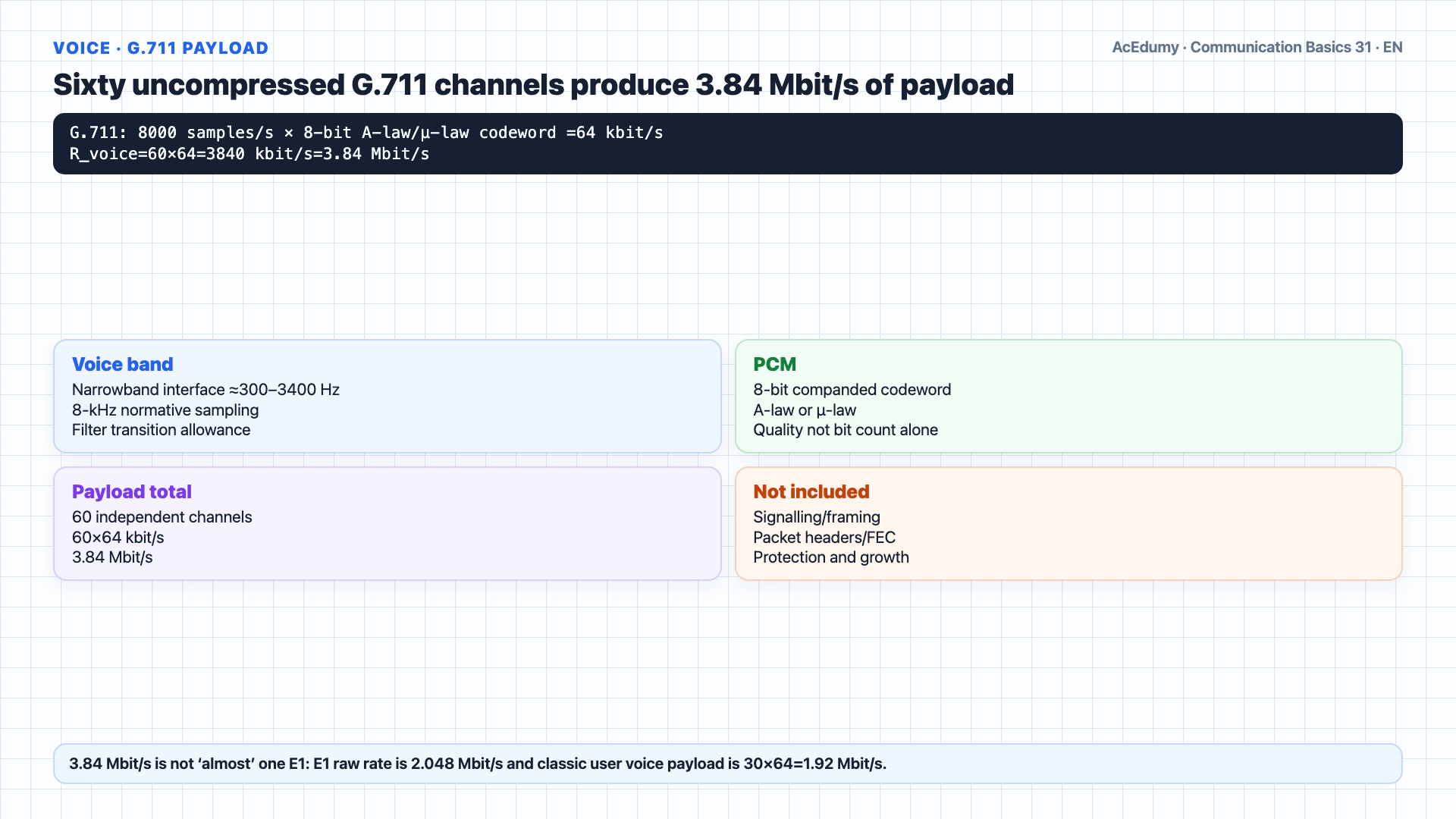
E4 raw line rate exceeds the conditional 99.84-Mbit/s payload total; actual fit and usable headroom require mapping, framing, and protection design. Part a — first stream — voice.One uncompressed G.711 voice-channel output is 64 kbit/s; other codecs, silence suppression, and packetization produce different rates and overhead.G.711 specifies 8-kHz sampling and one 8-bit A-law/µ-law PCM codeword per sample; 64 kbit/s is the standard output rate.A narrowband telephony voice-frequency interface is typically limited to roughly 300–3400 Hz; 8-kHz sampling includes transition/filter allowance.The ideal bandlimited model gives fs≥2B; realizable anti-alias filtering needs guard, while 8 kHz is the normative G.711 choice.G.711 encodes each sample as an 8-bit A-law or µ-law companded PCM codeword; quality is not guaranteed by bit count alone.Eight thousand samples per second times eight bits per sample equals sixty four kilobits per second.Sixty channels, each at sixty four kilobits per second.Total voice bandwidth equals sixty times sixty four, which is three thousand eight hundred forty kilobits per second — three point eight four megabits per second.3.84 Mbit/s is voice service payload only; it excludes framing/signalling/protection and exceeds one classic E1's 30-channel user capacity.Narration transcript
Part a — first stream — voice. A single voice call digitized for transmission requires sixty four kilobits per second. The reasoning behind that number is exactly the Nyquist plus P C M chain we have used in this course. Voice spectrum tops out at four kilohertz. Nyquist says we must sample at twice that, so eight thousand samples per second. P C M codes each sample as eight bits to keep quantization noise low. Eight thousand samples per second times eight bits per sample equals sixty four kilobits per second. Sixty channels, each at sixty four kilobits per second. Total voice bandwidth equals sixty times sixty four, which is three thousand eight hundred forty kilobits per second — three point eight four megabits per second. Comfortably small.
4. Condition the 96-Mbit/s video result on an explicit low-pass sampling model
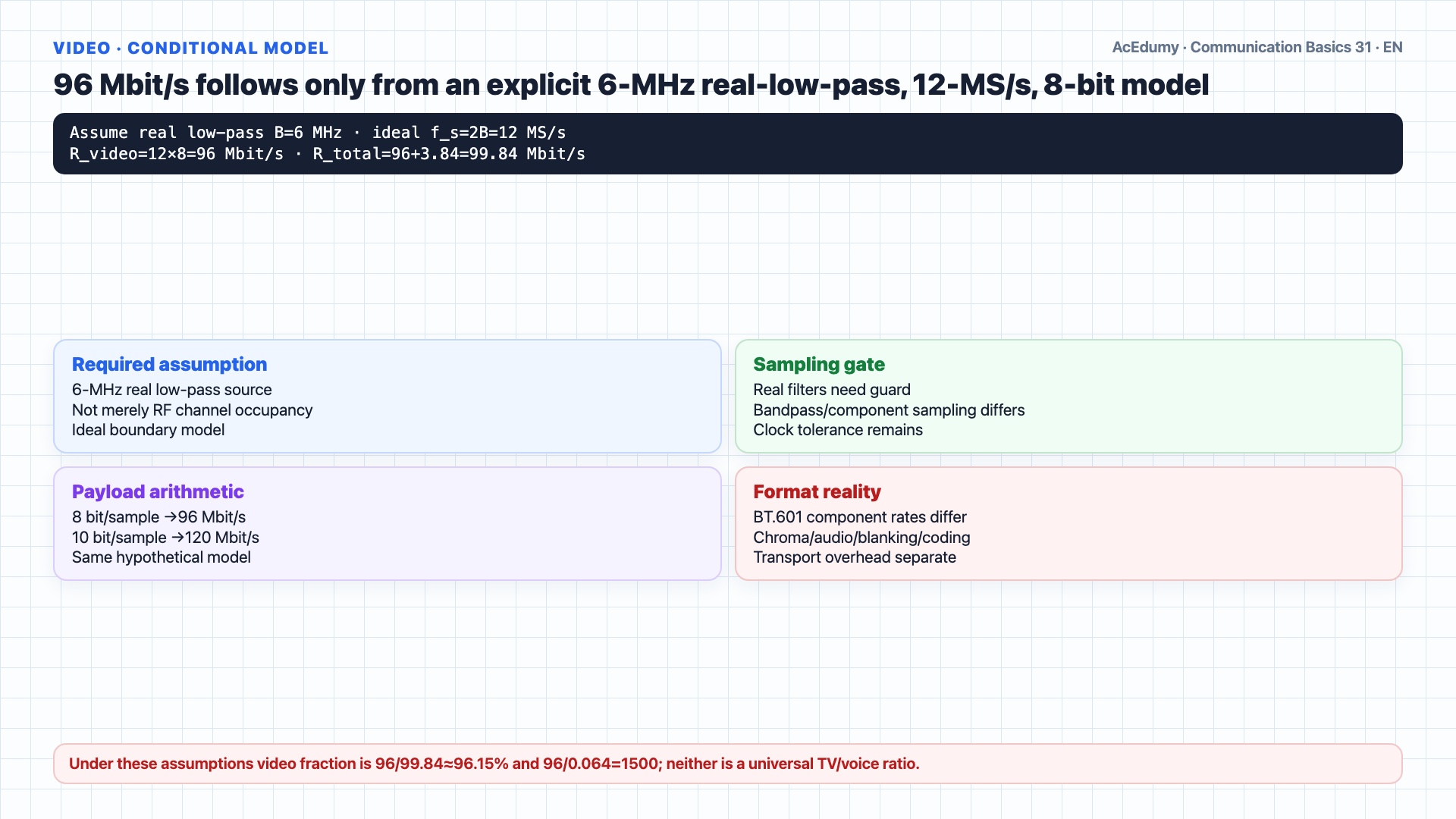
E4 raw line rate exceeds the conditional 99.84-Mbit/s payload total; actual fit and usable headroom require mapping, framing, and protection design. Part a continued — second stream — video.Additionally model the source as a real low-pass B=6-MHz signal for this problem; 6-MHz RF television-channel occupancy does not automatically imply that signal model.The ideal real-low-pass boundary is fs=2B=12 MS/s; realizable anti-alias filters need guard, while bandpass/component video sampling differs.Only under this explicit model is raw payload R=12 MS/s×8 bit=96 Mbit/s; blanking, chroma/audio, coding, framing, and transport overhead are excluded.The same hypothetical 12-MS/s model gives 120 Mbit/s at 10 bit/sample; 8 bit is not a universal TV standard, and formats such as BT.601 component sampling use different rates.Add the streams up.Three point eight four megabits for voice, plus ninety six megabits for video, equals about ninety nine point eight four megabits per second total.Under these assumptions video fraction is 96/99.84≈96.15%; retain the 3.84-Mbit/s voice payload in the capacity and mapping ledger.Dominance is specific to these raw-encoding assumptions; codec, resolution, frame rate, content, quality target, and service mix change the ratio.Narration transcript
Part a continued — second stream — video. One analog television channel occupies six megahertz of bandwidth. Apply Nyquist: sample at twice that, so twelve million samples per second. P C M coding at eight bits per sample gives ninety six megabits per second per television channel. If the receiver needs ten-bit quantization for higher quality, the rate climbs to one hundred twenty megabits per second — but for this problem we use the standard eight-bit value, ninety six megabits per second. Add the streams up. Three point eight four megabits for voice, plus ninety six megabits for video, equals about ninety nine point eight four megabits per second total. Notice immediately how dominant the video is — over ninety six percent of the total, and the voice is the rounding noise. This is the typical asymmetry whenever video shares a link with anything else.
5. Calculate the E4 raw-rate pass, 39.424-Mbit/s difference, and 71.69% ratio
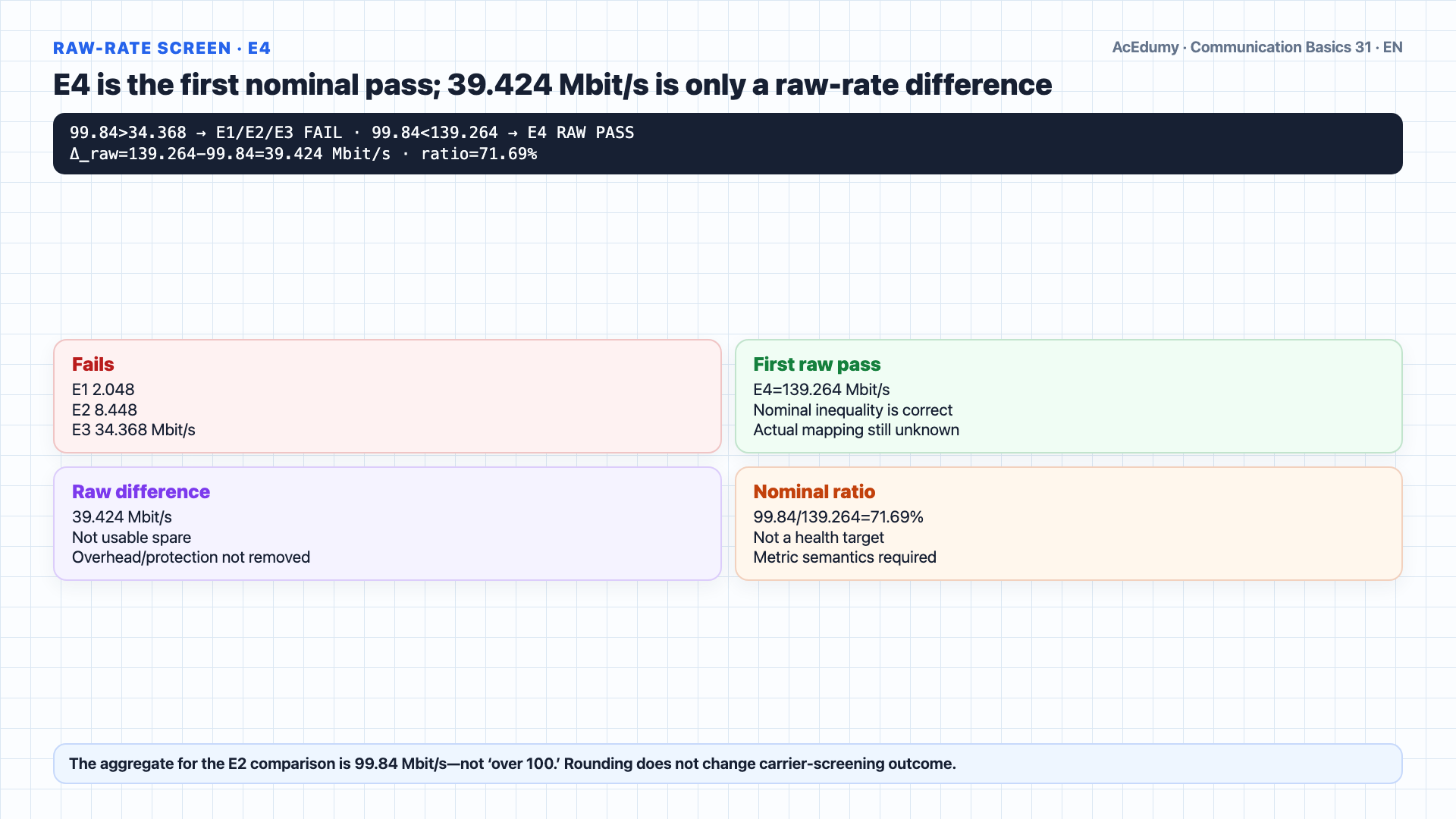
E4 raw line rate exceeds the conditional 99.84-Mbit/s payload total; actual fit and usable headroom require mapping, framing, and protection design. Part b — picking the carrier.We walk up the ladder.E1 raw line rate is 2.048 Mbit/s; 3.84-Mbit/s voice payload exceeds one E1, whose classic user capacity is only 30×64=1.92 Mbit/s.E2's 8.448-Mbit/s line rate fails; the stated aggregate payload is exactly 99.84 Mbit/s, not over 100.E-3 — thirty four megabits — closer, but still far short.The video alone overflows it.E4 raw line rate 139.264 Mbit/s exceeds the 99.84-Mbit/s payload total; actual fit requires supported mapping/container and overhead budget.We need ninety nine point eight four; we have a hundred thirty nine.Part c — how much headroom?One hundred thirty nine point two six four minus ninety nine point eight four equals thirty nine point four two megabits per second of spare capacity.Utilization is ninety nine point eight four divided by one hundred thirty nine point two six four, which is roughly seventy two percent.That ratio alone gives no health/SLA decision; loss/blocking/delay, availability, protection, growth, and failure-state load must also pass.What can we do with the spare?Another TV channel needs ninety six megabits — does not fit.Admit extra services only after supported grooming/mapping and residual usable-payload budget are computed; raw difference is not directly allocatable channels.Reserve capacity from the traffic model and SLA; constant circuit allocations and bursty packet queues do not share one utilization semantics.Narration transcript
Part b — picking the carrier. We walk up the ladder. E-1 — two megabits — does not fit, our voice alone almost equals it. E-2 — eight megabits — does not fit, voice plus video need over a hundred. E-3 — thirty four megabits — closer, but still far short. The video alone overflows it. E-4 — one hundred thirty nine point two six four megabits per second — finally fits. We need ninety nine point eight four; we have a hundred thirty nine. Part c — how much headroom? One hundred thirty nine point two six four minus ninety nine point eight four equals thirty nine point four two megabits per second of spare capacity. Utilization is ninety nine point eight four divided by one hundred thirty nine point two six four, which is roughly seventy two percent. Healthy. What can we do with the spare? Another TV channel needs ninety six megabits — does not fit. But we could load the headroom with data: file transfers, signalling overhead, or a few hundred extra voice channels. Or we keep it as engineering margin for traffic peaks.
6. Bound E4 selection with mapping, overhead, protection, and SLA gates
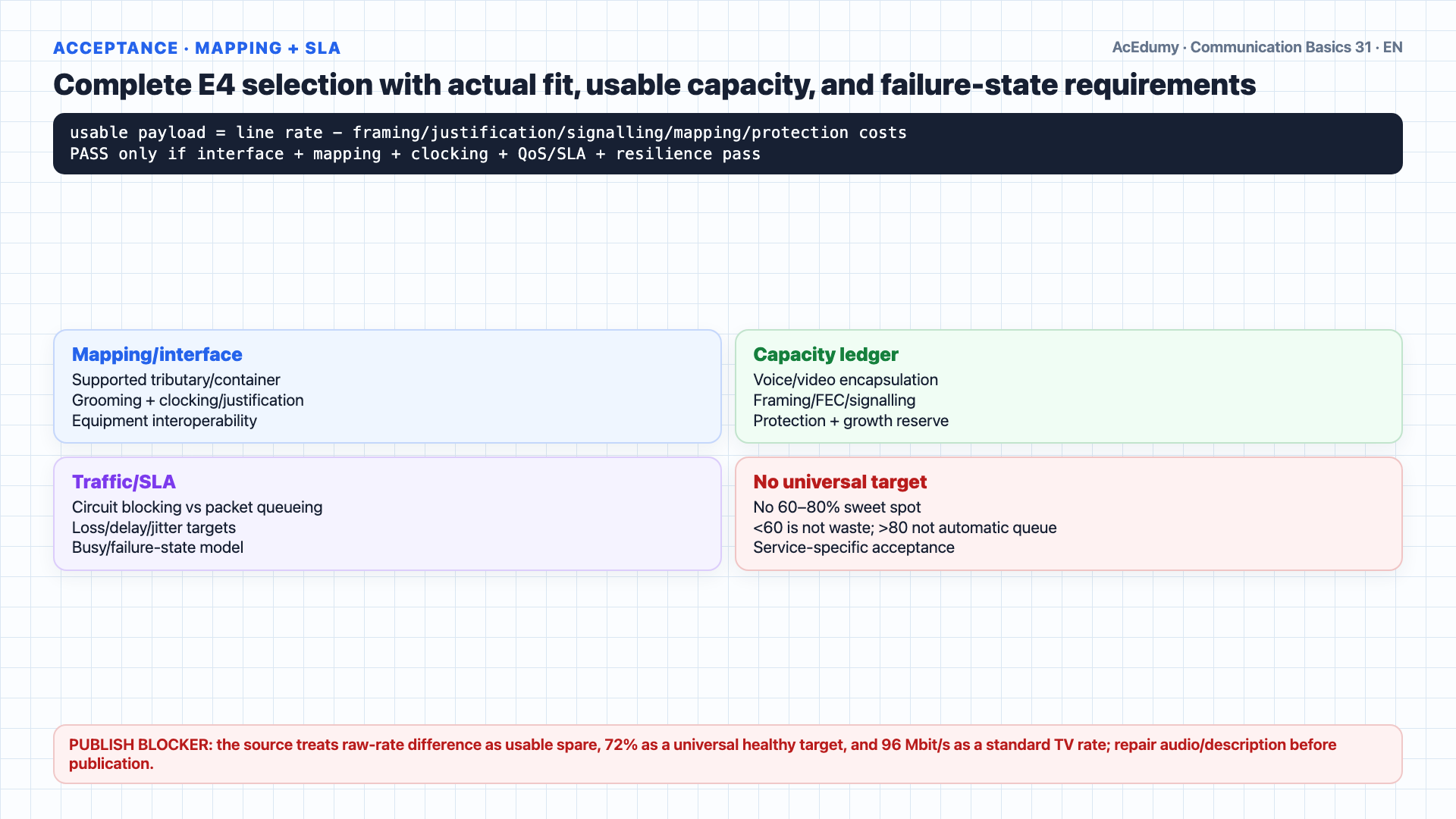
E4 raw line rate exceeds the conditional 99.84-Mbit/s payload total; actual fit and usable headroom require mapping, framing, and protection design. Three engineering takeaways.One: capacity planning is ladder climbing.Within this legacy shortlist select the next passing interface; real networks may use grooming, bonding, Ethernet/SDH/OTN/flexible rates, or architecture alternatives.Standard hierarchies provide common rates, framing, multiplexing, and interfaces for interoperability; pricing is not a single technical reason for their existence.Two: there is no universal 60–80% utilization sweet spot; derive a target from traffic model, technology, SLA, protection state, growth horizon, and cost risk.A low nominal ratio does not prove waste; it may provide protection, resilience, forecast uncertainty, burst absorption, or growth reserve.Circuit allocations do not automatically queue at 80%; packet queueing depends on offered-load distribution, bursts, scheduler, buffers, and QoS policy.71.69% is only a nominal arithmetic result, not an accepted operating target.Three: video dominates mixed links.The hypothetical 96-Mbit/s video payload is 1500× one 64-kbit/s G.711 payload; formats and transport overhead are not matched.The moment a video stream joins a link, the voice budget becomes a footnote.Video compression is widespread, but uncompressed production/transport exists; MPEG families, H.264, and AV1 output rate depends on resolution, frame rate, content, quality, and profile—not a universal 4–5 Mbit/s or vanished asymmetry.Narration transcript
Three engineering takeaways. One: capacity planning is ladder climbing. You do not get to order a custom-sized pipe — you compute your aggregate traffic and pick the next available standard rate above it. That is why hierarchies like E-carrier and S D H exist: they make pricing, multiplexing equipment, and interoperability tractable. Two: utilization between sixty and eighty percent is the sweet spot. Below sixty percent you are paying for unused capacity. Above eighty percent your link starts queuing during traffic peaks and quality of service degrades. Seventy two percent — like our example — is exactly where you want to be. Three: video dominates mixed links. One uncompressed television channel is roughly fifteen hundred voice calls in raw bandwidth. The moment a video stream joins a link, the voice budget becomes a footnote. This is the underlying reason why every video service in the real world is compressed — M P E G, H two six four, A V one — they push that ninety six megabit raw P C M figure down to four or five megabits, and suddenly the asymmetry vanishes.
Source video: Communication Basics #31 Worked Example: E-Carrier Selection — Voice + Video on One Backbone Link (6:55)