Electromagnetic Theory · Electric Dipole and Energy Density
#12 Electric dipoles, flux lines, equipotential surfaces, charge-assembly energy, and electrostatic energy density
Build the dipole field, read equipotential geometry, and calculate how electrostatic energy is distributed through space.
Question

Derive the electric dipole moment and far field; relate flux lines to equipotential surfaces, convert charge-assembly energy into field energy, and solve the uniformly charged sphere example.
Written solution and narration transcript(shows the full solution)
Below are all the lines written in the notebook together with the full narration transcript.
1. Move from potential to dipoles and field energy
The dipole field falls as 1/r³, while electrostatic energy is distributed wherever the field exists. Previously we established V, E = −∇V, and ∇×E = 0.Today we introduce two important topics.First, the electric dipole — a pair of equal and opposite charges that produces a distinctive field pattern.Second, we derive how much energy is stored in an electrostatic field and define the energy density.Narration transcript
In the previous lesson we defined the electric potential V, derived the gradient relationship E equals negative nabla V, and established Maxwell's second static equation: the curl of E equals zero. Today we introduce two important topics. First, the electric dipole — a pair of equal and opposite charges that produces a distinctive field pattern. Second, we derive how much energy is stored in an electrostatic field and define the energy density.
2. Derive the electric dipole and its far field
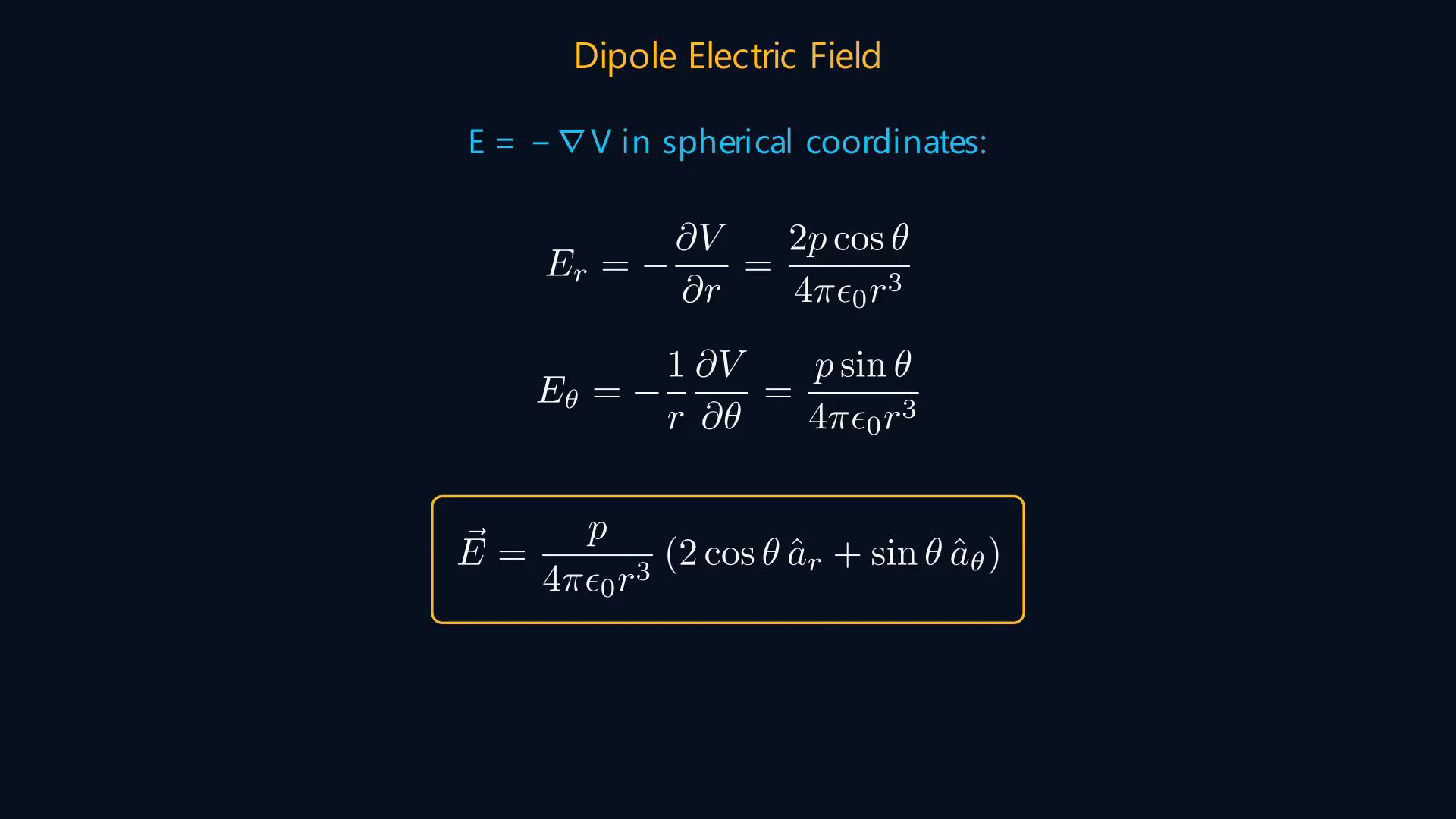
The dipole field falls as 1/r³, while electrostatic energy is distributed wherever the field exists. An electric dipole consists of two charges, plus Q and minus Q, separated by a small distance d.The dipole moment is p = Qd, directed from −Q to +Q.For r ≫ d, V = Qd cosθ/(4πε₀r²).With p = Qd az, V = p·ar/(4πε₀r²).The dipole field falls as 1/r³; a point-charge field falls as 1/r².This makes physical sense: from far away, the plus Q and minus Q fields nearly cancel.Narration transcript
An electric dipole consists of two charges, plus Q and minus Q, separated by a small distance d. The dipole moment is defined as p equals Q times d, and it points from the negative charge to the positive charge. For a dipole centered at the origin with its axis along z, the potential at a far point where r is much greater than d simplifies to: V equals Q d cosine theta divided by four pi epsilon-zero r-squared. We define the dipole moment vector p equals Q d a-z, so that V equals p dot a-r divided by four pi epsilon-zero r-squared. The electric field is found by taking E equals negative nabla V in spherical coordinates: E-r equals two p cosine theta divided by four pi epsilon-zero r-cubed, and E-theta equals p sine theta divided by four pi epsilon-zero r-cubed. Notice that the dipole field falls off as one over r-cubed — faster than the one over r-squared dependence of a point charge. This makes physical sense: from far away, the plus Q and minus Q fields nearly cancel.
3. Relate flux lines to equipotential surfaces
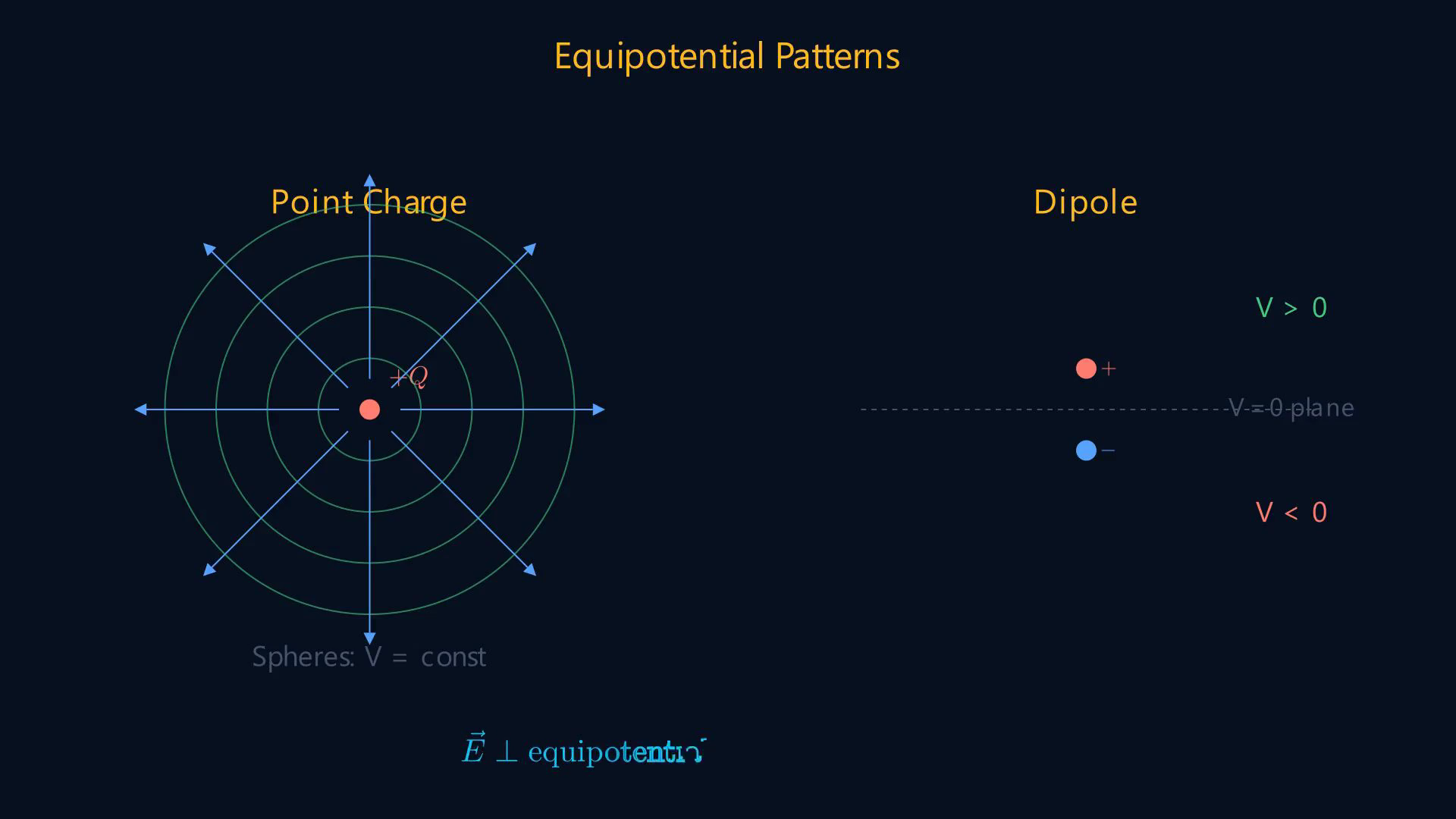
The dipole field falls as 1/r³, while electrostatic energy is distributed wherever the field exists. An electric flux line — also called a line of force — is a curve whose tangent at every point is in the direction of the electric field E.Faraday introduced these lines to visualize fields.An equipotential surface is a surface on which the potential V is constant everywhere.Because E = −∇V, flux lines are perpendicular to equipotential surfaces.Along an equipotential, E·dl = 0 and the work is zero.For a point charge, equipotential surfaces are concentric spheres.For a dipole, the pattern is more complex — positive potential above the midplane, negative below, with the zero-volt surface at the midplane itself.Narration transcript
An electric flux line — also called a line of force — is a curve whose tangent at every point is in the direction of the electric field E. Faraday introduced these lines to visualize fields. An equipotential surface is a surface on which the potential V is constant everywhere. Since E equals negative nabla V, and the gradient is perpendicular to constant-value surfaces, flux lines are always perpendicular to equipotential surfaces. Moving a charge along an equipotential surface requires zero work, because E dot d-l equals zero along the surface. For a point charge, equipotential surfaces are concentric spheres. For a dipole, the pattern is more complex — positive potential above the midplane, negative below, with the zero-volt surface at the midplane itself.
4. Build the assembly energy of a charge system
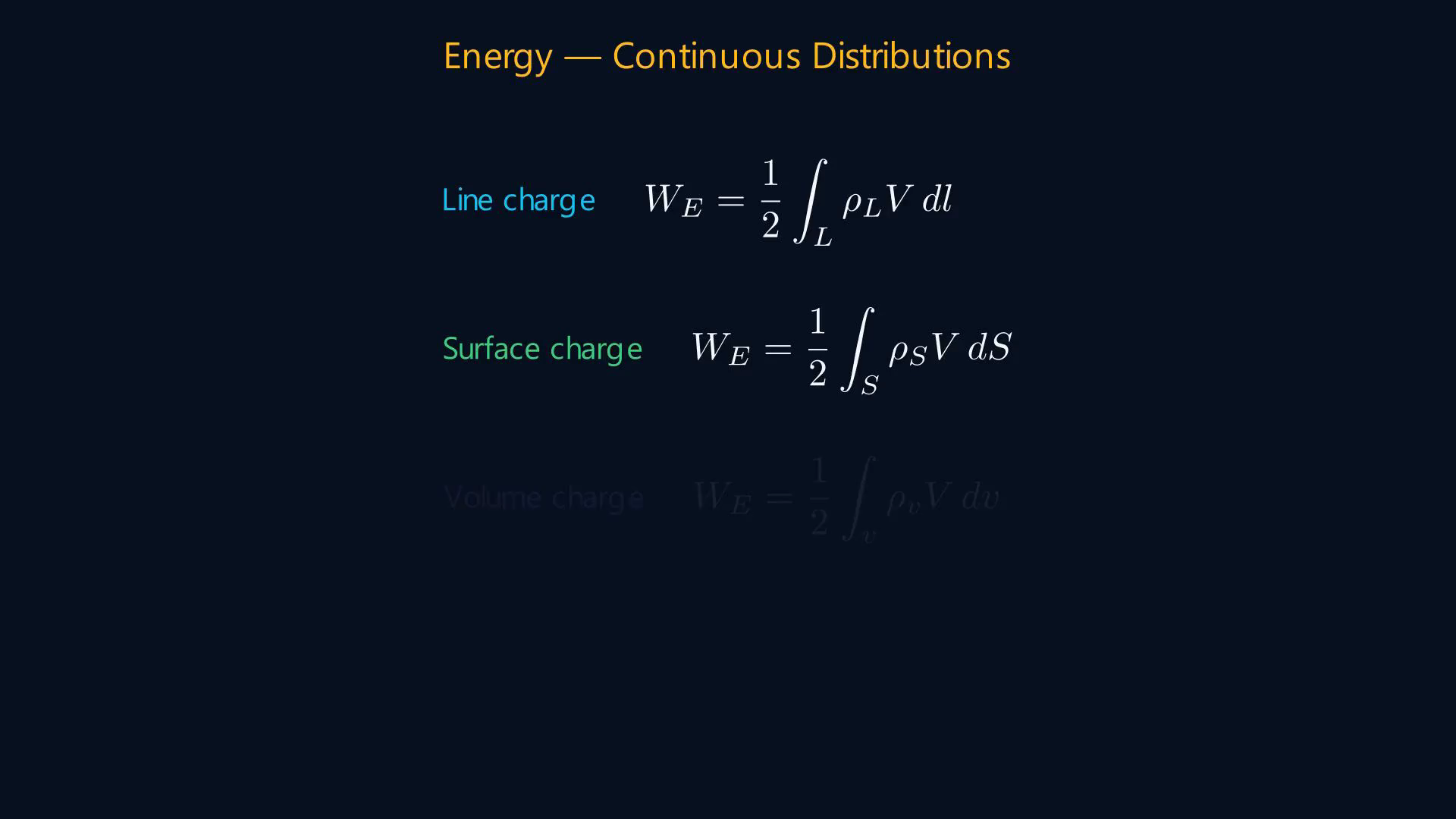
The dipole field falls as 1/r³, while electrostatic energy is distributed wherever the field exists. How much energy is stored when we assemble a collection of charges?Consider positioning three point charges one at a time.For the first charge, W₁ = 0; no field exists yet.For the second charge, W₂ = Q₂V₂₁.For the third charge, W₃ = Q₃(V₃₁ + V₃₂).The assembly energy is WE = ½ΣₖQₖVₖ.For a volume distribution, WE = ½∫ρvV dv.Similar expressions hold for line and surface charges.Narration transcript
How much energy is stored when we assemble a collection of charges? Consider positioning three point charges one at a time. The first charge Q-one costs zero energy — there is no existing field. Bringing Q-two to its position requires work equal to Q-two times V-twenty-one, where V-twenty-one is the potential at P-two due to Q-one. Similarly, Q-three requires work Q-three times the sum V-thirty-one plus V-thirty-two. Adding these up and using the symmetry argument of reversing the assembly order, we get: W-E equals one-half times the sum of Q-k V-k, from k equals one to n, where V-k is the total potential at the location of Q-k due to all other charges. For continuous charge distributions, the summation becomes an integral: W-E equals one-half integral of rho-v times V d-v for volume charge. Similar expressions hold for line and surface charges.
5. Derive electrostatic energy density
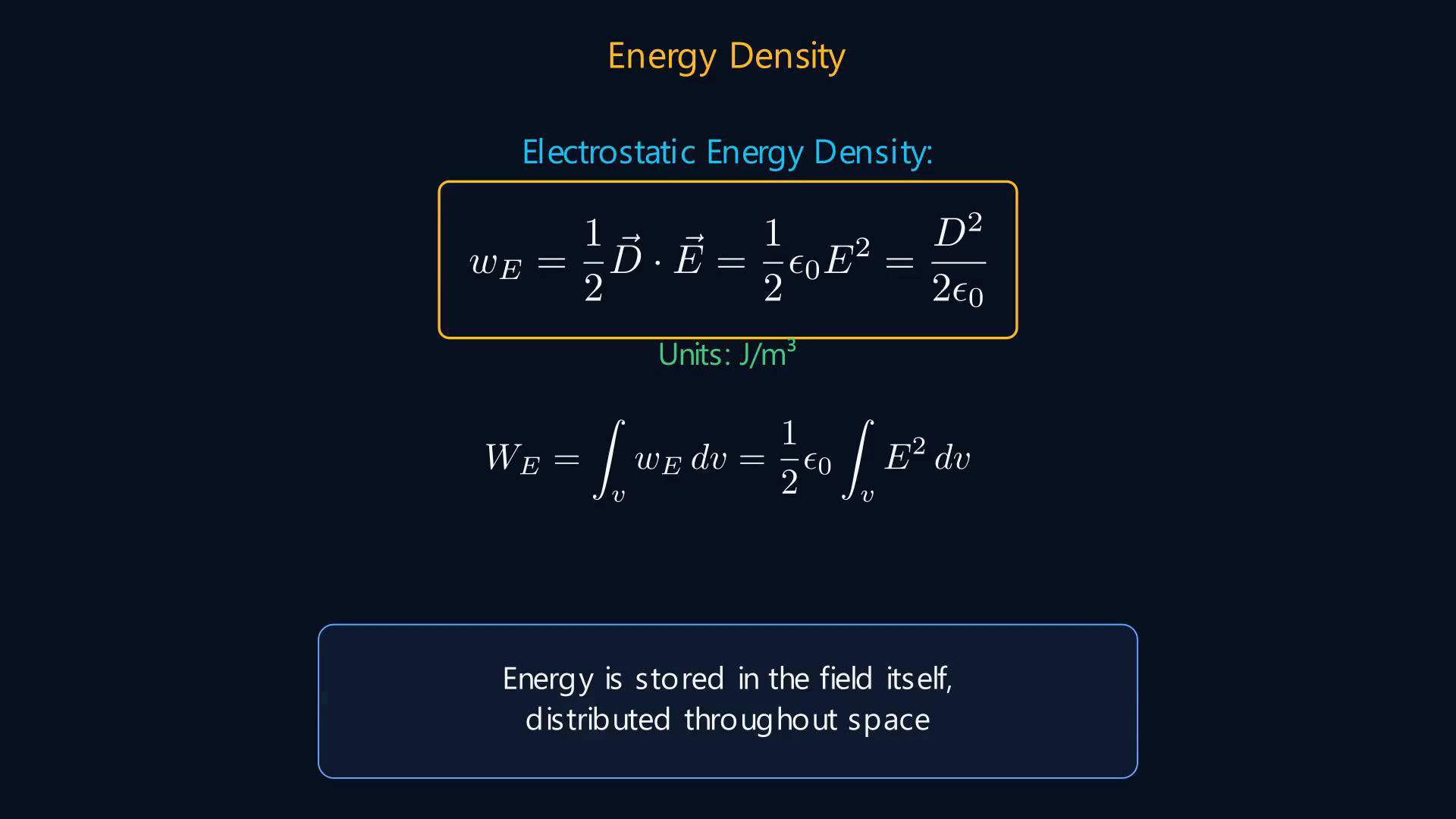
The dipole field falls as 1/r³, while electrostatic energy is distributed wherever the field exists. Start with WE = ½∫ρvV dv and ρv = ∇·D.The divergence theorem gives WE = ½∫D·E dv.In free space D = ε₀E, so WE = ½ε₀∫E² dv.Energy density:Units are joules per cubic meter.The total energy is then the volume integral of wE over all space where the field exists.This is a powerful result — the energy is stored in the field itself, distributed throughout space, not just at the charge locations.Narration transcript
Starting from W-E equals one-half integral of rho-v times V d-v, we substitute rho-v equals nabla dot D from Gauss's law and apply a vector identity. After using the divergence theorem and noting that the surface integral vanishes as the bounding surface goes to infinity, we arrive at: W-E equals one-half integral of D dot E d-v. Since D equals epsilon-zero times E, this becomes: W-E equals one-half epsilon-zero integral of E-squared d-v. We define the electrostatic energy density: w-E equals one-half D dot E, which equals one-half epsilon-zero E-squared, which also equals D-squared divided by two epsilon-zero. Units are joules per cubic meter. The total energy is then the volume integral of w-E over all space where the field exists. This is a powerful result — the energy is stored in the field itself, distributed throughout space, not just at the charge locations.
6. Calculate the energy of a uniformly charged sphere
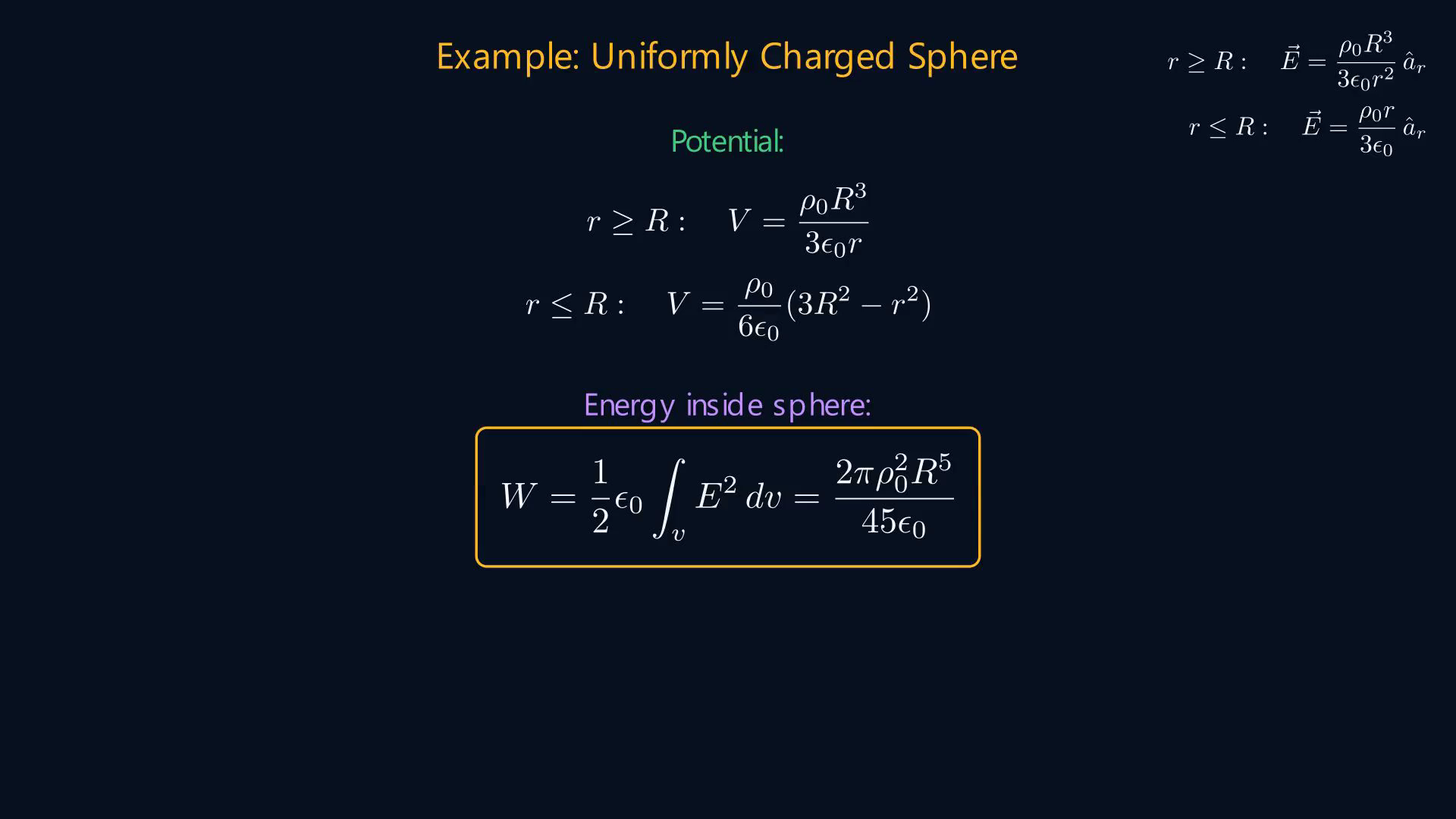
The dipole field falls as 1/r³, while electrostatic energy is distributed wherever the field exists. Let us work Example 4.15 from Sadiku.A sphere of radius R has uniform volume charge density ρ₀.Find V everywhere and the energy stored inside.From Gauss's law, we already know E.r ≥ R:r ≤ R:r ≥ R:r ≤ R:Inside the sphere, W = ½ε₀∫E² dv.Result:This result tells us exactly how much energy the field configuration stores within the charged region.Narration transcript
Let us work Example 4.15 from Sadiku. A sphere of radius R has uniform volume charge density rho-zero. Find V everywhere and the energy stored inside. From Gauss's law, we already know E. Outside, r greater than or equal to R: E equals rho-zero R-cubed divided by three epsilon-zero r-squared in the a-r direction. Inside, r less than or equal to R: E equals rho-zero r divided by three epsilon-zero in the a-r direction. For the potential outside: V equals rho-zero R-cubed divided by three epsilon-zero r. Inside, requiring continuity at r equals R, V equals rho-zero divided by six epsilon-zero times three R-squared minus r-squared. For the stored energy inside the sphere: W equals one-half epsilon-zero integral of E-squared d-v. Substituting and integrating in spherical coordinates gives: W equals two pi rho-zero-squared R-to-the-fifth divided by forty-five epsilon-zero. This result tells us exactly how much energy the field configuration stores within the charged region.
7. Review the dipole and energy relations
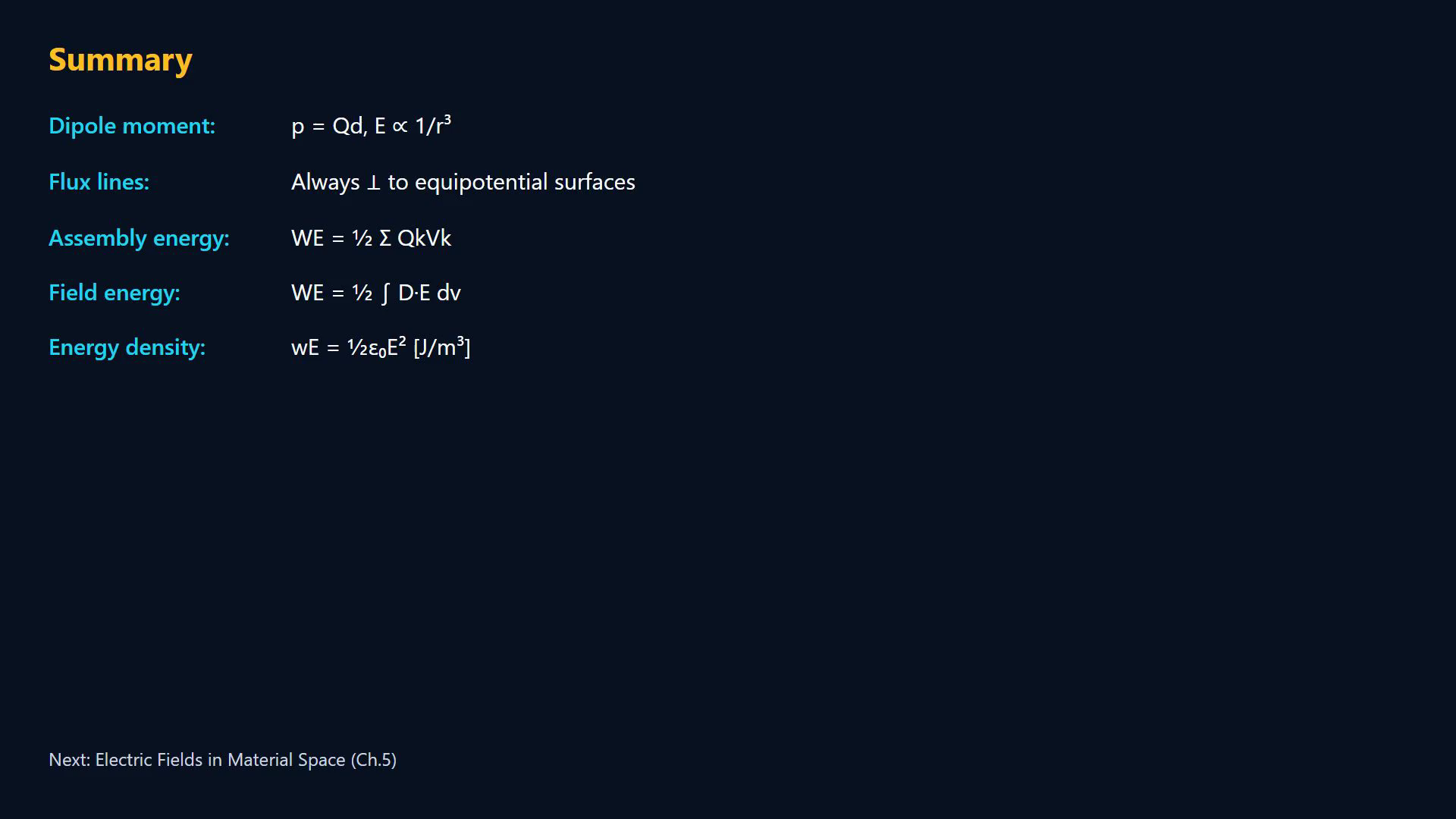
The dipole field falls as 1/r³, while electrostatic energy is distributed wherever the field exists. Let us review today's key results.The electric dipole moment is p = Qd.Its field falls off as one over r³.Flux lines are always perpendicular to equipotential surfaces.For a charge system, WE = ½ΣₖQₖVₖ.In field form, WE = ½∫D·E dv.In free space, wE = ½ε₀E².In the next lesson, we will move to Chapter 5 — electric fields in material space: conductors, dielectrics, and boundary conditions.Narration transcript
Let us review today's key results. The electric dipole moment is p equals Q d. Its field falls off as one over r-cubed. Flux lines are always perpendicular to equipotential surfaces. The energy stored in a system of charges is W-E equals one-half sum of Q-k V-k. In terms of the field: W-E equals one-half integral of D dot E d-v. The energy density is w-E equals one-half epsilon-zero E-squared. In the next lesson, we will move to Chapter 5 — electric fields in material space: conductors, dielectrics, and boundary conditions.
Source video: Electromagnetic Theory (v2) #12 Electric Dipole & Energy Density (7:38)