Electromagnetic Theory · Electric Flux Density and Gauss's Law
#10 Electric flux density D, integral and differential forms of Gauss's law, and symmetric charge distributions
Build electric flux density, derive Gauss's law, and turn long integrals into short algebra using symmetry.
Question

Define electric flux density D, connect the integral and differential forms of Gauss's law, and calculate fields in spherical, cylindrical, and planar symmetry using suitable Gaussian surfaces.
Written solution and narration transcript(shows the full solution)
Below are all the lines written in the notebook together with the full narration transcript.
1. Move from continuous-charge integrals to Gauss
With a suitable Gaussian surface, D is constant or tangent to the surface and the flux integral simplifies. Last time, we derived the electric field from continuous charge distributions: an infinite line, an infinite sheet, and a ring of charge.Those derivations required setting up and evaluating integrals, which can be quite involved.Today, we introduce a powerful shortcut.We'll define the electric flux density vector D, state Gauss's law, one of Maxwell's four equations, and show how it lets us find D and E almost instantly when the charge distribution has symmetry.Narration transcript
Last time, we derived the electric field from continuous charge distributions: an infinite line, an infinite sheet, and a ring of charge. Those derivations required setting up and evaluating integrals, which can be quite involved. Today, we introduce a powerful shortcut. We'll define the electric flux density vector D, state Gauss's law, one of Maxwell's four equations, and show how it lets us find D and E almost instantly when the charge distribution has symmetry.
2. Define electric flux density D
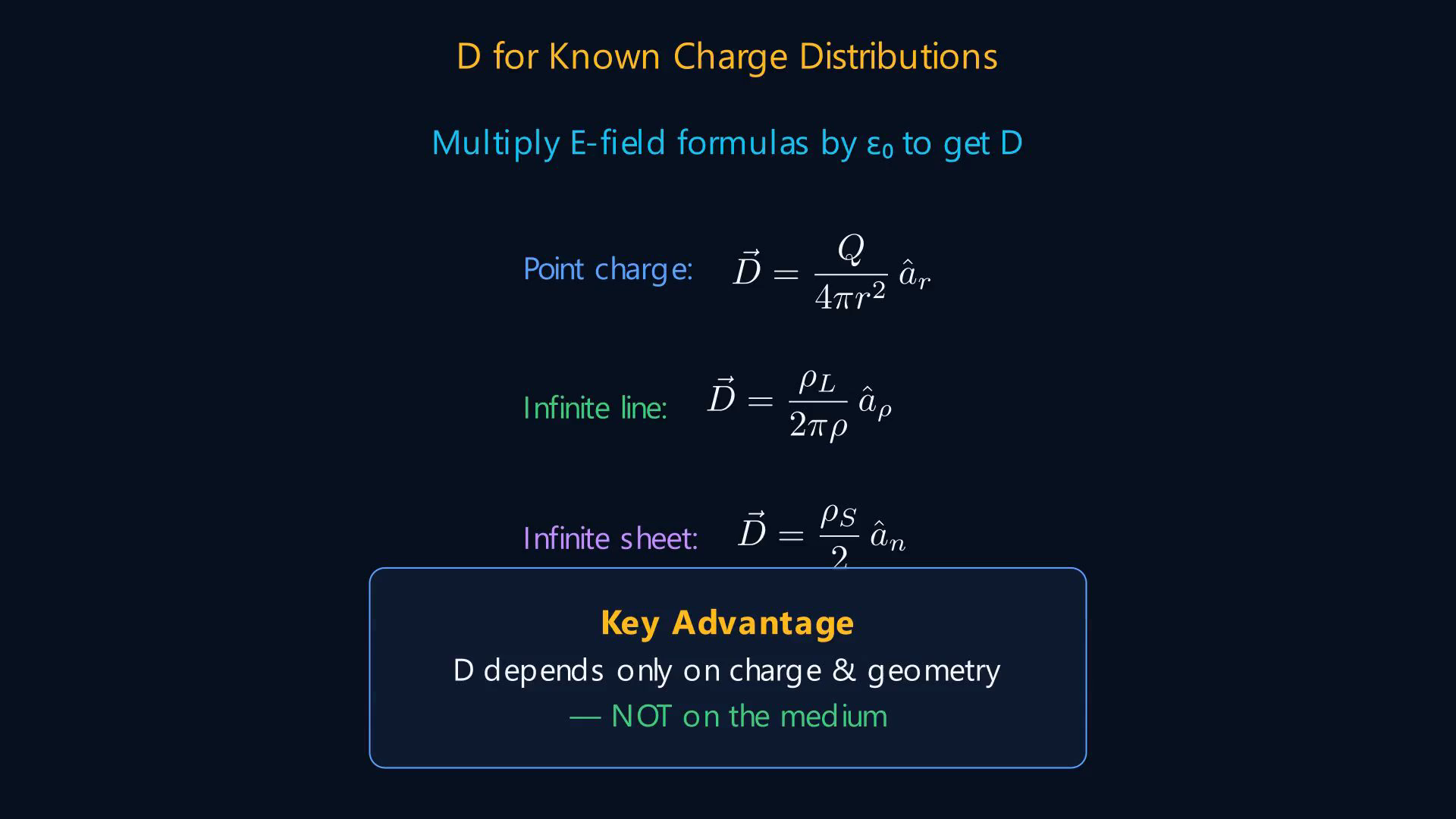
With a suitable Gaussian surface, D is constant or tangent to the surface and the flux integral simplifies. The electric field E depends on the medium.In free space, it includes the permittivity ε₀.To separate the field from the medium, we define a new vector: the electric flux density D.Electric flux density:The units of D are coulombs per square meter, the same units as surface charge density.This is no coincidence, as we'll see with Gauss's law.Electric flux through S: ψ = ∫ₛD·dS.In SI units, one line of electric flux starts on plus one coulomb and ends on minus one coulomb.So the total flux is measured in coulombs.The key advantage of D: all the formulas we derived for E from charge distributions still apply; just multiply by ε₀.For a point charge, D = [Q/(4πr²)]er.For an infinite line, D = [ρL/(2πρ)]eρ.For an infinite sheet, D = (ρS/2)en.Notice that D depends only on charge and geometry, not on the medium.Narration transcript
The electric field E depends on the medium. In free space, it includes the permittivity epsilon zero. To separate the field from the medium, we define a new vector: the electric flux density D. D equals epsilon zero times E. The units of D are coulombs per square meter, the same units as surface charge density. This is no coincidence, as we'll see with Gauss's law. The electric flux psi through a surface S is defined as the surface integral of D dot d S. In SI units, one line of electric flux starts on plus one coulomb and ends on minus one coulomb. So the total flux is measured in coulombs. The key advantage of D: all the formulas we derived for E from charge distributions still apply; just multiply by epsilon zero. For a point charge, D equals Q over four pi r squared. For an infinite line, D equals rho L over two pi rho. For an infinite sheet, D equals rho S over two. Notice that D depends only on charge and geometry, not on the medium.
3. Build both forms of Gauss's law
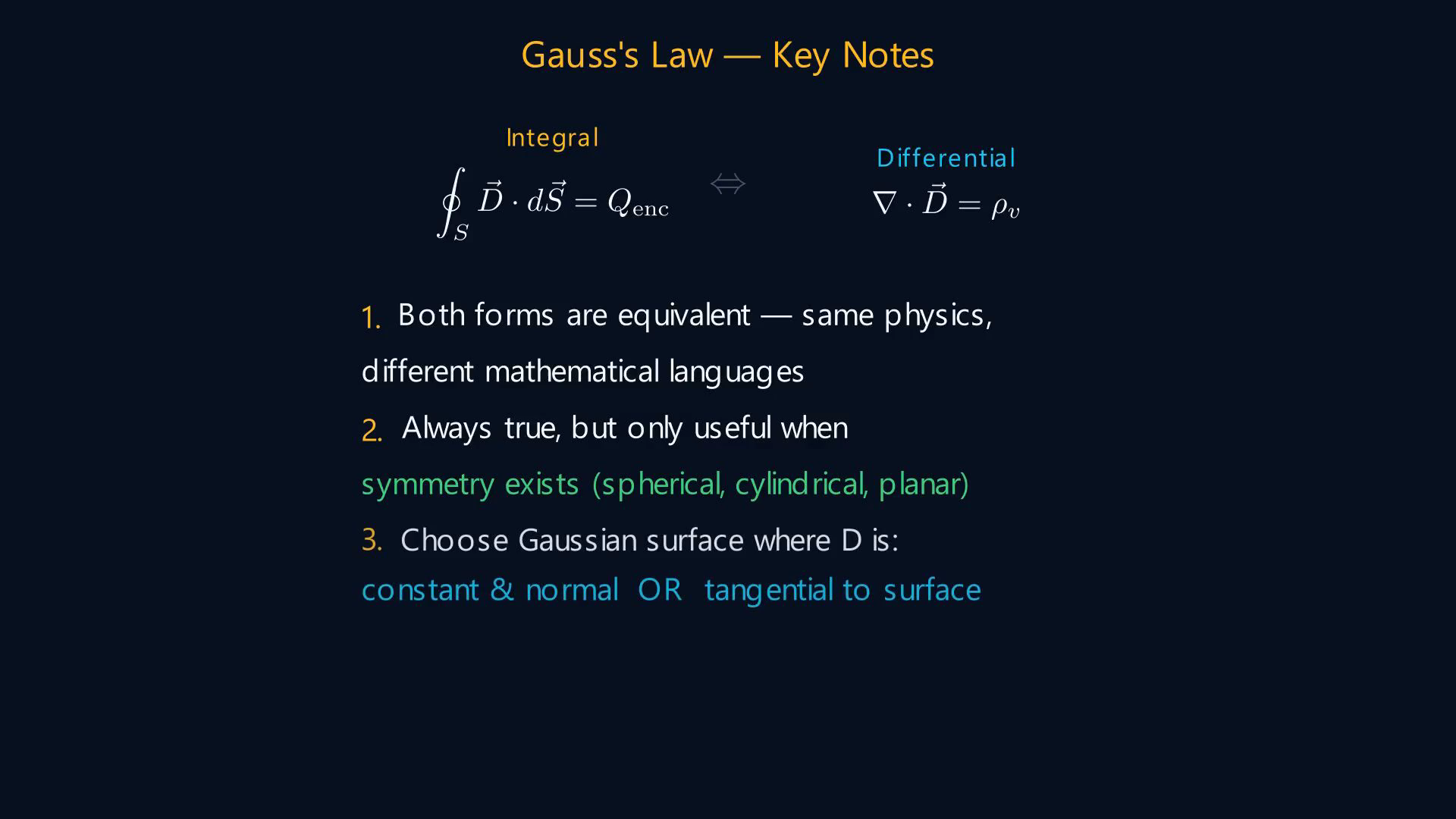
With a suitable Gaussian surface, D is constant or tangent to the surface and the flux integral simplifies. But now for the main result.Gauss's law states: the total electric flux through any closed surface equals the total charge enclosed by that surface.Integral form: ∮ₛD·dS = Qenclosed.This is the integral form of Gauss's law.Divergence theorem: ∫ᵥ(∇·D)dv = ∫ᵥρv dv.Since this must hold for any volume, the integrands must be equal.Differential form:This is the first of Maxwell's four equations.It tells us that electric flux diverges from positive charges and converges on negative charges.Three important notes.First, the integral and differential forms are equivalent; they say the same thing in different mathematical languages.Second, Gauss's law is always true, but it's only useful for finding D when the charge distribution has symmetry.Third, when symmetry exists, we choose a Gaussian surface on which D is either constant and normal or tangential, so the integral simplifies dramatically.Narration transcript
But now for the main result. Gauss's law states: the total electric flux through any closed surface equals the total charge enclosed by that surface. In equation form, the closed surface integral of D dot d S equals Q enclosed. This is the integral form of Gauss's law. By applying the divergence theorem to the left side, we can convert this to the volume integral of divergence of D d v equals the volume integral of rho v d v. Since this must hold for any volume, the integrands must be equal. This gives us the differential form, also called the point form: divergence of D equals rho v. This is the first of Maxwell's four equations. It tells us that electric flux diverges from positive charges and converges on negative charges. Three important notes. First, the integral and differential forms are equivalent; they say the same thing in different mathematical languages. Second, Gauss's law is always true, but it's only useful for finding D when the charge distribution has symmetry. Third, when symmetry exists, we choose a Gaussian surface on which D is either constant and normal or tangential, so the integral simplifies dramatically.
4. Apply Gauss to point and line charge
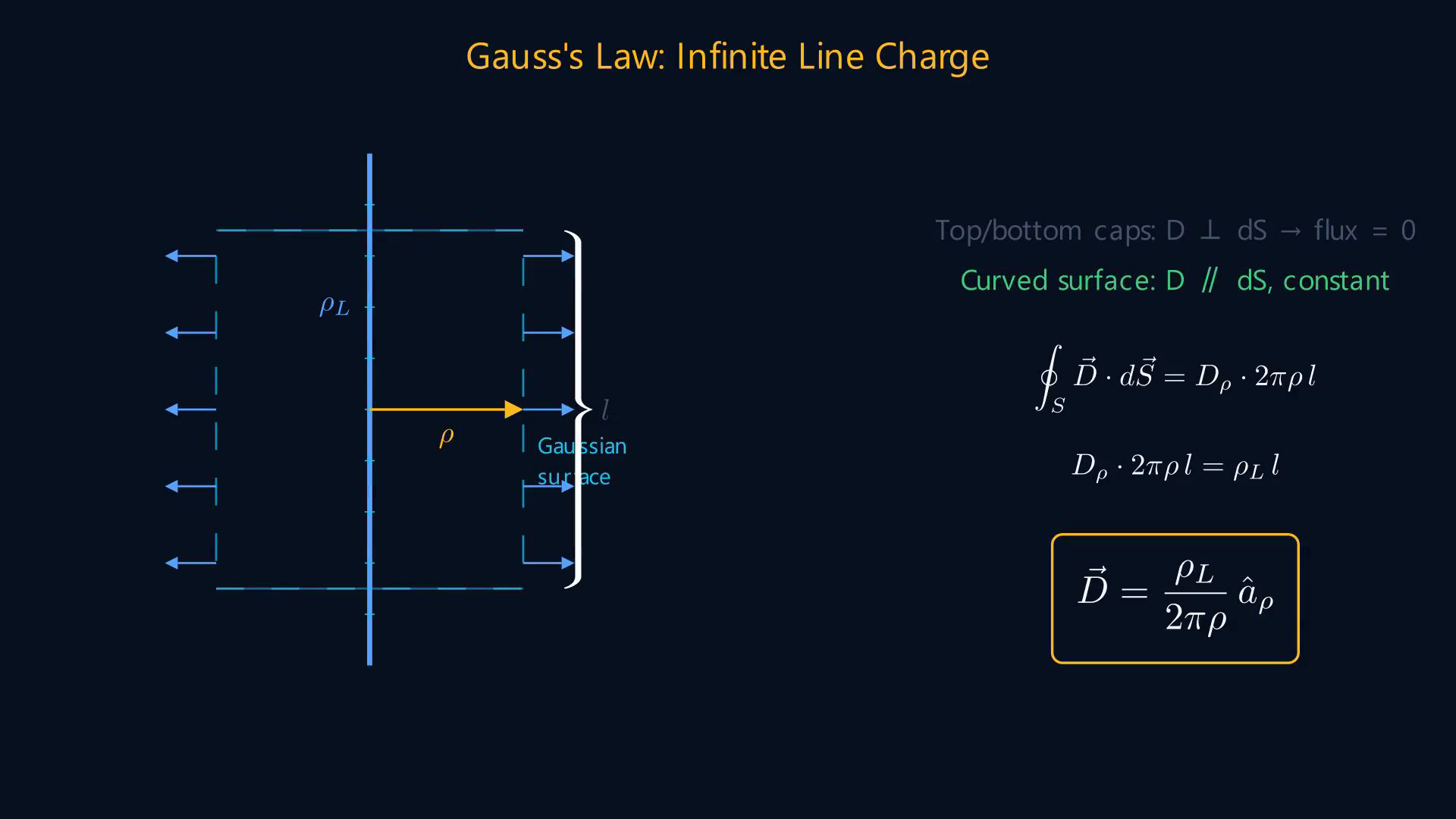
With a suitable Gaussian surface, D is constant or tangent to the surface and the flux integral simplifies. Let's apply Gauss's law.For a point charge Q at the origin, we choose a spherical Gaussian surface of radius r centered at Q.By spherical symmetry, D has only a radial component and it's constant on the sphere.On the sphere, ∮D·dS = Dr(4πr²).Therefore D = [Q/(4πr²)]er.Exactly what Coulomb's law gives, but derived in two lines instead of an integral.For an infinite line charge ρL along the z-axis, we choose a cylindrical Gaussian surface of radius ρ and length L.D has only eρ component by symmetry and it's constant on the curved surface.The flux through the top and bottom caps is zero; D is tangential there.Curved-surface flux: Dρ(2πρ L).Again, two lines versus a full integration.That's the power of Gauss's law with symmetry.Narration transcript
Let's apply Gauss's law. For a point charge Q at the origin, we choose a spherical Gaussian surface of radius r centered at Q. By spherical symmetry, D has only a radial component and it's constant on the sphere. So D dot d S becomes D r times the total surface area: D r times four pi r squared. Setting this equal to Q gives D r equals Q over four pi r squared. Therefore, D equals Q over four pi r squared in the a r direction. Exactly what Coulomb's law gives, but derived in two lines instead of an integral. For an infinite line charge rho L along the z-axis, we choose a cylindrical Gaussian surface of radius rho and length L. D has only a rho component by symmetry and it's constant on the curved surface. The flux through the top and bottom caps is zero; D is tangential there. The flux through the curved surface is D rho times two pi rho L. Setting this equal to the enclosed charge rho L times L gives D equals rho L over two pi rho in the a rho direction. Again, two lines versus a full integration. That's the power of Gauss's law with symmetry.
5. Solve the sheet and uniform sphere
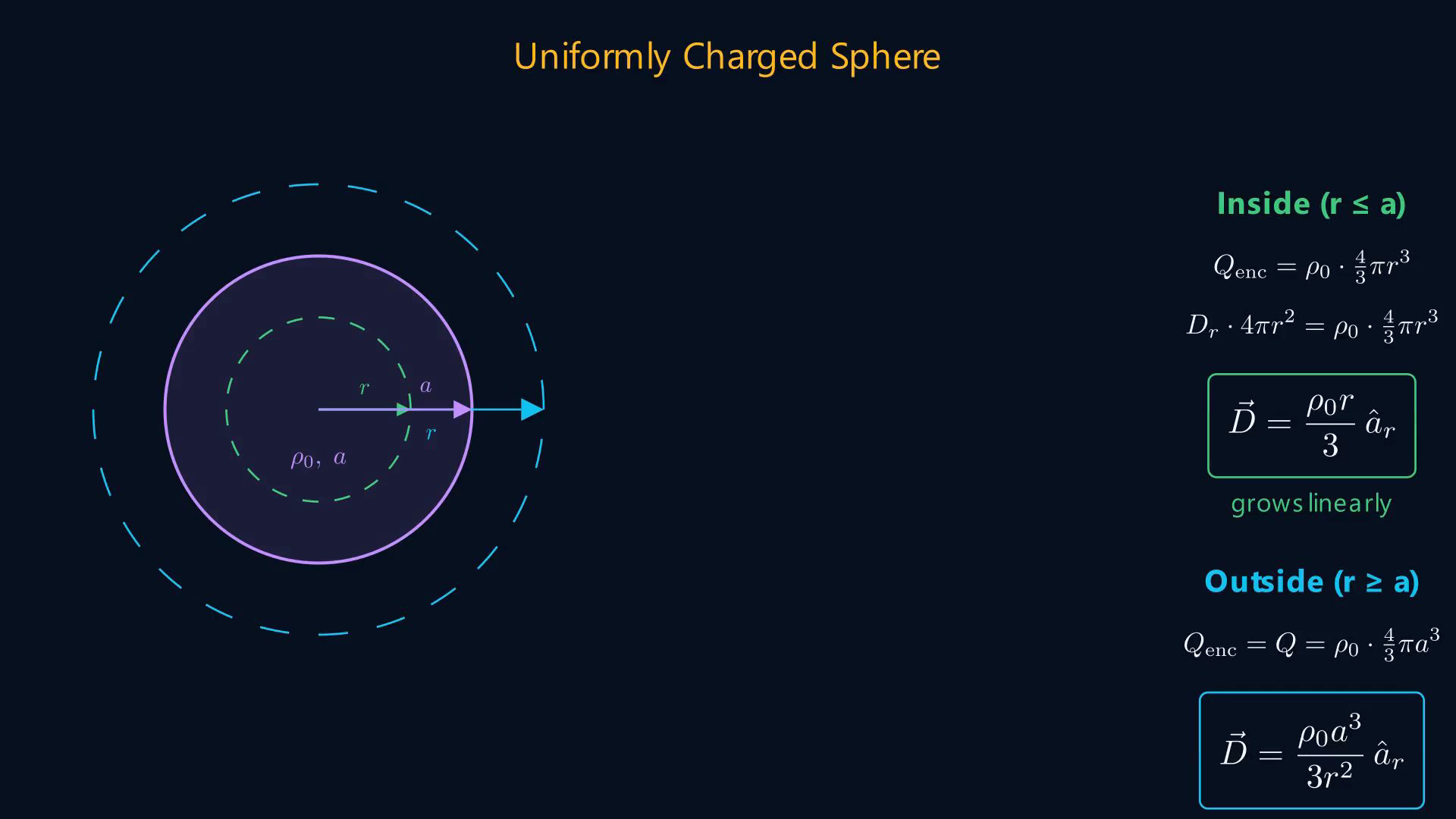
With a suitable Gaussian surface, D is constant or tangent to the surface and the flux integral simplifies. For an infinite ρS sheet at z = 0, choose a centered Gaussian pillbox.By symmetry, D points in the plus or minus z direction and has no component along the sides.The flux exits through the top and bottom faces only.For face area A, total flux is Dz A + Dz A = 2Dz A.The enclosed charge is Qenclosed = ρS A.Dz = ρS/2 and D = (ρS/2)en.One line of algebra.Now consider a uniformly charged sphere of radius a with volume charge density ρ₀.We need two Gaussian surfaces.For r ≤ a, use a spherical Gaussian surface of radius r.Inside the sphere, Qenclosed = ρ₀(4πr³/3).Inside, D = (ρ₀ r/3)er.The field grows linearly inside.For r ≥ a, Qenclosed = Q = ρ₀(4πa³/3).Outside, D = [ρ₀ a³/(3r²)]er.Outside it looks like a point charge, as expected.Narration transcript
For an infinite sheet of charge rho S in the z equals zero plane, we choose a rectangular box, a pillbox, centered on the sheet. By symmetry, D points in the plus or minus z direction and has no component along the sides. The flux exits through the top and bottom faces only. If each face has area A, the total flux is D z times A plus D z times A equals two D z A. The enclosed charge is rho S times A. So D z equals rho S over two, and D equals rho S over two in the a n direction. One line of algebra. Now consider a uniformly charged sphere of radius a with volume charge density rho zero. We need two Gaussian surfaces. For r less than or equal to a, inside the sphere, we use a spherical surface of radius r. The enclosed charge is rho zero times four thirds pi r cubed. Gauss's law gives D r times four pi r squared equals rho zero times four thirds pi r cubed. So D equals rho zero r over three in the a r direction. The field grows linearly inside. For r greater than or equal to a, outside the sphere, the enclosed charge is the total charge: Q equals rho zero times four thirds pi a cubed. So D equals rho zero a cubed over three r squared in the a r direction. Outside it looks like a point charge, as expected.
6. Review symmetry and the Maxwell link

With a suitable Gaussian surface, D is constant or tangent to the surface and the flux integral simplifies. Let's recap today's key ideas.The electric flux density removes the medium dependence.Gauss's law in integral form: ∮ₛD·dS = Qenclosed.In differential form:This is Maxwell's first equation.When symmetry exists—spherical, cylindrical, or planar—Gauss's law gives us D in one or two lines of algebra, replacing lengthy integrations.Next time, we'll introduce the electric potential V, which gives us yet another way to find E and connects energy to the electric field.Narration transcript
Let's recap today's key ideas. D equals epsilon zero E. The electric flux density removes the medium dependence. Gauss's law in integral form: the closed surface integral of D dot d S equals Q enclosed. In differential form, divergence of D equals rho v. This is Maxwell's first equation. When symmetry exists—spherical, cylindrical, or planar—Gauss's law gives us D in one or two lines of algebra, replacing lengthy integrations. Next time, we'll introduce the electric potential V, which gives us yet another way to find E and connects energy to the electric field.
Source video: Electromagnetic Theory (v2) #10 Electric Flux Density (D) & Gauss's Law (7:31)