Communication Basics · Electromagnetic Spectrum and Bandwidth
#04 ITU radio-frequency bands, wavelength in media, spectral bandwidth versus bit rate, and Nyquist/Shannon–Hartley limits
Separate spectrum, wavelength, bandwidth, and data rate with correct units; use Nyquist and Shannon limits together with their channel-model assumptions.
Question
State ITU radio bands with correct decade boundaries and relate wavelength to phase velocity in the medium. Separate spectral bandwidth in hertz from data rate in bit/s, then apply the Nyquist and Shannon–Hartley limits with their assumptions.
Written solution and narration transcript(shows the full solution)
Below are all the lines written in the notebook together with the full narration transcript.
1. Bound the ITU radio bands correctly
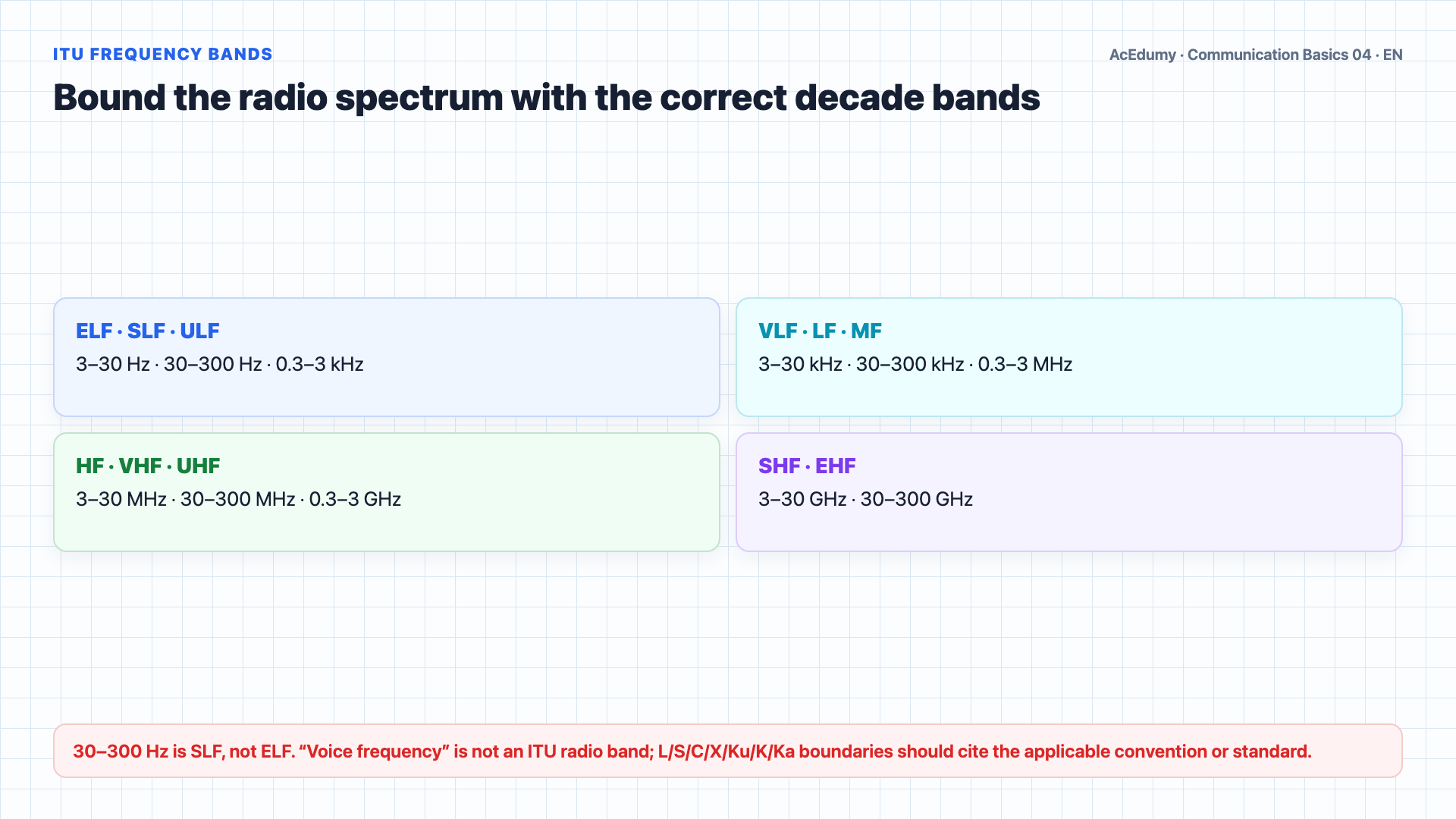
Spectral bandwidth is measured in hertz and data rate in bit/s; achievable rate depends on channel model, SNR, signal levels, coding, and power constraints. The electromagnetic spectrum extends from near-zero frequencies through gamma rays; the radio spectrum is the communication-oriented portion discussed here.In telecommunications, we divide this spectrum into named bands.In ITU naming, ELF is 3–30 Hz, SLF is 30–300 Hz, and ULF is 300 Hz–3 kHz; the source audio incorrectly labels 30–300 Hz as ELF.Voice frequency is a contextual telephony/audio term, not an ITU radio band; 300 Hz–3 kHz approximates an application passband.Very Low Frequency, VLF, goes from 3 to 30 kilohertz.Low Frequency from 30 to 300 kilohertz.Medium Frequency from 300 kilohertz to 3 megahertz — this is the AM radio band.High Frequency from 3 to 30 megahertz — used for shortwave radio.Very High Frequency, VHF, from 30 to 300 megahertz — FM radio and television.Ultra High Frequency, UHF, from 300 megahertz to 3 gigahertz — cellular and TV.Exact L/S/C/X/Ku/K/Ka microwave boundaries depend on the radar or satellite convention cited, and their applications extend beyond those two examples.Super High Frequency, SHF, covers 3 to 30 gigahertz.And Extremely High Frequency, EHF, goes from 30 to 300 gigahertz, also called the millimeter wave band.Narration transcript
The electromagnetic spectrum spans an enormous range of frequencies, from a few hertz all the way to hundreds of gigahertz and beyond. In telecommunications, we divide this spectrum into named bands. Starting from the lowest: Extremely Low Frequency, or ELF, operates from 30 to 300 hertz. Voice Frequency, VF, covers 300 hertz to 3 kilohertz. Very Low Frequency, VLF, goes from 3 to 30 kilohertz. Low Frequency from 30 to 300 kilohertz. Medium Frequency from 300 kilohertz to 3 megahertz — this is the AM radio band. High Frequency from 3 to 30 megahertz — used for shortwave radio. Very High Frequency, VHF, from 30 to 300 megahertz — FM radio and television. Ultra High Frequency, UHF, from 300 megahertz to 3 gigahertz — cellular and TV. Within the microwave range, we have specific sub-bands: L-band, S-band, C-band, X-band, Ku, K, and Ka — used for satellite communications and radar. Super High Frequency, SHF, covers 3 to 30 gigahertz. And Extremely High Frequency, EHF, goes from 30 to 300 gigahertz, also called the millimeter wave band.
2. Relate frequency to wavelength in the medium
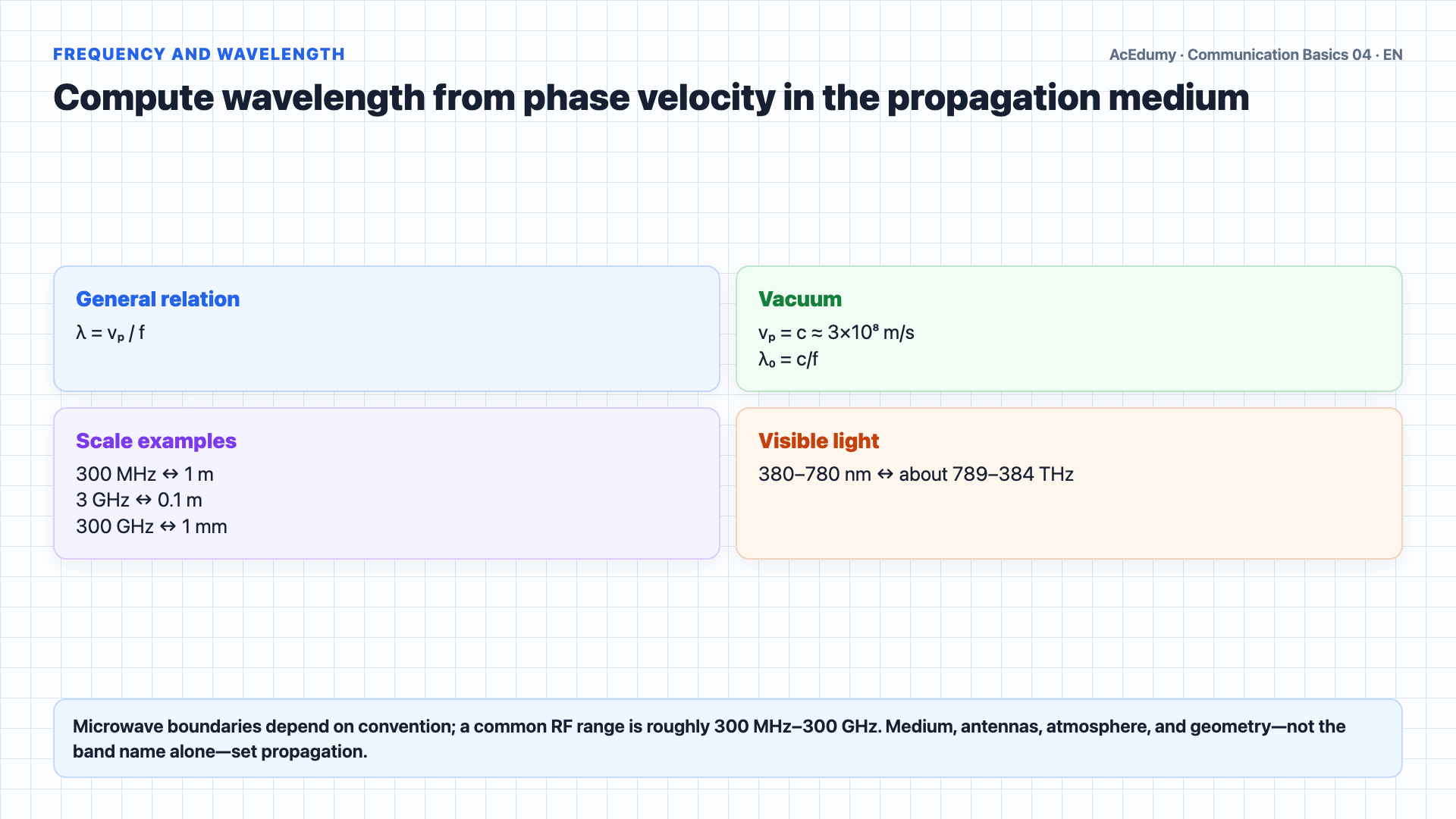
Spectral bandwidth is measured in hertz and data rate in bit/s; achievable rate depends on channel model, SNR, signal levels, coding, and power constraints. The general relation is λ=vₚ/f; only in vacuum is the phase velocity c and λ₀=c/f, while wavelength changes in material media.As frequency increases, wavelength decreases.Let us look at the full electromagnetic spectrum from highest to lowest frequency.Gamma rays have wavelengths below 10 picometers and frequencies above 30 exahertz.X-rays are below 10 nanometers, above 30 petahertz.Extreme ultraviolet is below 200 nanometers.The 380–780 nm visible range corresponds in vacuum to about 789–384 THz; saying only ‘above 384 THz’ omits its upper bound.Infrared has several sub-regions: near IR, mid IR, and far IR.Under a common RF convention, microwaves span roughly 300 MHz–300 GHz, or 1 m–1 mm; below 1 mm and above 300 GHz reverses that boundary.Then we enter the radio frequency bands: UHF radio covers wavelengths below 1 meter.VHF radio, used for TV and FM, is below 10 meters.Shortwave radio below 180 meters.Medium wave AM radio below 650 meters.Longwave radio below 10 kilometers.And VLF radio has wavelengths exceeding 10 kilometers.Propagation depends on frequency plus medium, atmosphere, antennas, geometry, and regulation; applications are selected from all these factors.Narration transcript
Wavelength and frequency are inversely related through the speed of light: lambda equals c divided by f. As frequency increases, wavelength decreases. Let us look at the full electromagnetic spectrum from highest to lowest frequency. Gamma rays have wavelengths below 10 picometers and frequencies above 30 exahertz. X-rays are below 10 nanometers, above 30 petahertz. Extreme ultraviolet is below 200 nanometers. Visible light ranges from about 380 to 780 nanometers, corresponding to frequencies above 384 terahertz. Infrared has several sub-regions: near IR, mid IR, and far IR. Microwaves start below 1 millimeter, above 300 gigahertz. Then we enter the radio frequency bands: UHF radio covers wavelengths below 1 meter. VHF radio, used for TV and FM, is below 10 meters. Shortwave radio below 180 meters. Medium wave AM radio below 650 meters. Longwave radio below 10 kilometers. And VLF radio has wavelengths exceeding 10 kilometers. Each part of the spectrum has unique propagation characteristics, which determine its applications in telecommunications.
3. Separate spectral bandwidth from bit rate
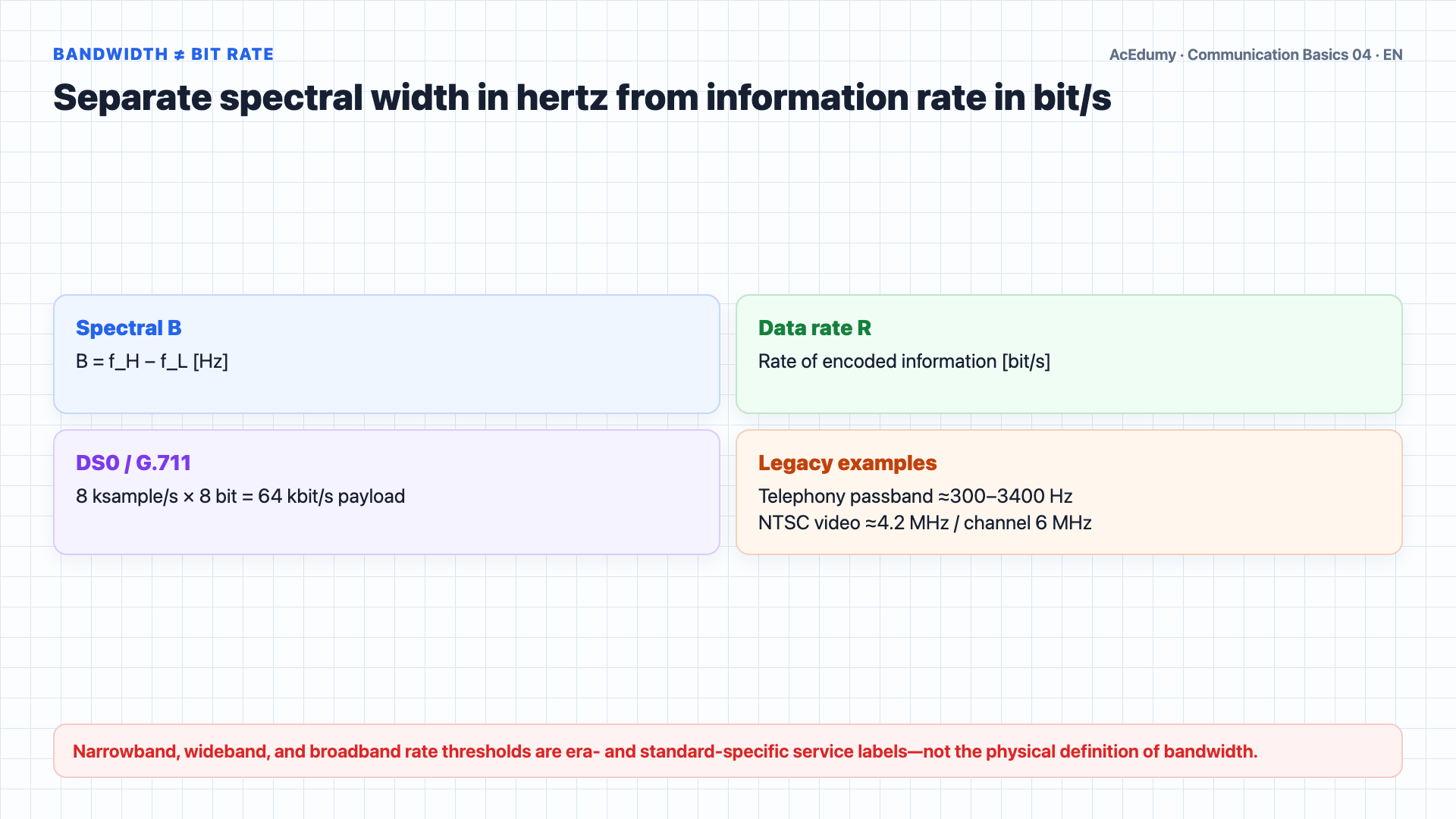
Spectral bandwidth is measured in hertz and data rate in bit/s; achievable rate depends on channel model, SNR, signal levels, coding, and power constraints. Spectral bandwidth is an occupied or permitted fH−fL frequency range under a stated definition and is measured in hertz; it is not data rate.Narrowband, wideband, and broadband are historical or standards-dependent service labels, not three universal categories of physical bandwidth.A 64 kbit/s threshold is a legacy digital-telephony service-rate example, not a universal current definition of narrowband.In the North American digital-carrier hierarchy, DS0 is typically a 64 kbit/s PCM time slot; the naming is not universal to every network.A G.711-style 8 ksample/s × 8-bit PCM payload is 64 kbit/s; other uncompressed formats and network overhead have different rates.n×64 kbit/s is a legacy channel-bonding/service example, not a universal mathematical definition of wideband.Broadband thresholds vary by authority, country, and era; 2 Mbit/s is a historical threshold, not a universal definition.A legacy telephony voice passband is typically about 300–3400 Hz, or 3.1 kHz; this is not the physical spectrum of human voice or every analog channel.Approximately 4.2 MHz video and a 6 MHz RF channel are legacy NTSC broadcast examples; digital and regional TV standards differ.Larger B can increase capacity, but achievable information rate also depends on SNR, power, channel model, modulation, and coding.Narration transcript
Bandwidth is the range of frequencies that make up a signal. In telecommunications, we classify connections by their bandwidth into three categories. Narrowband typically means up to 64 kilobits per second. This corresponds to a DS-0 channel, which is the basic digital signal level. 64 kilobits per second is the rate for one uncompressed digital voice channel. Wideband means n times 64 kilobits per second — multiple narrowband channels combined together. Broadband means more than 2 megabits per second. To put these in context: human voice has a bandwidth of about 4 kilohertz, specifically the range from 250 hertz to 3,400 hertz that is allocated for one analog voice channel. Commercial television requires a video bandwidth of 4.2 megahertz, with the full allocated channel bandwidth being 6 megahertz. The relationship is clear — the more bandwidth, the more information we can carry.
4. Build the Nyquist and Shannon–Hartley limits
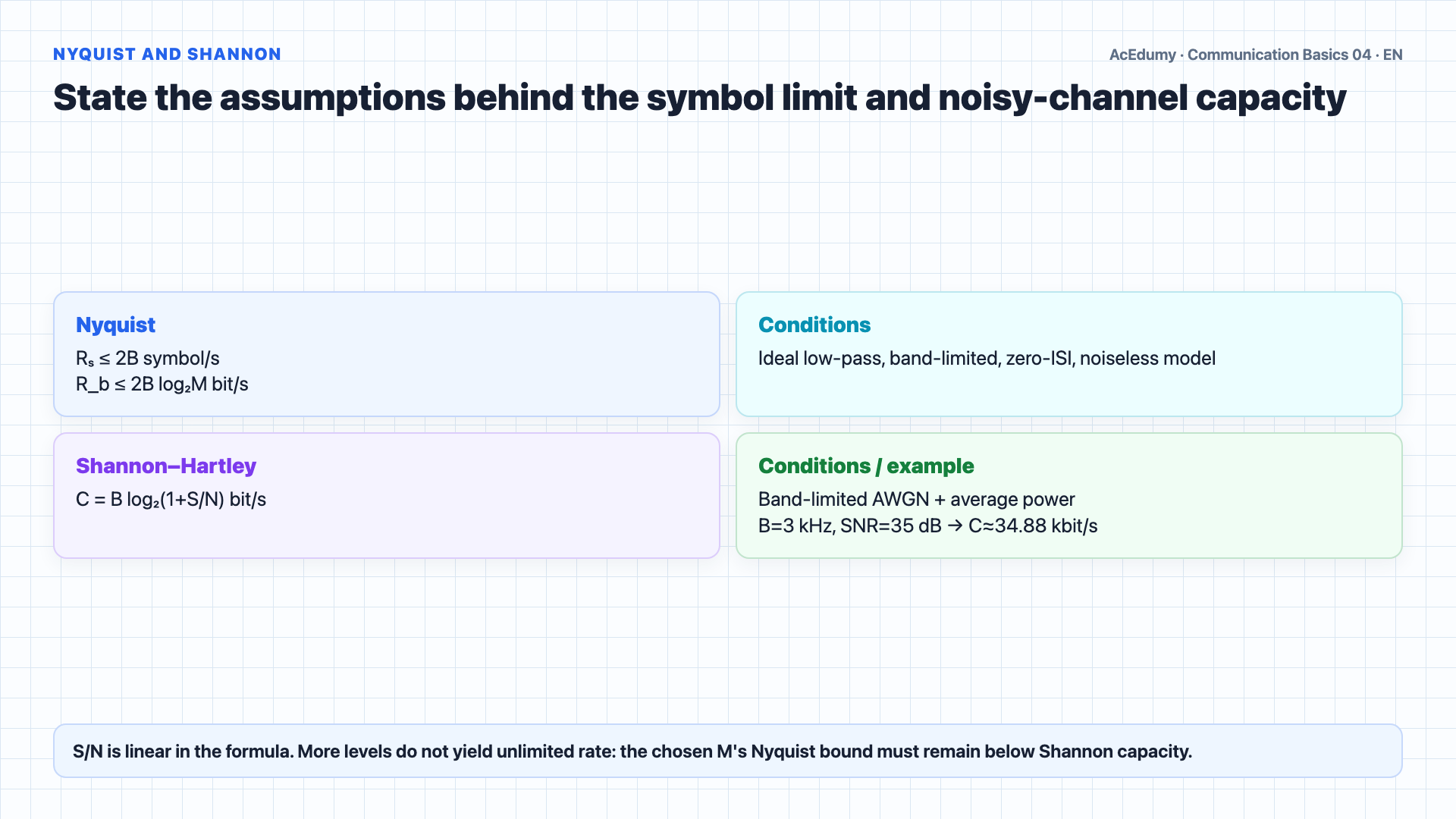
Spectral bandwidth is measured in hertz and data rate in bit/s; achievable rate depends on channel model, SNR, signal levels, coding, and power constraints. How fast can we actually send data over a channel?Two fundamental formulas answer this question.The Nyquist zero-ISI symbol limit for an ideal noiseless band-limited low-pass model is Rs≤2B; with M levels, Rb≤2B log₂M.Bit rate equals 2 times the bandwidth times log base 2 of L, where L is the number of signal levels.For example, a channel with 3000 hertz bandwidth using 2 signal levels gives a maximum bit rate of 2 times 3000 times log base 2 of 2, which equals 6000 bits per second.With 4 signal levels, each level carries 2 bits, so the maximum becomes 12,000 bits per second over the same bandwidth.But in reality, channels always have noise.Shannon–Hartley capacity under band-limited AWGN and average-power assumptions is C=B log₂(1+S/N), with S/N used as a linear ratio.For the assumed B=3000 Hz and S/N=3162 (about 35 dB), Shannon–Hartley gives C≈34.88 kbit/s; this is a specific AWGN example.This is the reliable-communication upper bound under the stated band-limited AWGN, average-power, and error-probability assumptions; it cannot be generalized outside that model.For a selected M, check the Nyquist bound together with Shannon capacity; increasing the number of levels alone does not give unlimited rate in noise.Narration transcript
How fast can we actually send data over a channel? Two fundamental formulas answer this question. The first is the Nyquist bit rate, for a noiseless channel. Bit rate equals 2 times the bandwidth times log base 2 of L, where L is the number of signal levels. For example, a channel with 3000 hertz bandwidth using 2 signal levels gives a maximum bit rate of 2 times 3000 times log base 2 of 2, which equals 6000 bits per second. With 4 signal levels, each level carries 2 bits, so the maximum becomes 12,000 bits per second over the same bandwidth. But in reality, channels always have noise. Claude Shannon introduced the Shannon capacity formula: C equals bandwidth times log base 2 of the quantity 1 plus SNR, where SNR is the signal-to-noise ratio. For a standard telephone line with 3000 hertz bandwidth and an SNR of about 3162, the capacity is 3000 times log base 2 of 3163, which gives approximately 34,860 bits per second. This is the absolute maximum — no modulation technique can exceed it. In practice, we use both formulas together: Shannon tells us the upper limit, and Nyquist helps us choose the right number of signal levels.
5. Summarize bands, waves, measures, and capacity
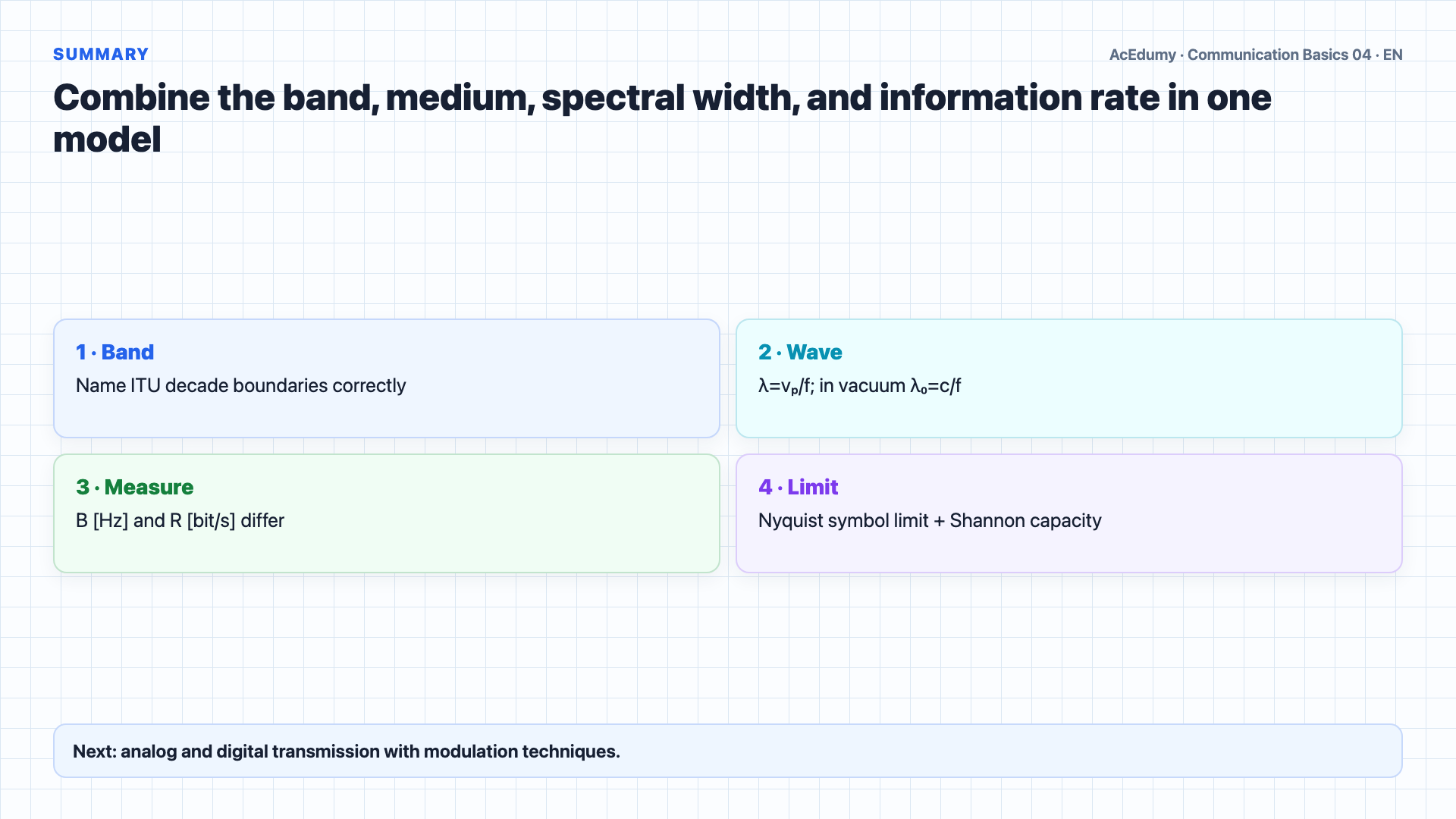
Spectral bandwidth is measured in hertz and data rate in bit/s; achievable rate depends on channel model, SNR, signal levels, coding, and power constraints. Let us review.In the radio spectrum ELF is 3–30 Hz, SLF is 30–300 Hz, and EHF is 30–300 GHz; microwave sub-band boundaries require a cited convention.Wavelength and frequency are inversely related through the speed of light.The 64 kbit/s and 2 Mbit/s thresholds are historical service labels; spectral bandwidth in hertz and data rate in bit/s must be defined separately.Nyquist bounds symbols/levels in an ideal noiseless band-limited model; Shannon–Hartley gives capacity under band-limited AWGN and power assumptions.In the next lesson, we will explore analog versus digital transmission, including modulation techniques like AM, FM, and phase modulation.Narration transcript
Let us review. The electromagnetic spectrum is divided into named bands from ELF at 30 hertz up to EHF at 300 gigahertz, with microwave sub-bands like L, C, Ku, and Ka for satellite and radar. Wavelength and frequency are inversely related through the speed of light. Bandwidth categories define connection speeds: narrowband up to 64 kilobits per second, wideband as multiples of 64 kilobits per second, and broadband above 2 megabits per second. The Nyquist formula gives the maximum bit rate for an ideal channel, while Shannon's formula gives the absolute capacity limit for a real, noisy channel. In the next lesson, we will explore analog versus digital transmission, including modulation techniques like AM, FM, and phase modulation.
Source video: Communication Basics #04 EM Spectrum & Bandwidth (6:27)