Antenna Theory · Far Field versus Stationary Phase
#07 Finite-source compactness at distance, far-field distance/phase approximation, and stationary-phase selection for extended sources
Choose between far-field and stationary-phase simplifications from source extent and observer distance.
Question

Compare near and far observation geometry for a finite antenna; explain what the far-field approximation simplifies and show how stationary phase isolates the dominant phase-stable region for an extended source.
Written solution and narration transcript(shows the full solution)
Below are all the lines written in the notebook together with the full narration transcript.
1. Recall the point-source spherical-wave result
Use far field when a bounded source looks compact; use stationary phase when cancellation over an extended source controls the answer. In the last lesson, the point source gave us the cleanest possible radiation example.The source integral collapsed, and the result naturally looked like a spherical wave, with e(−jkr)/r.That memory matters now, because the next question is not about a new formula first.It is about when a real antenna can start behaving like that simpler far-away picture.Narration transcript
In the last lesson, the point source gave us the cleanest possible radiation example. The source integral collapsed, and the result naturally looked like a spherical wave, with e to the minus j k r over r. That memory matters now, because the next question is not about a new formula first. It is about when a real antenna can start behaving like that simpler far-away picture.
2. See why a finite antenna still looks extended nearby
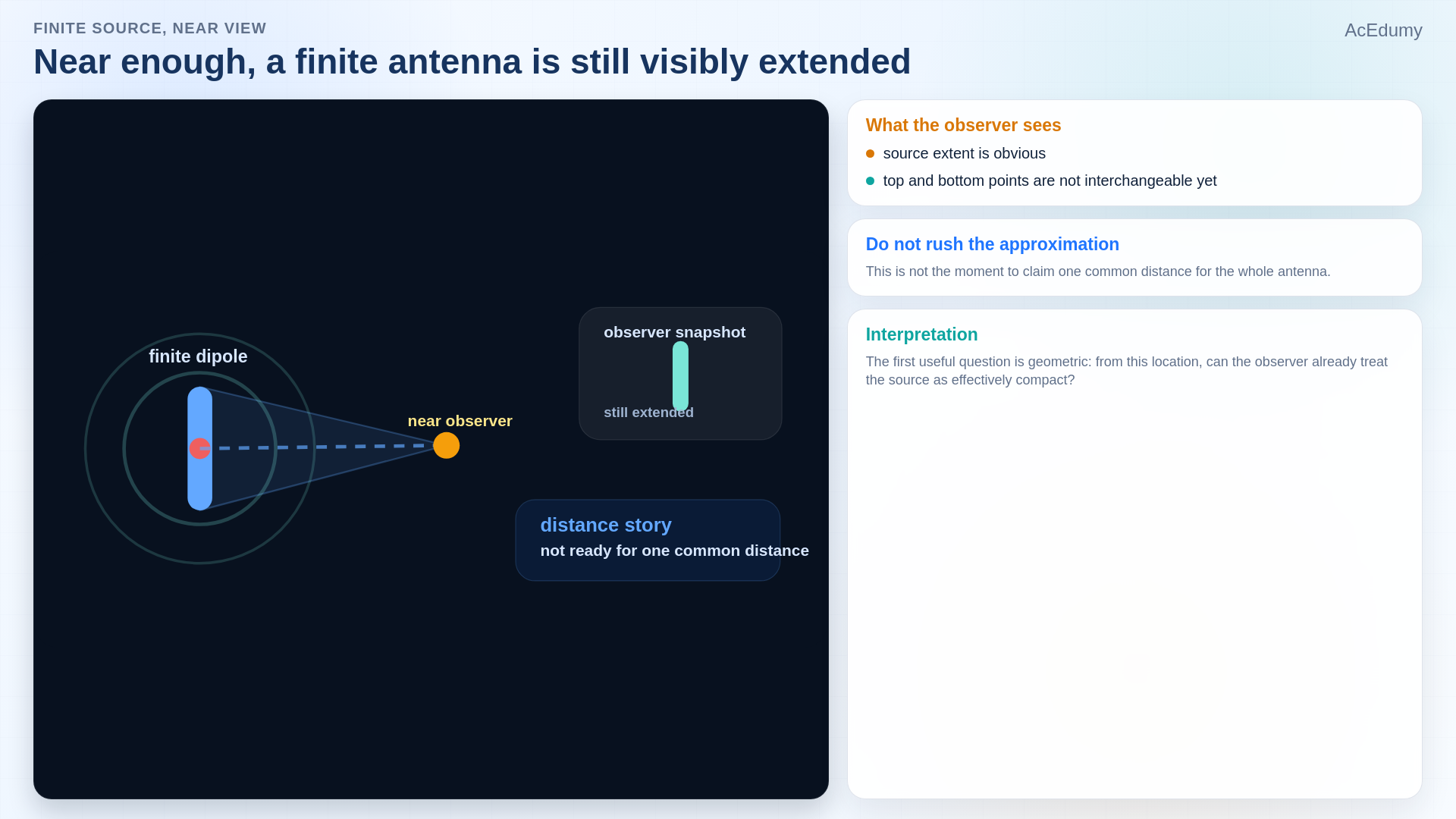
Use far field when a bounded source looks compact; use stationary phase when cancellation over an extended source controls the answer. Take a finite dipole and place the observer not very far away.From that position, the antenna is still visibly extended.Its top and bottom points do not look interchangeable yet, and one common distance for the whole source does not feel trustworthy.So at this stage, the far-field approximation has not earned its simplification.Narration transcript
Take a finite dipole and place the observer not very far away. From that position, the antenna is still visibly extended. Its top and bottom points do not look interchangeable yet, and one common distance for the whole source does not feel trustworthy. So at this stage, the far-field approximation has not earned its simplification.
3. See a bounded source become compact from far away
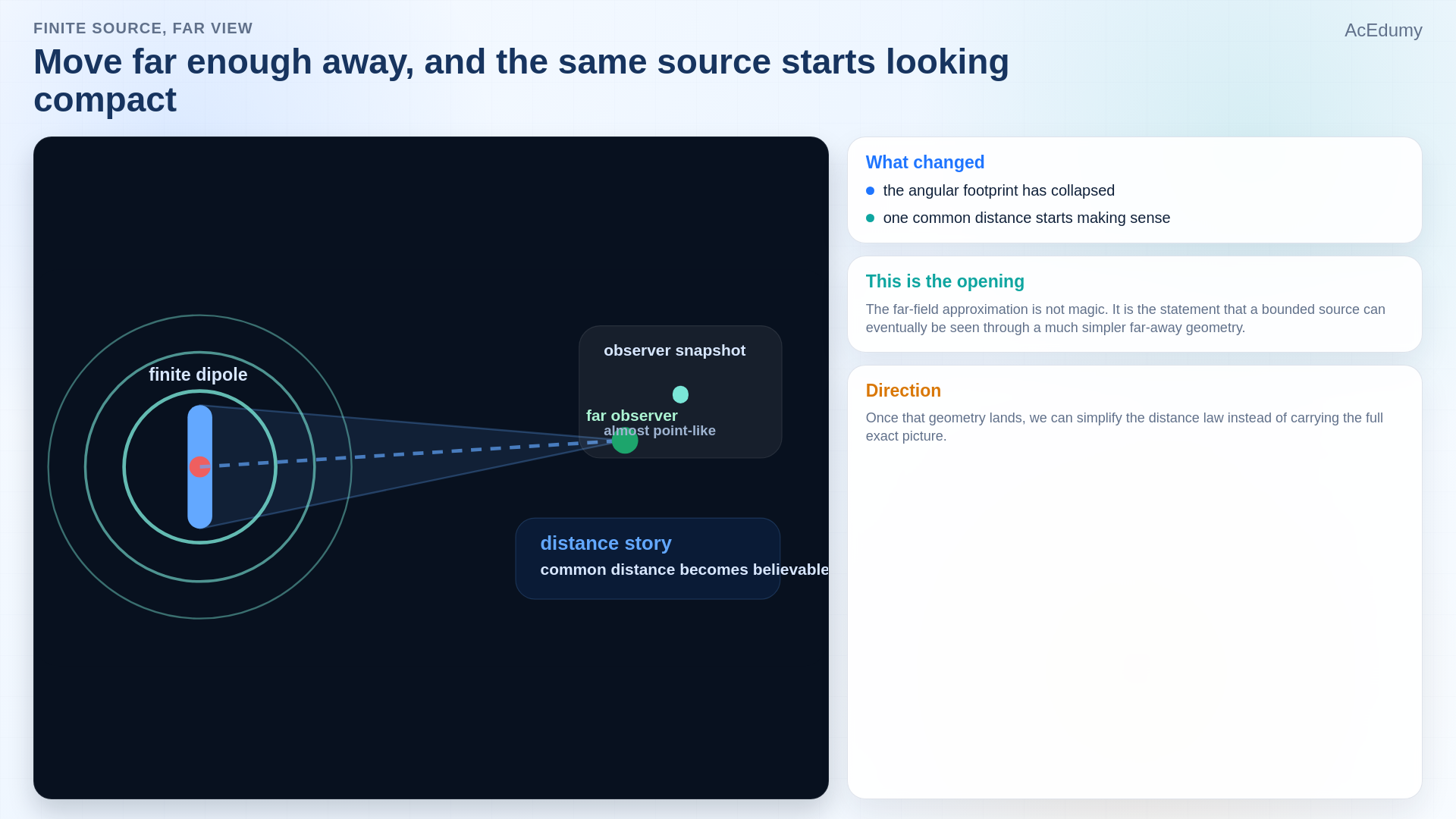
Use far field when a bounded source looks compact; use stationary phase when cancellation over an extended source controls the answer. Now move the observer much farther away, while keeping the same finite source.The angular footprint shrinks, and the antenna starts looking almost point-like.This is the real opening for the far-field approximation.A bounded source can eventually be seen through a much simpler far-away geometry.Narration transcript
Now move the observer much farther away, while keeping the same finite source. The angular footprint shrinks, and the antenna starts looking almost point-like. This is the real opening for the far-field approximation. A bounded source can eventually be seen through a much simpler far-away geometry.
4. Simplify distance and phase in the far field
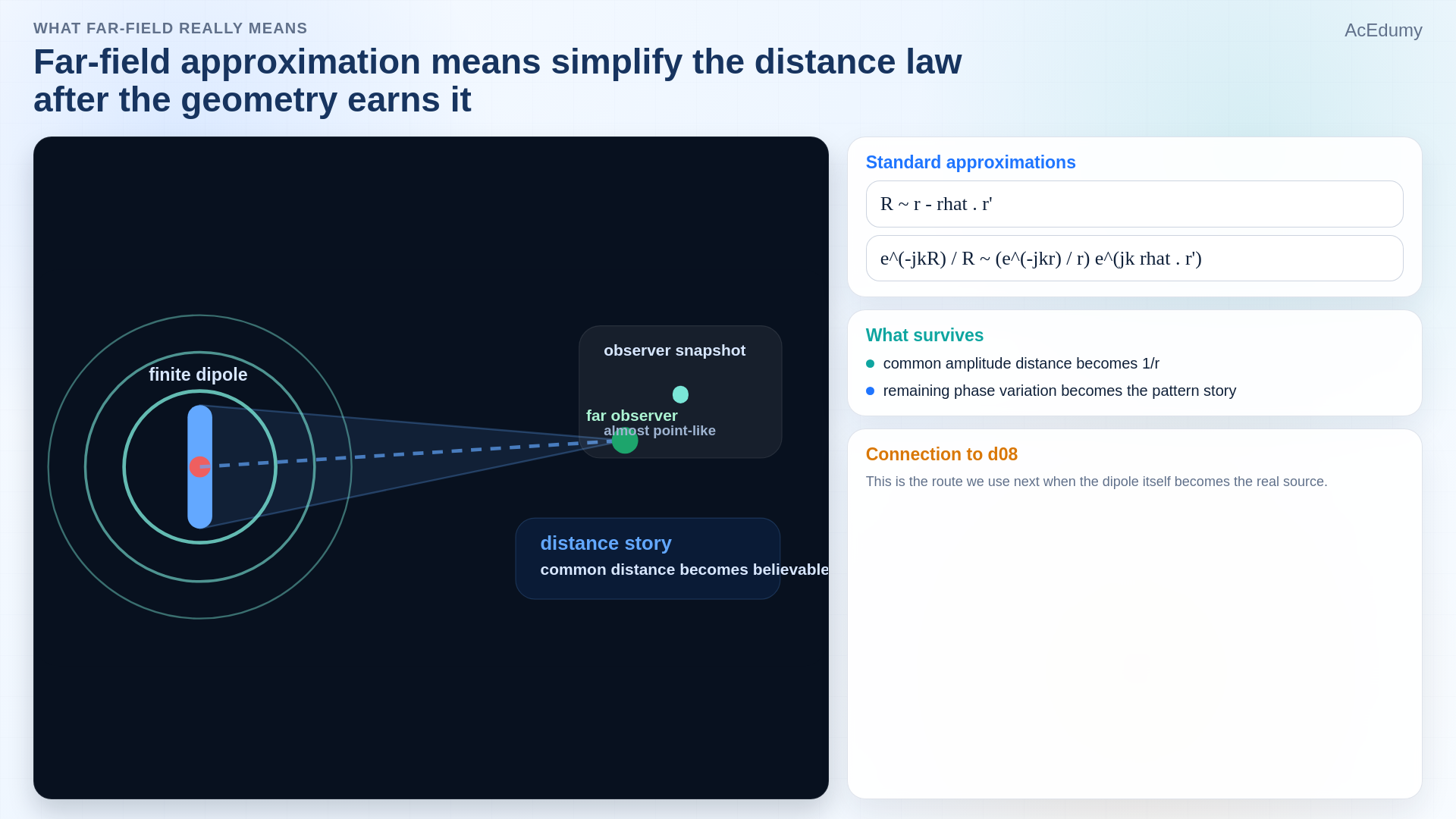
Use far field when a bounded source looks compact; use stationary phase when cancellation over an extended source controls the answer. Once that geometry lands, we simplify the distance law.We treat 1/R as 1/r, and we linearize the phase distance term.That keeps the common amplitude decay outside, while the remaining spatial phase variation becomes the pattern story.So far-field approximation means simplify the geometry only after the observer is far enough for that picture to make sense.Narration transcript
Once that geometry lands, we simplify the distance law. We treat one over big R as one over r, and we linearize the phase distance term. That keeps the common amplitude decay outside, while the remaining spatial phase variation becomes the pattern story. So far-field approximation means simplify the geometry only after the observer is far enough for that picture to make sense.
5. Recognize when an extended source never looks point-like
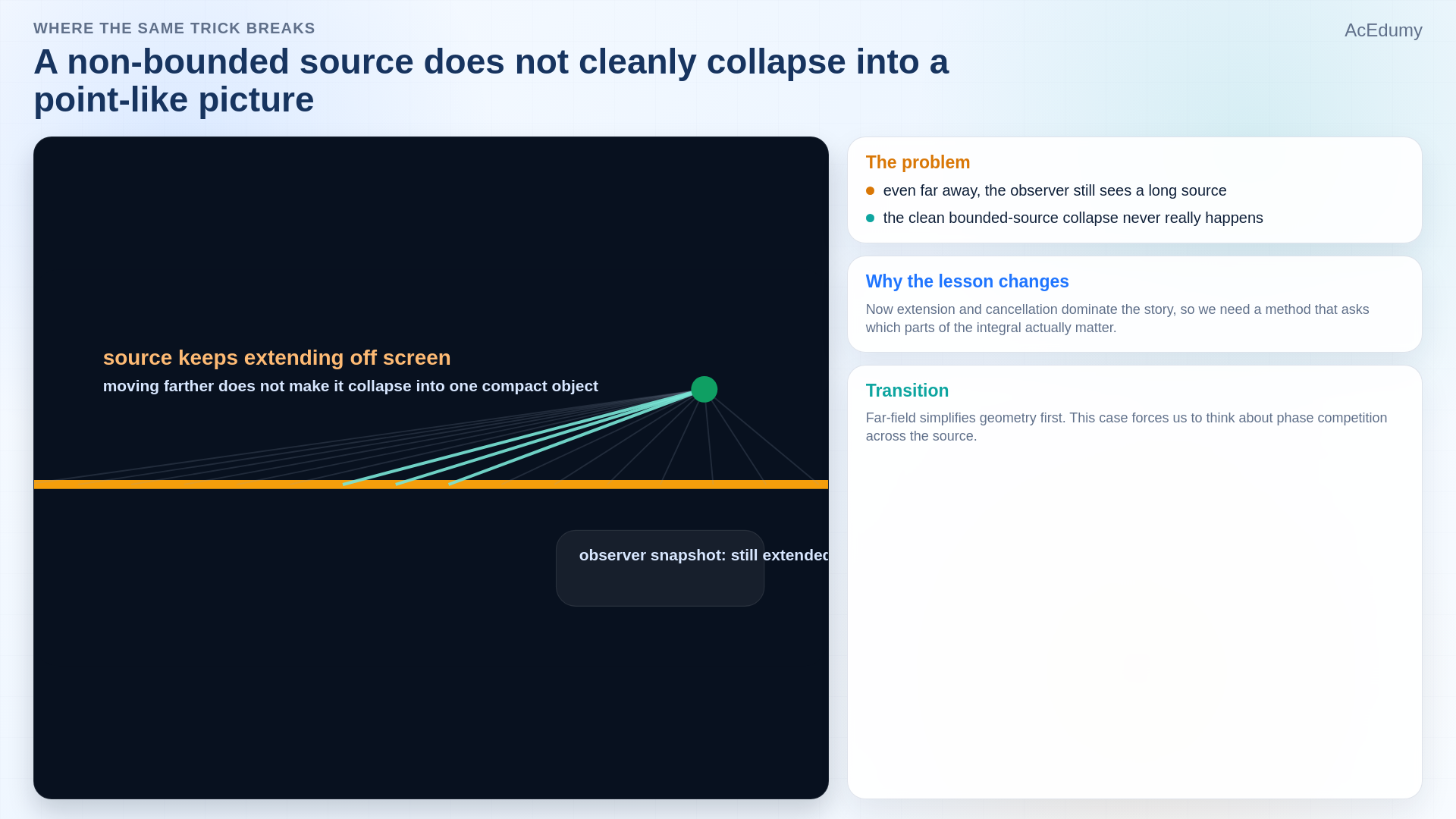
Use far field when a bounded source looks compact; use stationary phase when cancellation over an extended source controls the answer. But not every source cooperates like that.If the source is non-bounded or effectively very extended, then even from far away the observer can still see an extended structure.The clean bounded-source collapse never really happens.That is where plain far-field intuition stops being enough.Narration transcript
But not every source cooperates like that. If the source is non-bounded or effectively very extended, then even from far away the observer can still see an extended structure. The clean bounded-source collapse never really happens. That is where plain far-field intuition stops being enough.
6. Use stationary phase to isolate the surviving region
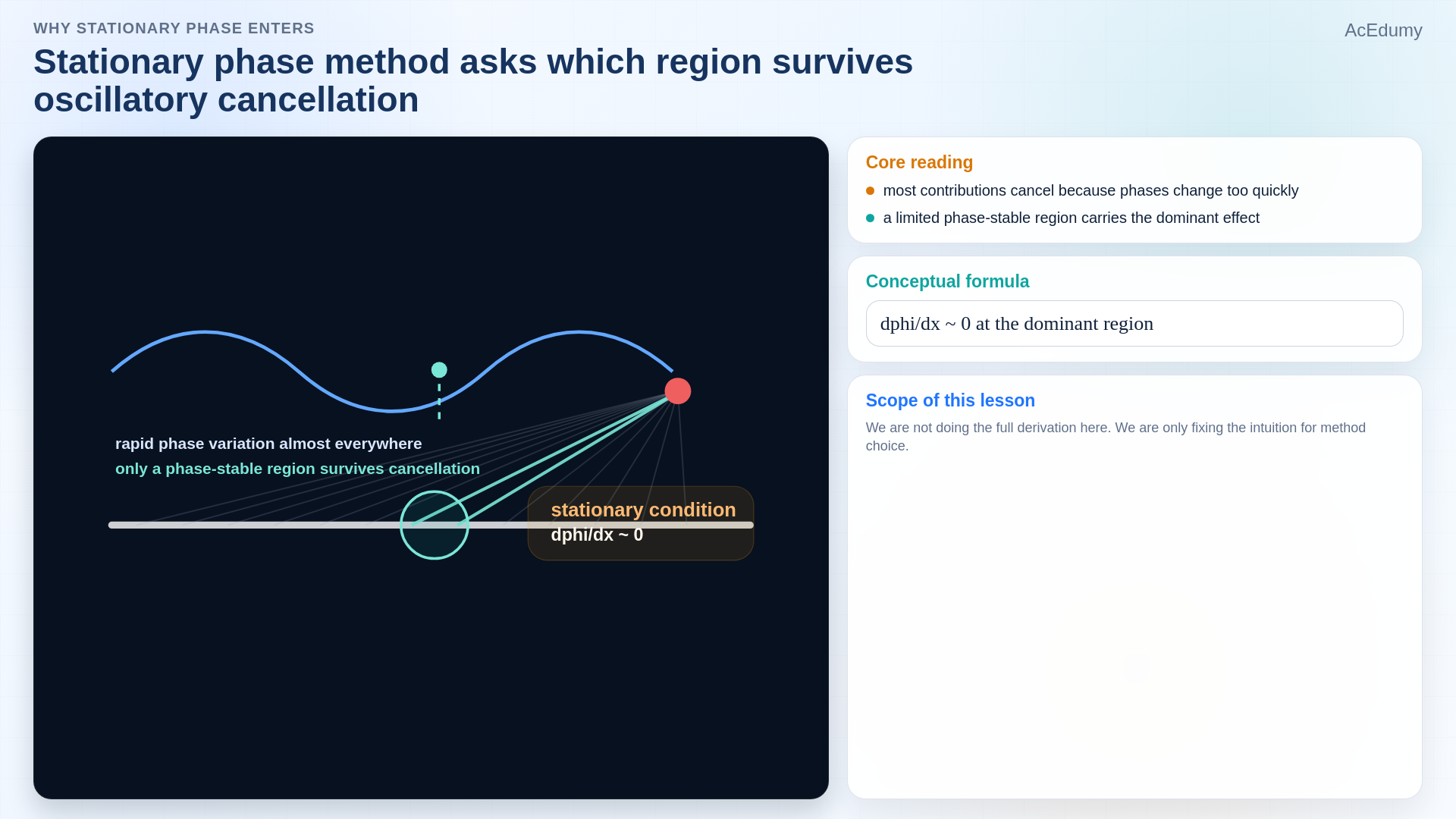
Use far field when a bounded source looks compact; use stationary phase when cancellation over an extended source controls the answer. Here the stationary phase method becomes natural.Instead of simplifying the geometry first, it asks which part of a rapidly oscillating integral actually survives cancellation.Most source regions cancel because their phases change too quickly.The dominant contribution comes from a limited phase-stable region, where the dφ/dx = 0 or nearly zero.Narration transcript
Here the stationary phase method becomes natural. Instead of simplifying the geometry first, it asks which part of a rapidly oscillating integral actually survives cancellation. Most source regions cancel because their phases change too quickly. The dominant contribution comes from a limited phase-stable region, where the phase slope is zero or nearly zero.
7. Choose the method from the source geometry
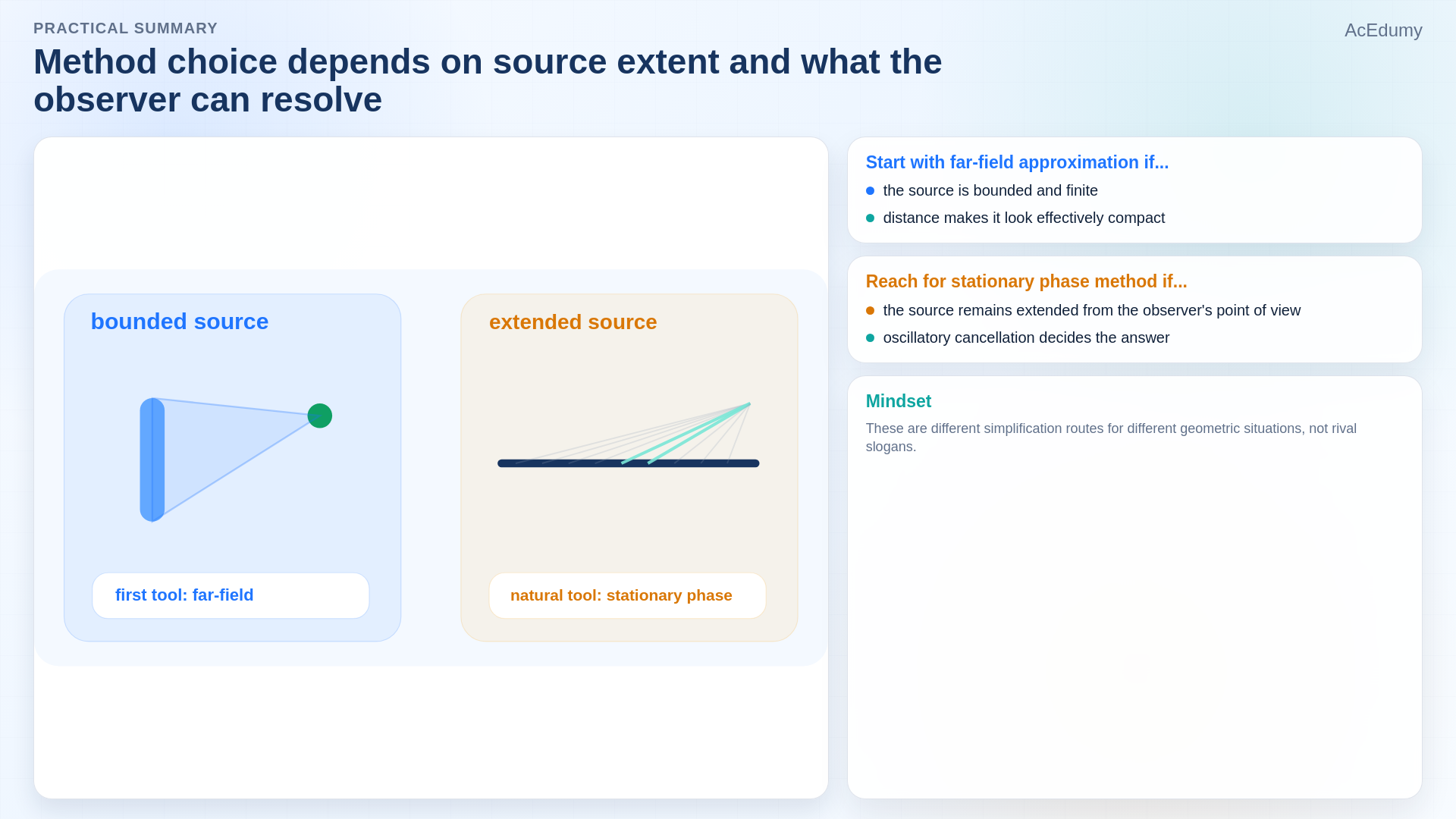
Use far field when a bounded source looks compact; use stationary phase when cancellation over an extended source controls the answer. So the practical rule is this.If the source is bounded and far enough away to look effectively compact, start with the far-field approximation.If the source remains extended from the observer's point of view, and cancellation across the source dominates the answer, the stationary phase method becomes the more natural tool.They are not rival slogans.They are different simplification routes for different geometric situations.Narration transcript
So the practical rule is this. If the source is bounded and far enough away to look effectively compact, start with the far-field approximation. If the source remains extended from the observer's point of view, and cancellation across the source dominates the answer, the stationary phase method becomes the more natural tool. They are not rival slogans. They are different simplification routes for different geometric situations.
8. Prepare for the real dipole far-field calculation
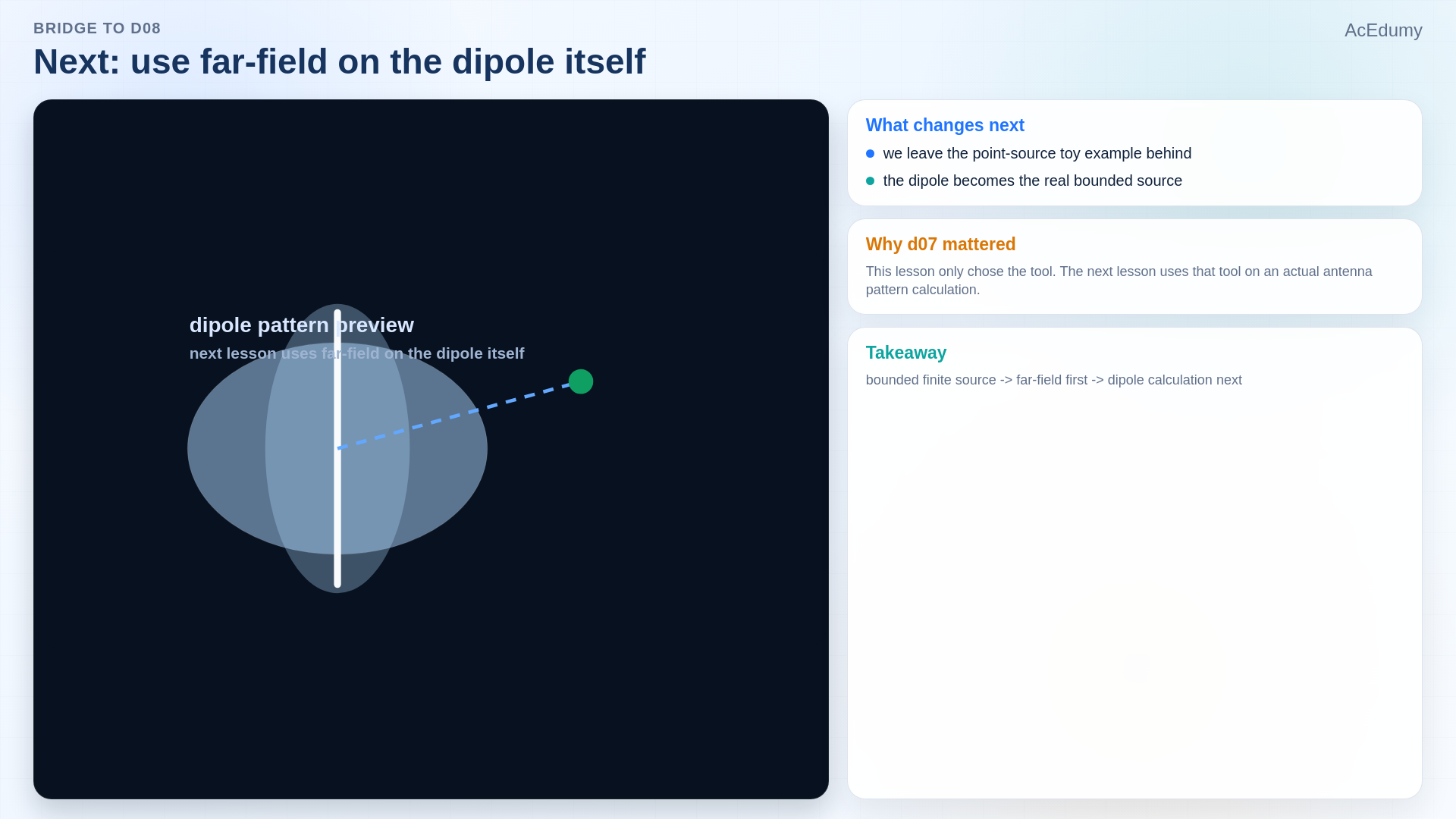
Use far field when a bounded source looks compact; use stationary phase when cancellation over an extended source controls the answer. In the next lesson, we use the far-field route on the dipole itself.That moves us from the point-source toy example to a real antenna pattern calculation.Narration transcript
In the next lesson, we use the far-field route on the dipole itself. That moves us from the point-source toy example to a real antenna pattern calculation.
Source video: Antenna Theory #07 | Far-Field vs Stationary Phase | Which Method Fits Which Problem? (3:08)