Communication Basics · FDM, Statistical MUX & WDM/DWDM
#07 FDM and duplex, statistical multiplexing and queues, inverse multiplexing, the ITU DWDM grid, and ideal throughput calculations
Compare frequency, time, and optical channel sharing under one capacity discipline with explicit filters, queues, grids, and overhead assumptions.
Question
Build FDM with filters and guard bands, statistical multiplexing with queue and QoS scope, WDM/DWDM with the ITU frequency grid, and distinguish gross from end-to-end throughput.
Written solution and narration transcript(shows the full solution)
Below are all the lines written in the notebook together with the full narration transcript.
1. Build FDM, filter, guard-band, and duplex distinctions
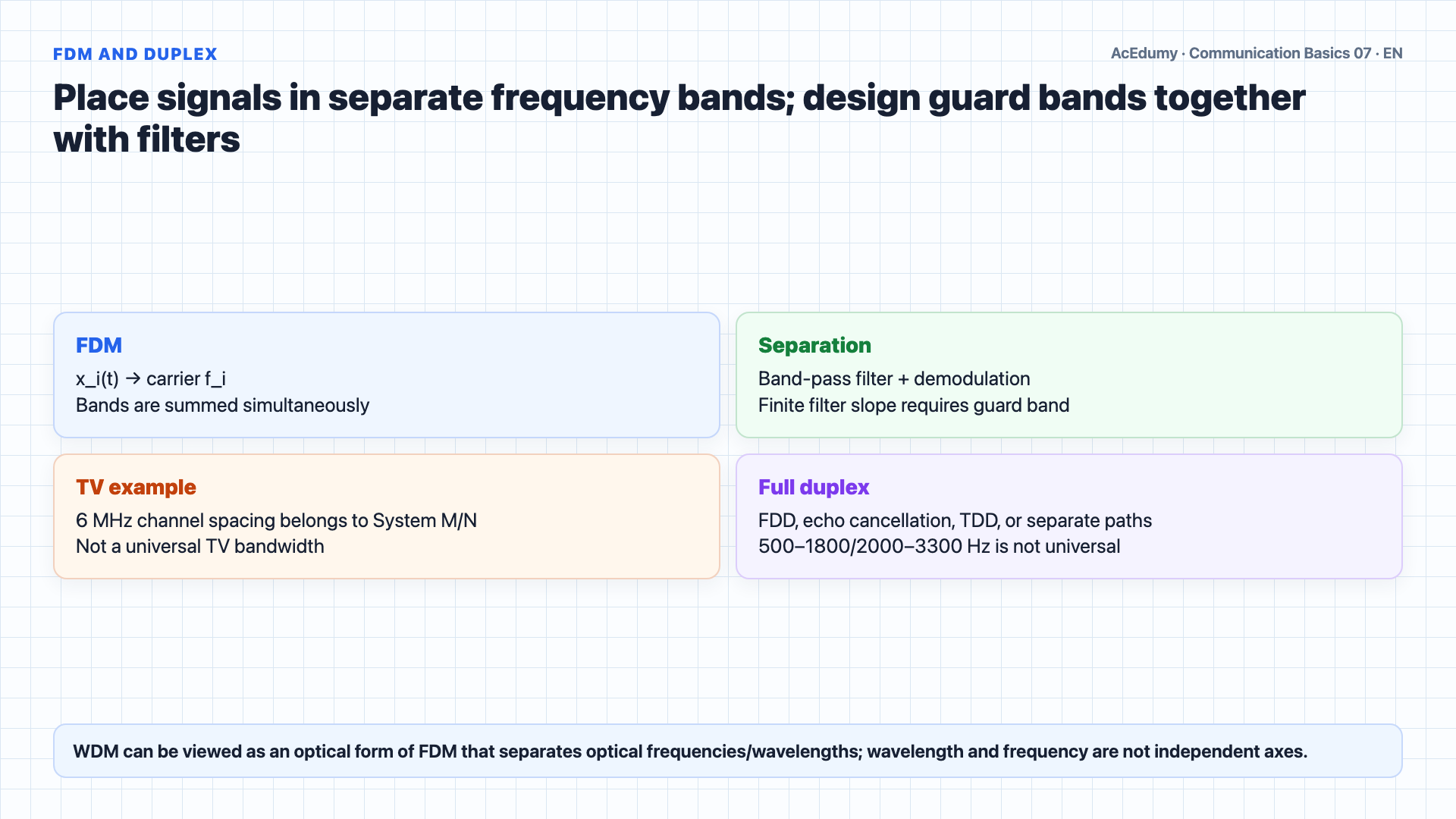
FDM, statistical multiplexing, and WDM/DWDM are compared under the same capacity and overhead discipline. In the previous lesson we covered Time Division Multiplexing, where channels share a line by taking turns in time.Now let us look at the other fundamental approach: Frequency Division Multiplexing, or FDM.In FDM, each signal is modulated onto a different carrier frequency.All the modulated signals are then combined and transmitted simultaneously over the same medium.To prevent interference between adjacent channels, unused frequency gaps called guard bands are placed between them.At the receiving end, bandpass filters separate the individual signals, and each is demodulated to recover the original data.Six-megahertz channel spacing is a historical System M/N analog-TV example; TV systems and guard/sideband placement vary by standard.Some modems use FDD in the voice band; echo cancellation, TDD, or separate paths are also possible, and 500–1800/2000–3300 Hz is not a universal split.While TDM divides time into slots, FDM divides frequency into bands.Both are still widely used today.Narration transcript
In the previous lesson we covered Time Division Multiplexing, where channels share a line by taking turns in time. Now let us look at the other fundamental approach: Frequency Division Multiplexing, or FDM. In FDM, each signal is modulated onto a different carrier frequency. All the modulated signals are then combined and transmitted simultaneously over the same medium. To prevent interference between adjacent channels, unused frequency gaps called guard bands are placed between them. At the receiving end, bandpass filters separate the individual signals, and each is demodulated to recover the original data. A classic example is analog television broadcasting, where each TV channel occupies a 6 megahertz band, separated by guard bands. FDM is also the basis of how full duplex modems work on a telephone line: the 300 to 3400 hertz voice band is split into a forward channel from 500 to 1800 hertz and a reverse channel from 2000 to 3300 hertz. While TDM divides time into slots, FDM divides frequency into bands. Both are still widely used today.
2. Scope statistical multiplexing with queues and QoS
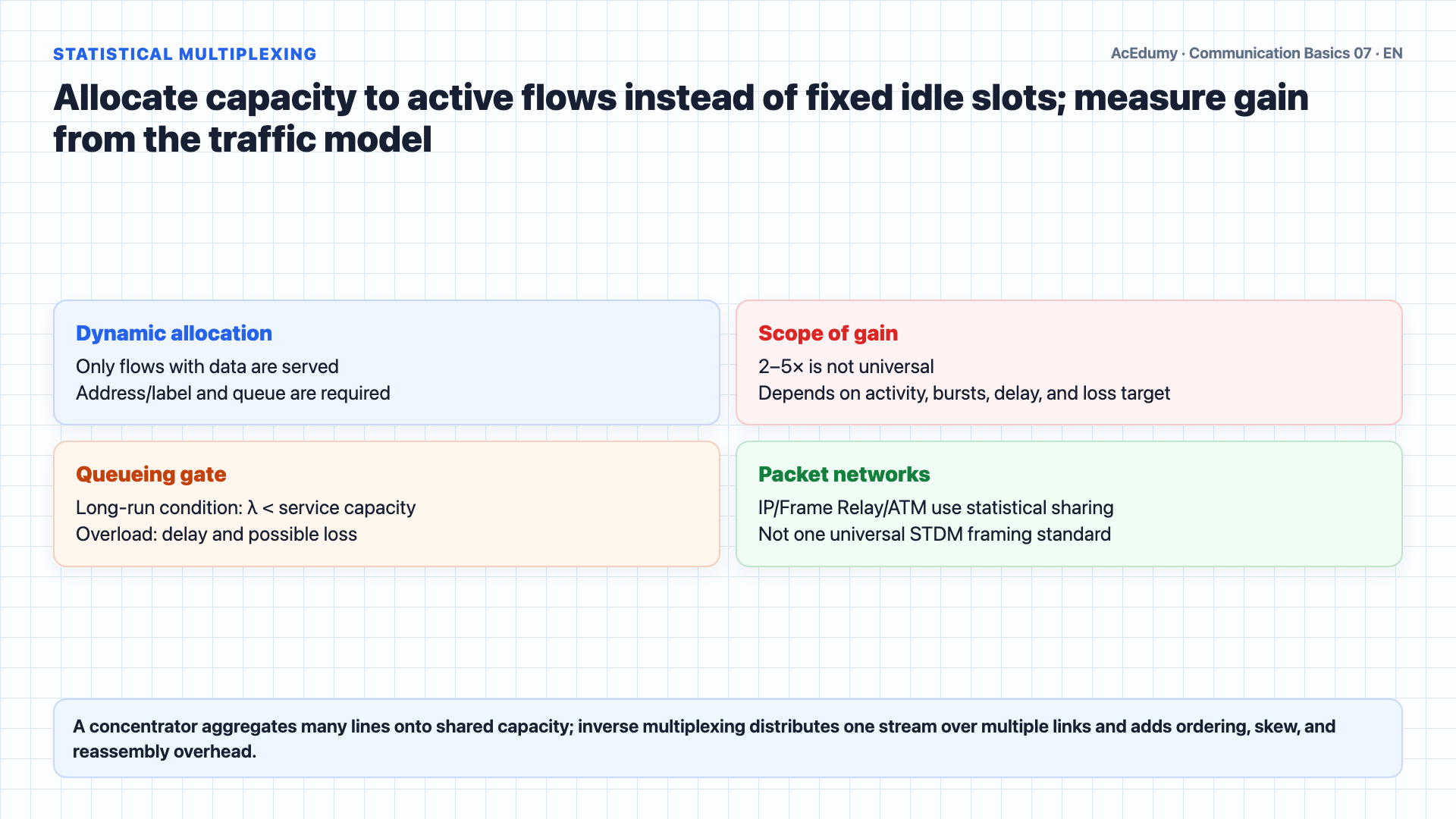
FDM, statistical multiplexing, and WDM/DWDM are compared under the same capacity and overhead discipline. Standard TDM has a limitation: if a terminal is idle, its time slot is wasted.Statistical Time Division Multiplexing, or STDM, solves this by dynamically allocating time slots only to terminals that have data to send.Statistical-multiplexing gain depends on terminal activity, burst distribution, delay/loss target, and overhead; 2–5× is not a universal ratio.STDM can even have more terminals than available time slots.When all slots are busy, excess data goes into a buffer.If the buffer fills up, data can be lost, so traffic analysis is essential.IP, Frame Relay, and ATM can use statistical capacity sharing; they are not direct descendants of one universal STDM framing standard.Two other multiplexer types are worth mentioning.A concentrator aggregates many lines onto shared capacity; 'intelligent multiplexer' is not a universally identical synonym.Digital Loop Carriers are a common example, connecting telephone subscribers to the local exchange.Inverse multiplexers do the opposite: they split a single high speed data stream across multiple lower speed links, like separate T1 or E1 lines, and recombine them at the far end.Inverse multiplexing can supply persistent or temporary aggregate capacity; ordering, inter-link skew, failure, and reassembly overhead must be managed.Narration transcript
Standard TDM has a limitation: if a terminal is idle, its time slot is wasted. Statistical Time Division Multiplexing, or STDM, solves this by dynamically allocating time slots only to terminals that have data to send. This makes bandwidth usage much more efficient, allowing STDM to carry 2 to 5 times more traffic than regular TDM. STDM can even have more terminals than available time slots. When all slots are busy, excess data goes into a buffer. If the buffer fills up, data can be lost, so traffic analysis is essential. STDM forms the basis of modern packet switching technologies like IP, Frame Relay, and ATM. Two other multiplexer types are worth mentioning. Intelligent multiplexers, also called concentrators, combine many low speed lines onto a single high speed link. Digital Loop Carriers are a common example, connecting telephone subscribers to the local exchange. Inverse multiplexers do the opposite: they split a single high speed data stream across multiple lower speed links, like separate T1 or E1 lines, and recombine them at the far end. This is useful for applications like video conferencing that need high bandwidth but only occasionally.
3. Build the WDM/DWDM optical frequency grid
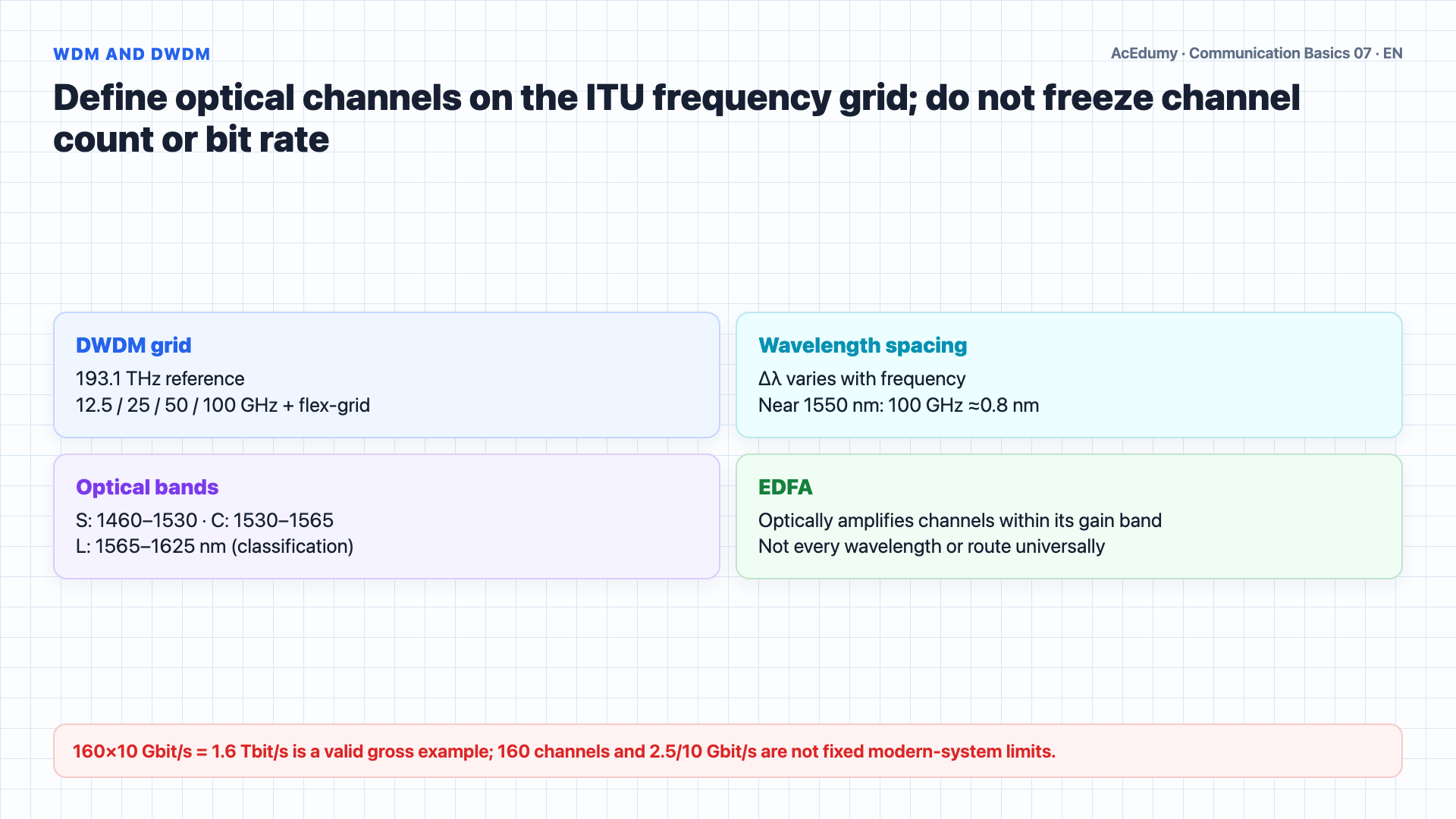
FDM, statistical multiplexing, and WDM/DWDM are compared under the same capacity and overhead discipline. Wavelength Division Multiplexing, or WDM, takes multiplexing into the optical domain.WDM uses distinct optical carrier frequencies/wavelengths on one fibre; wavelength is the inverse of frequency, so WDM can be viewed as optical FDM.The DWDM grid is defined in frequency; near 1550 nm, 50/100 GHz is approximately 0.4/0.8 nm, but nanometre spacing is not constant across the spectrum.Channel count depends on spectral band, grid, slot width, modulation, and line design; 160+ is a possible configuration, not a universal typical value.2.5 and 10 Gbit/s are historical per-channel examples; modern optical channels may carry 100, 400, 800 Gbit/s or other rates according to modulation, FEC, and baud rate.With 160 channels at 10 gigabits per second each, a single fiber can carry 1.6 terabits per second.ITU-T G.694.1 anchors the DWDM grid at 193.1 THz and supports 12.5/25/50/100 GHz and wider fixed spacings plus flexible grid; the C-band classification is approximately 1530–1565 nm.For classification, S is approximately 1460–1530 nm, C 1530–1565 nm, and L 1565–1625 nm; actual application bands come from system specifications.An EDFA can optically amplify multiple channels within its gain band without per-channel electrical conversion; 'all wavelengths' is not universal.DWDM is fundamental in long-haul and submarine optical backbones; its traffic share depends on topology, operator, and metric.Narration transcript
Wavelength Division Multiplexing, or WDM, takes multiplexing into the optical domain. Instead of dividing time or frequency, WDM puts multiple signals on a single optical fiber, each carried on its own separate wavelength of light. Dense WDM, or DWDM, spaces wavelengths very closely together, at intervals as small as 0.4 or 0.8 nanometers near 1550 nanometers. Modern DWDM systems can multiplex 160 or more wavelengths onto a single fiber. Each wavelength typically carries a TDM signal at 2.5 or 10 gigabits per second. With 160 channels at 10 gigabits per second each, a single fiber can carry 1.6 terabits per second. The ITU, the International Telecommunications Union, has standardized a frequency grid with 100 gigahertz spacing, centered around the C band from 1530 to 1570 nanometers. The L band from 1570 to 1610 nanometers and S band from 1490 to 1530 nanometers provide additional capacity. A critical component is the EDFA, the Erbium Doped Fiber Amplifier, which amplifies all wavelengths simultaneously without converting to electrical signals. DWDM is the backbone of today's internet, carrying the vast majority of intercontinental and long haul data traffic.
4. Audit gross rate and the ideal download calculation
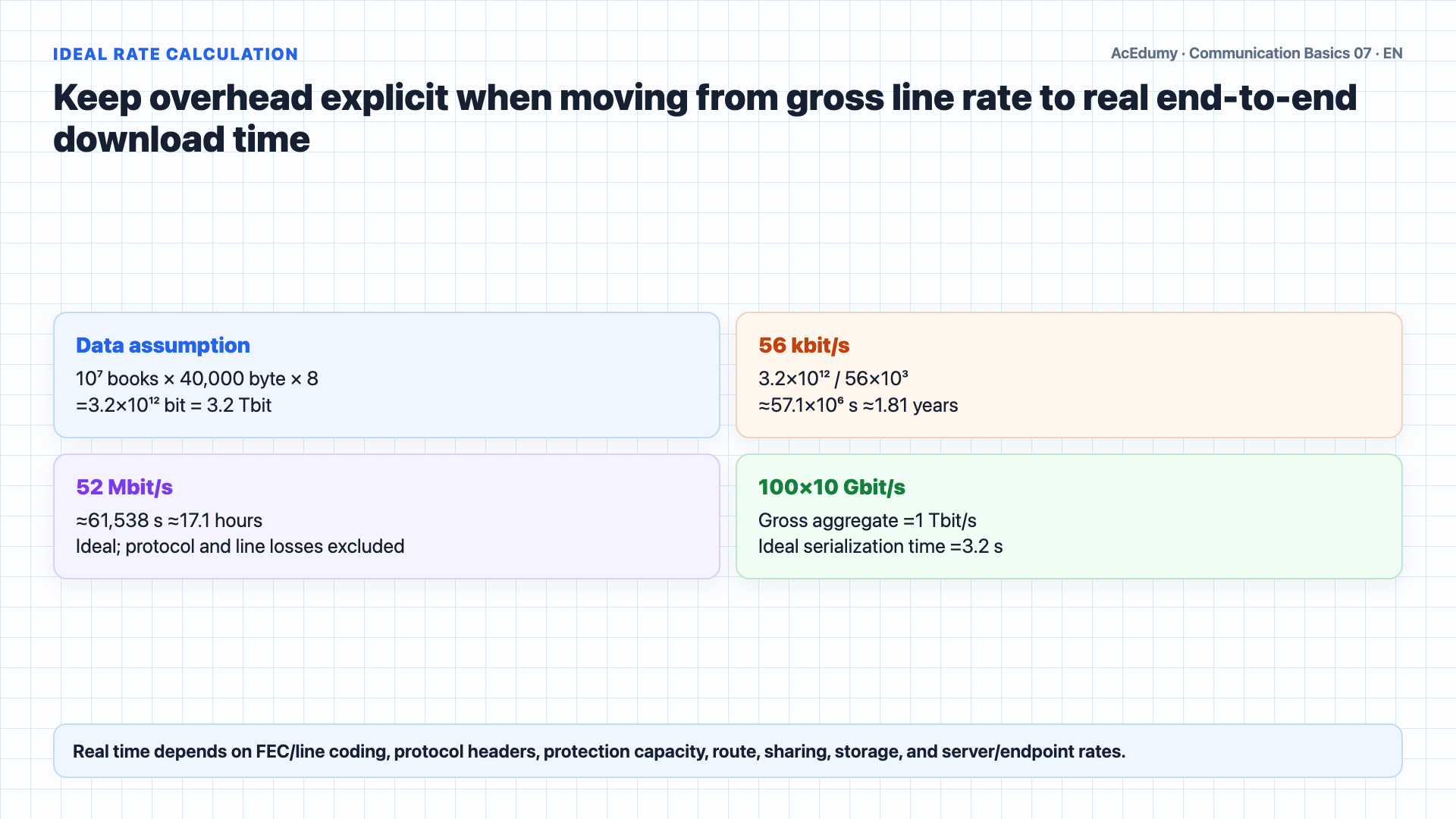
FDM, statistical multiplexing, and WDM/DWDM are compared under the same capacity and overhead discipline. Let us work through an example that shows the power of DWDM.Imagine a digital library containing 10 million books.Forty-thousand bytes per book is only this toy calculation's assumption; real e-book size depends on format, images, and content.The total data is 10 million times 320000 bits, which equals 3.2 terabits.How long would it take to download this entire library?With a 56 kilobits per second dial up modem, the time is 3.2 times 10 to the 12 divided by 56000, which equals about 57 million seconds, or approximately 1.81 years.With a VDSL connection at 52 megabits per second, it would take about 61500 seconds, or roughly 17 hours.100×10 Gbit/s=1 Tbit/s is gross optical aggregate rate; net end-to-end throughput may be lower after FEC, line coding, protection, protocols, and sharing.3.2 Tbit/1 Tbit/s=3.2 s is ideal serialization time only; route, server, storage, protocol, and sharing constraints are excluded.That is the difference between nearly 2 years and 3 seconds, demonstrating why DWDM is essential for modern backbone networks.Narration transcript
Let us work through an example that shows the power of DWDM. Imagine a digital library containing 10 million books. Assume each book is about 40000 bytes, or 320000 bits. The total data is 10 million times 320000 bits, which equals 3.2 terabits. How long would it take to download this entire library? With a 56 kilobits per second dial up modem, the time is 3.2 times 10 to the 12 divided by 56000, which equals about 57 million seconds, or approximately 1.81 years. With a VDSL connection at 52 megabits per second, it would take about 61500 seconds, or roughly 17 hours. But with a DWDM system using 100 channels at 10 gigabits per second each, the total throughput is 1 terabit per second. The download time becomes 3.2 terabits divided by 1 terabit per second, which equals just 3.2 seconds. That is the difference between nearly 2 years and 3 seconds, demonstrating why DWDM is essential for modern backbone networks.
5. Summarize FDM, STDM, WDM, and real throughput
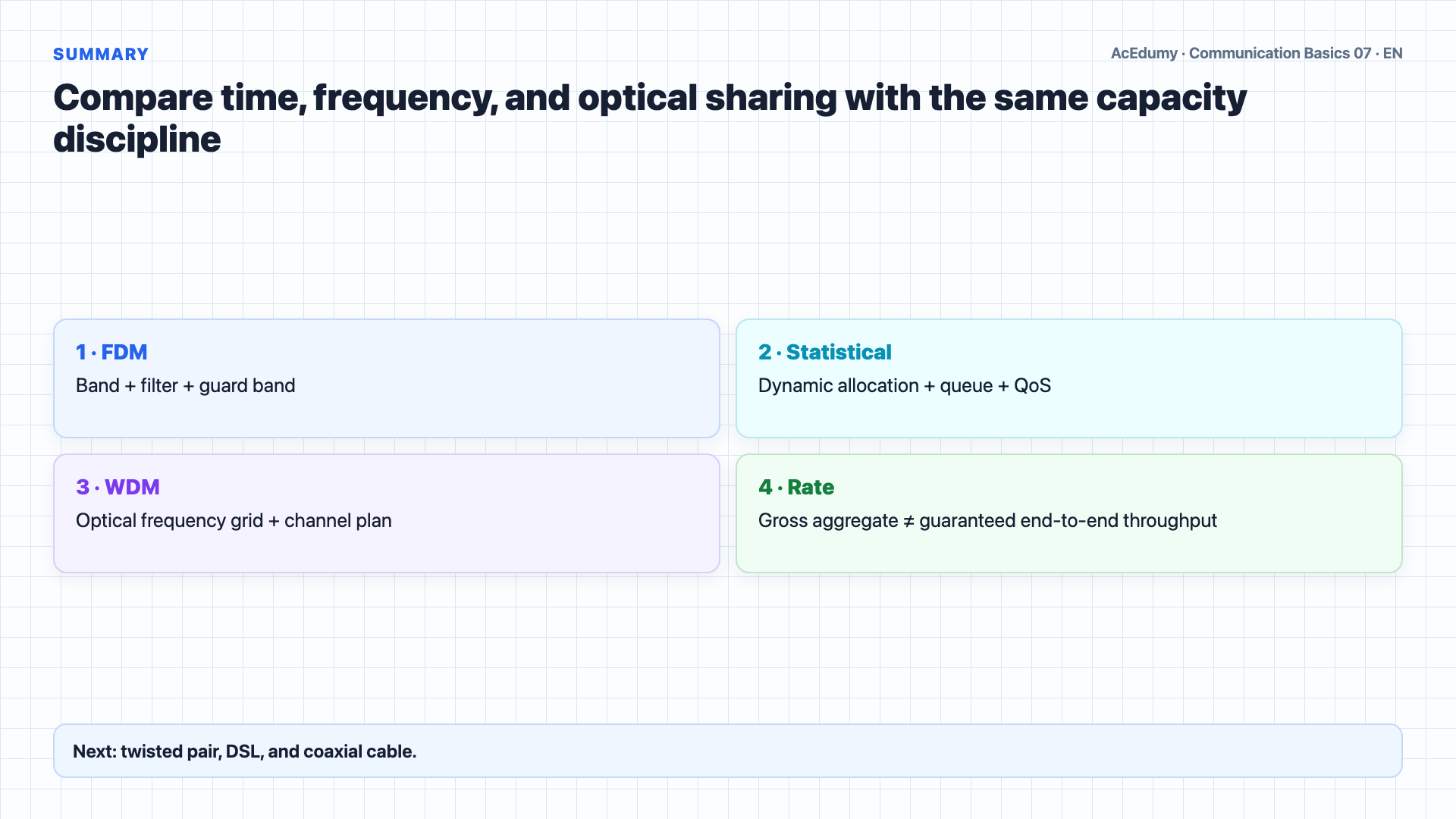
FDM, statistical multiplexing, and WDM/DWDM are compared under the same capacity and overhead discipline. Let us review.FDM, Frequency Division Multiplexing, assigns each signal a different carrier frequency with guard bands preventing interference.Statistical multiplexing dynamically assigns capacity to active flows; gain depends on the traffic/QoS model, with no universal 2–5× guarantee for packet networks.Intelligent multiplexers concentrate many low speed lines onto one high speed link.Inverse multiplexers split a high speed stream across multiple low speed links.WDM/DWDM channel count and rate depend on system design; EDFA optically amplifies only channels within its gain band without electrical conversion.DWDM is the backbone technology of today's internet.In the next lesson, we will explore wired transmission media: twisted pair cables, DSL technologies, and coaxial cable.Narration transcript
Let us review. FDM, Frequency Division Multiplexing, assigns each signal a different carrier frequency with guard bands preventing interference. STDM, Statistical Time Division Multiplexing, dynamically allocates slots for 2 to 5 times the efficiency of regular TDM, and forms the basis of IP and packet switching. Intelligent multiplexers concentrate many low speed lines onto one high speed link. Inverse multiplexers split a high speed stream across multiple low speed links. WDM and DWDM multiplex up to 160 plus wavelengths onto a single fiber, with each channel carrying gigabits per second, amplified by EDFA without electrical conversion. DWDM is the backbone technology of today's internet. In the next lesson, we will explore wired transmission media: twisted pair cables, DSL technologies, and coaxial cable.
Source video: Communication Basics #07 FDM, Statistical MUX & WDM/DWDM (7:17)