Circuit Theory 1 · First-Order Transients
#46 Transient Analysis #46 — First-order problem solving
Solves four problems: RC with initial voltage, RL through Thevenin, sequential switching, and time to a target voltage.
Question
Use the general three-step method to solve an RC initial-voltage problem, an RL Thevenin problem, two-region switching, and time to reach 8 V.
Written solution and narration transcript(shows the full solution)
Below are all the lines written in the notebook together with the full narration transcript.
1. Universal three-step method
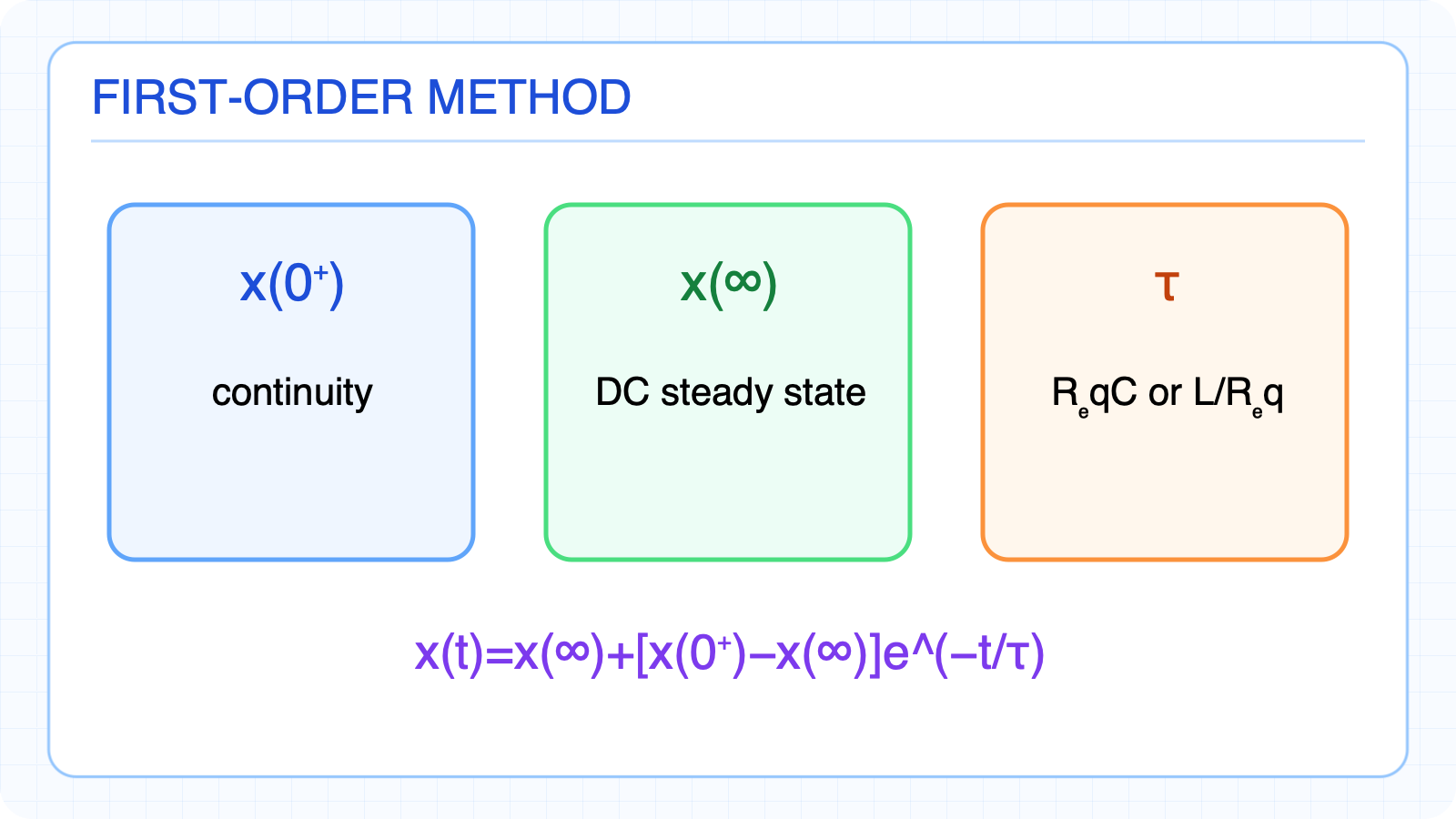
The three values enter the general exponential solution. Organize every RC/RL problem with three values1) x(0⁺): initial value from continuity2) x(∞): final value from DC steady state3) τ: equivalent seen by the storage elementCapacitor voltage cannot jumpInductor current cannot jumpAt DC, C is open and L is shortRC: τ=ReqC · RL: τ=L/ReqNarration transcript
Welcome to our first order problem solving session. In the previous lessons, we learned how to analyze R C and R L circuits with step inputs. Today we will practice by solving four problems of increasing difficulty. Before we begin, let us recall the universal three step method. Step one: find x of zero, the initial value. This comes from the circuit conditions just before the switch operates. Step two: find x of infinity, the final value. This is the steady state value long after the switch. For a capacitor, that means no current flows, so the capacitor acts as an open circuit. For an inductor, no voltage drop, so it acts as a short circuit. Step three: find tau, the time constant. For R C circuits, tau equals R C. For R L circuits, tau equals L over R. Then the complete solution is: x of t equals x of infinity plus the quantity x of zero minus x of infinity, times e to the negative t over tau.
2. Problem 1: RC with initial voltage
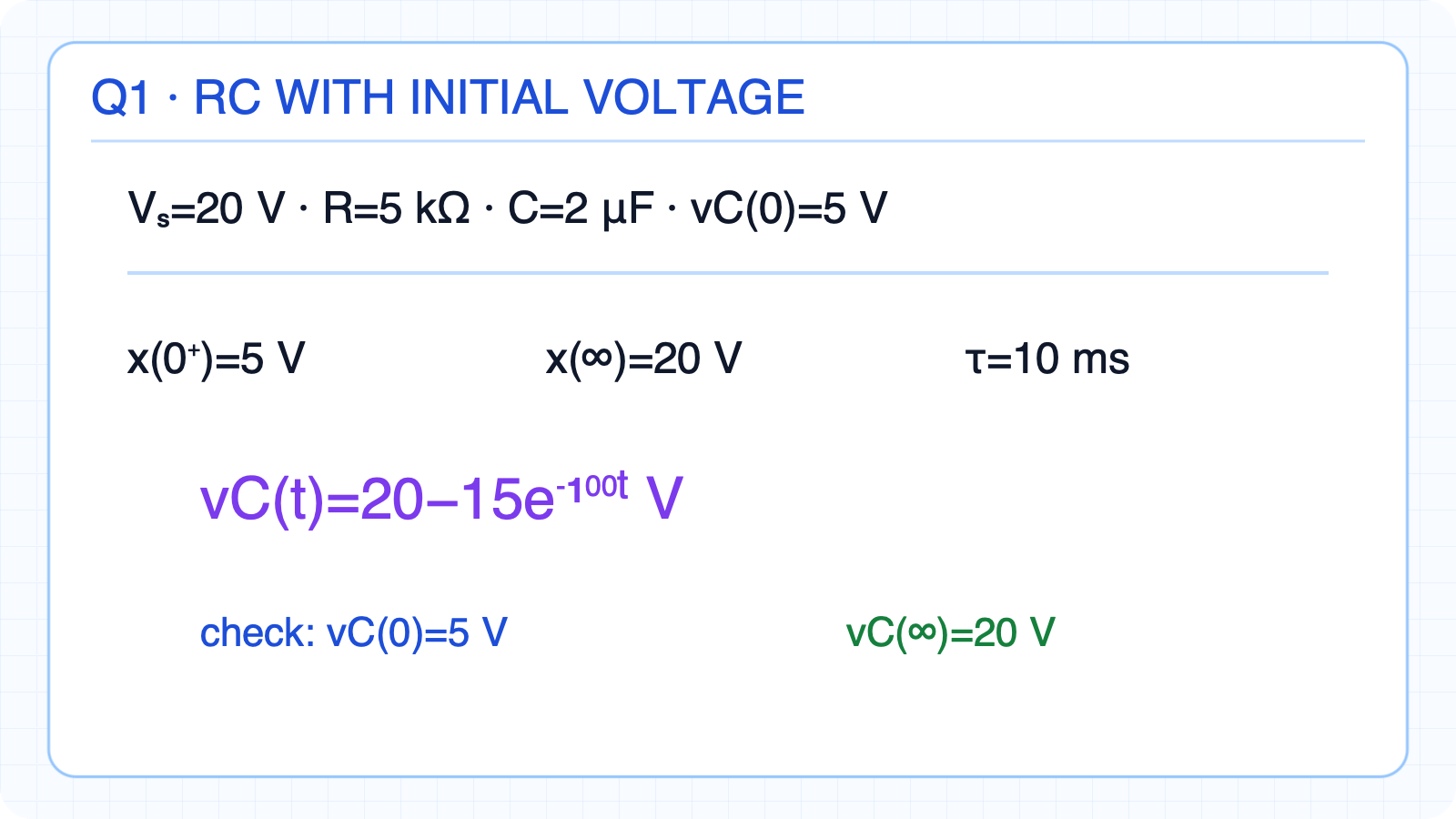
The solution rises from 5 V to 20 V with a 10 ms time constant. Steady-state current is zeroτ=RC=(5 kΩ)(2 μF)τ=10 msSubstitute into the general formulaChecks at t=0 and t→∞ passNarration transcript
Problem one. A simple R C step response. We have a voltage source V S equals twenty volts in series with a switch that closes at t equals zero, a resistor R equals five kilohms, and a capacitor C equals two microfarads. The initial capacitor voltage is v C of zero minus equals five volts. Find v C of t for t greater than or equal to zero. Step one: initial value. By the continuity principle, the capacitor voltage cannot change instantly. So v C of zero plus equals v C of zero minus equals five volts. Step two: final value. As t approaches infinity, the capacitor fully charges to the source voltage. No current flows, so v C of infinity equals twenty volts. Step three: time constant. Tau equals R C equals five times ten to the three, times two times ten to the negative six, which gives tau equals ten milliseconds. Now we plug into the formula: v C of t equals twenty plus five minus twenty times e to the negative t over zero point zero one. This simplifies to v C of t equals twenty minus fifteen e to the negative one hundred t volts. Let us verify: at t equals zero, v C equals twenty minus fifteen equals five volts. Correct. As t goes to infinity, the exponential vanishes and v C equals twenty volts. Also correct.
3. Problem 2: RL with a Thevenin equivalent
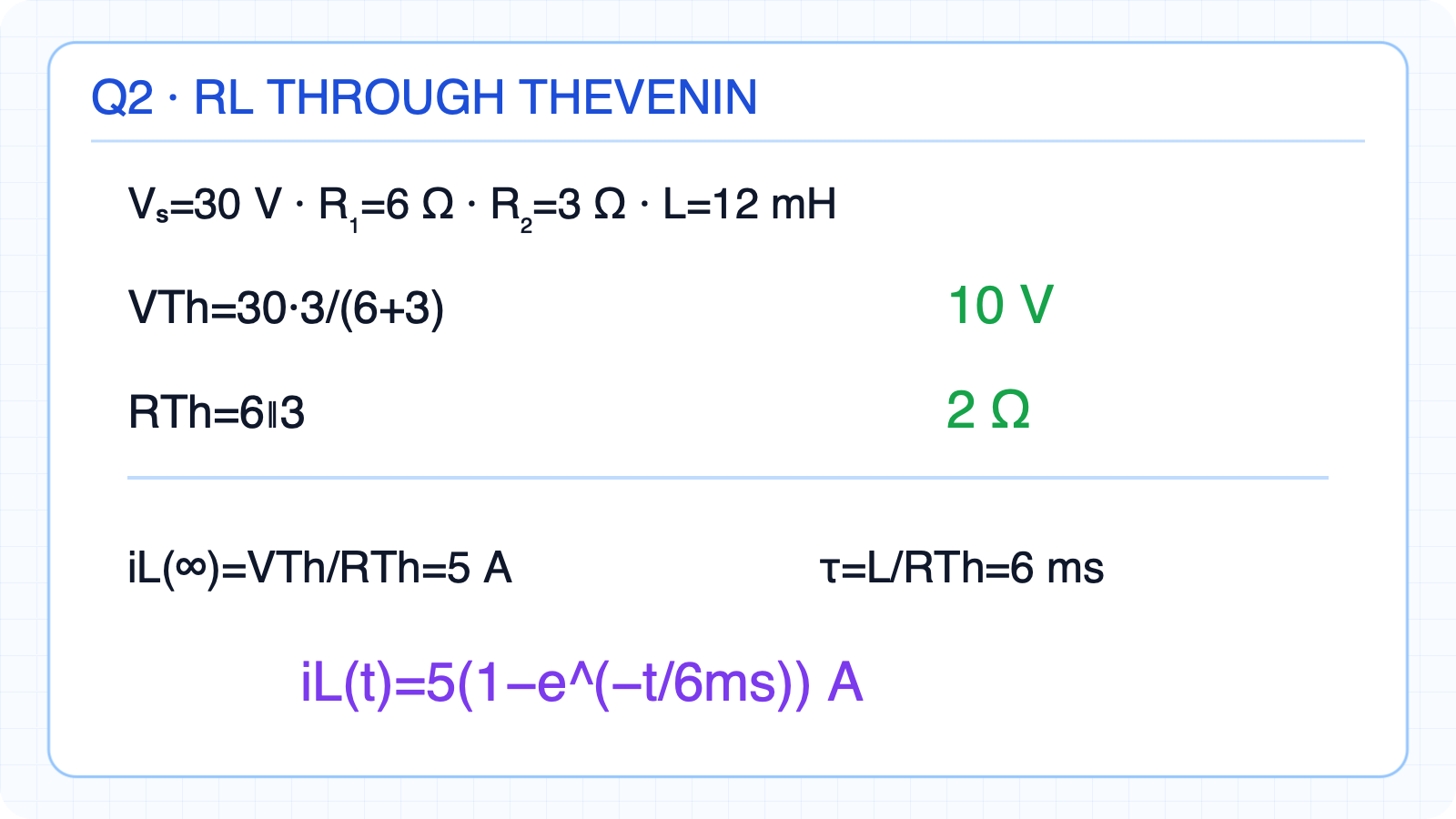
A 10 V, 2 Ω equivalent gives 5 A final current and 6 ms tau. VS=30 V, R₁=6 Ω, R₂=3 Ω, L=12 mHRemove the inductor and find Thevenin at its terminalsτ=L/RTh=6 msExponential rate is about 166.67 s⁻¹iL(t)=5(1−e(−t/6ms)) ANarration transcript
Problem two. An R L circuit that requires Thevenin simplification. We have a thirty volt source, connected to R one equals six ohms in series, which then splits into two parallel branches. The first branch has R two equals three ohms. The second branch has an inductor L equals twelve millihenrys. The switch closes at t equals zero, and the initial inductor current is zero. Find i L of t. Before applying the three step method, we need the Thevenin equivalent seen by the inductor. The Thevenin voltage: V Th equals V S times R two over R one plus R two, equals thirty times three over nine, equals ten volts. The Thevenin resistance: R Th equals R one parallel R two equals six times three over six plus three, equals two ohms. Now the three steps. Step one: i L of zero plus equals zero amperes. Step two: i L of infinity equals V Th over R Th equals ten over two equals five amperes. Step three: tau equals L over R Th equals zero point zero one two over two equals six milliseconds. The solution: i L of t equals five plus zero minus five times e to the negative t over zero point zero zero six. This gives i L of t equals five times one minus e to the negative one hundred sixty seven t amperes. The key lesson here: when the circuit seen by the storage element has multiple resistors and sources, always find the Thevenin equivalent first.
4. Problem 3: sequential switching
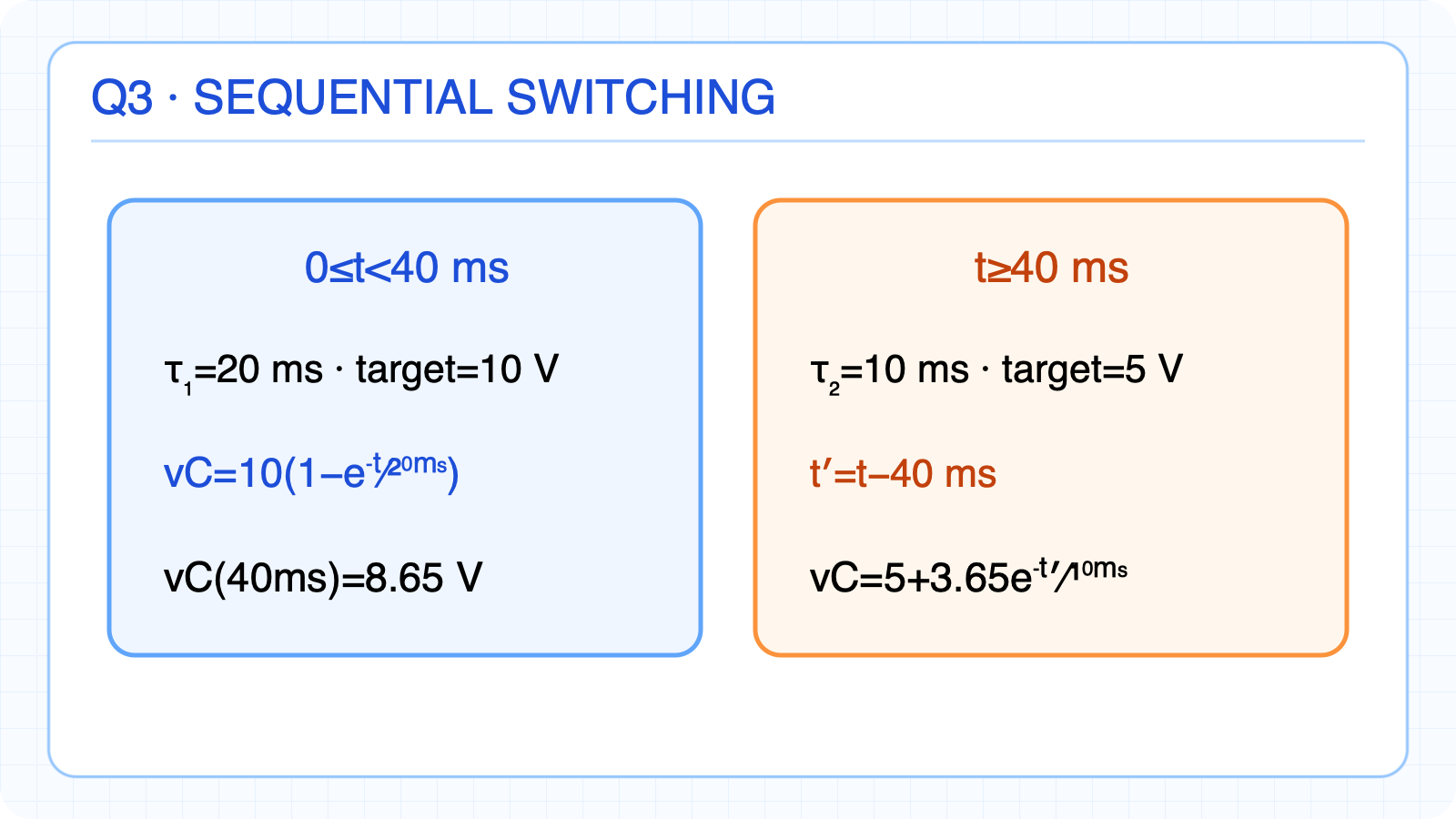
Voltage at 40 ms becomes the initial condition for region two. Region 1: 0≤t<40 msτ₁=20 ms; target 10 VvC=10(1−e(−t/20ms))vC(40 ms)=8.6466 VRegion 2: t≥40 ms with t′=t−40 msRTh=10 kΩ, τ₂=10 ms, target 5 VContinuity gives the 8.6466 V initial valuevC=5+3.6466e(−t′/10ms) VNarration transcript
Problem three. Sequential switching. This is the most interesting problem today. We have a ten volt source, R one equals twenty kilohms, R two equals twenty kilohms, and a capacitor C equals one microfarad. Switch one closes at t equals zero, connecting the source through R one to the capacitor. The capacitor starts at zero volts. Switch two closes at t equals forty milliseconds, adding R two in parallel with the capacitor. We must solve this in two regions. Region one: zero less than or equal to t less than forty milliseconds. Only R one and C are in the circuit. Tau one equals R one times C equals twenty times ten to the three times one times ten to the negative six, equals twenty milliseconds. v C of zero equals zero. v C of infinity equals ten volts. So v C of t equals ten times one minus e to the negative t over zero point zero two. At t equals forty milliseconds: v C of forty milliseconds equals ten times one minus e to the negative two, equals eight point six five volts. Region two: t greater than or equal to forty milliseconds. Now R two is in parallel with C. The Thevenin resistance becomes R one parallel R two equals ten kilohms. Tau two equals ten kilohms times one microfarad equals ten milliseconds. The Thevenin voltage is V S times R two over R one plus R two, equals ten times twenty over forty, equals five volts. Using t prime equals t minus zero point zero four: v C of t prime equals five plus eight point six five minus five times e to the negative t prime over zero point zero one. This simplifies to: v C equals five plus three point six five times e to the negative one hundred t prime volts. The capacitor was charging toward ten volts, but when R two joins, the new target drops to five volts, and the time constant halves.
5. Problem 4: time to a target
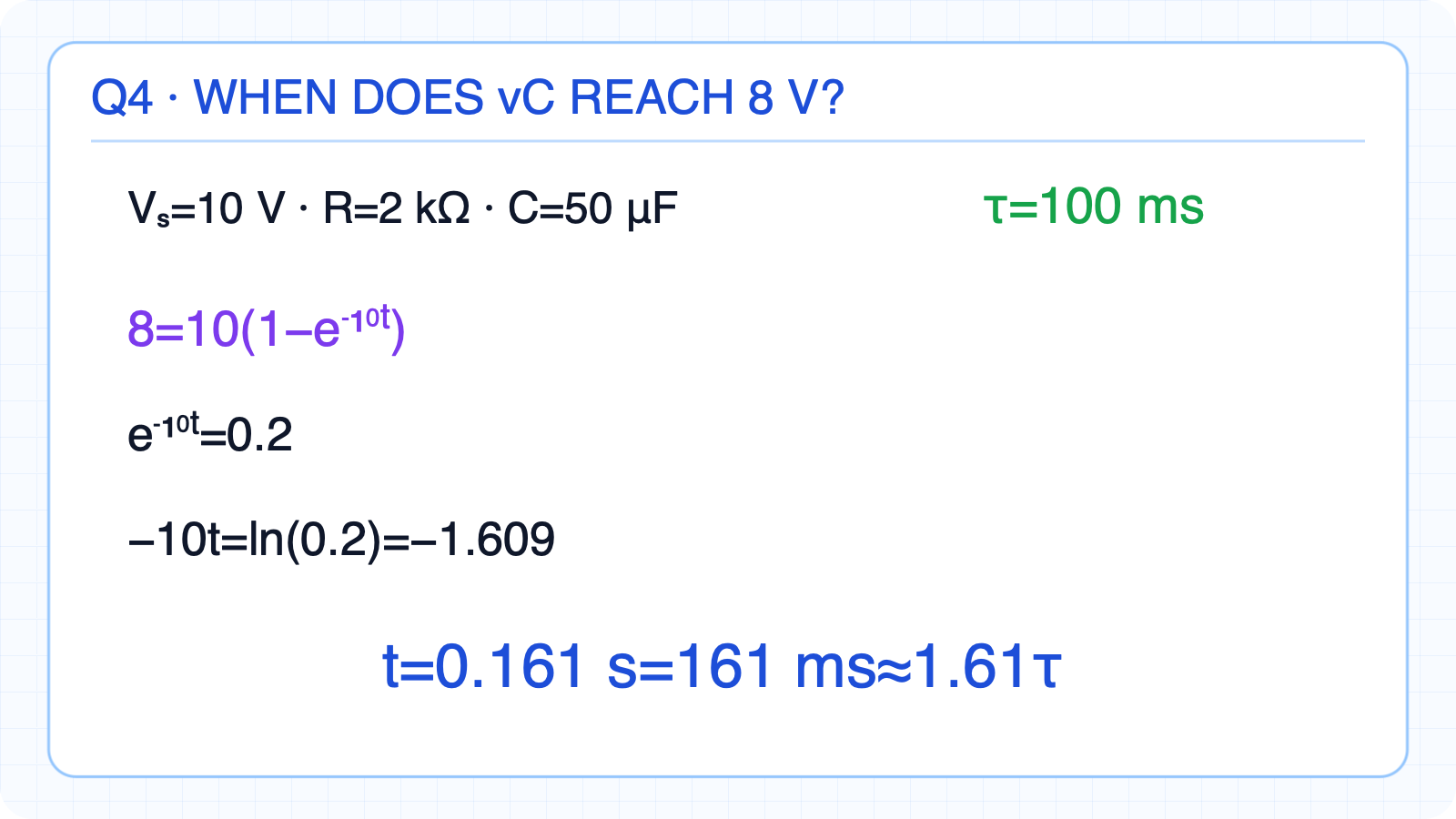
The 8 V target gives 161 ms through a logarithm. τ=RC=100 msSet vC=8 Vt=0.16094 s≈161 msNarration transcript
Problem four. Finding when a signal reaches a specific value. We have V S equals ten volts, R equals two kilohms, C equals fifty microfarads, and v C of zero equals zero. The switch closes at t equals zero. Question: how long does it take for the capacitor to reach eight volts? First, the time constant: tau equals R C equals two thousand times fifty times ten to the negative six, equals one hundred milliseconds. The response is: v C of t equals ten times one minus e to the negative ten t. We set this equal to eight: eight equals ten times one minus e to the negative ten t. Dividing both sides by ten: zero point eight equals one minus e to the negative ten t. Rearranging: e to the negative ten t equals zero point two. Taking the natural logarithm: negative ten t equals the natural log of zero point two, which equals negative one point six zero nine. Therefore t equals zero point one six one seconds, or one hundred sixty one milliseconds. This is approximately one point six one tau. So the capacitor reaches eighty percent of its final value in about one point six time constants. This is a very practical result. For example, in digital circuits, this tells you the minimum time before a signal is reliably read.
6. First-order problem-solving summary
The three values enter the general exponential solution. Organize the circuit before using the formulaFind initial, final, and tau separatelyQ1: RC step with continuityQ2: Thevenin first, then RL responseQ3: a new region at every switchThe switching value is the next initial valueQ4: set the target and take a logarithmAlways check t=0, t→∞, and unitsNext topic: second-order parallel RLCNarration transcript
Let us summarize. We solved four first order circuit problems. Problem one was a basic R C step response. We applied the three step formula directly: initial value five volts, final value twenty volts, tau ten milliseconds. Problem two introduced Thevenin simplification. When the inductor sees multiple components, find V Th and R Th first, then apply the same formula. Problem three demonstrated sequential switching. The circuit changes at t equals forty milliseconds, creating two separate regions, each with its own time constant and final value. The key is to use the voltage at the switching moment as the initial condition for the next region. Problem four showed how to find when a voltage reaches a target value. Set the formula equal to the target and solve for t using the natural logarithm. In the next lesson, we begin second order circuits with the parallel R L C configuration.