Circuit Theory 1 · First-Order Transients
#43 Transient Analysis #43 — Step response and RC charging
Derives the general first-order step-response formula, applies the initial-final-time-constant method, and solves a 12 V RC charging example.
Question
An uncharged RC circuit with R=10 kΩ, C=100 μF, and V_S=12 V is connected at t=0. Find v_C(t), i(t), τ, and the voltage at 1, 3, and 5 seconds.
Written solution and narration transcript(shows the full solution)
Below are all the lines written in the notebook together with the full narration transcript.
1. Natural, forced, and complete response
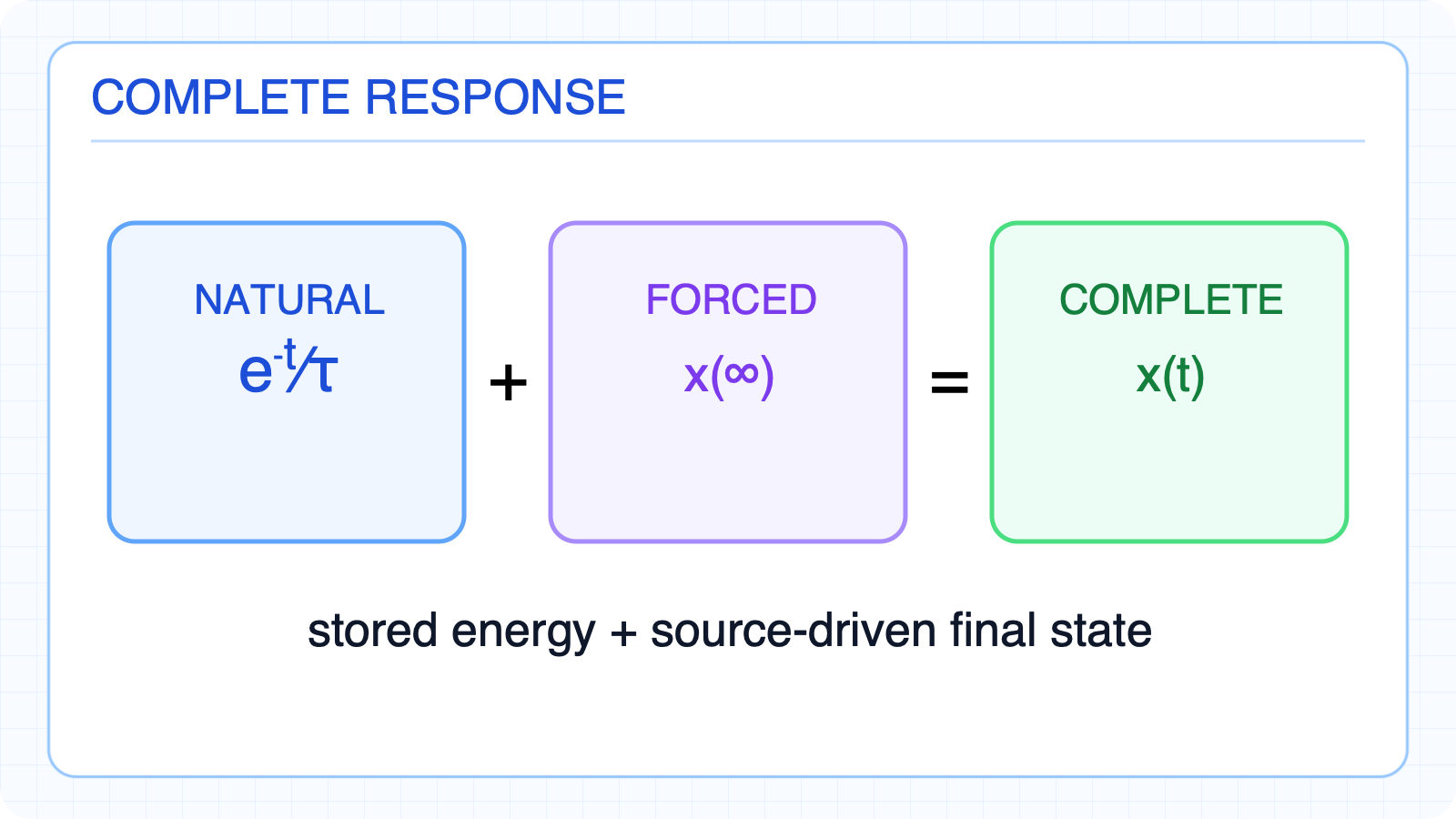
Stored energy and the source-driven final state are shown together. Apply a constant source at t=0The natural response comes from initially stored energyThe forced response is the source-driven steady stateComplete response = natural + forced responseThe natural component decays exponentiallyThe forced component establishes the final valueA first-order circuit has one time constantThe pre-switch condition determines the startLong-time analysis determines the final valueNarration transcript
So far we have studied the natural response, where a circuit releases its stored energy with no external source. Now we introduce the step response. What happens when we suddenly apply a constant voltage or current source to a circuit at time t equals zero? The complete response has two parts. The natural response is the familiar exponential decay driven by initial stored energy. The forced response is the steady state that the source drives the circuit toward. The complete response equals the natural response plus the forced response. This is the most important idea in first order circuit analysis.
2. General formula and three-step method
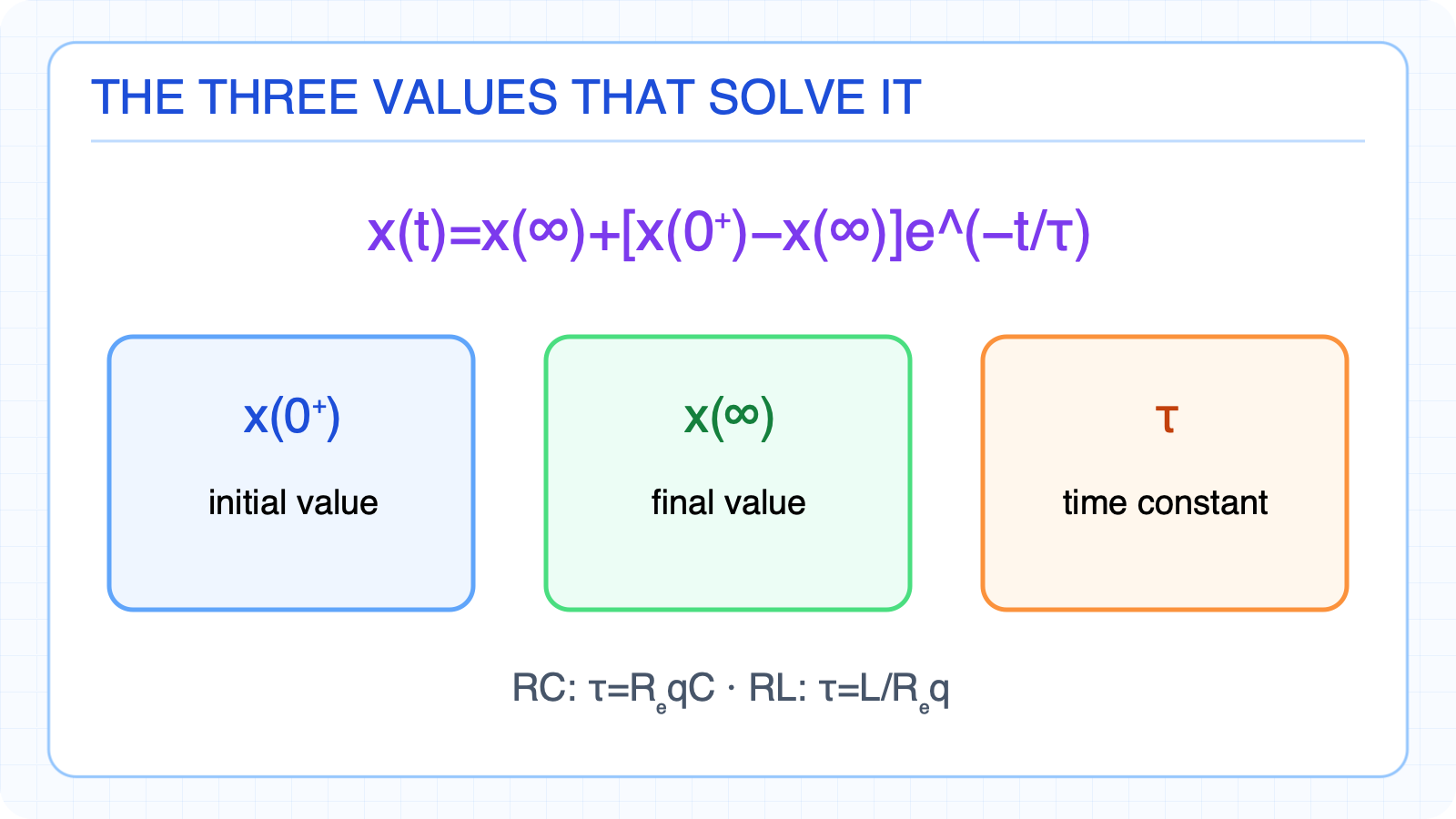
Initial value, final value, and time constant enter the general formula. x(0⁺): value immediately after switchingx(∞): long-time steady-state valueτ: time constant that controls transient speed1) Find x(0⁺)2) Find x(∞)3) Find τFor RC, τ=Req CFor RL, τ=L/ReqNarration transcript
Here is the general formula for any first order circuit with a step input. x of t equals x of infinity plus the quantity x of zero minus x of infinity times e to the negative t over tau. Let me explain each term. x of infinity is the final steady state value, the value the circuit settles to after a long time. x of zero is the initial value at the moment of switching. And tau is the time constant, R C for capacitor circuits or L over R for inductor circuits. The three step method to solve any first order step response is: step one, find x of zero from the initial conditions. Step two, find x of infinity by analyzing the circuit at steady state, where capacitors are open circuits and inductors are short circuits. Step three, find tau by computing the equivalent resistance seen by the storage element. Then plug all three values into the general formula. That is it.
3. The three values for an RC charge
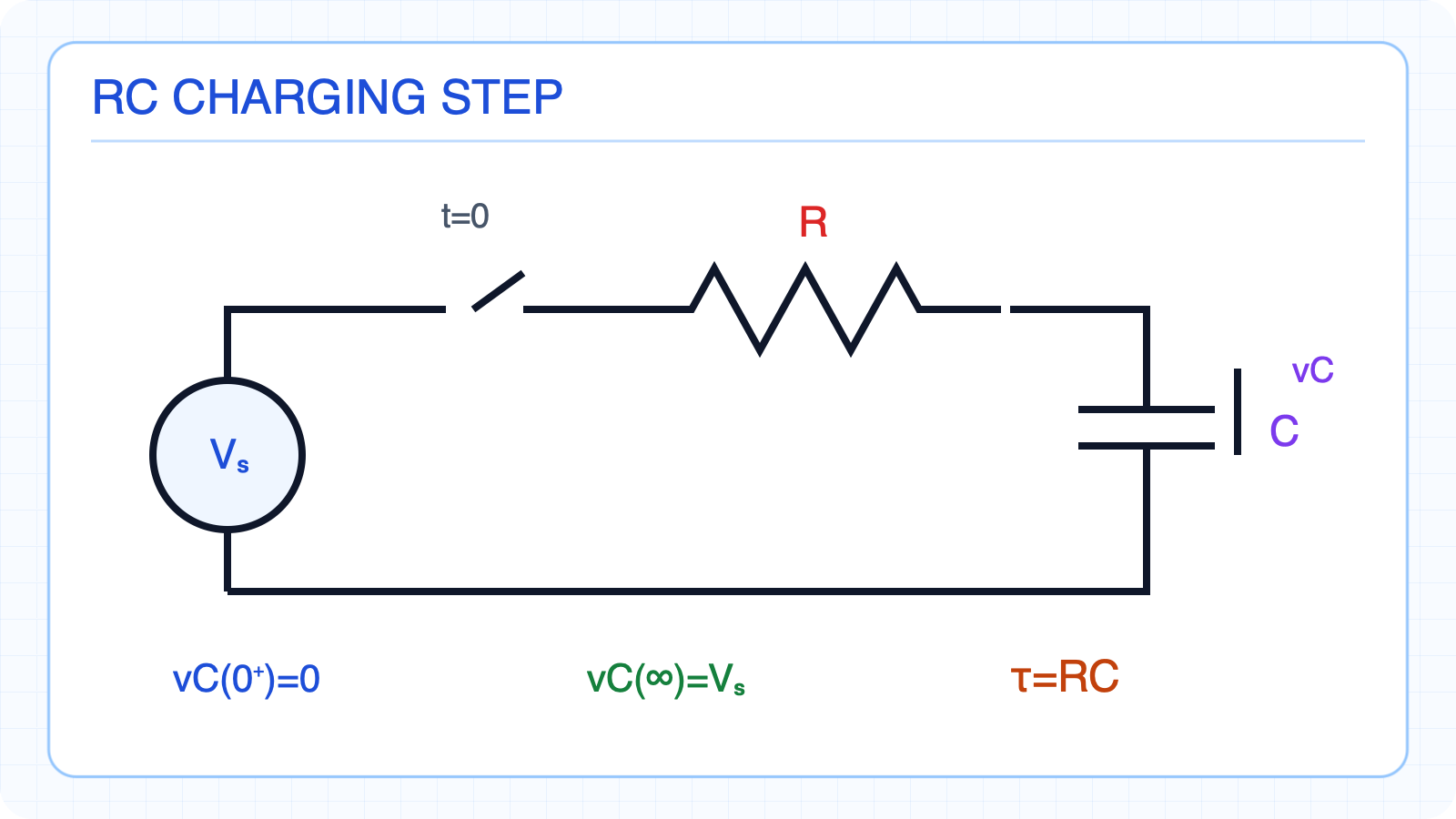
The capacitor rises from zero to the source voltage with τ=RC. The switch closes at t=0The capacitor starts unchargedAt long time the capacitor is an open circuitCurrent falls to zeroThe resistance seen by the capacitor is Rτ=RCAll three values for the formula are readyNarration transcript
Let us apply this formula to an R C charging circuit. We have a voltage source V S connected through a switch to a resistor R and capacitor C in series. The switch closes at t equals zero. Before switching, the capacitor is uncharged, so V C of zero equals zero. After a long time, the capacitor fully charges to the source voltage, so V C of infinity equals V S. The time constant is tau equals R C. These are our three values: initial is zero, final is V S, and tau is R C.
4. RC charging voltage and current
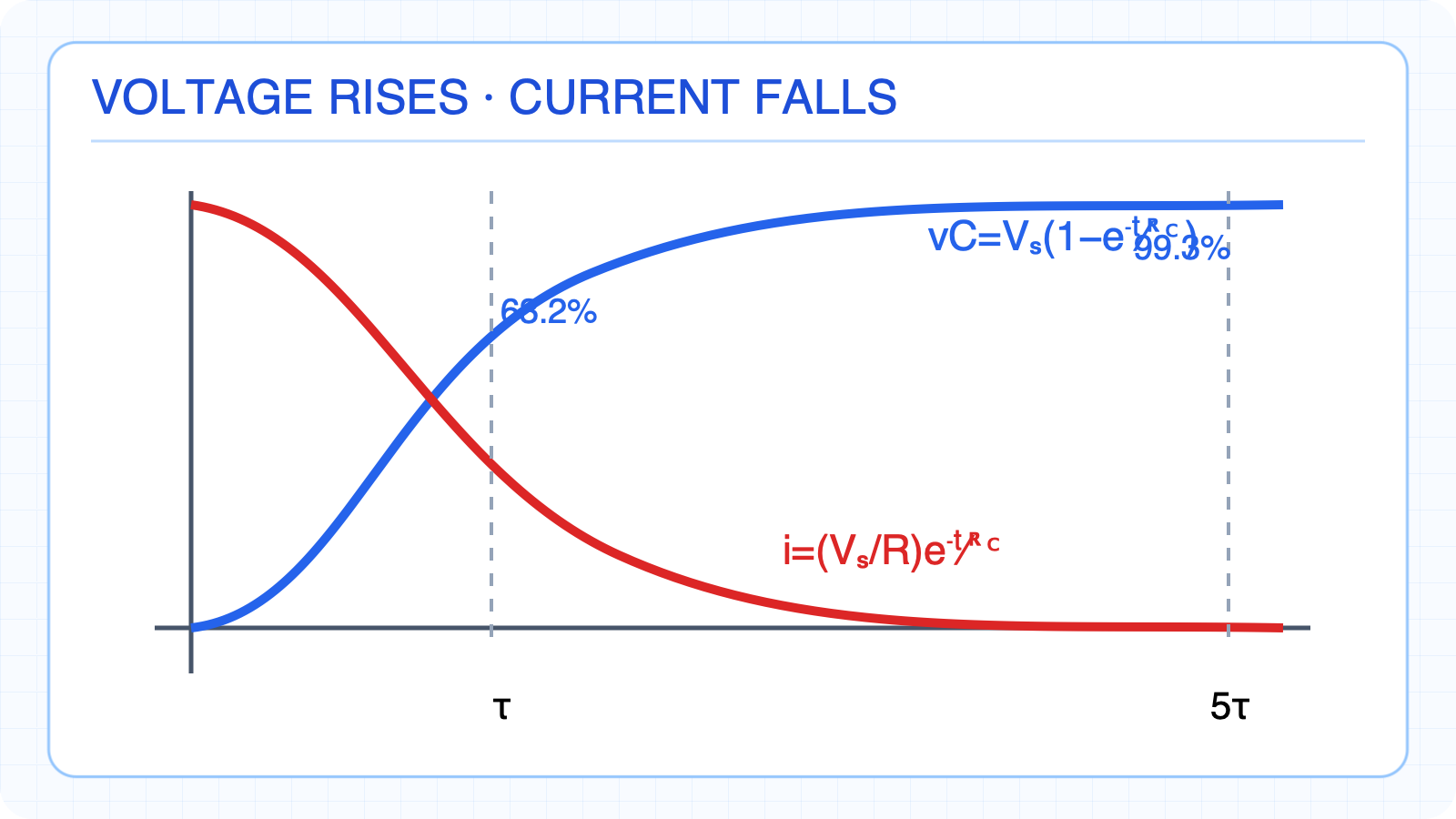
Voltage rises while current falls; one and five time constants are marked. Choose x=vC in the general formulavC(t)=VS+[0−VS]e(−t/RC)vC(t)=VS(1−e(−t/RC))Voltage rises from zero to VSi(t)=(VS/R)e(−t/RC)Current falls from VS/R to zeroAt t=τ, vC is 63.2 percent of finalAt t=5τ, vC reaches 99.3 percentVoltage rises while current fallsNarration transcript
Plugging into the general formula: V C of t equals V S plus the quantity zero minus V S times e to the negative t over R C. Simplifying, V C of t equals V S times the quantity one minus e to the negative t over R C. This is the R C charging equation. The voltage starts at zero and rises exponentially toward V S. At t equals tau, V C reaches sixty three point two percent of V S. At five tau, it reaches ninety nine point three percent, which is essentially fully charged. The current follows: i of t equals V S over R times e to the negative t over R C. The current starts at a maximum of V S over R and decays exponentially to zero. Notice: the voltage rises as the current falls. Energy flows from the source through the resistor into the capacitor.
5. Numerical 12 V RC charging example
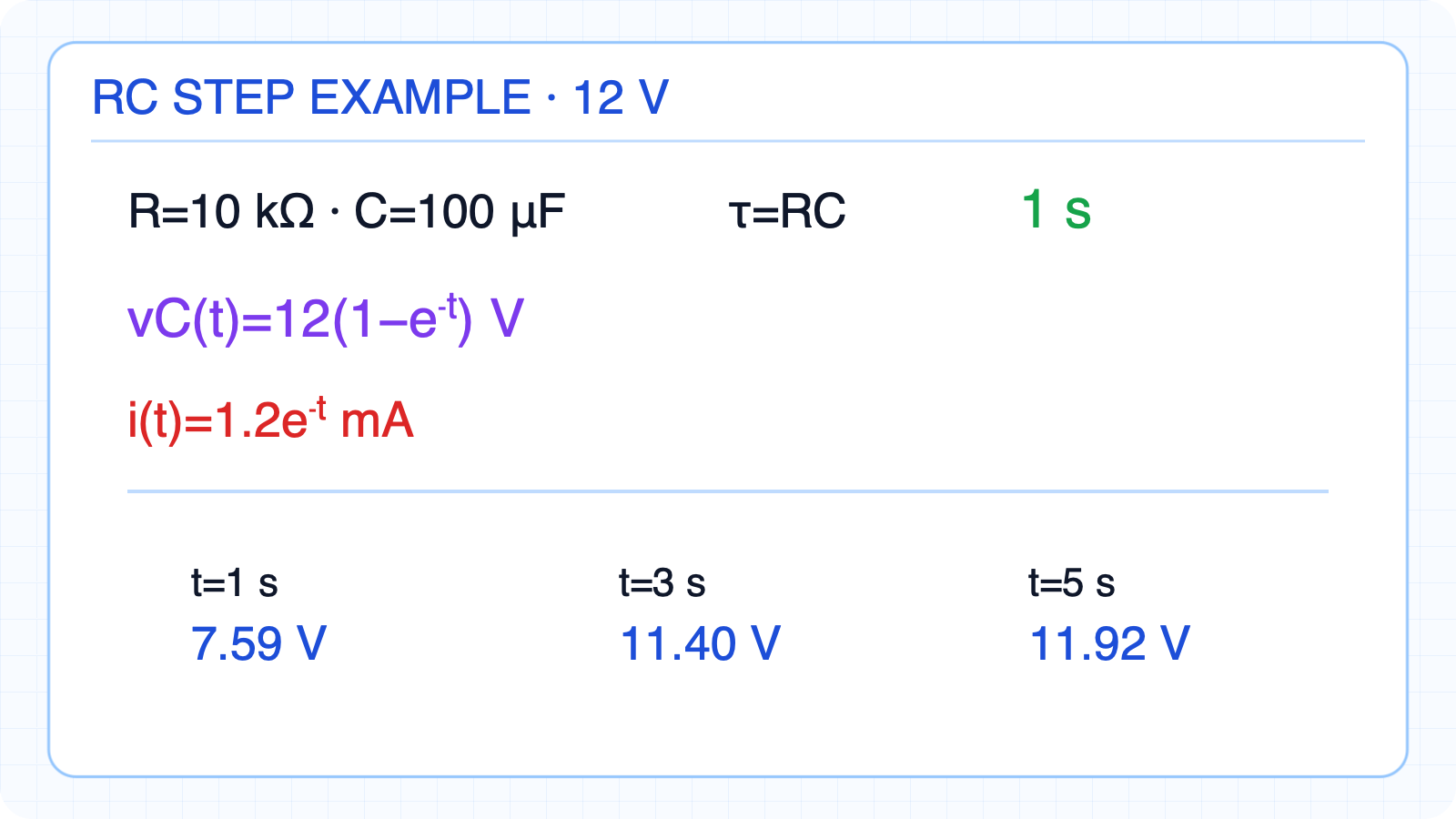
Capacitor voltage at 1, 3, and 5 seconds when τ=1 s. R=10 000 Ω and C=100×10⁻⁶ Fτ=RC=1 si(t)=1.2e(−t) mANarration transcript
Let us work a numerical example. Given R equals ten kilohms, C equals one hundred microfarads, and V S equals twelve volts. Step one: the initial condition is V C of zero equals zero volts, the capacitor starts uncharged. Step two: the final value is V C of infinity equals twelve volts. Step three: the time constant is tau equals R C equals ten thousand times one hundred times ten to the negative six, which equals one second. Now apply the formula: V C of t equals twelve times one minus e to the negative t. At t equals one second, V C equals twelve times one minus e to the minus one, which is twelve times zero point six three two, giving seven point five nine volts. At t equals three seconds, V C equals twelve times one minus e to the minus three, which equals eleven point four volts. At t equals five seconds, V C equals eleven point nine two volts, essentially twelve. The current: i of t equals twelve over ten thousand times e to the negative t, which is one point two milliamps times e to the negative t.
6. Step-response solution checks
Initial value, final value, and time constant enter the general formula. Draw the initial and final circuits firstThe energy-storage variable is continuousA capacitor is open at steady stateVerify the x(0⁺), x(∞), and τ trioTest the result at t=0 and t→∞Check that the exponential argument is dimensionlessOne tau is 63.2 percent; five tau is 99.3 percentNext: apply the same method to an RL step responseNarration transcript
Let us summarize. The general first order step response formula is: x of t equals x of infinity plus x of zero minus x of infinity times e to the negative t over tau. The three step method: find x of zero, find x of infinity, find tau, then substitute. For R C charging: V C of t equals V S times one minus e to the negative t over R C. Voltage rises from zero to V S. Current decays from V S over R to zero. At one tau, sixty three percent complete. At five tau, ninety nine percent complete. Next, we will apply the same formula to the R L step response.