Analog Communication · Frequency and phase modulation
#04 Phase derivative, FM/PM equivalence and conditional bandwidth tradeoffs
Relate frequency to phase, distinguish FM from PM, and use modulation index and Carson bandwidth with explicit comparison conditions.
Question
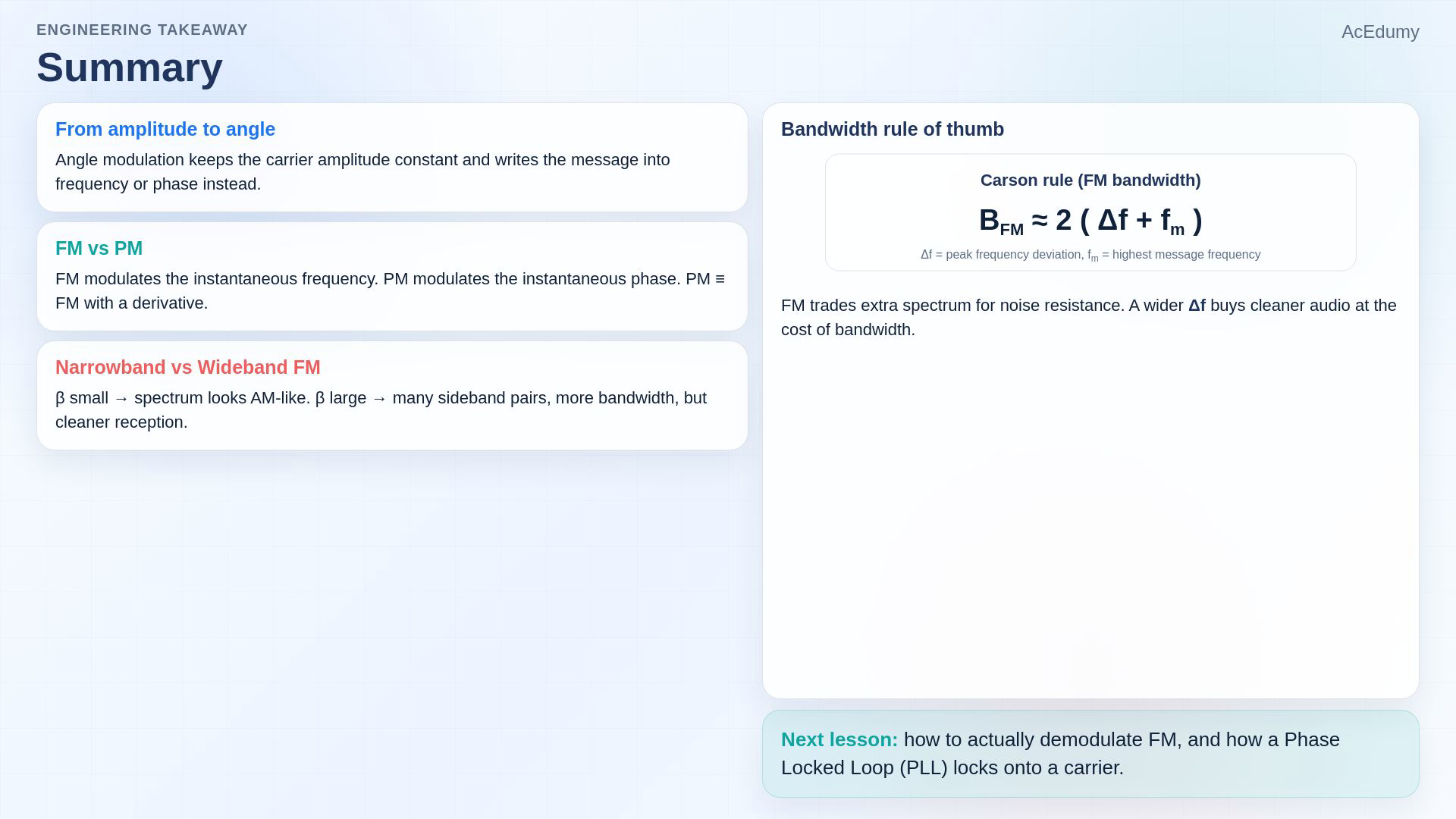
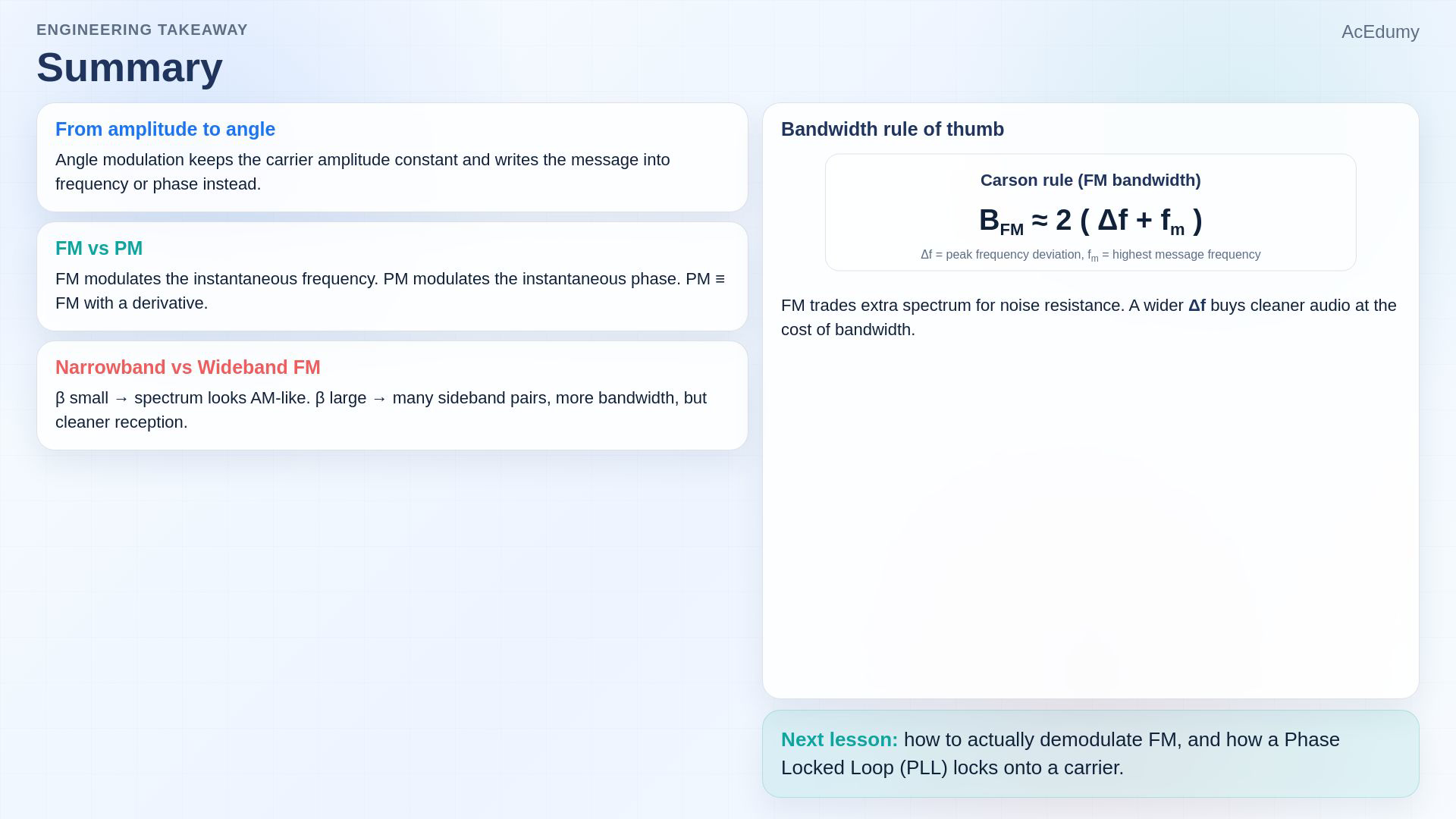
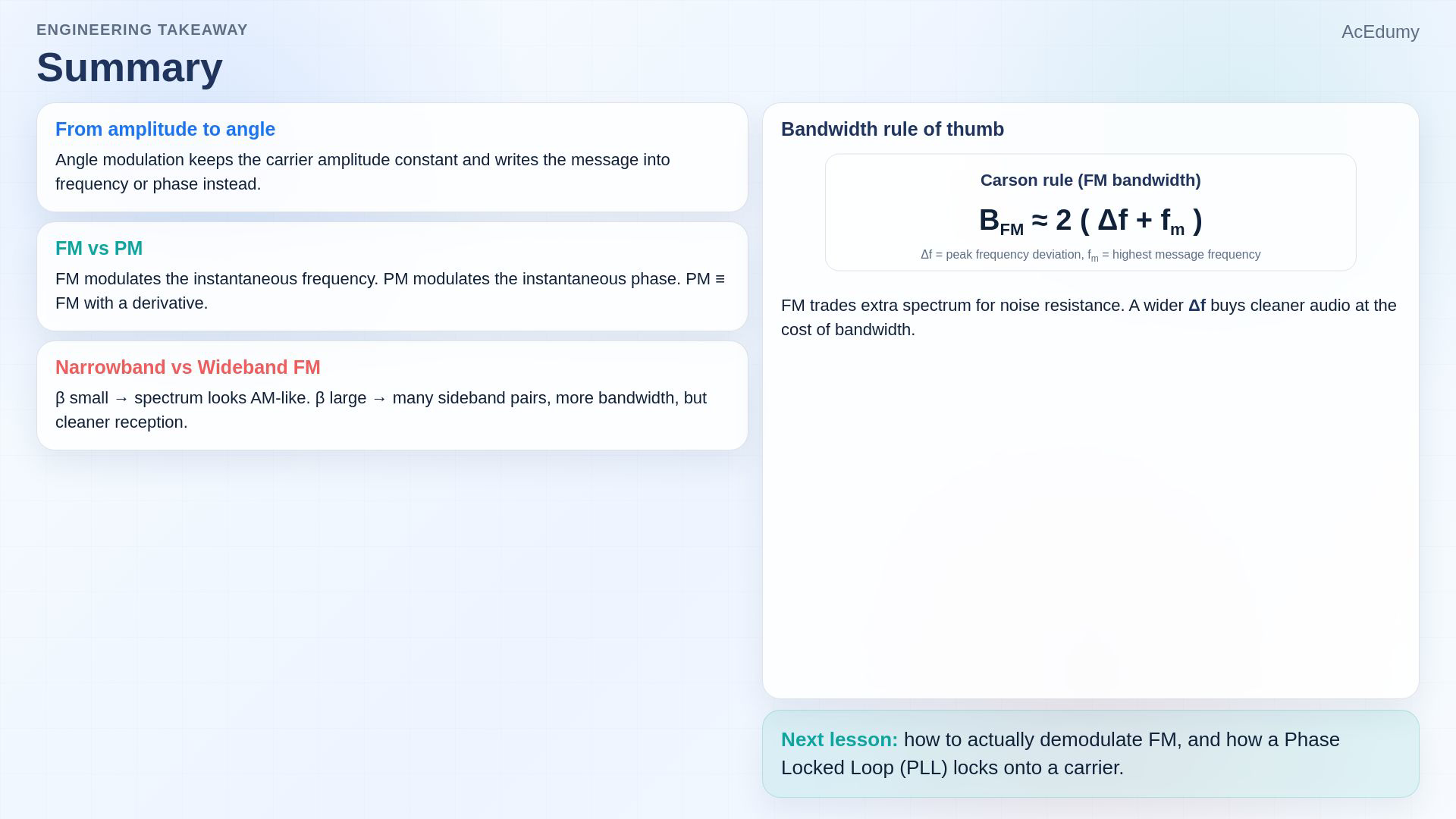
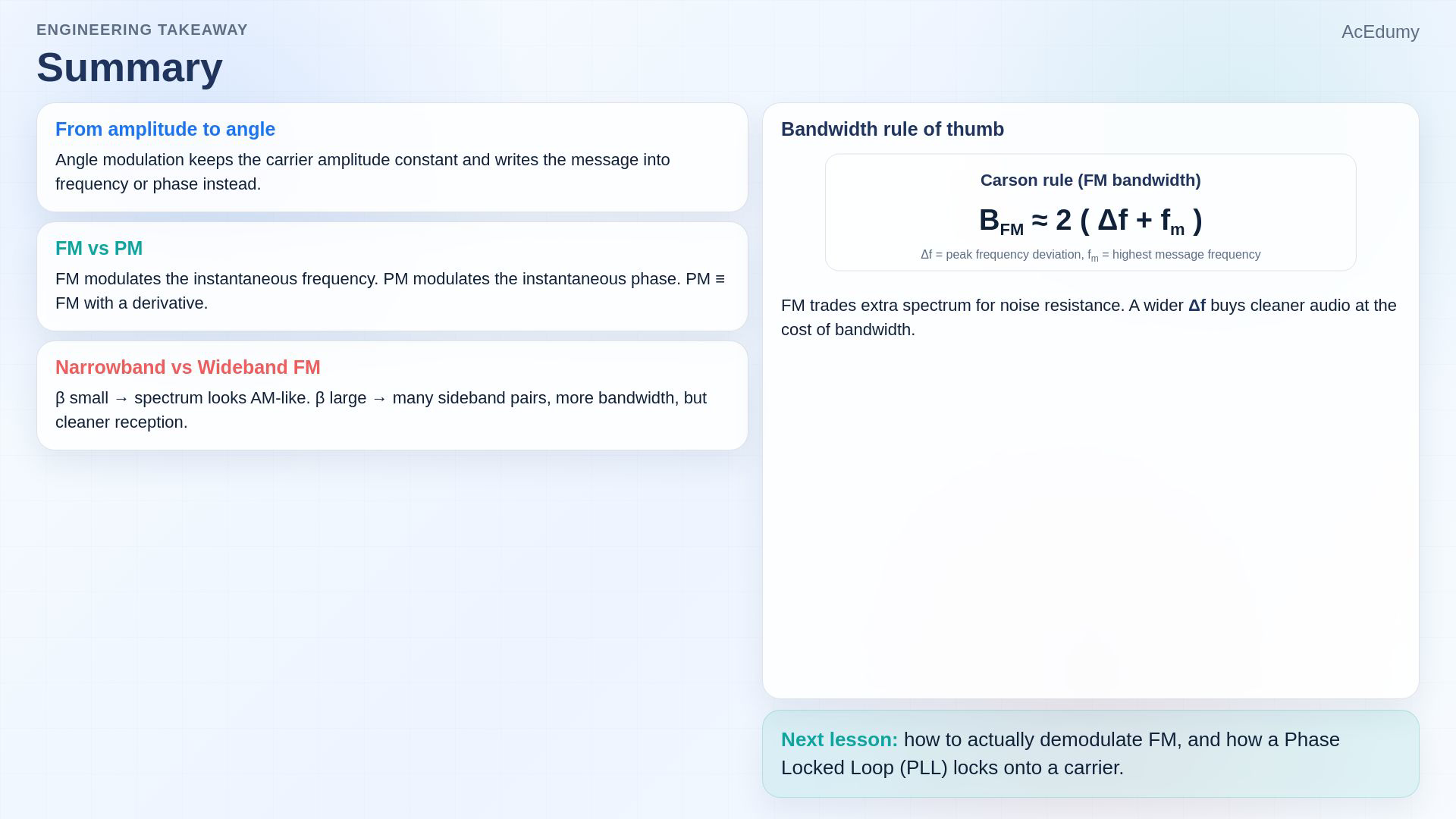
Use ideal real angle modulation s(t)=A_c cos(theta(t)), A_c>0, phase theta in radians, theta=2*pi*f_c*t+phi, and instantaneous frequency f_i=theta'(t)/(2*pi) in hertz. Phase is not a derivative of itself. A continuously defined phase is part of this signal model; it is not reconstructed uniquely from arbitrary zero crossings. FM sensitivity k_f>0 is hertz per message unit: f_i=f_c+k_f*m. PM sensitivity k_p is radians per message unit: phi_P=k_p*m. Assume differentiable bounded messages and f_c greater than the peak frequency deviation so instantaneous frequency stays positive. For a single tone m=A_m*cos(2*pi*f_m*t), A_m>0 and f_m>0, define Delta f=k_f*A_m, beta=Delta f/f_m and choose phi(0)=0. Integrating the cosine message gives phi=beta*sin(2*pi*f_m*t), whose derivative gives frequency deviation beta*f_m*cos(2*pi*f_m*t). A sine phase deviation therefore corresponds to a cosine message in FM, not the same sine message. In PM with that cosine message, phase deviation is k_p*A_m*cos(2*pi*f_m*t). To implement PM using an FM modulator, use x_D=[k_p/(2*pi*k_f)]*m'(t) and match its initial phase deviation to k_p*m(0). Integration then gives exactly k_p*m(t); omitting the gain or initial constant is not generally equivalent. The frequency- and phase-sensitivity units differ. Narrowband single-tone FM assumes beta much smaller than one and a first-order approximation. Carrier and first sideband pair are dominant in that approximation; nonzero higher Bessel sidebands are not literally removed. Their locations resemble AM, but their relative phases and the modulation laws differ. At larger beta more sideband orders are generally significant, while individual Bessel coefficients can increase, decrease or vanish. Do not interpret qualitative spectrum heights as numerical Bessel coefficients. Hold f_m fixed when comparing beta through Delta f. Define Carson estimate B_C=2*(Delta f+W), where W is the highest useful message frequency; for a single tone W=f_m and B_C=2*f_m*(beta+1). For a general multitone message, Delta f/W is a deviation ratio, not a separate single-tone phase index for every component. B_C is an approximate occupied-band estimate, not exact finite spectral support; sinusoidal FM generally has infinitely many sideband orders. Higher beta alone does not determine a larger bandwidth when f_m also changes. For example, fixed Delta f=75 kHz and f_m changing from15 to7.5 kHz gives beta5 to10 but B_C180 to165 kHz. This counterexample shows why the fixed-message-frequency condition is necessary. Wider deviation can improve noise-limited demodulated reception under appropriate comparisons with the same useful message bandwidth and adequate received carrier-to-noise ratio above threshold, sufficient channel/IF bandwidth and suitable demodulation. It cannot guarantee cleaner reception for every receiver, interference level, bandwidth constraint, distortion or below-threshold condition. The summary card's abbreviated noise and bandwidth claims are read only with these stated conditions. Its PM derivative equivalence includes the explicit gain and initial phase above.
Written solution and narration transcript(shows the full solution)
Below are all the lines written in the notebook together with the full narration transcript.
1. Define angle modulation and frequency as phase derivative
Source summary reference. Compare deviation at fixed message bandwidth; noise improvement needs adequate receiver conditions. PM uses a scaled message derivative at an FM input. The preceding AM-family examples vary the carrier envelope; here the carrier amplitude is fixed.Use an ideal real carrier with positive amplitude and continuously defined phase in radians.The constant-envelope angle-modulated signal is:Separate the carrier phase and the message-dependent phase deviation:Instantaneous frequency in hertz is the phase derivative divided by two pi:FM with positive frequency sensitivity follows the message value:PM with phase sensitivity changes phase directly:Frequency and phase are related quantities, not two derivatives of phase; frequency sensitivity is in hertz per message unit, phase sensitivity in radians per message unit.Narration transcript
In the previous lessons, every scheme was built on top of carrier amplitude. Now we change the rule. We keep the amplitude constant and push the message into the angle of the carrier. The angle has two natural handles, frequency and phase. That single decision splits into two related schemes. Frequency Modulation, or FM, lets the message control the instantaneous frequency. Phase Modulation, or PM, lets the message control the instantaneous phase. Both belong to the angle modulation family.
2. Keep the message and instantaneous frequency phase consistent
Source summary reference. Compare deviation at fixed message bandwidth; noise improvement needs adequate receiver conditions. PM uses a scaled message derivative at an FM input. Frequency determines the local rate of phase advance:A zero message leaves the FM carrier at its unmodulated frequency:For positive frequency sensitivity, a larger message value means a larger instantaneous frequency; the message derivative is not the FM control signal.Use a positive-frequency cosine message to keep phase and frequency consistent:With zero initial phase deviation, the corresponding FM phase deviation is:Differentiating this phase gives the same cosine message dependence:The envelope stays constant while phase spacing changes:Narration transcript
The key idea behind angle modulation is the concept of instantaneous frequency. Imagine a pure carrier oscillating at a fixed rate. When the message rises, we make the carrier oscillate slightly faster. When the message falls, we make it oscillate a bit slower. So at every instant, the carrier has its own local frequency that follows the message. The amplitude never changes, only how fast the wave advances in time. That is why an FM waveform looks compressed in some places and stretched in others, even though every cycle keeps exactly the same height.
3. Compare FM and PM with units and derivative gain
Source summary reference. Compare deviation at fixed message bandwidth; noise improvement needs adequate receiver conditions. PM uses a scaled message derivative at an FM input. FM makes frequency deviation proportional to the message; PM makes phase deviation proportional to the message.For positive FM sensitivity and message peak amplitude, the peak frequency deviation is:Scaling the same message waveform changes the peak frequency swing in the same proportion.Write the PM phase deviation explicitly:To realize PM with an FM modulator, drive it with the properly scaled derivative and match the initial phase:Broadcast and voice FM and phase-based digital modulation are application examples; waveform similarity alone does not identify the modulation law.Narration transcript
FM and PM look very similar on a screen, but they encode the message differently. In Frequency Modulation, the instantaneous frequency deviation is proportional to the message itself. So a louder message pushes the frequency further away from the carrier. In Phase Modulation, the instantaneous phase deviation is proportional to the message. That subtle change makes PM equivalent to applying FM after a derivative of the message. In practice, FM became dominant in broadcast and voice radio, while PM appears more often as a building block inside digital communication.
4. State what is held fixed when changing modulation index
Source summary reference. Compare deviation at fixed message bandwidth; noise improvement needs adequate receiver conditions. PM uses a scaled message derivative at an FM input. For a single tone, hold its positive frequency fixed while comparing peak deviations:When beta is much smaller than one, the first-order narrowband approximation retains the carrier and first sideband pair; higher pairs are small, not exactly absent.Narrowband FM has AM-like spectral locations for one tone, but different relative sideband phases and a different modulation law.At the fixed message frequency, increasing beta increases the peak deviation:Larger beta generally requires more significant sideband pairs; individual sideband amplitudes need not grow monotonically.At fixed message frequency, the Carson bandwidth estimate grows with beta; noise improvement additionally requires adequate receiver conditions:Narration transcript
Inside FM, one number controls how aggressive the modulation is, the modulation index, written as beta. When beta is small, only a small frequency deviation is used, and the spectrum looks almost like AM with a single sideband pair. This is narrowband FM. When beta grows, the carrier swings far in frequency, and the spectrum opens up into many sideband pairs around the carrier. This is wideband FM. A larger beta improves audio quality and resistance to noise, but it always costs more bandwidth.
5. Use Carson bandwidth without an unconditional noise-quality guarantee
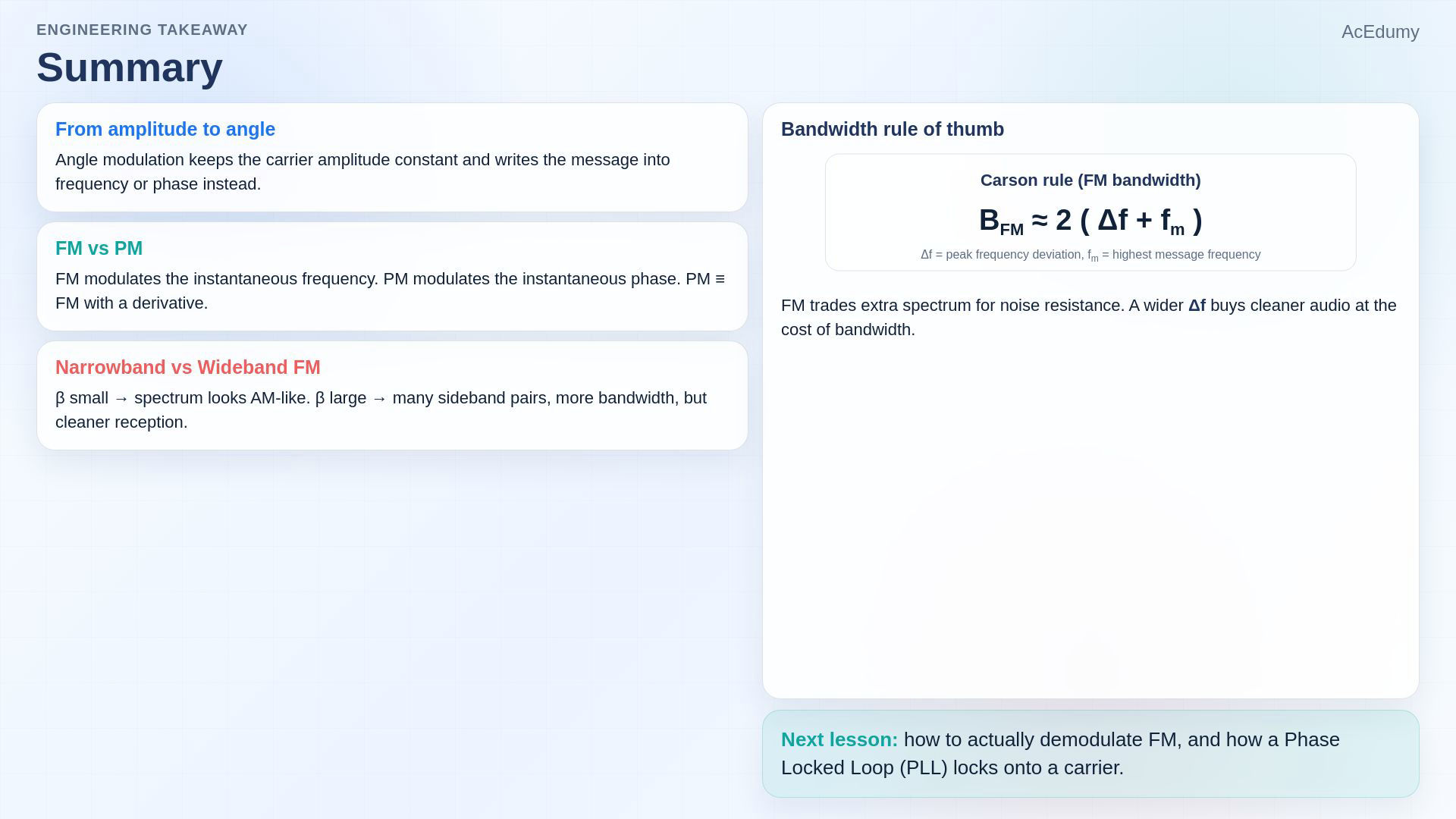
Source summary reference. Compare deviation at fixed message bandwidth; noise improvement needs adequate receiver conditions. PM uses a scaled message derivative at an FM input. Wider-deviation FM can improve noise-limited reception above the receiver threshold with adequate channel and IF bandwidth; it is not an unconditional audio-quality guarantee.For peak frequency deviation and highest message frequency W, define the Carson bandwidth estimate:Carson bandwidth is a practical occupied-band estimate, not a strict finite spectral support or an exact regulatory bandwidth.For the single-tone comparison, the highest message frequency equals the tone frequency:Increasing deviation at fixed message bandwidth increases this estimate. Changing message frequency as well can raise beta while reducing bandwidth.FM demodulation and the phase-locked loop are the next receiver concepts; bandwidth, threshold and tracking conditions remain part of the design.Narration transcript
To wrap up, FM and PM trade simplicity for noise resistance and quality. The bandwidth is no longer just twice the message bandwidth. A practical rule of thumb is the Carson approximation. The FM bandwidth is roughly twice the sum of the peak frequency deviation and the highest message frequency. So a wider deviation buys cleaner reception, but it always costs more spectrum. In the next lesson, we look at how to actually demodulate FM, and how a receiver locks onto a carrier with a Phase Locked Loop, or PLL.
Source video: Analog Communication #04 | Frequency Modulation (FM) and Phase Modulation (PM) Intuition (3:19)