Circuit Theory 1 · Fundamental Signals
#38 Fundamental Signals #38 — Step, impulse, ramp, and circuit waveforms
Explains unit-step, impulse, and ramp functions; exponential and damped-sinusoidal responses; piecewise-linear decomposition; and the derivative chain.
Question
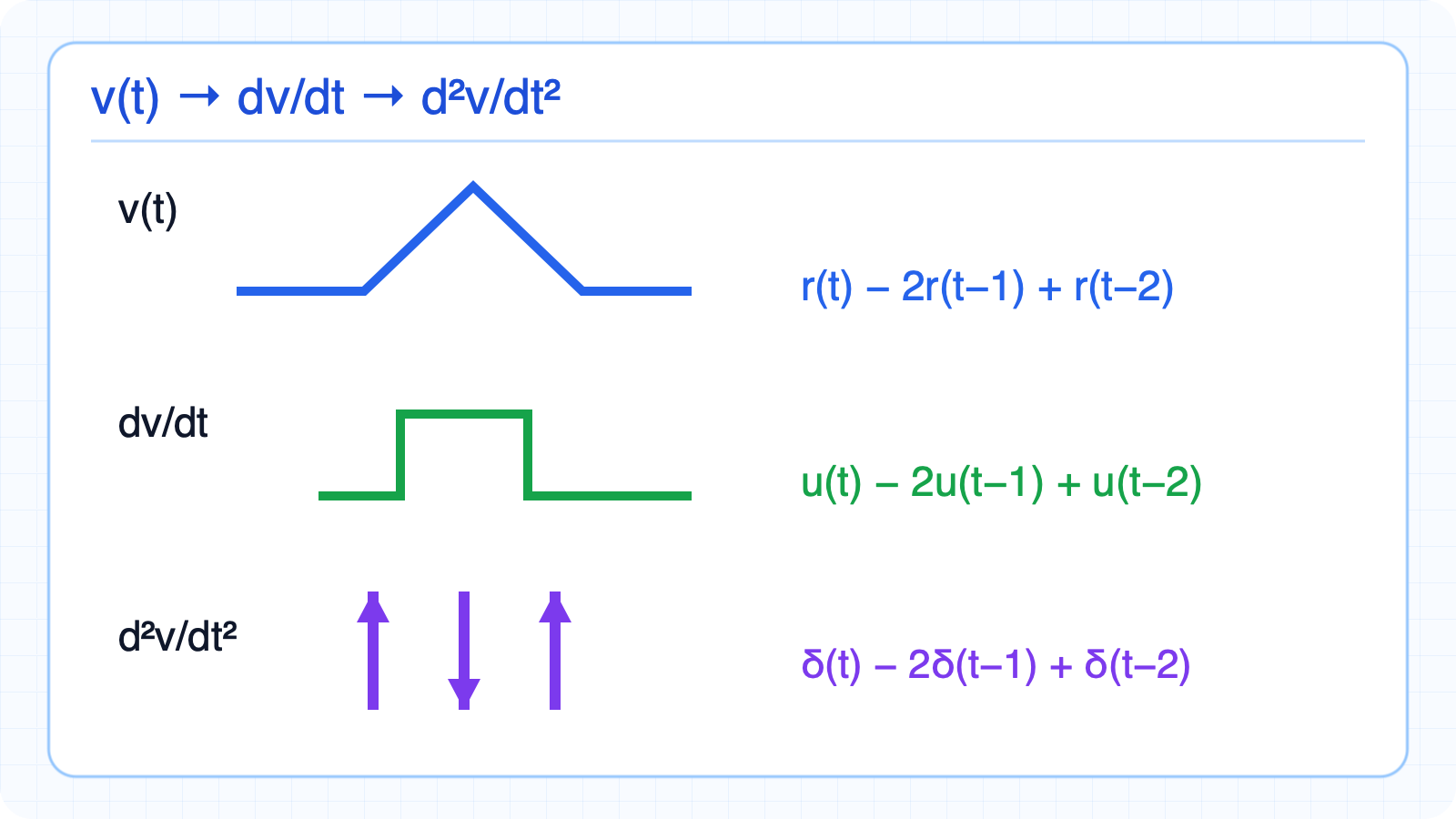
Construct the derivative-integral chain among step, impulse, and ramp; interpret exponential and damped-sinusoidal responses; express a triangular waveform with shifted ramps and differentiate it twice.
Written solution and narration transcript(shows the full solution)
Below are all the lines written in the notebook together with the full narration transcript.
1. Unit step and time shift
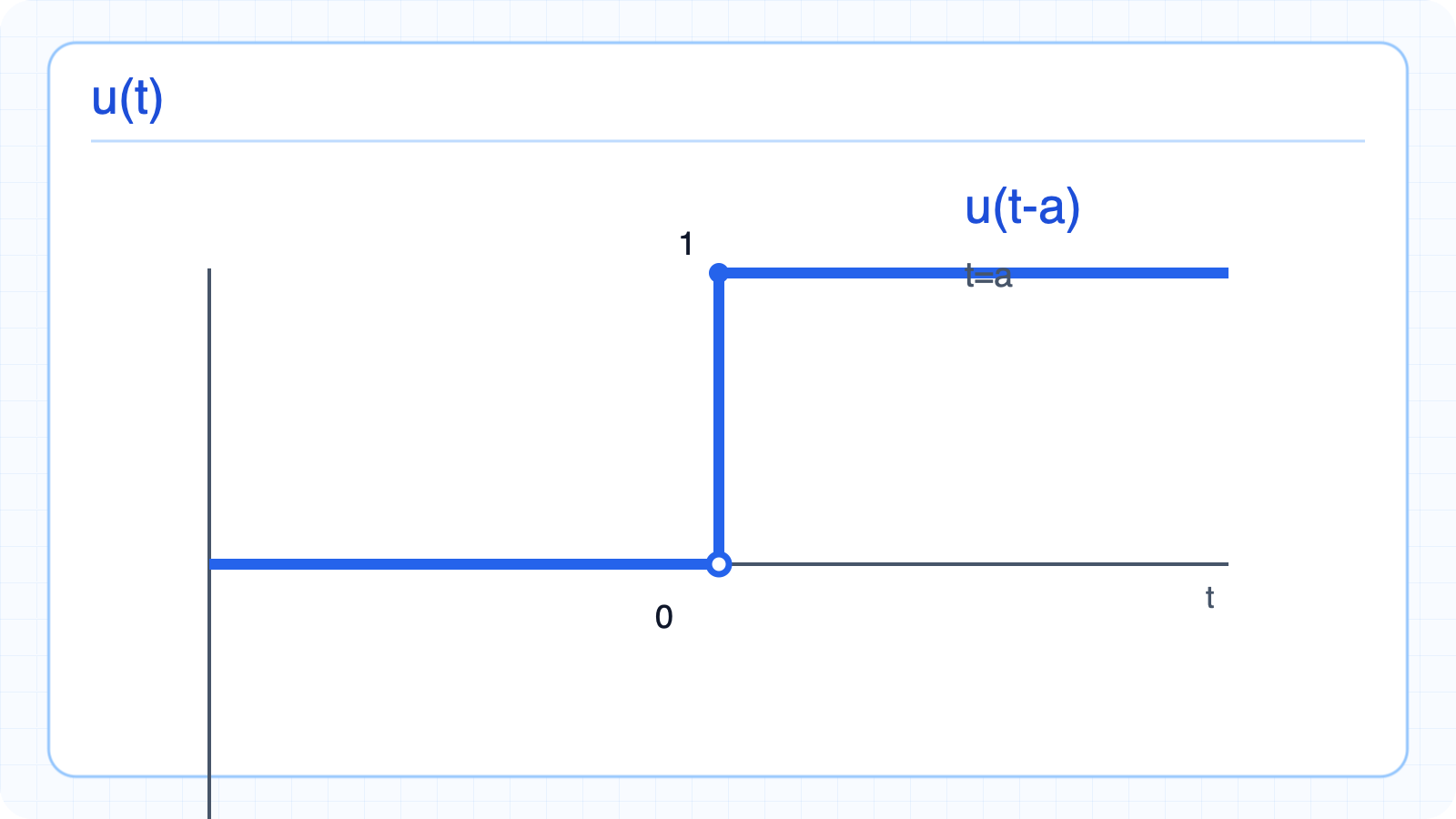
The fundamental signal that changes from zero to one at switching. Unit step u(t): the basic switching signalu(t)=0 for t<0u(t)=1 for t≥0u(t−a) turns on at t=aPhysical meaning: a switch connects a DC sourceAmplitude scaling: K·u(t)Circuit inputs can be built from shifted stepsNarration transcript
The unit step function, written u of t, is the simplest switching signal in circuit analysis. It equals zero for all negative time, and one for t greater than or equal to zero. Physically, it represents a switch closing at t equals zero, connecting a DC source. A shifted step, u of t minus a, turns on at time t equals a instead of zero. The step function is so fundamental that almost every circuit input can be described using it.
2. Step operations and rectangular pulse
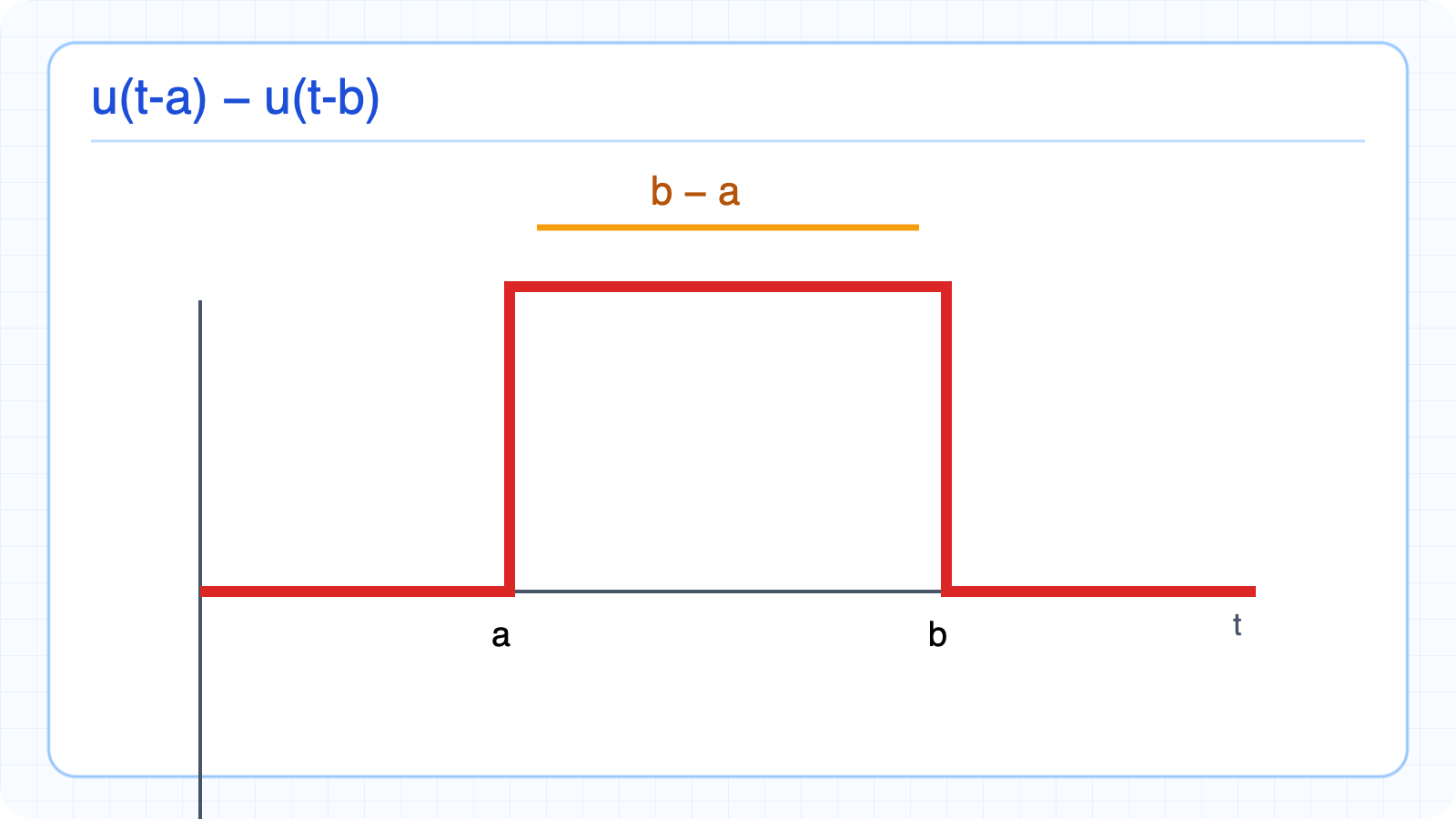
u(t−a)−u(t−b) equals one between a and b. Shift, scale, and reverseu(t−1)−u(t−3)t<1: 01≤t<3: 1t≥3: 0General pulse: u(t−a)−u(t−b)Pulse width is b−aNarration transcript
We can scale and shift the step function to build any rectangular waveform. Three times u of t gives a step of height three. A rectangular pulse is simply the difference of two shifted steps: u of t minus one, minus u of t minus three, creates a pulse of height one from t equals one to t equals three. We can also compress time: u of 2t minus 1 turns on at t equals one-half instead of one. And time inversion: u of minus t is one for all negative time. This is how we mathematically describe real circuit inputs.
3. Unit impulse and sifting
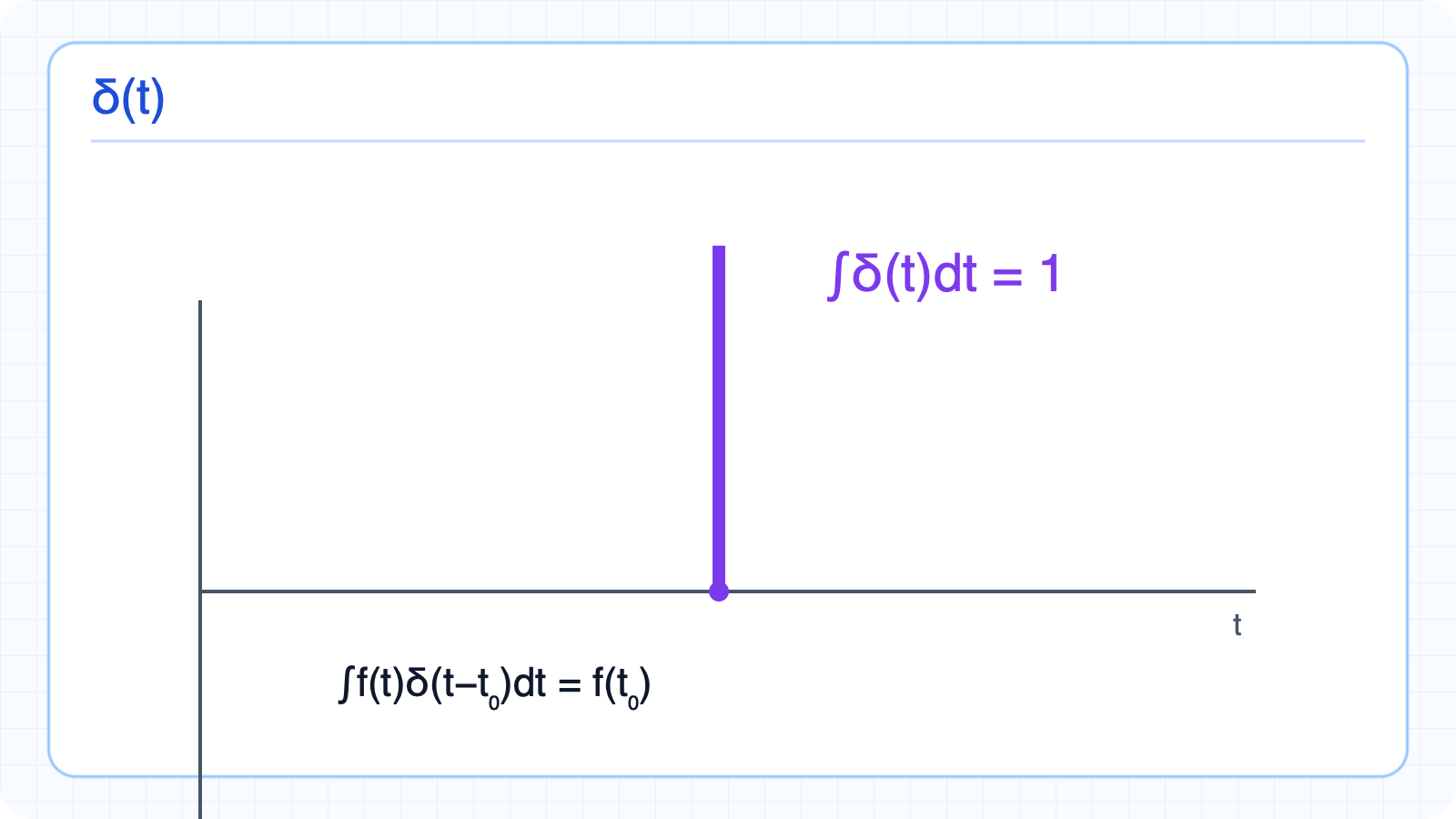
The zero-width ideal impulse is interpreted by total area, not point value. Unit impulse δ(t): model of an instantaneous actionIdeal limit: width→0, height→∞Total area:δ(t)=du(t)/dtSifting samples the signal at t₀δ(t) is not an ordinary finite point valueNarration transcript
The unit impulse, delta of t, is a mathematical idealization. Imagine a rectangular pulse of width delta and height one over delta, so its area is always one. As we make the pulse narrower and taller, in the limit we get the impulse: zero width, infinite height, unit area. The impulse is the derivative of the step function: d u d t equals delta of t. Its most powerful property is sifting: the integral of f of t times delta of t minus t-zero, d t, extracts the value f of t-zero. Multiplying any signal by a shifted impulse samples that signal at the impulse location.
4. Ramp–step–impulse chain
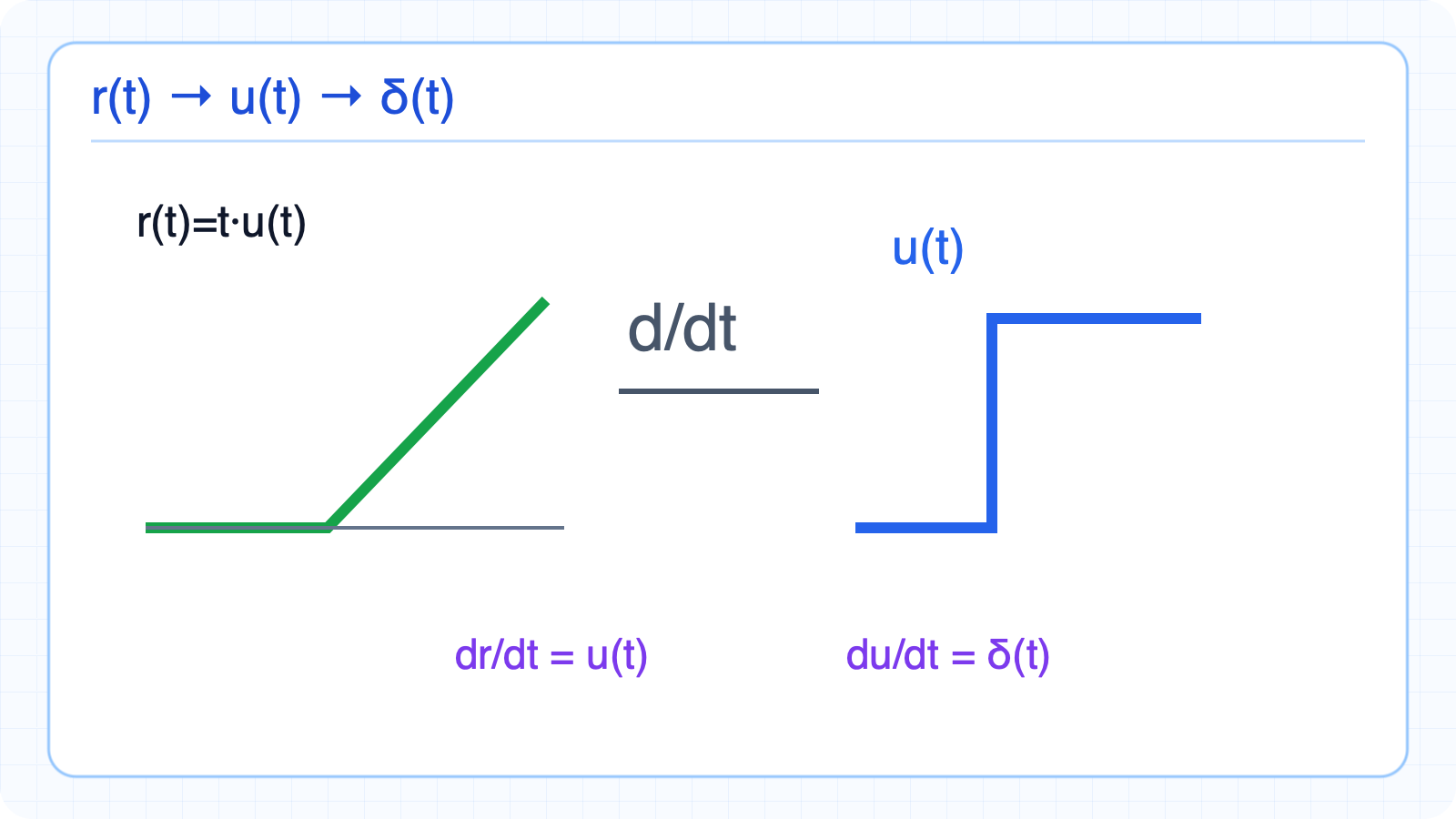
dr/dt=u(t) and du/dt=δ(t). Unit ramp:Zero for t<0Slope 1 for t≥0dr(t)/dt=u(t)du(t)/dt=δ(t)Integration travels in the reverse direction∫δ→u and ∫u→rNarration transcript
The unit ramp, r of t, equals t times u of t. It starts at zero and increases linearly with slope one. The ramp is the integral of the step function. This gives us a beautiful chain connected by differentiation: the derivative of the ramp is the step, and the derivative of the step is the impulse. Going the other direction through integration: integrating the impulse gives the step, and integrating the step gives the ramp. This chain — ramp, step, impulse — will appear throughout circuit analysis.
5. Exponential circuit responses
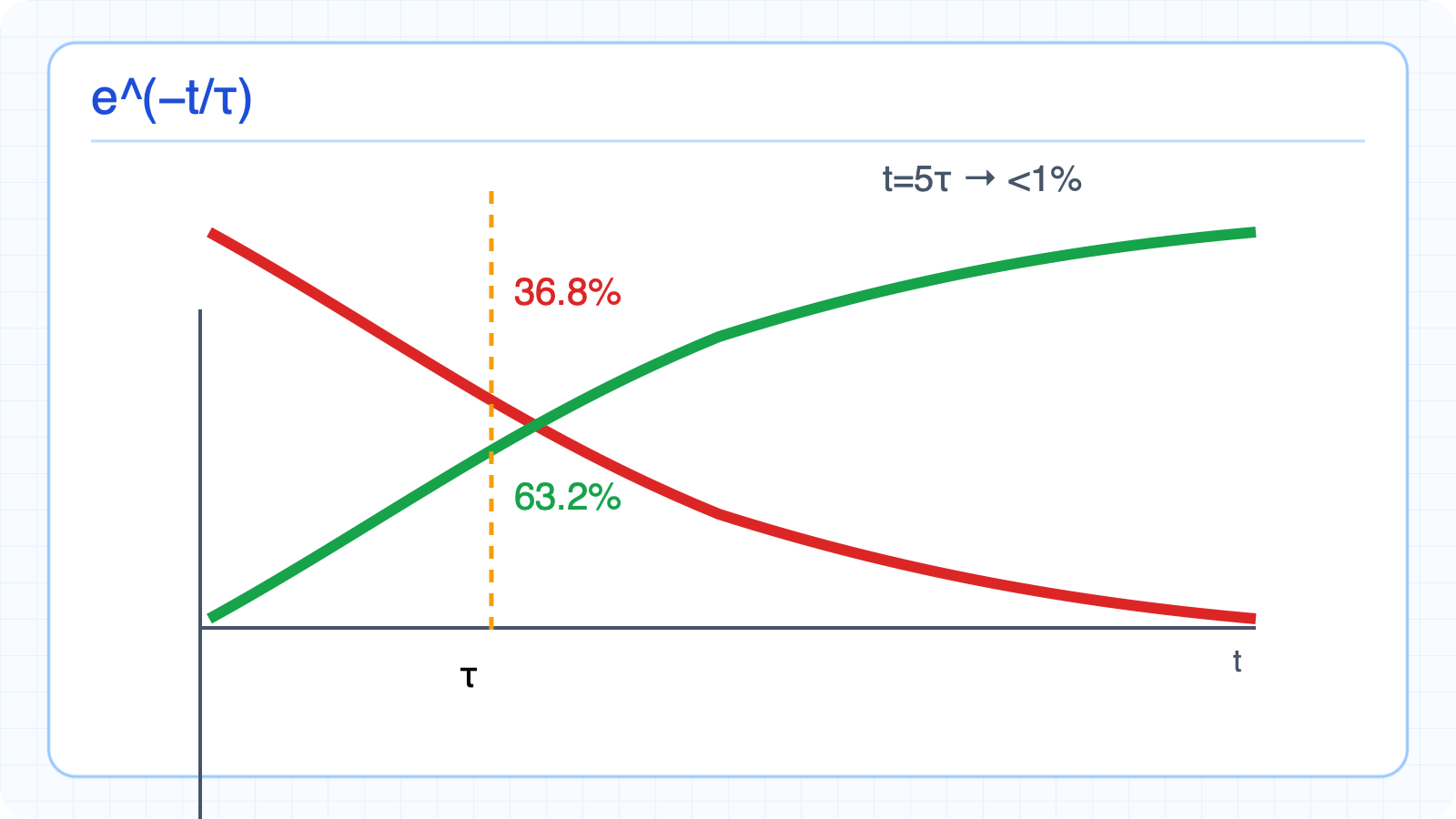
At τ: 36.8% and 63.2%; after 5τ: less than one percent. The basic first-order response shapeDecay: A·e(−t/τ)u(t)At t=τ:Rise: A[1−e(−t/τ)]u(t)At t=τ: 0.632AAt t=5τ:After 5τ the error is below one percentNarration transcript
The decaying exponential, A times e to the minus t over tau, times u of t, is THE shape of every first-order natural response. Tau is the time constant. At t equals tau, the signal drops to 36.8 percent of its initial value. At two tau, it's down to 13.5 percent. The five-tau rule says: after five time constants, the signal is below one percent — practically zero. The rising complement, A times one minus e to the minus t over tau, starts at zero and approaches A. At t equals tau it reaches 63.2 percent. The decay is the RC discharge shape. The rise is the RC charging shape. Together they describe all first-order circuit responses.
6. Sinusoid and damped oscillation
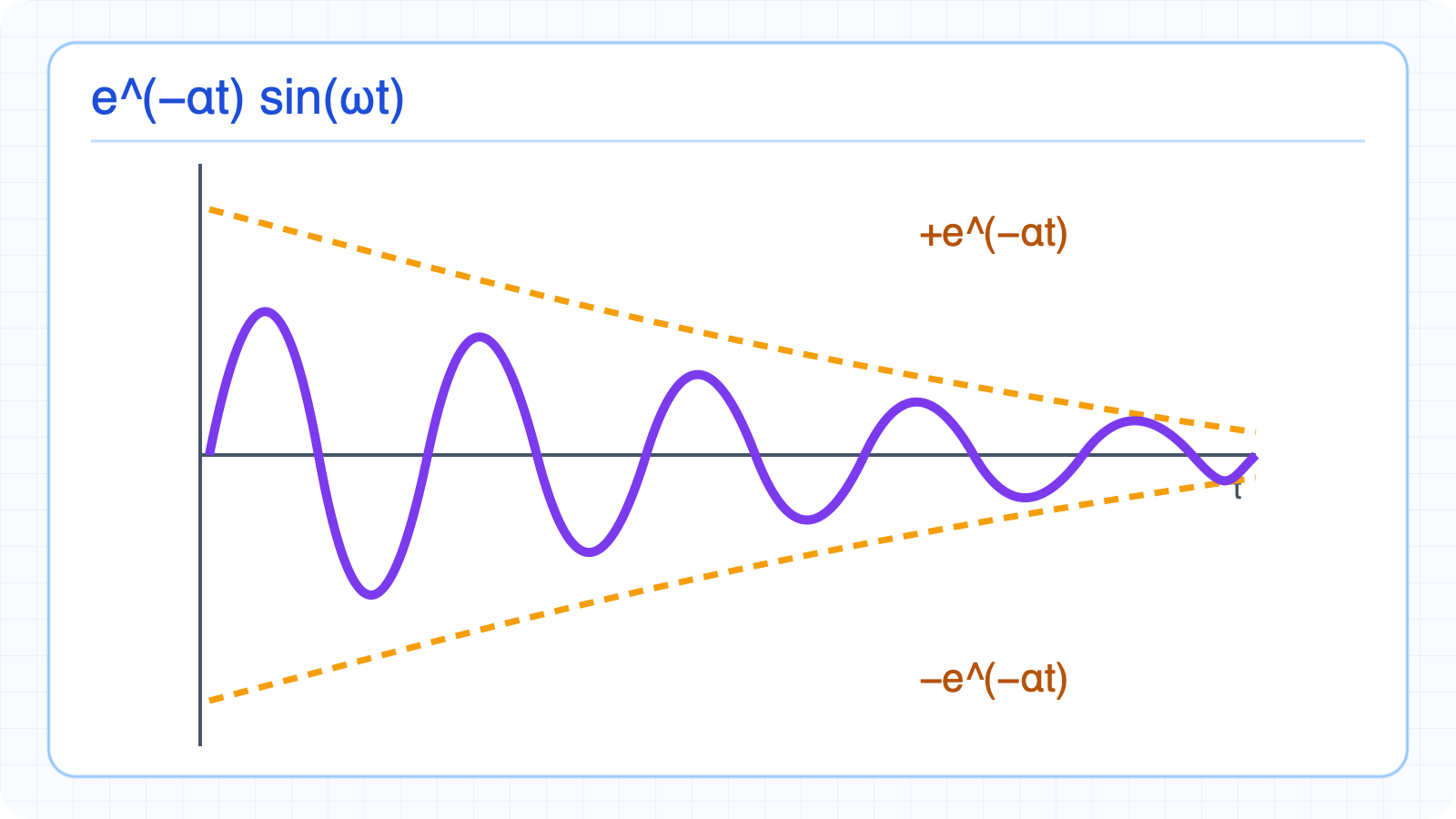
Oscillations die out in underdamped second-order circuits. General sinusoid: a sinωt+b cosωtAmplitude: √(a²+b²)Damped form: e(−αt)sin(ωt)u(t)Envelopes: ±e(−αt)For α>0, oscillation decays with timeFrequency ω, decay rate αAn underdamped RLC response rings before settlingNarration transcript
A general sinusoid can be written as a sine omega t plus b cosine omega t, which equals the square root of a squared plus b squared, times cosine of omega t minus theta. Here theta equals arc-tangent of a over b. The damped sinusoid, e to the minus t over tau times sine of omega t times u of t, combines exponential decay with oscillation. The envelope, plus and minus e to the minus alpha t, bounds the oscillation. As time increases, the oscillations die out within the decaying envelope. This is exactly the shape of an underdamped R-L-C circuit response — it rings before settling to its final value.
7. Piecewise-linear decomposition
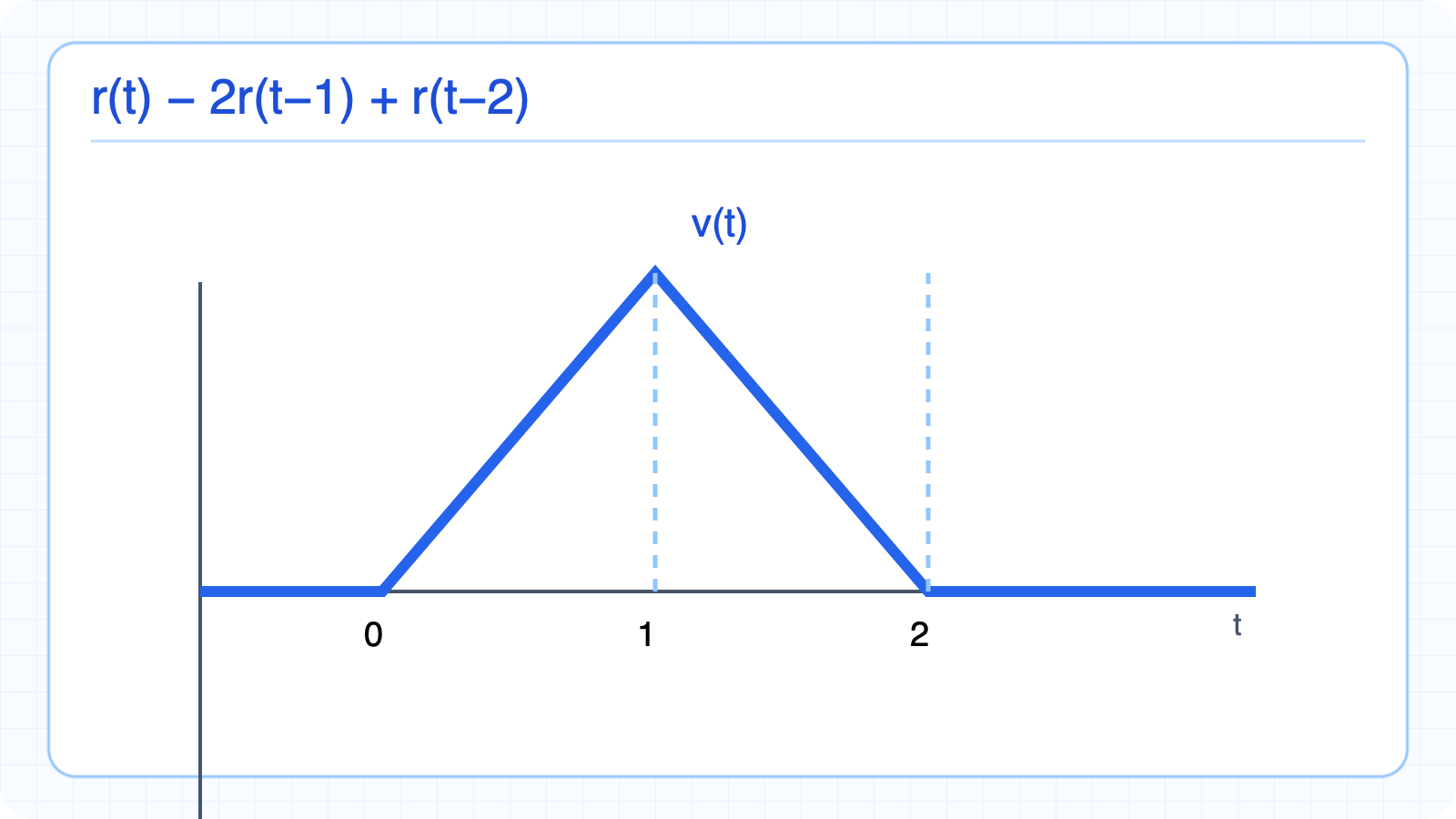
A ramp added at each corner changes the accumulated slope. Build each slope segment with shifted rampsInitial slope +1: r(t)At t=1 the slope changes from +1 to −1Slope change −2: −2r(t−1)At t=2 the slope changes from −1 to 0Slope change +1: +r(t−2)Narration transcript
Any piecewise linear waveform can be expressed as a sum of shifted ramp functions. Here's the key technique: start with r of t for the first rising segment. At each corner or slope change, add a shifted ramp to adjust the slope. For example, a triangular wave rising from zero to one over one second, then falling back: that's r of t, minus 2 r of t minus 1, plus r of t minus 2. Each ramp adds its slope to the running total. This decomposition works for any piecewise linear signal — trapezoids, sawtooth waves, staircase functions. It's the most important practical skill for describing circuit inputs.
8. Derivative chain of a piecewise waveform
Ramps become steps, and steps become signed impulses. Differentiate the triangular waveform twicedv/dt=u(t)−2u(t−1)+u(t−2)The first derivative is the piecewise-constant slopeThe second derivative marks corners with signed impulsesEach derivative moves one level up the chainNarration transcript
Let's see the ramp-step-impulse chain in action. Take our triangular waveform: v of t equals r of t minus 2 r of t minus 1 plus r of t minus 2. Its first derivative replaces each ramp with a step: d v d t equals u of t minus 2 u of t minus 1 plus u of t minus 2. This gives us a rectangular pulse train. The second derivative replaces each step with an impulse: d squared v over d t squared equals delta of t minus 2 delta of t minus 1 plus delta of t minus 2. This impulse train shows exactly where and how the slope changes. Every differentiation moves us one level up the chain: ramps become steps, steps become impulses.
9. Waveform toolbox
Ramps become steps, and steps become signed impulses. Fundamental signals for circuit analysisu(t): switchingr(t): linear changeδ(t): instantaneous action and siftinge(−t/τ): first-order transiente(−αt)sinωt: underdamped second-order responseShift + scale systematically constructs complex inputsNarration transcript
Let's review our waveform toolbox. The unit step u of t models switch actions. The unit ramp r of t models linear increases. The impulse delta of t is the derivative of the step and enables the sifting property. The exponential describes first-order circuit responses with a time constant tau. The damped sinusoidal describes underdamped second-order responses. And we learned to decompose any piecewise linear waveform into shifted ramps and steps. In the next lecture, we'll study series and parallel combinations of capacitors and inductors, and how to find initial conditions for circuit analysis.