Electromagnetic Theory · Gradient, Divergence and Curl
#05 Fundamental differential operators and identities of vector calculus
Compare steepest increase, source strength, and local circulation through gradient, divergence, and curl.
Question
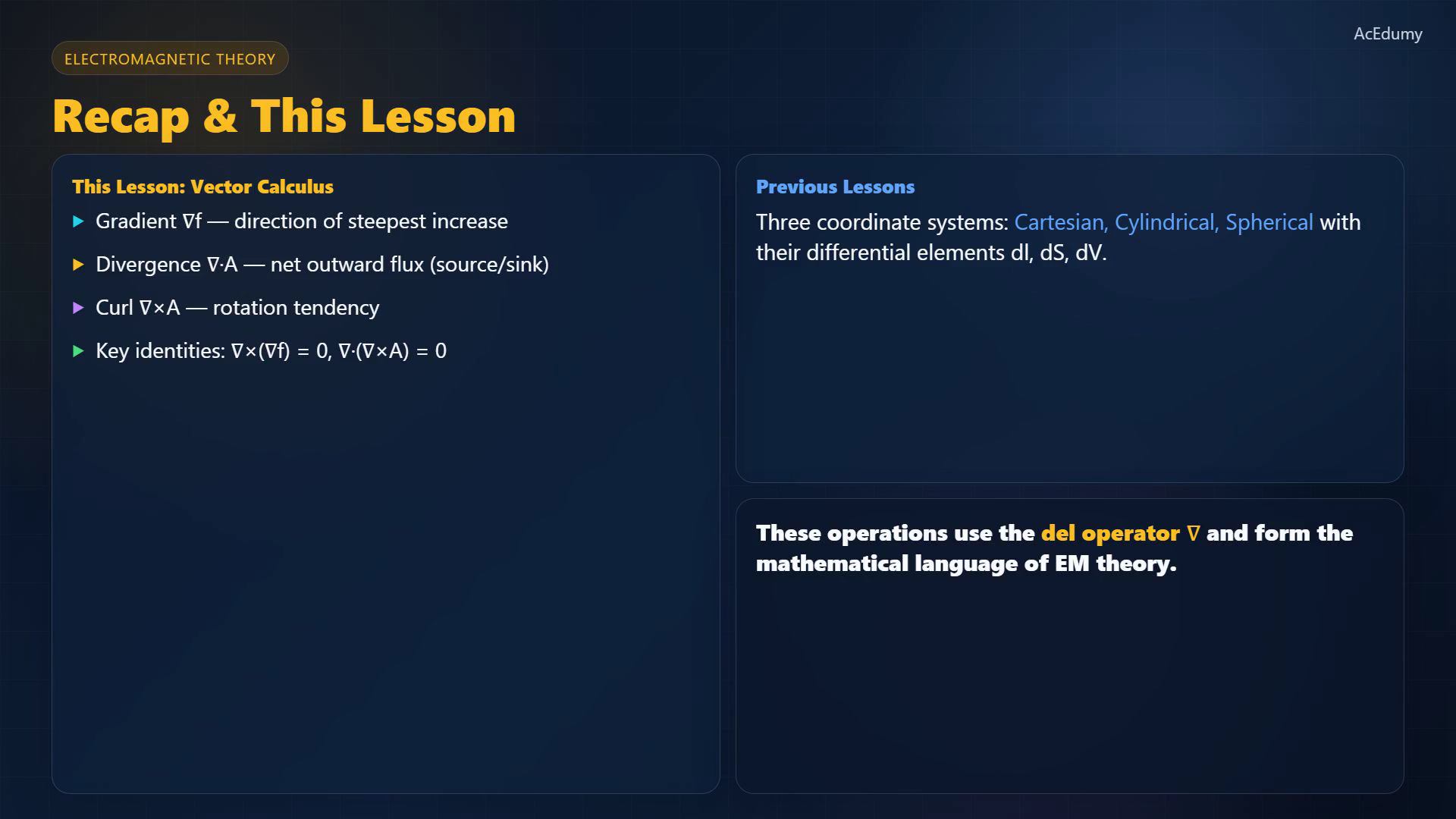
Explain the input and output types, physical meanings, Cartesian forms of gradient, divergence, and curl, and the identities ∇×∇f=0 and ∇·(∇×A)=0.
Written solution and narration transcript(shows the full solution)
Below are all the lines written in the notebook together with the full narration transcript.
1. Set up the move to vector calculus
Gradient maps scalar to vector, divergence maps vector to scalar, and curl maps vector to vector. In the previous lessons, we defined three coordinate systems: Cartesian, cylindrical, and spherical, along with their differential elements.Now we need the tools to describe how fields change in space.In this lesson, we introduce three fundamental operations of vector calculus: the gradient, the divergence, and the curl.These operations use the del operator, written as an inverted triangle ∇.The gradient tells us the direction of steepest increase of a scalar field.The divergence measures how much a vector field spreads out from a point.And the curl measures the rotation or circulation of a vector field.Narration transcript
In the previous lessons, we defined three coordinate systems: Cartesian, cylindrical, and spherical, along with their differential elements. Now we need the tools to describe how fields change in space. In this lesson, we introduce three fundamental operations of vector calculus: the gradient, the divergence, and the curl. These operations use the del operator, written as an inverted triangle nabla. The gradient tells us the direction of steepest increase of a scalar field. The divergence measures how much a vector field spreads out from a point. And the curl measures the rotation or circulation of a vector field.
2. Define and interpret the gradient
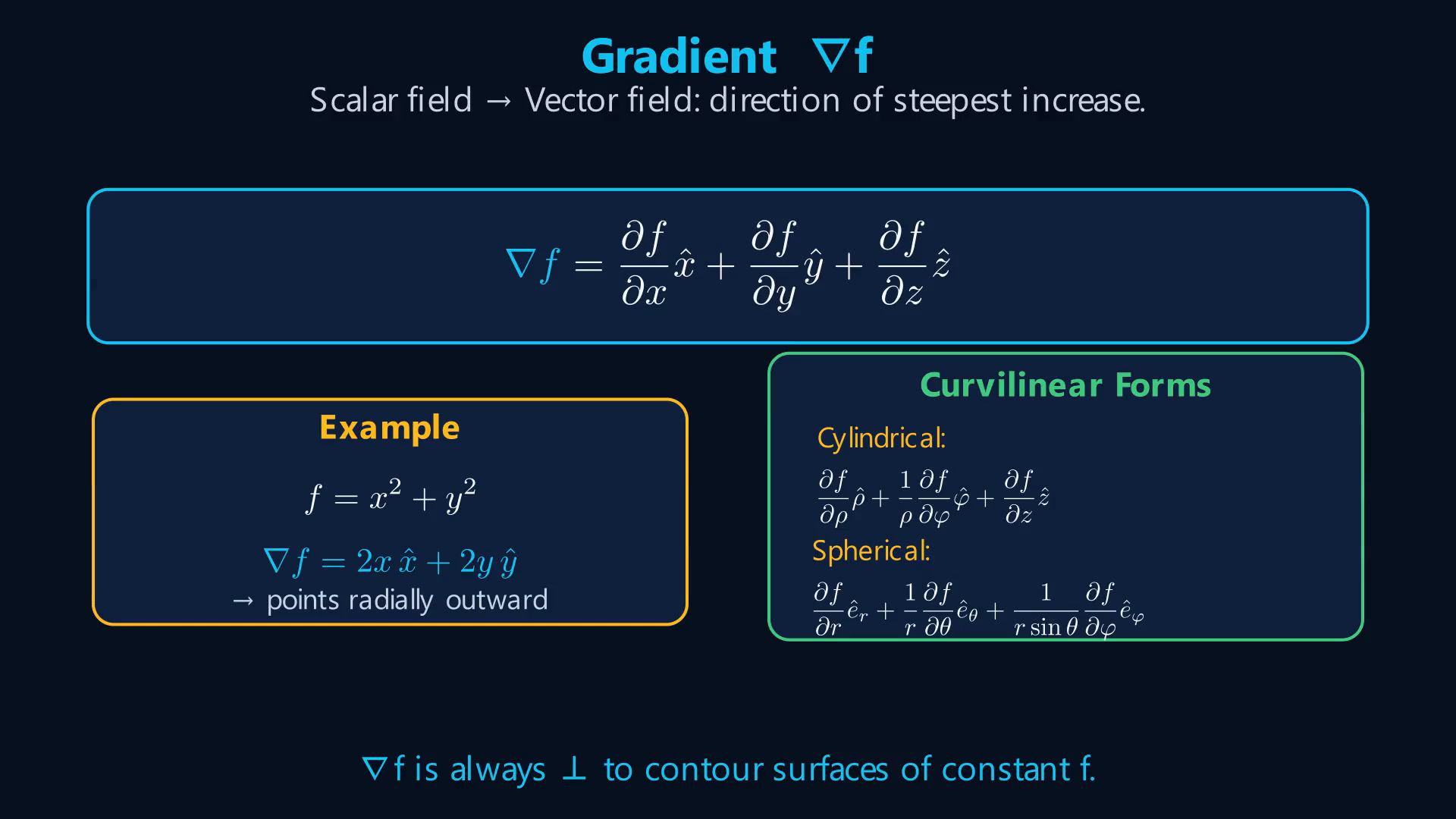
Gradient maps scalar to vector, divergence maps vector to scalar, and curl maps vector to vector. The gradient operates on a scalar field and produces a vector field.For scalar f(x,y,z), ∇f = (∂f/∂x)ex + (∂f/∂y)ey + (∂f/∂z)ez.The gradient vector points in the direction of the greatest rate of increase of f, and its magnitude equals that rate of increase.Geometrically, the gradient is always perpendicular to the contour surfaces of constant f.Example: if f = x² + y², then ∇f = 2x ex + 2y ey.This points radially outward from the origin, which makes sense because f increases as we move away from the origin.Cylindrical:Spherical:Notice how the metric coefficients appear in the denominator.Narration transcript
The gradient operates on a scalar field and produces a vector field. Given a scalar function f of x, y, z, the gradient is defined as nabla f equals partial f over partial x, x hat, plus partial f over partial y, y hat, plus partial f over partial z, z hat. The gradient vector points in the direction of the greatest rate of increase of f, and its magnitude equals that rate of increase. Geometrically, the gradient is always perpendicular to the contour surfaces of constant f. A simple example: if f equals x squared plus y squared, then nabla f equals 2 x, x hat, plus 2 y, y hat. This points radially outward from the origin, which makes sense because f increases as we move away from the origin. In cylindrical coordinates, the gradient has the form: partial f over partial rho, rho hat, plus one over rho, partial f over partial phi, phi hat, plus partial f over partial z, z hat. In spherical coordinates: partial f over partial r, r hat, plus one over r, partial f over partial theta, theta hat, plus one over r sine theta, partial f over partial phi, phi hat. Notice how the metric coefficients appear in the denominator.
3. Define and interpret divergence
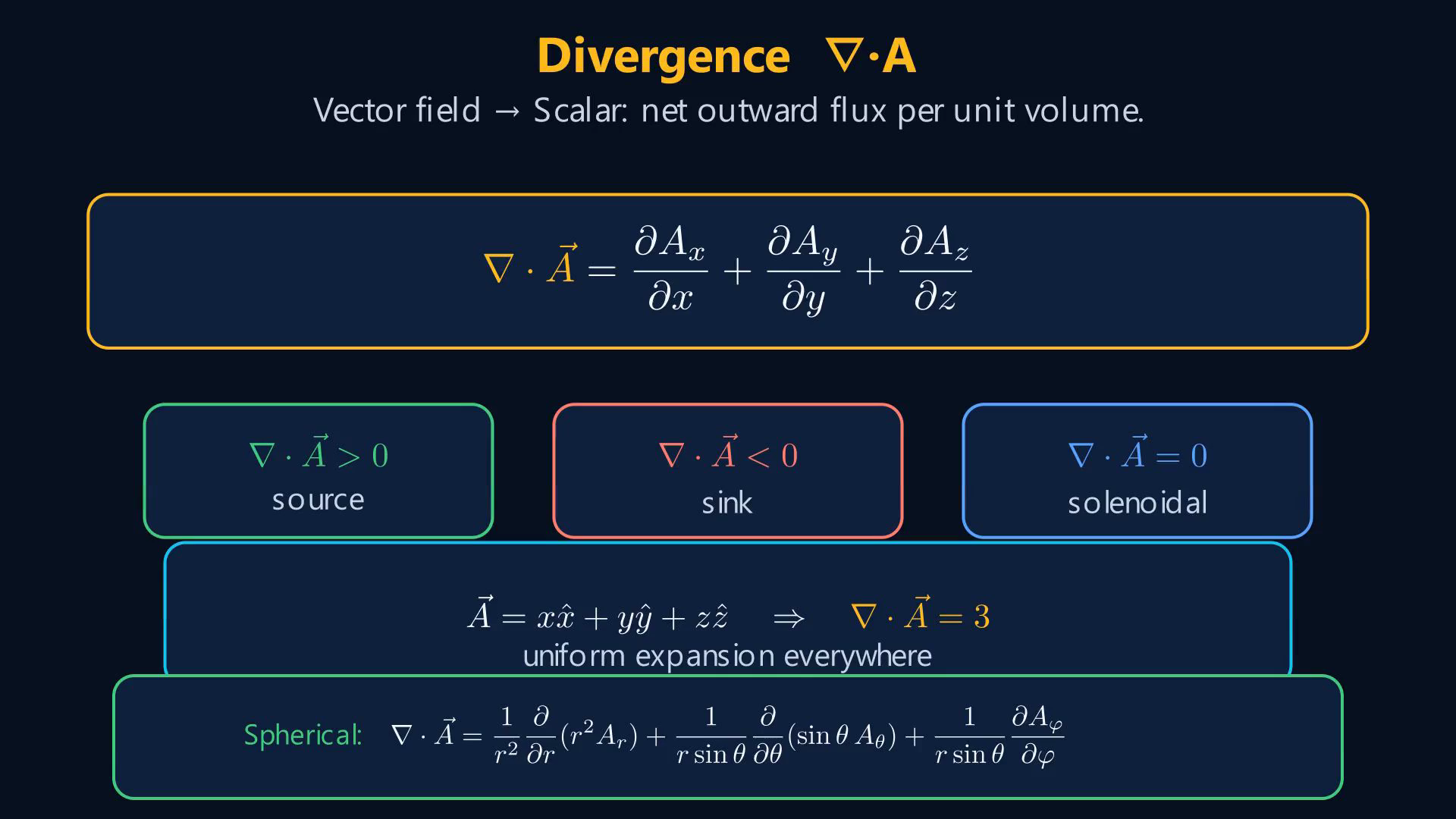
Gradient maps scalar to vector, divergence maps vector to scalar, and curl maps vector to vector. The divergence operates on a vector field and produces a scalar.For A = (Ax,Ay,Az), ∇·A = ∂Ax/∂x + ∂Ay/∂y + ∂Az/∂z.Physically, the divergence measures the net outward flux per unit volume from an infinitesimal region.A positive divergence means the field is a source at that point.A negative divergence means the field is a sink.Zero divergence means the field has no net outward flow, it is solenoidal.For example, A = x ex + y ey + z ez has ∇·A = 3, so it expands uniformly everywhere.Spherical:The divergence will be essential for Gauss's law in electrostatics.Narration transcript
The divergence operates on a vector field and produces a scalar. For a vector field A with components A x, A y, A z, the divergence is defined as nabla dot A equals partial A x over partial x, plus partial A y over partial y, plus partial A z over partial z. Physically, the divergence measures the net outward flux per unit volume from an infinitesimal region. A positive divergence means the field is a source at that point. A negative divergence means the field is a sink. Zero divergence means the field has no net outward flow, it is solenoidal. For example, the field A equals x, x hat, plus y, y hat, plus z, z hat has divergence equal to 3, meaning it uniformly expands everywhere. In spherical coordinates, the divergence formula becomes: one over r squared, partial over partial r of r squared A r, plus one over r sine theta, partial over partial theta of sine theta A theta, plus one over r sine theta, partial A phi over partial phi. The divergence will be essential for Gauss's law in electrostatics.
4. Define and interpret curl
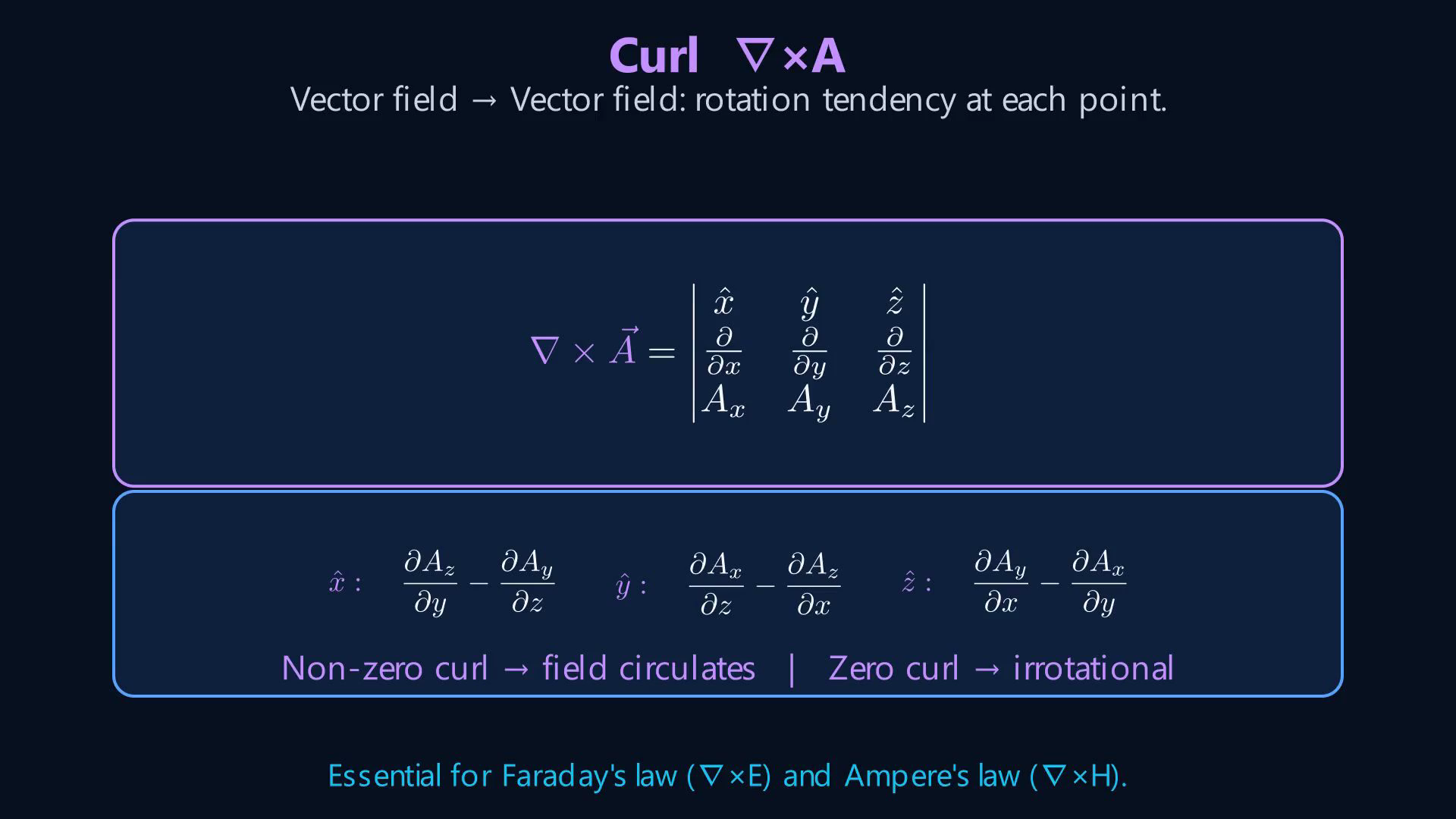
Gradient maps scalar to vector, divergence maps vector to scalar, and curl maps vector to vector. The curl operates on a vector field and produces another vector field.It measures the tendency of the field to circulate around a point.In Cartesian coordinates, the curl of A is computed as the determinant of a three by three matrix with ex, ey, ez in the first row, ∂ / ∂ x, ∂ / ∂ y, ∂ / ∂ z in the second row, and Ax, Ay, Az in the third row.Expanding this gives three components.The x component is (∇×A)x = ∂Az/∂y − ∂Ay/∂z.The y component is (∇×A)y = ∂Ax/∂z − ∂Az/∂x.The z component is (∇×A)z = ∂Ay/∂x − ∂Ax/∂y.Physically, a nonzero curl means the field has rotational behavior.If you place a tiny paddle wheel in the field, it would spin.A field with zero curl everywhere is called irrotational.The curl will be essential for Faraday's law and Ampere's law.Narration transcript
The curl operates on a vector field and produces another vector field. It measures the tendency of the field to circulate around a point. In Cartesian coordinates, the curl of A is computed as the determinant of a three by three matrix with x hat, y hat, z hat in the first row, partial over partial x, partial over partial y, partial over partial z in the second row, and A x, A y, A z in the third row. Expanding this gives three components. The x component is partial A z over partial y minus partial A y over partial z. The y component is partial A x over partial z minus partial A z over partial x. The z component is partial A y over partial x minus partial A x over partial y. Physically, a nonzero curl means the field has rotational behavior. If you place a tiny paddle wheel in the field, it would spin. A field with zero curl everywhere is called irrotational. The curl will be essential for Faraday's law and Ampere's law.
5. Connect the two key identities
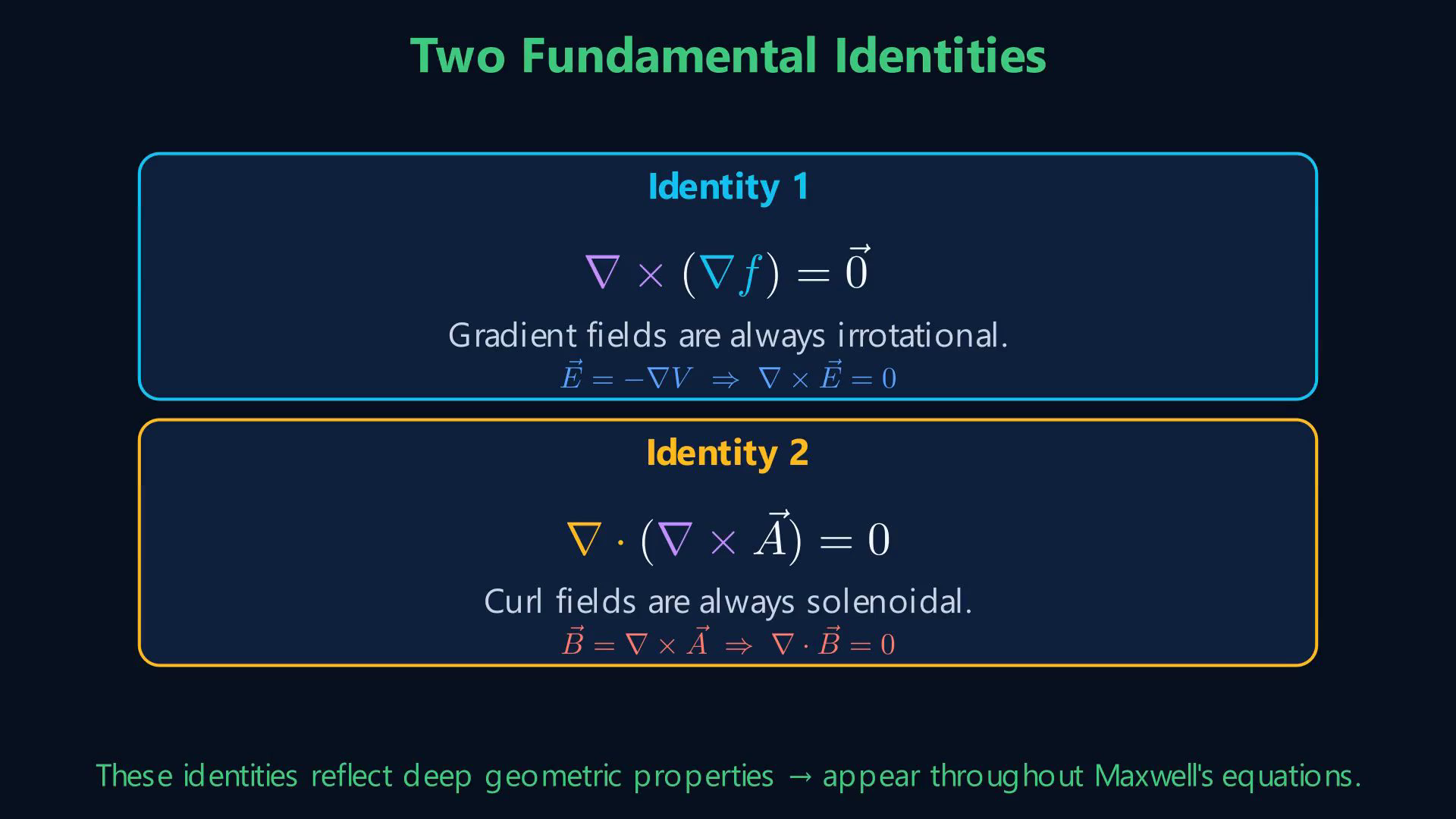
Gradient maps scalar to vector, divergence maps vector to scalar, and curl maps vector to vector. Two important identities connect these operations.First: the curl of a gradient is always zero.That is, ∇×(∇f) = 0⃗ for every scalar f.This means gradient fields are always irrotational.In electrostatics, E = −∇V implies ∇×E = 0⃗.Second: the divergence of a curl is always zero.That is, ∇·(∇×A) = 0 for every vector A.This means curl fields are always solenoidal.In magnetostatics, B = ∇×A implies ∇·B = 0.These two identities are not coincidences.They reflect deep geometric properties of space and will appear repeatedly in Maxwell's equations.Narration transcript
Two important identities connect these operations. First: the curl of a gradient is always zero. That is, nabla cross nabla f equals the zero vector for any scalar f. This means gradient fields are always irrotational. In electrostatics, this tells us the electric field E equals minus nabla V has zero curl. Second: the divergence of a curl is always zero. That is, nabla dot nabla cross A equals zero for any vector A. This means curl fields are always solenoidal. In magnetostatics, this tells us the magnetic field B equals nabla cross A has zero divergence. These two identities are not coincidences. They reflect deep geometric properties of space and will appear repeatedly in Maxwell's equations.
6. Compare the three operators
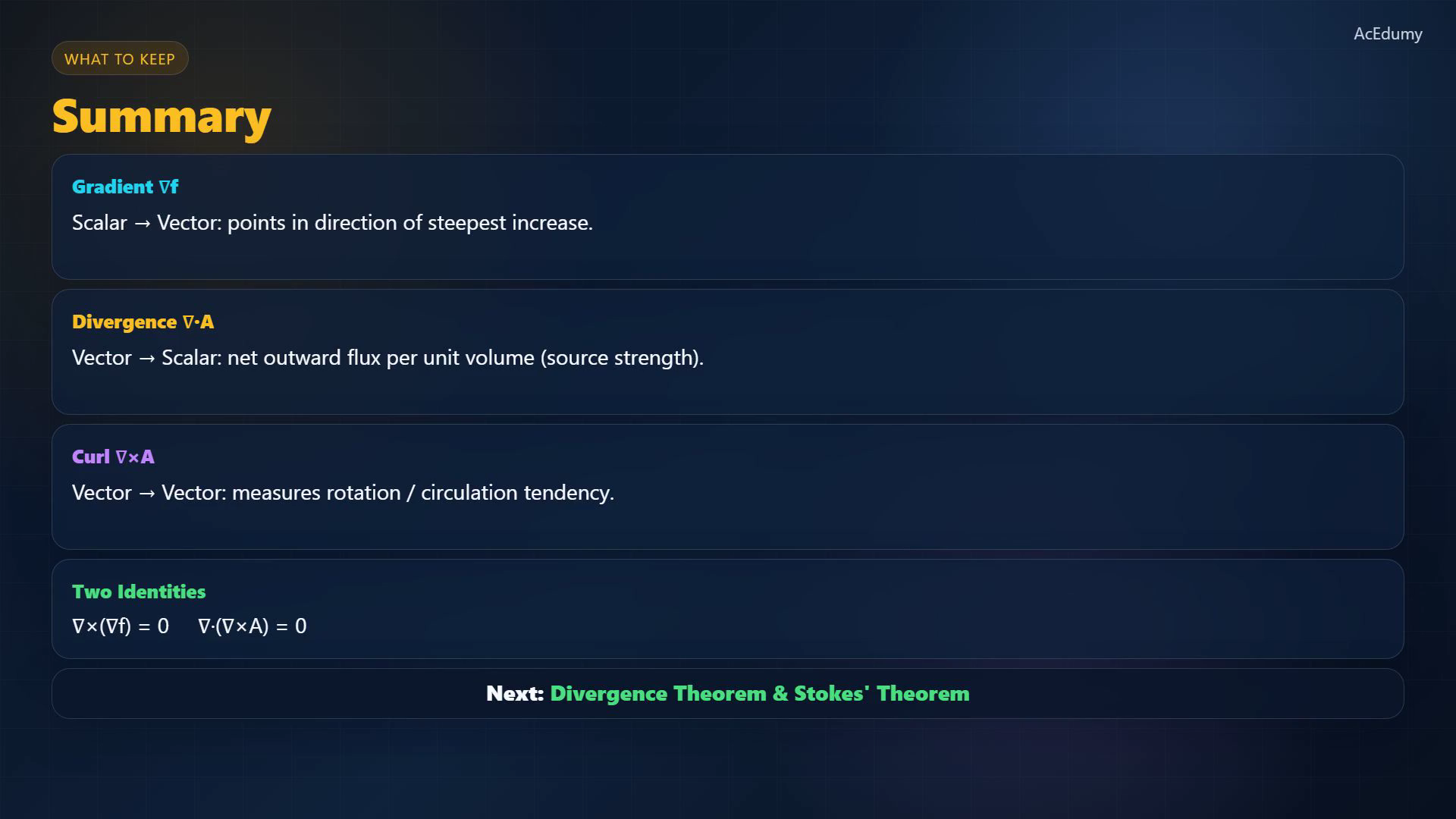
Gradient maps scalar to vector, divergence maps vector to scalar, and curl maps vector to vector. Let's review.The gradient takes a scalar field to a vector field, pointing in the direction of steepest increase.The divergence takes a vector field to a scalar, measuring the net outward flux or source strength at each point.The curl takes a vector field to a vector field, measuring the rotation or circulation tendency.Two key identities: curl of gradient is zero, and divergence of curl is zero.These three operations, together with the two identities, form the mathematical language of electromagnetic theory.Narration transcript
Let's review. The gradient takes a scalar field to a vector field, pointing in the direction of steepest increase. The divergence takes a vector field to a scalar, measuring the net outward flux or source strength at each point. The curl takes a vector field to a vector field, measuring the rotation or circulation tendency. Two key identities: curl of gradient is zero, and divergence of curl is zero. These three operations, together with the two identities, form the mathematical language of electromagnetic theory.
Source video: Electromagnetic Theory (v2) #05 Gradient, Divergence & Curl (6:03)