Antenna Theory · Infinite Line Source via Stationary Phase
#09 The infinite line source's vector potential, stationary phase point, phase cancellation, and cylindrical-wave 1/√ρ decay
Use rapid phase cancellation to isolate the dominant region of an infinite line source and derive cylindrical 1/√ρ spreading.
Question

Set up the vector-potential integral of an infinite z-directed line source; use the stationary-phase condition to select the nearest source region and compare the resulting e^(−jkρ)/√ρ cylindrical wave with spherical spreading.
Written solution and narration transcript(shows the full solution)
Below are all the lines written in the notebook together with the full narration transcript.
1. Recall why the far-field shortcut worked for a bounded dipole
Rapidly oscillating distant contributions cancel; the nearest stationary-phase region sets the e^(−jkρ)/√ρ cylindrical wave. In the previous lesson we solved the short dipole by exploiting one key fact: the source was bounded.Because the current existed only along a finite stretch of wire, we could pull the common amplitude factor 1/r outside the integral and keep only the source-dependent phase inside.That approach gave us the clean sin(theta) pattern.But now imagine a current filament that stretches to infinity in both directions along the z axis.The bounded-source shortcut we relied on no longer applies directly, and we need a different evaluation strategy.Narration transcript
In the previous lesson we solved the short dipole by exploiting one key fact: the source was bounded. Because the current existed only along a finite stretch of wire, we could pull the common amplitude factor one over r outside the integral and keep only the source-dependent phase inside. That approach gave us the clean sine theta pattern. But now imagine a current filament that stretches to infinity in both directions along the z axis. The bounded-source shortcut we relied on no longer applies directly, and we need a different evaluation strategy.
2. Set up the infinite line-source vector-potential integral
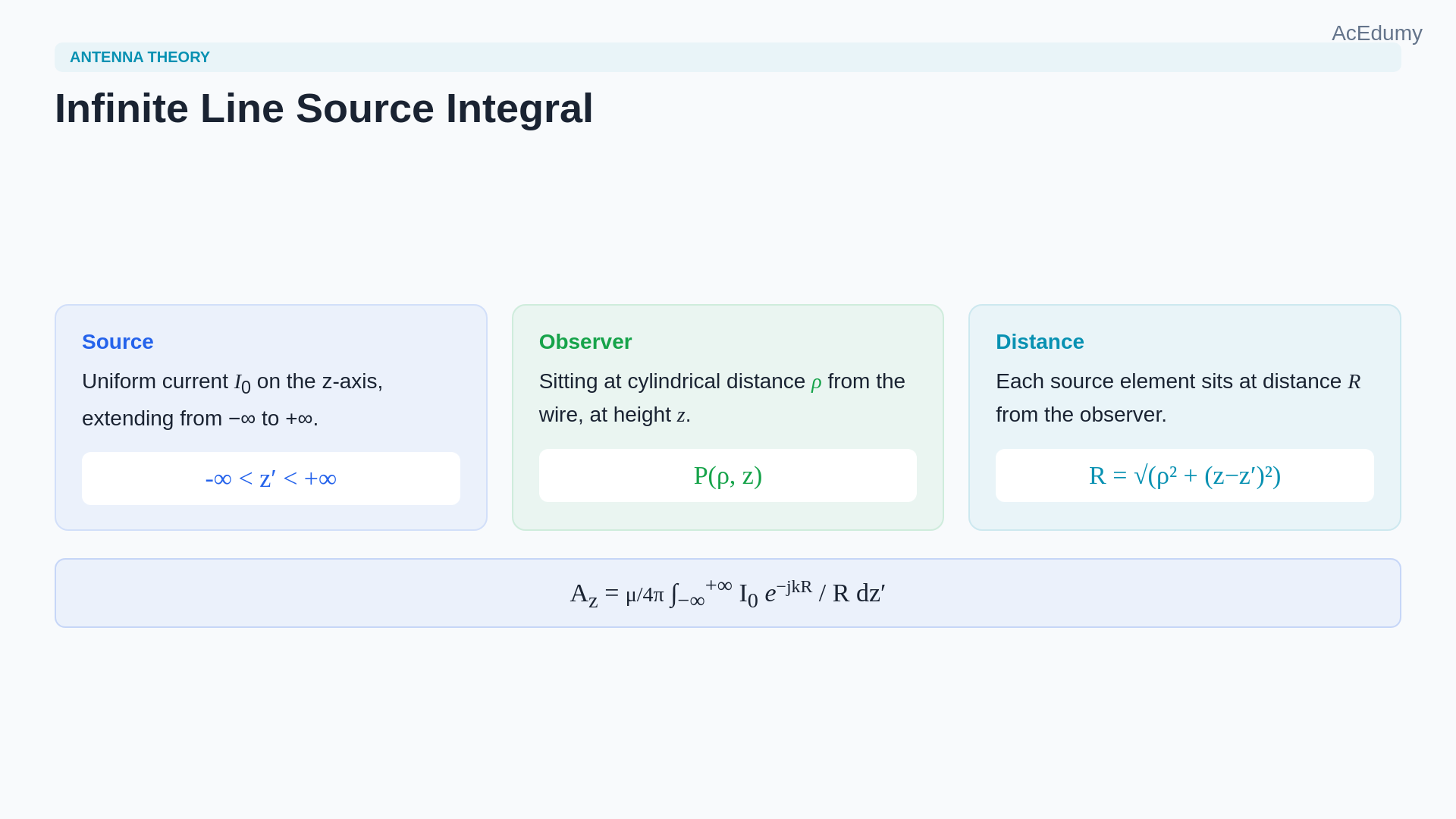
Rapidly oscillating distant contributions cancel; the nearest stationary-phase region sets the e^(−jkρ)/√ρ cylindrical wave. Place the infinite line source along the z axis, carrying a uniform current I₀.The observer sits at a cylindrical distance ρ from the wire.The vector potential integral now runs from minus infinity to plus infinity.Each source element at height z prime contributes through the kernel e(−jkR)/R, where R=√[ρ²+(z−z′)²].Writing this integral is straightforward.The real question is how to extract a useful closed-form answer from an integral whose limits stretch to infinity.Narration transcript
Place the infinite line source along the z axis, carrying a uniform current I zero. The observer sits at a cylindrical distance rho from the wire. The vector potential integral now runs from minus infinity to plus infinity. Each source element at height z prime contributes through the kernel e to the minus j k R divided by R, where R equals the square root of rho squared plus z minus z prime squared. Writing this integral is straightforward. The real question is how to extract a useful closed-form answer from an integral whose limits stretch to infinity.
3. See distant contributions cancel in the phase landscape
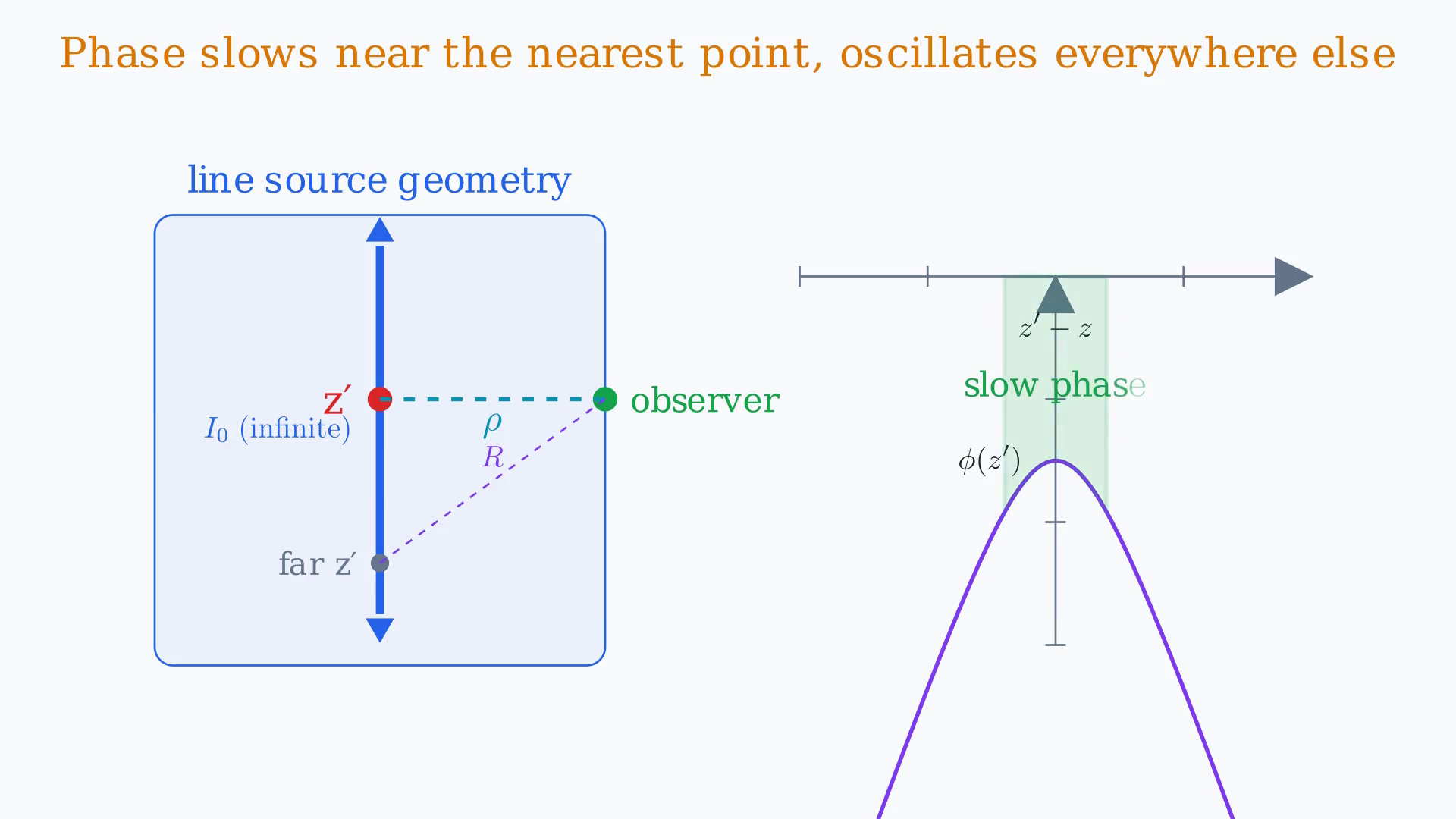
Rapidly oscillating distant contributions cancel; the nearest stationary-phase region sets the e^(−jkρ)/√ρ cylindrical wave. Plot the phase function −kR as a function of z prime.Near the observer's own height z, the phase changes slowly because R is near its minimum value ρ.But as z prime moves away from that point, R grows and the phase drops steeply.The integrand oscillates faster and faster.These rapid oscillations mean that positive and negative contributions cancel almost perfectly.Only the slow-phase neighborhood around the nearest point adds coherently to the integral.Narration transcript
Plot the phase function negative k times R as a function of z prime. Near the observer's own height z, the phase changes slowly because R is near its minimum value rho. But as z prime moves away from that point, R grows and the phase drops steeply. The integrand oscillates faster and faster. These rapid oscillations mean that positive and negative contributions cancel almost perfectly. Only the slow-phase neighborhood around the nearest point adds coherently to the integral.
4. Find the nearest point from dφ/dz′=0
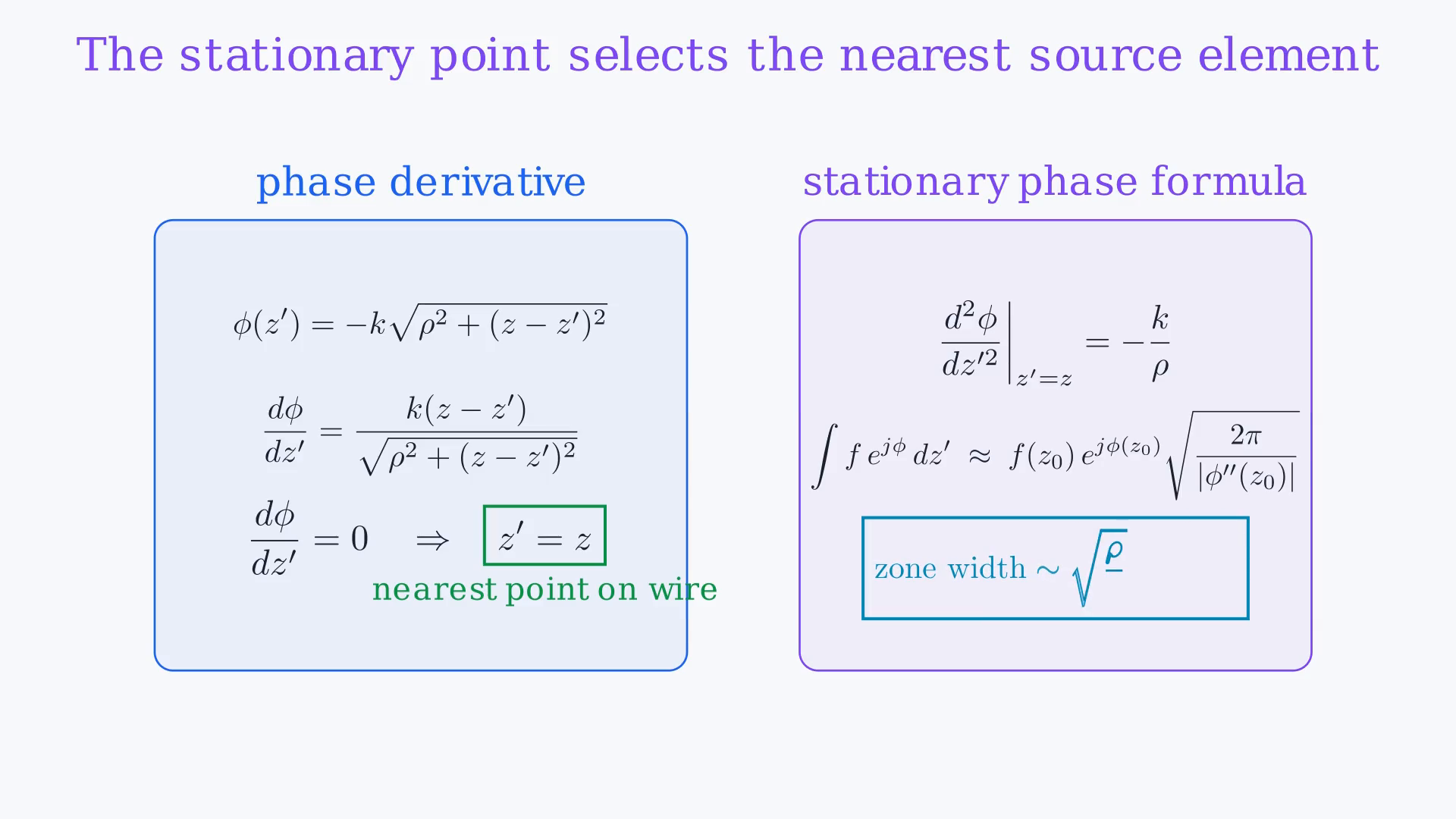
Rapidly oscillating distant contributions cancel; the nearest stationary-phase region sets the e^(−jkρ)/√ρ cylindrical wave. The stationary phase recipe formalizes this observation.Set the derivative of the phase function with respect to z prime equal to zero.For our distance law, the derivative of minus k R vanishes when z′=z, the observer's own height.That is the nearest point on the wire.The second derivative there equals −k/ρ, which tells us how narrow the contributing zone is.A larger ρ means a wider neighborhood contributes, while a shorter wavelength tightens the zone.Narration transcript
The stationary phase recipe formalizes this observation. Set the derivative of the phase function with respect to z prime equal to zero. For our distance law, the derivative of minus k R vanishes when z prime equals z, the observer's own height. That is the nearest point on the wire. The second derivative there equals minus k over rho, which tells us how narrow the contributing zone is. A larger rho means a wider neighborhood contributes, while a shorter wavelength tightens the zone.
5. Derive the e^(−jkρ)/√ρ cylindrical wave
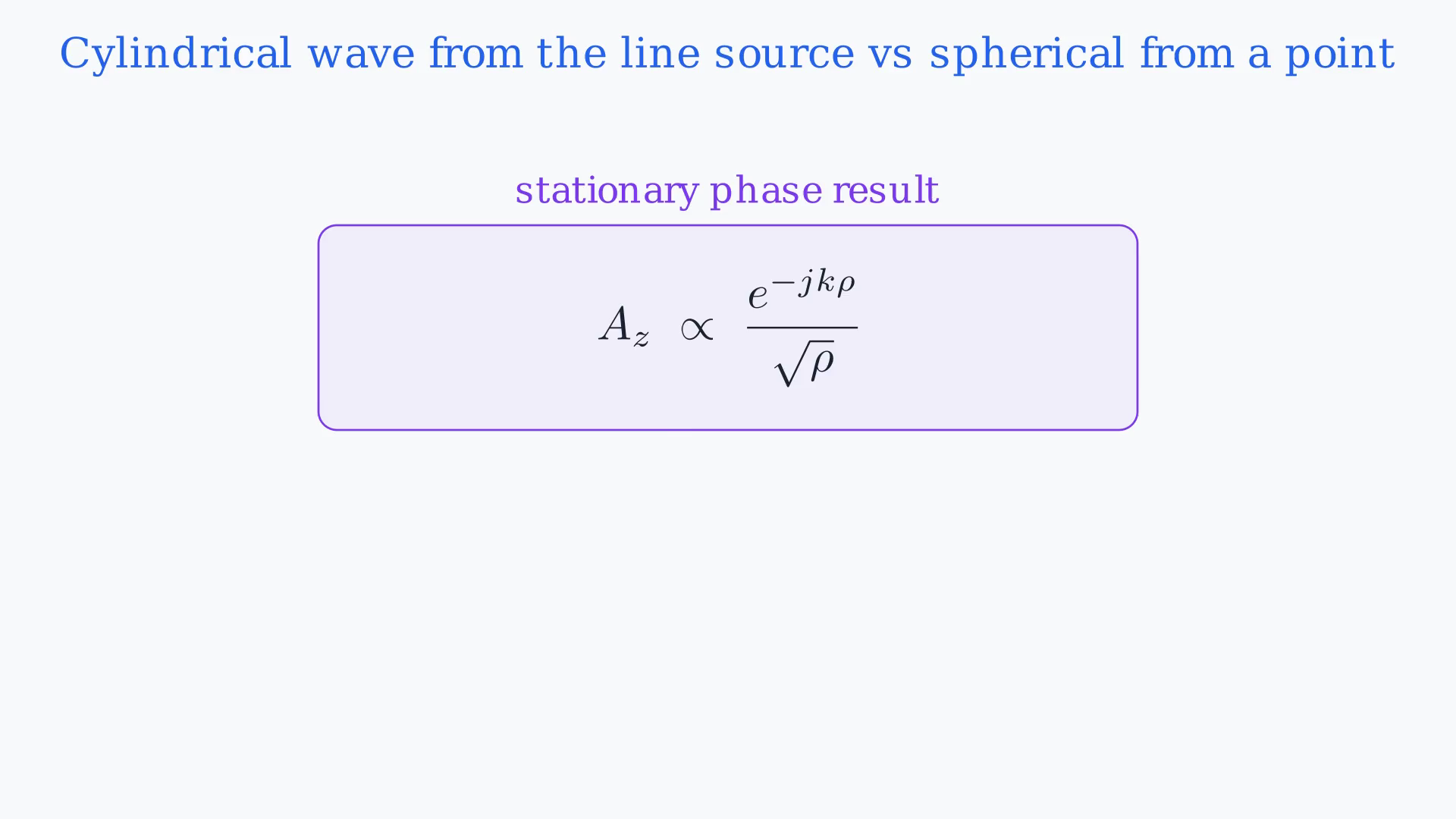
Rapidly oscillating distant contributions cancel; the nearest stationary-phase region sets the e^(−jkρ)/√ρ cylindrical wave. Applying the stationary phase approximation gives the vector potential proportional to e(−jkρ)/√ρ.Compare this with the bounded dipole, where the answer was e(−jkr)/r.The infinite line source produces a cylindrical wave.Energy spreads over expanding cylinders instead of expanding spheres, so the amplitude decays as 1/√ρ rather than 1/r.This slower decay reflects the fact that the line source maintains coherent radiation along its entire length.Narration transcript
Applying the stationary phase approximation gives the vector potential proportional to e to the minus j k rho over the square root of rho. Compare this with the bounded dipole, where the answer was e to the minus j k r over r. The infinite line source produces a cylindrical wave. Energy spreads over expanding cylinders instead of expanding spheres, so the amplitude decays as one over root rho rather than one over r. This slower decay reflects the fact that the line source maintains coherent radiation along its entire length.
6. Interpret the effective √(λρ) radiation zone
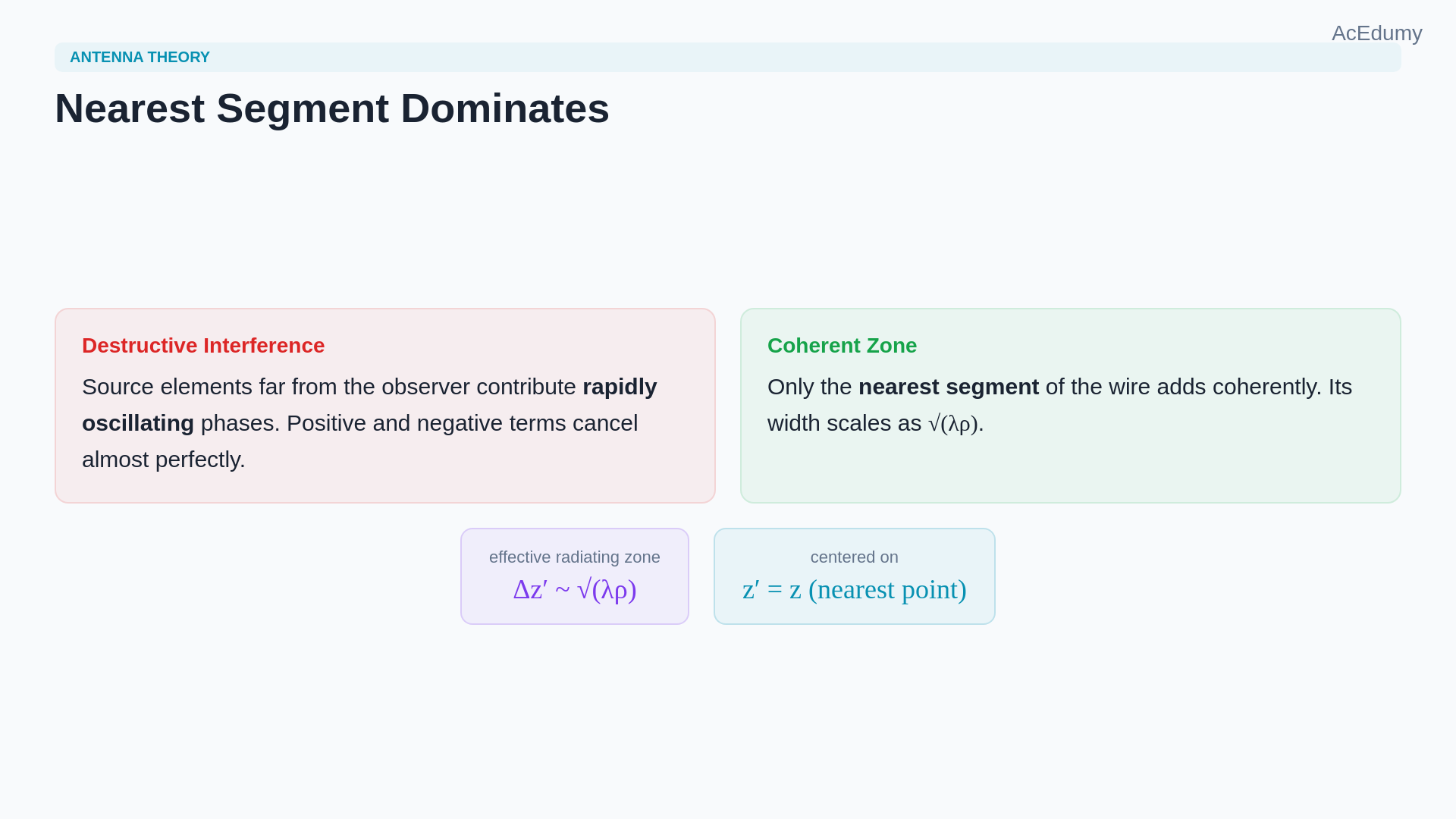
Rapidly oscillating distant contributions cancel; the nearest stationary-phase region sets the e^(−jkρ)/√ρ cylindrical wave. The physical picture is elegantly simple.Even though the wire extends to infinity, the radiation at any observation point comes predominantly from the nearest segment.Distant parts of the wire contribute rapidly oscillating phases that cancel through destructive interference.The effective radiating zone is centered on the nearest point and has a characteristic width proportional to the √(λρ).Narration transcript
The physical picture is elegantly simple. Even though the wire extends to infinity, the radiation at any observation point comes predominantly from the nearest segment. Distant parts of the wire contribute rapidly oscillating phases that cancel through destructive interference. The effective radiating zone is centered on the nearest point and has a characteristic width proportional to the square root of the product of wavelength and distance.
7. Summarize the three layers of the line-source solution
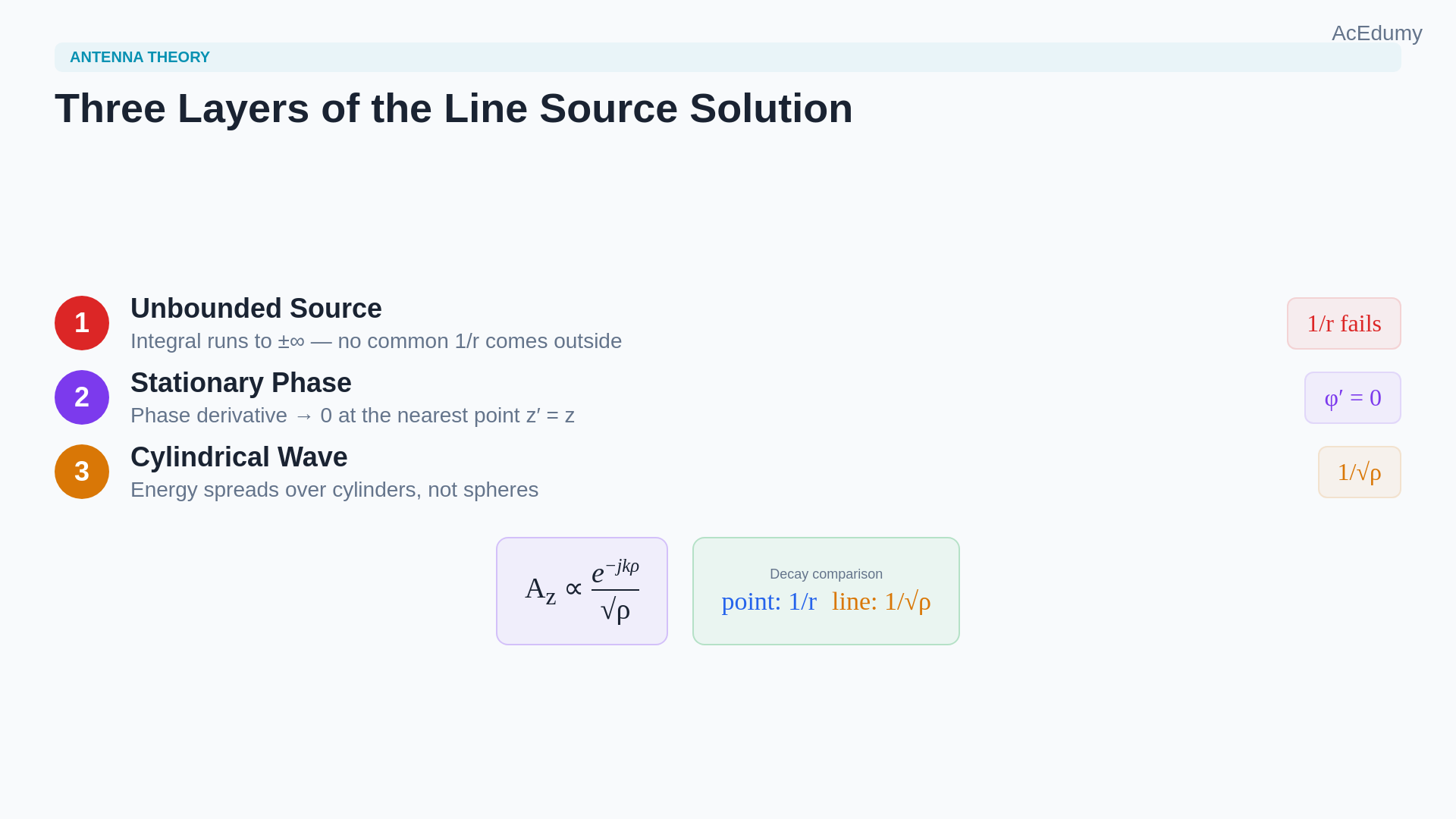
Rapidly oscillating distant contributions cancel; the nearest stationary-phase region sets the e^(−jkρ)/√ρ cylindrical wave. The infinite line source via stationary phase summarizes in three layers.First, the source is unbounded, so pulling 1/r outside does not work.Second, the stationary phase method identifies the dominant contributing zone around the nearest source point.And third, the result is a cylindrical wave with 1/√ρ decay, matching the cylindrical symmetry of the infinite geometry.Narration transcript
The infinite line source via stationary phase summarizes in three layers. First, the source is unbounded, so pulling one over r outside does not work. Second, the stationary phase method identifies the dominant contributing zone around the nearest source point. And third, the result is a cylindrical wave with one over root rho decay, matching the cylindrical symmetry of the infinite geometry.
8. Combine far field and stationary phase into one toolkit

Rapidly oscillating distant contributions cancel; the nearest stationary-phase region sets the e^(−jkρ)/√ρ cylindrical wave. This lesson and the previous one form a complementary pair.The far-field approach handles bounded sources by exploiting a shared observer distance.The stationary phase method handles extended sources by letting the phase landscape select the important zone.Together they give us the complete evaluation toolkit for radiation from any current distribution.Narration transcript
This lesson and the previous one form a complementary pair. The far-field approach handles bounded sources by exploiting a shared observer distance. The stationary phase method handles extended sources by letting the phase landscape select the important zone. Together they give us the complete evaluation toolkit for radiation from any current distribution.
Source video: Antenna Theory #09 | Infinite Line Source | Stationary Phase in Action (4:58)