Circuit Theory 2 · Instantaneous and average power
#07 Distinguish pointwise power, cycle-average power and energy transfer under the passive sign convention
Multiply voltage and current at each instant, distinguish storage from dissipation, and average over a cycle with explicit sign and RMS conventions.
Question
Use the passive sign convention: the reference current enters the terminal marked positive for the reference voltage. Positive instantaneous power means absorption at that instant; negative means delivery. These are reference directions, not a claim that current is always positive. For the sinusoidal comparisons assume a single-phase lumped circuit in periodic steady state at one nonzero frequency, ideal positive resistance R and ideal lossless inductance or capacitance. Let voltage be V_m cos(ωt), current I_m cos(ωt−φ), and V_m and I_m be nonnegative peak amplitudes; positive φ means current lags voltage. RMS values are the peak amplitudes divided by sqrt(2). Derive p(t)=v(t)i(t), and define average power as the integral over a full period divided by the period; net cycle energy is that average multiplied by the period. A positive resistor has nonnegative instantaneous power at all times, not briefly negative power. Its average is strictly positive for nonzero excitation; power is zero at the waveform zero crossings. Purely reactive elements alternate between absorption and return, with zero cycle-average power in periodic steady state; zero average does not mean zero instantaneous power or zero stored energy. Compare phase differences at fixed RMS voltage and current. The usual positive-average discussion refers to an absorbing passive load; an active delivering element can have negative average power. Do not interpret average power as energy or useful-work efficiency. The original narration and video are unchanged. The imprecise resistor narration, legacy graph scaling/sign error and nonzero 90-degree average-power bar require manual publication QA; this is an unpublished draft, not source-audio correction.
Written solution and narration transcript(shows the full solution)
Below are all the lines written in the notebook together with the full narration transcript.
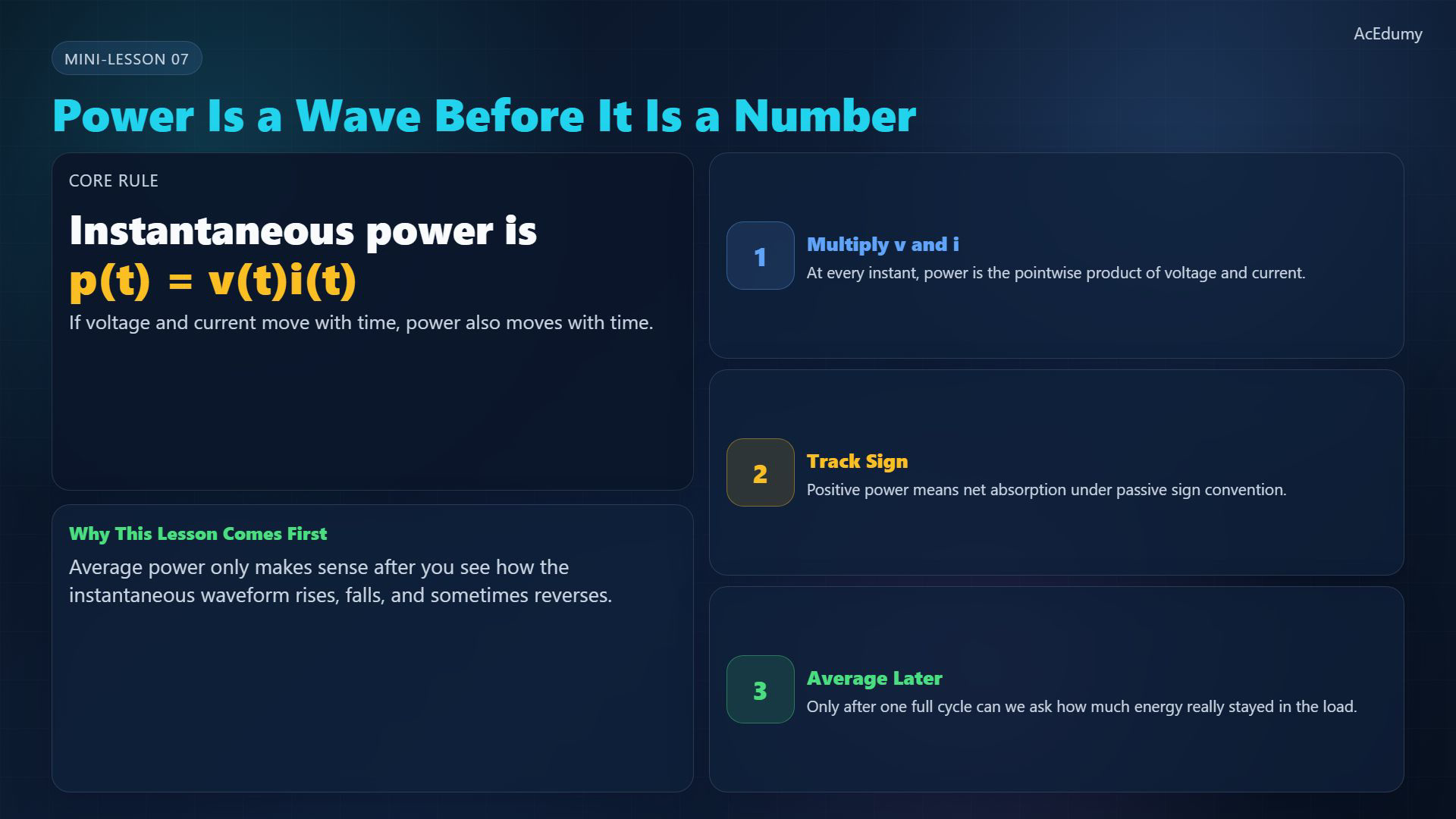
1. Multiply voltage and current at the same instant
Original-video reference card. Problematic waveform and average-power graph frames are replaced by this same lesson's formula overview. The notebook formulas specify passive signs, sinusoidal steady state and cycle-energy units; original narration is unchanged. Start with single-phase sinusoidal steady state and the passive sign convention.Instantaneous absorbed power is the product at the same instant:For nonzero sinusoidal voltage and current, their product varies at twice the waveform frequency.Inspect the instantaneous waveform first; then average it over a full period.Narration transcript
Power in AC circuits is not a fixed number at every instant. At each moment, instantaneous power is simply voltage times current. So if the voltage and current waveforms move, power moves with them. That is why we first study the time-domain power waveform before jumping to average power.
2. Interpret power in an ideal resistor
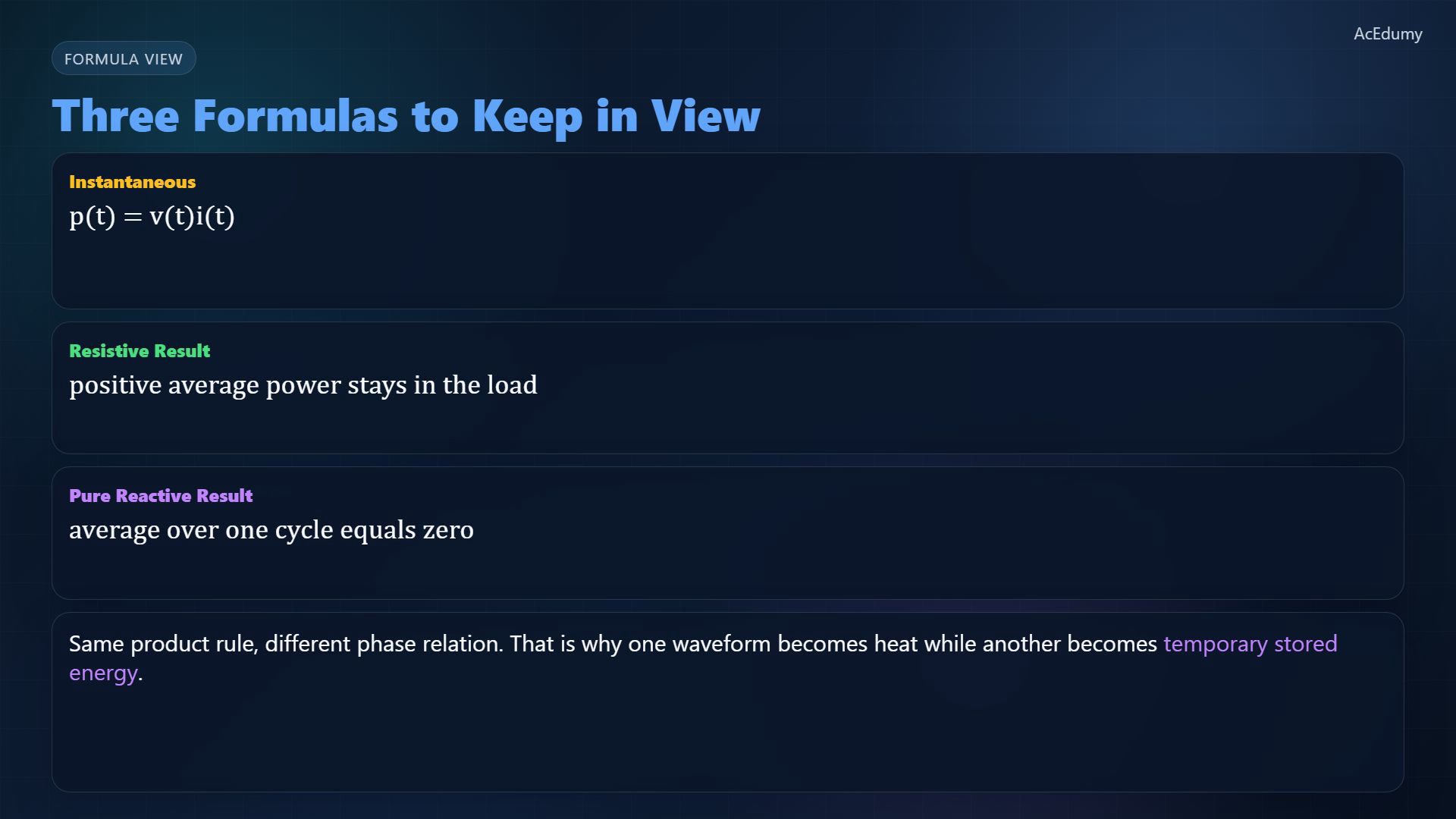
Original-video reference card. Problematic waveform and average-power graph frames are replaced by this same lesson's formula overview. The notebook formulas specify passive signs, sinusoidal steady state and cycle-energy units; original narration is unchanged. For an ideal positive resistor, voltage and current are in phase under passive references.A positive resistor never has negative instantaneous power:It dissipates electrical energy as heat; it does not return stored field energy.With nonzero excitation, the resistor's cycle-average power is positive:Narration transcript
For a pure resistor, voltage and current are in phase. Their product never stays negative for long, and the power waveform remains above zero on average. The source keeps delivering energy, and the resistor keeps converting it into heat. This is the cleanest case of continuous power absorption.
3. Follow reversible energy storage
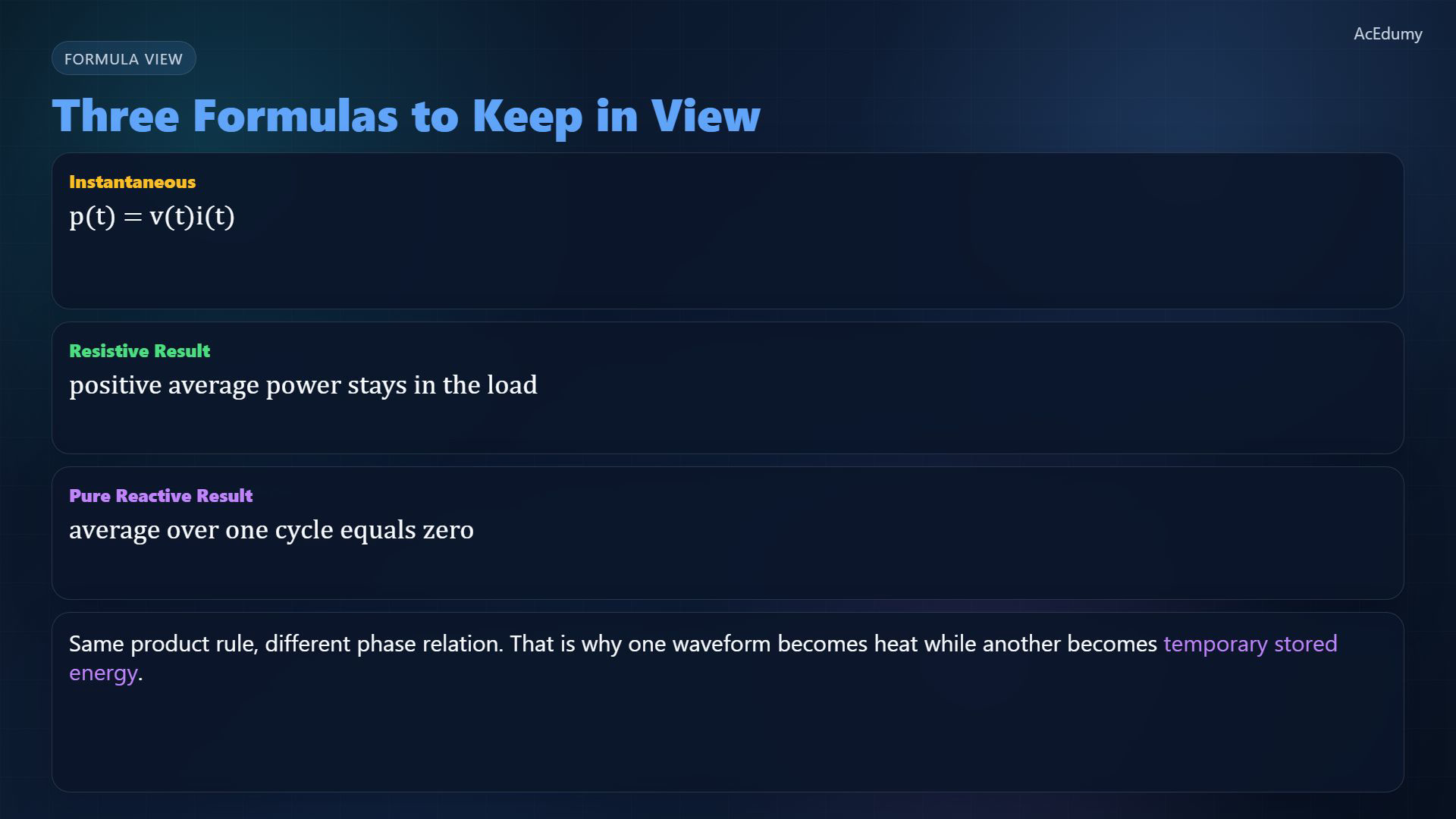
Original-video reference card. Problematic waveform and average-power graph frames are replaced by this same lesson's formula overview. The notebook formulas specify passive signs, sinusoidal steady state and cycle-energy units; original narration is unchanged. For ideal lossless L or C in sinusoidal steady state, voltage and current differ by 90°.The instantaneous power alternates in sign; its full-cycle average is:Zero average does not mean zero instantaneous power or zero stored energy.Positive instantaneous power increases stored energy; negative power returns it to the circuit.Narration transcript
For a pure inductor or capacitor, voltage and current are ninety degrees apart. Now the instantaneous power swings positive and negative around zero. That means energy is not only delivered to the element. Part of the time, the element stores energy, and part of the time it gives that energy back to the source.
4. Average over a complete cycle
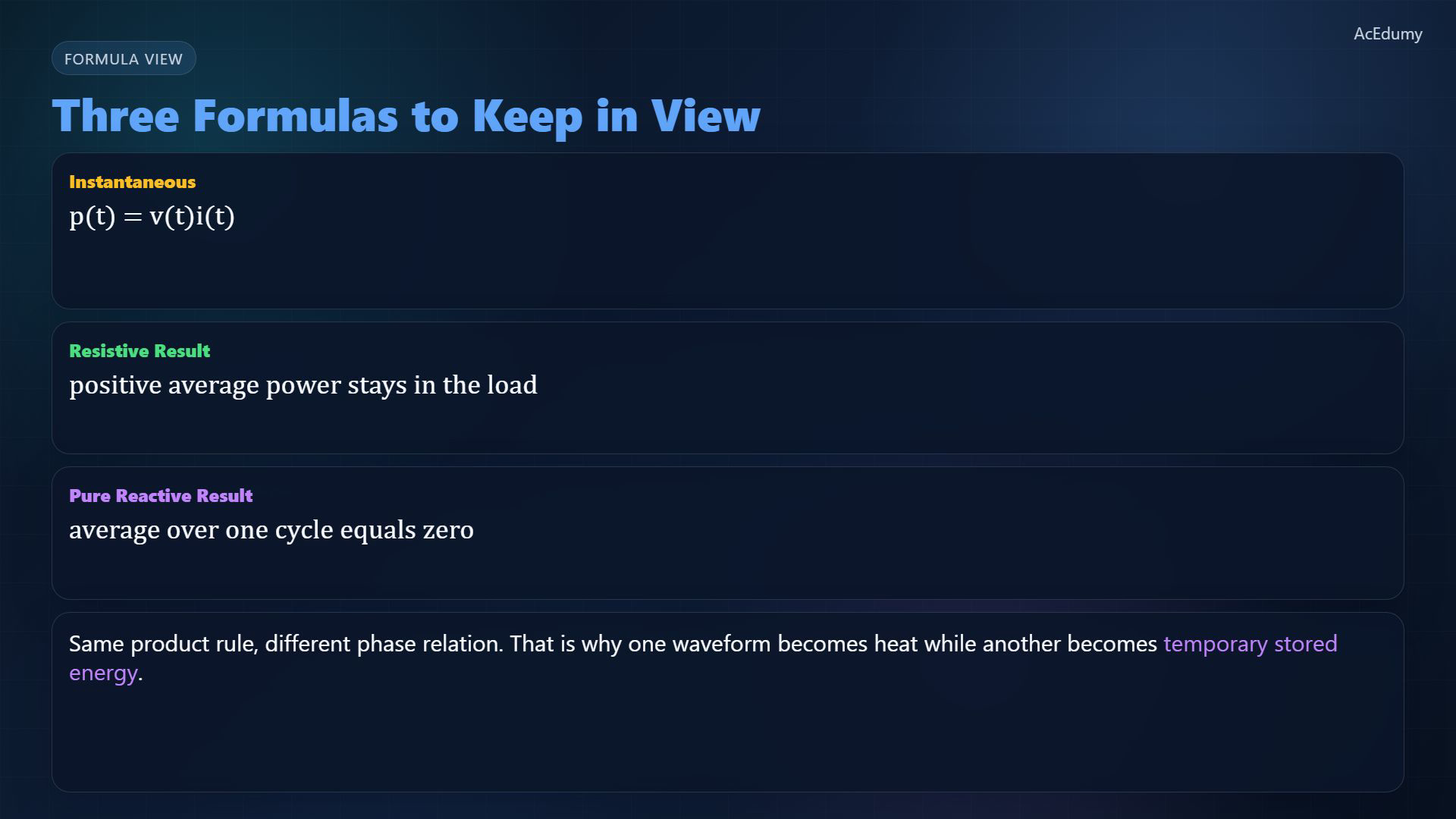
Original-video reference card. Problematic waveform and average-power graph frames are replaced by this same lesson's formula overview. The notebook formulas specify passive signs, sinusoidal steady state and cycle-energy units; original narration is unchanged. Average power is net cycle energy divided by the period T:Equal positive and negative signed areas give zero net cycle energy:For an absorbing passive load, a nonzero in-phase current component gives positive average power.At fixed RMS amplitudes, the sinusoidal average is:Narration transcript
Average power asks for the net energy transfer over one full cycle. If the positive and negative parts cancel completely, the average is zero. If a real in-phase component survives, the average stays positive. So phase difference decides how much of the instantaneous power becomes useful average power.
5. Choose the passive sign convention
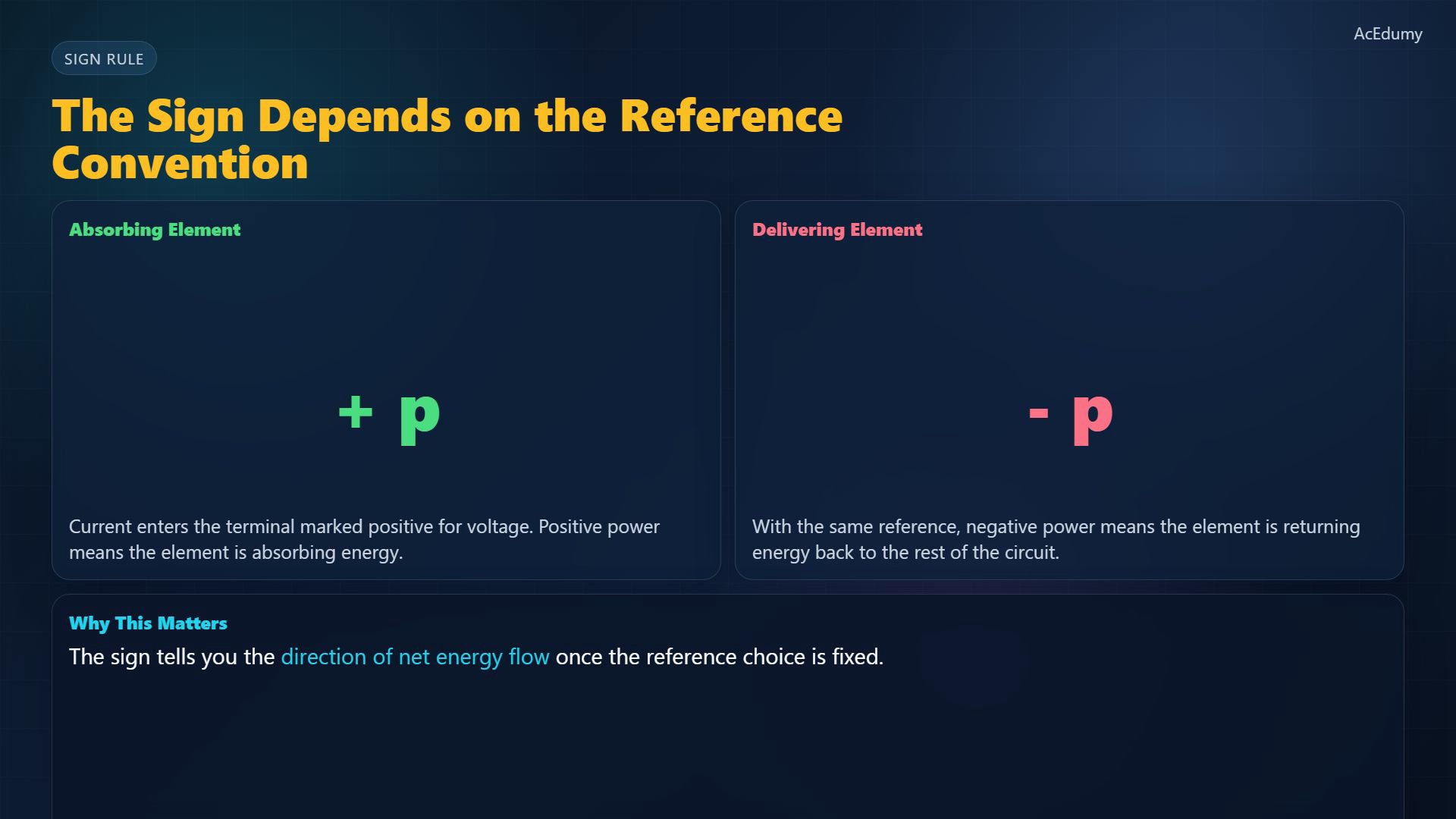
Original-video reference card. Problematic waveform and average-power graph frames are replaced by this same lesson's formula overview. The notebook formulas specify passive signs, sinusoidal steady state and cycle-energy units; original narration is unchanged. Fix the passive references — reference current enters the voltage reference's positive terminal.With those references, positive instantaneous power means absorption.Negative instantaneous power means delivery to the rest of the circuit.Reversing only the current reference changes the absorbed-power expression to:Narration transcript
The passive sign convention tells us how to read the sign. If current enters the terminal marked positive for voltage, positive power means the element absorbs power. Negative power then means the element is delivering power back. Without that sign rule, the waveform is easy to misread.
6. Compare instantaneous and average power
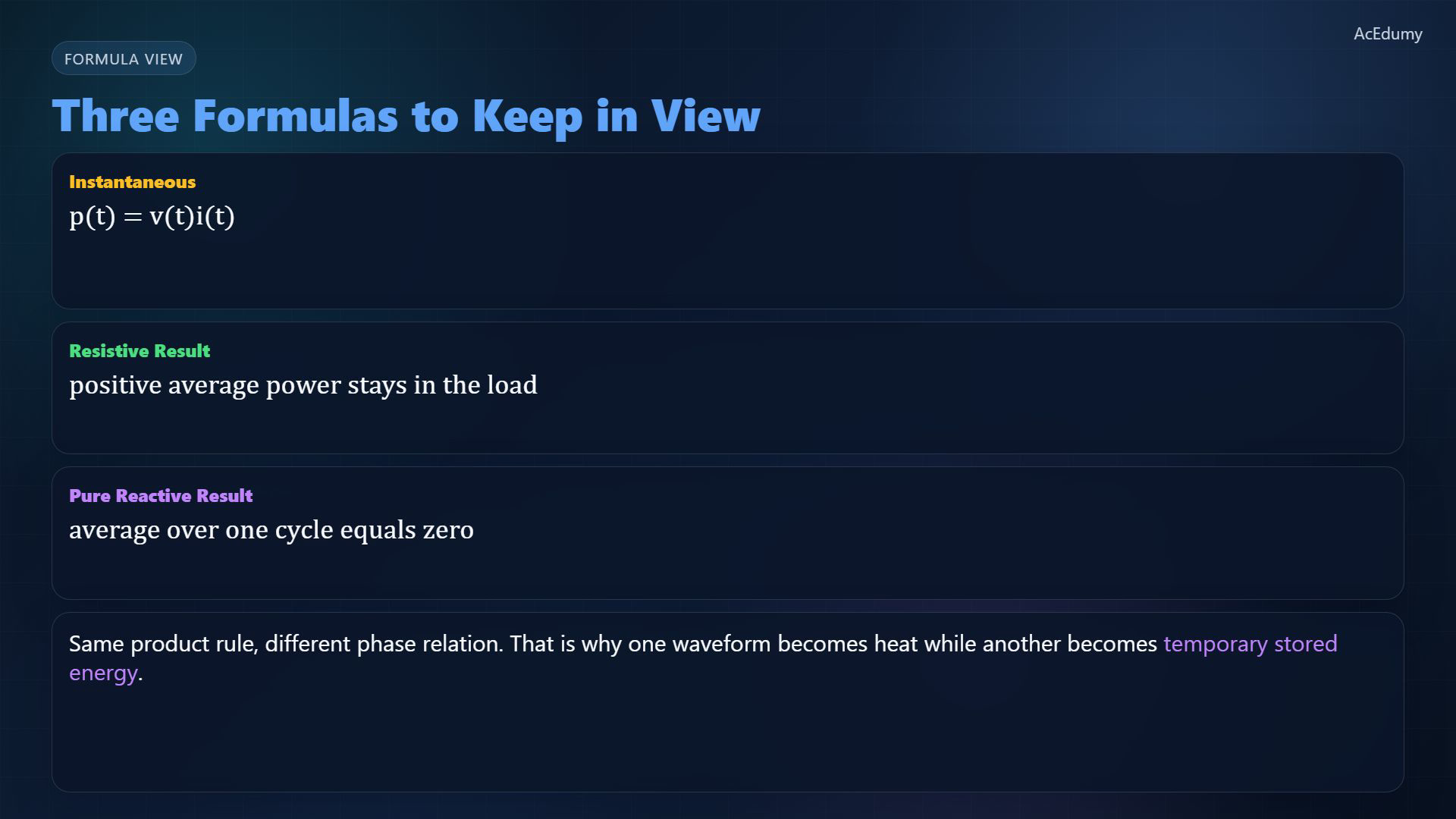
Original-video reference card. Problematic waveform and average-power graph frames are replaced by this same lesson's formula overview. The notebook formulas specify passive signs, sinusoidal steady state and cycle-energy units; original narration is unchanged. The same instantaneous product rule always applies:Use peak amplitudes and a lag angle φ — current is:For a positive resistor, the equivalent voltage expression is:An ideal reactive element in periodic steady state returns the energy it absorbs over a cycle.Narration transcript
The core formula is still simple: p of t equals v of t times i of t. What changes from case to case is the waveform shape and its average value. Resistive parts create positive average power. Purely reactive parts create zero average power over a full cycle.
7. Connect to RMS, complex power and power factor

Original-video reference card. Problematic waveform and average-power graph frames are replaced by this same lesson's formula overview. The notebook formulas specify passive signs, sinusoidal steady state and cycle-energy units; original narration is unchanged. Instantaneous power is energy-transfer rate at the present instant, measured in watts.Average power is also measured in watts; net cycle energy in joules is:Next: root-mean-square (RMS) values, complex power and power factor.Narration transcript
Instantaneous power tells us what is happening right now. Average power tells us what remains after one full cycle. That distinction is the doorway to RMS values, complex power, and power factor in the next lesson.
Source video: Circuit Theory-2 #07 Instantaneous and Average Power (2:32)