Electromagnetic Theory · Introduction to Electromagnetic Theory
#01 Electric and magnetic fields, scalar-vector distinction, and coordinate systems
Build the foundation from electric and magnetic fields through vectors and the three coordinate systems, with synchronized visual narration.
Question
Explain what electromagnetic theory studies, identify its major modern applications, distinguish scalar fields from vector fields, and state why Cartesian, cylindrical, and spherical coordinate systems are used.
Written solution and narration transcript(shows the full solution)
Below are all the lines written in the notebook together with the full narration transcript.
1. Define electromagnetic theory
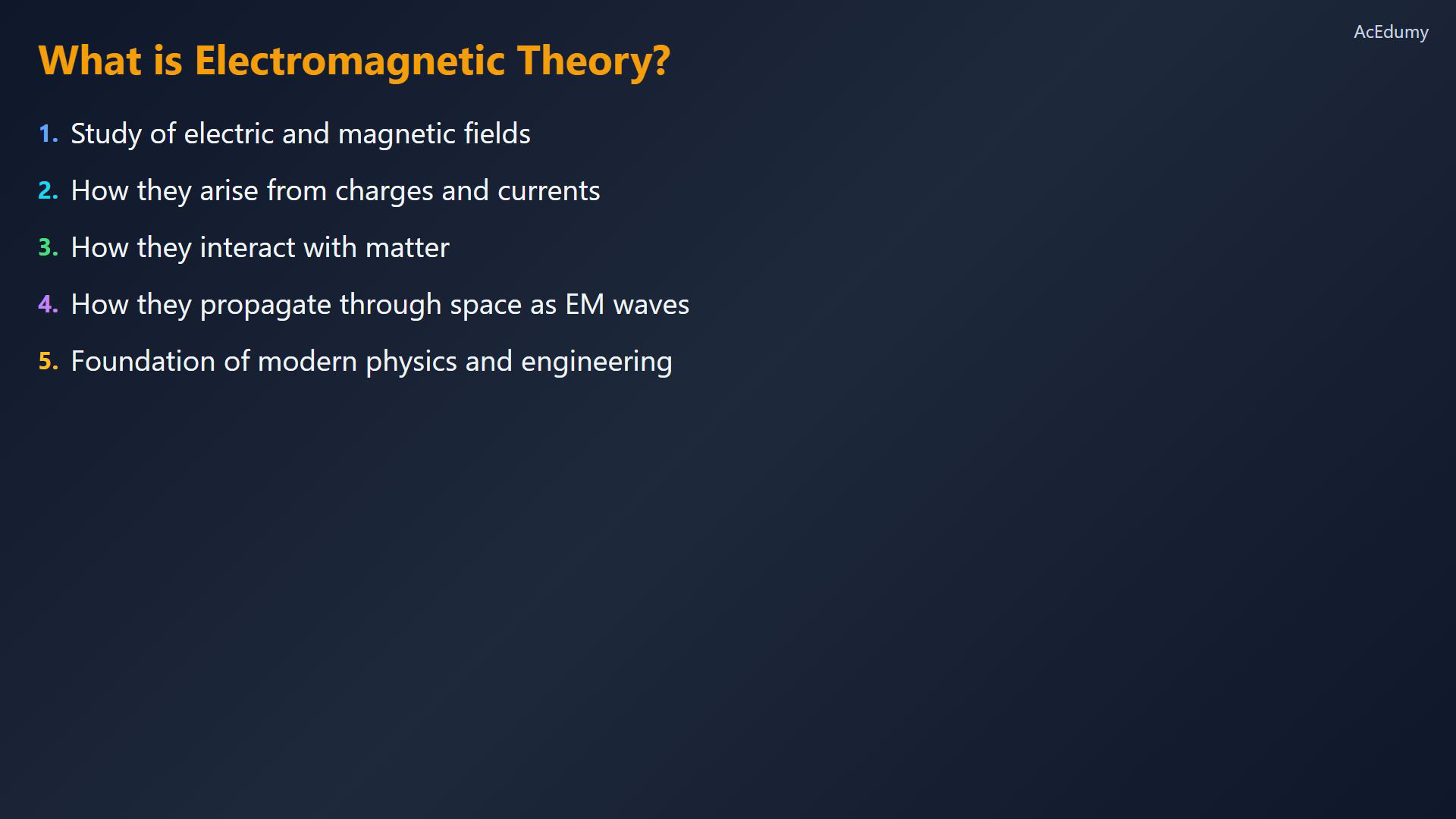
Electromagnetic theory studies fields, their sources, their interaction with matter, and their propagation through space. Electromagnetic theory is the study of electric and magnetic fields how they arise from charges and currents, how they interact with matter, and how they propagate through space as electromagnetic waves.It is one of the most fundamental branches of physics and engineering.In this series, we will build the theory from the ground up, starting with the mathematical tools we need.Narration transcript
Electromagnetic theory is the study of electric and magnetic fields how they arise from charges and currents, how they interact with matter, and how they propagate through space as electromagnetic waves. It is one of the most fundamental branches of physics and engineering. In this series, we will build the theory from the ground up, starting with the mathematical tools we need.
2. Visualize electric and magnetic fields
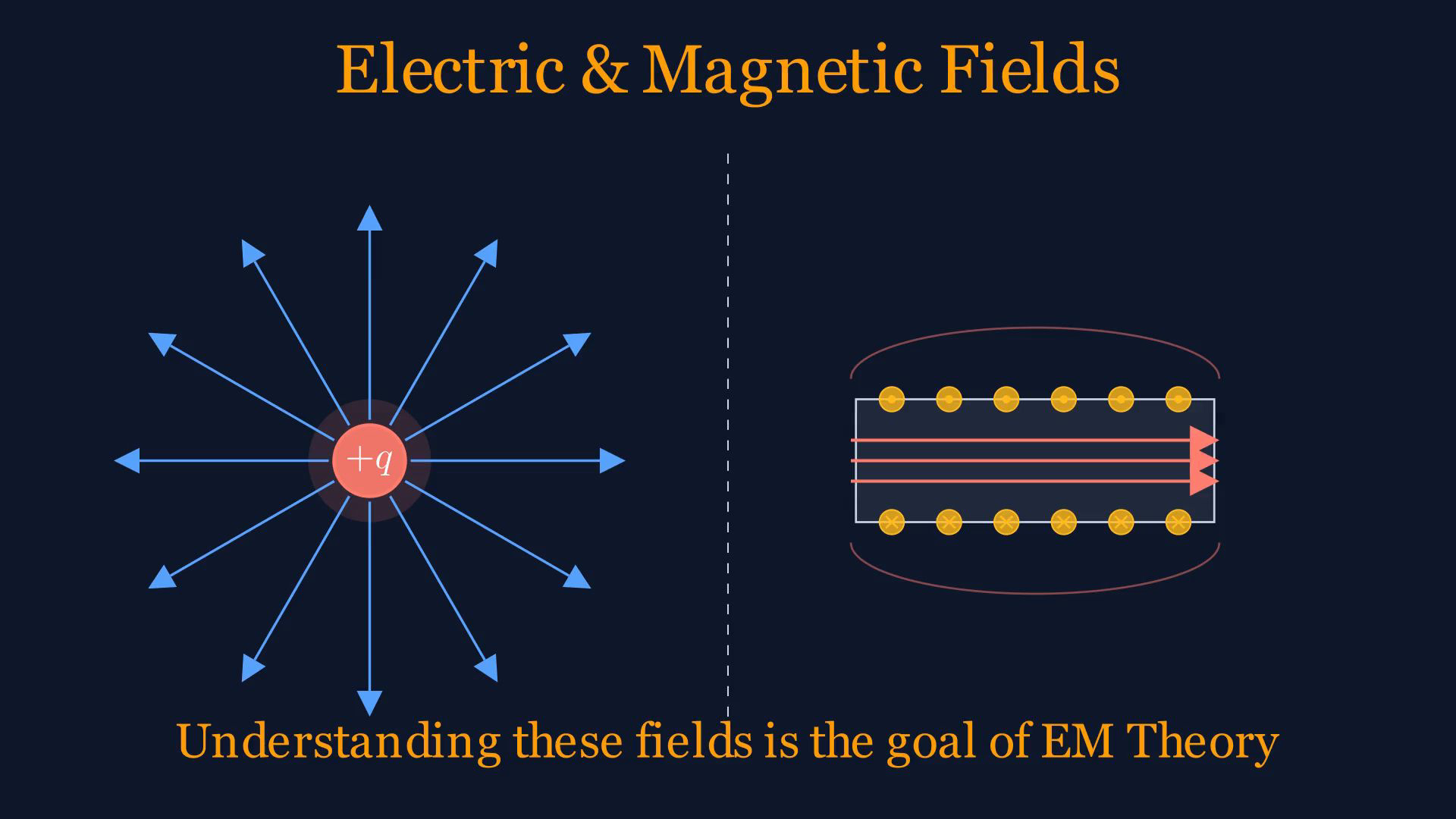
Electromagnetic theory studies fields, their sources, their interaction with matter, and their propagation through space. Let's start with a visual.Here you see the electric field produced by a single positive charge.The field lines radiate outward in every direction.This is a vector field, meaning at every point in space, the field has both a magnitude and a direction.Now look at a magnetic field: these field lines form closed loops, threading through this solenoid.Understanding these fields, how to calculate them, how they behave, that is the goal of electromagnetic theory.Narration transcript
Let's start with a visual. Here you see the electric field produced by a single positive charge. The field lines radiate outward in every direction. This is a vector field, meaning at every point in space, the field has both a magnitude and a direction. Now look at a magnetic field: these field lines form closed loops, threading through this solenoid. Understanding these fields, how to calculate them, how they behave, that is the goal of electromagnetic theory.
3. Connect the major applications
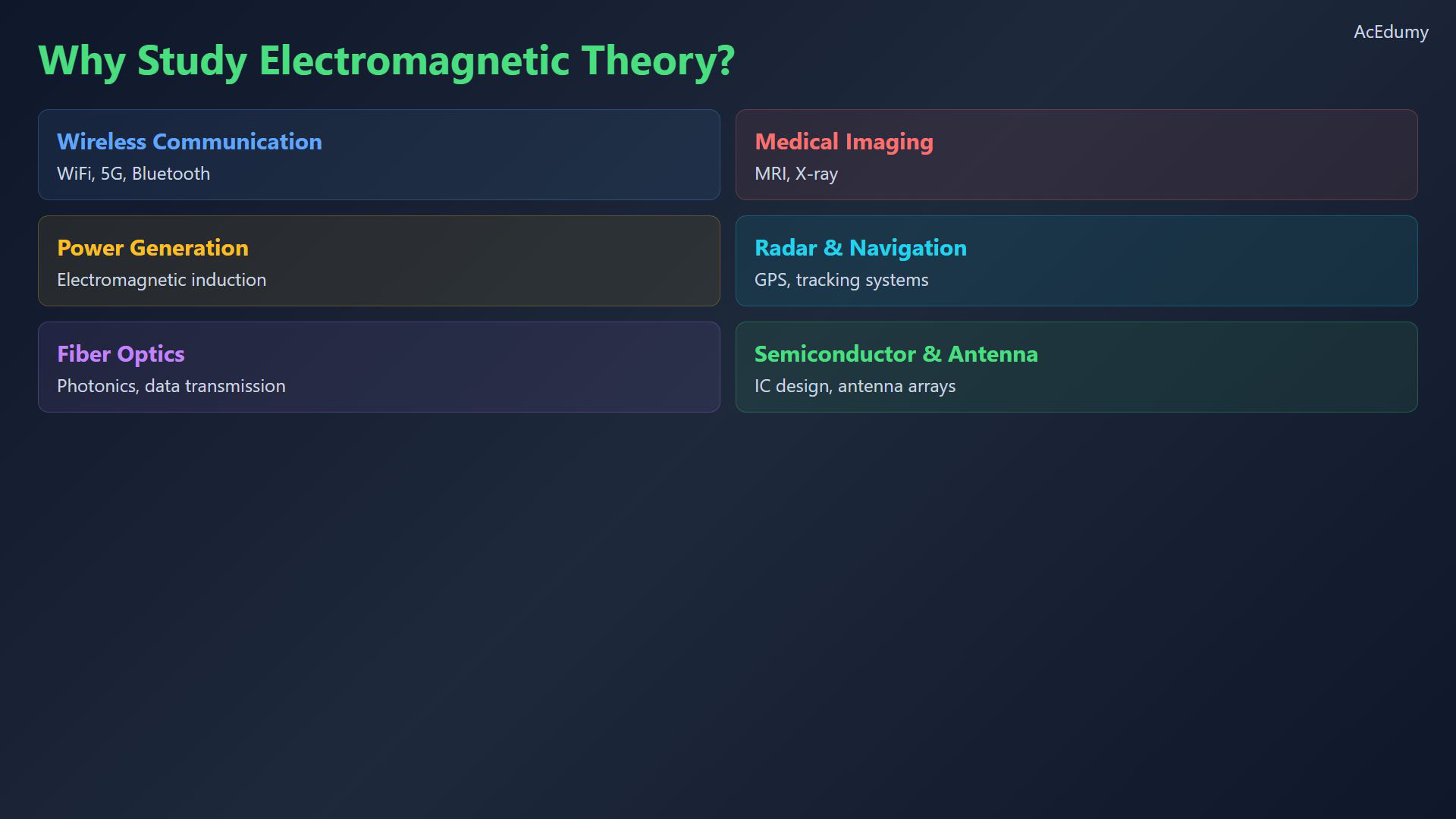
Electromagnetic theory studies fields, their sources, their interaction with matter, and their propagation through space. Why should we study this?Because electromagnetic theory is the foundation of almost all modern technology.Every wireless signal, WiFi, 5G, Bluetooth, is an electromagnetic wave.Medical imaging techniques like MRI rely on magnetic fields.Power generation and transmission use electromagnetic induction.Radar, GPS navigation, fiber optics, antenna design, semiconductor physics, all of these are direct applications of the theory we will learn in this series.Narration transcript
Why should we study this? Because electromagnetic theory is the foundation of almost all modern technology. Every wireless signal, WiFi, 5G, Bluetooth, is an electromagnetic wave. Medical imaging techniques like MRI rely on magnetic fields. Power generation and transmission use electromagnetic induction. Radar, GPS navigation, fiber optics, antenna design, semiconductor physics, all of these are direct applications of the theory we will learn in this series.
4. Distinguish scalar and vector fields
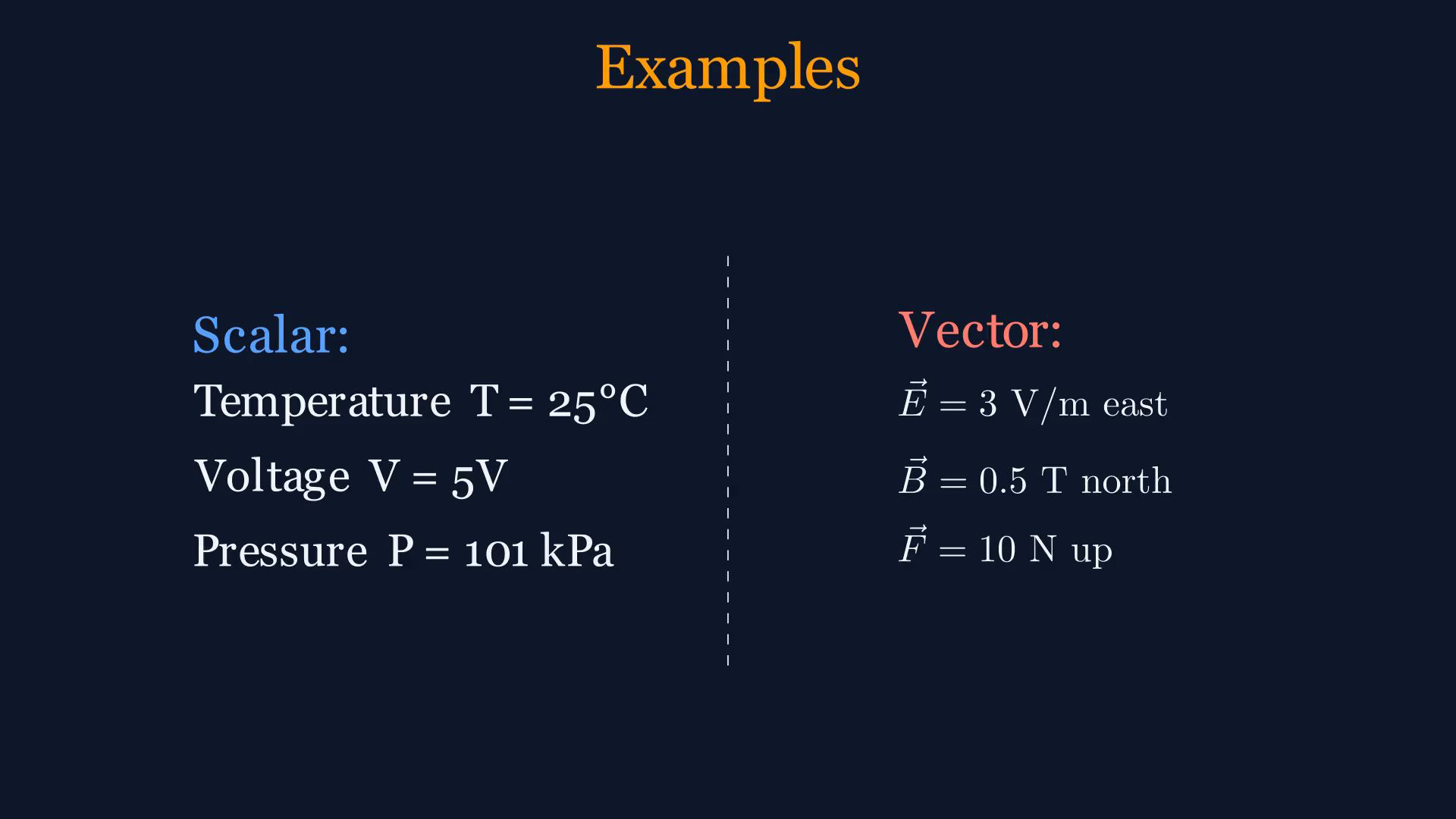
Electromagnetic theory studies fields, their sources, their interaction with matter, and their propagation through space. Before we dive into fields, let's clarify two fundamental concepts: scalar and vector fields.A scalar field assigns a single number to every point in space.For example, temperature: at each location, there is one value, 25 degrees, 30 degrees.A vector field assigns both a magnitude and a direction to every point.The electric field is a perfect example: at each point, we can ask how strong is it, and which direction does it point?This distinction between scalar and vector is essential.Everything in electromagnetic theory builds on it.Narration transcript
Before we dive into fields, let's clarify two fundamental concepts: scalar and vector fields. A scalar field assigns a single number to every point in space. For example, temperature: at each location, there is one value, 25 degrees, 30 degrees. A vector field assigns both a magnitude and a direction to every point. The electric field is a perfect example: at each point, we can ask how strong is it, and which direction does it point? This distinction between scalar and vector is essential. Everything in electromagnetic theory builds on it.
5. Build unit and position vectors
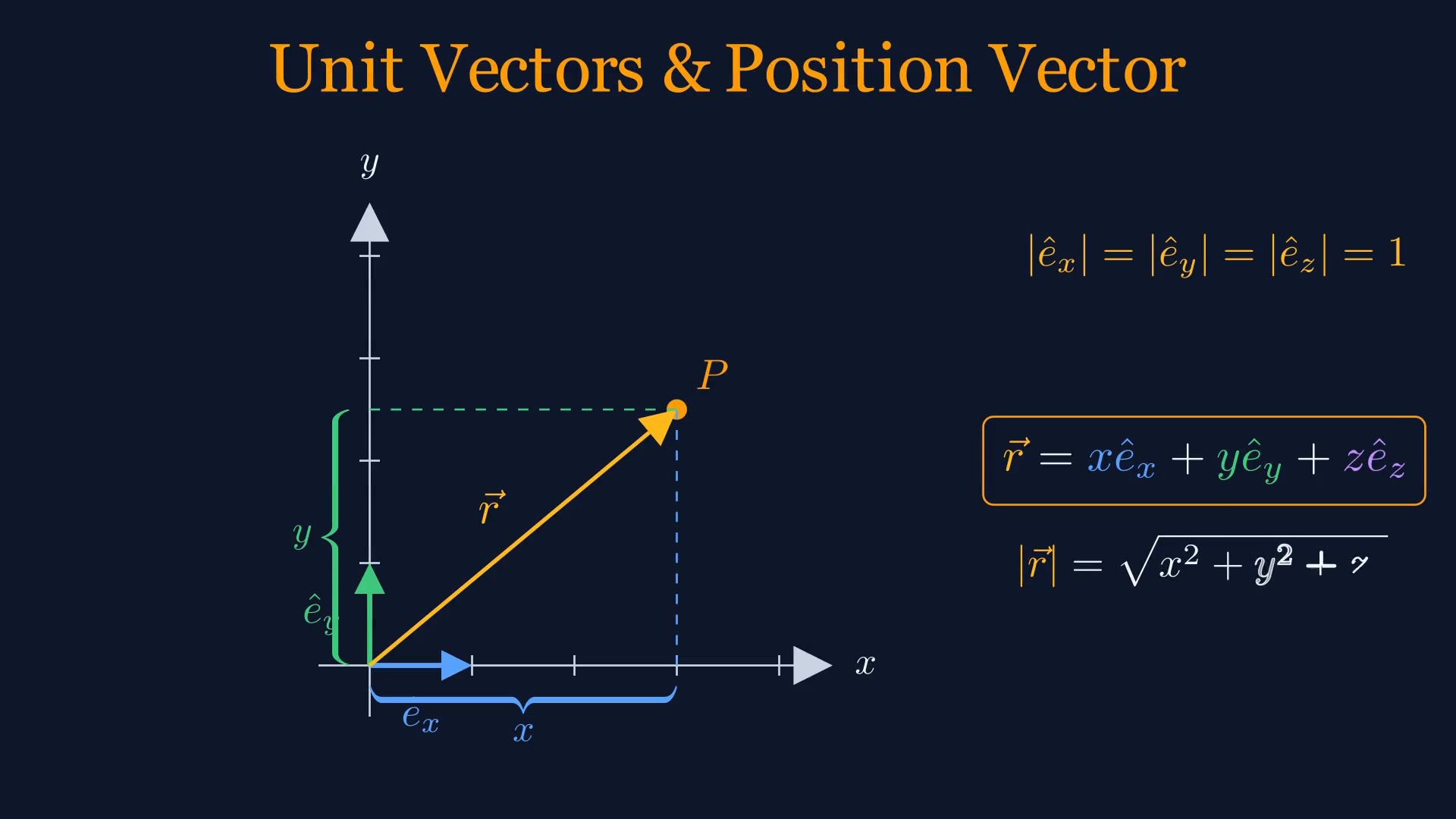
Electromagnetic theory studies fields, their sources, their interaction with matter, and their propagation through space. In Cartesian coordinates, we define three unit vectors: eₓ, eᵧ, and ez.Each has a magnitude of exactly one and points along its respective axis.Any point P in space can be described by the position vector r, which is the sum of its components: x times eₓ, plus y times eᵧ, plus z times ez.This position vector r points from the origin to the point P, and its magnitude gives us the distance from the origin.Narration transcript
In Cartesian coordinates, we define three unit vectors: e x, e y, and e z. Each has a magnitude of exactly one and points along its respective axis. Any point P in space can be described by the position vector r, which is the sum of its components: x times e x, plus y times e y, plus z times e z. This position vector r points from the origin to the point P, and its magnitude gives us the distance from the origin.
6. Choose a suitable coordinate system
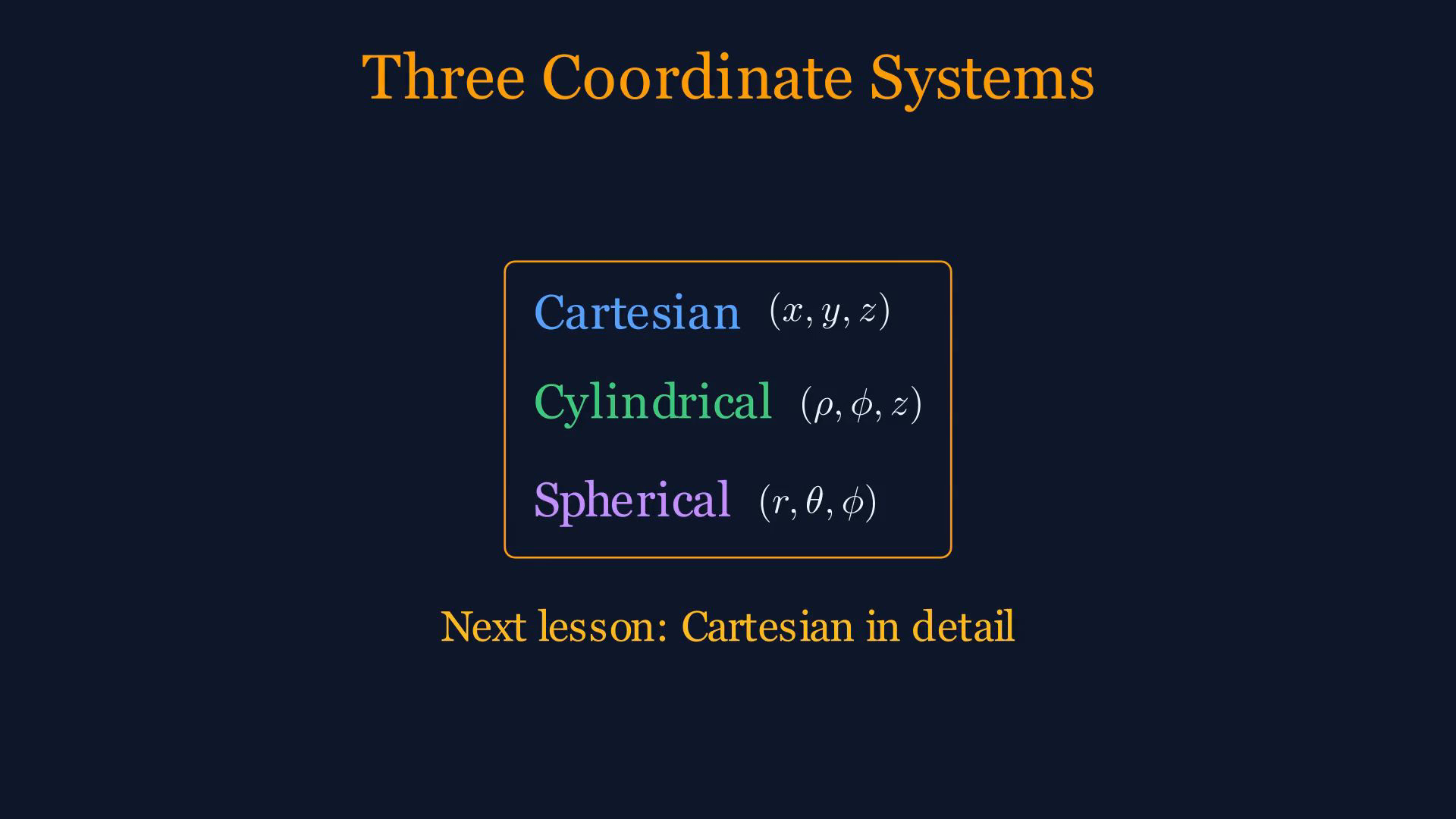
Electromagnetic theory studies fields, their sources, their interaction with matter, and their propagation through space. Now here is a key insight: not every problem is best solved in Cartesian coordinates.When we have cylindrical symmetry, like a wire or a solenoid, we use cylindrical coordinates with rho, phi, and z.When we have spherical symmetry, like a point charge, we use spherical coordinates with r, theta, and phi.In the next few lessons, we will master each of these coordinate systems and learn how to express lengths, surfaces, and volumes in each one.Narration transcript
Now here is a key insight: not every problem is best solved in Cartesian coordinates. When we have cylindrical symmetry, like a wire or a solenoid, we use cylindrical coordinates with rho, phi, and z. When we have spherical symmetry, like a point charge, we use spherical coordinates with r, theta, and phi. In the next few lessons, we will master each of these coordinate systems and learn how to express lengths, surfaces, and volumes in each one.
7. Summarize the foundation
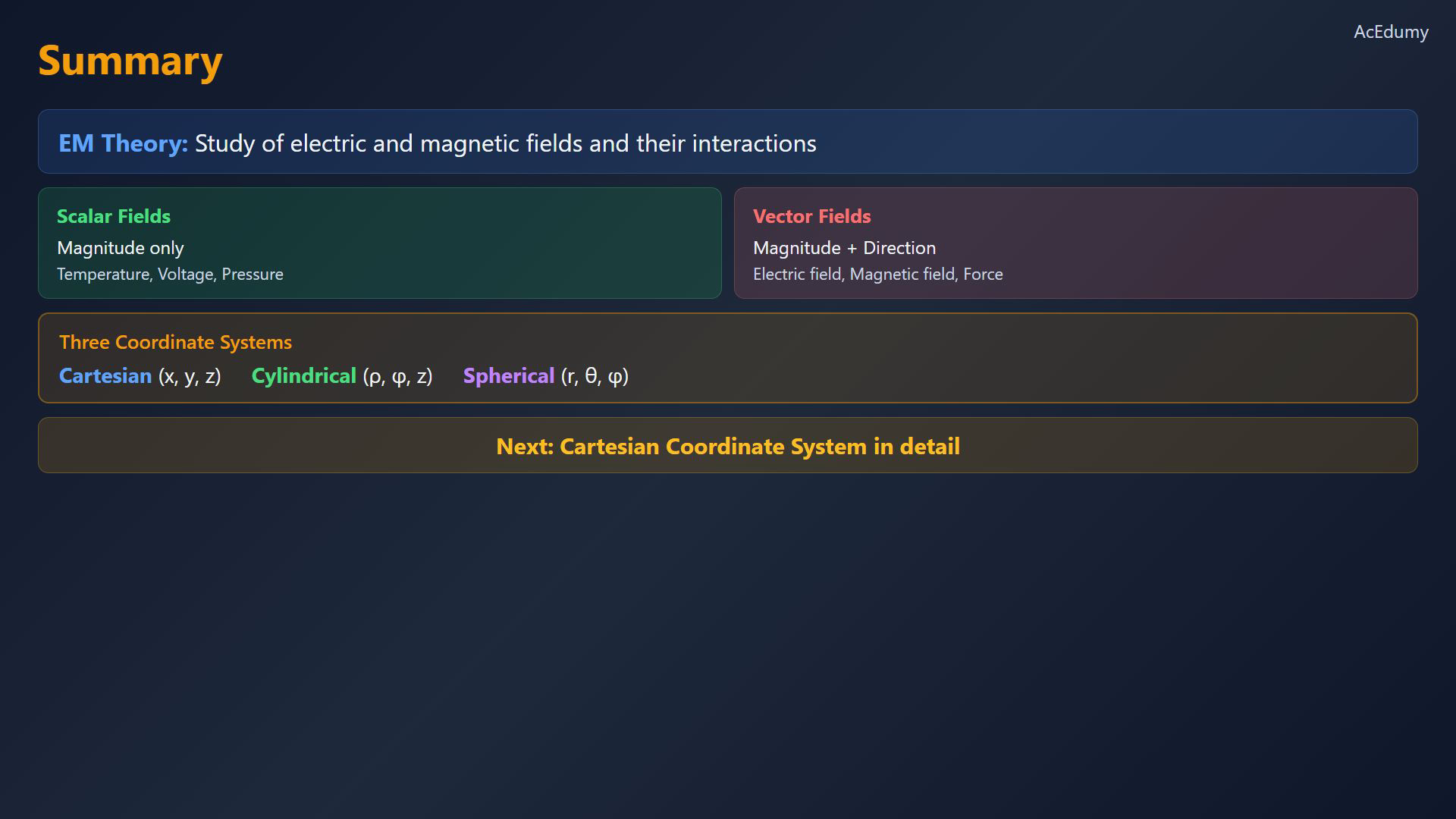
Electromagnetic theory studies fields, their sources, their interaction with matter, and their propagation through space. Let's recap.Electromagnetic theory studies electric and magnetic fields and their interactions.We distinguish between scalar fields, which have only magnitude, and vector fields, which have both magnitude and direction.We will work in three coordinate systems: Cartesian, cylindrical, and spherical, each suited to different symmetries.In the next lesson, we will dive deep into the Cartesian coordinate system.Narration transcript
Let's recap. Electromagnetic theory studies electric and magnetic fields and their interactions. We distinguish between scalar fields, which have only magnitude, and vector fields, which have both magnitude and direction. We will work in three coordinate systems: Cartesian, cylindrical, and spherical, each suited to different symmetries. In the next lesson, we will dive deep into the Cartesian coordinate system.
Source video: Electromagnetic Theory (v2) #01 Introduction to Electromagnetic Theory (3:43)