Circuit Theory 2 · Inverse Laplace transform and partial fractions
#15 Causal inverse pairs, distinct and repeated real poles, and coefficient-by-coefficient solutions
Solve both distinct and repeated real poles step by step, then recover causal exponentials with readable fractions and explicit convergence conditions.
Question
Recover two independent causal time signals by partial fractions: F_1(s)=(2s+5)/((s+1)(s+3)) and F_2(s)=(s+4)/(s+2)^2. Recalculate A and B in each example. Causal means zero for negative time; retain u(t) in each full answer and interpret separately displayed modes for positive time. Let s=σ+jω_s with σ the real part. The first example has ROC σ>−1, the second σ>−2. For the table a is real and ω>0; both have units inverse to the chosen time unit. No voltage/current units are specified. A transform arrow denotes a pair, not ordinary equality between domains. The source calls numerator degree strictly below denominator degree proper; the precise term used here is strictly proper (proper also permits equal degree). Divide first when the numerator degree is greater than or equal to the denominator degree. Retain any polynomial quotient, which may correspond to an impulse at the origin or its derivatives. Cancel common factors before identifying poles. The A/(s+a)+B/(s+b) template requires distinct linear factors and numerator degree below two; an irreducible real quadratic requires a linear numerator. A repeated linear factor requires every order of the ladder, even when an individual coefficient is zero. Substitute the pole values only after clearing denominators to form a polynomial identity, not into a singular fraction. Negative real poles in these causal examples give decaying exponentials. Calling signal modes natural circuit modes requires knowing that the denominator represents circuit dynamics. Verify the two decompositions and retain every sign, coefficient and squared bracket. Original script, MP3s and final video are unchanged. All nine original final reference frames were inspected; the common-mistakes role uses the same final's table card to avoid raw caret notation. The displayed notebook lines contain formatted fractions and complete derivations; they are not newly rendered video or animation. Source terminology and unqualified circuit-mode wording remain manual teaching QA notes. This is an unpublished draft, not a claim of full human listening or full motion QA.
Written solution and narration transcript(shows the full solution)
Below are all the lines written in the notebook together with the full narration transcript.
1. Go from a transform back to a causal time signal
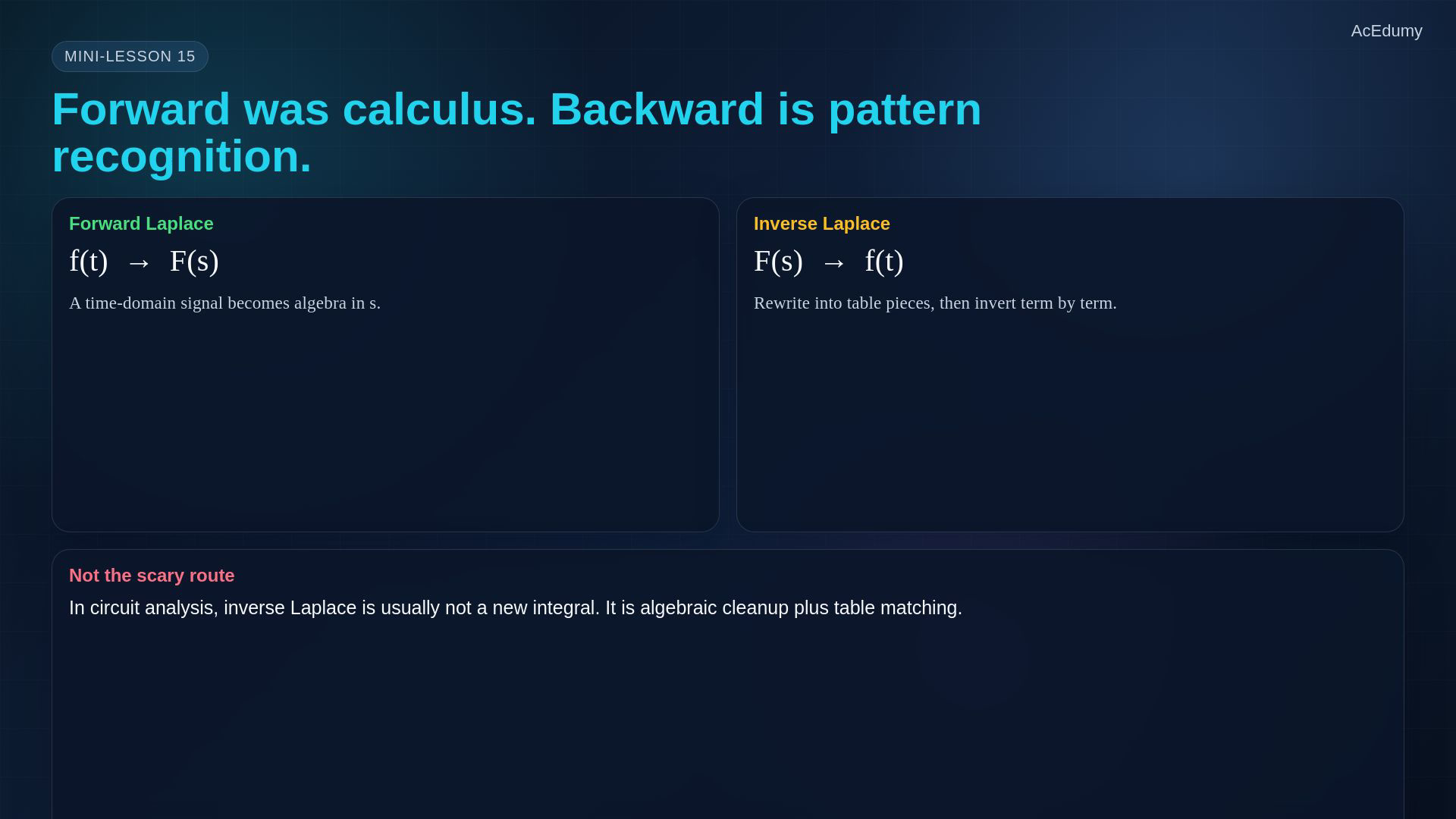
Reference from the existing English final. The notebook lines supply formatted fractions and explicit causal conditions; the common-mistakes role reuses the same video's table card. The previous direction takes a time signal to its transform; the two domains are different.Now recover the time signal from its transform.For these rational examples, use table pairs and linearity instead of evaluating the general inverse contour integral.Rewrite the transform into known fractions, then invert each term under the causal and convergence assumptions.The practical task here is not memorizing another integral.Use exact algebra first, then recognize the matching table pair.Narration transcript
In the last two lessons, we went forward: from f of t to F of s. Now we go back. Inverse Laplace usually looks scary because the definition is a contour integral, but in circuit analysis we almost never start there. We do something much more practical: rewrite F of s into simple pieces, then match each piece to a table entry. So the skill is not memorizing a new integral. The skill is algebraic cleanup plus pattern recognition.
2. Use inverse-transform pairs and linearity
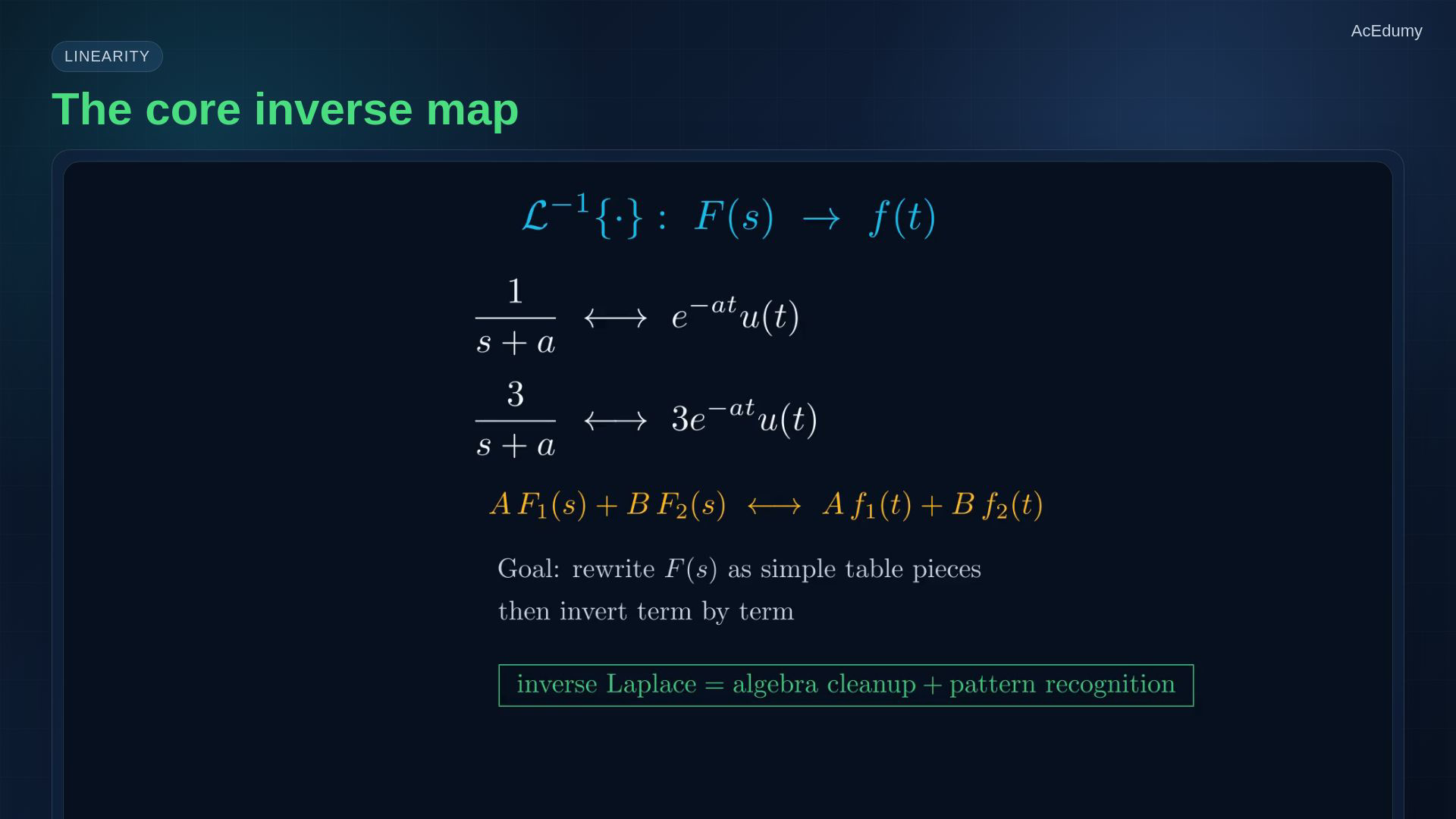
Reference from the existing English final. The notebook lines supply formatted fractions and explicit causal conditions; the common-mistakes role reuses the same video's table card. Start with a causal exponential pair; a transform arrow is not an ordinary equality between domains.Scaling a causal pair, with real a and σ>−a:Linearity, on a common region of convergence:A denominator specifies the term's shape and its numerator specifies the weight; include every required term.Keep the value of the transform unchanged while rewriting it into recognizable pieces.Narration transcript
Start with the core idea. If one over s plus a transforms back to e to the minus a t, then three over s plus a transforms back to three e to the minus a t. Linearity lets us invert term by term. So if F of s is a sum of simple fractions, inverse Laplace is easy: each denominator gives a time mode, and each numerator gives that mode's weight. The whole game is making the expression look like a sum of recognizable table pieces.
3. Set up a complete partial-fraction expansion
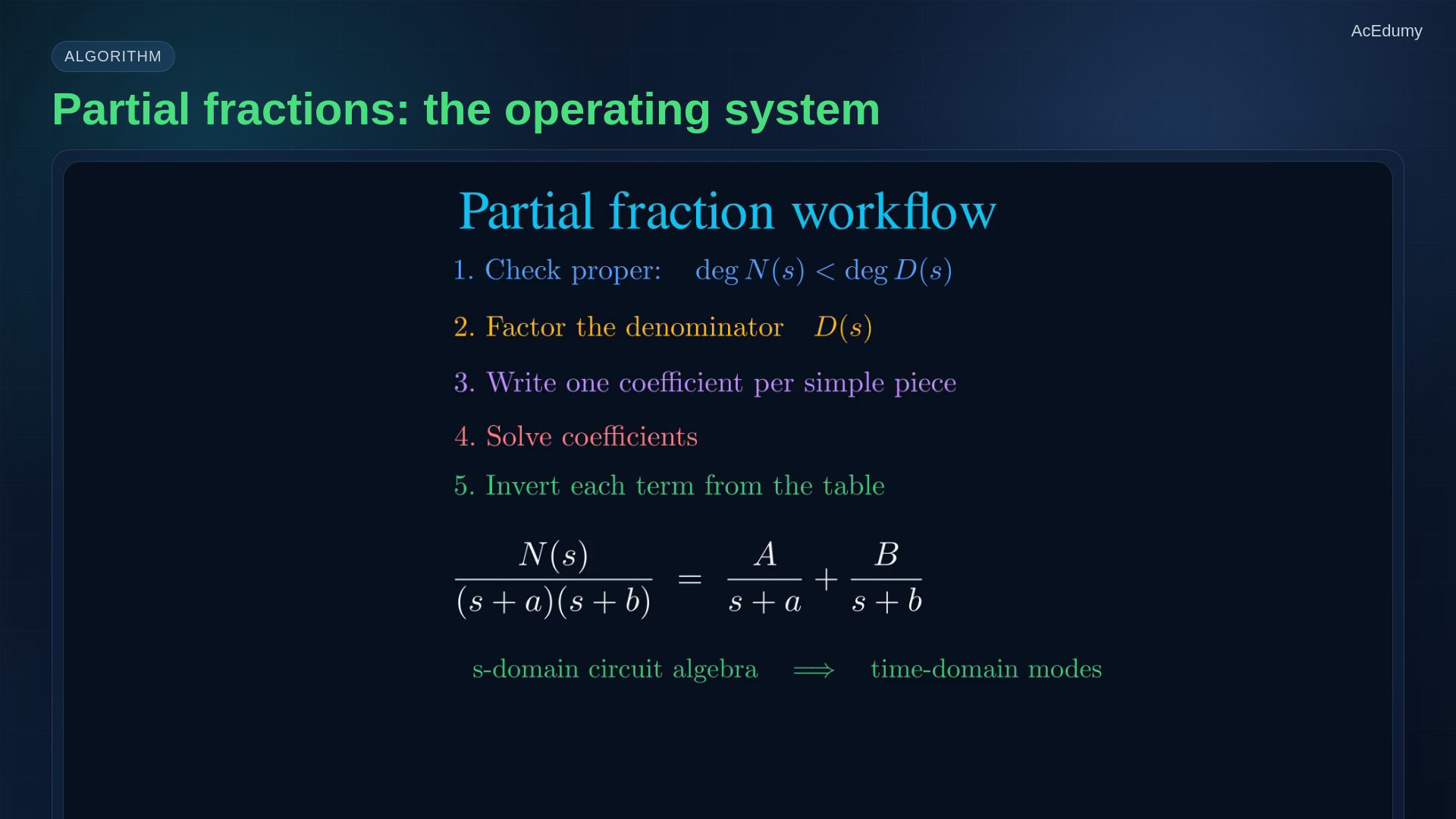
Reference from the existing English final. The notebook lines supply formatted fractions and explicit causal conditions; the common-mistakes role reuses the same video's table card. Partial fractions provide a systematic algebraic workflow.The source uses proper to mean strictly proper here: the numerator degree is strictly below the denominator degree.If the numerator degree is greater than or equal to the denominator degree, divide first and retain the polynomial part.Cancel common factors before identifying poles, then distinguish simple factors from repeated factors.For distinct linear factors a≠b and numerator degree below two:Multiply by the common denominator and solve the resulting polynomial identity.Invert each term using the correct table pair; a repeated pole changes the time-domain shape.Keep any polynomial quotient: in the generalized causal transform it corresponds to impulses or their derivatives.Narration transcript
Here is the partial fraction workflow. First, make sure the rational function is proper: the degree of the numerator must be below the degree of the denominator. If it is not, divide first. Second, factor the denominator. Third, write one unknown coefficient for each simple piece. Fourth, solve those coefficients. Finally, invert every term using the Laplace table. This is the bridge between circuit algebra in s and actual time-domain waveforms.
4. Keep the causal pairs and convergence conditions visible
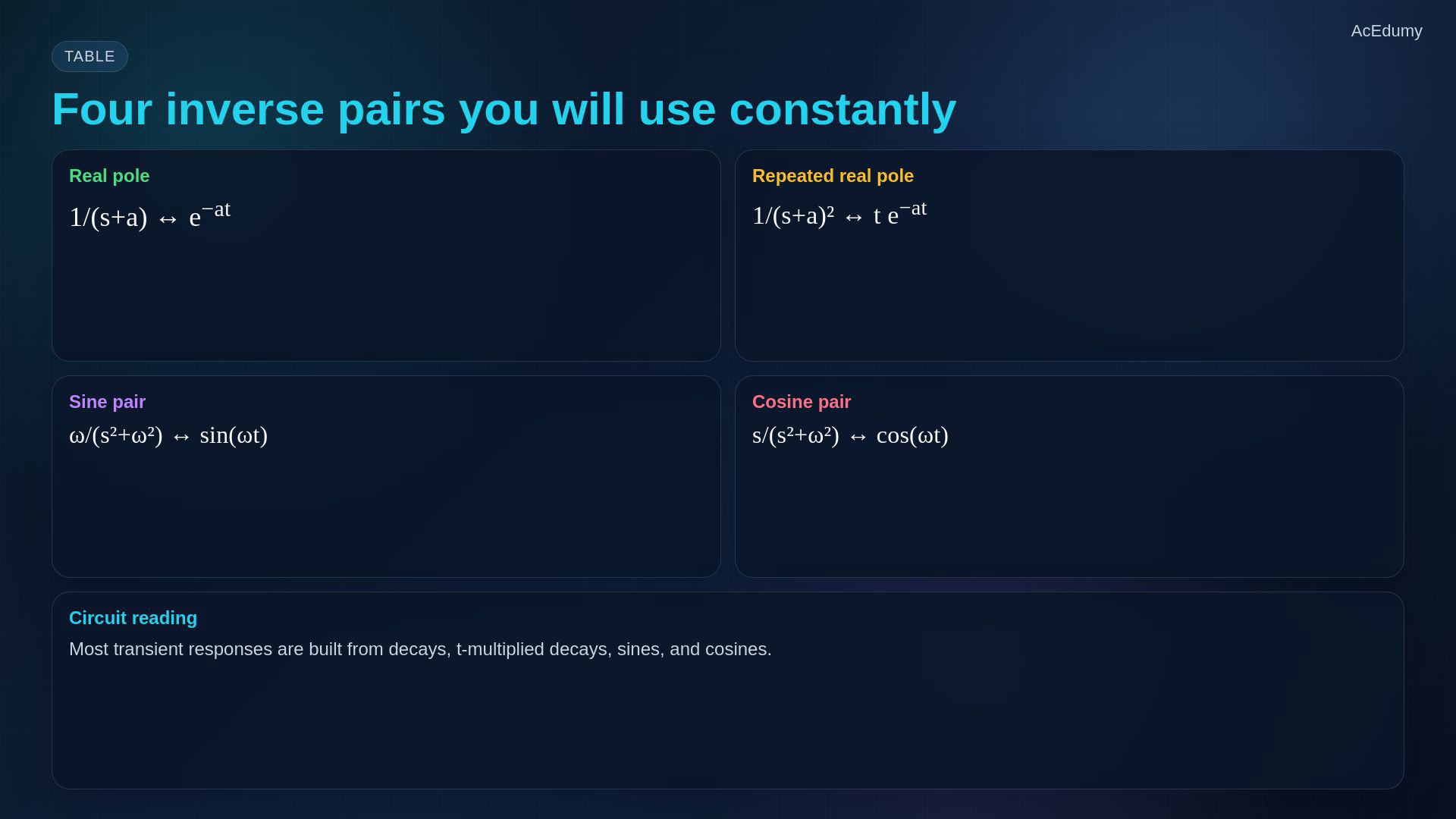
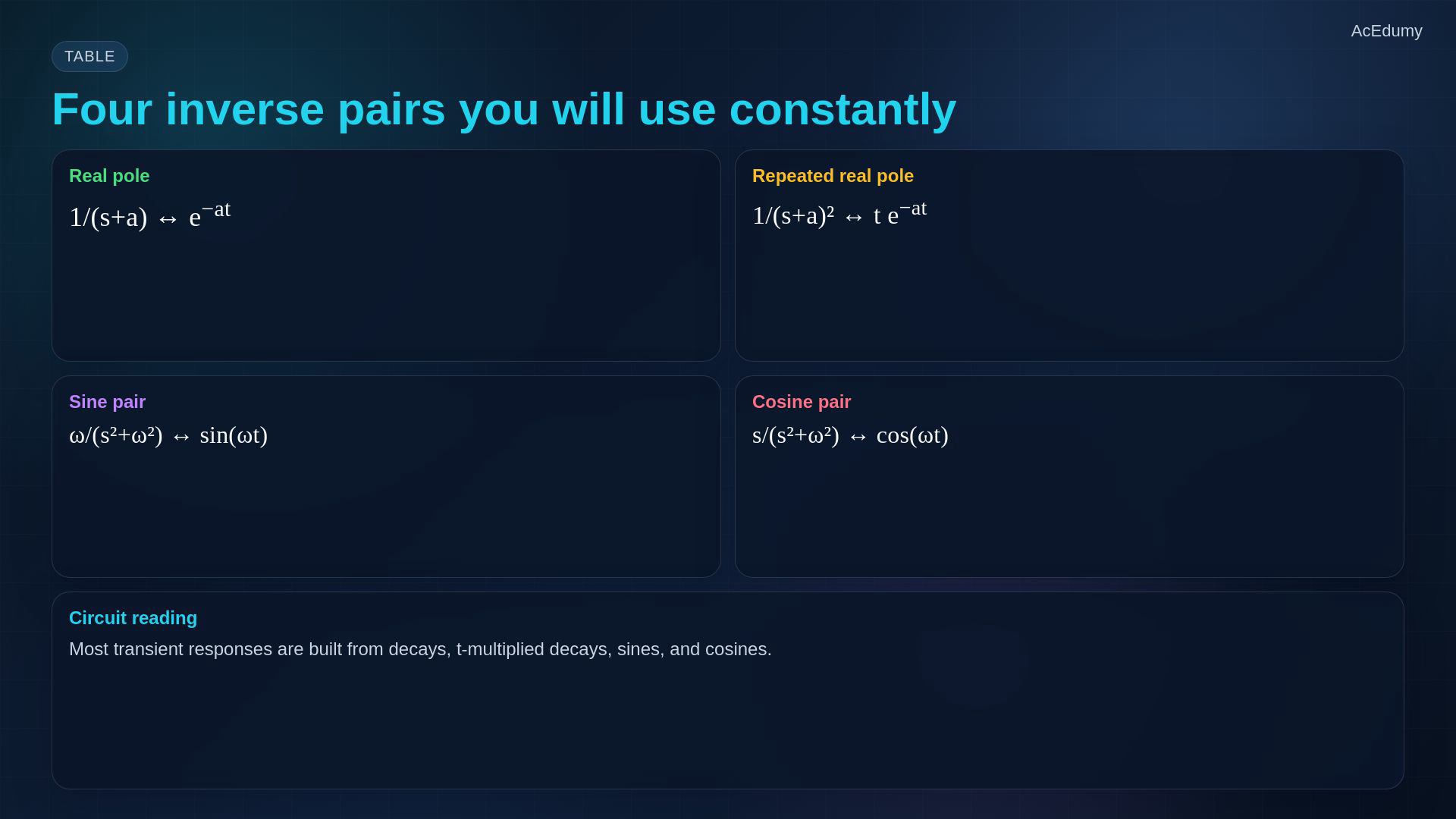
Reference from the existing English final. The notebook lines supply formatted fractions and explicit causal conditions; the common-mistakes role reuses the same video's table card. Four causal inverse pairs; u(t) is the unit step and σ is the real part of s.Exponential pair, real a and σ>−a:Repeated-pole pair, σ>−a; square the entire bracket:Sine and cosine pairs, real ω>0 and σ>0:These are common building blocks. The exponential decays when a is positive; a repeated pole adds a time factor.Narration transcript
Keep four inverse pairs in front of you. One over s plus a gives e to the minus a t. One over s plus a squared gives t e to the minus a t. Omega over s squared plus omega squared gives sine omega t, and s over s squared plus omega squared gives cosine omega t. Most transient circuit answers are combinations of exactly these shapes: decays, multiplied decays, sines, and cosines.
5. Solve the distinct-pole coefficients
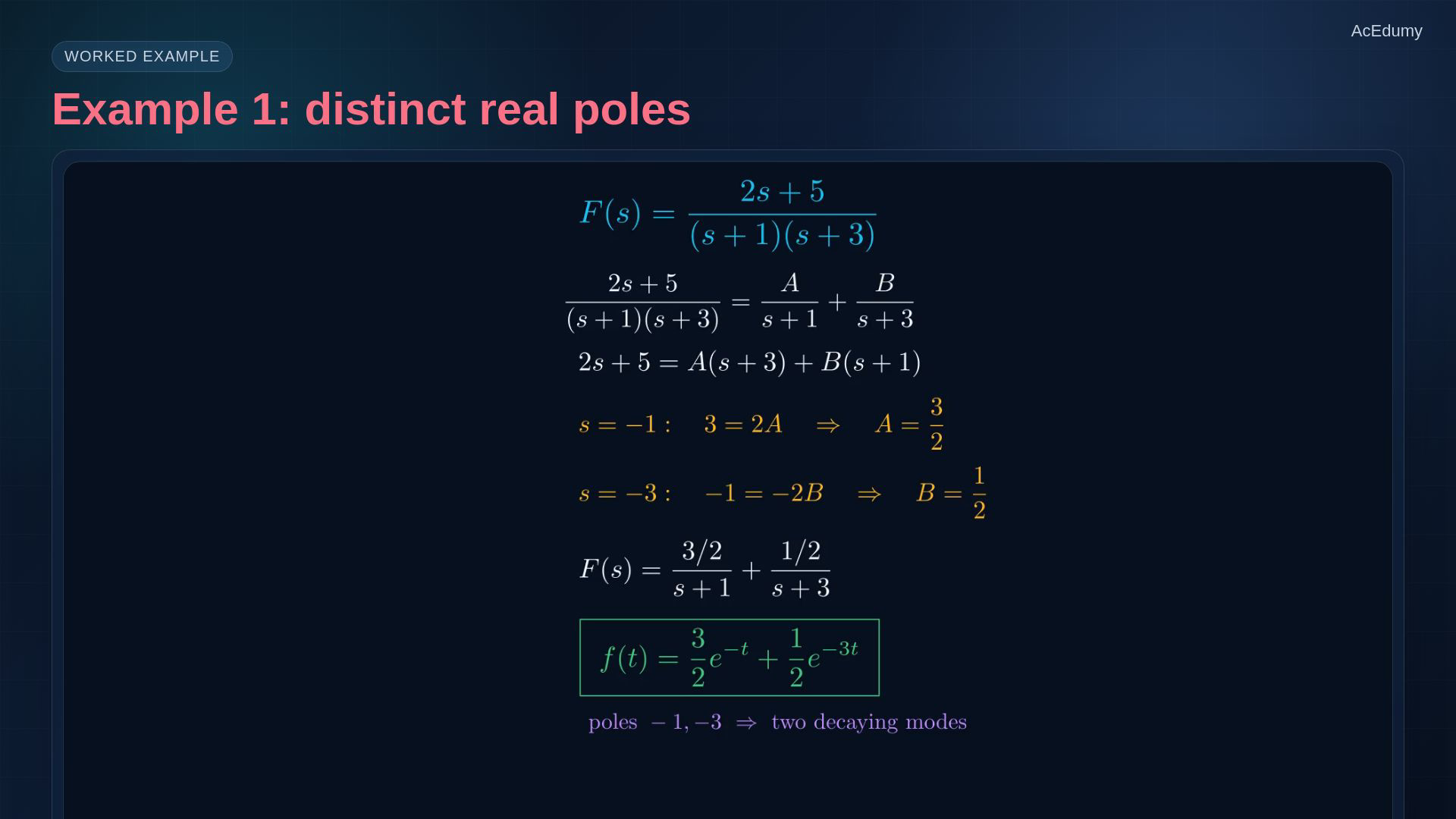
Reference from the existing English final. The notebook lines supply formatted fractions and explicit causal conditions; the common-mistakes role reuses the same video's table card. Example 1 has two distinct real poles; label its transform F1.Given a causal signal with σ>−1:Use one unknown coefficient for each distinct linear factor:Multiply both sides by the common denominator; solve a polynomial identity, not an undefined fraction at a pole.The resulting numerator identity:Substitute in the polynomial identity to isolate A:The B term vanishes:Substitute in the polynomial identity to isolate B:The A term vanishes; both sides have a negative factor:Restore the two coefficients:Invert term by term and keep causality explicit:Narration transcript
Example one: different real poles. Let F of s equal two s plus five over s plus one times s plus three. We split it as A over s plus one plus B over s plus three. Multiply both sides by the common denominator. Now two s plus five equals A times s plus three plus B times s plus one. To find A, set s equal to minus one. The B term vanishes, and we get three equals two A, so A equals three over two. To find B, set s equal to minus three. The A term vanishes, and we get minus one equals minus two B, so B equals one over two. Therefore F of s is three over two, over s plus one, plus one over two, over s plus three. Inverting term by term gives f of t equals three over two e to the minus t plus one over two e to the minus three t.
6. Read the two decay rates and weights
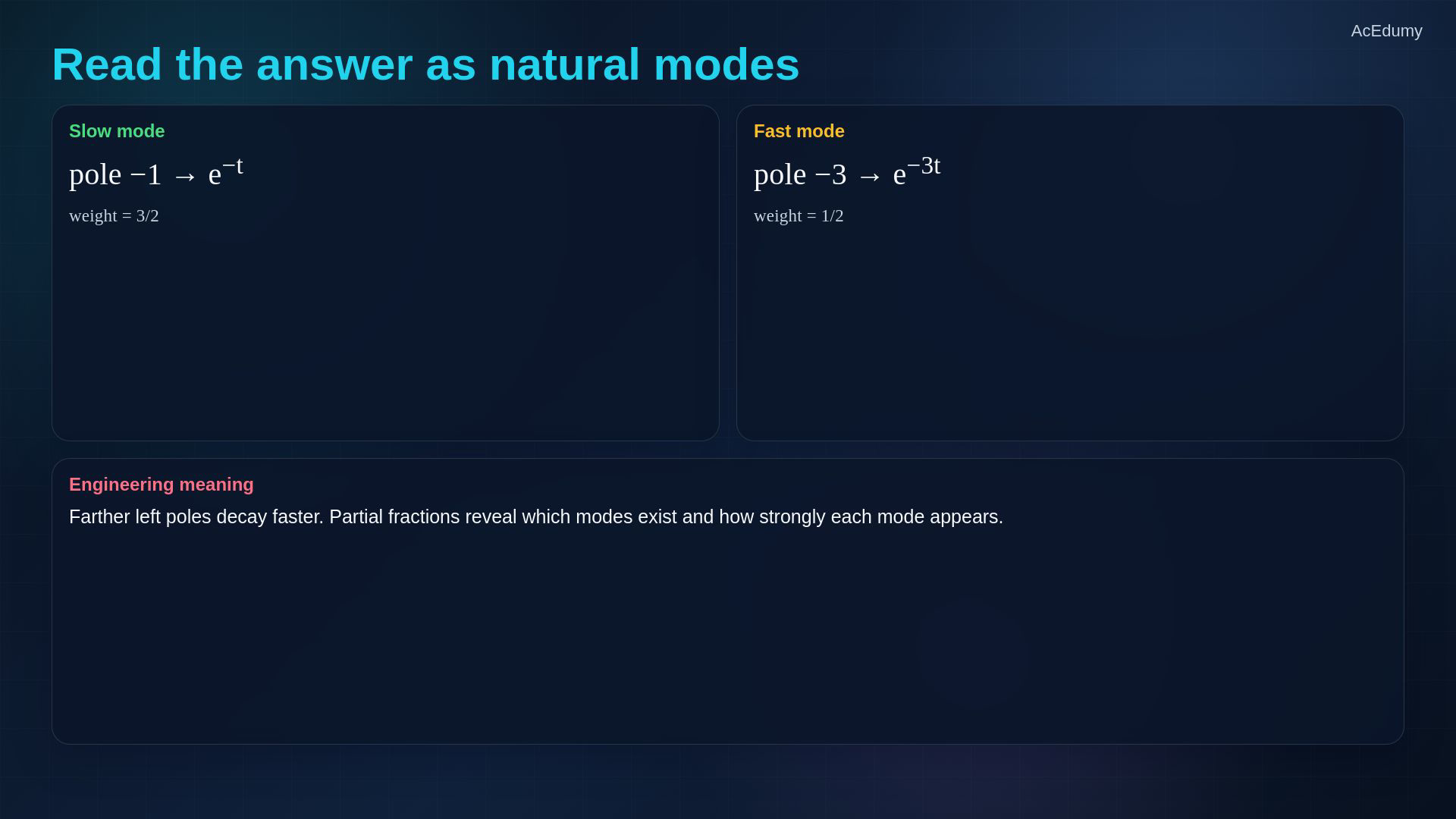
Reference from the existing English final. The notebook lines supply formatted fractions and explicit causal conditions; the common-mistakes role reuses the same video's table card. Read each pole together with its coefficient.For positive time, the slower term has pole −1 and weight 3/2:For positive time, the faster term has pole −3 and weight 1/2:For these negative real poles, farther left means faster exponential decay.These are modes of the given signal. Calling them natural circuit modes also requires linking the denominator to the circuit dynamics.Narration transcript
Read the answer like an engineer. The pole at minus one creates the slow mode e to the minus t, with weight three over two. The pole at minus three creates the faster mode e to the minus three t, with weight one over two. The farther left the pole is, the faster the decay. Partial fractions are not just algebra; they tell you which natural modes are present and how strongly each one appears.
7. Include every order of a repeated pole
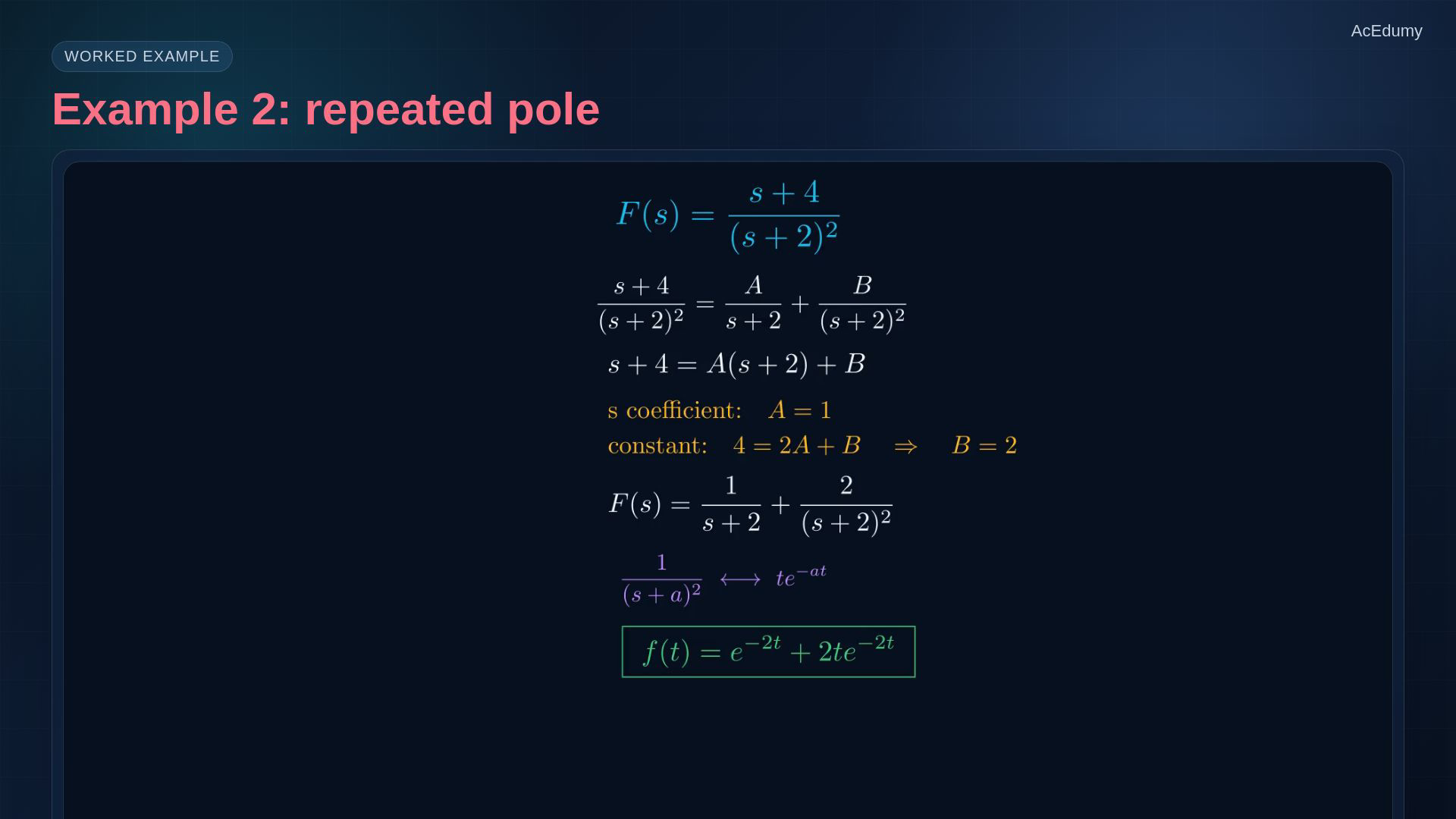
Reference from the existing English final. The notebook lines supply formatted fractions and explicit causal conditions; the common-mistakes role reuses the same video's table card. Example 2 is independent of Example 1; recompute A and B for a double pole at −2.The square applies to the whole bracket; the causal ROC is σ>−2:Include both orders of the repeated-pole ladder:Multiply by the common denominator:Substitute the given numerator:Expand the polynomial identity before comparing coefficients.Compare the coefficient of s:Compare the constant terms:Substitute A and solve for B:Restore both terms, including the plus sign and coefficient two:The first inverse term, for positive time:The squared denominator adds t while retaining the coefficient two:Add the two terms and retain the causal unit step:Narration transcript
Example two: a repeated pole. Let F of s equal s plus four over s plus two squared. A repeated factor needs a full ladder: A over s plus two, plus B over s plus two squared. Multiply through by s plus two squared. We get s plus four equals A times s plus two plus B. Compare coefficients. The coefficient of s gives A equals one. The constant term gives four equals two A plus B. Since A is one, B equals two. So F of s equals one over s plus two plus two over s plus two squared. The first term gives e to the minus two t. The second term gives two t e to the minus two t. So f of t equals e to the minus two t plus two t e to the minus two t.
8. Check division, the full ladder and pole signs
Reference from the existing English final. The notebook lines supply formatted fractions and explicit causal conditions; the common-mistakes role reuses the same video's table card. Three checks before accepting a partial-fraction answer.If the fraction is not strictly proper, divide first and retain the polynomial quotient.For a double pole, include the full ladder; an individual coefficient may be zero:Find the root of the factor; do not reverse the pole sign:For a causal exponential, a negative real pole gives decay and a positive real pole gives growth. Cancel common factors first.Narration transcript
Three mistakes to avoid. First, if the fraction is improper, divide before partial fractions. Second, for a repeated pole, do not write only one term; include the whole ladder, like A over s plus a and B over s plus a squared. Third, check signs carefully: s plus three means the pole is at minus three, not plus three. That sign decides whether the time response decays or grows.
9. Recombine and verify the answer
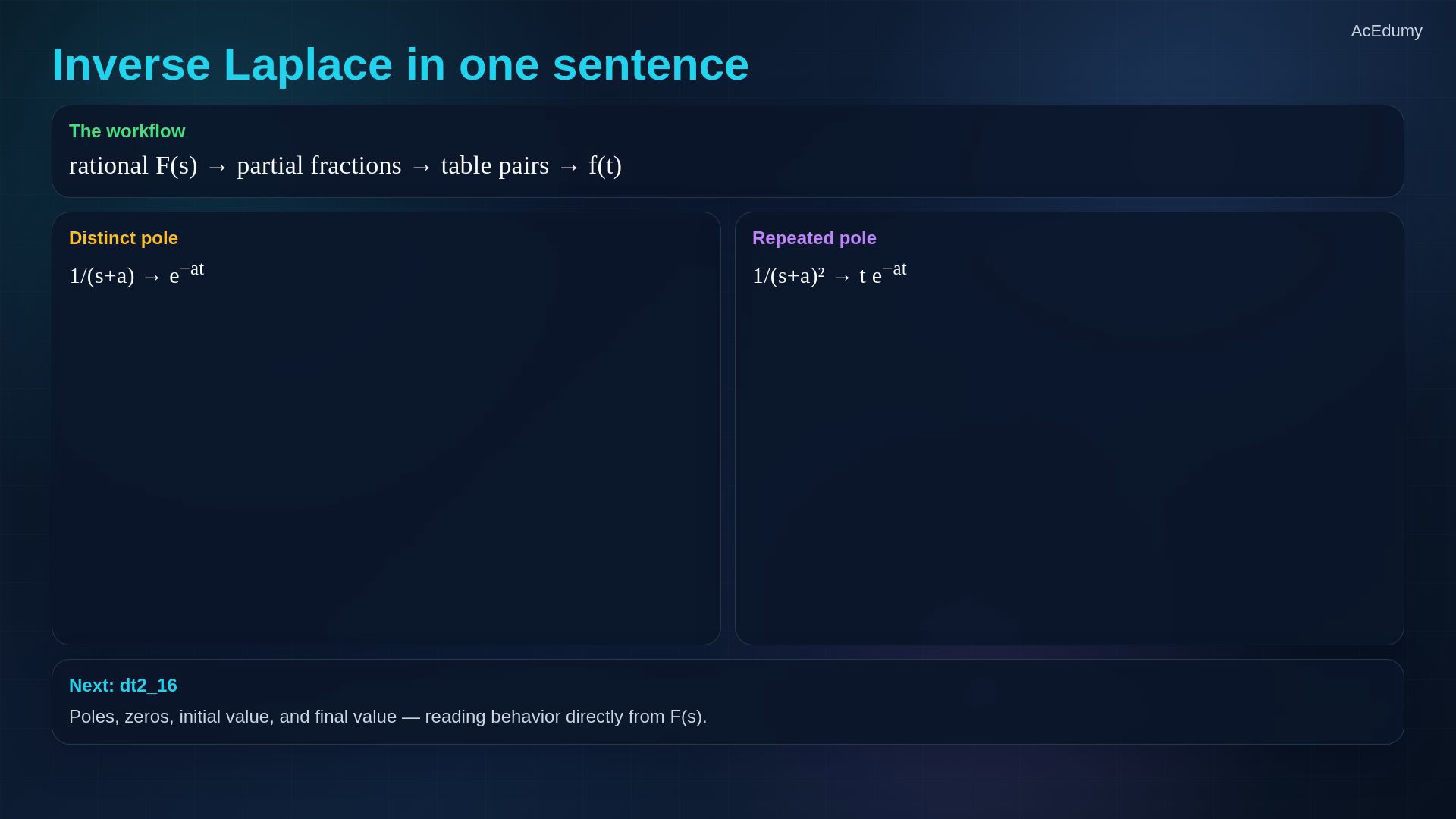
Reference from the existing English final. The notebook lines supply formatted fractions and explicit causal conditions; the common-mistakes role reuses the same video's table card. Summary: exact algebra, complete expansion, correct inverse pairs.Match each term to a table pair with its causal and convergence conditions.Check the decomposition by recombining the fractions; recover the given numerator and denominator.A simple pole gives an exponential; a double pole adds a term proportional to time times the exponential.Next: poles, zeros, initial value and final value, including the conditions required by the two value theorems.Narration transcript
Summary. Inverse Laplace in circuits is table matching after algebra. Partial fractions turn one complicated rational expression into a sum of simple modes. Distinct real poles give weighted exponentials; repeated poles add t times exponential terms. Next lesson we zoom out and read poles, zeros, initial value, and final value directly from F of s.
Source video: Circuit Theory-2 #15 | Inverse Laplace Transform and Partial Fractions (5:48)