Circuit Theory 1 · Circuit Analysis Fundamentals
#04 Kirchhoff's voltage and current laws — worked examples
Builds KVL and KCL equations, solves a 24-volt series loop, and verifies charge and voltage conservation.
Question
Explain Kirchhoff's voltage and current laws. In a single loop with a 24 V source and series resistors of 3 Ω, 5 Ω, and 4 Ω, find the loop current and each resistor voltage. Then write KCL at node a where i₁ and i₂ enter while i₃ and i₄ leave.
Written solution and narration transcript(shows the full solution)
Below are all the lines written in the notebook together with the full narration transcript.
1. KVL rule
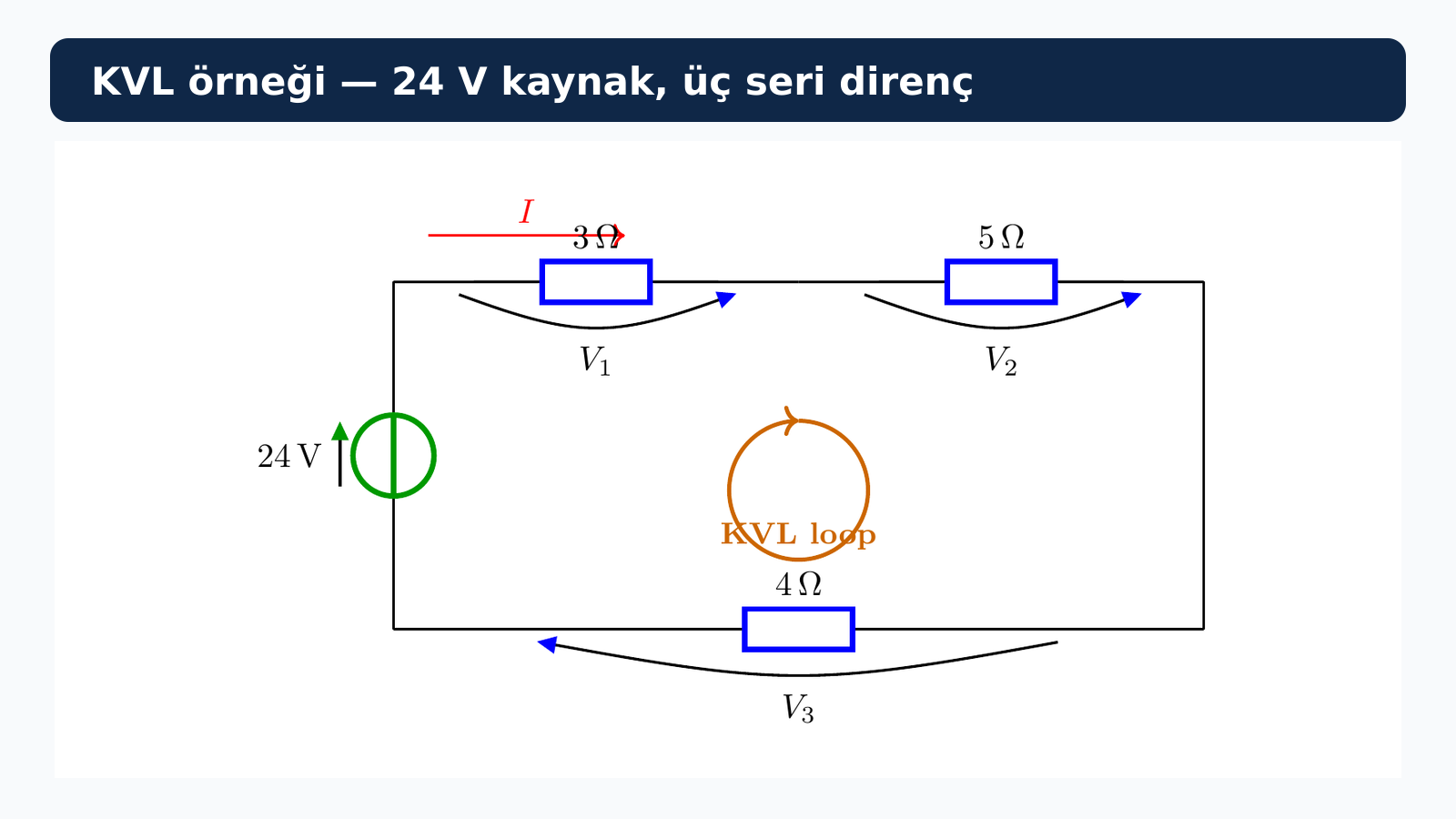
The loop current is common to all three resistors. Closed loop:− to + across a source → rise (+)With current through R → drop (−)Voltage rises = voltage dropsNarration transcript
Kirchhoff's Voltage Law, or KVL, states that the sum of all voltages around any closed loop equals zero. In other words, if you start at any point in a circuit and travel around a complete loop back to the same point, the voltage rises must equal the voltage drops. We write this as: the summation of V around a loop equals zero. Convention: when we travel through a source from minus to plus, that's a voltage rise, so we write it as positive. When we travel through a resistor in the direction of current, that's a voltage drop, so we write it as negative.
2. KVL worked loop
The loop current is common to all three resistors. Narration transcript
Let's apply KVL to a simple series circuit. We have a twenty four volt source connected to three resistors: three ohms, five ohms, and four ohms, all in series. Since they're in series, the same current I flows through all of them. Applying KVL around the loop: twenty four minus three I minus five I minus four I equals zero. Combining: twenty four minus twelve I equals zero. So I equals twenty four over twelve, which is two amperes. Now we can find each voltage: V one equals I times three, which is six volts. V two equals I times five, which is ten volts. V three equals I times four, which is eight volts. Let's verify: six plus ten plus eight equals twenty four. KVL checks out!
3. KCL rule
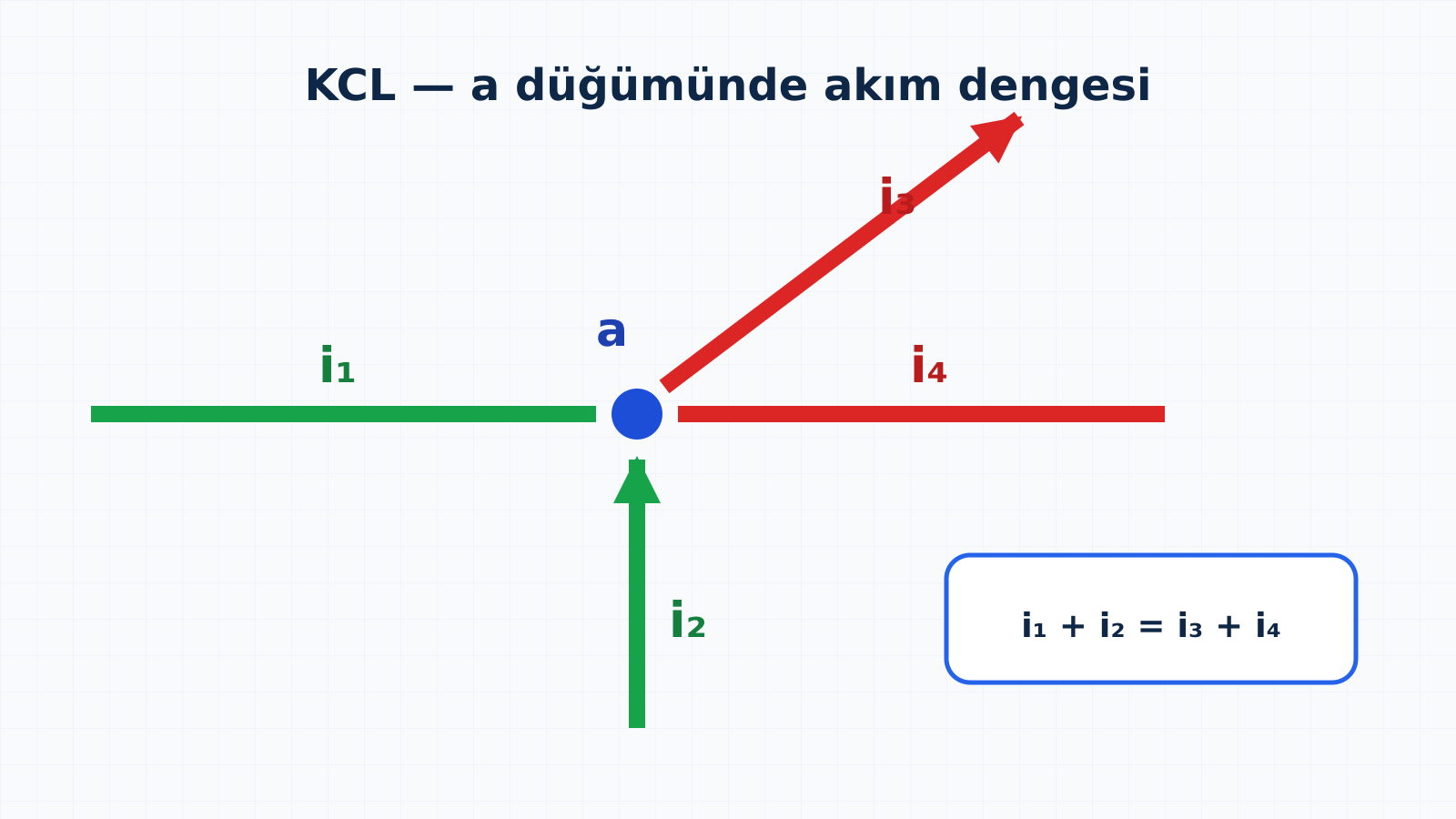
Use one sign convention consistently at the node. At a node:Entering currents (+)Leaving currents (−)Total entering = total leavingBasis: conservation of chargeNarration transcript
Kirchhoff's Current Law, or KCL, states that the sum of all currents entering a node equals the sum of all currents leaving that node. Equivalently, the algebraic sum of all currents at a node is zero. We write this as: the summation of I at a node equals zero. Convention: currents entering the node are positive, currents leaving the node are negative. Or you can use the opposite convention, as long as you're consistent. KCL is based on conservation of charge: charge cannot accumulate at a node, so whatever flows in must flow out.
4. KCL worked node
Use one sign convention consistently at the node. Node a: i1, i2 enteri3, i4 leaveCheck:Narration transcript
Let's apply KCL at node a. Four currents meet at this node. Using our convention: entering is positive, leaving is negative. Currents i one and i two enter the node. Currents i three and i four leave the node. Writing KCL at node a: plus i one plus i two minus i three minus i four equals zero. We can rearrange this as: i three plus i four equals i one plus i two. In words: total current out equals total current in. You can write KCL at every node in any circuit. For example, at another node with known values: two amperes minus four amperes plus two amperes equals zero. The sum is indeed zero, confirming KCL.
5. Conservation summary
KVL → voltage balanceKCL → current balanceOhm's law → element relationOhm + KCL + KVL → circuit analysisNarration transcript
Let's recap Kirchhoff's two laws. KVL says the sum of voltages around any closed loop is zero. Voltage rises equal voltage drops. KCL says the sum of currents at any node is zero. Currents entering equal currents leaving. Together with Ohm's law, these two laws give us everything we need to analyze any linear circuit. In the next video, we'll explore voltage and current dividers in more detail.
Source video: Circuit Theory #04 — Kirchhoff's Laws (KVL & KCL) with Solved Examples (3:52)