Circuit Theory 1 · Circuit Analysis Fundamentals
#05 KVL on multiple paths and combined KCL–KVL analysis
Writes KVL for any closed path, then combines KCL, KVL, and Ohm's law to solve currents, voltage, and the corrected power balance.
Question
Write KVL for three closed paths in the 24 V two-loop circuit. Then, for the circuit with a 120 V source, 10 Ω and 50 Ω resistors, and an upward 6 A current source, find i₀, iₓ, Vxy, and verify the power balance.
Written solution and narration transcript(shows the full solution)
Below are all the lines written in the notebook together with the full narration transcript.
1. KVL: any closed path
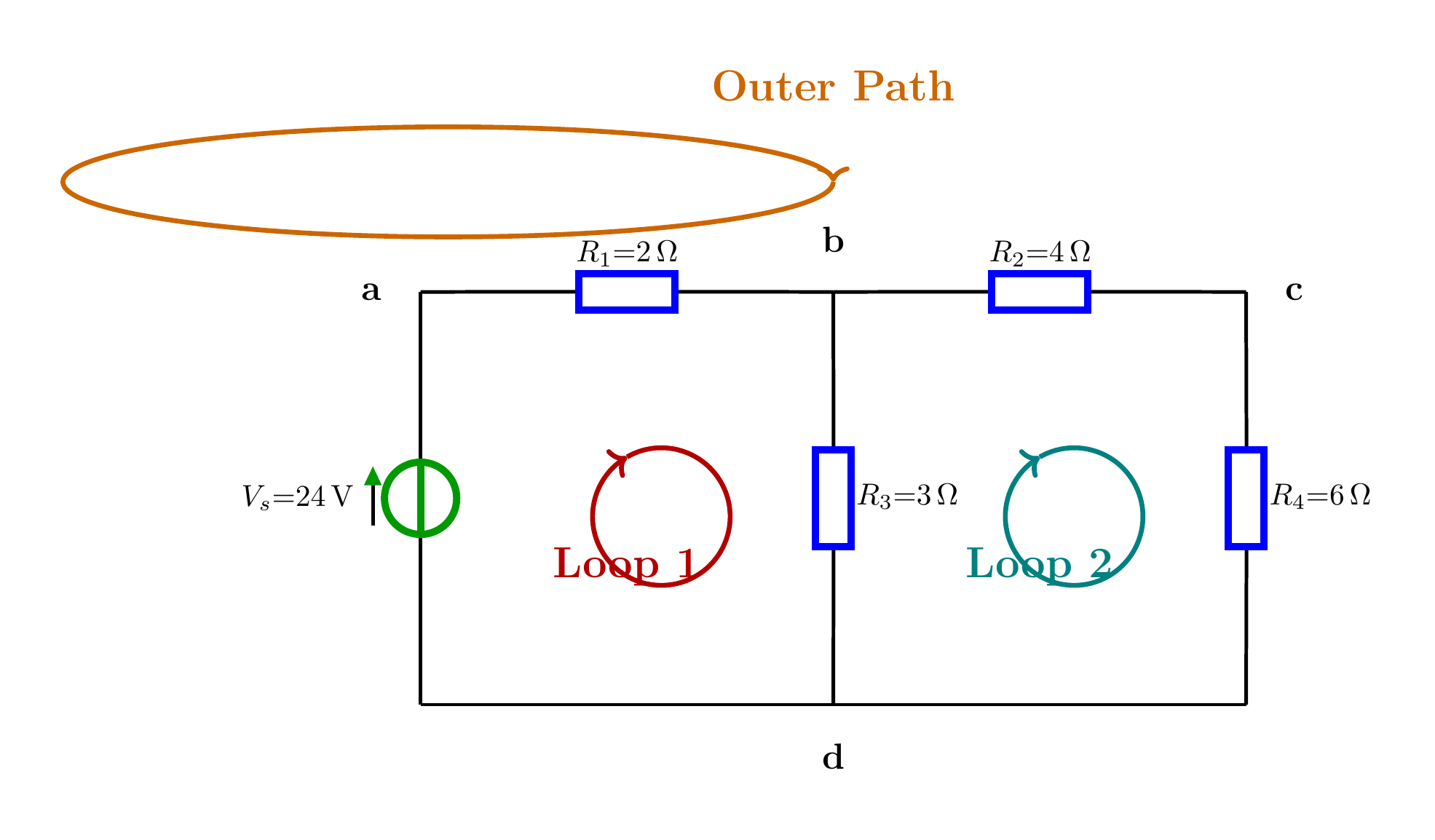
The left, right, and outer closed paths are marked for KVL. KVL: ∑vk = 0 on any closed pathStart and finish at the same nodeVoltage rises = voltage dropsChoose independent loops; avoid duplicate equationsNarration transcript
In Lesson four we learned Kirchhoff's Voltage Law: the sum of voltages around any closed loop is zero. But what does any really mean? KVL doesn't just apply to simple inner loops. It works for any closed path you can trace through a circuit, even paths that cross multiple loops or go around the outer edge. If you start at one node, walk through any sequence of branches, and return to the same node, the voltage rises and drops will cancel. Today we'll see this in action, then combine KVL with KCL and Ohm's Law to solve a real circuit.
2. Three closed paths
The left, right, and outer closed paths are marked for KVL. Left loop:Right loop:Outer path:Outer path = left loop + right loopNarration transcript
Here's a simple circuit with a twenty four volt source and four resistors: R one is two ohms, R two is four ohms, R three is three ohms, and R four is six ohms. R three connects node b to node d, creating two loops. Let's trace three different closed paths. Loop one on the left: V s minus V one minus V three equals zero. Loop two on the right: V three minus V two minus V four equals zero. And the outer path going all the way around: V s minus V one minus V two minus V four equals zero. Notice that the outer path equation is just the sum of the two inner loops. Every closed path obeys KVL. This is the key insight.
3. Set up the combined problem
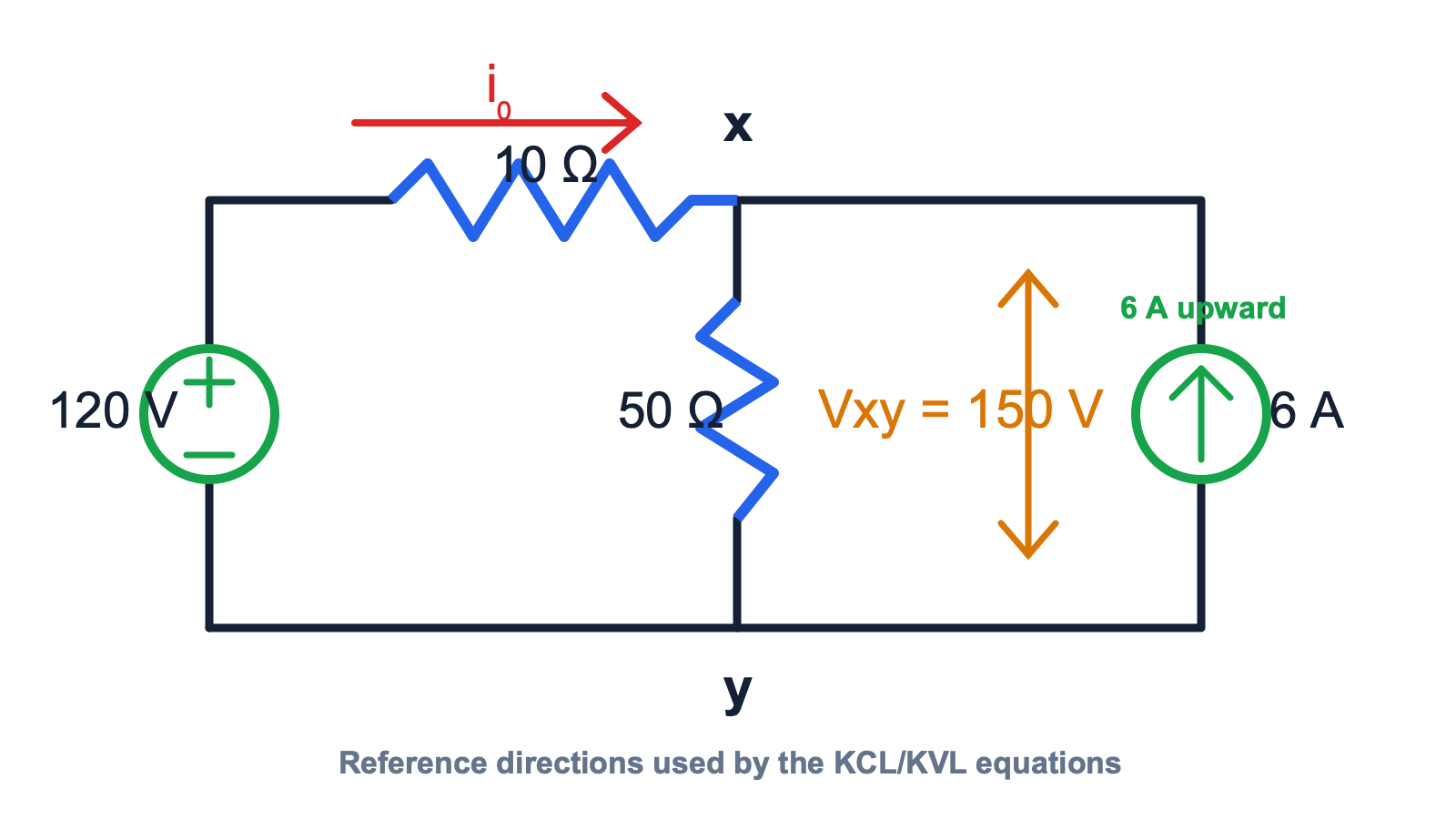
i₀ points right and Vxy is referenced from top to bottom; the directions match the KCL and KVL equations. Given: 120 V, 10 Ω, 50 Ω, 6 A ↑References: i0 right, ix downwardFind: i0, ix, Vxy, and powerThe current-source arrow matches the equationsNarration transcript
Now let's combine all three laws in one problem. This circuit has a hundred and twenty volt source on the left, a ten ohm resistor at the top, a fifty ohm resistor in the middle, and a six ampere current source on the right. We define i zero as the current through the ten ohm resistor, and i x as the current through the fifty ohm resistor. Our goal: find i zero and i x, the voltage across the current source, and the power it delivers.
4. Solve with KCL + KVL
i₀ points right and Vxy is referenced from top to bottom; the directions match the KCL and KVL equations. KCL:KVL:Narration transcript
Step one: apply KCL at the top node. The current i zero plus the six amp source current equals i x. So i x equals i zero plus six. Step two: apply KVL around the outer loop. A hundred and twenty minus ten times i zero minus fifty times i x equals zero. Step three: substitute the KCL result into the KVL equation. Replace i x with i zero plus six. Expanding: a hundred and twenty minus ten i zero minus fifty i zero minus three hundred equals zero. That gives us minus sixty i zero equals a hundred and eighty. So i zero equals minus three amperes. The negative sign means the actual current flows opposite to our assumed direction. That's perfectly normal. Back-substituting: i x equals minus three plus six, which is three amperes. The voltage across the current source is fifty times three, which is a hundred and fifty volts. And the power delivered by the current source is a hundred and fifty times six, equaling nine hundred watts.
5. Verify the power balance
i₀ points right and Vxy is referenced from top to bottom; the directions match the KCL and KVL equations. Passive sign: +P absorbed, −P deliveredNarration transcript
Let's verify our answer using conservation of energy. Use the passive sign convention, so positive power is absorbed and negative power is delivered. The one-hundred-twenty-volt source carries three amperes into its positive terminal, so it absorbs three hundred sixty watts. The six-ampere current source has one hundred fifty volts across it, and its current enters the negative terminal, so it delivers nine hundred watts; its absorbed power is minus nine hundred watts. The ten-ohm resistor absorbs i squared R, nine times ten, or ninety watts. The fifty-ohm resistor absorbs nine times fifty, or four hundred fifty watts. The absorbed-power sum is three hundred sixty minus nine hundred plus ninety plus four hundred fifty, which equals zero. Energy is conserved.
6. Method summary
1) Choose reference directions2) Write the KCL node equation3) Write an independent KVL loop4) Solve with Ohm's law5) Verify with ∑P = 0Narration transcript
Let's recap. KVL applies to any closed path you can trace through a circuit, not just simple inner loops. When you have multiple unknowns, combine KCL, KVL, and Ohm's Law together. Write one equation per unknown, then solve the system. A negative current simply means the actual direction is opposite to what you assumed. It's not an error. And always verify with a power balance: the total power delivered must equal the total power absorbed. In the next lesson, we'll work with dependent sources.
Source video: Circuit Theory #05 — KVL Multi-Path & Combined KCL+KVL Analysis (4:49)