Electromagnetic Theory · Magnetic Flux Density B and Maxwell's Equations for Statics
#21 The B=μH relation, magnetic flux, Gauss's law for magnetism, and the static forms of Maxwell's equations
Relate B to H through permeability, define magnetic flux, and collect all four static Maxwell equations in one coherent view.
Question

Explain magnetic flux density B, its relation to H, and permeability; define magnetic flux, convert ∇·B=0 to integral form, and summarize all four static Maxwell equations.
Written solution and narration transcript(shows the full solution)
Below are all the lines written in the notebook together with the full narration transcript.
1. Move from H to B
The B=μH relation and ∇·B=0 complete magnetostatics within the four static Maxwell equations. In the past two videos we built up the magnetic field H.We got it from Biot-Savart by integrating along currents, and more elegantly from Ampere's circuit law when the geometry was symmetric.But H is not the only magnetic field quantity we care about.There is a second one called B, the magnetic flux density, and today we connect the two.We will then write down all four of Maxwell's equations in their static form.Narration transcript
In the past two videos we built up the magnetic field H. We got it from Biot-Savart by integrating along currents, and more elegantly from Ampere's circuit law when the geometry was symmetric. But H is not the only magnetic field quantity we care about. There is a second one called B, the magnetic flux density, and today we connect the two. We will then write down all four of Maxwell's equations in their static form.
2. Define B=μH and permeability
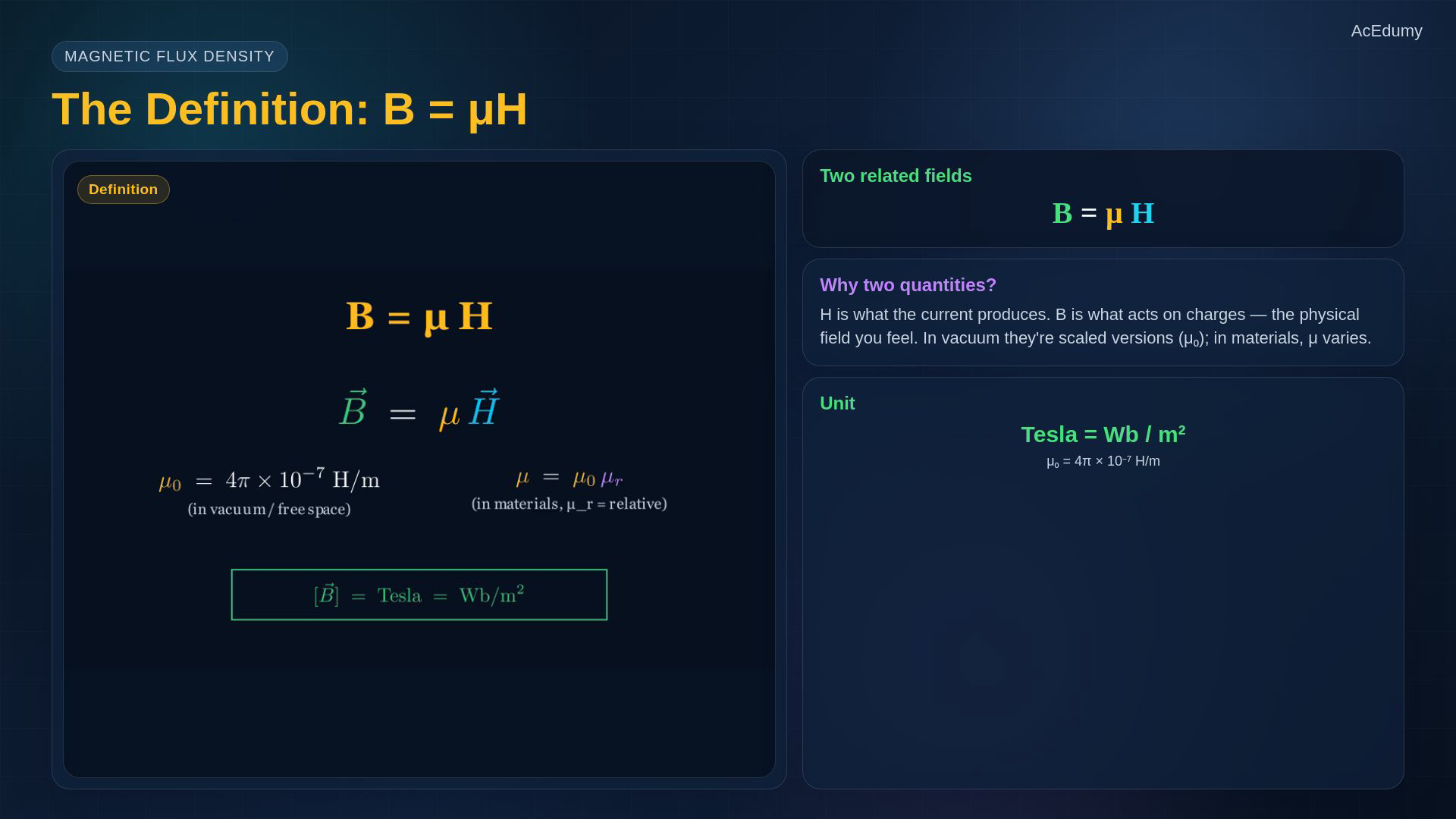
The B=μH relation and ∇·B=0 complete magnetostatics within the four static Maxwell equations. Magnetic flux density:In free space, μ = μ₀ ≈ 4π×10⁻⁷ H/m.In SI, μ₀ sets the scale of magnetic effects, while ε₀ sets the scale of electric effects.Inside a material, μ = μ₀μᵣ, where μᵣ is the relative permeability.Why two field quantities H and B, if they are proportional?Because H is what a current produces directly, and B is what acts on moving charges and causes the forces we observe.In vacuum they're just scaled versions of each other, but in matter they carry different physical information.The unit of B is Tesla, or equivalently, Webers per square meter.Narration transcript
The magnetic flux density B is defined by a very simple relationship: B equals mu times H. In free space, mu is the constant mu-zero, which equals four pi times ten to the minus seven. This number comes from the SI unit system — it sets the scale of magnetic effects the same way epsilon-zero sets the scale of electric effects. Inside a material, mu is generally different; we write it as mu-zero times mu-r, where mu-r is the relative permeability and captures how the material responds to the field. Why two field quantities H and B, if they are proportional? Because H is what a current produces directly, and B is what acts on moving charges and causes the forces we observe. In vacuum they're just scaled versions of each other, but in matter they carry different physical information. The unit of B is Tesla, or equivalently, Webers per square meter.
3. Build magnetic flux as a surface integral

The B=μH relation and ∇·B=0 complete magnetostatics within the four static Maxwell equations. Now we define magnetic flux.Magnetic flux through S: Φ = ∫S B·dS.You can think of dS as a tiny patch of the surface with an arrow sticking out of it; B dot dS measures how much of B pokes through that patch.Add them up over the whole surface and you get Φ, the total magnetic flux.[Φ] = Wb = T·m².This integral looks just like the electric flux from Gauss's law, and that's not a coincidence.The reason we define it is that magnetic flux through loops is what drives induction later on.Narration transcript
Now we define magnetic flux. The magnetic flux phi through a surface S is the surface integral of B dotted with d S. You can think of d S as a tiny patch of the surface with an arrow sticking out of it; B dot d S measures how much of B pokes through that patch. Add them up over the whole surface and you get phi, the total magnetic flux. The unit is the Weber, which is a Tesla times a square meter. This integral looks just like the electric flux from Gauss's law, and that's not a coincidence. The reason we define it is that magnetic flux through loops is what drives induction later on.
4. Explain the absence of magnetic monopoles
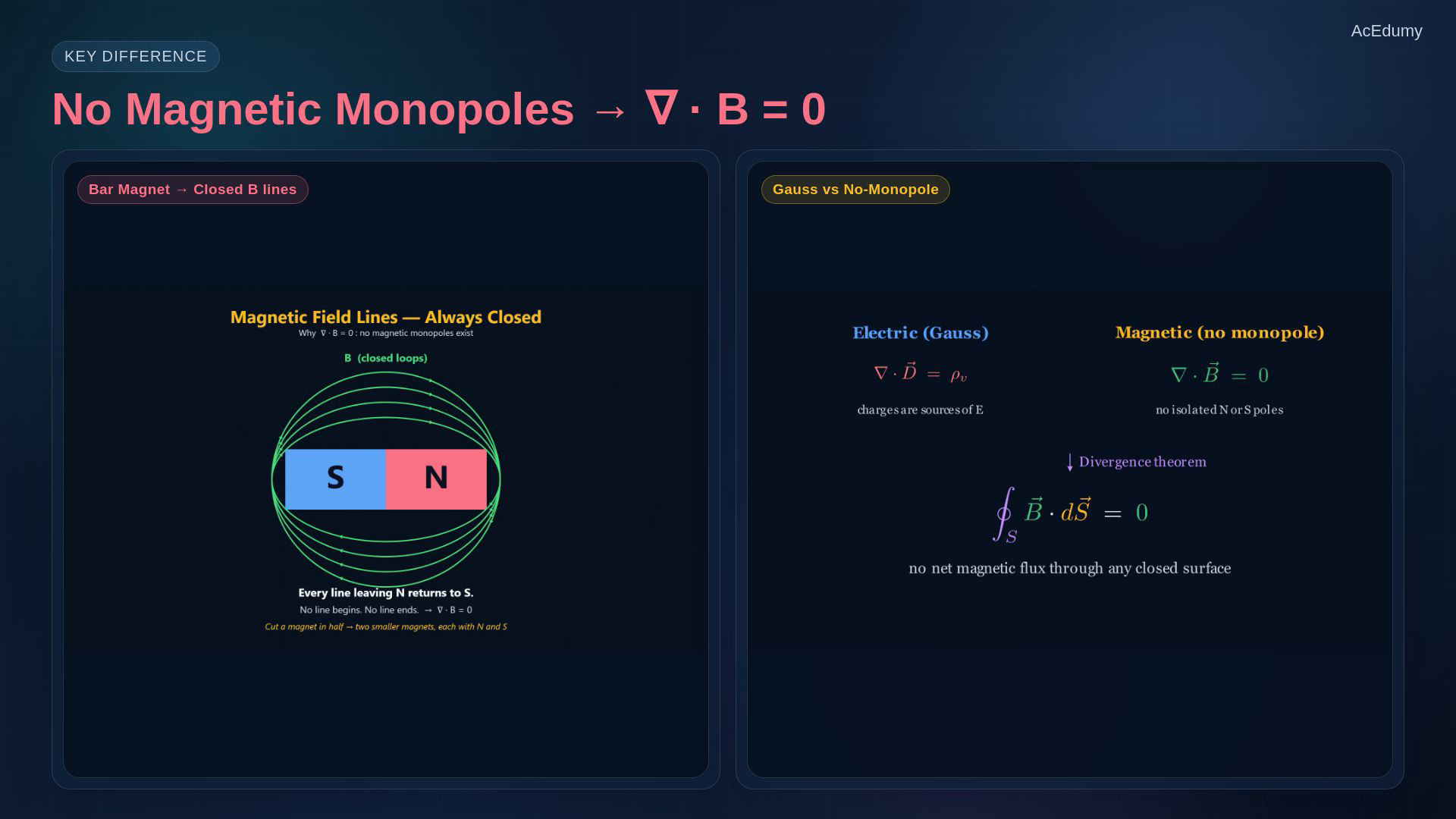
The B=μH relation and ∇·B=0 complete magnetostatics within the four static Maxwell equations. Here comes the big difference between electric and magnetic fields.For the electric field we had Gauss's law: the divergence of D equals the free charge density ρᵥ.Charges are the sources of E.Gauss's law for magnetism:Zero, everywhere, always.What does that mean physically?No isolated magnetic monopole has been observed: a north or south pole does not occur alone.If you take a bar magnet and cut it in half, you don't get a loose north pole and a loose south pole; you get two smaller magnets, each with both poles.The field lines of B always form closed loops.They never begin and never end.That's why the divergence is zero: at every point, as many lines enter as leave.By the divergence theorem: ∮S B·dS = 0.No net flux out of any closed surface.Narration transcript
Here comes the big difference between electric and magnetic fields. For the electric field we had Gauss's law: the divergence of D equals the free charge density rho-v. Charges are the sources of E. For magnetic fields, the analogous law reads: divergence of B equals zero. Zero, everywhere, always. What does that mean physically? It means there are no magnetic monopoles — no isolated north or south pole. If you take a bar magnet and cut it in half, you don't get a loose north pole and a loose south pole; you get two smaller magnets, each with both poles. The field lines of B always form closed loops. They never begin and never end. That's why the divergence is zero: at every point, as many lines enter as leave. In integral form, using the divergence theorem, this becomes the closed surface integral of B dotted with d S equals zero. No net flux out of any closed surface.
5. Combine the four static Maxwell equations
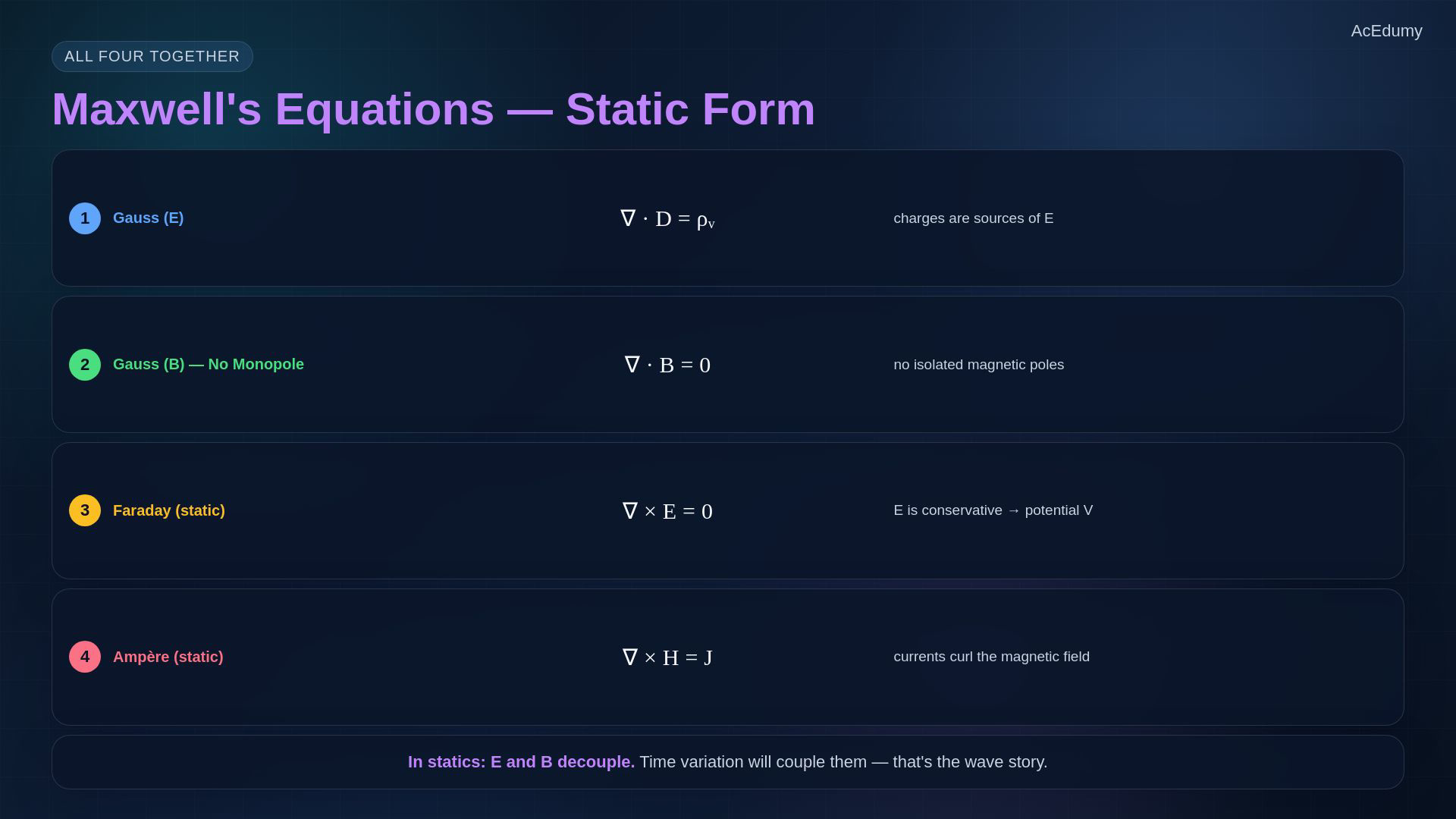
The B=μH relation and ∇·B=0 complete magnetostatics within the four static Maxwell equations. Let's collect all four Maxwell's equations in their static form — the form that applies when nothing is changing with time.Charges are the sources of the electric flux density.No magnetic monopoles.The electrostatic field is conservative, which is why we could define a potential V.Currents determine the circulation of the magnetic field: ∇×H = J, the differential form of Ampère's law.Notice something important: in the static case, the electric and magnetic fields decouple completely.The first and third equations only involve E and D, the second and fourth only involve H and B.They don't talk to each other.That changes when we let fields vary in time — but that's a story for another day.Narration transcript
Let's collect all four Maxwell's equations in their static form — the form that applies when nothing is changing with time. First, divergence of D equals rho-v. Charges are the sources of the electric flux density. Second, divergence of B equals zero. No magnetic monopoles. Third, curl of E equals zero. The electrostatic field is conservative, which is why we could define a potential V. Fourth, curl of H equals J. Currents are the sources of the curl of the magnetic field — this is the differential form of Ampere's law from the last video. Notice something important: in the static case, the electric and magnetic fields decouple completely. The first and third equations only involve E and D, the second and fourth only involve H and B. They don't talk to each other. That changes when we let fields vary in time — but that's a story for another day.
6. Review the magnetostatics block

The B=μH relation and ∇·B=0 complete magnetostatics within the four static Maxwell equations. Quick wrap-up.B = μH connects the two magnetic field quantities.Magnetic flux: Φ = ∫S B·dS.In classical electromagnetism, ∇·B = 0; no isolated magnetic monopole has been observed.And when we stack this next to the other three static laws, we get all four Maxwell equations for statics.This closes the block on magnetostatics — the last piece of static field theory.From here, two paths open up: wave theory, where time-varying fields couple E and B together, and applied problem solving, where we use everything we've built to crack textbook problems step by step.That is where the course turns next.Narration transcript
Quick wrap-up. B equals mu H connects the two magnetic field quantities. The flux phi is the surface integral of B dotted with d S. Divergence of B is zero, because magnetic monopoles do not exist. And when we stack this next to the other three static laws, we get all four Maxwell equations for statics. This closes the block on magnetostatics — the last piece of static field theory. From here, two paths open up: wave theory, where time-varying fields couple E and B together, and applied problem solving, where we use everything we've built to crack textbook problems step by step. That is where the course turns next.
Source video: Electromagnetic Theory (v2) #21 | Magnetic Flux Density B & Maxwell (Static) (5:27)