Electromagnetic Theory · Magnetic Forces, Torque, and Materials
#22 Lorentz force, force on a current-carrying wire, current-loop torque, magnetization, and magnetic material classes
Move from a charged particle to a current-carrying wire and loop, then classify how materials respond through magnetization and permeability.
Question
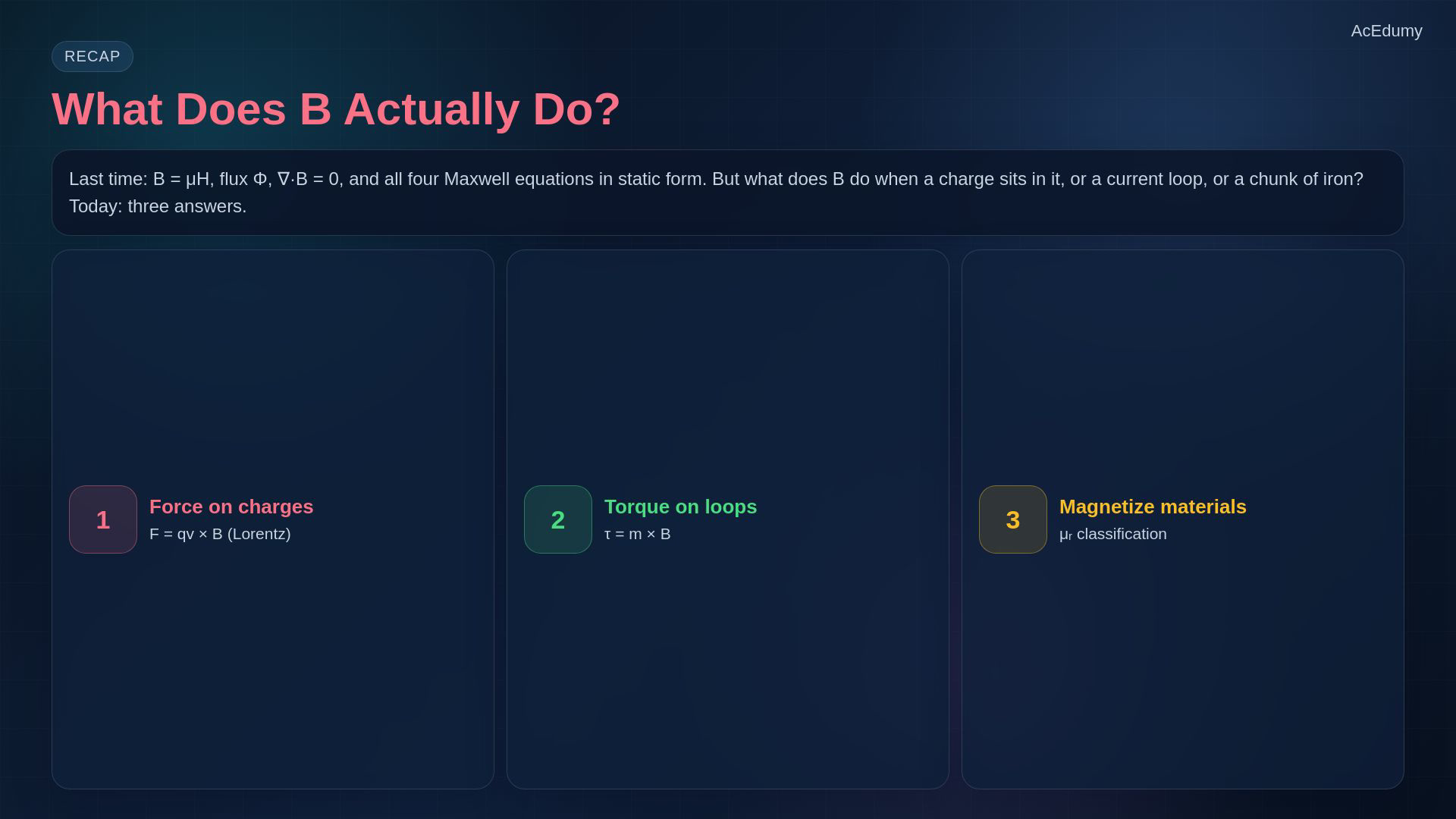
Derive the Lorentz force and the force on a current-carrying wire; explain a current loop's dipole moment, torque, and energy; relate magnetization to magnetic material classes.
Written solution and narration transcript(shows the full solution)
Below are all the lines written in the notebook together with the full narration transcript.
1. Identify what the B field does
The B field exerts force on moving charges and torque on current loops; material response is described by M and μ. Last time we defined the magnetic flux density B and wrote down all four Maxwell equations in their static form.But a question stayed open: what does B actually do?Today we answer it.B exerts forces on moving charges, torques on current loops, and it magnetizes materials.By the end of the video we'll have the force-and-materials toolbox we need to handle motors, inductors, and magnetic recording.Narration transcript
Last time we defined the magnetic flux density B and wrote down all four Maxwell equations in their static form. But a question stayed open: what does B actually do? Today we answer it. B exerts forces on moving charges, torques on current loops, and it magnetizes materials. By the end of the video we'll have the force-and-materials toolbox we need to handle motors, inductors, and magnetic recording.
2. Build the Lorentz force on a moving charge
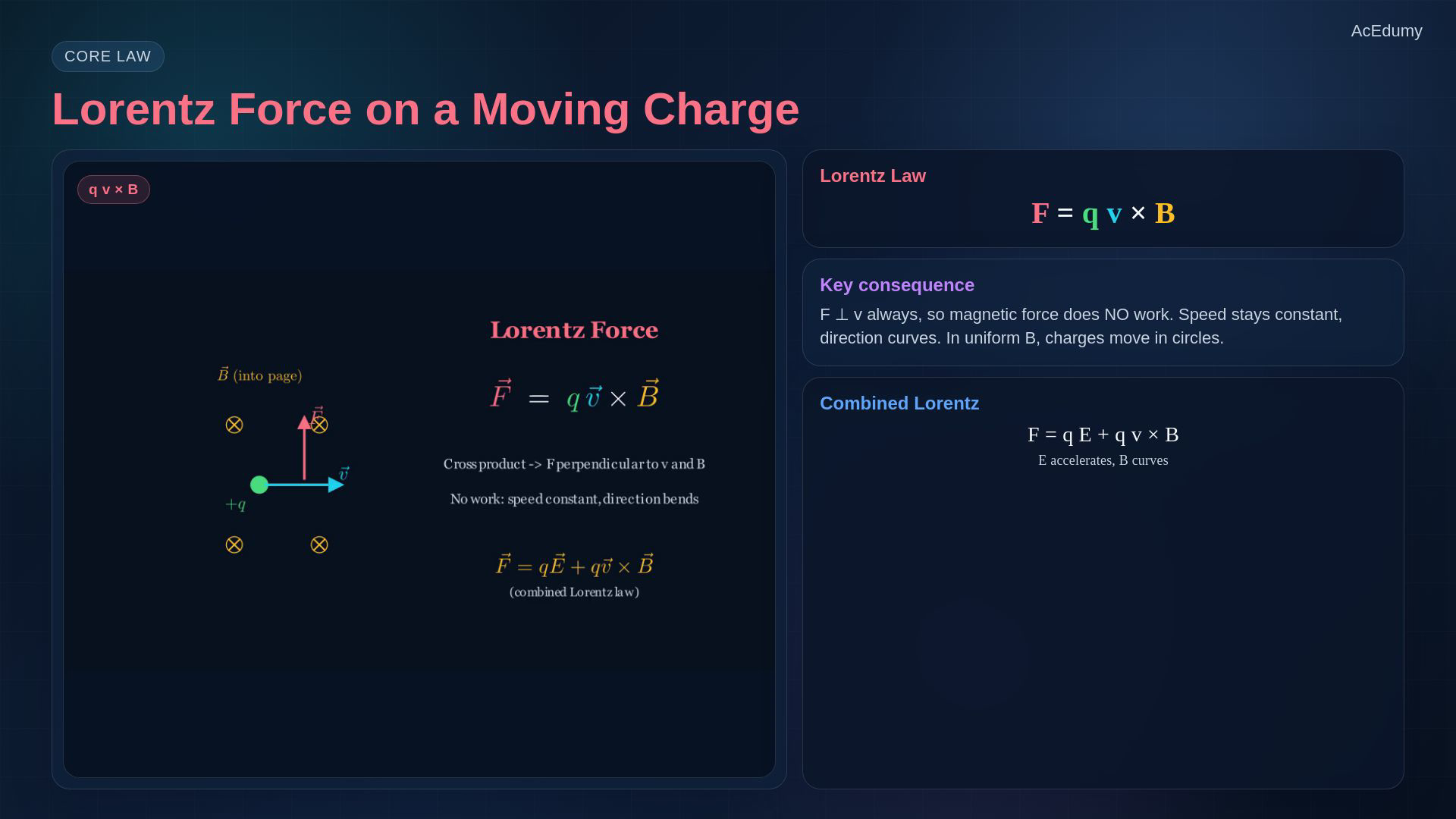
The B field exerts force on moving charges and torque on current loops; material response is described by M and μ. Start with a single point charge q, moving with velocity v, inside a magnetic field B.Magnetic Lorentz force:Why a cross product, not a simple product?Because the force is always perpendicular to both v and B.If the charge moves along B, v and B are parallel, the cross product is zero, and no force acts.If v ⟂ B, |FB| = |q|vB is maximum.The direction follows the right-hand rule, just like in Biot-Savart.One important consequence: since F is always perpendicular to v, the magnetic force never does work on the charge.It changes the direction, not the speed.The component of v perpendicular to B produces circular motion; a parallel component makes the path helical.Complete Lorentz force:The electric part accelerates, the magnetic part curves.Narration transcript
Start with a single point charge q, moving with velocity v, inside a magnetic field B. The force on it is given by the Lorentz law: F equals q times v cross B. Why a cross product, not a simple product? Because the force is always perpendicular to both v and B. If the charge moves along B, v and B are parallel, the cross product is zero, and no force acts. If v is perpendicular to B, we get the maximum magnitude q v B. The direction follows the right-hand rule, just like in Biot-Savart. One important consequence: since F is always perpendicular to v, the magnetic force never does work on the charge. It changes the direction, not the speed. That's why charges in a uniform B field move in circles. If we combine electric and magnetic forces, we get the complete Lorentz force: F equals q E plus q v cross B. The electric part accelerates, the magnetic part curves.
3. Derive the force on a current-carrying wire
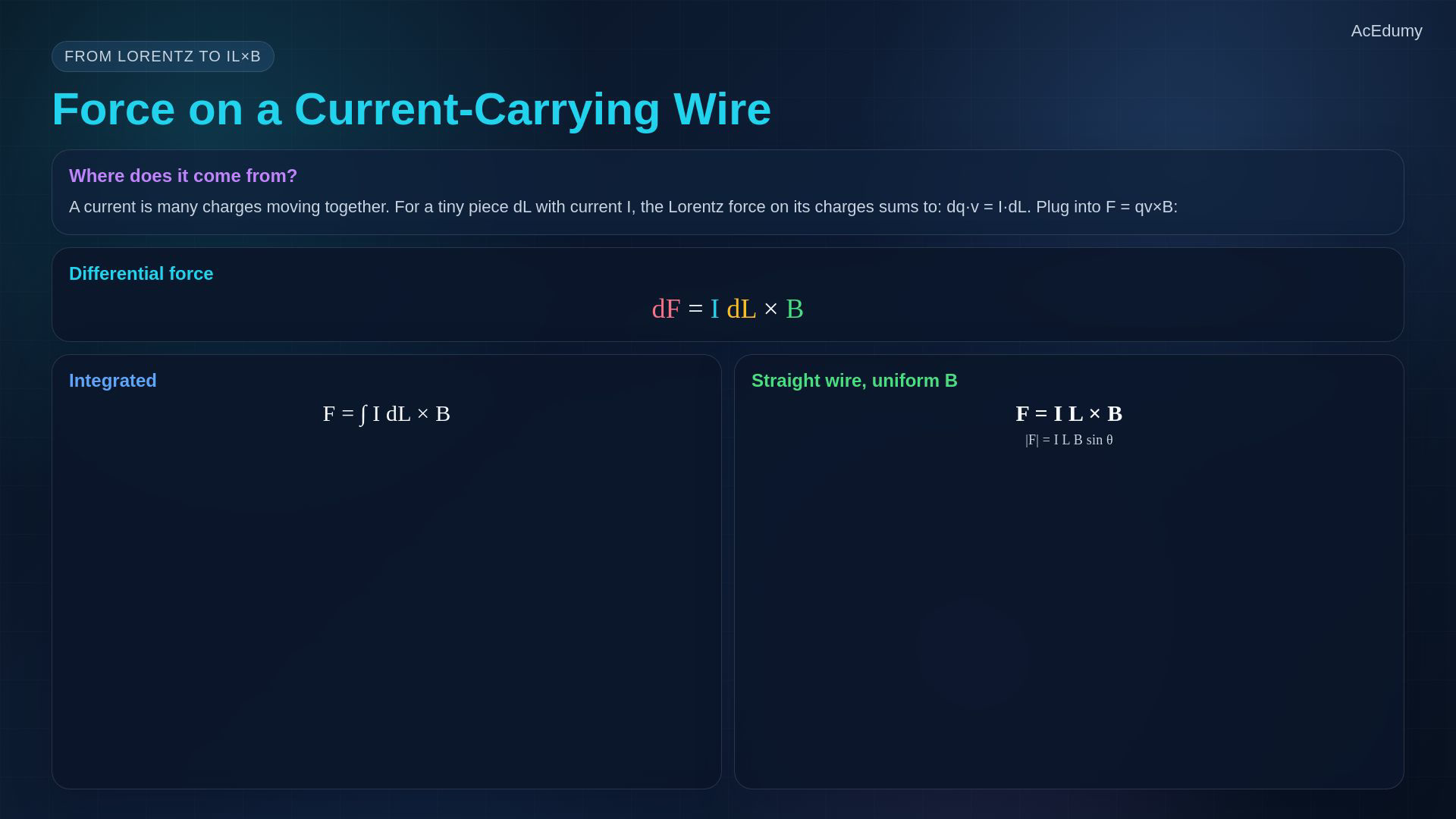
The B field exerts force on moving charges and torque on current loops; material response is described by M and μ. Now scale this up to a current-carrying wire.A current I is just a bunch of charges moving together.For a tiny piece of wire dℓ carrying current I, the charges inside give rise to a force.Using dq·v = I dℓ gives dF = I dℓ×B.Along the wire:For a straight wire in a uniform field, F = I L×B.Magnitude |F| = ILB sin θ, where θ is the angle between L and B.This is the formula behind every electric motor: a current-carrying coil inside a magnet feels a force, and if the geometry is right, that force turns it.Narration transcript
Now scale this up to a current-carrying wire. A current I is just a bunch of charges moving together. For a tiny piece of wire d L carrying current I, the charges inside give rise to a force. Using d q times v equals I times d L, the Lorentz law becomes d F equals I d L cross B. Integrate along the wire, and we get the total force: F equals the integral of I d L cross B. For a straight piece of wire of length L in a uniform field, this simplifies to F equals I L cross B. Magnitude is I L B sine theta, where theta is the angle between the wire and B. This is the formula behind every electric motor: a current-carrying coil inside a magnet feels a force, and if the geometry is right, that force turns it.
4. Find a current loop's moment and torque
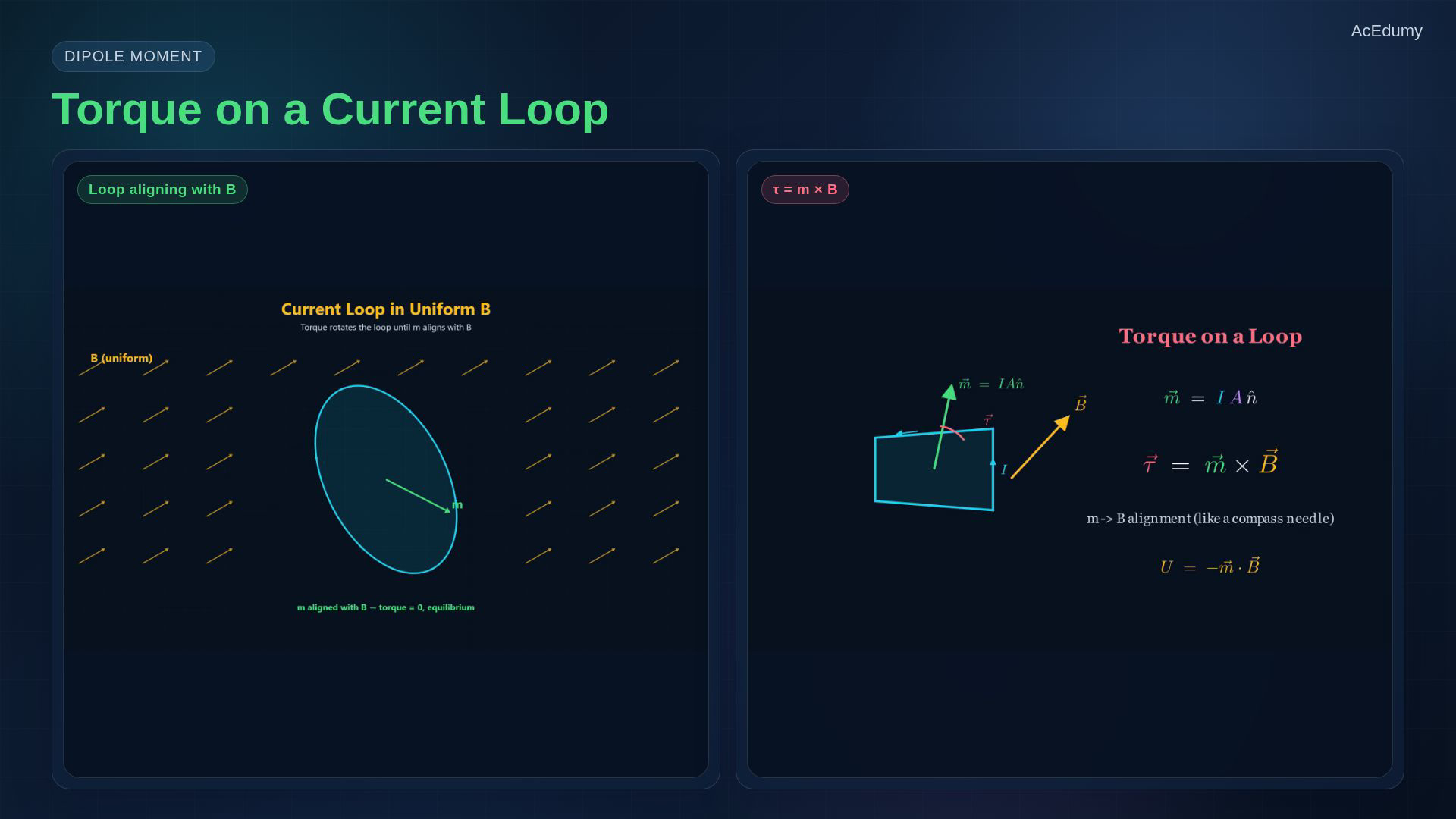
The B field exerts force on moving charges and torque on current loops; material response is described by M and μ. What about a closed current loop in a uniform field?Here the net force is zero — the forces on opposite sides cancel.But there is a torque, and it tries to rotate the loop.Magnetic dipole moment: m = IA n̂, with n̂ set by the right-hand rule.Why this particular definition?In a uniform B field, τ = m×B.Same structure as the force law, just with m instead of q v.The cross product tells us where the loop wants to settle.If m is parallel to B, the torque is zero and the loop is at rest.If m is perpendicular to B, the torque is maximum and the loop rotates to align.Exactly like a compass needle settling in the Earth's field.Potential energy U = −m·B; it is minimum when aligned and maximum when anti-aligned.Narration transcript
What about a closed current loop in a uniform field? Here the net force is zero — the forces on opposite sides cancel. But there is a torque, and it tries to rotate the loop. We define the magnetic dipole moment m as I times A times n-hat, where A is the area of the loop and n-hat is the unit normal, chosen by the right-hand rule along the current direction. Why this particular definition? Because with it, the torque on the loop in a uniform B field takes a clean form: tau equals m cross B. Same structure as the force law, just with m instead of q v. The cross product tells us where the loop wants to settle. If m is parallel to B, the torque is zero and the loop is at rest. If m is perpendicular to B, the torque is maximum and the loop rotates to align. Exactly like a compass needle settling in the Earth's field. The associated potential energy is U equals minus m dotted with B — minimum when aligned, maximum when anti-aligned.
5. Explain magnetization and material classes
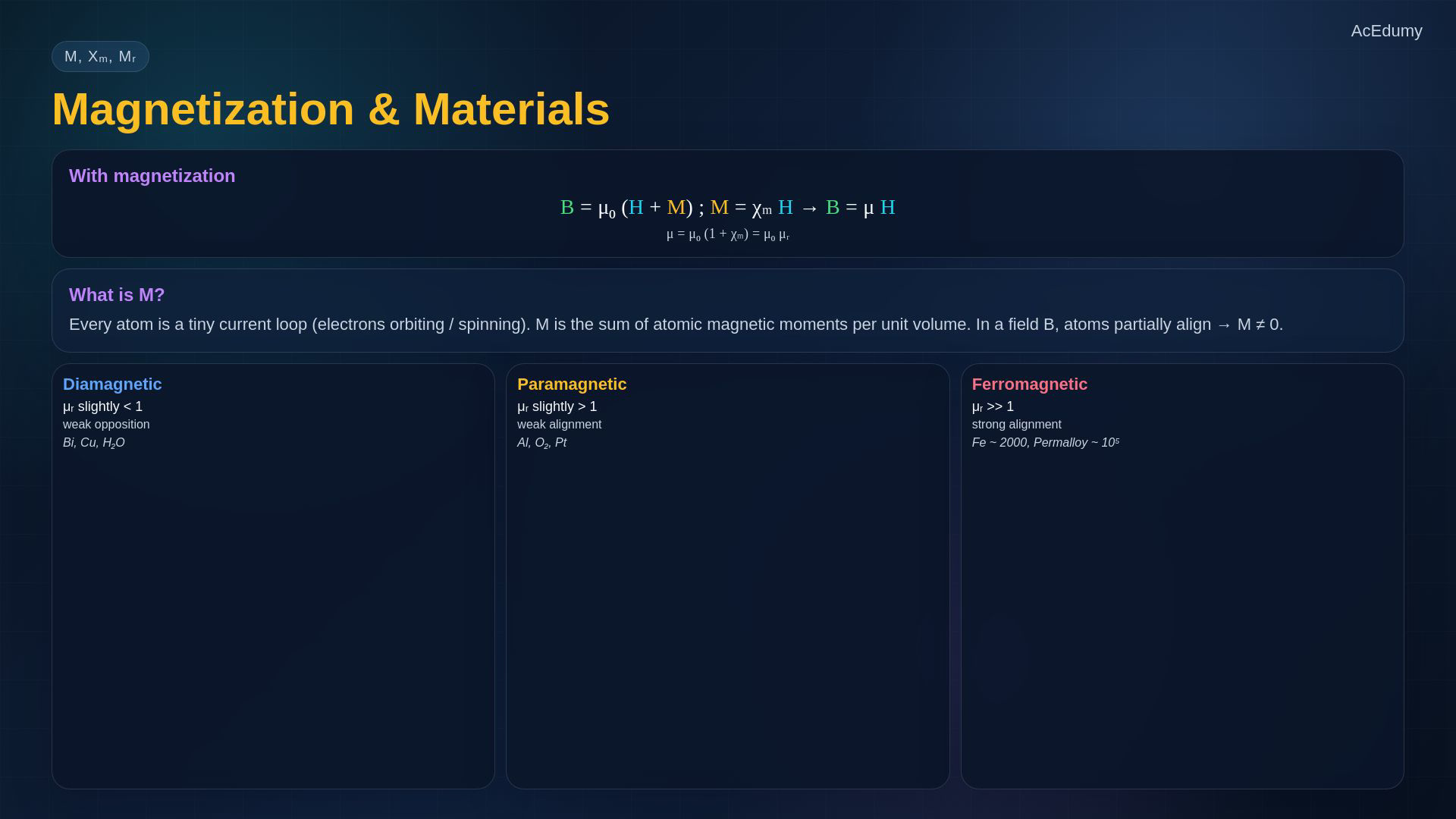
The B field exerts force on moving charges and torque on current loops; material response is described by M and μ. So far we've put currents and loops inside an external field.What happens when the field is inside a material?Atomic magnetic moments arise from electron orbital and spin angular momentum; contributions may cancel in closed shells.Usually these point in random directions and cancel out.But in a field B, they partially align, and the sum per unit volume is called the magnetization M.With magnetization, B = μ₀(H + M).For a linear isotropic material, M = χₘH, where χₘ is magnetic susceptibility.Thus B = μ₀(1+χₘ)H = μH and μᵣ = 1+χₘ.Materials fall into three classes.Diamagnetic: μᵣ slightly less than one, weak opposition to B, like bismuth or copper.Paramagnetic: μᵣ slightly greater than one, weak alignment with B, like aluminum or oxygen.Ferromagnetic: μᵣ much greater than one, strong alignment, like iron with μᵣ around two thousand, or permalloy with μᵣ up to a hundred thousand.These are the materials that make transformers, motors, and hard drives possible.Narration transcript
So far we've put currents and loops inside an external field. What happens when the field is inside a material? Every atom has electrons orbiting and spinning, so every atom is a tiny current loop with its own magnetic moment. Usually these point in random directions and cancel out. But in a field B, they partially align, and the sum per unit volume is called the magnetization M. With M around, the relationship B equals mu-zero times H picks up a new piece: B equals mu-zero times the quantity H plus M. And for linear isotropic materials, M is proportional to H: M equals chi-m H, where chi-m is the magnetic susceptibility. Plug this in and you get B equals mu-zero times one plus chi-m times H, which we write compactly as B equals mu H, with mu-r equals one plus chi-m being the relative permeability. Materials fall into three classes. Diamagnetic: mu-r slightly less than one, weak opposition to B, like bismuth or copper. Paramagnetic: mu-r slightly greater than one, weak alignment with B, like aluminum or oxygen. Ferromagnetic: mu-r much greater than one, strong alignment, like iron with mu-r around two thousand, or permalloy with mu-r up to a hundred thousand. These are the materials that make transformers, motors, and hard drives possible.
6. Review the force-and-materials toolbox

The B field exerts force on moving charges and torque on current loops; material response is described by M and μ. Quick wrap.Lorentz force:For a wire element, dF = I dℓ×B.For a current loop, τ = m×B with m = IA n̂.Inside materials, the field couples with atomic magnetic moments through the magnetization M, and the relative permeability μᵣ classifies materials into diamagnetic, paramagnetic, or ferromagnetic.Next video closes the static block: magnetic boundary conditions between materials, inductance, and magnetic energy storage.Narration transcript
Quick wrap. The Lorentz law, F equals q E plus q v cross B, is the single equation that governs how fields push on charges. Scaled up to a wire, we get d F equals I d L cross B. For a current loop, the torque is tau equals m cross B, where m equals I A n-hat. Inside materials, the field couples with atomic magnetic moments through the magnetization M, and the relative permeability mu-r classifies materials into diamagnetic, paramagnetic, or ferromagnetic. Next video closes the static block: magnetic boundary conditions between materials, inductance, and magnetic energy storage.
Source video: Electromagnetic Theory (v2) #22 | Magnetic Forces, Torque & Materials (6:26)