Circuit Theory 1 · Thevenin and Norton
#30 Thevenin and Norton #30 — Maximum power transfer
Derives R_L=R_Th from the Thevenin equivalent, then finds the load and P_max in a worked example.
Question
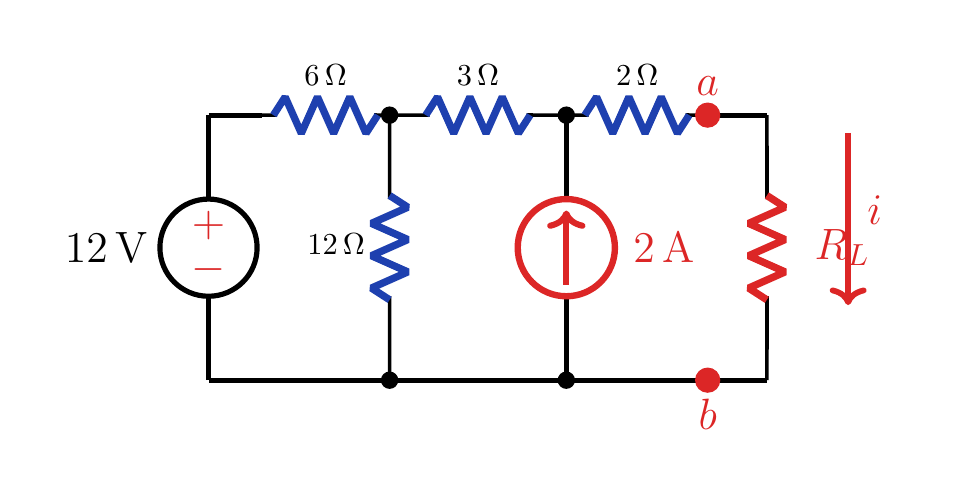
Find the value of load R_L that receives maximum power at terminals a-b and calculate that maximum power.
Written solution and narration transcript(shows the full solution)
Below are all the lines written in the notebook together with the full narration transcript.
1. Power balance
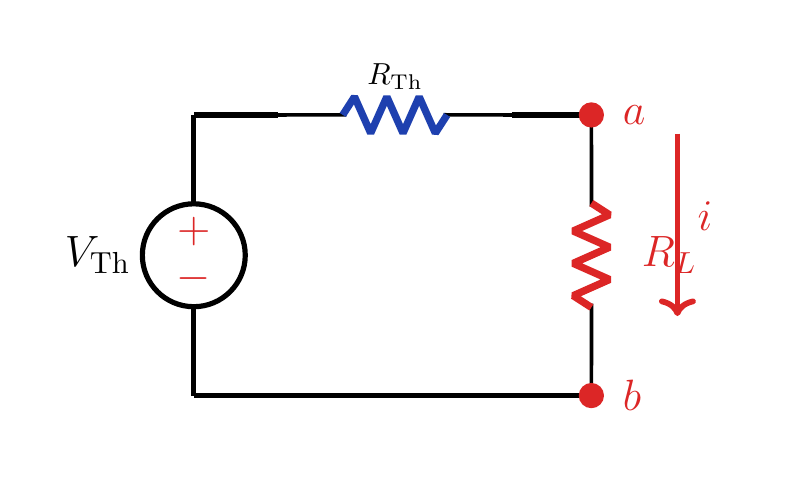
For a purely resistive DC load, maximum power occurs at R_L=R_Th. Why is maximum power a balance?Network fixed; RL is selectableRL→0: load voltage fallsRL→∞: load current fallsReduce the network to TheveninGoal: maximize PLNarration transcript
Maximum power transfer answers a very practical question. Suppose everything to the left of terminals a and b is fixed, and only the load resistor can be chosen. What value of R L makes the load receive the largest power? The common wrong instinct is to say, make R L very small so the current is large, or make R L very large so the voltage is large. Both instincts miss the tradeoff. A tiny load gets current but almost no voltage. A huge load gets voltage but almost no current. Maximum power happens in the balance between the two.
2. Load power
For a purely resistive DC load, maximum power occurs at R_L=R_Th. Load-power functionVTh, RTh: constantsOne-variable optimizationNarration transcript
We replace the left side by its Thevenin equivalent. That is a voltage source V Thevenin in series with R Thevenin, feeding the load R L. Now call the load value x. The current through the load is V Thevenin divided by R Thevenin plus x. The load power is i squared times R L. So substitute the current: P equals V Thevenin over R Thevenin plus x, squared, times x. In one line: P of x equals V Thevenin squared times x, divided by R Thevenin plus x, all squared.
3. Maximum condition
For a purely resistive DC load, maximum power occurs at R_L=R_Th. Maximum conditiondP/dx=VTh2(RTh−x)/(RTh+x)30<x<RTh: dP/dx>0x=RTh: dP/dx=0x>RTh: dP/dx<0Narration transcript
To find the best x, differentiate P with respect to x. V Thevenin squared is a constant, so it stays outside. The derivative reduces to V Thevenin squared times R Thevenin minus x, divided by R Thevenin plus x, cubed. For a maximum, set the numerator to zero. R Thevenin minus x equals zero, so x equals R Thevenin. Since x is the load resistor, the rule is R L equals R Thevenin. Then the maximum power is V Thevenin squared divided by four R Thevenin. This is the rule to remember: match the load to the resistance seen from the port.
4. Example circuit
Remove R_L to find the Thevenin equivalent seen at the a-b port. Example — required resultsLoad RL is between a and bSources: 12 V and 2 AResistors: 6, 12, 3, 2 Ω1) RTh2) VTh3) RL and PmaxNarration transcript
Now use the rule on the example. The question is not asking for the current first, and it is not asking for an arbitrary load. It asks: what R L gives maximum power between a and b? So we need two things from the network with the load removed: first R Thevenin seen from a b, and second V Thevenin, the open-circuit voltage at a b. After those two numbers are known, the answer is direct: R L equals R Thevenin, and P max equals V Thevenin squared over four R Thevenin.
5. R_Th
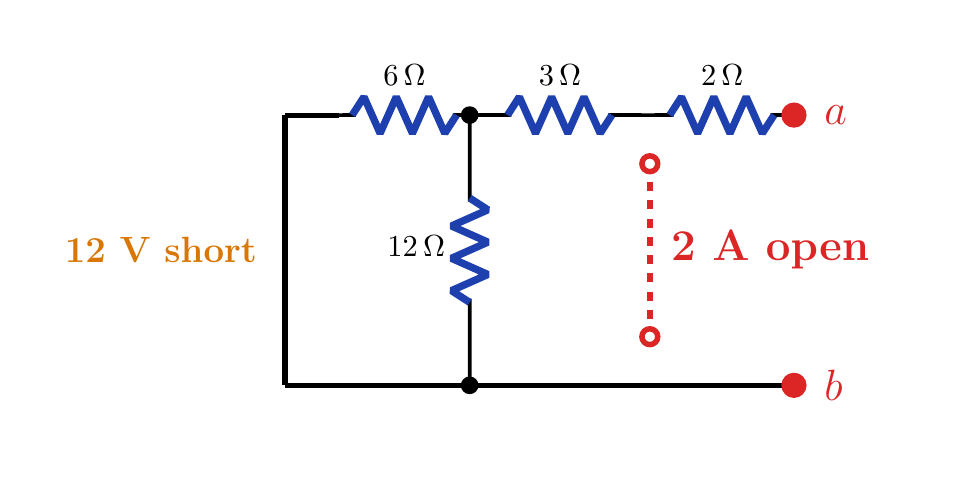
From a-b, 2 Ω and 3 Ω are in series with 6 Ω in parallel with 12 Ω. Find RTh12 V source → short circuit2 A source → open circuitNarration transcript
Start with R Thevenin. Turn off the independent sources only. The 12 volt voltage source becomes a short circuit. The 2 amp current source becomes an open circuit. Looking in from a and b, the 2 ohm resistor is in series with the 3 ohm resistor. After that, the 6 ohm and 12 ohm resistors are in parallel to the bottom node. Compute the parallel part: 6 times 12 is 72. 6 plus 12 is 18. 72 divided by 18 is 4 ohms. Then add the series resistors: 2 plus 3 plus 4 equals 9 ohms. Therefore R Thevenin is 9 ohms, and the maximum-power load will also be 9 ohms.
6. V_Th equation
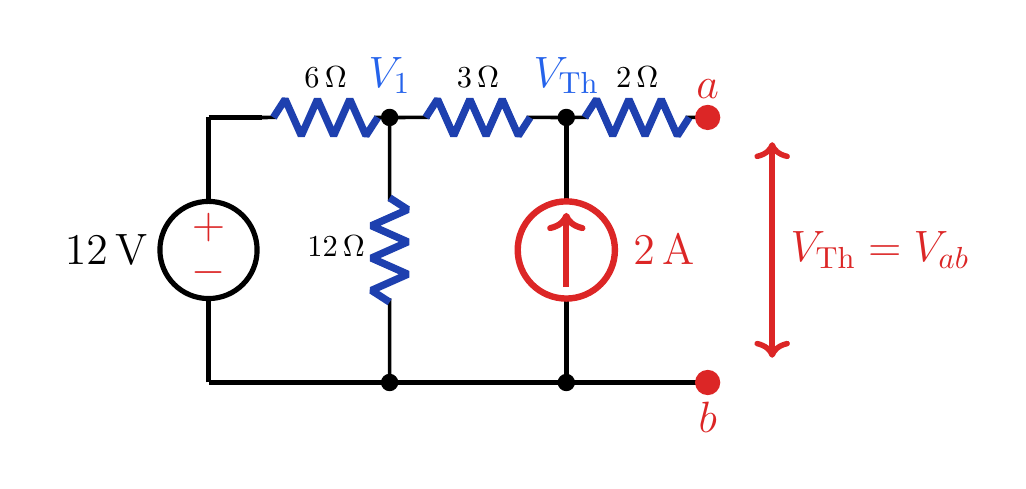
No current flows through 2 Ω, so terminal a has the same voltage as the V_Th node. VTh — node equationRemove RL: output is openNo current through 2 ΩLeft node: V1Narration transcript
Next find V Thevenin. Remove R L, so the output is open. Because the output is open, no current flows through the 2 ohm resistor; therefore there is no voltage drop across it, and the terminal a voltage equals the top middle node voltage, V Thevenin. Let the node between 6 ohms, 12 ohms, and 3 ohms be V 1. At the V Thevenin node, the 2 amp source injects current upward, so KCL gives V Thevenin minus V 1 over 3, minus 2, equals zero. That means V Thevenin minus V 1 equals 6.
7. Solve V_Th
No current flows through 2 Ω, so terminal a has the same voltage as the V_Th node. VTh — solutionMultiply the equation by 12Narration transcript
Now write KCL at V 1. Current through 6 ohms is V 1 minus 12 over 6. Current through 12 ohms is V 1 over 12. Current through 3 ohms is V 1 minus V Thevenin over 3. Add them and set the sum to zero. Multiply the whole equation by 12 to clear denominators. We get 2 V 1 minus 24, plus V 1, plus 4 V 1 minus 4 V Thevenin equals zero. Combine like terms: 7 V 1 minus 4 V Thevenin equals 24. Together with V Thevenin minus V 1 equals 6, solving gives V Thevenin equals 22 volts.
8. R_L and P_max
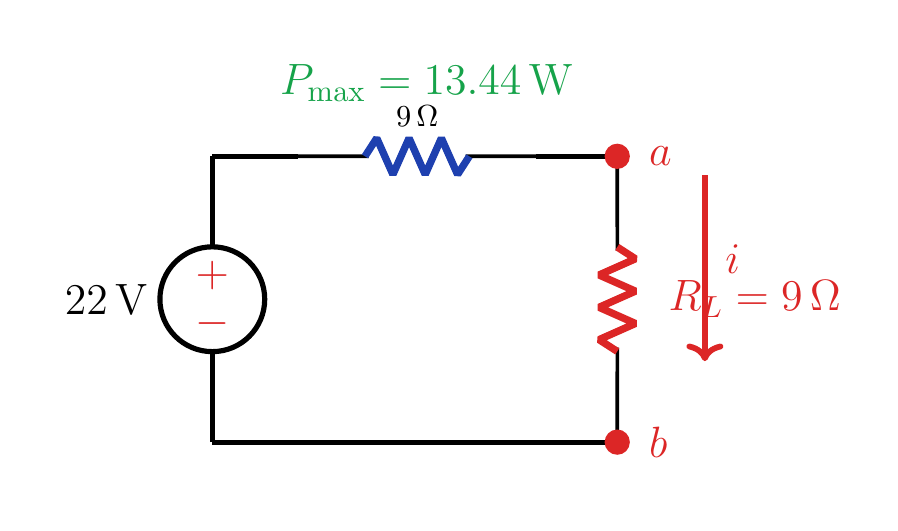
The maximum load power is approximately 13.44 W. Load and maximum powerNarration transcript
Now combine the two results. For maximum power, R L equals R Thevenin, so R L equals 9 ohms. For the maximum power value, use P max equals V Thevenin squared over 4 R Thevenin. Substitute the numbers: V Thevenin is 22 volts, so 22 squared is 484. Four times R Thevenin is 4 times 9, which is 36. Then 484 divided by 36 is 13.44 watts. That is the largest power this network can deliver to a purely resistive load.
9. Method summary
The maximum load power is approximately 13.44 W. Method summaryRemove the loadRTh: deactivate independent sourcesVTh: leave the port open9 Ω, 22 V, 13.44 WNarration transcript
The whole method is short, but the order matters. First convert the rest of the circuit into what the load sees. Find R Thevenin with independent sources turned off. Find V Thevenin with the load open. Then choose R L equal to R Thevenin. If the question also asks for power, use P max equals V Thevenin squared over four R Thevenin. In this example, R Thevenin is 9 ohms, V Thevenin is 22 volts, and the maximum load power is 13.44 watts.
Source video: Circuit Theory #30 | Maximum Power Transfer - Find RL and Pmax (6:23)