Circuit Theory 1 · Mesh-Current Method
#16 Mesh currents #16 — equivalent resistance and a dependent source
Finds equivalent resistance with a test source and solves the controlling current in a three-mesh dependent-source circuit.
Question
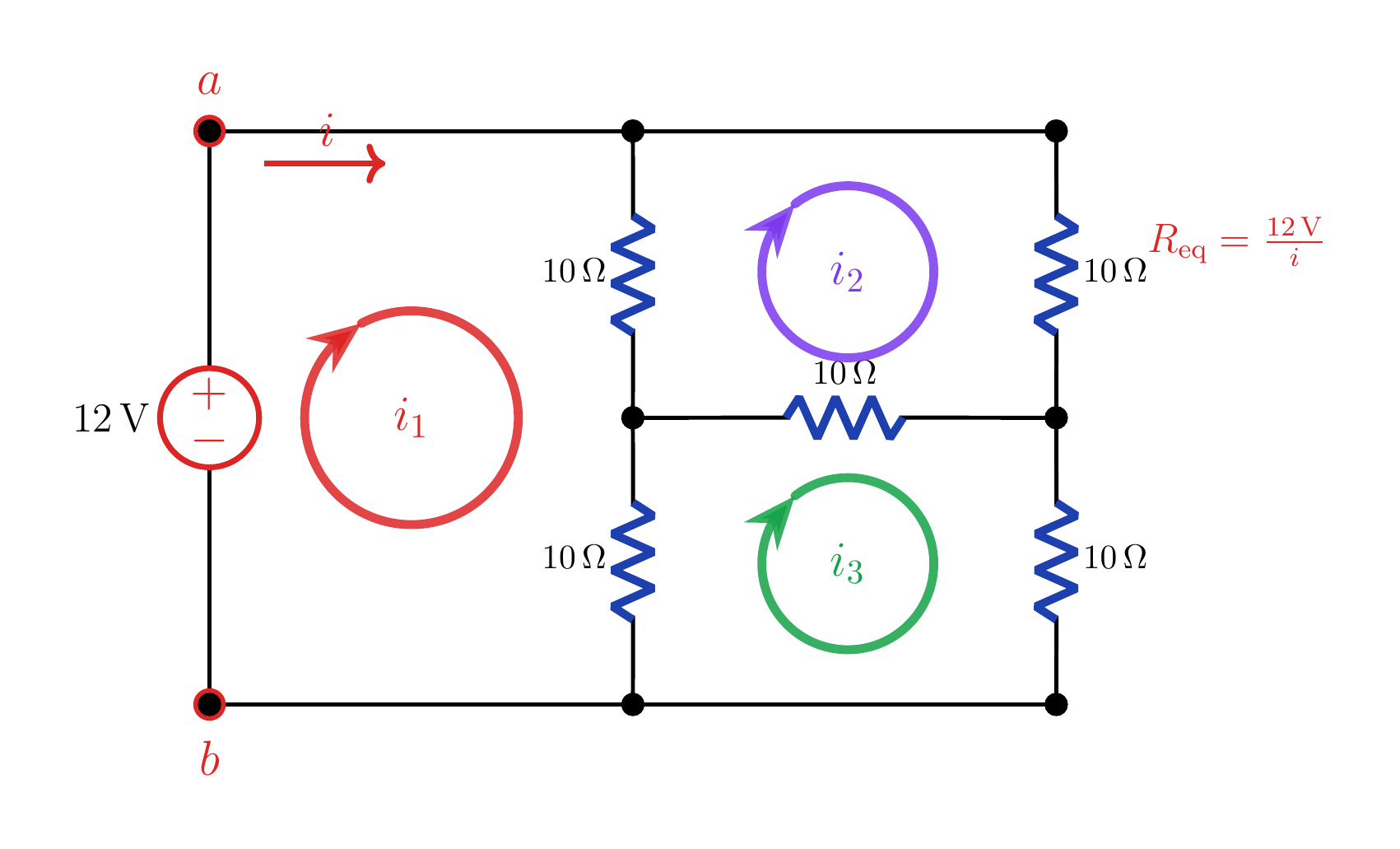
Use mesh currents to find the resistance seen at terminals a-b in Example 2 and the controlling current i_x in the dependent-source circuit of Example 3.
Written solution and narration transcript(shows the full solution)
Below are all the lines written in the notebook together with the full narration transcript.
1. Roadmap for two examples
Clockwise mesh currents i_1, i_2 and i_3 are used to find the resistance seen at terminals a-b. Two new mesh-current examplesExample 2: Req from a test sourceExample 3: dependent source and ixNarration transcript
In the previous lesson, we introduced mesh currents with one complete worked example. Now we continue with two more examples. The first one uses a 12 volt test source to find an equivalent resistance. The second one includes a dependent voltage source, so the controlling current must stay visible until the end. The workflow is the same in both cases: choose clockwise mesh currents, write K V L, solve the linear system, then interpret the requested current or resistance.
2. Example 2 circuit
Clockwise mesh currents i_1, i_2 and i_3 are used to find the resistance seen at terminals a-b. Vtest=12 V; all five resistors are 10 ΩNarration transcript
Example two asks for the equivalent resistance seen from terminals a and b. We apply a 12 volt test source at the terminals and define the input current i. All five resistors are 10 ohms. There are three meshes, so we choose i one, i two, and i three clockwise. Because the current through the source branch is i one, the equivalent resistance will be 12 divided by i one.
3. Solve Example 2
Clockwise mesh currents i_1, i_2 and i_3 are used to find the resistance seen at terminals a-b. Narration transcript
The three mesh equations are written in positive diagonal form. Loop one gives 20 i one minus 10 i two minus 10 i three equals 12. Loop two gives negative 10 i one plus 30 i two minus 10 i three equals zero. Loop three gives negative 10 i one minus 10 i two plus 30 i three equals zero. Solving this system gives i one equals 1.2 amperes, while i two and i three are each 0.6 amperes. So the equivalent resistance is 12 volts divided by 1.2 amperes, which is 10 ohms.
4. Example 3 circuit
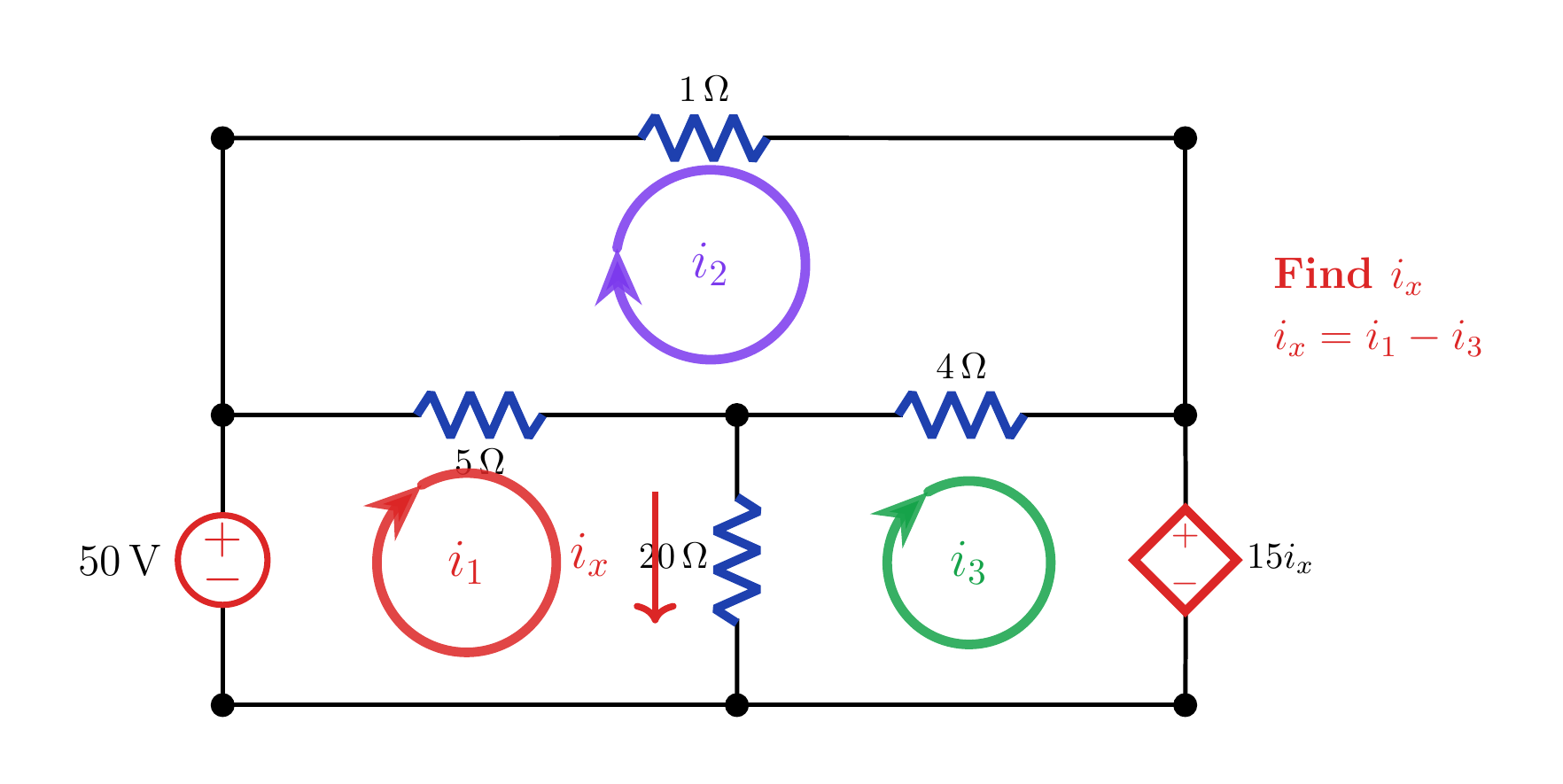
The controlling current i_x is referenced downward in the shared 20 Ω branch and equals i_1−i_3. Independent source: 50 VDependent source: 15ixFind: ixNarration transcript
Example three adds one new ingredient: a dependent voltage source. The left source is 50 volts. The right dependent source has value 15 times i x. The controlling current i x is drawn downward through the 20 ohm resistor. With the mesh currents shown, that branch current is i one minus i three. This relation is the key point; if we lose it, the dependent source equation becomes unclear.
5. Equations for Example 3
The controlling current i_x is referenced downward in the shared 20 Ω branch and equals i_1−i_3. Narration transcript
Now write the equations. Loop one contains the 50 volt source, the 5 ohm resistor, and the 20 ohm shared resistor. It gives 25 i one minus 5 i two minus 20 i three equals 50. Loop two is the upper mesh with the 1 ohm, 5 ohm, and 4 ohm resistors. It gives negative 5 i one plus 10 i two minus 4 i three equals zero. Loop three includes the dependent source. After substituting i x equals i one minus i three, the simplified equation is negative 5 i one minus 4 i two plus 9 i three equals zero.
6. Solve Example 3
The controlling current i_x is referenced downward in the shared 20 Ω branch and equals i_1−i_3. Physical direction: downwardNarration transcript
Solving the three equations gives i one equals 29.6 amperes, i two equals 26 amperes, and i three equals 28 amperes. The question asks for i x, not directly for the mesh currents. So we return to the controlling current relation: i x equals i one minus i three. That is 29.6 minus 28, so i x equals 1.6 amperes. The result is positive, which means the actual current direction is the same as the downward arrow in the circuit.
7. Method summary
The controlling current i_x is referenced downward in the shared 20 Ω branch and equals i_1−i_3. Test source ⇒ Req=Vtest/ItestShared resistor ⇒ difference of neighboring mesh currentsDependent source ⇒ express its control variable using mesh currentsNarration transcript
The important lesson is not just the final numbers. In example two, a test source turned equivalent resistance into a mesh-current problem. In example three, the dependent source forced us to keep the controlling current relation i x equals i one minus i three. For mesh analysis, shared resistors always create difference terms. Dependent sources are handled the same way, as long as the controlling variable is written in terms of the mesh currents.
Source video: Circuit Theory #16 | Mesh-Current Examples — Equivalent Resistance + Dependent Source (4:15)