Electromagnetic Theory · Method of Images
#17 Image charges above a grounded plane, induced surface charge, wedge geometry, and a right-angle conducting-plane example
Replace conducting boundaries with image charges and construct plane and wedge solutions by superposition.
Question
Explain the method of images; derive potential and surface charge for a grounded plane, determine the image count for a wedge, and analyze the right-angle two-plane example.
Written solution and narration transcript(shows the full solution)
Below are all the lines written in the notebook together with the full narration transcript.
1. Move from field solutions to the method of images
Image charges are placed outside the physical solution region so that the conductor boundary conditions are satisfied. In our last lessons, we solved boundary-value problems by integrating Laplace's equation and applying boundary conditions.We computed resistance and capacitance from field solutions.Today, we introduce an elegant alternative: the method of images, which avoids solving differential equations entirely.Narration transcript
In our last lessons, we solved boundary-value problems by integrating Laplace's equation and applying boundary conditions. We computed resistance and capacitance from field solutions. Today, we introduce an elegant alternative: the method of images, which avoids solving differential equations entirely.
2. Build the image-charge idea
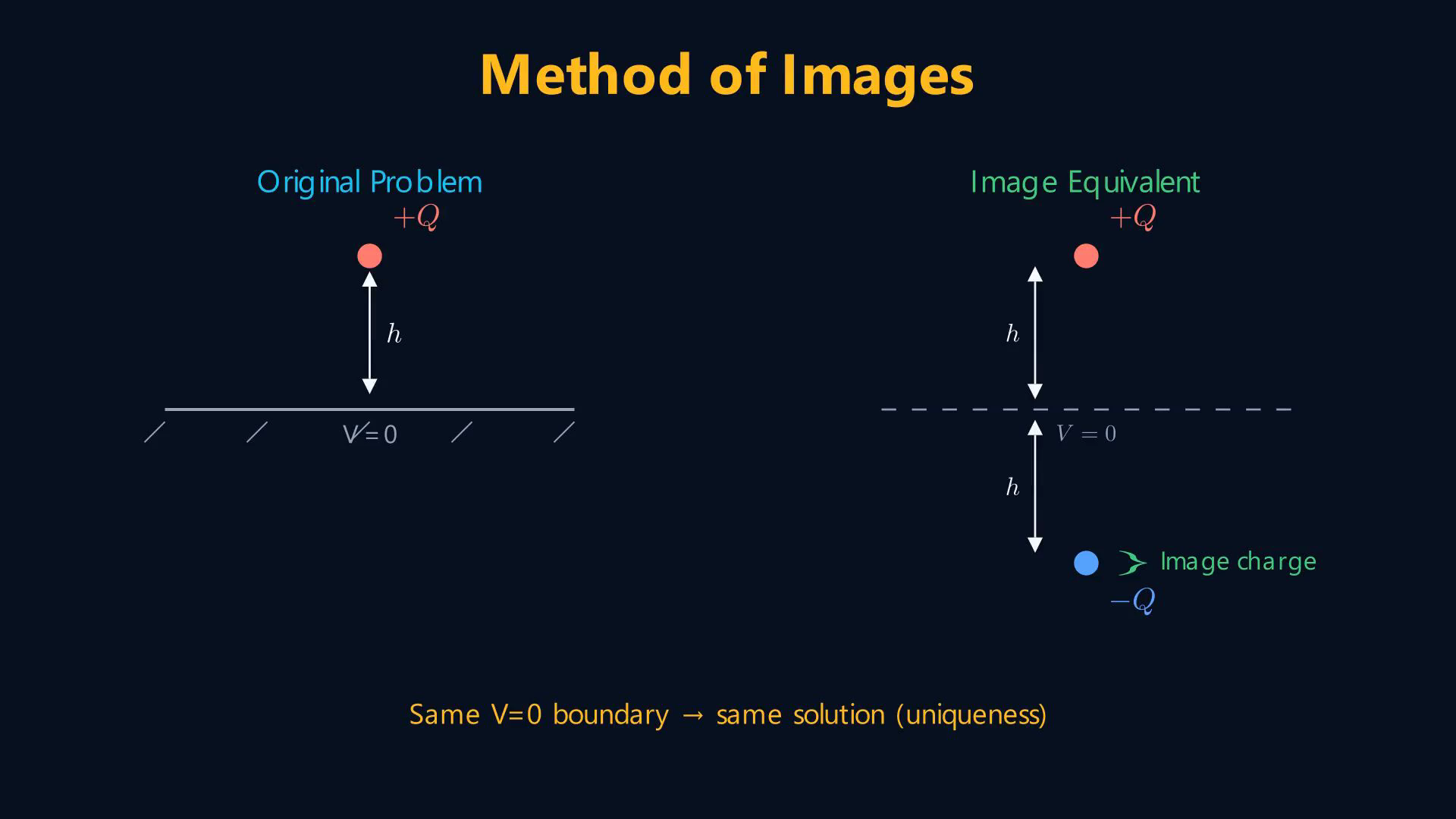
Image charges are placed outside the physical solution region so that the conductor boundary conditions are satisfied. The method of images was introduced by Lord Kelvin in 1848.The idea is beautifully simple.Instead of solving Laplace's equation with complicated boundary conditions on a conducting surface, we remove the conductor and replace it with an equivalent image charge.The image charge is placed so that the original boundary conditions are automatically satisfied.By the uniqueness theorem, this must give the correct solution.Consider a point charge Q at height h above an infinite grounded conducting plane.The grounded conductor enforces V = 0 on its surface.We remove the conductor and place an image charge negative Q at the mirror position, a distance h below the plane.The real Q and image −Q pair produces V = 0 at the midplane.The solution above the plane is then just the superposition of two point charges.Narration transcript
The method of images was introduced by Lord Kelvin in 1848. The idea is beautifully simple. Instead of solving Laplace's equation with complicated boundary conditions on a conducting surface, we remove the conductor and replace it with an equivalent image charge. The image charge is placed so that the original boundary conditions are automatically satisfied. By the uniqueness theorem, this must give the correct solution. Consider a point charge Q at height h above an infinite grounded conducting plane. The conductor enforces V equals zero on its surface. We remove the conductor and place an image charge negative Q at the mirror position, a distance h below the plane. This pair of charges naturally produces V equals zero at the midplane, exactly matching our boundary condition. The solution above the plane is then just the superposition of two point charges.
3. Derive plane and wedge relations
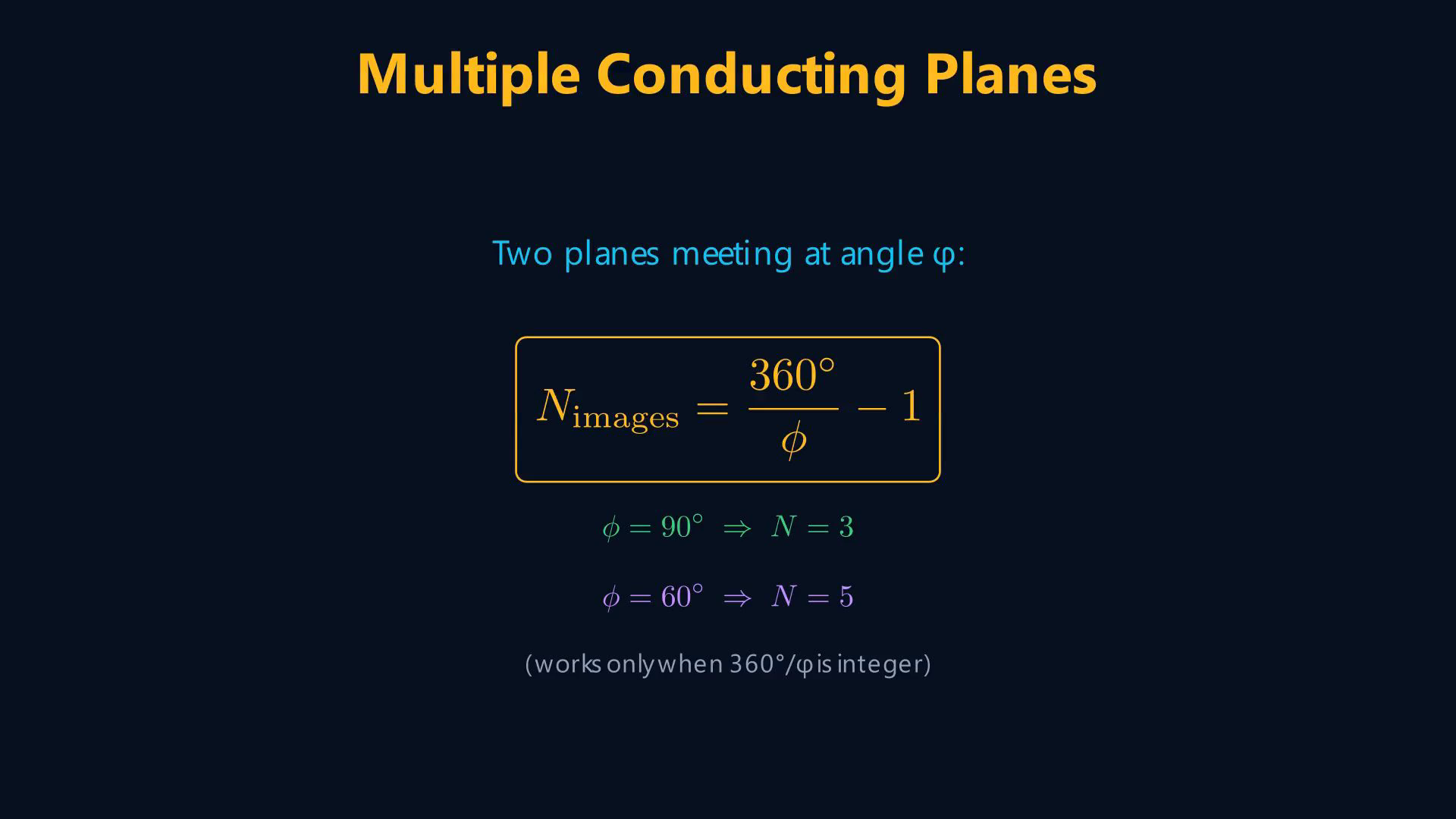
Image charges are placed outside the physical solution region so that the conductor boundary conditions are satisfied. For the point charge Q at position 0, 0, h above the grounded plane at z equals zero, the image is negative Q at 0, 0, negative h.For z > 0, V = Q/(4πε₀)(1/r₁ − 1/r₂).Here r₁ is the distance from the real charge and r₂ from the image.Inside/below the conductor, V = 0.At z = 0, ρs = −Qh/[2π(x²+y²+h²)(3/2)].If we integrate this over the entire conducting plane, we find that the total induced charge equals negative Q.All field lines from Q terminate on the conductor.This same approach works for a line charge above a grounded plane.The image is a parallel line charge of opposite sign at the mirror position.An interesting extension is the wedge geometry.When a charge sits between two conducting planes meeting at angle φ, we need multiple image charges.The image count is N = 360°/φ − 1.This only works when 360 over φ is an integer.For example, two planes at 90 degrees require 3 image charges.Narration transcript
For the point charge Q at position 0, 0, h above the grounded plane at z equals zero, the image is negative Q at 0, 0, negative h. The potential anywhere above the plane is: V equals Q over 4 pi epsilon zero, times the quantity 1 over r1 minus 1 over r2. Here r1 is the distance from the real charge, and r2 is the distance from the image. Below the conductor, V equals zero. On the surface at z equals zero, the induced surface charge density is: rho s equals negative Q h, divided by 2 pi times the quantity x squared plus y squared plus h squared, raised to the 3 halves power. If we integrate this over the entire conducting plane, we find that the total induced charge equals negative Q. All field lines from Q terminate on the conductor. This same approach works for a line charge above a grounded plane. The image is a parallel line charge of opposite sign at the mirror position. An interesting extension is the wedge geometry. When a charge sits between two conducting planes meeting at angle phi, we need multiple image charges. The number of images is N equals 360 over phi, minus 1. This only works when 360 over phi is an integer. For example, two planes at 90 degrees require 3 image charges.
4. Solve the right-angle two-plane example
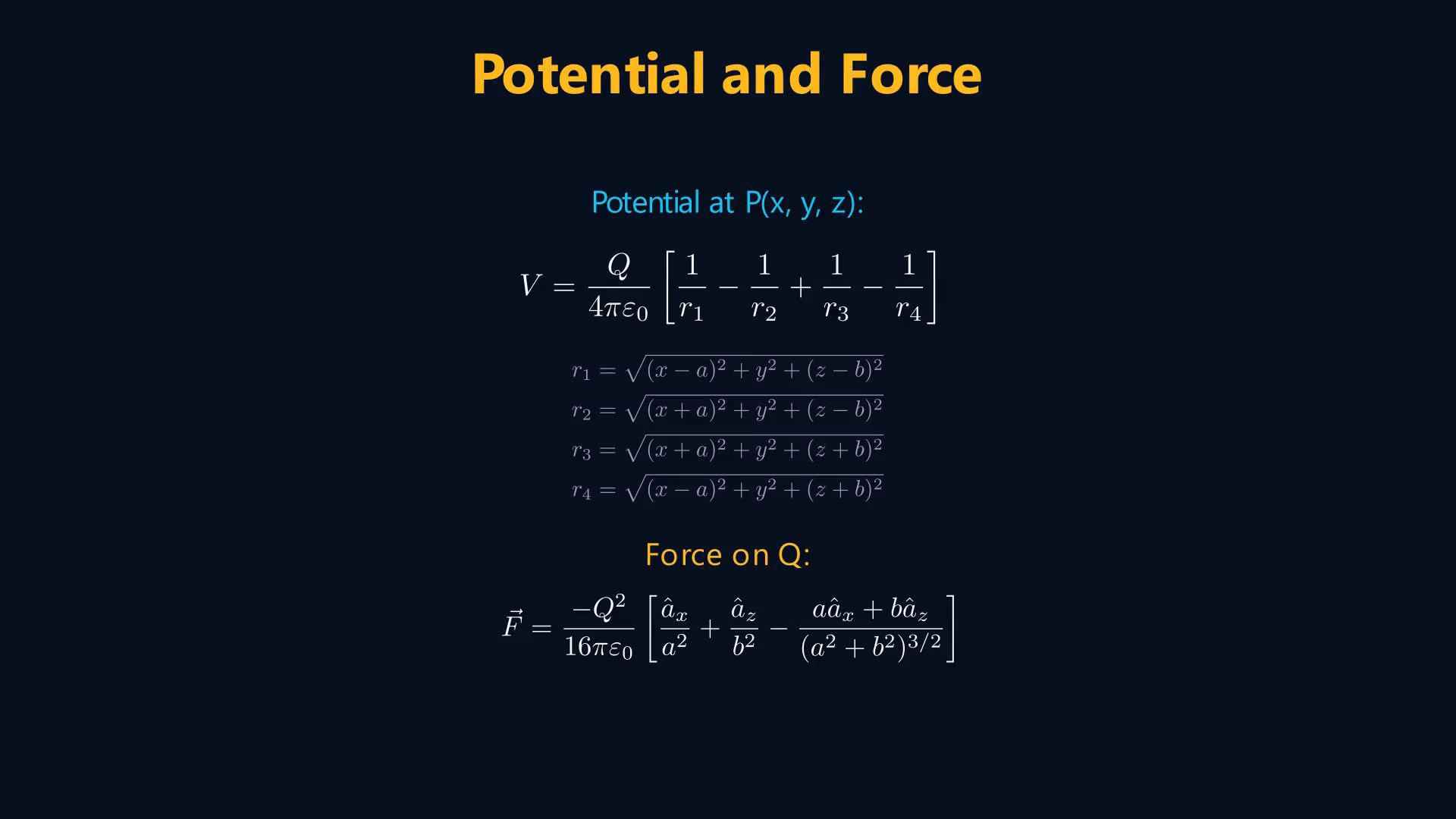
Image charges are placed outside the physical solution region so that the conductor boundary conditions are satisfied. Let's apply this to Sadiku's Example 6.14.A point charge Q is located at position a, 0, b, between two grounded conducting planes that intersect at right angles along the z-axis.One plane is y equals zero, the other is x equals zero.Find the potential at any point and the force on Q.Step one: Determine the number of images.For φ = 90°, N = 360°/90° − 1 = 3.So we need 3 image charges.Step two: Place the images.We reflect Q across each plane and add the image of the image.The four charges are: plus Q at a, 0, b, which is our real charge; minus Q at negative a, 0, b, the reflection across x equals zero; minus Q at a, 0, negative b, the reflection across z equals zero; and plus Q at negative a, 0, negative b, the image of the image.Step three: Write the potential.Expression stated by the source audio:Here r1 through r4 are the distances from each charge to P.Step four: Find the force.The force on Q is calculated using Coulomb's law with its three images.The image at negative a, 0, b attracts Q in the negative x direction, with a force proportional to 1 over 4 a².The image at a, 0, negative b attracts Q in the negative z direction, with a force proportional to 1 over 4 b².The image at negative a, 0, negative b repels Q because it has the same sign.This repulsive force has both x and z components, with magnitude proportional to 1 over the quantity 4 a² plus 4 b².Narration transcript
Let's apply this to Sadiku's Example 6.14. A point charge Q is located at position a, 0, b, between two grounded conducting planes that intersect at right angles along the z-axis. One plane is y equals zero, the other is x equals zero. Find the potential at any point and the force on Q. Step one: Determine the number of images. With phi equals 90 degrees, N equals 360 over 90 minus 1 equals 3. So we need 3 image charges. Step two: Place the images. We reflect Q across each plane and add the image of the image. The four charges are: plus Q at a, 0, b, which is our real charge; minus Q at negative a, 0, b, the reflection across x equals zero; minus Q at a, 0, negative b, the reflection across z equals zero; and plus Q at negative a, 0, negative b, the image of the image. Step three: Write the potential. V at point P x, y, z equals Q over 4 pi epsilon zero, times the sum: 1 over r1, minus 1 over r2, plus 1 over r3, minus 1 over r4. Here r1 through r4 are the distances from each charge to P. Step four: Find the force. The force on Q is calculated using Coulomb's law with its three images. The image at negative a, 0, b attracts Q in the negative x direction, with a force proportional to 1 over 4 a squared. The image at a, 0, negative b attracts Q in the negative z direction, with a force proportional to 1 over 4 b squared. The image at negative a, 0, negative b repels Q because it has the same sign. This repulsive force has both x and z components, with magnitude proportional to 1 over the quantity 4 a squared plus 4 b squared.
5. Review the method of images
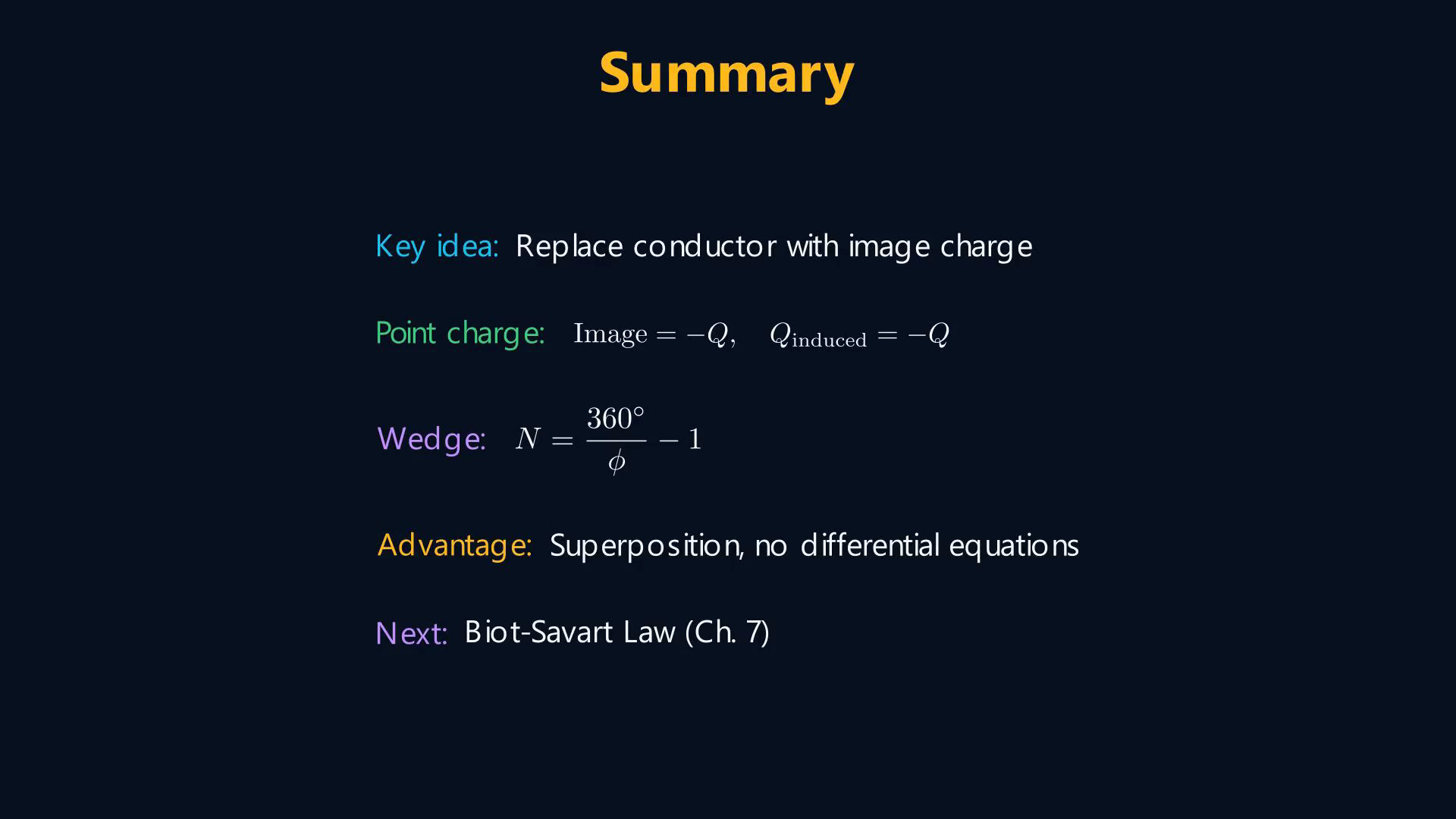
Image charges are placed outside the physical solution region so that the conductor boundary conditions are satisfied. Let's summarize the method of images.Replace the conductor with an image charge at the mirror position that maintains the boundary conditions.For a point charge Q above a grounded plane, the image is negative Q, and the total induced charge on the conductor equals negative Q.For a wedge, N = 360°/φ − 1.The method gives exact solutions through simple superposition, avoiding the need to solve differential equations.In our next lesson, we'll move to Chapter 7 and begin magnetostatics with the Biot-Savart law.Narration transcript
Let's summarize the method of images. Replace the conductor with an image charge at the mirror position that maintains the boundary conditions. For a point charge Q above a grounded plane, the image is negative Q, and the total induced charge on the conductor equals negative Q. For wedge geometries, the number of images is N equals 360 over phi minus 1. The method gives exact solutions through simple superposition, avoiding the need to solve differential equations. In our next lesson, we'll move to Chapter 7 and begin magnetostatics with the Biot-Savart law.
Source video: Electromagnetic Theory (v2) #17 Method of Images (6:16)